
The Ultimate B2B Lead Generation Services Examples for High-Converting Leads

Did you know that 74% of B2B marketers consider content the most effective way to attract leads to their sales funnel? It’s true, the data consistently shows that content drives real results.
Companies that publish 16+ blog posts monthly generate 4.5 times more leads than those publishing 4 or fewer. And before they even think about contacting your sales team, 53% of B2B buyers read 3-5 pieces of your content. These numbers make it crystal clear why effective lead generation strategies are essential for growing your business.
But content is just one piece of the puzzle. Email marketing delivers an astonishing 4,400% ROI for lead generation, while companies using social selling outperform competitors by 78%. With 81% of consumers willing to pay more for better experiences, you need lead conversion tactics that are both comprehensive and customer-focused.
Understanding B2B lead generation best practices isn’t just helpful, it’s crucial for survival in today’s competitive market. Whether it’s content syndication or intent data services, the right approach can fill your sales pipeline with quality prospects ready to convert.
In this guide, we’ll explore eight B2B lead generation services that deliver real results. You need a steady stream of quality leads to generate sales, and we’re about to show you exactly how to get them. Let’s get started 👇
What Makes B2B Lead Generation Services Work?
Lead generation is key to business growth as it attracts potential customers into the sales funnel, driving revenue and profitability. Without a lead generation strategy, businesses risk losing potential customers to competitors who actively engage them. According to research, 61% of marketers consider lead generation their top challenge.
What separates effective lead generation services from the rest?
Good lead generation services don’t just hand you a list of contacts, they deliver quality prospects who actually convert into customers. Studies show businesses that source over 40% of their leads from marketing experience higher conversion rates than their competitors.
Want to know what makes the best services stand out? Here are the crucial elements:
-
They target the right audience – They find not just relevant companies but also the specific decision-makers who can say “yes” to your offer.
-
They focus on value, not promotion – They create content addressing your prospects’ specific challenges rather than generic sales pitches.
-
They use multiple channels effectively – From cold calling and emails to social media and content marketing, they integrate various approaches seamlessly.
-
They don’t give up after one attempt – The best services know it typically takes 5 or more attempts to get in contact with a potential customer.
-
They prioritize quality over quantity – Instead of flooding you with mediocre leads, they deliver qualified prospects genuinely interested in your solution.
The most effective services also measure everything. They track lead-to-customer conversion rates, cost per lead, and other key metrics to continuously fine-tune their approach.
B2B vs. B2C lead generation: Not the same game
B2B lead generation is fundamentally different from B2C approaches. First, there’s the audience, B2B marketing targets business decision-makers like procurement managers, executives, and team leaders. This means you often need to convince multiple stakeholders before making a sale.
B2B sales cycles are much longer too. While a consumer might make a purchase decision in minutes, B2B purchases typically take weeks or months due to complex approval processes. Business contracts usually require multiple sign-offs and involve larger resources. This extended timeline means you need different strategies to nurture B2B leads.
The content you use changes dramatically as well. B2B lead generation needs to emphasize logic, efficiency, and ROI. Whitepapers, case studies, and detailed analysis reports work well with business audiences. B2C content, on the other hand, can be less formal and more emotionally driven.
Platform preferences are different too. LinkedIn dominates B2B lead generation, helping you directly approach decision-makers. B2C efforts can spread across more platforms including Instagram, Facebook, and Twitter.
Perhaps most importantly, B2B lead generation must focus on relationship-building rather than quick transactions. Most B2B sales happen through established relationships with people they already know or have worked with. That’s why effective B2B lead generation services focus on building trust through thought leadership and meaningful communication.
The Lead Generation Funnel: From Awareness to Conversion

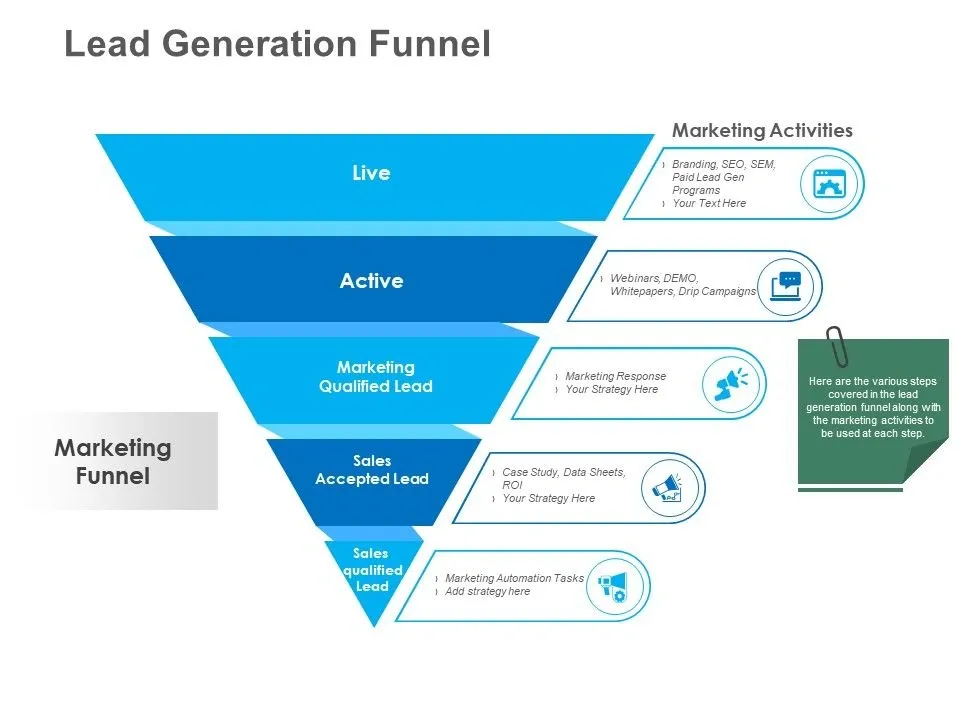
The success of your B2B marketing depends on understanding the lead generation funnel, the journey prospects take from first discovering your brand to becoming paying customers. With the right funnel strategy, you’ll deliver the right message at the right time and convert more high-quality leads.
Top of Funnel: Attracting the right audience
At the top of the funnel (TOFU), your goal is creating awareness among potential customers who recognize they have a problem but aren’t ready to buy. During this stage, prospects begin identifying business problems and searching for tools.
The best TOFU strategies focus on:
- Blog posts, videos, white papers, and ebooks that drive organic awareness
- Social media engagement that establishes your authority
- Targeted paid advertising on Google and social platforms
- Content that highlights prospects’ problems and offers tools
Your content at this stage should educate your audience without pushing for an immediate sale. Focus on addressing your target audience’s pain points and show how your product or service might solve these challenges. Publishing helpful content establishes your thought leadership and increases brand visibility, essential first steps in generating quality B2B leads.
Middle of Funnel: Nurturing and qualifying leads
When leads reach the middle of the funnel (MOFU), they’ve moved beyond awareness and are actively exploring tools. They understand their problem, so your messaging should shift toward introducing your product as the answer.
MOFU content needs more depth than awareness-stage material. The most effective assets include:
- Detailed white papers and industry reports
- Educational webinars that showcase your expertise
- Case studies demonstrating successful implementations
- Product videos that highlight key features
These content types build trust with prospects who aren’t quite ready to purchase by showcasing your authority and achievements.
Lead qualification becomes critical at this stage. A good lead scoring system assigns points based on specific actions, webinar attendance, whitepaper downloads, or engagement with high-value website pages. This helps your sales team prioritize the leads most likely to convert.
Bottom of Funnel: Converting leads into customers
The bottom of the funnel (BOFU) is where prospects are ready to make a purchase decision. These leads have shortlisted a few products and need that final push to convert.
Your most effective BOFU tactics will include:
- Free trials and consultations that give hands-on experience
- Customer testimonials that showcase real-world success
- Personalized recommendations based on previous engagement
- Limited-time offers that create a sense of urgency
At this stage, you need to address objections directly and make yourself available to answer questions promptly. Personalize your approach based on each prospect’s unique needs and position in the funnel.
The BOFU stage is where b2b lead generation services really prove their worth, helping you optimize conversion through abandoned cart emails, retargeting, and comparison content that sets your offerings apart from competitors. By tailoring your approach to each funnel stage, you create a seamless journey that guides prospects toward becoming loyal customers.
8 High-Converting B2B Lead Generation Services That Fill Your Pipeline
Looking to supercharge your sales pipeline? Let’s face it – you need lead generation services that actually deliver results, not just promises. I’ve rounded up eight tested B2B lead generation approaches that consistently produce high-quality leads your sales team will thank you for.
1. Content syndication platforms
Content syndication helps your content reach new audiences through third-party platforms. Headley Media’s content syndication campaigns deliver quality B2B tech leads across more than 300 websites in 60 countries and 32 languages. The numbers speak for themselves – businesses using content syndication achieve 45% higher sales compared to those who don’t. That’s a significant boost just from extending your content’s reach!
2. LinkedIn lead gen services
LinkedIn is the undisputed champion for B2B prospecting, with 89% of B2B marketers using it for lead generation. It delivers leads at twice the rate of the next best social channel. Agencies like Cleverly analyze thousands of outbound campaigns to craft personalized messages that convert, generating over 224,700 client leads and $51.2 million in client revenue. If you’re not using LinkedIn for B2B leads, you’re missing out on your most valuable channel.
3. Email outreach and cold email agencies
Cold email remains incredibly effective when done right. These specialized agencies handle everything from domain setup to campaign optimization for you. Belkins analyzes your outreach history and domain reputation before creating proper mailbox setups and sending emails in small batches to prepare for larger campaigns. Their writers craft sequences with one compelling intro message and at least four strategic follow-ups. This methodical approach yields significantly better results than random spray-and-pray tactics.
4. SEO-focused lead generation firms
SEO lead generation improves your online visibility to attract businesses actively searching for tools like yours. Companies like Victorious implement comprehensive strategies including deep-dive analysis, custom keyword research, content creation, and technical optimization. These firms continuously monitor performance metrics to refine strategies and demonstrate clear ROI. When done well, SEO brings you leads already looking for what you offer.
5. PPC and paid media lead services
Paid media that leverages intent data delivers both quality leads and faster sales cycles. These services target accounts actively searching for your solution using AI-driven advertising strategies. The results can be dramatic – one client saw a 101% increase in MQLs after implementing a comprehensive sitelink extension strategy. PPC lets you get in front of prospects at exactly the right moment.
6. Webinar and virtual event lead providers
Webinars have become essential for connecting with potential B2B buyers. An impressive 74% of B2B buyers say webinars help determine which vendors make their shortlist. Services like UnboundB2B offer a complete approach from pre-webinar strategy to during-webinar engagement and post-webinar follow-up. The interactive nature of webinars builds trust and demonstrates expertise in ways static content simply can’t match.
7. Intent data and account-based marketing services
Intent data reveals which accounts are actively researching tools like yours right now. Combined with ABM strategies, this approach can increase pipeline conversion rates by 14%. These services monitor digital footprints left by prospects while researching products online, creating weekly “hot accounts” lists of companies showing strong buying signals. This intelligence lets your sales team prioritize outreach to accounts already in buying mode.
8. Chatbot and conversational marketing tools
Conversational marketing tools like Drift help identify website visitors, understand their intent, and deliver the right content to nurture them through your funnel. Before implementation, these tools help distinguish target accounts from general prospects, offering 24/7 engagement through AI chatbots. Companies using conversational marketing see an average 17.5% increase in expansion revenue. These tools turn your website from a static brochure into an active lead generation machine.
Best Practices for Choosing a Lead Generation Partner
Selecting the right B2B lead generation partner can dramatically impact your marketing ROI. With 60% of B2B marketers struggling with poor lead quality, you need to be picky about who handles your lead generation efforts.
Check for industry-specific experience
Every industry has unique sales cycles, buyer behaviors, and terminology. When evaluating potential partners, dig into their case studies specific to your sector. Don’t be shy about asking direct questions:
- Have they worked with businesses your size?
- Do their sales development representatives receive specialized training in your niche?
This industry knowledge ensures your campaigns actually connect with your target audience rather than falling flat with generic approaches that waste your budget.
Evaluate lead quality over quantity
A flood of unqualified leads does nothing but waste resources and frustrate your sales team. Focus on services that prioritize lead quality, prospects who match your ideal customer profile (ICP), show genuine buying interest, and have decision-making authority.
Top providers typically use qualification frameworks like BANT (Budget, Authority, Need, Timing) or CHAMP (Challenges, Authority, Money, Prioritization) to deliver sales-ready leads. Remember, high conversion rates are the real indicator of quality targeting, not impressive lead volume.
Ask about lead verification and scoring methods
Lead verification is essential for filtering out fake emails, outdated contacts, and bot submissions that plague 60% of B2B marketers. Before signing any contract, inquire about:
- Email and phone validation processes
- IP and domain verification checks
- Data enrichment from trusted third-party sources
You should also examine their lead scoring system, how do they assign points based on prospect behaviors like webinar attendance, whitepaper downloads, or website engagement? A robust scoring system helps your team prioritize follow-up efforts on leads most likely to convert.
Ensure alignment with your sales process
The handover from lead generation to your sales team should feel seamless. Clarify qualification criteria and delivery methods before you kick off any campaigns.
Don’t underestimate cultural alignment either, partners who understand and share your vision make the whole process smoother. This compatibility ensures better communication and more productive working relationships throughout your campaigns.
Finally, verify their reporting capabilities provide full visibility into critical metrics like lead-to-deal conversion rates. You can’t improve what you can’t measure, after all.
Optimising Your Lead Conversion Strategy

Getting quality leads is only half the battle. Once you’ve got prospects interested, your internal systems need to be ready to convert them into paying customers. Let’s look at how you can refine your conversion strategy for maximum impact.
Use CRM and automation tools effectively
Implementing CRM platforms removes friction by bringing all your data and tools together in one place. This makes lead tracking seamless and straightforward. But here’s the problem – 46% of B2B businesses don’t use their CRM for personalizing customer experiences, and 25% don’t use personalization at all. That’s a huge missed opportunity!
Tools like HubSpot and Pipedrive can automate those tedious sales tasks, freeing your team to focus on what really matters – building relationships with prospects rather than drowning in admin work.
Look for these essential features:
- Lead scoring systems that help you prioritize hot prospects
- Visual sales pipelines so you can track deals at a glance
- Meeting schedulers and conversation intelligence tools
- Automated workflows that ensure consistent follow-up
Segment and personalize follow-ups
The most effective follow-up strategies start with good segmentation. You need to categorize your leads based on factors like industry, company size, where they are in your sales funnel, or their previous interactions with your business.
Once you’ve got these segments, you can create truly tailored experiences through targeted ads, personalized emails, and custom landing pages that speak directly to each group’s specific needs.
The data you collect from your website and CRM is gold for personalization that dramatically boosts engagement and conversion rates. You can also set up behavioral triggers to make your communications timely and relevant – for example, when someone downloads your whitepaper, they could automatically receive an invitation to a related webinar.
Track key metrics like CPL and conversion rate
You can’t improve what you don’t measure. Tracking your B2B lead generation progress through clear metrics not only strengthens team morale but also helps you set realistic sales goals. Here are the essential numbers you should be watching:
Cost Per Lead (CPL) = total marketing spend ÷ total number of new leads
Conversion Rate (CR) = number of sales for a period ÷ leads generated over the same time
Cost of Customer Acquisition (CAC) = marketing spend ÷ number of new customers
At the same time, track lead quality through lead scoring models that evaluate factors like company size, job title, and engagement level. By analyzing these metrics regularly, you’ll quickly spot which channels are bringing in your best leads, allowing you to invest more in what works and cut back on what doesn’t.
What Makes B2B Lead Generation Work?
Effective B2B lead generation is the foundation of sustainable business growth. Throughout this guide, we’ve looked at strategies that deliver high-quality prospects instead of just filling your pipeline with contacts who never convert. Quality always beats quantity when it comes to leads that actually become paying customers.
The most successful B2B companies understand that lead generation isn’t a one-trick pony. Content syndication platforms, LinkedIn services, email outreach, SEO strategies, and conversational marketing tools all serve specific purposes within your overall lead generation strategy. When you understand the entire funnel, you can deliver the right messaging at each stage, dramatically boosting your conversion potential.
Choosing the right lead generation partner can make or break your marketing ROI. Look for industry experience, solid lead verification methods, and alignment with your existing sales processes. And don’t forget, your internal conversion optimization matters just as much as getting those leads in the first place.
Measurement is non-negotiable for ongoing success. By tracking metrics like cost per lead, conversion rates, and customer acquisition costs, you’ll quickly see which strategies deserve more of your budget. This lets you refine your approach based on actual data rather than hunches or assumptions.
The B2B landscape is always changing, but some principles remain rock solid. Successful lead generation still comes down to understanding your audience, providing genuine value, staying persistent, and building real relationships. When you combine these timeless fundamentals with modern tools and targeted strategies, your lead generation efforts will drive business growth for years to come.
Ready to put these insights into action? The right lead generation services are waiting to help you connect with your ideal customers and grow your business. The only question is, which one will you try first?
FAQs
Q1. What are the key components of an effective B2B lead generation strategy?
An effective B2B lead generation strategy includes personalized outreach, providing value upfront, using multiple channels like content marketing and social media, and using data-driven approaches to target the right prospects. It’s crucial to focus on building relationships rather than just pushing for immediate sales.
Q2. How can AI and automation improve B2B lead generation efforts?
AI and automation can enhance B2B lead generation by enabling personalized outreach at scale, improving lead scoring and qualification, and automating routine tasks. Tools like GPT can help craft tailored messages, while data scraping techniques can gather relevant information about prospects to create more targeted campaigns.
Q3. What metrics should I track to measure the success of my B2B lead generation campaigns?
Key metrics to track include reply rates, positive response rates, conversion rates from leads to meetings, cost per lead (CPL), and ultimately, customer acquisition cost (CAC). It’s also important to monitor the quality of leads generated and how they progress through your sales funnel.
Q4. How can I provide value in my initial outreach to potential B2B clients?
Providing value in initial outreach can involve offering relevant industry insights, sharing useful contacts or resources, or providing a brief analysis of the prospect’s current situation. The key is to demonstrate your expertise and willingness to help, rather than immediately pushing for a sale.
Q5. How often should I follow up with B2B leads, and what’s the best approach?
Follow-up frequency depends on the prospect’s engagement level and your industry norms. Generally, a good approach is to follow up 2-3 times over a couple of weeks after the initial contact. Each follow-up should provide additional value or insights, rather than just asking for a response. Be persistent but respectful of the prospect’s time and preferences.

Builds the demand intelligence, automation, and deliverability systems behind Growleads pipeline.