
Outsource Sales Examples: From $1M+ Revenue Companies

Did you know that outsourced lead generation services can deliver 43% better results compared to in-house teams? This isn’t just a random statistic, it’s a proven advantage that $1M+ revenue companies are leveraging through specialized expertise and dedicated focus.
The numbers don’t lie. By 2030, the outsourcing market is projected to reach $512.4 billion USD. Businesses aren’t just jumping on a trend, they’re recognizing genuine value. When you outsource sales and marketing functions, you’re not just delegating tasks; you’re gaining access to expert talent and proven systems without the headache of building everything from scratch.
For most companies, this approach delivers real savings. Mid-sized businesses are saving 30-40% on lead generation costs through outsourcing compared to maintaining internal teams. Even better, companies using outsourced lead generation typically see up to a 43% improvement in lead quality while freeing up valuable time previously spent on prospecting activities.
Think about it: professional outsource sales companies deliver specialized solutions tailored to your industry and niche, ensuring your business goals stay front and center. Instead of struggling with the industry average cost per lead of $198 (or higher in sectors like technology at $208), you can focus on your core business while experts handle the complex work of finding and nurturing quality leads.
Ready? Let’s explore real-world examples from million-dollar companies that you can apply to your own business
Why $1M+ Companies Choose to Outsource Sales

Million-dollar companies don’t outsource sales just to cut costs. They’re after strategic advantages that in-house teams simply can’t match. These businesses recognize that outsourcing creates competitive edges that fuel substantial growth.
Faster go-to-market with fewer internal resources
Time-to-market is a major factor pushing successful companies toward outsourced sales solutions. When you partner with a specialized sales firm, you skip the lengthy process of building and training an internal team from the ground up. This strategy lets you “leapfrog technology constraints and break out of silos within your own organization”, giving your business immediate momentum.
For companies eyeing new opportunities, outsourced teams provide rapid launch capabilities without draining internal resources. As one provider points out, businesses can have “right-fit sellers producing and contributing to sales objectives in a fraction of the time” compared to building an in-house department. This speed advantage is particularly valuable when entering new markets or launching products where being first creates significant competitive advantage.
Established sales outsourcing partners already have the infrastructure, training systems, and operational processes needed to hit the ground running. This means you can focus your internal resources on core business functions instead of diverting attention to creating sales systems from scratch.
Access to specialized outbound and inbound expertise
Million-dollar companies value the specialized expertise that outsourced teams bring to the table. These teams typically have deep knowledge in specific:
- Industry verticals (healthcare, technology, manufacturing)
- Sales methodologies (appointment setting, lead qualification)
- Geographic markets (with local cultural understanding)
- Product categories (SaaS, financial services, e-commerce)
This specialization delivers real results. Research shows “customer journey data aligned with sales processes can lead to 12% higher win rates” when used correctly. Outsourced sales teams employ specialists who understand how to optimize these processes better than generalist in-house teams.
You also gain access to advanced technology without the investment burden. Outsourced partners “bring with them advanced technologies such as CRM platforms like Salesforce and HubSpot, AI-powered sales enablement tools, and predictive analytics”. These tools might otherwise be out of reach due to cost or complexity barriers.
Inbound sales expertise is another specialized area where outsourcing pays off. By partnering with dedicated inbound teams, you “improve response times and customer satisfaction while reducing operational costs”, creating better conversion opportunities from incoming leads.
Scalability without long-term hiring commitments
The flexibility of outsourced sales is perhaps most compelling for growing companies. Instead of making long-term employment commitments, you can adjust your sales force based on actual business conditions. This scalability is particularly valuable for companies dealing with “seasonal surge needs” or testing expansion strategies.
With traditional hiring models, scaling back during market downturns means making difficult personnel decisions. In contrast, outsourced arrangements allow you to “scale up or down quickly” as market conditions change, without the emotional and financial costs of layoffs or rapid hiring.
Financial flexibility goes hand-in-hand with this operational adaptability. Many outsourced sales providers operate with “month-to-month contracts” and performance-based compensation models where “outsourcers are typically paid on a success-fee basis”. This payment structure aligns costs directly with results, significantly reducing financial risk.
For million-dollar companies navigating uncertain economic landscapes, this combination of operational flexibility and performance-based economics makes a compelling business case for outsourcing critical sales functions rather than building everything internally.
Real Examples of Outsourced Sales Success
Let’s move beyond theory and look at what’s actually working in the real world. These outsource sales examples show measurable success across different industries. Here’s how five companies generating $1M+ annual revenue achieved significant growth by strategically outsourcing their sales functions.
Example 1: SaaS company scaling with outsourced SDRs
Mighty, an NYC-based SaaS startup providing software for personal injury lien holders, faced a common challenge – they needed to accelerate growth but were skeptical about outsourcing. After partnering with Bandalier for outbound lead generation, they discovered that external sales development representatives (SDRs) dramatically improved their results.
The outsourced team didn’t just handle outbound calling. They adapted quickly to changing company needs – from developing marketing copy to managing customer success calls. Mighty’s leadership admitted, “Without the reps we just wouldn’t be able to grow as quickly as we are now”.
This isn’t an isolated case. Another SaaS provider working with an outsourced sales team saw their meeting rate increase by 25% within just three months while also shortening their sales cycle.
Example 2: B2B agency using AI for outbound prospecting
MarketLauncher took a different approach by embracing AI-powered tools to transform their B2B outbound engagement strategy. By integrating ChatGPT and Agent.ai into their workflow, they achieved an “exponential increase” in connecting with C-suite executives.
Their secret? Combining AI-generated personalized messages with human expertise to craft highly relevant outreach that resonated with senior decision-makers.
Other companies are seeing similar results. A B2B SaaS provider using Regie.ai scaled their outbound pipeline by 24% in just one year, while B2B Rocket helped a client discover approximately 25,000 ideal leads in the software solutions industry during their first five months.
Example 3: E-commerce brand using hybrid sales model
E-commerce companies have discovered the advantages of hybrid sales outsourcing models. This approach allows them to maintain control over core functions while leveraging external expertise for specialized tasks.
One global company achieved significant improvements by outsourcing product list optimization through collaboration with specialized sales providers. This strategy enhanced their sales efficiency, allowing the internal team to focus entirely on strategic initiatives.
Example 4: Fintech startup using appointment-setting services
Financial services companies often struggle with balancing prospecting and closing. One financial services firm solved this by outsourcing appointment setting to maximize their sales team efficiency.
The results were compelling, their outsourced appointment setters scheduled meetings with pre-qualified decision-makers who had both interest and purchasing authority. This approach reduced costs while increasing qualified sales appointments, effectively feeding their pipeline with higher-quality leads.
Example 5: Healthtech firm outsourcing lead qualification
OneOme, a medical technology startup offering pharmacogenomic testing solutions, faced challenges promoting their innovation to physicians and pharmacists across various markets.
After partnering with an outsourced lead qualification service, they generated over 60 qualified leads monthly. Notably, two-thirds of all clinical decision-makers they reached converted to either a lead or sales appointment.
In a similar case, Medicom Health Interactive reported an impressive 30:1 return on investment from their outsourced calling campaigns, with 70% of generated leads advancing in their sales process.
What These Companies Did Differently
The million-dollar companies in our examples didn’t just throw money at external sales teams and hope for the best. They approached sales outsourcing as a strategic partnership rather than a simple vendor relationship. Their success boiled down to three distinct approaches that separated them from businesses getting mediocre outsourcing results.
Defined clear ICPs and sales goals
Successful companies did their homework first. They invested real time defining comprehensive Ideal Customer Profiles (ICPs) before launching any outsourced sales initiatives. These weren’t vague sketches, they included specific characteristics like industry, company size, location, and business type.
But they didn’t stop at basic demographics. These businesses dug deeper to identify operational challenges their products could solve, whether efficiency bottlenecks, cost issues, scaling problems, or compliance headaches.
In practice, they created SMART goals for their outsourced teams:
- Specific
- Measurable
- Achievable
- Relevant
- Time-bound
Instead of vague directions like “get more sales,” they set concrete targets tied to revenue objectives, conversion rates, and pipeline growth metrics. This clarity aligned both parties from day one.
As one provider noted, “Before outsourcing any aspect of sales, make sure you understand what success will mean for you… Clarity is required to ensure that the expectations of the third party and your company running the operations are on the same line”.
Integrated outsourced teams into internal workflows
High-performing companies rejected the “set it and forget it” approach. They knew better. Instead, they established clear roles between outsourced SDRs, AI sales agents, and in-house representatives to prevent confusion or overlap.
These businesses implemented centralized communication platforms, typically through unified CRM systems or collaboration tools like Slack, ensuring real-time updates flowed seamlessly between all stakeholders.
They also standardized handoff processes for passing qualified leads between outsourced teams and internal sales representatives. This created momentum throughout the sales pipeline and maintained continuity for prospects. Regular reviews and optimizations kept the process improving over time.
Used performance-based contracts to align incentives
Perhaps most importantly, million-dollar companies structured agreements that aligned financial interests between both parties. Traditional hourly or fixed-fee models often create misaligned incentives, what’s good for one party may hurt the other financially. Performance-based contracts solved this by linking compensation directly to desired outcomes.
These agreements shifted the focus from supplier outputs to business outcomes, creating what experts call a “win-win economic model”. Compensation structures typically included:
- Payments based on qualified leads delivered (pay-per-lead)
- Success in converting leads (commission-based)
- Hybrid models combining multiple approaches
One expert explained that properly structured performance agreements “shift the burden of performance to the supplier. In exchange, the buyer recognizes the supplier as an expert and gives the supplier the autonomy they need to make improvements within their control”.
How to Evaluate an Outsource Sales Company
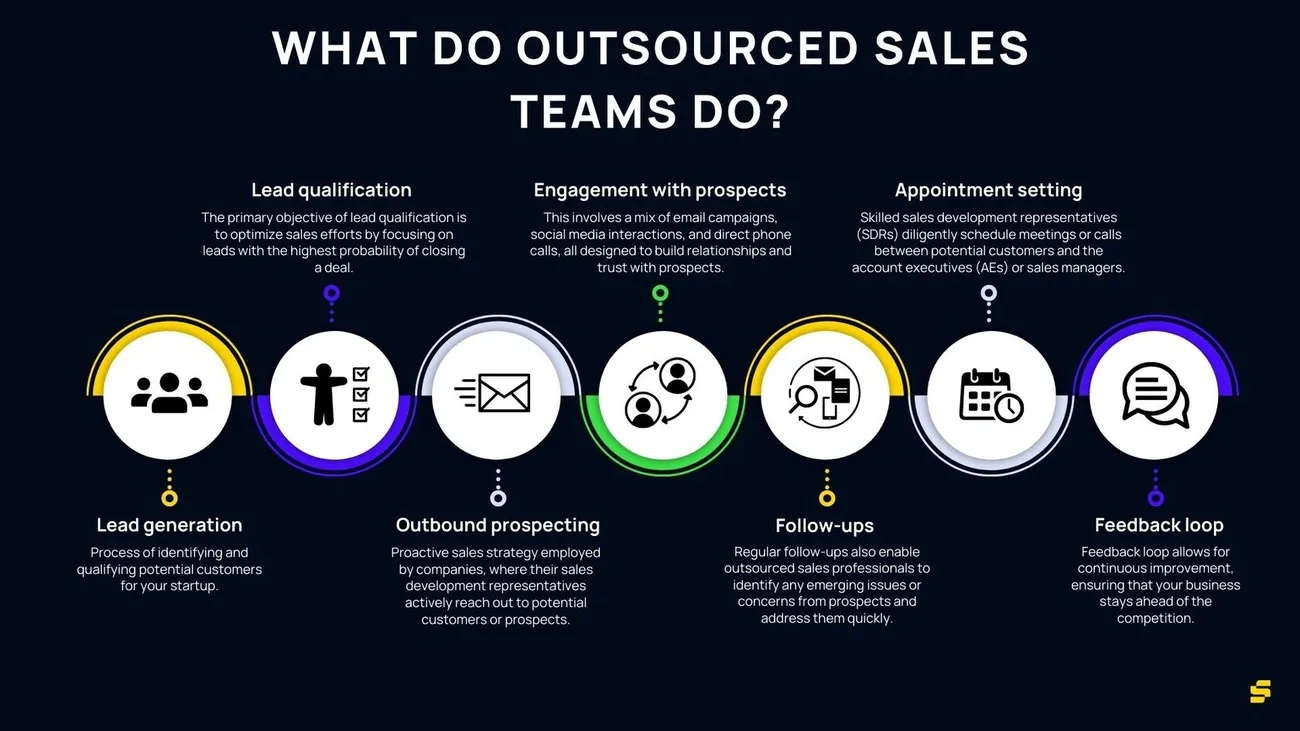
Selecting the right partner isn’t just about fancy pitches and polished presentations. When you’re looking for an outsource sales company for your $1M+ business, you need to dig deeper. Here are the critical areas to focus on to find a partner who actually delivers results.
Check for industry-specific experience
Does your potential partner really understand your industry? This matters more than you might think. Partners with relevant background get the unique market nuances, customer behaviors, and competitive dynamics of your business environment.
Ask them pointed questions about similar projects they’ve handled and how complex those were. For example, providers who specialize in technology sectors understand the rapid pace of change and know when to use consultative selling approaches. Their established industry connections can open doors that might otherwise take you months to crack.
Review lead quality and conversion metrics
Numbers don’t lie. When evaluating potential partners, ask for specific data on their conversion rates, lead-to-opportunity ratios, and cost per lead metrics.
The lead-to-opportunity ratio is particularly telling, it shows whether they’re targeting the right audience and generating qualified opportunities. Take a close look at their sales qualified lead (SQL) generation capacity, which directly reflects lead quality.
Don’t overlook their customer feedback collection process either. This often-missed metric provides valuable insights into their real performance and how they handle client relationships.
Understand their data compliance and security practices
With 57% of businesses globally relying on outsourcing for core operations, data security isn’t something you can compromise on. The average time to detect security breaches stands at 118 days, making prevention absolutely essential.
What specific certifications do they have? Look for ISO 27001 certification, which 48% of companies adopt as their cybersecurity framework. If they’ll handle financial data, make sure they maintain PCI DSS compliance to protect cardholder information.
Get specific about their protocols: How do they manage data access permissions? Do they use multi-factor authentication? What emergency response procedures do they have in place if something goes wrong?
Ask for case studies and client references
Client references tell you what marketing materials can’t. Examine the diversity of their testimonials across different industries and business sizes to gauge how adaptable they really are.
Ask for detailed case studies with specific metrics from client projects similar to yours. Find out about their achievements and how their clients have grown through the partnership.
When speaking with references, don’t just ask for praise, inquire about challenges they faced and how the outsourcer solved problems. Make sure these references come from companies in your industry and of similar size for the most relevant comparisons.
Applying These Lessons to Your Business
Making the decision to outsource your sales function isn’t something to take lightly. It requires careful consideration of your timing, resources, and business goals. After examining what successful million-dollar companies are doing, here’s how you can apply their proven strategies to your own business.
When to consider outsourcing sales or lead generation
Not sure if it’s the right time to partner with an external sales team? Start by looking at your current situation. Outsourcing makes the most sense when your company hits resource limitations that make it difficult to meet your sales objectives. If you’re constantly finding yourself with too little time to achieve your sales targets, outsourcing becomes hugely valuable.
Are you planning to expand into new markets? This is another perfect opportunity for outsourcing, since external teams already have specialized knowledge of specific market demands. This approach reduces your risks while giving you a practical way to scale your market expansion.
Companies facing growth challenges benefit particularly well from outsourcing. You’ll get faster ramp-up time and immediate access to skilled sales professionals without the headache of a lengthy hiring process. Why build from scratch when you can tap into ready-made expertise?
How to align outsourced efforts with your internal team
Successful alignment doesn’t happen by accident, it starts with crystal-clear expectations. You need to stay actively involved in the outsourcing process. Communicate your objectives clearly with your vendor and maintain consistent communication throughout the partnership.
Set up regular updates, meetings, and feedback loops to ensure the outsourced team stays aligned with your objectives and values. This isn’t a “set it and forget it” arrangement, it’s a dynamic partnership that requires attention.
For proper integration, implement centralized communication platforms through unified CRM systems or collaboration tools like Slack to ensure real-time updates flow seamlessly between all stakeholders. Your assigned Account Manager should serve as the bridge between your internal sales team and the client SDRs, consistently refining strategy and tracking performance.
Setting up KPIs and feedback loops for success
Don’t just hope things are working, know they are. Establish specific, measurable goals such as number of qualified leads, conversion rates, or revenue targets to effectively track performance and ROI. Tracking the right KPIs ensures your outsourcing relationship delivers not just short-term savings but long-term value supporting your broader business goals.
The key metrics you should monitor include:
- Conversion rates
- Sales cycle length
- Customer acquisition cost
- Return on investment
Regular performance reviews should identify strengths to build upon and weaknesses to address. By implementing a comprehensive feedback system, you’ll spot inefficiencies early, make necessary adjustments, and optimize operations for sustained growth.
What You Can Learn from $1M+ Outsourced Sales Wins
Let’s cut to the chase, million-dollar companies have cracked the code on outsourced sales, and their playbook is available to businesses at any stage. Their success isn’t magic; it’s methodical.
The returns go far beyond simple cost savings. Companies with the strongest outsourcing partnerships typically see a 300% spike in ROI and generate over $40 million in incremental revenue. That’s not just an improvement, it’s a transformation of business potential.
The market numbers tell their own story. The outsourced sales industry has grown to over $500 billion with a healthy 15% annual growth rate. Sales outsourcing specifically makes up about 25% of total outsourcing revenue while growing at an impressive 30% annually. These aren’t just statistics, they’re proof of the tangible value businesses are extracting from these partnerships.
Speed is a massive advantage you can’t overlook. While building an internal team typically drags on for months of recruitment and training, experienced outsourcing partners can deploy fully operational sales teams in as little as 45 days. This means you can capitalize on market opportunities while your competitors are still posting job descriptions.
What drives the best partnerships? A fundamental shift in economic alignment. Performance-based contracts tie compensation directly to results rather than hours worked, creating mutual incentives for success. This arrangement transfers performance risk to the supplier while generating higher returns for both parties. It’s a win-win by design, not by accident.
Then there’s the data advantage. Outsourced sales teams provide comprehensive analytics that reveal customer trends, conversion patterns, and operational efficiencies. These insights drive continuous improvement across your entire sales ecosystem, something that would take years to develop internally.
Perhaps most valuable is the flexibility factor. Outsourced models allow you to scale operations rapidly based on market conditions without the disruption of hiring or layoffs. This adaptability is particularly valuable during seasonal surges, new market entries, or when testing expansion strategies.
Million-dollar companies don’t view outsourcing as merely delegating tasks. They approach it as a strategic partnership that provides specialized expertise, technological capabilities, and market knowledge that would be prohibitively expensive to develop internally.
| Discover key strategies in our Ultimate Guide to Lead Qualification. Elevate your sales with GrowLeads.io’s proven methods today! |
FAQs
Q1. How long does it typically take for a company to reach $1 million in revenue?
The time to reach $1 million in revenue varies widely depending on the industry and business model. While some companies achieve this milestone within 1-2 years, others may take 3-5 years or longer. Factors like market demand, scalability, and effective sales strategies play crucial roles in determining growth rate.
Q2. What are the key benefits of outsourcing sales for growing companies?
Outsourcing sales offers several advantages for growing companies, including faster market entry, access to specialized expertise, scalability without long-term hiring commitments, and the ability to focus internal resources on core business functions. It can also provide cost savings and improved lead generation capabilities.
Q3. How do successful companies integrate outsourced sales teams with their internal processes?
Successful companies integrate outsourced sales teams by defining clear expectations, establishing regular communication channels, implementing centralized platforms for information sharing, and creating standardized handoff processes for qualified leads. They also ensure alignment between outsourced efforts and internal sales goals.
Q4. What metrics should be tracked when evaluating the performance of an outsourced sales team?
Key metrics to track include conversion rates, lead quality, sales cycle length, customer acquisition cost, and return on investment. It’s also important to monitor lead-to-opportunity ratios, SQL (Sales Qualified Lead) generation capacity, and customer feedback to gage the effectiveness of the outsourced team.
Q5. How can businesses ensure data security when outsourcing sales functions?
To ensure data security, businesses should verify that outsourcing partners have robust security protocols in place, including ISO 27001 certification for cybersecurity. It’s crucial to understand their data access permissions, multi-factor authentication implementation, and emergency response procedures. For financial data, ensure PCI DSS compliance is maintained.
The Outsourced Sales Checklist: 12 Decisions to Make Before You Sign a Contract
Outsourced sales programs fail more often than they succeed. The failures cluster around 12 decisions that should have been made in writing before the engagement started. The successes are not luckier; they made these decisions early and held the partner accountable to them.
Decision 1: ICP definition. Written. Single page. Industry, company size, role, geography, technographic match. If the outsourced team is operating from a vague ICP, every meeting they book will have low quality.
Decision 2: Targeting depth. Are they working an account list of 200 named accounts, or 5,000 accounts surfaced from a database? The economics of those two motions are different. Match the engagement model to the targeting depth, not the other way around.
Decision 3: Meeting definition. What qualifies as a meeting that you pay for? Show-up rate? Qualifying threshold (BANT, MEDDIC)? Acceptance from your AE? Vague meeting definitions are the single most common cause of outsourced sales disputes.
Decision 4: SLAs and ramp expectations. How many meetings per month at month 1, month 3, month 6? What happens if they miss? What happens if you pause campaigns?
Decision 5: Domain isolation. Are they sending from your primary domain or from a sub-domain? The wrong answer here will burn your inboxes and you will not see the damage for 60 days.
Decision 6: Data ownership. Who owns the contact data they enrich? Your CRM or theirs? When the engagement ends, what data transfers?
Decision 7: Brand voice constraints. What language are they not allowed to use in your name? The faster outsourced teams write copy, the more often they violate brand voice unless you give them a written rule sheet.
Decision 8: Technology stack. What sending infrastructure, sequence engine, and CRM connectors will they use? Are you paying for the tools or are they?
Decision 9: Reporting cadence. Weekly metric review with what data? Daily activity reports? Monthly QBR with what stakeholders?
Decision 10: Escalation path. When something goes wrong (deliverability incident, off-brand message goes out), who hears it first and how fast?
Decision 11: Renewal terms. What metric defines renewal? Closed-won? SAL acceptance? Pipeline created? The metric needs to be observable, agreed in writing, and reviewed at month 4 of a 6-month engagement, not at month 6.
Decision 12: Exit terms. How does the engagement end cleanly? What deliverables transfer? How long is the cooldown before either side can re-engage with prospects?
Most outsourced sales contracts cover 4 of these 12 in writing. The remaining 8 become arguments at month 3 when expectations diverge from reality. The engagements that compound into multi-year partnerships have all 12 documented before kickoff.

Runs the sales process, lead qualification, and client delivery that turn signals into qualified meetings.