
The Key Technology Challenges Facing Fintech Startups in 2026
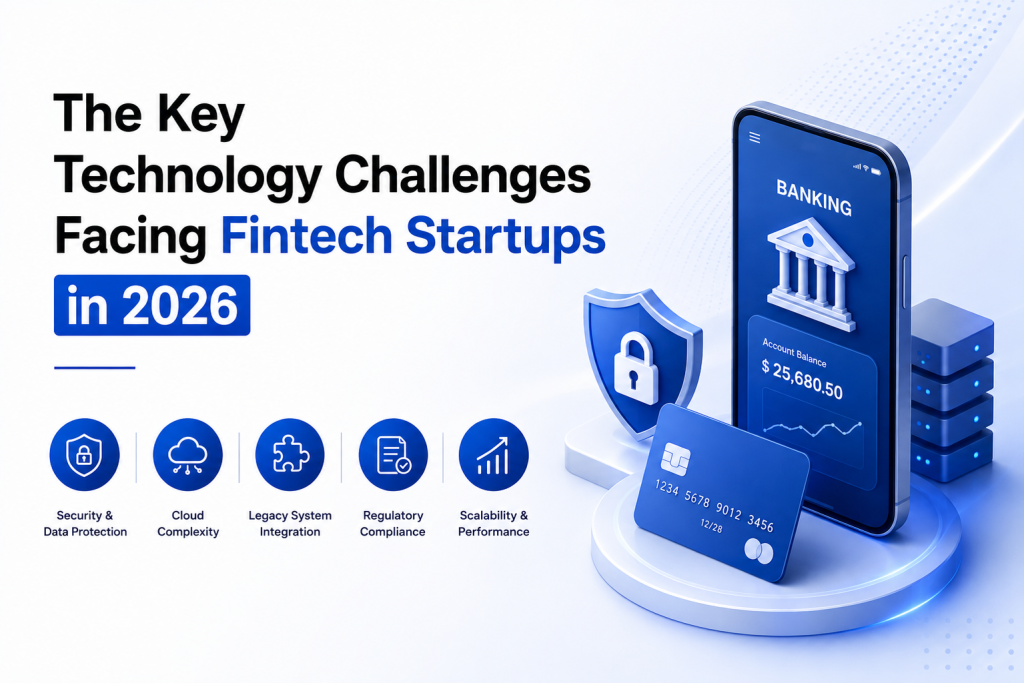
Fintech startups have never had more opportunity in front of them. Open banking is mainstream, embedded finance is showing up in industries that had nothing to do with banking a decade ago, and customers expect financial products to feel as smooth as their favorite apps. But opportunity comes with pressure. Building a fintech product in 2026 means solving harder technical problems than most founders anticipate.
Below are the technology challenges that are shaping which fintech startups scale successfully this year, and which ones stall out.
| Challenge | Why It Matters |
|---|---|
| Regulatory complexity | Compliance now has to be built into the architecture, not added later |
| Legacy infrastructure | Connecting to banking rails can quietly add months to a launch timeline |
| Security expectations | A single breach can undo years of trust-building with customers |
| Scaling infrastructure | Overbuilding wastes cash; underbuilding breaks under growth |
| Specialized talent gap | Fintech-specific engineering skills are scarce and expensive to hire in-house |
| AI integration | Models must be effective and explainable to regulators and customers |
Regulatory Complexity Is Now a Product Requirement
Compliance used to be something startups bolted on after building their core product. That approach no longer works. Regulators across the US, UK, and EU have tightened enforcement, and startups now need to think about compliance from the very first architecture decision, not as an afterthought before a review.
A few areas regulators are focusing on most closely in 2026:
- Data privacy — how customer data is stored and shared
- AML — transaction monitoring and suspicious activity reporting
- Consumer protection — fair treatment in automated decisions
- Audit trails — reconstructing how a decision was made
This shift means founders need engineering teams who understand regulatory frameworks well enough to build them into the system design, not just developers who can ship features quickly. Getting this wrong doesn’t just slow down a launch; it can trigger fines or force a costly rebuild later.
Legacy Infrastructure Still Gets in the Way
Even startups building “from scratch” often end up connecting to banking rails, card networks, or core systems that were designed decades ago. These weren’t built for modern API-first development, and integrating with them can eat up months of engineering time. Many teams underestimate this, only to discover a “simple” payment integration takes a quarter longer than expected because of how outdated the underlying infrastructure is.
This is one of the reasons many founders now bring in specialized technical partners early rather than trying to solve every integration problem in-house. Firms with deep experience in this space, such as DashDevs, have already mapped out the common pitfalls of connecting new products to legacy banking infrastructure, which saves startups from relearning these lessons the hard way through trial and error.
Security Expectations Keep Rising
Fintech products are a constant target for fraud and cyberattacks, and customers have gotten less forgiving about breaches. A single security incident can permanently damage trust in a brand that took years to build. This means startups need to invest in encryption, secure authentication, and fraud detection far earlier than their budgets often allow and treat security as an ongoing discipline rather than a one-time project.
Scaling Infrastructure Without Overbuilding
Early-stage fintech teams face a balancing act. Build too little infrastructure and the product breaks under growth. Build too much too early, and the company burns cash on systems it doesn’t need yet. Cloud-native architecture, microservices, and modular system design have become the standard approach because they let startups scale specific parts of their platform without rearchitecting everything each time user numbers grow. The teams that get this right usually have engineers who have already built fintech platforms at scale before, since they know which parts tend to become bottlenecks first.
The Talent Gap in Specialized Fintech Engineering
General software developers are not hard to find. Developers who understand payment processing, banking APIs, and regulatory constraints are a much smaller pool.
“The bottleneck for most fintech startups isn’t a good idea; it’s finding engineers who already understand the constraints they’re building around.”
This gap has pushed many startups toward outsourcing specific fintech development work rather than hiring an entire in-house team from day one. Common reasons founders choose this path:
- Faster time to launch, without a lengthy specialized hiring cycle
- Lower fixed costs while the business model is still being validated
- Access to engineers who have already solved similar problems
- More flexibility to scale the team as priorities shift
This isn’t a sign of weakness in a startup’s strategy. It’s often the more capital-efficient path for teams that need to launch and prove out their business model before committing to a large permanent headcount.
AI Integration Without Losing Trust
Artificial intelligence is now expected in fintech products, whether for fraud detection, personalized advice, or automated underwriting. But integrating AI into a regulated financial product is trickier than adding it to a typical consumer app. Startups need to explain how their models make decisions, especially when those decisions affect a customer’s access to credit. Building AI features that are both effective and explainable is quickly becoming a core technical challenge rather than a nice-to-have.
Moving Forward
None of these challenges are reasons to slow down. They’re simply the realities of building fintech products in a market that has matured significantly. The startups that succeed in 2026 will plan for compliance, security, and scalability from the start, rather than treating them as problems to solve later. Technology decisions made in a fintech startup’s first year tend to shape its trajectory for years afterward, so getting the foundation right matters more than moving fast for its own sake.

Builds the demand intelligence, automation, and deliverability systems behind Growleads pipeline.