
Is Hiring a Lead Generation Agency Worth It? Cost, ROI & What to Expect
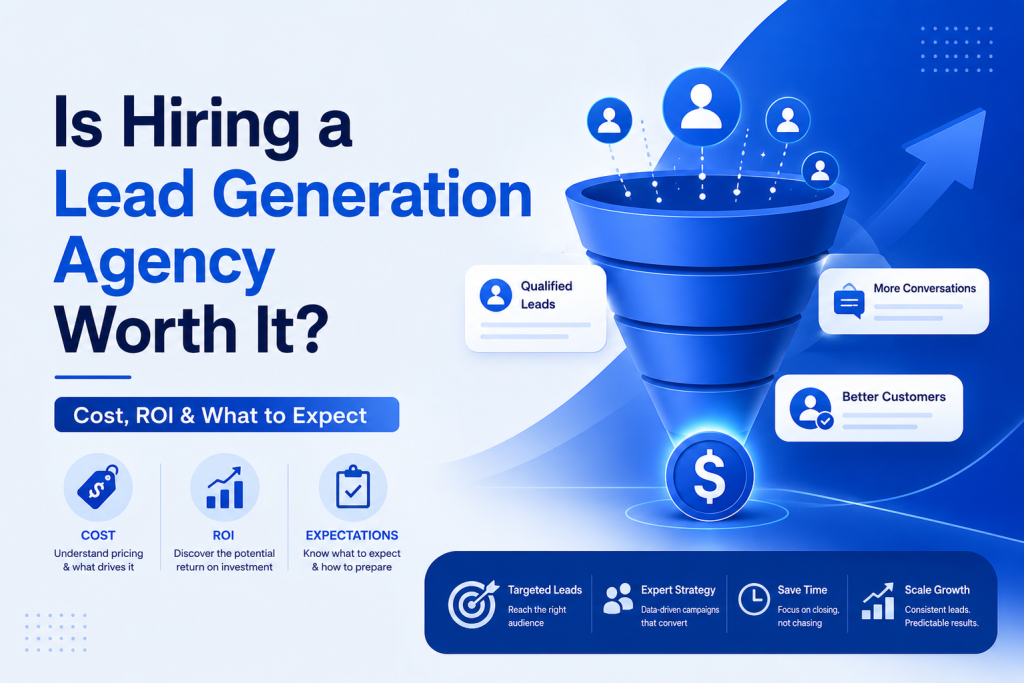
Yes, hiring a lead generation agency can be worth it when your economics support outbound acquisition, your offer is proven, and the agency creates qualified sales opportunities rather than simply delivering contacts. It is usually a poor investment when the ICP is unclear, sales follow-up is weak, or success is measured only by leads, replies or meetings booked.
The real question is not whether lead generation agencies work.
It is whether an external partner can create qualified pipeline more efficiently than your current alternative.
That requires looking beyond the monthly retainer. You need to understand the cost per qualified meeting, conversion to opportunities, sales pipeline created, customer acquisition cost and, eventually, revenue or gross profit generated.
Key Takeaways
- A lead generation agency is worth considering when you have a clear ICP, a proven offer, sufficient deal value and a sales team capable of converting meetings.
- Current published 2026 pricing varies widely, but managed B2B programs commonly fall somewhere around $3,000 to $15,000 per month. Scope, market, channels and qualification requirements can move pricing significantly higher or lower.
- Lead generation ROI should be measured from qualified meetings through opportunities, pipeline and closed revenue, not from raw lead volume alone.
- Cheap leads can produce poor economics if they rarely become sales opportunities.
- Outsourcing can reduce setup time and operational complexity, but it does not remove the need for internal sales follow-up, CRM discipline and market feedback.
- For many B2B companies, the strongest model is not purely outsourced or purely in-house. A hybrid model can combine external execution with internal market knowledge and sales ownership.
Is Hiring a Lead Generation Agency Worth It?
Hiring a lead generation agency is worth it when the expected commercial value of the pipeline exceeds the total cost of producing it.
That sounds obvious, but many companies evaluate agencies using the wrong comparison.
They ask:
How many leads will we get for $5,000?
A better question is:
How much qualified pipeline and gross profit can we reasonably generate from every $5,000 invested?
A company receiving 100 inexpensive leads may perform worse than a company receiving 12 conversations with the right decision-makers.
The important unit is not the lead.
It is the progression from target account → engaged buyer → qualified meeting → sales opportunity → customer → gross profit.
A lead generation agency is more likely to be worth it when:
| Situation | Why outsourcing can make sense |
|---|---|
| Your sales team needs more opportunities | The agency adds prospecting capacity without asking closers to spend their time building lists and running outreach |
| Your ICP is already reasonably clear | Targeting can begin from evidence rather than guesswork |
| Your average contract value supports outbound economics | A small number of wins can justify meaningful prospecting investment |
| You want to enter a new market | An external team can help test segments before you build permanent headcount |
| You lack outbound infrastructure | The partner can handle data, email infrastructure, research, sequencing and campaign management |
| Salespeople are spending too much time prospecting | Outsourcing can separate pipeline creation from closing |
| You need multiple acquisition channels | A capable demand generation partner can coordinate email, LinkedIn, paid acquisition and other channels |
A lead generation agency may not be worth it when:
- You are still trying to discover what your product should be.
- Nobody can clearly describe the ideal customer.
- Your offer has not converted through founder-led or direct selling.
- Your customer value is too low to support the acquisition cost.
- Your sales team does not follow up quickly or consistently.
- You expect the agency to close deals for you when the engagement only covers prospecting.
- Leadership expects immediate predictable revenue from a new campaign.
- You cannot track opportunities and revenue inside a CRM.
An agency can improve execution.
It cannot repair every underlying GTM problem.
What Are You Actually Paying a Lead Generation Agency For?
A good lead generation partner is not simply selling a database of names.
You are paying for a system that identifies relevant buyers, reaches them, creates interest, qualifies responses and moves viable prospects into your sales process.
Depending on scope, that system can include:
- ICP research
- Account selection
- Buyer and contact research
- Buying-signal identification
- Contact-data verification
- Cold email infrastructure
- LinkedIn prospecting
- Messaging and sequence development
- Campaign management
- Follow-ups
- Reply classification
- Lead qualification
- Appointment setting
- CRM updates
- Campaign reporting
- Continuous targeting and messaging improvements
This distinction matters.
If you outsource lead generation but only receive spreadsheets containing contacts, you have outsourced list building.
If the partner takes responsibility for targeting, outreach, qualification and pipeline creation, you are buying a much broader revenue function.
Companies evaluating outsourced B2B lead generation should therefore compare scope before comparing price.
How Much Does a Lead Generation Agency Cost in 2026?
There is no universal price for B2B lead generation.
Current 2026 pricing guides published by providers show managed programs ranging broadly from a few thousand dollars per month to $15,000 or more. Larger multichannel or enterprise programs can cost considerably more. Published pay-per-meeting rates also vary significantly based on seniority, geography, market difficulty and what counts as qualified.
These figures should be treated as market observations, not audited industry benchmarks.
Common lead generation pricing models
| Pricing model | Typical structure | Advantage | Main risk |
| Monthly retainer | Fixed monthly fee | Predictable budget and dedicated capacity | You carry more performance risk |
| Pay per lead | Fee for each defined lead | Easy to understand | Incentives can favour quantity |
| Pay per meeting | Fee for booked or qualified appointments | Connects spend closer to sales activity | Meeting quality definitions become critical |
| Hybrid | Base retainer plus performance fee | Shares risk between client and agency | Requires very clear attribution |
| Dedicated SDR | Monthly fee for dedicated prospecting capacity | Closest to an outsourced internal team | Performance still depends on management and strategy |
| Project or pilot | Fixed short-term engagement | Useful for testing a market | Short periods can produce misleading conclusions |
The headline price tells you very little without the scope.
A $4,000 program that includes research, data, infrastructure, messaging, campaign management and qualification could have better economics than a $2,000 program where your team must provide most of those components separately.
Ask what is included before asking whether the fee is expensive.
What Determines Lead Generation Agency Cost?
Five agencies can quote five different prices for the same company because they may not actually be proposing the same work.
Target-market difficulty
Reaching owners of 50-person marketing agencies is very different from reaching CIOs at global banks.
Smaller addressable markets, senior decision-makers and highly specialised industries usually require more research and personalisation.
Geography
Campaigns targeting one country are simpler than programs covering multiple languages, cultures and regulatory environments.
Channels
Cold email alone usually requires less operational scope than a program combining:
- Calling
- LinkedIn Ads
- Google Ads
- Retargeting
- Content or authority building
Qualification depth
There is a major difference between:
Prospect responded positively.
and:
Prospect matches the ICP, has a relevant business need, is the correct stakeholder and has agreed to discuss the problem.
The more responsibility the agency takes for qualification, the greater the operational work involved.
Data and infrastructure
Prospecting can involve enrichment platforms, databases, verification systems, sending domains, mailboxes, sequencing platforms, CRM integrations and automation.
Always determine whether those costs are included in the retainer.
How Should You Calculate Lead Generation ROI?
Lead generation ROI measures the financial return generated from the total amount invested in acquiring those opportunities.
A standard ROI formula is:
Lead Generation ROI = (Return Generated – Total Lead Generation Cost) ÷ Total Lead Generation Cost × 100
For decision-making, gross profit is often more useful than headline revenue because a $50,000 contract does not necessarily create $50,000 of economic value.
Current lead-generation measurement guidance also emphasises looking beyond cost per lead because a low CPL can still produce poor ROI if those leads fail to convert.
Do not jump directly from spend to revenue
B2B sales cycles can take months.
Instead, measure the economics at several levels.
Level 1: Cost per qualified meeting
Cost per Qualified Meeting = Total Program Cost ÷ Qualified Meetings Held
Use meetings held rather than simply booked whenever possible.
A calendar containing no-shows is not pipeline.
Level 2: Cost per sales opportunity
Cost per Opportunity = Total Program Cost ÷ Accepted Sales Opportunities
This tells you how much you are paying to create something your sales organisation believes is genuinely worth pursuing.
Level 3: Pipeline-to-cost ratio
Pipeline-to-Cost Ratio = Qualified Pipeline Created ÷ Lead Generation Cost
If you spend $20,000 and create $200,000 of genuinely qualified pipeline, the pipeline-to-cost ratio is 10:1.
That does not mean you achieved a 10:1 ROI.
Pipeline is not revenue.
Level 4: Customer acquisition cost
For the agency-generated channel:
Channel CAC = Total Relevant Acquisition Cost ÷ Customers Won
Depending on how you analyse CAC, relevant costs can include agency fees, media, data, software and allocated internal resources.
Level 5: Financial ROI
Once enough deals have closed:
ROI = (Gross Profit Attributable to the Program – Total Program Cost) ÷ Total Program Cost × 100
This is where you discover whether the lead generation program actually created economic value.
A Practical Lead Generation ROI Example
Consider a hypothetical B2B software company.
This example is educational, not a benchmark.
The company invests:
- Agency program: $6,000 per month
- Evaluation period: 3 months
- Total investment: $18,000
During that period:
- 24 meetings are booked
- 18 qualified prospects attend
- 7 become genuine sales opportunities
- 2 become customers
- Each new customer produces $25,000 in expected gross profit
The numbers become:
Cost per qualified meeting
$18,000 ÷ 18 = $1,000
Cost per opportunity
$18,000 ÷ 7 = $2,571
Gross profit generated
2 × $25,000 = $50,000
ROI
($50,000 – $18,000) ÷ $18,000 × 100 = 177.8%
Now change one variable.
If none of the seven opportunities close, the same campaign has created pipeline but has not yet generated a positive realised ROI.
That is why B2B marketing ROI must be viewed alongside the sales cycle.
The Most Useful Pre-Hire Calculation: Maximum Affordable Cost per Meeting
Senior revenue teams can reverse the mathematics before hiring anyone.
A simple educational formula is:
Maximum Expected Value per Qualified Meeting = Gross Profit per Customer × Qualified Meeting-to-Customer Close Rate
Suppose:
- Gross profit per customer = $30,000
- 10% of genuinely qualified meetings become customers
Expected gross profit per qualified meeting is:
$30,000 × 10% = $3,000
That does not mean you should willingly pay $3,000 for every meeting.
It means $3,000 represents the expected gross-profit value before accounting for your desired margin of safety, internal sales costs and other acquisition expenses.
If your economics show that a qualified meeting is worth approximately $3,000 and your real acquisition cost is $700, there may be room for an attractive return.
If a meeting is worth $300 and costs $700 to create, outsourcing will not become profitable simply because the agency generates more meetings.
Agency vs In-House Lead Generation
Outsourcing is not automatically cheaper than building an internal team.
The right comparison is total cost, speed, control and strategic importance.
| Factor | Lead generation agency | In-house team |
| Initial setup | Usually faster | Recruitment and infrastructure required |
| Fixed employment cost | Lower | Higher |
| Specialist expertise | Available immediately if the agency is capable | Must be hired or developed |
| Control | Shared | High |
| Product knowledge | Must be transferred | Usually stronger |
| Testing new markets | Flexible | More expensive to build before validation |
| Institutional knowledge | Risk of staying with agency | Stays internally |
| Scaling capacity | Can often expand faster | Requires hiring |
| Brand oversight | Requires governance | Easier to control directly |
| Long-term capability | Depends on knowledge transfer | Becomes internal competence |
Neither model wins universally.
Build in-house when:
- Prospecting is strategically central to the company.
- You have enough scale to justify a dedicated team.
- Your product requires deep specialist knowledge.
- You have strong sales-development management internally.
- Your market and messaging are already mature.
- You want complete ownership of every process.
Outsource when:
- You need pipeline without immediately building another department.
- You want to test a geography or ICP.
- Your sales team is strong at closing but weak or understaffed at prospecting.
- You lack outbound operations expertise.
- Speed and flexibility matter.
Use a hybrid model when:
Your company wants internal ownership of strategy, customer knowledge and closing while an external partner provides research, infrastructure, campaign execution or additional prospecting capacity.
For many established B2B businesses, this is a sensible middle ground.
What Should You Expect During the First 90 Days?
A lead generation agency should not be judged only by how many meetings appear in week one.
Good B2B prospecting involves learning.
A practical first-90-day progression may look like this:
| Period | Main objective | What you should evaluate |
| Weeks 1-2 | Discovery and setup | ICP quality, targeting logic, messaging, infrastructure, CRM process |
| Weeks 3-4 | Initial launch | Deliverability, engagement, response quality, early objections |
| Month 2 | Optimisation | Which segments, roles and messages produce qualified conversations |
| Month 3 | Commercial validation | Qualified meetings, opportunities, pipeline, sales feedback and early revenue indicators |
| Ongoing | Scale what works | Cost efficiency, conversion rates, pipeline quality and realised ROI |
This timeline is not a guarantee.
Complex enterprise markets may take longer. Strong offers in reachable markets may produce useful signals sooner.
What matters is whether the campaign becomes more intelligent over time.
If month three looks exactly like week one, the partner may be executing activity rather than learning from the market.
What Should a Good Lead Generation Partner Own?
A capable partner should be able to explain the entire path between your target market and your sales calendar.
ICP definition
Who should be approached?
That includes:
- Industry
- Geography
- Company size
- Revenue
- Business model
- Technology environment
- Relevant roles
- Buying triggers
- Exclusion criteria
Buyer intelligence
Why might the prospect care now?
Useful signals can include funding, hiring, leadership changes, expansion, technology adoption, product launches or other observable business events.
Messaging
The message should connect:
buyer situation → relevant problem → credible reason to talk
Personalisation without relevance is still bad messaging.
Channel execution
The agency should explain why email, LinkedIn, calling, paid media or another channel fits your buyers.
A channel should not be selected merely because it is the agency’s favourite service.
Qualification
Define qualification before the campaign starts.
Questions can include:
- Does the company match the agreed ICP?
- Is the contact an appropriate stakeholder?
- Is there a relevant business problem or initiative?
- Is there genuine interest in discussing it?
- Did the prospect attend the meeting?
- What would cause the client to reject the meeting?
For a deeper framework, see how to measure lead quality.
Reporting
Reporting should connect activity to commercial outcomes.
At minimum, you should be able to follow:
accounts targeted → conversations → meetings → attended qualified meetings → opportunities → pipeline → wins
What Your Internal Team Still Needs to Own
Outsourcing lead generation does not mean outsourcing responsibility for growth.
Your company still needs to provide:
A credible offer
An agency cannot permanently compensate for a proposition buyers do not value.
Market knowledge
Your sales calls contain information an external team needs.
Share:
- Common objections
- Reasons deals are lost
- Reasons customers buy
- Competitor comparisons
- Successful use cases
- Language customers naturally use
Fast sales follow-up
A qualified prospect can lose interest while sitting untouched in a CRM.
Sales capacity is part of lead generation ROI.
Feedback
Do not simply tell the agency:
Leads are bad.
Explain why.
Was the company too small?
Wrong geography?
No current need?
Wrong seniority?
Poor use case?
No budget?
Good feedback improves targeting.
Closing
Most appointment setting services create conversations.
Your sales team normally owns discovery, proposal, negotiation and closing.
That distinction should be explicit before signing.
What Metrics Actually Matter?
The best lead generation dashboard gets more commercial as you move from left to right.
Operational metrics
- Prospects contacted
- Deliverability
- Response rate
- Positive response rate
- Connection acceptance
Useful for diagnosing campaigns.
Not sufficient for judging ROI.
Meeting metrics
- Meetings booked
- Show rate
- Qualified meetings held
- Cost per qualified meeting
Better indicators of prospecting performance.
Pipeline metrics
- Sales opportunities created
- Opportunity rate
- Cost per opportunity
- Pipeline created
- Pipeline-to-spend ratio
These connect activity to the sales pipeline.
Revenue metrics
- Closed-won customers
- Customer acquisition cost
- Gross profit
- Payback period
- Lead generation ROI
These determine whether the channel deserves more investment.
A revenue leader should eventually be able to trace qualified sales opportunities back to the channel, campaign, segment and source that created them.
Seven Questions to Decide Whether Outsourcing Makes Sense
The following Lead Generation Agency Readiness Score is an educational decision framework, not a proprietary Growleads methodology.
Score each question:
- 0: No
- 1: Partly
- 2: Yes
| Question | Score |
| Can we clearly define our ICP? | 0-2 |
| Has our offer already produced paying customers? | 0-2 |
| Is customer value high enough to support paid acquisition? | 0-2 |
| Can our sales team handle additional qualified meetings? | 0-2 |
| Can we track leads, opportunities and revenue through our CRM? | 0-2 |
| Can we provide consistent feedback to the agency? | 0-2 |
| Are we prepared to evaluate the program across a meaningful sales cycle? | 0-2 |
11-14: Strong outsourcing readiness
You probably have enough foundations to evaluate a partner commercially.
7-10: Conditional fit
Outsourcing may work, but identify which missing foundations could damage performance.
0-6: Fix the fundamentals first
More prospecting volume could magnify existing GTM problems rather than solve them.
Warning Signs When Evaluating Lead Generation Agencies
They cannot define “qualified”
Ask exactly what you will be paying for.
A reply?
A lead?
A booked call?
An attended meeting?
A sales-qualified opportunity?
Ambiguity creates conflict later.
They guarantee revenue they do not control
An agency may influence pipeline.
Your sales team, product, pricing, market conditions and sales cycle also affect revenue.
Be careful with guarantees that ignore those variables.
Every client gets the same playbook
Different markets require different targeting, channels and messages.
A cybersecurity company selling to enterprise CISOs should not receive the same campaign design as an accounting firm targeting small businesses.
Reporting stops at activity
Thousands of emails sent is not a business outcome.
Neither are connection requests or impressions.
Nobody discusses sales conversion
Lead generation cannot be evaluated separately from what happens after the meeting.
The cheapest price is the entire pitch
Low acquisition cost is valuable.
Low-quality pipeline is not.
There is no learning process
A serious partner should be asking:
- Which meetings converted?
- Which were rejected?
- Which segments created opportunities?
- What objections appeared?
- Which messages attracted the strongest buyers?
The campaign should become better informed with time.
If you are comparing providers, a structured guide on how to choose a lead generation agency can help standardise the evaluation.
Retainer vs Pay Per Meeting: Which Is Better?
Neither pricing model is automatically superior.
Retainers work well when:
- The program requires substantial research.
- Multiple channels are involved.
- You value continuous optimisation.
- Brand and message quality matter.
- The addressable market is narrow.
The client carries more short-term performance risk, but the agency can optimise for the overall system rather than simply producing a contractual number of meetings.
Pay-per-meeting works well when:
- Qualification is objective.
- Your addressable market is large.
- Meeting economics are well understood.
- Attendance rules are clear.
- You want variable acquisition costs.
The risk is incentive design.
If the provider gets paid only for booked appointments, it may be economically encouraged to maximise calendar volume rather than downstream opportunity quality.
The contract should therefore define:
- Qualification criteria
- No-show policy
- Replacement policy
- Duplicate handling
- Existing opportunities
- Out-of-ICP meetings
- Rescheduling
- Attribution
How Long Should You Give a Lead Generation Agency?
Evaluate the agency according to the length of your actual buying and sales cycle.
You can measure activity almost immediately.
You can evaluate meeting quality once meetings occur.
You can assess opportunity creation after sales qualification.
You can only measure realised ROI after enough opportunities have had time to close.
That means a company with a six-month enterprise buying cycle should not expect a complete revenue verdict after 30 days.
At the same time, a long sales cycle should not become an excuse for poor execution.
Early indicators still matter:
- Is the right market being targeted?
- Are messages producing relevant responses?
- Are prospects attending?
- Are salespeople accepting the opportunities?
- Is the campaign learning?
What ROI Should You Expect From a Lead Generation Agency?
There is no universal lead generation ROI target that every B2B company should demand.
The right threshold depends on:
- Gross margin
- Customer lifetime value
- Average contract value
- Close rate
- Sales-cycle length
- Churn
- Internal sales cost
- Opportunity cost
- Cash-flow requirements
A company selling a $200,000 annual enterprise contract can tolerate a very different cost per qualified meeting from a company selling a $2,000 service.
Rather than asking an agency for a generic ROI benchmark, calculate your own break-even point.
Then ask whether the proposed campaign has credible economics below that threshold.
Conclusion: Is Hiring a Lead Generation Agency Worth It?
Hiring a lead generation agency is worth it when outsourcing improves the economics or speed of creating qualified sales opportunities without sacrificing buyer quality or brand trust.
Do not make the decision from the retainer alone.
Work backwards from customer economics.
Understand what a customer is worth. Calculate what an opportunity is worth. Determine how many qualified meetings are required to create that opportunity. Then compare those numbers against the true cost of the program.
The strongest agency relationships also extend beyond sending messages. They connect buyer research, targeting, outreach, qualification, sales feedback and pipeline measurement.
Growleads positions its role in this way as a Demand Intelligence partner, with an emphasis on understanding buyers first and measuring qualified meetings, pipeline and revenue influence rather than simply selling lead volume.
If your company is considering outsourcing, the next step does not need to be a long contract. Start by mapping your acquisition economics, ICP, current conversion rates and pipeline gaps. Then evaluate whether an external partner can improve those numbers with acceptable risk.
Frequently Asked Questions
Is it worth paying a lead generation company?
Yes, paying a lead generation company can be worthwhile when the qualified opportunities it creates have greater expected commercial value than the total cost of generating them. Evaluate cost per qualified meeting, opportunities, pipeline and customer acquisition cost rather than raw lead volume.
How much does a lead generation agency cost?
Managed B2B lead generation programs in current published 2026 pricing guides commonly range from roughly $3,000 to $15,000 per month, although specialised, enterprise and multichannel programs can cost more. Pricing varies according to market difficulty, channels, research requirements and qualification depth.
Should I outsource lead generation or hire an SDR?
Outsource lead generation when speed, specialist infrastructure or market testing matter more than complete internal control. Hire internally when prospecting is strategically central, you have strong SDR management and the scale exists to support a permanent team.
How do you calculate lead generation ROI?
Calculate lead generation ROI by subtracting the total lead generation cost from the gross profit attributable to the program, dividing the result by total cost, and multiplying by 100. For long B2B sales cycles, also track qualified meetings, opportunities and pipeline before enough revenue has closed.
How long does it take for a lead generation agency to work?
A lead generation program can produce early campaign signals quickly, but reliable conclusions require enough time for targeting, messaging, meetings and sales conversion to develop. The appropriate evaluation period depends heavily on your market and normal sales cycle.
What should a lead generation agency actually deliver?
A strong B2B lead generation agency should create qualified sales opportunities, not simply contact lists. Depending on the engagement, that can involve ICP research, prospect data, buyer signals, outreach infrastructure, messaging, campaign execution, qualification, appointment setting, reporting and optimisation.
What is more important, cost per lead or lead generation ROI?
Lead generation ROI is more important because a cheap lead has little value if it never becomes an opportunity or customer. Cost per qualified meeting, cost per opportunity, CAC and gross profit provide a more useful picture of commercial performance.
When should you not hire a lead generation agency?
Do not hire a lead generation agency to compensate for an unproven offer, undefined ICP or broken sales process. Establish the basic GTM foundations first, then use an agency to increase or improve pipeline creation rather than expecting outsourcing to solve product-market fit.

Builds the demand intelligence, automation, and deliverability systems behind Growleads pipeline.