
What Should a Lead Generation Agency Actually Do? A Complete Guide for B2B Companies
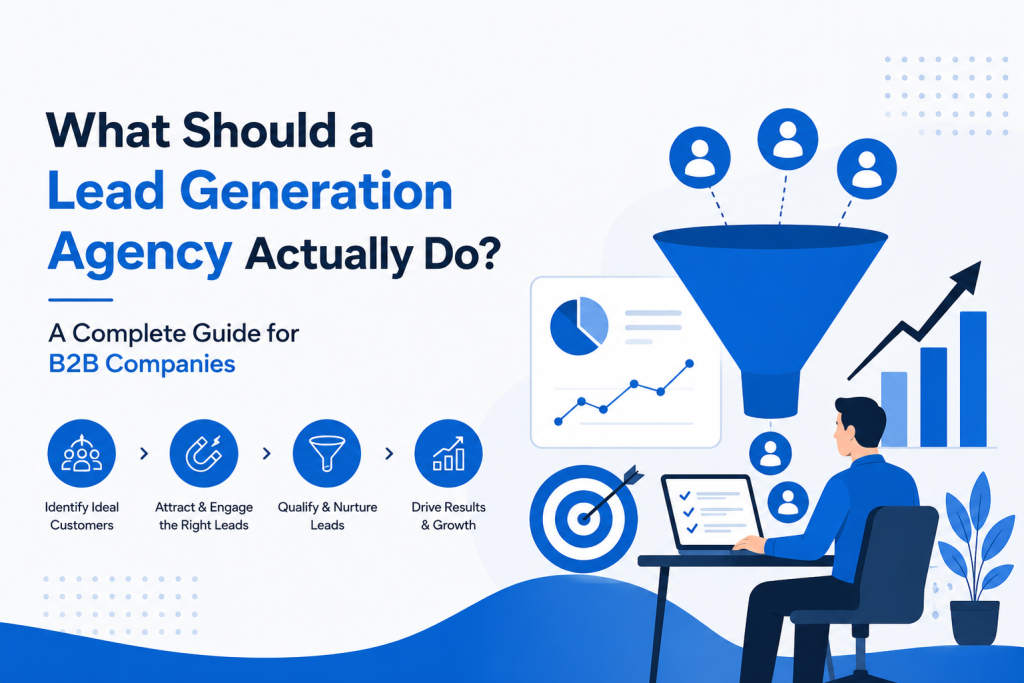
A B2B lead generation agency should do more than send emails or hand over contact lists. It should identify the right buyers, build accurate prospect data, create relevant messaging, run outreach, qualify responses, book suitable meetings, track activity in the CRM and show how its work contributes to sales pipeline. The exact scope depends on the company, market and sales model.
That distinction matters.
Many B2B companies hire an agency expecting “more leads.” But lead volume alone says very little about whether the engagement is working.
A database of 5,000 contacts is not pipeline.
A positive reply from the wrong company is not a qualified lead.
A booked meeting with someone who has no relevance to the buying process is not necessarily a good outcome.
The real job of a lead generation partner is to create a reliable path from target market to qualified sales conversation, while giving your team enough visibility to understand what is working and what needs to change.
Quick Answer: What Should a Lead Generation Agency Do?
A capable lead generation agency should normally handle some or all of the following:
- Understand your business, offer and sales motion.
- Define or refine your ideal customer profile.
- Identify target accounts and relevant decision-makers.
- Research buyer signals and prioritise accounts.
- Build and verify prospect data.
- Choose appropriate acquisition channels.
- Develop messaging and outreach sequences.
- Set up the required campaign infrastructure.
- Launch, monitor and optimise campaigns.
- Manage replies and qualify prospects.
- Provide appointment setting services where required.
- Hand qualified opportunities to sales with context.
- Track meetings, opportunities and pipeline contribution.
- Feed campaign learnings back into the GTM strategy.
Not every lead generation agency needs to provide every service.
The important question is whether the agency clearly defines what it owns, what your internal team owns and how both sides will measure success.
What Should a Lead Generation Agency Do Before Launching Outreach?
A good lead generation agency should understand the buyer before choosing the channel.
This is one of the most important parts of the engagement because poor targeting cannot usually be fixed with better copy.
1. Understand the business and sales model
Before generating a prospect list, the agency needs context.
It should understand:
- What you sell
- Who normally buys it
- The business problem you solve
- Typical contract value
- Sales cycle
- Target geography
- Existing customers
- Strongest use cases
- Common objections
- Competitors and alternatives
- Why customers choose you
- What usually creates urgency
A company selling a $150,000 enterprise software implementation needs a very different lead generation system from an agency selling a $2,000 monthly service.
The first may have a narrow account universe, several stakeholders and a long sales cycle. The second may have thousands of potential buyers and a much faster buying process.
The lead generation strategy needs to reflect those realities.
2. Define the ideal customer profile
An ideal customer profile, or ICP, describes the type of company most likely to benefit from your offer and become a commercially valuable customer.
A useful ICP may include:
- Industry
- Geography
- Employee count
- Revenue range
- Business model
- Technology used
- Growth stage
- Regulatory environment
- Current business priorities
- Existing suppliers
- Relevant trigger events
The agency should then identify the people involved in the buying process.
That may include economic buyers, functional leaders, users, influencers and procurement stakeholders.
For example, targeting “technology companies in the US” is usually too broad.
A stronger definition might be:
B2B SaaS companies with 100 to 500 employees, selling enterprise software in the US, with an established sales team and a need to increase qualified sales conversations.
The more precise the ICP becomes, the easier it is to improve research, messaging and qualification.
For a deeper breakdown of the stages involved, see the B2B lead generation process.
3. Identify buyer signals
A prospect can fit your ICP without being ready to buy.
That is why modern B2B prospecting should look beyond static firmographic data.
Useful signals can include:
- New funding
- Leadership changes
- Expansion into a new market
- Rapid hiring
- New product launches
- Technology adoption
- Technology replacement
- Mergers or acquisitions
- New regulatory requirements
- Changes in business strategy
- Relevant website activity
- Engagement with company content
Signals are not proof that somebody will buy.
They are prioritisation inputs.
The agency should use signals to decide which accounts deserve attention first and what context may make outreach more relevant.
What Does the B2B Lead Generation Process Actually Look Like?
A complete B2B lead generation process moves through several connected stages.
Skipping one often creates problems further down the funnel.
| Stage | What the agency should do | Expected output |
|---|---|---|
| Strategy | Understand offer, market and goals | Campaign brief |
| ICP | Define companies and buyer roles | Targeting criteria |
| Research | Identify accounts, contacts and signals | Prospect database |
| Messaging | Build value propositions and sequences | Campaign copy |
| Infrastructure | Prepare channels, tracking and systems | Launch-ready setup |
| Outreach | Run campaigns across selected channels | Conversations |
| Qualification | Assess fit and interest | Qualified prospects |
| Appointment setting | Coordinate suitable meetings | Booked conversations |
| Handoff | Give sales the required context | Sales-ready lead |
| Reporting | Track funnel and pipeline outcomes | Performance visibility |
| Optimisation | Analyse results and improve campaigns | Better future execution |
The process should be connected.
The agency should not optimise one stage while ignoring what happens next.
For example, generating more replies is not useful if those replies consistently come from companies your sales team would never pursue.
4. Build Accurate Prospect Data
Data quality is one of the least glamorous parts of lead generation and one of the most important.
The agency should determine:
- Which companies fit the ICP
- Which contacts are relevant
- Whether job titles are current
- Whether contact details are valid
- Whether duplicate accounts exist
- Whether the company should be excluded
- Which signal or reason justified targeting the account
A prospect list should not simply be a large export from a sales database.
The list should represent a commercial hypothesis.
Every account should have a reason for being there.
For high-value B2B sales, the agency may also need account-level research before outreach begins.
5. Select the Right Lead Generation Channels
There is no universal channel mix for B2B lead generation services.
Common options include:
- Cold email
- LinkedIn outreach
- Cold calling
- LinkedIn advertising
- Google Ads
- Search and content
- Events
- Account-based campaigns
- Founder-led content
- Retargeting
Channel selection should follow buyer behaviour.
For example, cold email can make sense when the addressable market is large and relevant contacts can be identified accurately.
LinkedIn may be useful when decision-makers are active there and trust or personal authority matters.
Google Ads can capture buyers who are already searching for a solution.
Content and demand generation can help when buyers need education before they are ready to speak with sales.
A company should be cautious when an agency recommends its favourite channel before understanding how the company’s customers actually buy.
Lead Generation vs Demand Generation vs Appointment Setting
These terms are often used as if they mean the same thing. They do not.
| Function | Primary job | Typical outcome |
| Lead generation | Identify or capture potential buyers | Leads and conversations |
| Demand generation | Build awareness, interest and preference | Future and existing demand |
| Appointment setting | Turn suitable interest into scheduled sales conversations | Meetings |
| Pipeline generation | Create and progress commercially relevant opportunities | Qualified pipeline |
A lead generation agency is generally focused on creating identifiable sales prospects.
A demand generation agency works more broadly to create awareness and interest among the target market, including people who are not currently ready to engage with sales.
Appointment setting sits further down the process. It converts relevant conversations into scheduled meetings.
Pipeline generation is broader again. It asks whether lead generation activity is creating real sales opportunities rather than just top-of-funnel activity.
For companies that need both inbound demand creation and lead capture, the role of a demand generation agency can therefore be different from a purely outbound appointment-setting provider.
6. Create Messaging That Gives Buyers a Reason to Respond
Personalisation is not the same as inserting a first name or company name.
Effective B2B messaging should connect three things:
Buyer context + relevant problem + credible reason to talk
The agency should understand:
- What matters to each buyer persona
- What business problem is being addressed
- Why the problem deserves attention now
- What makes the offer relevant
- What level of proof is available
- What the next step should be
Messaging also needs to reflect the channel.
A LinkedIn message should not simply be a cold email copied into a smaller box.
A paid-search landing page should not communicate like an outbound email.
An enterprise account may require more research than a smaller transactional prospect.
The agency should test messaging, but testing should have a purpose.
Changing random subject lines without understanding buyer behaviour is not a strategy.
7. Set Up and Manage the Infrastructure
Lead generation has a technical layer that companies often underestimate. When outdated business software or legacy systems create operational limitations, companies may also need help modernizing the technology that supports their growth. A specialist such as Mind Studios can help businesses modernize and re-engineer legacy software as part of a broader technology improvement strategy.
Depending on the channels involved, an agency may need to manage:
- Email sending infrastructure
- Mailboxes
- Domains
- Deliverability monitoring
- Prospecting tools
- Enrichment tools
- LinkedIn outreach tools
- Advertising accounts
- Landing pages
- CRM connections
- Calendars
- Conversion tracking
- Lead routing
- Reporting dashboards
The company should know who owns each asset.
Where practical, important business data and customer records should remain accessible to the client.
An agency relationship should not create unnecessary dependence on systems the client cannot see or control.
8. Launch Outreach and Manage Follow-Ups
Launching is not the end of the work.
It is where the feedback begins.
The agency should monitor:
- Deliverability
- Responses
- Response quality
- Buyer objections
- Positive conversations
- Incorrect targeting
- Unsubscribe or negative feedback
- Meeting conversion
- No-show patterns
- Performance by segment
- Performance by messaging angle
Follow-ups also need judgement.
More follow-ups do not automatically create better results.
The right frequency depends on the channel, target audience, offer and buyer behaviour.
For companies using proactive prospecting, well-managed outbound lead generation services should combine targeting, outreach, qualification and learning rather than measuring success by messages sent alone.
9. Qualify Leads Before Sending Them to Sales
This is where many lead generation engagements break down.
A reply is not automatically a lead.
A lead is not automatically an opportunity.
And a meeting is not automatically qualified.
The agency and client should agree on qualification criteria before campaigns begin.
Depending on the sales motion, qualification may consider:
- ICP fit
- Job role
- Decision-making influence
- Business need
- Current priorities
- Timing
- Existing solution
- Budget relevance
- Geography
- Company size
- Expressed interest
Not every criterion needs to be verified before a first meeting.
Over-qualification can create friction and eliminate prospects who would have become valuable opportunities.
The goal is to filter obvious mismatches without trying to complete the entire sales discovery process before sales becomes involved.
10. Handle Appointment Setting Properly
Appointment setting services should do more than place a calendar link in an email.
A strong appointment-setting process should:
- Confirm the prospect is relevant
- Understand why the prospect agreed to talk
- Offer appropriate scheduling options
- Record the meeting accurately
- Give both sides relevant context
- Reduce avoidable scheduling friction
- Follow up when appropriate
The sales representative should not enter the meeting wondering:
Who is this person and why are we speaking?
A proper handoff might contain:
- Prospect name
- Company
- Role
- Relevant account information
- Conversation history
- Reason for interest
- Original outreach angle
- Any question or concern raised by the prospect
That context can be just as valuable as the calendar booking itself.
11. Track Pipeline, Not Just Activity
A lead generation agency should report what happened after outreach.
Activity metrics still have value because they help diagnose campaigns.
Useful operational metrics can include:
- Accounts researched
- Prospects contacted
- Email delivery
- Connection acceptance
- Replies
- Positive replies
- Qualified replies
- Meetings booked
- Meetings attended
But senior revenue teams should also look further down the funnel:
- Sales-accepted meetings
- Opportunities created
- Opportunity value
- Pipeline generated
- Conversion by segment
- Conversion by channel
- Reasons prospects are disqualified
- Revenue influenced
Closed revenue cannot always be attributed entirely to the lead generation agency.
Sales execution, pricing, product-market fit, competition and the client’s closing process all matter.
But the agency should be able to connect its activity to the pipeline wherever the available data allows it.
The reporting hierarchy that matters
A useful way to evaluate performance is:
Activity → Engagement → Qualified Meetings → Opportunities → Pipeline → Revenue
If reporting stops at the first two stages, senior leadership has limited information about commercial impact.
What Should the Agency Own and What Should the Client Own?
Lead generation works best when responsibilities are explicit.
| Agency should usually own | Client should usually own |
| Campaign strategy | Accurate product information |
| ICP recommendations | Final ICP approval |
| Prospect research | Strategic account exclusions |
| Campaign execution | Sales capacity |
| Messaging drafts | Proof points and positioning input |
| Reply management within scope | Product and technical questions |
| Lead qualification | Discovery and closing |
| Appointment coordination | Fast meeting follow-up |
| Campaign reporting | CRM opportunity updates |
| Optimisation | Feedback on lead quality |
Lead generation is rarely a successful “throw it over the wall” function.
The client still has an important role.
If sales representatives do not attend meetings, update the CRM or tell the agency why opportunities are being rejected, campaign optimisation becomes much harder.
What Should a Lead Generation Agency Not Be Expected to Do?
Clear expectations protect both sides.
Guarantee closed revenue
An agency can influence pipeline creation.
It cannot independently control whether your sales team closes every opportunity.
Fix a weak offer through outreach
Good campaigns can improve positioning through market feedback.
They cannot make buyers want an offer that has little relevance or differentiation.
Produce unlimited qualified buyers
Every target market has a finite size.
For narrow ICPs, sending more messages may simply exhaust the market faster.
Replace the entire sales function automatically
Some agencies provide outsourced SDR teams, while others stop at qualified meetings.
Account executives, solution consultants and commercial teams may still be required.
Generate predictable results immediately
Lead generation is a system that needs data.
Targeting, messaging, channel selection and qualification usually improve as real buyer feedback becomes available.
Common Warning Signs When Hiring a Lead Generation Agency
Be cautious when an agency:
- Cannot clearly explain who it will target
- Talks primarily about sending volume
- Defines success only as contacts delivered
- Will not explain how data is sourced
- Has no clear qualification criteria
- Treats every positive reply as a qualified lead
- Cannot explain its handoff process
- Reports activity without pipeline context
- Uses exactly the same campaign structure for every market
- Promises specific revenue without understanding your sales process
- Cannot explain who owns infrastructure and data
- Avoids discussing what happens when a campaign underperforms
A good agency does not need to have every answer before onboarding.
It should, however, have a clear process for finding those answers.
A Practical Lead Generation Agency Evaluation Scorecard
The following scorecard is an educational framework for comparing agencies. It is not a proprietary Growleads methodology.
Score each category from 1 to 5 and multiply it by the suggested weighting.
| Evaluation area | Weight | What to look for |
| ICP and market understanding | 20% | Can the agency explain who should be targeted and why? |
| Data and research | 15% | How are accounts, contacts and signals identified? |
| Messaging quality | 15% | Is messaging based on buyer context rather than templates? |
| Channel execution | 15% | Does the agency understand the selected channels operationally? |
| Qualification and handoff | 15% | What actually counts as a qualified lead or meeting? |
| Reporting and pipeline tracking | 10% | Can activity be connected to opportunities? |
| Transparency and learning | 10% | Can you see what is happening and what is changing? |
A company scoring agencies this way is less likely to choose purely on price, presentation quality or promised lead volume.
Should You Hire an Agency or Build Lead Generation In-House?
Neither model is automatically better.
An agency may make sense when:
- You need to build pipeline without hiring a full SDR function
- Your internal team lacks outbound expertise
- You want to test a new geography or segment
- Your sales team is spending too much time prospecting
- You need specialist infrastructure or campaign operations
- You want to add a new channel quickly
- Your company needs a repeatable prospecting system before hiring a larger team
An in-house team may make more sense when:
- Deep product knowledge is required in every conversation
- The available target market is very small
- Sales relationships are highly strategic
- Outreach must be tightly integrated with account executives
- You already have experienced SDR leadership and infrastructure
- The organisation wants full day-to-day control of prospecting
A hybrid model is also common.
An agency can handle research, campaign systems and top-of-funnel execution while the internal sales team owns discovery, relationship development and closing.
Lead Generation Is Becoming a Broader GTM Function
B2B pipeline generation increasingly connects several functions that companies once managed separately.
Buyer research informs targeting.
Targeting informs outbound.
Outbound responses improve messaging.
Demand generation builds familiarity.
Founder content creates trust.
Paid search captures existing demand.
CRM data shows which segments produce opportunities.
Automation reduces repetitive work.
The strongest lead generation programmes therefore operate as connected go-to-market systems rather than isolated campaigns.
That does not mean every company needs every channel.
It means every channel should have a clear role in moving the right buyers closer to a commercial conversation.
Where Growleads Fits
Growleads positions itself as a B2B Demand Intelligence company, with the goal of helping B2B companies create qualified sales meetings and predictable pipeline through channels including cold email, LinkedIn outreach, paid acquisition, authority building, GTM consulting and automation.
The distinction is intentional. Growleads describes its role as a Demand Intelligence partner rather than simply a company that sells leads, with an emphasis on qualified pipeline and understanding buyers before campaigns begin.
For a company evaluating Growleads or any other provider, the same standard should apply: understand exactly who will be targeted, why they are being targeted, what the agency will execute, what constitutes a qualified result and how that activity will connect to pipeline.
Conclusion: Judge a Lead Generation Agency by the System, Not the Lead Count
So, what should a lead generation agency actually do?
It should build and operate a disciplined system for finding the right buyers, reaching them through appropriate channels, creating relevant conversations, qualifying genuine interest and connecting those conversations to the sales pipeline.
The agency should also make the process visible.
You should know who is being targeted, what is being tested, what prospects are saying, which meetings qualify and whether those meetings are progressing into opportunities.
That is a much more useful standard than asking how many leads an agency can deliver.
If your company is considering outsourced lead generation, start by mapping your ICP, sales process, qualification criteria and current pipeline gaps. From there, you can determine which parts should remain internal and where a specialist partner such as Growleads can genuinely add value.
Frequently Asked Questions
What does a B2B lead generation agency do?
A B2B lead generation agency identifies target buyers and creates qualified sales opportunities for a company. Its work can include ICP definition, prospect research, data enrichment, outbound messaging, campaign execution, lead qualification, appointment setting, CRM handoff and pipeline reporting.
What services should a lead generation agency provide?
Lead generation services commonly include market research, prospect list building, cold email, LinkedIn outreach, calling, lead qualification, appointment setting and campaign reporting. Some agencies also provide paid acquisition, demand generation, content, account-based marketing or GTM consulting.
Does a lead generation agency book meetings?
Many lead generation agencies provide appointment setting, but it should be confirmed before hiring. Some agencies deliver prospect data or positive leads, while others manage the conversation through qualification and place meetings directly on the sales team’s calendar.
What is the difference between lead generation and demand generation?
Demand generation creates awareness and interest among potential buyers, while lead generation identifies or captures prospects who can enter a sales process. In practice, the two can work together because demand creation can make later lead generation and outbound conversations more effective.
How does the B2B lead generation process work?
The B2B lead generation process usually starts with ICP definition, followed by account research, contact identification, messaging, outreach, response management, qualification, appointment setting and sales handoff. Performance data then feeds back into targeting and campaign optimisation.
What metrics should a lead generation agency report?
A lead generation agency should report both operational and commercial metrics. Useful measures include prospects contacted, replies, qualified replies, meetings booked, meetings attended, sales-accepted meetings, opportunities created and pipeline value where CRM data is available.
How long should you evaluate a lead generation agency?
A lead generation agency should be evaluated over enough time to collect meaningful campaign data rather than from a few days of outreach. The appropriate period depends on the market, sales cycle, channel, target audience and technical setup, so companies should agree on review points before launch.
What should I ask before hiring a lead generation agency?
Ask who the agency will target, how prospect data is sourced, which channels it will use, what counts as a qualified lead, who manages replies, how meetings are handed to sales, which systems you will own and how results will be connected to opportunities and pipeline.

Builds the demand intelligence, automation, and deliverability systems behind Growleads pipeline.