
AEO for B2B SaaS: A Practical Playbook
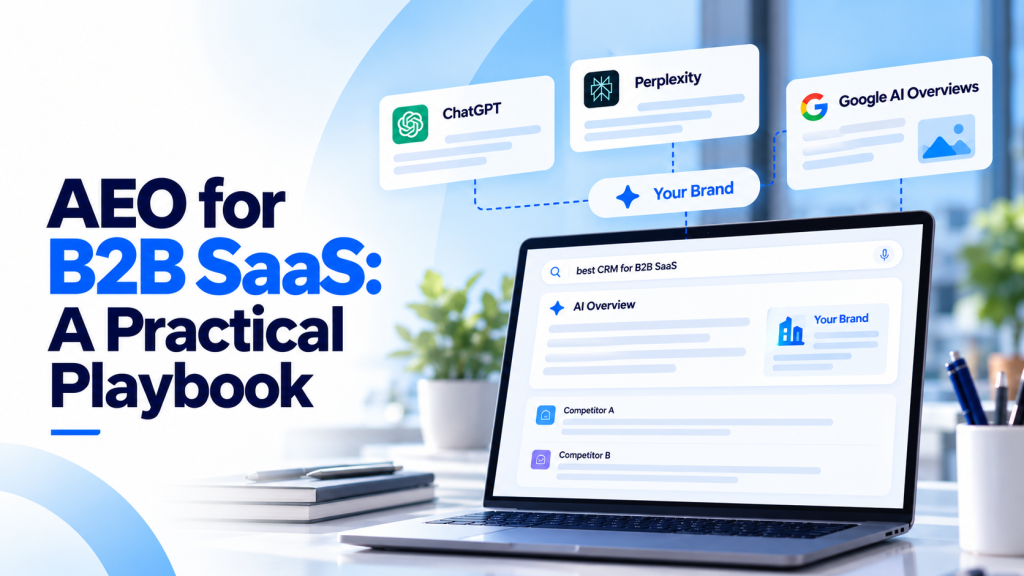
AEO for B2B SaaS helps software companies become more visible when potential buyers ask AI-powered search platforms for solutions, comparisons, and recommendations. It combines useful content, technical accessibility, clear product positioning, and credible third-party references. The goal is not simply to appear in AI-generated answers. It is to influence buying decisions and create more qualified sales opportunities.
For B2B SaaS companies, this introduces an important change in how demand is discovered.
A potential customer researching customer relationship management software might previously have searched Google for “best CRM for B2B sales teams.”
Today, that same buyer might ask ChatGPT:
“Which CRM platforms work best for a 50-person SaaS sales team using HubSpot for marketing and Salesforce for reporting?”
The second question reveals much more about the buyer.
It includes company context, team size, existing technology, integration requirements, and a specific business problem.
An AI platform can use those details to provide a shortlist of relevant solutions, explain the differences, and suggest what the buyer should evaluate next.
If your SaaS company is not represented accurately in that research process, it may miss an opportunity to enter the buyer’s consideration set.
This does not mean traditional search is disappearing. It means B2B SaaS marketing teams now need to think beyond rankings and website traffic.
They need to understand how their products are discovered, evaluated, compared, and recommended across different search experiences.
This practical playbook explains how to build that visibility, which activities deserve priority, and how to connect the work to revenue.
What Is AEO for B2B SaaS?
Answer Engine Optimization (AEO) for B2B SaaS is the process of making a software company’s content, product information, and expertise easier for answer engines to discover, understand, and reference when responding to potential buyers.
It applies to experiences such as Google AI Overviews, ChatGPT with search, Perplexity, Microsoft Copilot, and other AI-powered research tools.
Traditional SEO primarily helps a website become discoverable through search results.
AEO extends that work by making information useful within generated answers.
For example, consider a SaaS company selling contract management software.
A buyer might ask:
- What is the best contract management software for a mid-sized legal team?
- Which tools integrate with Salesforce and Microsoft 365?
- How do contract lifecycle management platforms compare?
- What should a growing company look for in contract management software?
- Which vendors support approval workflows and audit trails?
A company publishing only broad articles about contract management may struggle to answer these questions in enough detail.
A company with clearly documented features, integrations, limitations, security practices, implementation requirements, and comparisons provides more useful information for a buyer’s evaluation.
That is the foundation of effective AEO.
The objective is to become a credible source of information about the problems your software solves.
AEO vs. SEO vs. GEO: What Is the Difference?
These disciplines overlap, but they emphasise different aspects of search visibility.
| Approach | Primary focus | Example objective |
|---|---|---|
| SEO (Search Engine Optimization) | Organic search discoverability and rankings | Rank for “project management software for agencies” |
| AEO (Answer Engine Optimization) | Making information useful for direct answers | Help answer “Which project management tools support agency workflows?” |
| GEO (Generative Engine Optimization) | Visibility and representation in generative AI experiences | Earn relevant mentions or citations in AI-generated software comparisons |
| SaaS content marketing | Educating buyers and building trust throughout the buying journey | Help prospects understand their problem and evaluate solutions |
In practice, AEO and GEO are closely related.
Both rely on accessible information, accurate product descriptions, topical expertise, and credible supporting evidence.
Neither requires abandoning established SEO practices.
Google’s documentation explains that existing SEO fundamentals remain relevant to AI Overviews and AI Mode, with no separate technical requirements for appearing in these features.
For most SaaS companies, the most sensible strategy is to strengthen existing SEO foundations while improving how content answers specific buyer questions.
Why AEO Matters for B2B SaaS Companies in 2026
B2B software purchases rarely happen after a single search.
A buying committee may include marketing, sales, operations, IT, finance, procurement, and executive leadership.
Each stakeholder evaluates a product differently.
A CRO might ask which sales intelligence platform can improve pipeline coverage.
A RevOps leader might investigate CRM integrations and data quality.
An IT leader might research security, authentication, and implementation requirements.
A finance leader might compare total cost of ownership across vendors.
AI-powered research tools can help buyers explore these questions before they contact a sales representative.
Google continues to expand AI-powered search experiences, while Microsoft’s Bing Webmaster Tools now provides reporting on website citations across supported AI experiences.
For SaaS marketing leaders, three implications are particularly important.
1. Buyers Can Evaluate Software Before Visiting Your Website
AI-generated answers may summarise a vendor’s capabilities, use cases, and competitive positioning.
This means a potential customer can learn about several products without visiting every vendor’s website.
A company that communicates its capabilities poorly may be misunderstood or excluded from an answer.
Clear information about product functionality, ideal customers, pricing models, and integrations becomes increasingly valuable.
2. Specific Buyer Questions Create Opportunities
Broad searches such as “best sales software” attract many different types of buyers.
Specific questions reveal more useful context.
Consider:
“Which sales engagement software is suitable for a 30-person outbound team operating across the US and Europe?”
That question provides several useful signals:
- A defined team size
- A specific use case
- Geographic requirements
- Potential compliance considerations
- A likely software evaluation process
AEO gives SaaS companies an opportunity to create content around these detailed buying scenarios.
However, a detailed question is not proof that someone is ready to purchase. It is a useful indication of what that buyer is researching.
3. Brand Trust Extends Beyond Your Website
AI-generated answers can draw on information from vendor websites, independent publications, documentation, comparison platforms, and other accessible sources.
A SaaS company might describe itself as an enterprise-ready platform.
But buyers will still want evidence.
They may look for customer references, relevant integrations, security documentation, implementation guidance, and independent discussions.
Visibility becomes more valuable when the information surrounding a brand is consistent and credible.
The B2B SaaS AEO Playbook: 8 Practical Steps
AEO works best when treated as a structured business initiative rather than a collection of isolated content tasks.
The following eight-step framework is designed as an educational implementation model for SaaS marketing and revenue teams.
Step 1: Start With Your Ideal Customer Profile, Not Keywords
The first step in AEO for B2B SaaS is understanding who should discover your software and why.
Many SaaS SEO strategies begin with keyword volume.
A marketing team identifies a broad keyword, creates an article, and measures how much traffic it generates.
The problem is that search volume does not necessarily reflect commercial value.
A keyword attracting thousands of students, researchers, and early-stage learners may contribute less to pipeline than a smaller topic researched by qualified enterprise buyers.
Start with your ideal customer profile (ICP).
Define:
- Industry and company size
- Buyer roles and decision-making responsibilities
- Primary business challenges
- Relevant technology stack
- Geographic markets
- Buying triggers
- Common objections
- Factors that create purchase urgency
For example, a SaaS company selling customer support automation might target:
ICP: B2B technology companies with 100 to 500 employees.
Decision-makers: VP Customer Success, Head of Support, COO.
Problems: Rising ticket volume, slow response times, and inconsistent support quality.
Potential buying signals: Rapid hiring, international expansion, increasing customer volume, or changes to the existing support platform.
This information helps identify the questions your target buyers are likely to ask.
Instead of focusing only on “customer support automation software,” the company can address:
“How can a SaaS support team automate repetitive tickets without losing personalisation?”
That question connects the content to a real operational problem.
A buyer-first approach also helps teams understand the difference between general market interest and demand from accounts that match their ICP.
For a deeper look at that distinction, Growleads explains how buyer intelligence can reveal market demand.
Step 2: Map the Questions Buyers Ask at Every Stage
A successful AEO strategy should address questions throughout the SaaS buying journey.
Not every prospective customer is ready to compare vendors.
Some are trying to understand a problem. Others are evaluating technical requirements, preparing a business case, or choosing between shortlisted products.
Your content should reflect those differences.
Build a Buyer Question Map
| Buyer stage | Example question | Recommended content |
|---|---|---|
| Problem awareness | Why is our sales forecasting inaccurate? | Diagnostic guide |
| Solution exploration | How can revenue intelligence software improve forecasting? | Educational solution guide |
| Category evaluation | What should we look for in revenue intelligence software? | Buying checklist |
| Vendor comparison | How does Platform A compare with Platform B? | Transparent comparison |
| Technical validation | Does the platform integrate with Salesforce? | Integration documentation |
| Business justification | What is the potential ROI of implementing revenue intelligence software? | ROI framework or calculator |
| Purchase decision | How long does implementation take? | Implementation and onboarding guide |
This mapping process is more useful than creating unrelated blog posts around high-volume keywords.
It allows marketing teams to identify gaps in the information a potential buyer needs before making a decision.
Use Sales Conversations to Find Better Questions
Some of the most valuable content ideas are already available inside the business.
Review:
- Sales discovery call notes
- Demo questions
- Lost-deal reasons
- CRM opportunity records
- Customer onboarding questions
- Product support tickets
- Procurement and security questionnaires
For example, if prospects repeatedly ask whether your software supports multi-region data storage, that question deserves a clear, accurate answer.
It may belong in your product documentation, FAQ content, and enterprise buying guide.
The key is to document the questions buyers genuinely ask, rather than creating questions solely because they contain attractive keywords.
Step 3: Build Topic Clusters Around Product Capabilities
AEO requires more than publishing individual articles.
A SaaS company should provide connected information that explains the product category, customer problems, technical capabilities, and purchasing considerations.
A topic cluster helps organise this information.
Consider a SaaS platform offering sales forecasting software.
Example Topic Cluster
Primary topic: Sales forecasting software
Supporting topics:
- What is sales forecasting software?
- Sales forecasting methods for B2B SaaS companies
- Spreadsheet forecasting vs. automated forecasting
- How to evaluate forecasting accuracy
- Salesforce forecasting integrations
- Revenue forecasting for enterprise sales teams
- Common forecasting implementation challenges
- Sales forecasting software comparison criteria
- How forecasting software supports revenue planning
Each page should answer a distinct question.
The main category page explains the broader solution.
Supporting pages explore specific use cases, methodologies, integrations, and decision criteria.
Relevant links help readers move between related information.
Why Topic Depth Matters
A single article may explain what a product does.
A connected collection of useful pages can explain:
- Which problems the product solves
- How its capabilities work
- Which teams benefit
- What implementation involves
- Where limitations exist
- How buyers should compare alternatives
This creates a more complete information base for people researching the category.
It also makes it easier to maintain accurate product information across different stages of the buying journey.
However, publishing more pages is not automatically better.
Ten useful, distinct pages can provide more value than fifty articles repeating the same basic explanation.
Step 4: Make Every Important Page Answer a Specific Question
Effective SaaS content should answer the reader’s main question early and clearly.
A common problem with enterprise SaaS content is that important information is buried under long introductions.
A buyer searching for implementation requirements does not need several paragraphs explaining why digital transformation matters.
They need a useful answer.
Structure Content for Clarity
For important questions, use a simple four-part structure:
1. Direct answer
Answer the question in the first paragraph.
2. Explanation
Explain how the product, process, or concept works.
3. Business implications
Describe why the answer matters to the buyer.
4. Practical considerations
Cover requirements, limitations, alternatives, or next steps.
Consider a SaaS company publishing an article about CRM implementation timelines.
A weak opening might say:
“Businesses today operate in an increasingly competitive digital environment where choosing the right technology is essential.”
A more useful opening would say:
“CRM implementation timelines depend on company size, data quality, integrations, workflow complexity, and user training requirements. A small team using standard configurations may need considerably less time than an enterprise migrating multiple systems and custom processes.”
The second version answers the question immediately.
It also introduces the factors a buyer needs to evaluate.
Create Content That Reflects Real Product Knowledge
For B2B software, useful information may include:
- Supported integrations and configuration requirements
- Feature availability by subscription tier
- Technical prerequisites
- Security and compliance documentation
- Implementation dependencies
- Product limitations
- Onboarding responsibilities
- Common workflow examples
These details help buyers evaluate whether a solution fits their needs.
They also reduce ambiguity when information is summarised outside the original page.
Avoid Creating Content Only for AI Platforms
Do not fill pages with unnatural questions and repetitive answers.
Do not add unnecessary definitions to every paragraph.
Do not publish large volumes of generic AI-written content without reviewing accuracy.
Clear, original, useful information remains more important than formatting designed to impress a search system.
Step 5: Strengthen Technical Accessibility and Product Clarity
Strong content has limited value if search systems cannot access or interpret it reliably.
Technical SEO remains an important foundation for AEO.
A SaaS company should ensure that its public website can be discovered, crawled, and indexed where appropriate.
Technical Checklist for B2B SaaS Websites
| Area | What to check | Why it matters |
|---|---|---|
| Indexing | Important public pages are indexable | Supports discoverability |
| Crawlability | Relevant crawlers can access intended content | Helps eligible systems retrieve information |
| Site architecture | Product, solution, and documentation pages have logical navigation | Supports discovery and understanding |
| Canonical URLs | Duplicate pages have appropriate canonical signals | Reduces ambiguity |
| Structured data | Relevant schema accurately reflects visible content | Helps machines interpret supported page information |
| JavaScript rendering | Important content is accessible without unnecessary rendering barriers | Reduces retrieval problems |
| Page performance | Pages are responsive and reasonably fast | Improves usability and technical quality |
| Content freshness | Product descriptions reflect current capabilities | Reduces outdated information |
| Sitemaps | Important indexable URLs are included | Assists discovery |
Does Schema Markup Improve AI Visibility?
Structured data helps describe information in a machine-readable format.
Depending on the page, relevant types may include Organization, SoftwareApplication, Product, BreadcrumbList, and other supported schema types.
For example, valid software-related markup may help clarify a product’s name, category, and applicable attributes.
However, schema markup does not guarantee that a product will be recommended or cited by an AI platform.
Structured data should reflect genuine, visible information and follow the requirements of the relevant search platform.
Similarly, adding FAQ schema to every SaaS blog post does not create a special shortcut to AI visibility. Google’s traditional FAQ rich-result eligibility has been restricted to certain authoritative government and health websites.
Should SaaS Companies Allow AI Crawlers?
Crawler access should be evaluated according to the company’s business objectives, security requirements, and content policies.
Different crawlers may serve different purposes, including search discovery, retrieval, and model training.
Allowing one crawler does not necessarily allow every AI system to access or cite the website.
Marketing and technical teams should agree on which public information is intended to be discoverable.
Confidential customer data, private documentation, and restricted resources should remain protected.
Crawler configuration is an accessibility decision, not a guarantee of visibility.
Step 6: Build Credibility Beyond Your Own Website
AEO for B2B SaaS is not limited to publishing content on the company’s domain.
Potential buyers often validate software claims through independent sources.
They may review software directories, implementation partners, technical communities, industry publications, customer references, and expert discussions.
A SaaS company’s public information should be accurate and consistent across relevant sources.
Which Third-Party Sources Matter?
The answer depends on the product category and target buyer.
Potentially useful sources include:
Software review platforms: G2, Capterra, and category-specific directories where buyers compare relevant vendors.
Technical ecosystems: Integration marketplaces, developer documentation, and technology partner directories.
Industry publications: Relevant publications covering operational problems and software categories.
Customer evidence: Genuine case studies, implementation stories, and publicly approved customer references.
Professional communities: Expert discussions addressing real implementation and product questions.
These sources can help buyers evaluate the credibility of a company’s claims.
They may also provide information used in AI-assisted research, although inclusion and citation are not guaranteed.
Build Evidence, Not Just Mentions
Suppose a cybersecurity SaaS provider claims to help enterprise teams manage compliance requirements.
A generic promotional article repeating that claim adds little value.
A detailed explanation of the product’s supported controls, relevant integrations, security documentation, and implementation limitations gives buyers something more useful.
Third-party recognition is most valuable when it is accurate, independently meaningful, and relevant to the buyer.
This also explains why brands should not approach AEO as a simple exercise in purchasing mentions across websites.
The stronger long-term goal is to develop credible information that others have a genuine reason to reference.
For additional context, this article explores how B2B brands can become relevant in AI-generated recommendations.
Step 7: Connect AI Search Visibility With Demand Generation
AI visibility becomes commercially meaningful when it helps the right buyers discover and evaluate your product.
Being mentioned in a broad informational answer is different from appearing in a comparison that matches your ideal customer profile.
For example, consider two scenarios.
Scenario A: Your cybersecurity platform appears in an answer to “What is cybersecurity?”
Scenario B: Your platform appears in an answer to “Which cybersecurity compliance platforms support mid-market financial services companies using Microsoft Azure?”
Scenario B may be more commercially relevant because it reflects a defined use case and customer profile.
The exact business value still depends on whether the buyer is qualified, whether the product fits the requirement, and whether the interaction eventually leads to a sales opportunity.
Connect Visibility to the Revenue Funnel
Buyer research
Problem, comparison, and purchase-related questions
Relevant brand discovery
AI answers, citations, search results, and third-party references
Evaluation and trust
Documentation, comparisons, case studies, and product validation
Qualified sales engagement
Demo requests, consultations, and sales conversations
Pipeline and revenue
Opportunities, influenced pipeline, and closed business
This is a possible buyer journey, not a guaranteed conversion path.
Some buyers may discover a vendor through AI search and later visit its website directly.
Others may encounter the brand through LinkedIn, sales outreach, an industry event, or a colleague’s recommendation before conducting AI-assisted research.
That makes attribution more complicated.
A useful marketing measurement system should recognise these different touchpoints instead of assuming that every opportunity can be traced to a single source.
Combine Inbound Visibility With Buyer Intelligence
For SaaS companies, the strongest opportunity is often connecting educational content with a broader go-to-market strategy.
For example:
A company expanding its sales team may begin researching sales enablement platforms.
The same company may also be hiring revenue operations professionals, investing in new CRM infrastructure, or entering new markets.
These changes can indicate a potential future need.
Marketing teams can use relevant content to support buyer education, while sales teams use legitimate buying signals to prioritise outreach.
This is where the process of identifying qualified sales opportunities becomes especially important.
Instead of measuring content success by traffic alone, SaaS teams can evaluate whether visibility is helping attract accounts that fit their ICP.
Step 8: Measure AI Visibility Without Confusing It With Revenue
AEO measurement requires more than checking whether your company appears in an answer from ChatGPT.
AI-generated answers can change based on the prompt, platform, available sources, location, and other contextual factors.
One favourable answer does not establish consistent visibility.
Similarly, a missing mention does not prove that a strategy is failing.
The Four Layers of AEO Measurement
| Measurement layer | KPIs | What they tell you |
|---|---|---|
| Discoverability | Indexed pages, crawl health, organic impressions | Whether important content can be discovered |
| AI visibility | Relevant mentions, citations, cited URLs, category presence | Whether your brand or content appears in monitored answers |
| Engagement | Qualified visits, demo page engagement, conversions | Whether discovery leads to meaningful buyer activity |
| Revenue | Qualified meetings, opportunities, sourced or influenced pipeline | Whether marketing contributes to commercial outcomes |
Each layer serves a different purpose.
Track a Consistent Set of Buyer Questions
Create a list of prompts based on your ICP and the problems your software solves.
For example:
- Best sales forecasting software for mid-market SaaS companies
- Revenue intelligence platforms for Salesforce users
- Alternatives to manual sales forecasting
- Software for improving forecast accuracy
- Sales forecasting tools for enterprise RevOps teams
Track how your brand appears across selected AI platforms.
Document whether it is mentioned, whether an owned page is cited, whether product information is accurate, and which competitors appear.
Where possible, repeat the exercise consistently to identify directional changes.
Treat these results as a monitored sample rather than a complete measure of every buyer’s AI search experience.
Use Available Platform Reporting
Bing Webmaster Tools introduced an AI Performance report in 2026 that shows citation-related activity across supported Microsoft AI experiences.
It includes information such as cited pages, citation trends, and grounding queries.
These are useful diagnostic signals, but citation counts do not directly measure leads, rankings, or revenue.
Google Search Console, web analytics, CRM records, and first-party conversion data can provide additional context.
No single dashboard should be treated as a complete picture of AI-driven demand.
Measure Pipeline Influence Carefully
For B2B SaaS companies, the most important question is:
“Are more qualified buyers discovering, understanding, and considering our product?”
That question requires combining multiple signals.
Useful practices include:
- Asking prospects how they discovered the company
- Tracking AI-origin referral traffic where identifiable
- Monitoring conversions on relevant solution pages
- Reviewing brand search trends
- Connecting content engagement with CRM opportunities
- Analysing lead quality rather than only lead volume
Avoid assigning all resulting revenue to AI search without credible attribution evidence.
The purpose of measurement is to improve business decisions, not inflate a visibility report.
How to Prioritise AEO Opportunities for Your SaaS Business
Not every SaaS company has the resources to optimise every product page, integration, comparison, and blog topic immediately.
Prioritisation matters.
The following scoring system is an illustrative planning framework, not a validated ranking model.
The Buyer-Value Priority Score
Score each potential content opportunity from 1 to 5 across five criteria.
| Criteria | Question | Score |
|---|---|---|
| ICP relevance | Does the topic address a buyer we want to reach? | 1–5 |
| Buying intent | Does the question relate to evaluation or purchase? | 1–5 |
| Product fit | Can our product credibly solve the problem? | 1–5 |
| Evidence availability | Can we support the answer with accurate information? | 1–5 |
| Content gap | Is our current coverage incomplete or unclear? | 1–5 |
Add the five scores to create a total out of 25.
How to Interpret Your AEO Opportunity Score
| Total Score | Priority | Recommended Action |
|---|---|---|
| 21–25 | High | Prioritise this topic for content development. |
| 15–20 | Medium | Improve supporting evidence or positioning before investing. |
| 5–14 | Low | Reassess the topic’s relevance and business value. |
This framework helps marketing teams compare potential content investments.
High-scoring topics should still be reviewed for feasibility, available resources, and alignment with business priorities.
The strongest opportunities are usually those where buyer relevance, product fit, and credible supporting information overlap.
A Practical 90-Day AEO Implementation Roadmap
SaaS companies do not need to rebuild their entire website to begin improving AI search visibility.
A focused 90-day plan can establish the foundations, improve important content, and create an initial measurement process.
Days 1–30: Audit and Research
Objective: Understand current visibility and buyer information gaps.
Key activities:
- Define priority ICP segments and buyer roles.
- Collect real questions from sales and customer conversations.
- Identify important commercial and product-related pages.
- Audit technical accessibility and indexing.
- Review current visibility across selected AI search platforms.
- Identify missing or outdated product information.
- Build an initial list of high-priority content opportunities.
Deliverable: A baseline visibility report, buyer question map, and prioritised content backlog.
Days 31–60: Improve Content and Product Information
Objective: Make important SaaS information easier to discover and evaluate.
Key activities:
- Rewrite unclear solution and product pages.
- Add accurate integration and implementation information.
- Publish useful buying guides or comparison content.
- Strengthen relevant internal links.
- Fix material technical accessibility problems.
- Review structured data for accuracy.
- Identify legitimate industry and partner publication opportunities.
Deliverable: Improved commercial pages and a connected set of useful supporting content.
Days 61–90: Validate and Measure
Objective: Establish repeatable monitoring and refine priorities.
Key activities:
- Recheck selected buyer questions across AI platforms.
- Review citation and referral information where available.
- Measure engagement with improved pages.
- Compare qualified inbound enquiries with the baseline.
- Review product accuracy in monitored AI answers.
- Identify remaining gaps in buyer education.
- Plan the next content and authority-building cycle.
Deliverable: An initial performance review and the next 90-day action plan.
Ninety days is a reasonable period for an initial implementation and learning cycle.
It is not a promise that AI visibility, citations, or revenue will increase within that time.
Outcomes depend on the competitive environment, existing website quality, product differentiation, and the ability of external systems to discover and use the information.
Common AEO Mistakes B2B SaaS Companies Should Avoid
AEO can become inefficient when marketing teams focus on visibility tactics without connecting them to real buyer needs.
1. Publishing Generic Content at Scale
Producing hundreds of similar articles does not automatically build authority.
If the content lacks original examples, product knowledge, or useful decision criteria, it may add little value.
Focus on answering questions your company understands well.
2. Targeting Every Possible AI Prompt
A SaaS platform cannot be equally relevant to every software category and customer segment.
Trying to appear in unrelated recommendations can weaken positioning.
Prioritise the questions that match your ICP and genuine product capabilities.
3. Confusing Mentions With Qualified Demand
An AI mention can indicate visibility.
It does not prove that a buyer is interested or that an opportunity has been generated.
Track relevant discovery alongside engagement and pipeline.
4. Ignoring Product Documentation
Marketing articles may describe broad benefits, but buyers also need operational information.
Incomplete integration documentation, outdated features, and unclear limitations make software evaluation harder.
Product, marketing, and technical teams should work together to keep important information accurate.
5. Treating AEO as a Replacement for SEO
Technical SEO, useful content, information architecture, and search accessibility remain important.
AEO should extend those foundations rather than replace them.
6. Expecting Guaranteed AI Recommendations
AI platforms control how they retrieve information, select sources, and generate answers.
No agency or marketing team can guarantee consistent recommendations across all platforms and prompts.
Be cautious of providers promising fixed rankings or guaranteed mentions in AI-generated responses.
7. Ignoring the Broader Buyer Journey
An AI answer may introduce a software company to a buyer.
The buyer still needs evidence that the product is suitable.
Clear positioning, useful documentation, trustworthy customer information, and a strong sales experience all matter.
AEO should support the buying process, not operate separately from it.
Should You Manage AEO In-House or Work With a SaaS SEO Agency?
The right delivery model depends on your internal expertise, content resources, technical requirements, and commercial priorities.
For some SaaS companies, an internal team can manage the work effectively.
Others may benefit from specialist support.
| Evaluation factor | In-house team | External specialist |
|---|---|---|
| Product knowledge | Usually stronger direct access | Requires onboarding and collaboration |
| Technical expertise | Depends on internal capabilities | May provide specialised support |
| Content production | Controlled internally | Can expand execution capacity |
| Speed of implementation | Depends on team bandwidth | Depends on scope and available resources |
| Long-term knowledge retention | Stays within the company | Requires documentation and knowledge transfer |
| Cost structure | Salaries, tools, and internal resources | Fees, tools, and agreed deliverables |
| GTM alignment | Can work closely with revenue teams | Requires regular coordination |
A B2B SaaS SEO agency should be evaluated on more than keyword rankings.
The agency should understand the software buying journey, enterprise decision-making, product differentiation, and revenue measurement.
Before engaging a provider, ask:
- How will you identify our highest-value buyer questions?
- How will you validate technical product information?
- What role does our internal team need to play?
- How will you distinguish relevant mentions from general visibility?
- What technical SEO work is included?
- How will you measure qualified demand?
- What deliverables will we own?
- How will you report progress without promising outcomes you cannot control?
A SaaS SEO agency that understands both search visibility and revenue operations may be better suited to a growth-stage company than a provider focused primarily on content volume.
For enterprise SaaS SEO, the requirements are often broader.
Multiple products, regional websites, complex integrations, security reviews, and distributed marketing teams introduce coordination challenges.
Clear responsibilities and measurable deliverables become particularly important.
How AEO Fits Into a Broader B2B SaaS Growth Strategy
AEO is one part of demand generation.
It helps buyers discover information when they are researching problems, evaluating solutions, or comparing vendors.
Other channels serve different purposes.
Google Ads can reach buyers making relevant searches.
LinkedIn can support professional visibility, founder authority, and targeted engagement.
Outbound campaigns can start conversations with accounts that fit a defined ICP.
Product marketing helps explain the software’s value, while sales development qualifies potential opportunities.
These activities can reinforce one another.
For example, a SaaS company might publish a detailed guide explaining how to reduce customer onboarding time.
That guide could support relevant organic searches and AI-assisted research.
The company could then use the same insights in founder-led educational content and relevant sales conversations.
A prospect who encounters the business through several channels may develop a stronger understanding of the product before requesting a demo.
This is why demand generation built around revenue goals matters more than simply increasing activity across channels.
At Growleads, this connection between buyer understanding and pipeline development is central to how demand intelligence is approached.
The work starts with identifying ideal customers, their problems, and relevant buying signals. Search visibility, content, and outreach can then support a coordinated go-to-market strategy.
For SaaS companies exploring this area, AI search visibility and answer engine services should be evaluated in the context of broader growth priorities, rather than treated as an isolated marketing experiment.
The objective is to help the right buyers discover a credible solution and make it easier for qualified opportunities to progress.
Frequently Asked Questions About AEO for B2B SaaS
1. Is AEO necessary for B2B SaaS companies that already rank well on Google?
AEO is worth evaluating even if your SaaS company already performs well in traditional search. Strong SEO provides a useful foundation, but AI-powered research can present information differently. Review whether your most important product information is accurate, accessible, and useful for the questions your buyers ask.
2. How long does AEO take to show results for SaaS companies?
AEO has no reliable universal results timeline. Content and technical improvements may be implemented within weeks, but meaningful changes in discoverability and citations can take longer and vary by platform. SaaS teams should establish baseline measurements and assess progress over several review cycles.
3. Can a new SaaS company compete with established brands in AI search?
A newer SaaS company can compete for relevant discovery opportunities by demonstrating clear expertise in a specific use case or market segment. However, established competitors may have stronger brand recognition and third-party evidence. New companies should focus on differentiated product knowledge, accurate documentation, and credible sources rather than attempting to cover every broad software category.
4. Does structured data guarantee visibility in ChatGPT or Google AI Overviews?
No. Structured data can help eligible systems interpret information, but it does not guarantee citations, mentions, or inclusion in AI-generated answers. Accurate, accessible content and technical search fundamentals remain important.
5. What is the difference between AEO and SaaS content marketing?
AEO focuses on making information useful and discoverable in answer-driven search experiences. SaaS content marketing covers the broader process of educating, engaging, and building relationships with potential customers. A strong content marketing programme can support AEO when it addresses genuine buyer questions with credible information.
6. Should B2B SaaS companies optimise for ChatGPT, Gemini, and Perplexity separately?
B2B SaaS companies should maintain a strong shared foundation of accurate product information, useful content, and technical accessibility. Different platforms may retrieve and present information differently, so monitoring them separately can identify meaningful gaps. Creating entirely different content strategies for every platform is usually unnecessary.
7. How do you measure the ROI of AEO for B2B SaaS?
Measure AEO using a combination of relevant AI visibility, identifiable referral traffic, qualified enquiries, sales opportunities, and credible pipeline attribution. Citation counts alone are insufficient. CRM records, self-reported attribution, and conversion data can help identify whether AI-assisted discovery contributes to revenue.
8. Do SaaS companies need a specialist agency for AEO?
A specialist agency is not always necessary. SaaS companies with strong internal SEO, product marketing, technical, and analytics capabilities may manage AEO themselves. External support can be valuable when the company lacks resources or needs specialist expertise, but the partner should understand buyer intent, product positioning, and pipeline measurement.
Conclusion: Build Visibility Around the Buyers You Want to Reach
AEO for B2B SaaS is not about appearing in every AI-generated answer.
It is about making your software easier for relevant buyers to discover, understand, evaluate, and trust.
The practical starting point is to identify your ideal customers and the questions they ask before purchasing.
Then improve the information that helps them make decisions.
Focus on clear product positioning, useful content, accurate technical documentation, credible external references, and consistent measurement.
Most importantly, connect visibility to commercial outcomes.
A SaaS business does not grow simply because its brand appears in more answers. Growth depends on whether the right buyers recognise the value of the product and move toward a qualified sales conversation.
For SaaS companies reviewing their next growth priorities, Growleads can help assess how buyer intelligence, inbound visibility, and go-to-market execution fit together.
Start with the questions your best customers are already asking. Build the answers they need, and make qualified pipeline the measure of success.

Builds the demand intelligence, automation, and deliverability systems behind Growleads pipeline.