
Fake Leads vs Qualified Sales Opportunities: What B2B Teams Need to Know
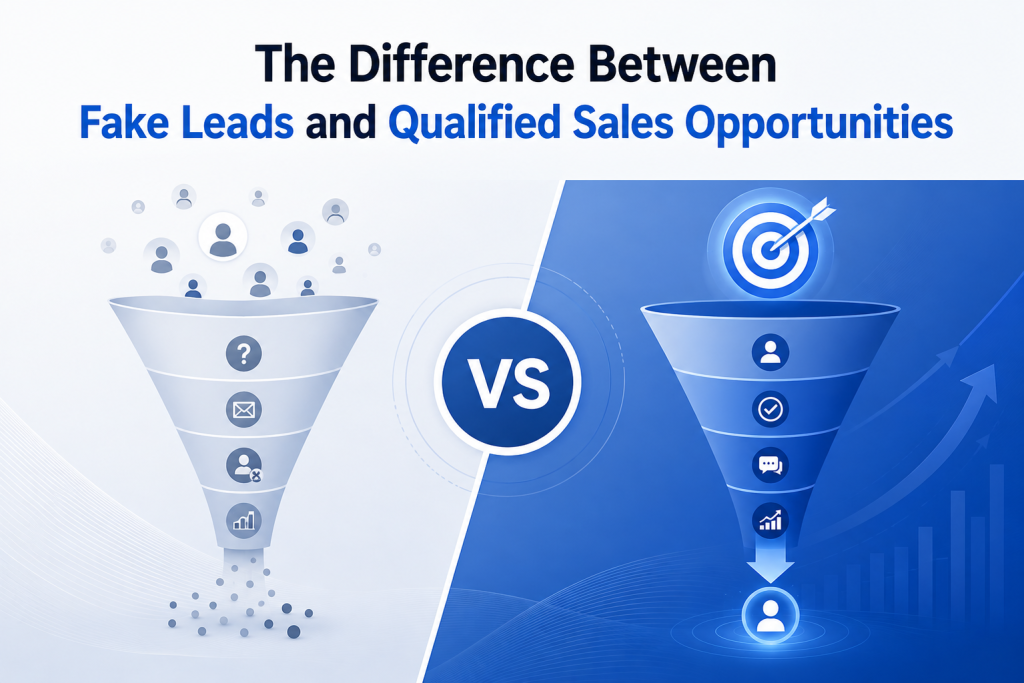
A fake lead is not the same as a qualified sales opportunity. A fake lead may contain invalid, fabricated, duplicate or misleading information, while a qualified sales opportunity is a real buyer or account with verified fit, a genuine business problem, sufficient buying intent and a credible path toward a commercial decision. The difference matters because pipeline quality determines where sales time is spent.
For B2B teams, the goal should not be the largest possible database. It should be a pipeline in which sales can quickly see who is worth pursuing, why the account may buy and what should happen next.
Key Takeaways
- A lead is only the start of the process. It is not automatically an opportunity.
- Fake leads and low-quality leads are different problems.
- MQLs, SQLs and qualified sales opportunities represent different levels of readiness.
- Strong qualification combines ICP fit, buyer signals, need, stakeholder relevance, timing and verified engagement.
- Lead volume matters only when it produces qualified meetings, opportunities and revenue potential.
- Sales and marketing need one shared definition of what qualifies for active pipeline.
What Are Qualified Sales Opportunities?
Qualified sales opportunities are real prospects or accounts that have moved beyond basic lead status and meet the criteria a sales team requires before treating a potential deal as active pipeline.
A credible opportunity usually has several things in common:
- The person and company are real.
- The account fits the ideal customer profile.
- There is a relevant business problem or goal.
- The contact has authority, influence or access to the buying group.
- There is evidence of genuine interest or buying intent.
- The potential timing is compatible with the sales process.
- There is a clear next commercial step.
That last point matters. Someone may like your content, accept a LinkedIn request or reply positively to an email without being an active opportunity.
Salesforce describes an opportunity as a qualified lead that has progressed through initial evaluation and is considered a viable business deal, typically with details such as sales stage, expected revenue and close timing.
Fake Leads vs Qualified Sales Opportunities
| Factor | Fake or Invalid Lead | Qualified Sales Opportunity |
|---|---|---|
| Identity | Invalid, fabricated, duplicate or unverifiable | Real person and company |
| ICP fit | Unknown or irrelevant | Matches agreed account criteria |
| Need | No confirmed business problem | Relevant problem or objective exists |
| Stakeholder | False, unclear or unrelated role | Decision-maker, influencer or champion |
| Intent | No meaningful evidence | Clear engagement or buying signal |
| Timing | Unknown | Buying window discussed or estimated |
| Sales action | Disqualify, suppress or investigate | Continue discovery and advance |
| Pipeline value | Creates noise | Represents credible revenue potential |
A row in a CRM is not a sales opportunity. A contact becomes valuable when the information behind the record gives sales a reason to invest time.
Fake Leads Are Not the Same as Bad Leads
A fake lead is fundamentally invalid. The identity, contact details, company information or engagement may be fabricated, automated, duplicated or otherwise unreliable.
A bad lead can be completely real but still be unsuitable. For example, a genuine company may be too small, a real manager may have no influence over the purchase, or an interested buyer may need something your company does not provide.
This distinction matters because the causes are different.
Fake leads point toward data quality, fraud, source quality or verification issues. Poor-fit leads point toward targeting, ICP definition, messaging or qualification issues.
Calling every poor-fit lead “fake” prevents the team from fixing the actual problem.
MQL vs SQL vs Sales Opportunity
MQL, SQL and opportunity should represent increasingly stronger evidence that a prospect deserves sales attention.
HubSpot’s current lifecycle model separates Marketing Qualified Lead, Sales Qualified Lead and Opportunity. It defines an SQL as a contact or company sales has qualified as a potential customer, while an Opportunity is associated with a deal. HubSpot also allows lifecycle stages to be customized, so every company still needs its own written definitions.
| Stage | Practical Meaning | Typical Evidence | Primary Owner |
|---|---|---|---|
| Lead | Identifiable person or account | Contact captured or sourced | Marketing or SDR |
| MQL | Marketing sees fit or engagement | ICP fit, content activity, intent signal | Marketing |
| SQL | Sales accepts the lead as worth pursuing | Verified fit, stronger intent, relevant conversation | SDR or Sales |
| Qualified Sales Opportunity | A viable potential deal exists | Need, stakeholder access, buying context, next step | Sales |
| Customer | Commercial agreement is won | Closed-won deal | Sales and Customer Success |
HubSpot’s updated MQL vs SQL guidance describes sales readiness as the core distinction: an MQL may still need nurturing, while an SQL is ready for direct sales engagement. Salesforce similarly describes SQLs as leads sales has qualified as worth pursuing based on criteria such as need, budget and authority.
An SQL does not always need to become an opportunity immediately. In complex B2B sales, discovery may still need to confirm the problem, buying committee, urgency or commercial viability.
Why Fake and Poor-Quality Leads Damage the B2B Sales Pipeline
Sales time goes to the wrong accounts
Every fake, duplicate or irrelevant record creates research, outreach, follow-up and CRM work.
The larger cost is opportunity cost. Time spent chasing weak records is time not spent on real buying conversations.
Marketing metrics become misleading
A campaign can generate a large lead count and still create little commercial value.
The stronger questions are:
- How many leads matched the ICP?
- How many were verified?
- How many were accepted by sales?
- How many became qualified opportunities?
- Which sources created the best pipeline?
Fewer leads can still mean a better campaign.
Sales and marketing stop trusting each other
Marketing can say it delivered the agreed number. Sales can say the leads were unusable. Both teams can be technically correct when they never agreed on what “qualified” meant.
The organization should define qualification before it defines volume targets.
Forecasting becomes unreliable
If weak leads are turned into deals too early, pipeline value becomes inflated. Opportunity stages only help forecasting when they represent a reasonably consistent level of qualification.
A Six-Part Framework for Qualifying B2B Opportunities
The following framework is an educational model, not a proprietary Growleads methodology.
1. Identity
Verify that the person, company and contact information are real. Review the business email, company domain, role, duplicate records and obvious source anomalies.
Salesforce’s lead-scoring guidance explicitly treats spam, junk and fake form information as data that should be filtered or negatively scored.
2. ICP Fit
Check whether the account is commercially relevant based on criteria such as industry, geography, employee count, revenue, use case, technology environment and contract-value potential.
Strong interest does not compensate for a poor business fit.
3. Problem or Need
A qualified opportunity should connect to a real business problem, objective or change.
The need does not have to be fully quantified during the first conversation, but there should be a credible reason the buyer may act.
4. Stakeholder Relevance
The first contact does not always need to be the final signer.
A decision-maker, budget owner, evaluator, operational stakeholder or internal champion can all be useful if the relationship can move the deal toward the buying group.
5. Buying Intent
Useful signals include demo requests, pricing questions, vendor comparisons, implementation questions, relevant outbound replies and discussions about a current project.
No single signal should automatically qualify every lead. Intent needs context.
6. Timing and Next Step
A viable opportunity should have a logical next action, such as discovery, technical evaluation, a demo, proposal, pilot or discussion with another stakeholder.
“Interested, follow up sometime” is not the same as active pipeline.
Simple Opportunity Scorecard
| Criterion | 0 Points | 1 Point | 2 Points |
|---|---|---|---|
| Identity | Unverified | Mostly verified | Fully verified |
| ICP Fit | Poor | Partial | Strong |
| Need | None found | Possible | Clear |
| Stakeholder | Irrelevant | Influencer | Decision-maker or champion |
| Intent | Passive | Some engagement | Active buying signal |
| Next Step | None | Unclear | Defined |
A scorecard should support judgment, not replace it. Strategic accounts may deserve continued work even when one criterion is incomplete.
How to Detect Fake Leads Before Sales Gets Them
Validate the contact and company
Check whether the email, company domain, role and employer are plausible. For higher-value deals, a quick account review can catch mismatches that basic automation misses.
Email verification is useful, but it proves data usability, not buying intent.
Remove duplicates and recycled records
Duplicate contacts can inflate lead counts and waste sales time. Your CRM should identify repeated emails, domains, contacts and account records before they are counted as new demand.
Watch source-level quality
If one publisher, form, database or campaign produces a high share of invalid records, investigate the source rather than reviewing every lead as an isolated problem.
Track lead source through SQL and opportunity creation.
Add negative qualification signals
Consider negative rules for personal email domains where business email is required, unsupported geographies, students, competitors, companies below your commercial threshold, duplicate submissions and obvious bot-like behavior.
Verify through conversation
For outbound and appointment-setting programs, the conversation itself often reveals the strongest qualification data.
A useful exchange should gradually answer:
- What prompted the interest?
- What problem exists?
- Who owns the initiative?
- What has already been tried?
- What is a sensible next step?
That is why a booked meeting is not automatically a qualified sales opportunity.
How to Generate More Qualified Sales Opportunities
Define the ICP before choosing volume
Do not start with “How many emails can we send?” or “How many leads can we buy?”
Start with which accounts are commercially valuable, which roles experience the problem, what triggers make timing relevant and what should disqualify an account.
If your team is evaluating qualified lead generation services, the important question is not only how many contacts will be delivered. It is how targeting and qualification connect to pipeline.
Add buyer signals to firmographic targeting
Industry, geography and company size tell you who could buy. Buyer signals help explain who may have a reason to buy now.
Signals can include funding, hiring, expansion, leadership changes, technology changes or strategic initiatives. They are prioritization inputs, not proof of demand.
Match channels to the buyer
Different audiences respond differently to email, LinkedIn, paid search, paid social, events and referrals.
Strong outbound lead generation services should therefore combine ICP selection, signal research, messaging, channel choice and qualification rather than treating outreach volume as the strategy.
If you are assessing a cold email lead generation agency, ask how it handles list quality, deliverability, reply qualification and handoff, not only how many emails it can send.
Agree on a sales-acceptance definition
Document:
- ICP requirements
- Required contact information
- Intent threshold
- Qualification questions
- Disqualification reasons
- Rules for opportunity creation
- Ownership at each stage
- Follow-up SLA
If qualification lives only in individual sales reps’ heads, reporting will never be consistent.
Feed sales outcomes back into targeting
Review which industries create real opportunities, which titles become champions, which signals correlate with meetings, which sources produce SQLs but few opportunities and why deals are disqualified.
The goal is not a perfect lead score. The goal is a system that learns from pipeline outcomes.
Growleads approaches this as a buyer-first Demand Intelligence problem, with ICP, buyer signals, qualification and pipeline outcomes taking priority over vanity metrics.
What Metrics Should B2B Teams Track?
A useful dashboard should show both volume and quality.
| Metric | What It Tells You |
|---|---|
| Total leads | Top-of-funnel volume |
| Verified lead rate | Data validity |
| ICP-fit rate | Targeting quality |
| MQL-to-SQL rate | Sales acceptance and readiness |
| SQL-to-opportunity rate | Whether accepted leads become real deals |
| Opportunity-to-close rate | Sales conversion quality |
| Pipeline value | Commercial value created |
| Disqualification reasons | Why leads fail |
| Pipeline by source | Which channels create viable deals |
The right emphasis depends on the business model. High-value B2B sales may care far more about opportunity quality and stakeholder access than weekly lead count.
Common Mistakes That Create Low-Quality Pipeline
Paying for volume without defining quality. “100 leads” means little without an ICP, verification standard and qualification definition.
Treating every positive reply as qualified. A reply can signal curiosity without proving a viable deal.
Confusing activity with intent. Opens, clicks, downloads and profile views can help prioritize contacts, but they do not automatically mean someone wants to buy.
Using only demographic fit. The right title at the right company can still have no relevant project.
Ignoring disqualification data. If reason codes are not recorded, teams repeatedly target the same poor-fit segments.
Optimizing SDRs or agencies for meetings alone. Meeting volume is easy to inflate when qualification standards are weak. Measure how many meetings are accepted and become opportunities.
Letting every rep define “qualified” differently. Judgment is necessary, but the minimum standard should be shared.
Conclusion
The difference between fake leads and qualified sales opportunities is the difference between having names in a system and having credible potential deals.
B2B teams should verify identity, define the ICP, use relevant buyer signals, confirm a real problem, understand stakeholder relevance and require a meaningful next step before treating a lead as active pipeline.
The practical decision is to stop optimizing demand generation around lead count alone. Measure how many real prospects become sales-accepted leads, qualified sales opportunities and commercially meaningful pipeline.
If your funnel produces plenty of activity but too few real opportunities, Growleads can help review the ICP, buyer signals, outreach and qualification process to identify where quality is being lost.
Frequently Asked Questions
What is a qualified sales opportunity?
A qualified sales opportunity is a verified prospect or account that meets your sales team’s agreed criteria for a viable potential deal. It normally combines ICP fit, a relevant business need, stakeholder access, buying intent and a credible next step.
What is the difference between a qualified lead and a sales qualified lead?
A qualified lead is a broad term for a lead that meets defined fit or interest criteria. A sales qualified lead, or SQL, has specifically been accepted or qualified by sales for direct engagement.
What is the difference between MQL and SQL?
An MQL has met marketing’s qualification threshold, while an SQL has met the sales team’s threshold for direct pursuit. The most important difference is usually sales readiness, not simply the number of marketing interactions.
Is every SQL a qualified sales opportunity?
No. An SQL can be worth a sales conversation without yet meeting the company’s standard for an active opportunity. Many B2B teams create an opportunity only after discovery confirms a real problem, stakeholder relevance and a credible buying process.
How can you tell if a B2B lead is fake?
Verify the identity, email, company, role and source, then check duplicates and suspicious submission patterns. Fake or junk records should be filtered, while legitimate but poor-fit contacts should be disqualified for fit rather than labelled fake.
What questions should sales ask before accepting a lead?
Sales should establish the buyer’s problem, why it matters now, who is involved in the decision, whether the account fits the commercial model and what the next step should be. Budget and timing may also matter depending on the sales cycle.
Should B2B companies measure leads or opportunities?
B2B companies should measure both, but opportunities are closer to commercial value. Lead volume diagnoses the top of the funnel, while opportunity creation, pipeline value and conversion show whether demand is becoming revenue potential.
Can outbound leads become high-quality sales opportunities?
Yes. Outbound can create strong opportunities when targeting is specific, data is accurate, messaging is relevant and qualification is disciplined. The channel does not determine quality by itself.

Builds the demand intelligence, automation, and deliverability systems behind Growleads pipeline.