
How to Build Qualified Pipeline Growth with Managed IT Services
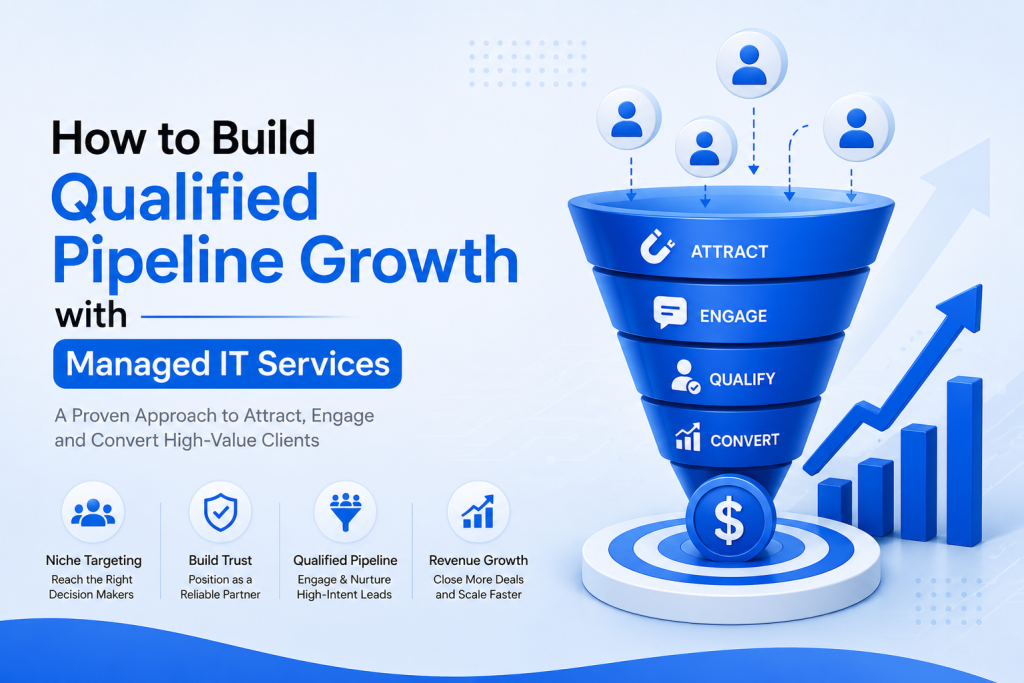
Quick answer: Qualified pipeline growth for managed IT services starts with targeting the right businesses, understanding their IT maturity, and qualifying prospects before they reach the sales team. Managed service providers (MSPs) can improve pipeline quality by defining a clear ideal customer profile (ICP), focusing messaging on business outcomes, using targeted demand generation, and tracking metrics that connect sales activity to revenue.
For mid-market IT services firms, generating leads is rarely the biggest challenge. Generating the right leads is.
Demand for outsourced technology support continues to grow, but many managed service providers still struggle to build a predictable pipeline of qualified opportunities. Marketing teams generate interest, sales teams follow up, and deals often stall because the prospect was never a strong fit for the managed services model.
The problem is usually not a lack of demand for IT support. It is a lack of clear qualification criteria based on how managed IT services are actually sold, implemented, and delivered.
Firms like Diamond IT have shown that regional expertise combined with a disciplined go-to-market approach can turn scattered inbound interest into a pipeline of businesses that are genuinely ready to buy. Qualified pipeline growth isn’t about volume — it’s about matching the right service model to the right operational maturity level, at the right moment in a prospect’s technology lifecycle.
What Are Managed IT Services?
Managed IT services allow businesses to outsource some or all of their ongoing technology management to a specialized provider.
Depending on the provider and service agreement, this can include:
- Network monitoring
- Cybersecurity
- Endpoint management
- Cloud infrastructure
- Help desk support
- Data backup and recovery
- Software management
- IT strategy
- Compliance support
However, businesses rarely purchase managed IT services simply because they want someone to manage servers or devices.
They are usually looking for broader business outcomes.
These may include reducing operational risk, improving uptime, controlling IT costs, strengthening security, and giving internal teams more time to focus on core business priorities.
What Managed IT Services Really Solve Beyond Technology
On the surface, managed IT services appear to be a technical purchase.
A provider may patch servers, monitor networks, secure endpoints, manage cloud systems, and resolve support tickets.
For the buyer, however, the value is often much broader.
A CFO may care more about predictable IT spending, compliance exposure, and financial risk than the technical details of endpoint detection software.
An operations director may care about uptime because technology disruptions can affect productivity and revenue.
A founder or general manager may simply want technology issues to stop distracting the team from running the business.
Understanding these motivations is important because they influence how MSP lead generation and sales messaging should work.
Focus on Business Outcomes, Not Only Technical Features
Sales and marketing teams that lead primarily with technical specifications can attract prospects who are comparing features and prices.
Instead, messaging should connect technical capabilities to measurable business outcomes.
Examples include:
- Reduced downtime
- Predictable IT costs
- Faster employee onboarding
- Improved cybersecurity
- Better compliance readiness
- Faster issue resolution
- Reduced pressure on internal teams
This approach helps prospects understand why managed IT services matter to the business, not just what technology is included.
It can also improve lead quality before a sales conversation begins.
How Managed IT Services Create Qualified Pipeline Growth
Qualified pipeline growth happens when marketing and sales agree on exactly what a good customer looks like.
Instead of targeting every company that may need IT support, managed service providers should build a clearly defined ideal customer profile (ICP).
An effective MSP ICP can include:
- Company size: Employee count, locations, and technology users can affect service complexity and pricing.
- Industry: Different industries have different technology, security, and compliance requirements.
- Compliance requirements: Frameworks such as HIPAA, PCI DSS, and CMMC can significantly influence IT requirements.
- Existing IT maturity: A company without an internal IT department requires a different sales approach from a company replacing an existing MSP.
- Technology environment: Existing infrastructure, cloud adoption, security requirements, and software environments can affect fit.
- Business needs: Growth, security concerns, recurring IT problems, compliance pressure, and internal resource constraints can create buying intent.
For example, a 40-person healthcare practice with HIPAA obligations has very different needs from a 200-person manufacturing company concerned about operational technology security.
Using the same outreach message for both audiences reduces relevance.
Segmentation allows MSPs to create messaging based on the specific problems, risks, and outcomes that matter to each buyer.
Use Buyer Signals to Find Better MSP Prospects
Firmographic data tells an MSP whether a company fits its target market.
Buyer signals can help identify when that company may be more likely to need support.
Useful signals may include:
- Rapid hiring
- Opening a new office
- Expanding into new markets
- Leadership changes
- New compliance requirements
- Technology migrations
- Cybersecurity incidents
- Cloud adoption
- Business acquisitions
- Changes in internal IT leadership
These signals can help sales teams prioritize accounts instead of contacting every company in the market with the same message.
The goal is not simply to generate more outreach.
The goal is to create more relevant conversations with businesses that have a realistic reason to evaluate managed IT services.
Use Content to Pre-Qualify Prospects Before Sales
Content can play an important role in MSP pipeline qualification.
Instead of using content only to generate website traffic, providers can create resources that help prospects understand whether a managed service is right for them.
Useful content includes:
- Case studies with measurable business outcomes
- IT maturity assessments
- Cybersecurity checklists
- Service comparison pages
- Pricing and service explainers
- Industry-specific IT guides
- Compliance resources
- Migration guides
- Frequently asked questions
For example, an IT maturity assessment can help a prospect identify weaknesses in its current technology environment before speaking with sales.
Case studies can show what type of businesses the MSP works with and what outcomes those businesses achieved.
This allows potential buyers to self-qualify before entering the sales process.
The same principle applies across B2B demand generation. Growleads’ services combine ICP development, buyer-focused targeting, multi-channel outreach, and lead qualification to focus on qualified meetings and pipeline rather than raw lead volume.
Combine Inbound and Outbound Lead Generation
Relying on a single acquisition channel can make pipeline growth unpredictable.
Managed IT providers can build a stronger demand generation system by combining inbound and outbound channels.
Inbound Lead Generation
Inbound strategies help businesses discover an MSP while actively researching a problem or solution.
Common inbound channels include:
- Search engine optimization
- Educational content
- Google Ads
- Case studies
- Local SEO
- Industry guides
- Comparison pages
- Referral traffic
Outbound Lead Generation
Outbound strategies allow MSPs to proactively reach businesses that match their ICP.
Common outbound channels include:
- Cold email
- LinkedIn outreach
- Account-based campaigns
- Targeted advertising
- Sales prospecting
- Buyer signal-based outreach
A layered approach can help MSPs reach buyers at different stages of the buying journey.
Some prospects are already searching for managed IT services.
Others fit the ideal customer profile but have not started actively researching providers.
A combination of inbound and outbound demand generation can address both groups.
Key Metrics for Managed IT Services Pipeline Growth
Lead volume alone does not show whether an MSP pipeline is healthy.
Teams should track metrics that indicate lead quality, sales efficiency, and revenue potential.
Important metrics include:
- Qualified meetings
- Sales opportunities
- Lead-to-opportunity conversion rate
- Opportunity-to-customer conversion rate
- Average sales cycle
- Customer acquisition cost
- Average contract value
- Pipeline value
- Customer retention
- Revenue generated by lead source
- Time-to-value
1. Time-to-Value
Time-to-value measures how quickly a new customer experiences a meaningful benefit after onboarding.
Examples might include:
- Fewer support issues
- Faster device provisioning
- Improved system visibility
- A resolved security vulnerability
- Better backup coverage
- Improved response times
Reducing time-to-value can help demonstrate that the provider is delivering on the expectations established during the sales process.
2. Revenue Impact
Pipeline measurement should eventually connect marketing and sales activity to revenue.
Instead of asking only how many leads a campaign generated, MSPs should also ask:
- How many became qualified opportunities?
- How many resulted in sales conversations?
- How many became customers?
- What was the average contract value?
- Which ICP segments produced the strongest opportunities?
- Which acquisition channels influenced the most pipeline?
These questions give sales and marketing teams a clearer view of which activities contribute to business growth.
Managed IT Services Market Demand
Demand for technology expertise remains significant.
According to the U.S. Bureau of Labor Statistics, employment in computer and information technology occupations is projected to grow much faster than the average for all occupations between 2024 and 2034. The BLS projects approximately 317,700 openings each year during that period.
Market research also points to continued growth in managed services.
Grand View Research projects that the global managed services market will grow from approximately $437.3 billion in 2026 to $847.4 billion by 2033, representing a compound annual growth rate of 9.9%.
For managed IT providers, this creates opportunity but also competition.
A growing market does not automatically create qualified pipeline. Providers still need clear positioning, focused targeting, relevant messaging, and a structured qualification process.
How to Build an ICP for Managed IT Services
A managed IT services ICP should be built around the customers a provider can serve successfully.
Start with delivery capacity rather than creating a broad list of companies that could theoretically purchase IT services.
For example, imagine an MSP performs particularly well with professional services businesses that have:
- 50 to 150 employees
- Multiple locations
- Moderate compliance requirements
- Limited internal IT resources
- Cloud-based infrastructure
- Recurring cybersecurity needs
That profile provides sales and marketing teams with much more direction than simply targeting businesses with 10 to 1,000 employees.
Build the ICP Around Real Customer Data
MSPs can review their strongest existing customers and look for common characteristics.
Consider:
- Which customers are most profitable?
- Which customers stay the longest?
- Which customers are easiest to support?
- Which industries experience the most value?
- Which customers expand their contracts?
- Which customers refer new business?
These patterns can help define the operational sweet spot for future targeting.
Strong Qualification Also Means Fast Disqualification
Not every interested prospect should become a sales opportunity.
A company may fall outside the provider’s core capabilities because of its:
- Industry
- Size
- Location
- Technology environment
- Compliance requirements
- Budget
- Service expectations
Identifying these mismatches early protects sales time and helps prevent poor-fit engagements.
A smaller pipeline containing qualified opportunities can be more valuable than a large pipeline filled with businesses unlikely to close.
The Role of Predictable Recurring Revenue in MSP Sales
One of the key characteristics of managed IT services is the recurring revenue model.
Buyers often compare the predictability of a monthly managed services agreement with the uncertainty of ad hoc break-fix IT support.
This gives MSP sales teams an opportunity to frame the conversation around financial predictability as well as technology.
For a CFO or business owner, predictable IT spending can make budgeting and forecasting easier.
Instead of unexpected repair costs, the business has greater visibility into its ongoing IT expenses.
Recurring contracts can also help MSPs:
- Forecast revenue
- Plan hiring
- Invest in new services
- Allocate technical resources
- Build more predictable growth models
The result can be greater stability for both the provider and the customer.
Common Pipeline Mistakes When Selling Managed IT Services
Several common mistakes can reduce pipeline quality even when lead volume appears healthy.
Mistake 1: Treating Every Inbound Lead as Sales-Qualified
A form submission shows interest.
It does not automatically indicate that the company is a good customer.
Before allocating significant sales resources, MSPs can use lightweight qualification methods such as:
- Short discovery calls
- IT assessments
- Qualification forms
- Security questionnaires
- Budget questions
- Technology environment questions
This helps separate genuine opportunities from early-stage researchers or poor-fit prospects.
Mistake 2: Underselling Migration and Onboarding
Managed IT transitions can involve significant operational work.
Setting unrealistic expectations during sales can create problems after the contract is signed.
Instead, providers should clearly communicate:
- Migration timelines
- Required access
- Discovery processes
- Security reviews
- Documentation requirements
- User onboarding
- Potential transition challenges
Clear expectations help create a smoother relationship between sales and delivery.
Mistake 3: Marketing and Sales Define “Qualified” Differently
Pipeline reporting becomes unreliable when marketing and sales use different definitions of a qualified lead.
For example, marketing may classify someone as qualified after a form submission, while sales may require confirmed need, fit, budget, and authority.
Both teams should agree on a documented qualification framework.
It can include:
- ICP fit
- Business need
- Technology environment
- Buying authority
- Budget
- Timing
- Current provider situation
- Trigger event
A shared definition creates more consistent pipeline reporting and helps sales teams trust marketing-generated opportunities.
Mistake 4: Measuring Lead Volume Instead of Pipeline
More leads do not necessarily mean more revenue.
A campaign generating 100 poorly matched leads may create less value than a campaign generating 15 highly relevant sales opportunities.
MSPs should measure performance deeper into the funnel.
Track the path from:
Lead → Qualified Lead → Meeting → Opportunity → Customer → Revenue
This makes it easier to identify which channels, audiences, and campaigns actually contribute to growth.
How to Build a Predictable MSP Pipeline
A predictable managed IT services pipeline requires a repeatable process.
A practical framework is:
- Define your ICP: Identify the businesses your service model is best equipped to support.
- Understand buyer problems: Determine what operational, financial, security, and compliance issues drive purchasing decisions.
- Identify buying signals: Prioritize companies showing signs that they may need managed IT support.
- Create relevant messaging: Connect technical services to business outcomes.
- Use multiple acquisition channels: Combine inbound content, search visibility, paid campaigns, outbound email, LinkedIn, and other relevant channels.
- Pre-qualify prospects: Use content, assessments, and discovery questions before assigning significant sales resources.
- Measure pipeline outcomes: Track qualified opportunities, conversion rates, sales cycles, pipeline value, and revenue.
- Refine the system: Use performance data to improve ICP criteria, messaging, channel selection, and qualification.
The objective is not simply to increase activity.
It is to build a repeatable system that produces sales conversations with businesses that are more likely to become successful long-term customers.
Conclusion: From Service Delivery to Demand Generation
Qualified pipeline growth for managed IT services is not only a marketing challenge or a sales challenge.
It is an alignment challenge.
The provider’s ideal customer profile, marketing message, sales qualification process, and service delivery capabilities should all point toward the same type of customer.
MSPs that understand their strongest customer segments can focus their marketing resources more effectively. They can create content around real buyer problems, prioritize accounts using relevant signals, and qualify opportunities before investing significant sales time.
This creates a healthier pipeline focused on fit and revenue potential rather than lead volume alone.
As demand for outsourced IT expertise continues to grow, managed service providers that combine strong service delivery with disciplined demand generation will be better positioned to turn market demand into sustainable pipeline growth.
FAQs
What is qualified pipeline growth for managed IT services?
Qualified pipeline growth means increasing the number and value of sales opportunities that match an MSP’s ideal customer profile and have a realistic need for its services. The goal is to generate opportunities with strong customer fit rather than simply increasing raw lead volume.
How do managed IT service providers generate leads?
Managed IT service providers can generate leads through SEO, educational content, Google Ads, local search, referrals, cold email, LinkedIn outreach, account-based campaigns, partnerships, and buyer signal-based prospecting. Combining inbound and outbound channels can help create a more consistent pipeline.
What makes a qualified MSP lead?
A qualified MSP lead typically matches the provider’s ICP based on factors such as company size, industry, location, IT environment, compliance requirements, business need, budget, authority, and buying timeline.
What is the difference between an MSP lead and a qualified lead?
A lead is a person or business that has shown interest or has been identified as a potential prospect. A qualified lead has been evaluated against defined criteria to determine whether the company is a realistic fit for the provider’s services and sales process.
Why do managed IT services pipelines stall?
An MSP pipeline can stall when targeting is too broad, prospects are poorly qualified, messaging focuses too heavily on technical features, sales and marketing use different qualification standards, or opportunities do not match the provider’s delivery capabilities.
How can MSPs improve lead quality?
MSPs can improve lead quality by defining a narrower ICP, targeting relevant buyer signals, segmenting prospects by business needs, creating industry-specific messaging, using content to pre-qualify buyers, and establishing clear qualification criteria between marketing and sales.
Which metrics should MSPs track for pipeline growth?
Useful MSP pipeline metrics include qualified meetings, sales opportunities, lead-to-opportunity conversion rate, win rate, sales cycle length, average contract value, pipeline value, customer acquisition cost, customer retention, and revenue generated by lead source.
How can content marketing help qualify managed IT services leads?
Content can help prospects understand their problems, evaluate potential solutions, and determine whether an MSP is a good fit before contacting sales. Case studies, assessments, comparison pages, service explainers, compliance guides, and FAQs can all support this process.
Should MSPs use both inbound and outbound lead generation?
Yes. Inbound channels can capture buyers already researching IT solutions, while outbound strategies can identify and engage businesses that fit the provider’s ICP but may not yet be actively searching. Using both approaches can create broader and more predictable pipeline coverage.

Builds the demand intelligence, automation, and deliverability systems behind Growleads pipeline.