
Best Student Lead Generation Companies for Schools, Colleges & Universities
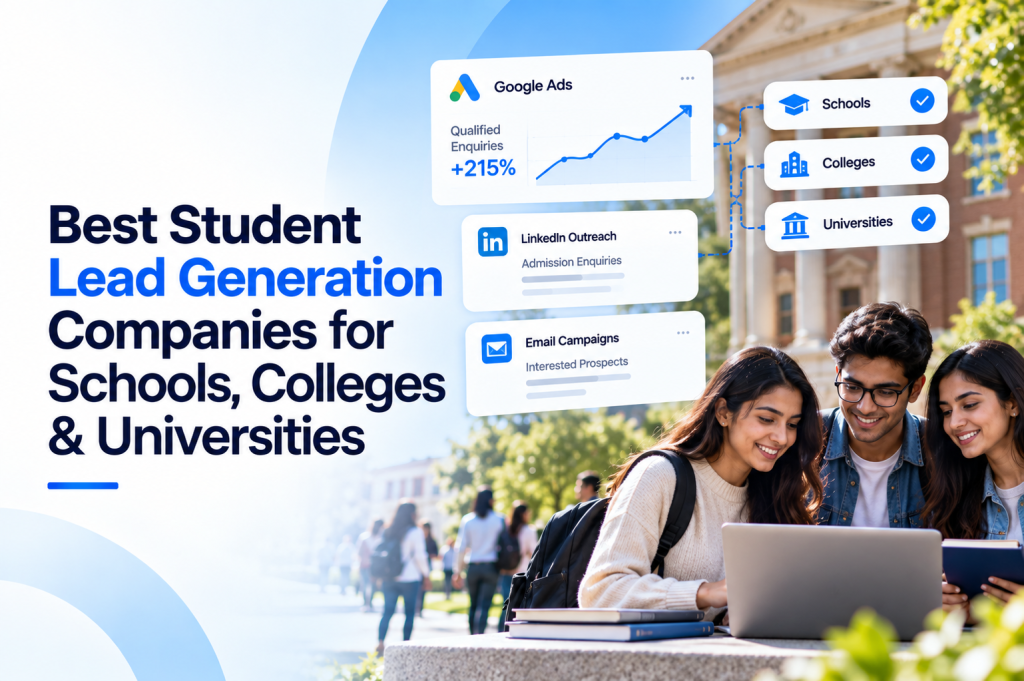
The best student lead generation companies help schools, colleges and universities attract prospective students, turn interest into qualified enquiries, and connect marketing activity with applications and enrolments. The right partner depends on your institution, geography, admission cycle, programs, internal admissions team and whether you need paid acquisition, student recruitment, nurturing, institutional outreach or a combination of these.
A school targeting parents within a 15-kilometre catchment needs a very different lead generation system from a university recruiting postgraduate students across India or an international institution trying to recruit students from South Asia.
That distinction matters.
A large number of enquiries does not automatically mean a successful admissions campaign. Institutions need prospective students or parents who fit the program, location, eligibility criteria and stage of the admissions journey.
This guide compares student lead generation companies serving different parts of that journey and explains how to evaluate them.
Quick Answer: Which Are the Best Student Lead Generation Companies?
Here are 10 companies worth evaluating based on their current service offerings and student recruitment focus.
| Company | Primary Strength | Best Suited For |
|---|---|---|
| Growleads | Paid acquisition, demand intelligence and multi-channel campaigns | Schools, colleges, universities and education businesses needing measurable acquisition |
| Mediagarh | Education-focused digital marketing | Indian schools, colleges, universities and coaching institutes |
| Keystone Education Group | Global higher education recruitment and marketing | Universities recruiting across international markets |
| GPRS | Higher education enrollment marketing | Colleges and universities needing recruitment, nurturing and analytics |
| Shakil Education Group | International student recruitment marketing | Institutions targeting international students |
| REI Marketing | Recruitment and enrollment management | Colleges, universities and specialised academic programs |
| UniBrijj | India-focused international student recruitment | Overseas universities targeting Indian students |
| ICAE India | Recruitment fairs plus digital outreach | Universities looking for school access and student engagement |
| Advance Education | Higher education enrollment campaigns | Undergraduate, graduate and continuing education programs |
| EDU SolPro | University-focused performance marketing | Indian colleges and universities |
This is not a universal ranking. Student acquisition companies solve different parts of the recruitment funnel. The right choice depends on whether your institution needs enquiries, applications, enrolments, international recruitment, digital advertising, lead nurturing or institutional partnerships.
What Is a Student Lead Generation Company?
A student lead generation company helps educational institutions identify, attract and convert prospective students or parents into admissions opportunities.
Depending on the provider, this can include:
- Google Ads
- Meta advertising
- Search engine marketing
- Landing page development
- Student audience targeting
- Parent targeting
- Lead qualification
- CRM integration
- Email and WhatsApp nurturing
- Retargeting
- International student recruitment
- Student fairs
- School partnerships
- Admissions funnel optimisation
- Conversion tracking
A student lead should not simply mean someone who submitted a form.
For most institutions, a useful lead is someone who matches basic criteria such as program interest, location, academic eligibility, intake timing and genuine intent.
That is why institutions should evaluate providers based on downstream admissions outcomes, not simply cost per lead.
Why Student Lead Generation Is Different From General Lead Generation
Education has an unusually complex buying journey.
Prospective students may compare courses, rankings, fees, scholarships, placements, campus facilities, location, faculty, accreditation and career outcomes before applying.
Parents may participate heavily in school and undergraduate decisions.
Postgraduate and executive education candidates may evaluate programs through a completely different lens, including career progression, employer recognition and return on investment.
Admissions are also deadline-driven.
Unlike a normal evergreen lead generation campaign, an institution may have a narrow window in which thousands of potential students are simultaneously researching alternatives.
A good student lead generation agency therefore needs to understand three things:
Intent. What is the prospective student actually looking for?
Timing. How close are they to an application or enrolment decision?
Fit. Does the student match the institution, program and admission criteria?
Campaigns that ignore any one of these variables tend to generate impressive-looking lead volumes that admissions teams struggle to convert.
Best Student Lead Generation Companies to Consider in 2026
1. Growleads
Growleads approaches acquisition through buyer and demand intelligence rather than treating lead generation as simply a volume exercise. Its wider model combines outbound, inbound, Google Ads, LinkedIn and GTM capabilities around qualified pipeline rather than raw lead counts.
For educational institutions, paid search is particularly relevant because prospective students and parents often reveal their intent directly through their searches.
Instead of grouping every education-related keyword into one campaign, an admissions strategy can separate searches by:
- Program
- Location
- Course category
- Parent versus student intent
- Fees
- Eligibility
- Admissions
- Comparison queries
- Brand searches
- Campus-related searches
Growleads has documented this approach across different education campaigns.
For a school campaign, its Scotle Google Ads enrolment case study reports 480+ parent enrolment enquiries during one admissions cycle. The campaigns focused on geographic catchment, parent intent and admissions-stage actions rather than broad education traffic.
For higher education, the JECRC University admissions case study shows how program-level search campaigns were separated around engineering, management, law and other course categories. The documented campaign generated 1,480 admissions enquiries.
Institutions offering professional or postgraduate programs can also review the SPJIMR Google Ads admissions case study for another example of education-focused paid acquisition.
Growleads is especially relevant where the institution wants to connect campaign activity to qualified enquiries and pipeline instead of optimising only for clicks or inexpensive form submissions.
Its wider approach also makes it relevant for education businesses selling to institutions. One university outreach campaign mapped roughly 2,600 institutions and around 6,000 stakeholders, generating 320+ qualified conversations and 52 leadership meetings over six months.
Best suited for: Schools, colleges, universities and education businesses looking for measurable student acquisition or institution-level demand generation.
Worth evaluating if: You want paid acquisition, demand intelligence and a stronger connection between marketing activity and actual admissions opportunities.
2. Mediagarh
Mediagarh positions itself specifically around marketing for educational institutions rather than serving education as one vertical among many.
Its services cover schools, colleges, universities and coaching institutes, with lead generation, advertising, SEO and admissions-focused digital marketing forming part of its offering.
That sector specialisation can be useful because educational campaigns frequently need to work around intake dates, local competition, entrance examinations and short admissions windows.
Best suited for: Indian institutions looking for an education-specialist digital marketing agency.
Worth evaluating if: You prefer a provider dedicated primarily to the education sector.
3. Keystone Education Group
Keystone Education Group operates at a much larger international higher education level.
Its marketing offering covers undergraduate, postgraduate, MBA, PhD and other higher education programs. The company states that its student recruitment capabilities can support international campaigns across multiple languages and markets.
Keystone is therefore different from a typical school lead generation agency.
Its value is strongest when a university needs access to prospective students across countries rather than simply running a local enquiry campaign.
Best suited for: Universities and higher education providers recruiting internationally.
Worth evaluating if: International reach, multilingual campaigns and global student demand are more important than local admission lead generation.
4. GPRS
GPRS specialises in higher education marketing and enrollment.
Its offering includes strategy, lead generation, student nurturing, recruitment and analytics across undergraduate, graduate and specialised institutions.
That broader enrollment focus is important because lead generation often fails after the enquiry arrives.
A university can generate thousands of leads and still miss its intake target if response times, nurturing, counsellor processes or admissions follow-up are weak.
Best suited for: Higher education institutions looking beyond initial lead acquisition.
Worth evaluating if: Your problem extends from student acquisition into nurturing and enrollment management.
5. Shakil Education Group
Shakil Education Group focuses on education marketing and student recruitment, particularly within international education.
Its approach covers market intelligence, program positioning, demand generation, enquiries, qualified leads and applications.
This makes it relevant to institutions that need to decide not only how to advertise, but also where student recruitment opportunities exist and how a program should be positioned within those markets.
Best suited for: Universities and education providers targeting international student recruitment markets.
Worth evaluating if: Market selection and program positioning are important parts of the challenge.
6. REI Marketing
REI Marketing focuses on recruitment, enrollment, international education and marketing for colleges and universities.
Its services include student recruitment, enrollment strategy, digital marketing, agent network support and broader marketing execution.
The company therefore sits closer to enrollment consulting than a narrow paid-media lead generation vendor.
Best suited for: Colleges and universities requiring support across multiple parts of the enrollment process.
Worth evaluating if: You want recruitment strategy and execution under the same partnership.
7. UniBrijj
UniBrijj helps international universities expand their presence and student recruitment activity in India and the wider subcontinent.
Its services include market intelligence, strategic consultation, targeted student recruitment, digital marketing and local relationship building.
This makes UniBrijj more relevant for international institutions entering India than for Indian colleges trying to acquire domestic students.
Best suited for: Overseas universities targeting students in India and South Asia.
Worth evaluating if: Local market knowledge and in-country recruitment relationships matter more than pure digital lead generation.
8. ICAE India
ICAE combines student recruitment activity with university fairs, school networks, digital marketing and branding.
Its current offering includes student recruitment tours, virtual student recruitment, global university fairs and digital marketing for universities.
For international institutions, this combination of digital and offline student access can be useful.
Some students can be acquired through search or social advertising. Others may first encounter an institution through counsellors, school events or education fairs.
Best suited for: Universities wanting a combination of digital campaigns and direct student engagement.
Worth evaluating if: School networks, events and student fairs form part of your recruitment strategy.
9. Advance Education
Advance Education focuses specifically on higher education enrollment marketing.
Its solutions cover undergraduate, graduate, vocational and continuing education recruitment, with campaigns designed around individual institution enrollment goals.
That program-level segmentation is particularly relevant for institutions with several audiences.
The acquisition strategy for a postgraduate course aimed at working professionals should not resemble the strategy for undergraduate admissions.
Best suited for: Higher education institutions with multiple program types.
Worth evaluating if: Different programs require separate recruitment strategies.
10. EDU SolPro
EDU SolPro positions itself as a digital marketing specialist for universities and colleges in India.
Its offering includes paid media, SEO, content and reputation strategy aligned with university admission cycles.
This can be relevant for institutions looking for a provider focused specifically on higher education rather than broader education categories.
Best suited for: Indian universities and colleges.
Worth evaluating if: You need education-focused performance marketing across several digital channels.
How to Compare the Best Student Lead Generation Companies
Do not choose a provider from a company list alone.
The more useful exercise is to compare providers against your own admissions model.
1. Start With the Outcome You Actually Need
Ask what your institution wants to increase:
- Enquiries
- Qualified enquiries
- Campus visits
- Counselling sessions
- Applications
- Completed applications
- Offers accepted
- Enrolments
These are not interchangeable metrics.
Consider two hypothetical campaigns:
| Metric | Campaign A | Campaign B |
|---|---|---|
| Leads | 1,000 | 450 |
| Qualified leads | 180 | 220 |
| Applications | 70 | 105 |
| Enrolments | 20 | 42 |
Campaign A generates more than twice the number of leads.
Campaign B produces more enrolments.
If your agency is compensated or evaluated only on lead volume, it has an incentive to optimise the wrong metric.
Our guide on how to measure lead quality explains why downstream qualification should be included when evaluating acquisition performance.
2. Ask Whether the Agency Understands Your Student
A college lead generation agency should be able to describe your prospective students in more detail than:
Students aged 18 to 24 interested in higher education.
Useful segmentation may include:
- Program interest
- Geographic market
- Academic level
- Entrance exam status
- Financial considerations
- Career objective
- Domestic versus international applicant
- Parent involvement
- Application stage
- Intake
- Eligibility
- Previous education
- Online versus campus preference
The more expensive or considered the education decision becomes, the more important this segmentation becomes.
3. Examine Channel Fit
Different channels capture different types of demand.
Google Search
Strong when students or parents already know what they are looking for.
Examples include:
- MBA colleges in Jaipur
- CBSE schools near me
- BTech admissions 2026
- online data science masters
- best private universities for law
Search demand is usually closer to active consideration.
A specialist Google Ads approach can therefore work well when institutions already have meaningful program-level search demand.
Meta and Social Advertising
Useful when institutions need to create demand or reach broader student and parent audiences.
Creative quality, audience targeting and landing-page experience matter heavily because the prospect may not have been actively searching for an institution.
Organic Search
Useful for capturing recurring research questions around programs, fees, careers, admissions and comparisons.
Organic student acquisition usually takes longer to build but can reduce reliance on paid media over time.
Email and CRM Nurturing
Useful after enquiry.
Many institutions focus heavily on acquiring leads while underinvesting in what happens during the next 7, 14 or 30 days.
That is often where enrollment economics break.
School Lead Generation Agency vs College Lead Generation Agency
The two categories overlap, but the buying journey is different.
| Area | School Admissions | College & University Admissions |
|---|---|---|
| Primary decision-maker | Often parent-led | Student-led, often with parent input |
| Geography | Usually local catchment | Local, regional, national or international |
| Search behaviour | School, board, locality, facilities | Course, career, fees, placements, eligibility |
| Decision cycle | Family comparison | Multi-stage academic and career decision |
| Key conversion | Visit, enquiry, counselling | Enquiry, application, counselling |
| Common channels | Search, Meta, local search | Search, social, portals, content, email |
| Segmentation | Age, grade, locality | Program, eligibility, career intent, intake |
A school lead generation agency should understand parent behaviour and geographic catchment.
A college lead generation agency needs to understand program-level search intent, course economics and the admissions funnel.
Treating both audiences identically usually creates poor campaign economics.
The Student Acquisition Funnel Institutions Should Measure
A practical student acquisition funnel looks like this:
Visibility → Website Visit → Enquiry → Qualified Enquiry → Counselling → Application → Admission → Enrolment
Every stage answers a different question.
Visibility: Are enough relevant students discovering the institution?
Website visit: Are campaigns attracting the right audience?
Enquiry: Does the value proposition create enough interest?
Qualified enquiry: Does the student actually fit?
Counselling: Can the admissions team establish serious interest?
Application: Is the student prepared to move forward?
Admission: Does the applicant meet the institution’s requirements?
Enrolment: Did the student ultimately join?
The mistake is stopping measurement at the third stage.
The difference between lead quality and lead quantity becomes especially important in education because admissions teams have limited counselling capacity.
Sending counsellors 5,000 weak enquiries may create worse outcomes than sending them 1,500 well-qualified ones.
A Practical Framework for Choosing a Student Lead Generation Agency
Use the following framework during agency discussions.
Student Acquisition Agency Evaluation Checklist
Score each provider from 1 to 5 across these areas.
| Evaluation Area | What to Ask |
|---|---|
| Education experience | Have they worked with institutions similar to yours? |
| Audience understanding | Can they explain your student and parent segments? |
| Channel expertise | Which acquisition channels do they actually operate? |
| Lead qualification | How is an enquiry classified as qualified? |
| Tracking | Can enquiries be tied to applications or enrolments? |
| Landing pages | Who owns conversion optimisation? |
| CRM integration | How quickly do leads reach admissions teams? |
| Nurturing | What happens after a student enquires? |
| Reporting | Are reports based on leads or admissions outcomes? |
| Transparency | Can you see campaign, spend and conversion data? |
Do not automatically choose the company with the highest score.
Weight the criteria based on your own bottleneck.
If your problem is weak lead quality, qualification and audience strategy matter more.
If your problem is international recruitment, market access matters more.
If enquiry volume is already strong but applications remain weak, lead generation may not be your actual problem at all.
The more detailed framework for choosing a lead generation agency can also help structure vendor evaluation beyond surface-level promises.
Red Flags When Evaluating Student Acquisition Companies
Promising a Fixed Number of Admissions
An agency controls marketing.
It usually does not control:
- Eligibility
- Fees
- Scholarships
- Counselling quality
- Applicant competition
- Faculty
- Campus experience
- Placement outcomes
- Admission decisions
- Student preferences
Guaranteed enrollment claims should therefore be examined carefully.
Selling Shared Student Databases as Lead Generation
A contact list is not the same as generated demand.
Always ask:
- Where did the student come from?
- When was the enquiry generated?
- What did they enquire about?
- Was consent collected?
- Is the same lead being sold elsewhere?
- How was program interest verified?
Reporting Only Cost Per Lead
Cost per lead is useful.
It is not enough.
A ₹300 lead that never answers the phone is more expensive than a ₹1,000 lead that becomes an application.
Institutions should eventually measure:
Cost per qualified enquiry
Cost per counselling session
Cost per application
Cost per enrolment
Using One Landing Page for Every Program
Engineering, law, MBA and design students have different questions.
Sending every campaign to one generic admissions page reduces message relevance and makes optimisation harder.
The JECRC University example illustrates why matching program-level searches to the relevant admissions path can make traffic more actionable for the admissions team.
Lead Generation vs Student Recruitment: What Is the Difference?
Student lead generation creates prospective student enquiries.
Student recruitment is broader.
Recruitment may include:
- Market selection
- School partnerships
- Education agents
- Student fairs
- Counsellor relationships
- Digital advertising
- Lead generation
- Applicant nurturing
- Admissions support
- International representation
An institution entering a new international market may therefore need a student recruitment company.
An institution that already has strong admissions infrastructure but needs more qualified enquiries may need a specialist student lead generation agency.
Some providers cover both.
Others specialise in one side of the funnel.
Should Schools and Universities Use One Agency or Multiple Specialists?
There is no universal answer.
A single agency can simplify accountability, reporting and strategy.
Specialist partners can provide deeper expertise in individual channels.
A university might, for example, use:
- One international recruitment partner
- One paid acquisition agency
- An internal admissions team
- A separate CRM platform
This can work well if ownership is clear.
Problems begin when every provider optimises its own metric.
The paid media agency celebrates leads.
The recruitment partner celebrates applications.
Admissions tracks enrolments.
Nobody owns the complete journey.
The strongest operating model creates one shared funnel with agreed definitions for every stage.
What Should Your Student Lead Generation Company Report?
At minimum, reporting should show:
- Advertising spend
- Traffic
- Enquiries
- Cost per enquiry
- Qualified enquiries
- Cost per qualified enquiry
- Counselling outcomes
- Applications
- Application source
- Enrolments, where CRM data permits
Channel metrics such as impressions, clicks and click-through rate still matter.
They help diagnose campaign performance.
They simply should not become the final measure of success.
The business question is not:
How many leads did marketing generate?
It is:
Which campaigns consistently generate students who progress through the admissions funnel?
How to Improve Results Before Hiring an Agency
A student acquisition company cannot fix every admissions problem with advertising.
Before increasing media spend, check five areas.
Clarify Your Program Positioning
Students need concrete reasons to choose one institution over another.
Generic claims such as:
- World-class education
- Experienced faculty
- Holistic learning
- Excellent infrastructure
are difficult to differentiate.
Stronger messages connect specific institutional strengths to what the prospective student values.
Fix Your Landing Pages
A prospective student should quickly understand:
- Program
- Eligibility
- Duration
- Location
- Admissions process
- Fees or fee information
- Career outcomes
- Important deadlines
- Next step
Reducing uncertainty improves the quality of enquiries as well as conversion rate.
Improve Lead Response Speed
Student intent decays.
An enquiry generated today should not sit untouched until the admissions team follows up several days later.
Build routing and response processes before scaling campaigns.
Separate Programs
Do not treat every course as one market.
Demand for an MBA, BTech program and undergraduate design degree will behave differently.
Budget, keywords, audience, landing pages and nurturing should reflect those differences.
Connect Marketing to Admissions Data
Without downstream data, campaign optimisation becomes guesswork.
At minimum, send qualification status and application outcomes back into reporting.
Over time, marketing should learn which campaigns create actual enrollment opportunity rather than simply inexpensive enquiries.
So, Which Student Lead Generation Company Should You Choose?
Choose the provider whose operating model matches your admissions problem.
If you need local school enrolments, prioritise parent intent, geography and campus-visit conversion.
If you need domestic university admissions, prioritise course-level demand, student qualification and application tracking.
If you need international students, evaluate market access, language capabilities, recruitment networks and in-country expertise.
If your problem is poor enquiry quality, focus on targeting, qualification and conversion tracking before increasing volume.
And if your institution already generates plenty of leads but cannot convert them, investigate the admissions process before hiring another lead generation company.
Growleads is one option for institutions that want to connect paid acquisition and demand intelligence more closely with qualified admissions opportunities. The most useful first step is not increasing campaign spend. It is identifying where the existing student acquisition funnel is leaking and deciding whether the constraint is demand, qualification, conversion or follow-up.
Frequently Asked Questions
What is the best student lead generation company?
There is no single best student lead generation company for every institution. Schools, universities, online education providers and international institutions have different audiences and recruitment models, so the best partner is the one whose capabilities match your acquisition problem and admissions funnel.
How do student lead generation companies generate leads?
Student lead generation companies typically use channels such as Google Ads, Meta Ads, search marketing, landing pages, education portals, content, remarketing, email campaigns and student recruitment partnerships to attract prospective students or parents.
How much does student lead generation cost?
Student lead generation costs vary significantly by geography, program, competition, channel, institution type and admission cycle. Institutions should compare cost per qualified enquiry, application and enrolment instead of judging performance only by cost per lead.
What is a qualified student lead?
A qualified student lead is a prospective student who matches relevant admission criteria such as program interest, location, eligibility, intake and genuine consideration. The exact definition should be agreed between the institution, marketing team and admissions team before campaigns begin.
Are purchased student leads worth it?
Purchased student leads can be useful in limited situations, but institutions should understand how the data was collected, whether the enquiry is exclusive, how recently it was generated and whether the student explicitly expressed interest in the relevant program. First-party enquiries usually provide much clearer intent signals.
What is the difference between a school lead generation agency and a college lead generation agency?
A school lead generation agency usually focuses more heavily on parents, geographic catchment and campus visits, while a college lead generation agency typically works with program-level demand, student intent, eligibility, counselling and applications.
Which channels work best for student lead generation?
The best channel depends on the institution and audience. Google Search can capture existing admission intent, social advertising can create awareness and demand, organic search can support long-term discovery, and CRM or WhatsApp nurturing can help convert enquiries after they arrive.
How should universities measure student lead generation success?
Universities should measure the full funnel from enquiry to qualified lead, counselling, application, admission and enrolment. Cost per lead is useful operationally, but cost per qualified enquiry, application and enrolled student provides a clearer picture of acquisition performance.

Builds the demand intelligence, automation, and deliverability systems behind Growleads pipeline.