
What a Transparent Lead Generation Process Looks Like
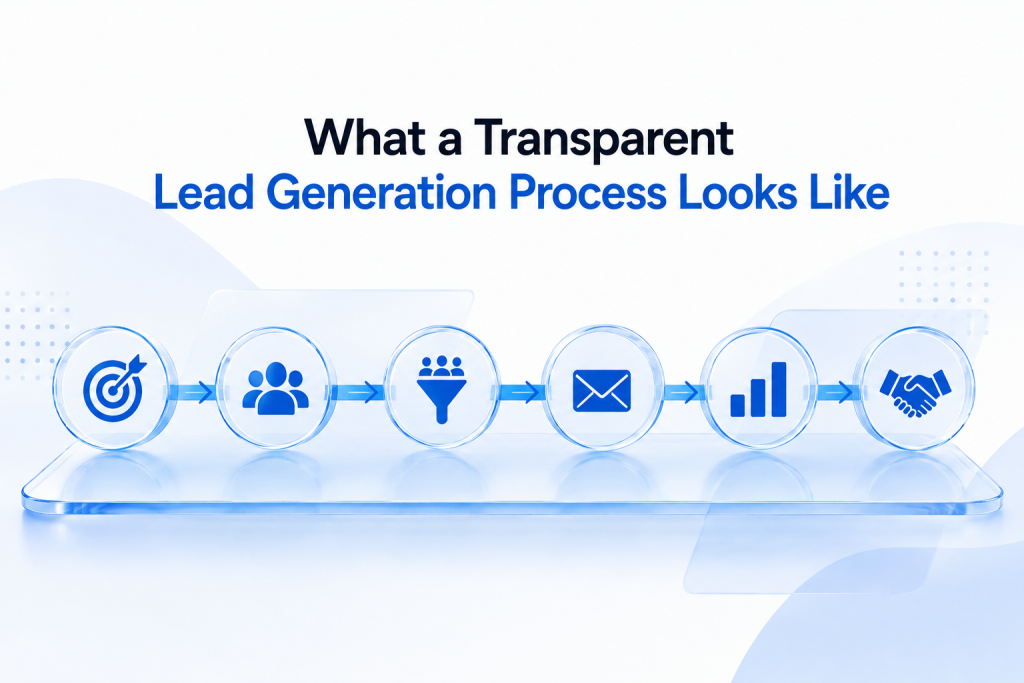
A transparent lead generation process makes every important decision visible: who is being targeted, why those accounts were selected, what messaging is being used, how responses are qualified, what gets handed to sales, and how results are measured. In B2B, activity alone tells you very little. A useful process connects buyer selection to qualified pipeline.
That distinction matters.
A company can send thousands of emails, generate hundreds of form fills, or build a large prospect database without creating meaningful sales opportunities.
A transparent process makes it possible to see what is actually working, what is not, and why.
Salesforce describes lead generation as a process that begins with creating awareness and interest before capturing potential buyers for further engagement. In B2B, the operational process often goes further by adding prospect research, qualification, sales handoff and pipeline measurement.
For revenue leaders evaluating an internal team or an external B2B lead generation partner, that visibility should be non-negotiable.
Quick Answer: What Should a Transparent Lead Generation Process Include?
A transparent B2B lead generation process should cover eight connected stages: commercial goals, ICP definition, buyer research, data validation, channel and messaging design, campaign execution, lead qualification, and sales handoff followed by pipeline reporting. At every stage, the business should know what is happening, who owns it, what criteria are being applied, and how decisions are being made.
| Stage | What should be visible |
|---|---|
| 1. Goals | Pipeline objective, target market, qualification criteria |
| 2. ICP | Industries, company size, geography, personas, exclusions |
| 3. Research | Account selection logic, buyer signals, data sources |
| 4. Workflow | Channels, sequences, routing, follow-up logic |
| 5. Messaging | Positioning, message variations, approvals |
| 6. Qualification | What makes a lead qualified, rejected or nurtured |
| 7. Sales handoff | Ownership, context, CRM status, next action |
| 8. Reporting | Meetings, opportunities, pipeline, quality feedback |
The point is not to create more documentation.
The point is to remove ambiguity.
What Is a Lead Generation Process?
A lead generation process is the repeatable system a company uses to identify potential buyers, create or capture interest, evaluate whether those buyers are relevant, and move qualified prospects toward the sales process. It connects marketing, prospecting, qualification and sales rather than treating each as a separate activity.
For B2B companies, a lead generation workflow can include both inbound and outbound acquisition.
Inbound activity may involve:
- Search
- Paid advertising
- Content
- Webinars
- Events
- Referral traffic
- Website conversions
Outbound activity may involve:
- Cold email
- LinkedIn outreach
- Account-based prospecting
- Calling
- Direct outreach to buying committees
The channels are only one part of the system.
A strong B2B lead generation process also answers:
Who should we target?
Why should we target them now?
Which problem are we addressing?
What indicates genuine interest?
When should sales become involved?
What information should follow the lead into the CRM?
How will we know whether the process is creating pipeline?
Without those answers, lead generation can quickly become a volume exercise.
What Does Transparency Actually Mean in Lead Generation?
Transparency means a revenue team can understand and inspect the logic behind its lead generation workflow. It should be possible to trace a sales opportunity back through the process and understand where the account came from, why it was targeted, what happened before the meeting, and why it was considered qualified.
A useful way to evaluate transparency is through three simple questions:
Is it visible?
Can the client or internal revenue leader see what is happening?
Is it traceable?
Can a result be connected to the activities and decisions that produced it?
Is it accountable?
Is somebody responsible for the quality and outcome of each stage?
This is an educational test, not a formal industry framework. But it exposes many of the problems hidden by activity-heavy reporting.
Transparent vs opaque lead generation
| Transparent process | Opaque process |
|---|---|
| ICP criteria are documented | “We found relevant prospects” |
| Account selection logic is clear | Large lists appear without explanation |
| Messaging can be reviewed | Outreach happens behind closed doors |
| Qualification criteria are agreed | Every positive reply becomes a lead |
| Disqualified leads have reasons | Bad leads simply disappear |
| Sales feedback changes targeting | Campaigns continue regardless of feedback |
| Pipeline outcomes are tracked | Reporting ends at meetings booked |
| Problems are surfaced early | Weak performance is hidden behind activity |
Transparency does not mean every stakeholder needs to manage every campaign.
It means the business should never have to guess how its pipeline is being built.
The 8 Stages of a Transparent B2B Lead Generation Process
1. Start With the Commercial Goal
A transparent lead generation process begins with the business outcome, not the channel. Before deciding how many emails to send or which advertising platform to use, define what the company actually needs from the program and what qualifies as a meaningful result.
For example, “we need more leads” is not specific enough.
A better discussion asks:
- Which market are we trying to penetrate?
- What type of account would be commercially valuable?
- What size of opportunity makes the campaign worthwhile?
- Which personas typically influence the purchase?
- What should count as a qualified conversation?
- What happens after a meeting is booked?
- How will pipeline influence be measured?
This is where lead generation connects to the wider GTM strategy.
A company expanding into enterprise accounts requires a different process from a SaaS business selling a simple product to small companies.
The goal determines the workflow.
2. Define the ICP Before Building the Prospect List
The Ideal Customer Profile, or ICP, should define which companies are worth pursuing. A transparent process documents inclusion and exclusion criteria before prospecting begins.
At minimum, the ICP may consider:
- Industry
- Geography
- Company size
- Revenue range
- Business model
- Technology environment
- Growth stage
- Relevant business problems
- Existing solutions
- Decision-maker roles
- Buying committee structure
The ICP should also include exclusions.
For example, a company might exclude businesses below a minimum size, unsupported territories, competitors, existing customers or sectors where its product has little relevance.
This matters because a prospect can have the perfect job title and still work for the wrong company.
A good process qualifies the account before celebrating the contact.
3. Add Buyer Signals and Account Context
A mature lead generation process asks more than “Does this company fit our ICP?”
It also asks, “Why might this account care now?”
Buyer or account signals can include:
- New funding
- Hiring activity
- Geographic expansion
- Leadership changes
- Technology adoption
- Technology replacement
- New product launches
- Regulatory or market changes
- Relevant job openings
- Business transformation projects
- Engagement with relevant content
Signals do not prove purchase intent.
They provide context.
For example, a company hiring ten enterprise salespeople may have a different commercial priority from an otherwise identical company that is reducing its sales organisation.
Signal-based targeting helps teams decide where deeper research is worth the effort.
The transparent part is being able to explain why an account entered the campaign.
4. Build and Validate the Data
The prospect list should be treated as an input to the process, not the final product.
A transparent data workflow documents where the data came from, how it was filtered, how contacts were selected and what checks were completed before outreach.
Quality controls may include:
- Company-level ICP validation
- Job-title and seniority checks
- Contact verification
- Duplicate removal
- Existing customer suppression
- Competitor exclusions
- Geography validation
- CRM matching
- Previous outreach checks
- Do-not-contact or opt-out suppression
Compliance requirements vary by jurisdiction, channel and data source. Businesses operating across multiple markets should make sure their data collection and outreach practices are reviewed against the requirements that apply to them.
A large database is not useful if the underlying accounts are irrelevant.
5. Design the Lead Generation Workflow and Channel Mix
The right channel mix depends on where the buyer spends time, how complex the purchase is and how much context the message requires. A transparent workflow explains why each channel exists and how the channels work together.
A company might combine:
Cold email for direct access to specific decision-makers.
LinkedIn outreach for relationship-building and additional context.
LinkedIn Ads for account-level visibility.
Google Ads for active search demand.
Content and organic search for education and inbound discovery.
Founder authority for credibility during buyer research.
For companies using outbound lead generation services, transparency should extend to sequencing.
For example:
- Account qualifies against ICP.
- Relevant decision-maker is identified.
- Buyer context is researched.
- Email or LinkedIn outreach begins.
- Follow-ups are triggered according to response status.
- Positive replies enter qualification.
- Relevant conversations are handed to sales.
- Non-ready prospects are routed appropriately.
The exact workflow varies.
The important part is that the logic is deliberate rather than accidental.
6. Make Messaging Reviewable
A transparent lead generation campaign should make its messaging visible before and during execution.
That does not mean every email needs executive approval.
It means the business should understand:
- Which problem is being discussed
- Which personas receive each message
- Which proof points are being used
- Which offers are being made
- What call to action is being tested
- Which variables are personalised
- What follow-ups look like
Messaging should also change when the market gives useful feedback.
If prospects repeatedly say the problem is irrelevant, the issue may be targeting or positioning.
If the right buyers engage but refuse the next step, the offer or CTA may be creating friction.
If messages receive no meaningful response, the team needs to investigate audience, deliverability, timing and relevance rather than simply increasing volume.
Transparency makes those decisions easier because the inputs are visible.
7. Use a Defined Lead Qualification Process
A lead qualification process decides which prospects deserve sales attention. The criteria should be agreed before campaigns launch so that “qualified” does not change depending on who is reviewing the lead.
LinkedIn describes lead qualification as filtering prospects so sales teams can focus on people and organisations that are more likely to become suitable customers. Its guidance also highlights company characteristics and engagement as useful qualification inputs.
For many B2B businesses, qualification can consider five areas:
ICP fit
Does the company match the target account profile?
Persona fit
Is the contact a decision-maker, influencer, champion or relevant stakeholder?
Business relevance
Is there a plausible problem or objective that the offer can address?
Intent or engagement
Has the prospect demonstrated enough interest to justify the next step?
Timing and next action
Is there a realistic reason to continue the conversation now?
Qualification should match the sales motion.
A complex enterprise sale may require MEDDIC-style discovery later in the sales process. A high-volume SMB motion may use simpler criteria. The framework matters less than having consistent definitions that marketing, SDRs and sales understand. Pipedrive similarly recommends defining an ICP and using fit, intent, authority and timing as part of qualification, while noting that the right framework depends on the sales motion.
An Educational B2B Qualification Scorecard
A simple scorecard can make qualification discussions more objective.
This example is for educational purposes only. Each business should adapt the weighting to its own sales motion.
| Criterion | 0 | 1 | 2 |
|---|---|---|---|
| Account fit | Poor fit | Partial fit | Strong ICP fit |
| Persona relevance | Unrelated | Influencer | Decision-maker or key stakeholder |
| Problem relevance | No known fit | Possible need | Clear relevant problem |
| Engagement | No interest | Mild interest | Active conversation |
| Timing | No path forward | Future possibility | Defined next step |
A score should never replace judgment.
Its value is consistency.
If sales repeatedly rejects leads that score highly, the team should review the scoring model rather than blaming sales or marketing.
8. Create a Clean Sales Handoff
A qualified lead is not finished when a meeting reaches the calendar.
The handoff should give sales enough context to continue the conversation without making the buyer repeat everything.
A useful handoff can include:
- Account name
- Contact and role
- Source or campaign
- Reason the account was targeted
- Relevant buyer signal
- Messaging history
- Prospect response
- Qualification notes
- Known pain point
- Other stakeholders identified
- Meeting details
- Recommended next step
Lead generation and the sales pipeline are connected, but they are not the same thing.
LinkedIn’s sales pipeline guidance places qualification before later stages such as meetings and proposals. That distinction is useful because the lead generation team should not claim ownership of revenue stages it does not directly control.
The handoff is where responsibility changes.
That change should be explicit.
Lead Generation vs Demand Generation vs the Sales Pipeline
Lead generation, demand generation and sales pipeline management solve related but different problems. Confusing them can create poor reporting because teams start measuring one process with another process’s KPIs.
| Process | Primary purpose | Typical activities | Main outcome |
|---|---|---|---|
| Demand generation | Build awareness and interest | Content, search, events, paid media, thought leadership | Market demand and engaged audiences |
| Lead generation | Identify and engage potential buyers | Prospecting, lead capture, outreach, qualification | Qualified prospects |
| Sales pipeline | Progress active opportunities | Discovery, demos, proposals, negotiation | Closed revenue |
The distinction between demand generation vs lead generation is especially important.
Demand generation can influence prospects before they identify themselves.
Lead generation creates a mechanism for turning suitable interest or target accounts into identifiable sales conversations.
The sales pipeline begins when those conversations become active commercial opportunities.
A company may operate all three together, but it should measure them separately.
What Should Lead Generation Reporting Show?
Transparent lead generation reporting should show the path from activity to revenue relevance. A report full of sends, clicks, impressions or connection requests may help diagnose campaign performance, but those numbers are not substitutes for lead quality, opportunities or pipeline.
A useful reporting hierarchy looks like this:
1. Operational metrics
These show whether the system is functioning.
Examples:
- Emails delivered
- Bounce rate
- Contacts reached
- LinkedIn connections
- Campaign volume
- Form submissions
2. Engagement metrics
These show whether buyers are reacting.
Examples:
- Replies
- Positive responses
- Conversations started
- Ad engagement
- Landing-page conversions
3. Qualification metrics
These show whether the engagement is commercially relevant.
Examples:
- Qualified conversations
- Qualified lead rate
- Meetings booked
- Meetings accepted by sales
- Disqualification reasons
4. Pipeline metrics
These show whether lead generation is contributing to business outcomes.
Examples:
- Sales opportunities created
- Lead-to-opportunity conversion
- Pipeline value
- Opportunity stages
- Closed-won revenue influenced
Not every business can attribute revenue perfectly.
Long sales cycles, multiple touchpoints and buying committees make attribution difficult.
The answer is not to pretend attribution is perfect. It is to document how attribution is being handled and keep the methodology consistent.
The Sales Feedback Loop Is Part of the Process
A transparent lead generation process does not end when leads reach sales. Sales feedback should influence future targeting, messaging and qualification.
For example:
Sales says the companies are too small.
Update the ICP.
Sales says the companies are strong but the wrong personas are attending.
Update stakeholder targeting.
Sales says prospects understand the problem but lack urgency.
Review buyer signals and timing.
Sales says meetings look good but opportunities consistently stall at the same stage.
Investigate positioning, qualification or the sales process.
This feedback loop prevents the lead generation team from optimising for meetings that sales does not value.
The strongest signal is not simply “meeting booked.”
It is what happens after the meeting.
What Should a Lead Generation Agency Be Transparent About?
A B2B lead generation agency should be able to explain its targeting, workflow, qualification standards, communication process and reporting before asking a client to scale the campaign. The client does not need every operational detail, but it should have enough visibility to understand how its brand is being represented and how pipeline is being created.
Before appointing a partner, ask:
- How will you define our ICP?
- Who decides which accounts enter a campaign?
- What data sources will you use?
- Can we review targeting samples?
- How do you identify buyer signals?
- Which outreach channels will you use and why?
- Can we review messaging before launch?
- What exactly counts as a qualified lead or meeting?
- How are negative replies and opt-outs handled?
- What information will sales receive at handoff?
- Which metrics will appear in reporting?
- Will we see opportunity and pipeline outcomes?
- How does sales feedback affect the campaign?
- What happens when performance is weak?
The quality of the answers is often more useful than a long list of tools.
Common Problems an Opaque Lead Generation Process Creates
Optimising for volume instead of relevance
If the primary objective is “send more,” poor targeting can scale quickly.
More activity does not repair an unclear ICP.
Counting every positive reply as a qualified lead
A prospect asking for information is not automatically a sales opportunity.
Qualification needs a separate step.
Hiding weak targeting behind campaign averages
A campaign can produce acceptable overall numbers while one segment performs badly.
Reporting should allow teams to compare audiences, messages and channels.
Passing incomplete context to sales
A calendar invitation without qualification notes creates unnecessary work for the salesperson.
It can also create a poor buyer experience.
Treating sales rejection as somebody else’s problem
Repeated rejection is data.
The lead generation process should capture why leads are rejected and use the pattern to improve targeting.
Changing definitions after campaigns launch
If a “qualified meeting” means one thing when the contract is signed and another thing when results are reviewed, reporting becomes meaningless.
Definitions should be documented early.
Automating before the workflow is clear
AI and automation can help with research, scoring, routing, summarisation and follow-up, but they need reliable inputs.
Pipedrive’s current qualification guidance makes a similar point: AI works best when applied to an already defined qualification system. Automating a weak ICP or poor qualification model simply allows the wrong process to operate faster.
How Much Transparency Is Enough?
Transparency does not mean giving everyone access to every tool, mailbox, database or internal operating procedure. The right level of visibility gives stakeholders enough information to evaluate decisions, quality, risk and business outcomes without turning the engagement into daily micromanagement.
A client should generally understand:
What is being done.
Why it is being done.
Who is being targeted.
What buyers are being told.
What counts as success.
What the market is saying back.
What happens next.
An agency may still have proprietary processes, licensed data sources or internal systems it cannot fully expose.
That is reasonable.
“We cannot share every operational detail” is very different from “You do not need to know how we generate your leads.”
When a Lead Generation Process Is Not the Real Problem
Lead generation cannot repair every growth problem.
A new campaign may be the wrong solution when:
- Product-market fit is unclear
- The target market is too small
- Positioning changes every week
- There is no clear customer problem
- Pricing prevents viable acquisition
- Sales cannot follow up consistently
- The company lacks capacity to serve new customers
- Existing leads are already being poorly converted
In these situations, increasing lead volume may add noise instead of revenue.
The better decision may be to improve the offer, ICP, sales process or customer proposition first.
This is another reason transparency matters.
A good process should reveal when lead generation itself is not the bottleneck.
A Practical Transparency Checklist
Before scaling any B2B lead generation workflow, a revenue leader should be able to answer “yes” to most of the following:
- We know exactly which companies we are targeting.
- We know why those companies fit our ICP.
- We know which personas matter inside those accounts.
- We can explain why an account enters a campaign.
- Our prospect data has a defined validation process.
- We understand which channels are being used.
- We can review the core messaging.
- We have documented qualification criteria.
- Marketing, SDRs and sales agree on those criteria.
- Sales receives useful context with each handoff.
- Disqualified leads have recorded reasons.
- Sales feedback changes future targeting.
- Reports show quality as well as volume.
- We can connect qualified leads to sales opportunities.
- We know what will happen when performance drops.
If several answers are “no,” the priority may not be generating more leads.
It may be fixing the system behind them.
Conclusion: Transparency Turns Lead Generation Into a Revenue Process
A good lead generation process should make it easy to understand how a company moves from a target market to qualified sales opportunities.
That means defining the ICP before prospecting, using account context to prioritise buyers, validating data, documenting messaging, agreeing on qualification, creating a clean sales handoff and measuring what happens after the meeting.
The objective is not visibility for its own sake.
It is better decision-making.
When teams can see why leads are generated and what happens to them, they can improve the process instead of simply demanding more activity.
Growleads approaches this from a buyer-first perspective. Rather than beginning with a channel, the process starts by understanding the ICP, buyer signals and commercial objective before building campaigns around them.
If you are reviewing an existing lead generation system, start by mapping the eight stages above and identifying where visibility disappears. That gap is often the best place to improve before adding more volume.
Frequently Asked Questions
What are the main steps in the lead generation process?
The main steps are defining the commercial goal, identifying the ICP, researching target accounts, validating data, selecting channels, creating messaging, qualifying responses, handing qualified prospects to sales and measuring pipeline outcomes. The exact workflow varies between inbound and outbound models.
What makes a B2B lead generation process transparent?
A B2B lead generation process is transparent when targeting criteria, messaging, qualification rules, campaign activity, sales handoffs and performance data are visible and understandable. A revenue leader should be able to explain why a prospect was targeted and what happened before that prospect became a sales opportunity.
What is the difference between lead generation and demand generation?
Demand generation builds awareness and interest across a target market, while lead generation identifies or captures potential buyers and moves suitable prospects toward a sales conversation. Lead generation can sit inside a broader demand generation strategy, but the two processes should not be measured as if they are identical.
How do you qualify a B2B lead?
A B2B lead can be qualified by evaluating account fit, persona relevance, business need, engagement or intent, timing and the viability of a next step. The exact criteria should reflect the company’s sales motion rather than applying one generic qualification framework to every business.
What KPIs should a lead generation process track?
A lead generation process should track operational metrics, engagement, lead quality and pipeline outcomes. Important measures can include qualified conversations, meetings, sales acceptance, lead-to-opportunity conversion, pipeline created and disqualification reasons. Activity metrics remain useful for diagnosis, but should not be treated as the final business outcome.
How long does a B2B lead generation process take to work?
There is no universal timeline because results depend on the target market, offer, channel, sales cycle, brand awareness and quality of execution. Early campaign responses may appear before meaningful pipeline evidence. Businesses should separate early engagement signals from later opportunity and revenue outcomes rather than judging the entire process from initial activity alone.
Should a lead generation agency give clients access to its campaigns?
A lead generation agency should provide enough visibility for the client to understand targeting, messaging, qualification and results, but full access to every internal system is not always necessary. The important standard is whether the client can evaluate how its brand is represented, how leads are produced and how performance is measured.
Can AI automate the lead generation process?
AI can support parts of the lead generation process such as research, data enrichment, message preparation, lead scoring, routing, CRM updates, reporting and signal monitoring. Human judgment remains important for ICP decisions, positioning, complex qualification and buyer conversations. Automation should improve a well-designed workflow rather than compensate for a weak one.

Builds the demand intelligence, automation, and deliverability systems behind Growleads pipeline.