PPC Analytics: What Top Marketers Measure for Campaign Success
 PPC analytics can make or break your ad budget’s success rate. Much of the total PPC campaign spending ends up on irrelevant or low-intent queries that slip through the original negative keyword filters. The average click-through rate across Google Ads is around 3.17%. However, leading marketers beat this measure consistently through evidence-based tactics that aren’t accessible to more people.
Let’s get into the world of PPC analysis and the vital PPC metrics behind successful campaigns. Quality scores range from 1 to 10 and directly affect your cost-per-click and impression share. Return on Ad Spend (ROAS) stands out as one of the most valuable PPC campaign metrics to assess profitability. Marketers should analyze it differently for acquisition and retargeting campaigns. This piece will give you the PPC data insights you need to join marketers who achieve above-average conversion rates. The average for Google Ads was 6.96% as of 2024.
What is PPC Analysis and Why It Matters
PPC (pay-per-click) analysis is what makes digital advertising campaigns work. PPC analysis takes a well-laid-out, analytical approach to evaluate paid media performance on platforms like Google Ads, Microsoft Ads, and Meta. The process looks at how your campaigns perform by tracking metrics that show different aspects of campaign success. Raw data gives you solid insights to fine-tune strategies and remain competitive, unlike relying on gut feelings or assumptions.
Understanding the role of PPC data in campaign success
The biggest mistake in PPC marketing happens when you treat it as a “fire-and-forget” part of your marketing efforts. You risk wasting a lot of ad spend without proper analysis, especially if your ads get clicks but no conversions. Data-backed decisions are the foundation of successful PPC campaigns. The advertising landscape has become too competitive to rely on intuition alone.
PPC analysis done right serves several vital purposes:
- Identifying budget wastage – A structured approach spots where you’re not using your ad spend well, which lets you make precise tweaks instead of broad changes.
- Understanding conversion efficiency – Looking at conversion metrics helps you tell the difference between high-CTR traffic that converts and traffic that just pumps up numbers without real effect.
- Lining up performance with business goals – PPC analysis creates a feedback loop between upper-funnel media performance and lower-funnel business results.
Your PPC data holds valuable insights that go unnoticed without analysis. Campaigns end up running on guesswork, which makes you more likely to waste money. On top of that, it helps you catch potential issues before they grow into expensive problems.
Good PPC analysis breaks down performance by:
- Device type
- Keyword match types
- Time of day
- Audience segments
This detailed view shows exactly where your budget works best or falls short. Advanced PPC analysis even connects platform data with backend systems like CRM or analytics tools to see how paid traffic affects qualified pipeline, sales velocity, or customer acquisition cost.
How PPC analysis is different from simple reporting
Simple reporting and thorough PPC analysis are worlds apart. Reports just show what happened. Analysis explains why it happened and what to do about it. Reports give you raw numbers. Analysis turns those numbers into actions you can take.
A PPC report shows metrics like impressions, clicks, and conversions. PPC analysis interprets this data based on your campaign goals. Without good analysis, you might overvalue branded terms, underreport assisted conversions, or misread platform-optimized campaigns. This ended up causing poor budget choices.
To cite an instance, see how you might proudly report a great click-through rate (CTR) but miss the low conversion rate and return on ad spend (ROAS). This narrow view stops stakeholders from seeing how your campaign really performs.
Good PPC analysis needs:
- Clearly defined goals – You must know what success means for your account before any real analysis can start.
- Context and commentary – Numbers mean little without proper context. Analysis tells you the “why” behind the data.
- Performance segmentation – PPC performance changes by a lot between devices, audience types, and days of the week. Analysis reveals these hidden patterns.
- Actionable recommendations – Analysis should guide data-backed decisions to improve your account.
PPC analysis changes reactive fixes into a repeatable strategy that helps sustainable growth. It goes beyond tracking activity to make decisions that improve results. Bid strategies and automation aren’t enough in today’s complex media landscape. Structured analysis makes the difference between campaigns that just spend money and those that drive real business results.
This analytical approach transforms your PPC work from educated guesses into a precise, data-driven strategy that brings higher returns from your ad spend consistently.
The Most Important PPC Metrics to Track
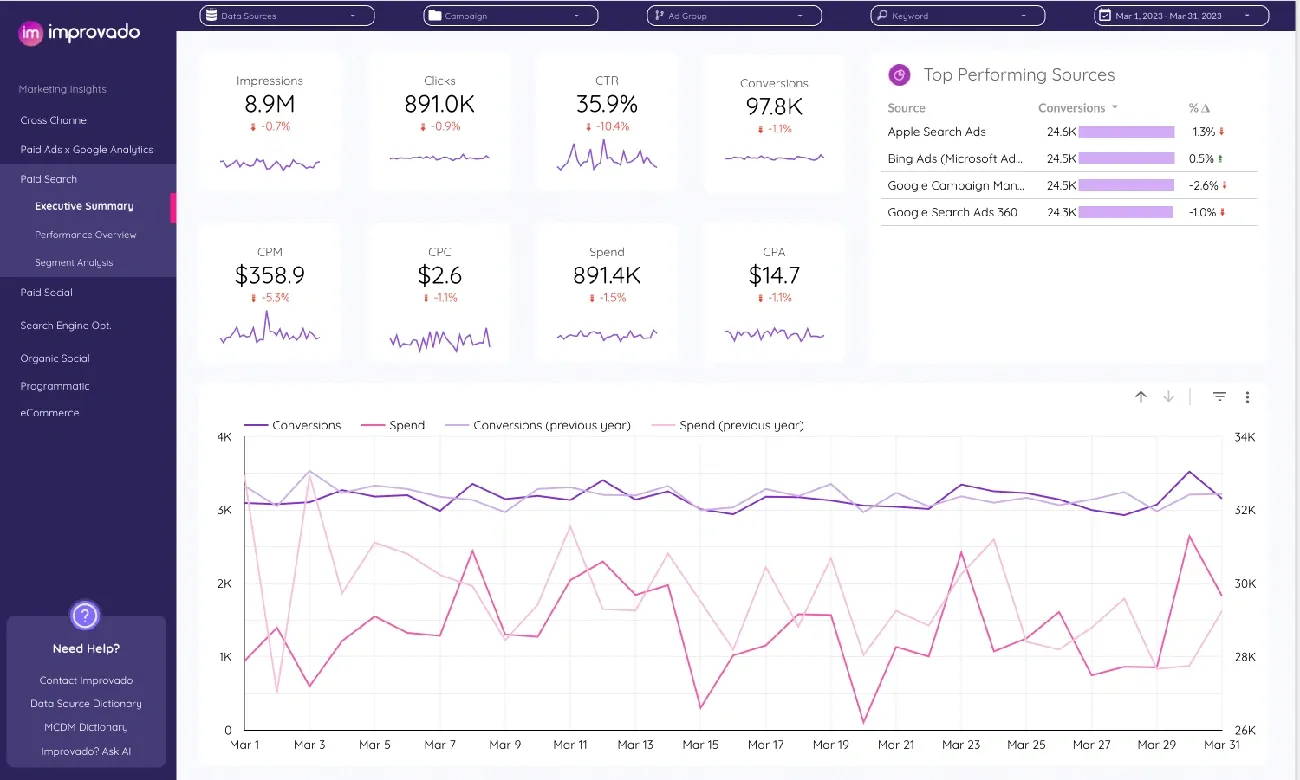
Image Source: Improvado
The life-blood of successful PPC campaigns lies in tracking the right metrics. Your ad spend optimization becomes guesswork without proper measurement instead of a data-driven strategy. Let’s get into six vital PPC metrics that leading marketers watch to achieve campaign success.
Click-Through Rate (CTR)
CTR shows the percentage of people clicking your ad after viewing it. The calculation divides clicks by impressions and multiplies by 100. To name just one example, an ad getting 5 clicks from 100 impressions results in a 5% CTR.
Your ad’s relevance and appeal to target audiences becomes clear through CTR. Users find your ads helpful and relevant when you have a high CTR. A low CTR points to possible problems with your ad copy or targeting.
CTR changes substantially based on industry and platform. Search ads usually perform better than display ads. The average CTR across Google search ads reaches 1.91% while display ads achieve just 0.35%. Some industries like dating and personal services see CTRs as high as 3.40% on search networks.
Cost Per Click (CPC)
Each ad click comes with a price tag – that’s your CPC. An auction system determines this cost based on your maximum bid, ad quality, and competition.
The average CPC calculation remains straightforward – total ad cost divided by clicks. A $4.00 spend with 2 clicks gives you a $2.00 average CPC.
Legal services and finance industries face higher CPCs due to competition. Education and retail sectors enjoy lower costs. Your CPC can drop when you improve Quality Score through relevant ads and landing pages.
Conversion Rate
The percentage of clicks leading to desired actions like purchases or form submissions makes up your conversion rate. The math involves dividing conversions by ad clicks and multiplying by 100.
The average PPC conversion rate in all industries sits at 2.35%. Google Ads conversion rates have grown by 17% over the last several years. Top performers in the 25th percentile reach average conversion rates of 11.45%, setting a standard for excellence.
Your target conversion rate should land between 5-10%, depending on your industry. Well-aligned landing pages and effective targeting usually result in higher conversion rates.
Return on Ad Spend (ROAS)
ROAS tells you how much revenue each advertising dollar brings in. Revenue from conversions divided by ad spend gives you this metric, often shown as ratios or percentages.
Many consider a 4:1 ratio as the standard for acceptable ROAS – earning $4 for every dollar spent on ads. A $20,000 ad investment bringing in $80,000 revenue shows a 4:1 ROAS.
Different businesses need different ROAS targets to stay profitable. Some need 10:1 while others thrive at 2:1, based on their margins and business model.
Quality Score
Google rates your ad quality from 1-10 using their Quality Score diagnostic tool. Three main factors determine this score:
- Expected click-through rate: Your ad’s click likelihood when shown
- Ad relevance: How well your ad matches what users search for
- Landing page experience: Your landing page’s usefulness and relevance
Google compares each component to other advertisers targeting similar keywords, rating them “Above average,” “Average,” or “Below average”. Better ad positions and lower costs come with higher Quality Scores, making this metric key to campaign optimization.
Cost Per Acquisition (CPA)
CPA measures your spending to get one paying customer through specific channels or campaigns. Total campaign cost divided by new customers acquired gives you this figure.
Campaign efficiency and profitability assessment relies heavily on CPA. Search ads across industries average $56.11 CPA, while display network CPAs reach around $90.80.
Your industry determines what makes a “good” CPA, but it should always align with customer lifetime value. The rule of thumb suggests keeping CPA substantially below your average order value or customer lifetime value to run profitable campaigns.
These six key metrics give you the tools to fine-tune your PPC campaigns and maximize both performance and investment returns.
Step-by-Step PPC Analysis Framework
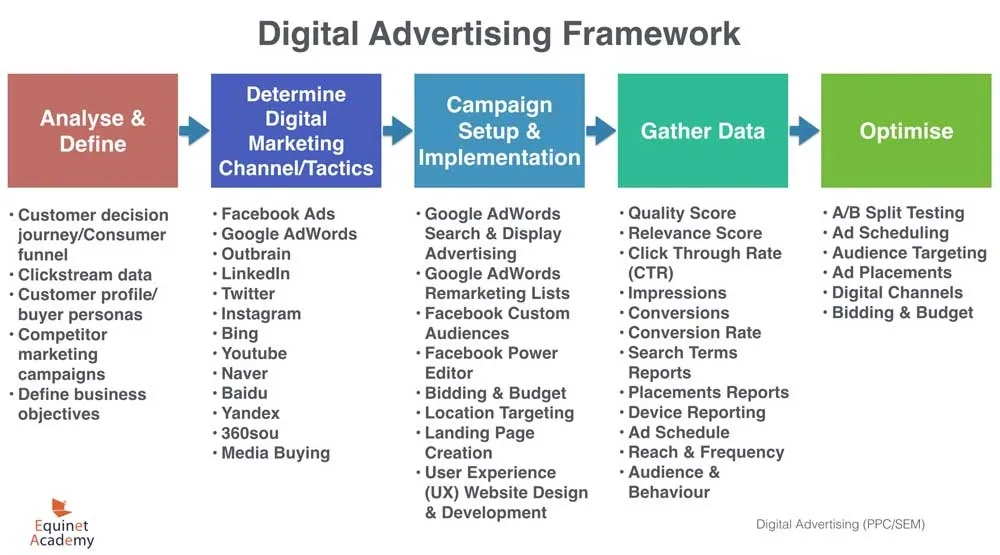
Image Source: Equinet Academy
Raw data becomes a powerful strategy through a systematic PPC analysis approach. Marketers can analyze campaigns better and gain meaningful insights with this six-step framework that directly affects performance.
1. Define your campaign goals and KPIs
PPC analysis success starts with clear objectives. You need to set your campaign goals before you dive into data. Your SMART goals (Specific, Measurable, Achievable, Relevant, and Time-bound) should line up with your business’s broader objectives.
The first step is to figure out if your campaigns target awareness, consideration, or conversion stages. Each stage in the funnel needs different metrics to measure success:
- Top-funnel campaigns focus on reach and awareness
- Mid-funnel campaigns emphasize engagement and consideration
- Bottom-funnel campaigns prioritize conversions and revenue
Your next step is picking KPIs that connect to these goals. Performance-focused campaigns might track clicks, impressions, and CTR. Conversion-focused campaigns would look at conversion rate, CPC, and ROI.
2. Collect and organize PPC data
Good PPC analysis needs thorough data from multiple platforms. Make sure your tracking is set up right – check if conversion tracking works and your analytics accounts are properly configured.
Your data from different sources should be in one place. Manual exports can take too much time. Tools that work with Google Ads, Facebook Ads, and other platforms can make this process easier.
You should also pick a regular reporting schedule – daily, weekly, or monthly. This helps you compare metrics over time more easily. Regular reporting shows trends more clearly and gives you reliable insights.
3. Evaluate performance against benchmarks
After collecting data, you should measure it against proper benchmarks. This gives context to your metrics. Start by looking at spend, clicks, CTR, CPC, and conversions at both account and campaign levels.
Your analysis should focus on week-over-week or month-over-month changes instead of single-period differences. Big changes need deeper investigation.
Industry benchmarks give you a good viewpoint. Google Ads shows an average CTR of 6.66%, with users paying $5.26 on average per click. Compare your numbers to these standards but remember that different industries have different metrics.
4. Segment data by audience, device, and location
Breaking down data shows hidden patterns and gives raw numbers real meaning. Different dimensions of your data can tell different stories.
Look at performance across:
- Audience segments based on demographics, interests, and behavior
- Device types (desktop, mobile, tablet)
- Geographic locations
- Time periods (day, week, month, hour)
This detailed view helps you spot which audiences, devices, or locations drive good or bad results. You can then move your budget to what works best or fix what’s not working.
5. Identify trends and patterns
Your PPC performance story comes from analyzing trends over time. Different timeframes show seasonality, campaign improvements, and outside factors.
The customer’s path becomes clear when you look at conversion journeys. Patterns show up in:
- Time of day or day of week performance
- Keyword performance patterns
- Audience engagement sequences
Competitive benchmarking using auction insights and impression share data adds another layer. A lower CTR or impression share might mean more competition rather than poor ad creative.
6. Generate actionable insights
Analysis becomes useful when it leads to action. After you find patterns and opportunities, create specific ways to make campaigns better.
Focus on practical tactics like:
- Moving budget to campaigns, ad groups, or keywords that work well
- Changing bids based on device, time, location, or audience results
- Testing new ad copy variations
- Making targeting better by removing irrelevant searches with negative keywords
- Making landing pages better when conversion rates are too low
Link your campaign results to business metrics like revenue, pipeline contribution, or qualified leads. This ensures your improvements help the business, not just platform metrics.
This six-step framework turns PPC analysis from reactive to strategic. It helps you improve campaign performance and business results continuously.
Tools That Power Effective PPC Analysis
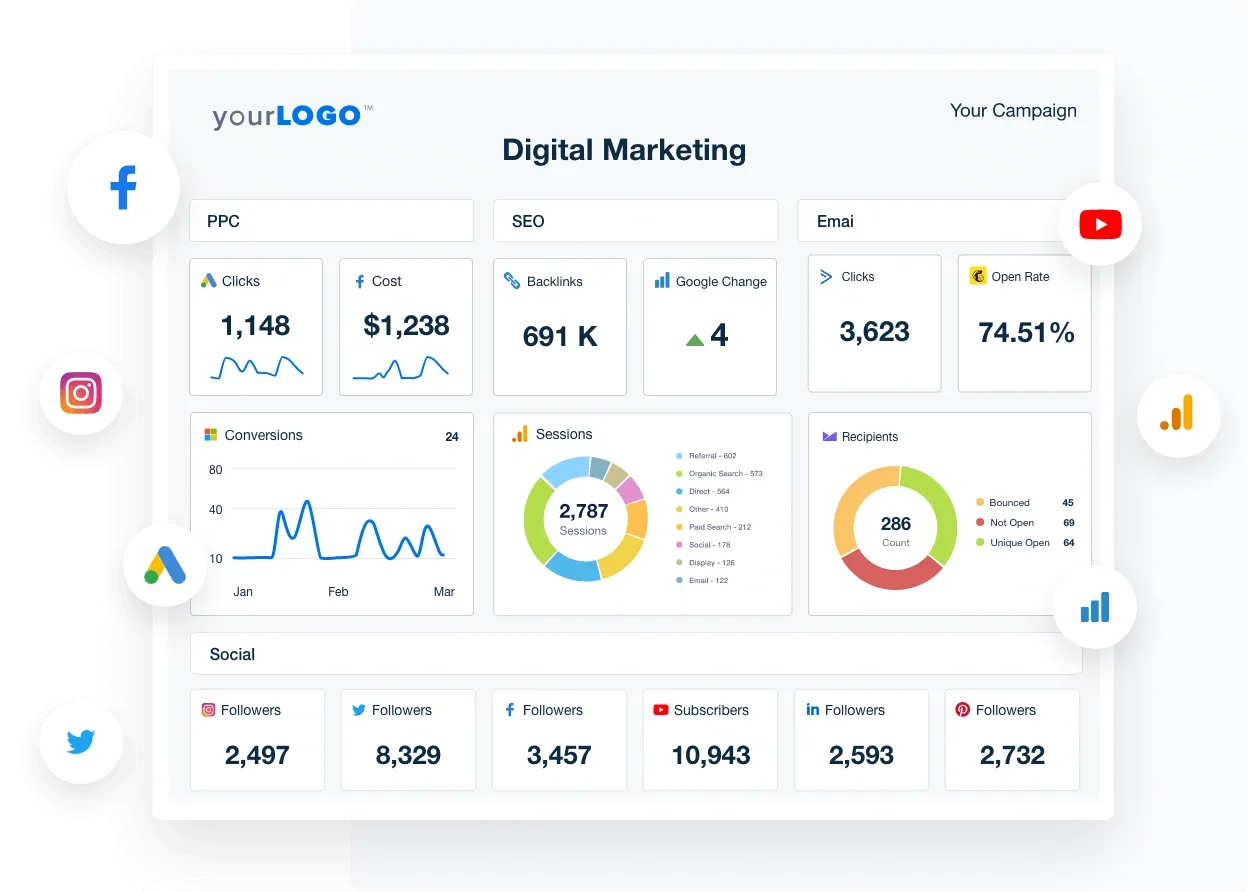
Image Source: AgencyAnalytics
A powerful toolset helps marketers learn about meaningful patterns in complex data. This makes every successful PPC campaign tick. The right tools can transform basic reporting into strategic PPC analysis that delivers ground results.
Google Ads and Bing Ads
Native advertising platforms are the foundations of PPC analytics that work. Google Ads leads with 89.73% search engine market share, and Microsoft Advertising (formerly Bing Ads) has 3.98%. Bing shows better results on desktop with 12.23% market share compared to Google’s 78.83%.
These platforms have distinct features beyond their reach. Microsoft Advertising gives you unique targeting options like LinkedIn Profile Targeting. Google Ads offers complete ad group management and detailed demographics. Microsoft lets you import your Google Ads campaigns directly. This makes cross-platform optimization more efficient.
SEMrush and Ahrefs
SEMrush shines with its complete paid search software suite and extensive PPC competitor analysis features. The platform works as a multi-tool that covers SEO, PPC, social media, and content marketing, unlike Ahrefs with its limited PPC features.
SEMrush’s Advertising Research tool is a great way to get insights into competitors’ Google ad strategies. You can see their keywords, ad copy, and estimated traffic costs. The platform’s Keyword Magic Tool helps you find budget-friendly keywords with search volume, competitive density, and CPC data.
Improvado and Looker Studio
PPC analysis often suffers from data integration issues. Improvado solves this by connecting over 200 data sources, including hard-to-extract platforms like Snapchat and LinkedIn. The tool naturally syncs cross-channel data with Looker Studio for visualization.
Looker Studio turns raw data into meaningful presentations through a “Connect – Visualize – Share” approach. It processes data from many sources and blends with Google’s ecosystem. Improvado collects and normalizes data, while Looker Studio creates useful visualizations.
MatchCraft and Optmyzr
Optmyzr has become a leading PPC management tool that boosts efficiency by a lot. The platform’s Rule Engine creates custom optimizations and automated workflows for Google, Microsoft, Amazon, and Meta campaigns. Users have seen impressive results – account managers’ productivity jumped 56% and they saved USD 600,000 on irrelevant placements.
Key Optmyzr features include:
- Automated bid management and budget allocation
- Performance alerts and anomaly detection
- Cross-platform optimization across multiple ad networks
Optmyzr stands out because it makes repetitive tasks efficient while providing advanced insights. HawkSEM CEO Sam Yadegar says these tools are “a great assist, never a replacement for human IQ.” This shows why finding the right balance between automation and strategic thinking matters.
These specialized tools help marketers move from time-consuming data collection to strategic decisions that improve campaign performance consistently.
Advanced Techniques Top Marketers Use
PPC marketers stand out by using sophisticated techniques beyond simple campaign management. These advanced methods deliver better results through precise targeting, testing, and optimization.
Audience segmentation and intent mapping
Breaking down targets into distinct groups based on specific traits helps boost relevance and conversion rates. When you group users by their search purpose, you’ll see higher click-through rates and improved ROI.
Advanced segmentation strategies include:
Custom segments target users who visit specific types of sites or use certain apps. Google’s custom segments use specific keywords, URLs, and apps related to your product to reach users who might be interested in these areas.
Branded searches work best when you split audiences into segments, new visitors, non-buyers, and previous customers. This approach lets you craft messages that speak to needs at each stage.
A/B testing for ad creatives and landing pages
A/B testing shows which version of an ad or landing page works better. This method can boost conversion rates up to 80% when you use strong CTAs.
The best A/B tests change just one element at a time, like headlines, CTA phrases, or creative elements. Google’s Responsive Search Ads run automatic tests of different headline and description combinations to find what works best.
Attribution modeling for better ROI tracking
Attribution modeling shows how different touchpoints contribute to sales. Last-click attribution gives full credit to the final interaction, while informed attribution spreads credit based on actual impact across the conversion path.
You can choose from several models: first-click, linear, time-decay, and position-based attribution. The right model helps allocate marketing budgets by showing which channels truly drive conversions.
Using AI for predictive bidding and optimization
AI reshapes PPC campaigns with automated bidding strategies. These strategies analyze signals like time, device, location, and user behavior to adjust bids in real time. Google’s Smart Bidding uses machine learning to optimize conversions across every auction, a process called ‘auction-time bidding’.
AI excels at personalizing ads for target segments by analyzing behavior, search history, and demographics. It also uses predictive analytics to forecast which users will likely convert, helping marketers make smarter budget decisions.
Google’s Conversion Probability feature shows how likely someone will convert after clicking an ad. This helps marketers focus their budgets on high-intent audiences.
Common PPC Analysis Mistakes to Avoid
PPC campaigns can fail even with sophisticated strategies when marketers make common analytical mistakes. These errors can ruin well-designed strategies and waste budgets while missing valuable opportunities.
Over-relying on vanity metrics
Vanity metrics give marketers false confidence about campaign success without showing real business results. Surface-level numbers like high impressions or click-through rates without conversions create a fake sense of success while hiding poor performance. Lead generation companies waste money when they focus only on lead volume instead of quality. This quantity-over-quality mindset results in higher acquisition costs with little return, and sales teams get frustrated with low-quality leads.
Ignoring conversion lag and attribution windows
Marketers often judge campaigns too early because they don’t account for conversion lag – the time between when someone sees an ad and converts. Google Ads uses a 30-day default attribution window, but many marketers don’t adjust this to match their actual sales cycle. Products that need more time to think over need longer conversion windows. Short windows miss conversions that happen later, making campaigns look worse than they are.
Letting automation run without oversight
Automation makes campaign management easier, but “set and forget” creates problems quickly. PPC automation needs human guidance – it’s a tool to help, not replace human decisions. Wrong settings can drain budgets fast as automated systems might bid too much on wrong audiences. Web traffic includes 38% bots, and 24% of these are “bad bots” that can trigger automated campaigns wrongly.
Failing to act on insights
Campaigns drift away from their goals when teams don’t review performance data regularly, and optimization becomes reactive. Teams that look at metrics only during problems fix symptoms instead of finding root causes. To name just one example, higher CPA might make someone lower bids right away without checking if the problem comes from more competition, targeting changes, or tired ad creative from days before.
Conclusion
PPC analytics mastery makes the difference between campaigns that waste money and those that deliver exceptional business results. This piece explores what sets top PPC marketers apart from average performers. Good PPC analysis goes way beyond simple reporting. It turns raw data into actionable insights that affect campaign performance directly.
We got into six key metrics – Click-Through Rate, Cost Per Click, Conversion Rate, Return on Ad Spend, Quality Score, and Cost Per Acquisition. These metrics form the foundation of informed decision making. In spite of that, these numbers only create value when marketers analyze them within a framework that links platform data to business outcomes.
The step-by-step analysis process we’ve shared gives you a tested path to optimize campaigns. This systematic approach helps you spot specific opportunities across audience segments, devices, and locations. On top of that, the specialized tools we covered can make this process much faster. You’ll have more time to think strategically instead of wrestling with data.
Top marketers set themselves apart through advanced techniques. They use intent-based audience segmentation, thorough A/B testing, multi-touch attribution modeling, and AI-driven bidding strategies. These methods need more expertise but deliver results that are a big deal as it means that they outperform standard campaign management.
Maybe even more crucial is avoiding common analytical mistakes. Don’t fixate on vanity metrics, misunderstand attribution windows, rely too heavily on automation, or fail to act on insights. These pitfalls can hurt your campaigns despite your best efforts.
Without doubt, PPC success needs disciplined analysis and constant optimization. Marketers who use this informed approach consistently beat their competitors and see remarkable returns on ad spend. With these insights, you can now raise your PPC campaigns from budget spenders to real business growth drivers.
Start mastering your PPC with GrowLeads.io now.
FAQs
Q1. What are the most important PPC metrics to track for campaign success?
The key metrics to monitor include Click-Through Rate (CTR), Cost Per Click (CPC), Conversion Rate, Return on Ad Spend (ROAS), Quality Score, and Cost Per Acquisition (CPA). These metrics provide insights into ad performance, cost-effectiveness, and overall campaign success.
Q2. How does PPC analysis differ from basic reporting?
PPC analysis goes beyond simply presenting raw numbers. It involves interpreting data within the context of campaign goals, providing context and commentary, segmenting performance, and offering actionable recommendations to improve outcomes.
Q3. What are some advanced techniques used by top PPC marketers?
Top marketers employ techniques such as audience segmentation and intent mapping, A/B testing for ad creatives and landing pages, attribution modeling for better ROI tracking, and using AI for predictive bidding and optimization.
Q4. What common mistakes should be avoided in PPC analysis?
Common pitfalls include over-relying on vanity metrics, ignoring conversion lag and attribution windows, letting automation run without oversight, and failing to act on insights derived from data analysis.
Q5. How can tools enhance PPC analysis and campaign management?
Tools like Google Ads, SEMrush, Improvado, and Optmyzr can streamline data collection, provide competitive insights, enable cross-platform optimization, and automate repetitive tasks. These tools allow marketers to focus more on strategic decision-making rather than manual data processing.

Runs paid acquisition across Google, LinkedIn, and Meta for B2B pipeline.