
B2B SaaS Pipeline: Build Predictable Revenue in 2026
The B2B SaaS market, projected at $376 billion by 2026, operates with a structural flaw most founders refuse to diagnose. Single-channel dependence, underdefined ICPs, and manual qualification stacks create pipelines that spike and collapse with the rhythm of ad spend rather than market demand. Ad costs are up 20% year-over-year. Organic reach is fragmenting. The firms still running one-channel bets are not experiencing a bad quarter. They are operating a broken architecture.
The root of pipeline volatility is not budget. 70% of leads reaching sales teams in 2026 are unqualified, produced by systems that optimise for volume over signal. Founders and CMOs chase MQL counts while revenue-generating signals, namely behavioural intent, firmographic fit, and multi-touch engagement, go unscored. The result is a sales team perpetually triaging noise.
Predictable lead generation pipeline architecture eliminates this by engineering three interdependent systems: ICP precision filters, multi-channel demand distribution, and AI-driven qualification thresholds. Growleads clients running this architecture achieve 20% month-over-month pipeline growth within 90 days. The briefing below documents the exact build sequence.
Why Pipeline Predictability Defines SaaS Revenue in 2026
2026 marks the inflection point where AI-driven buyer research, vertical SaaS consolidation, and rising paid media CPCs converge. Firms without systematic pipeline engines are not competing at a disadvantage. They are competing in a different game entirely, one with no consistent scoring, no repeatable signal, and no velocity floor.
Execution Metric: Pipeline velocity below 20% MoM growth signals a structural channel or scoring failure, not a demand problem. Diagnose the architecture before adjusting budget.
Velocity, not volume, defines a high-performance pipeline. The metric framework below separates operators from experimenters.
| Metric | Minimum Threshold | Revenue Signal |
|---|---|---|
| Pipeline Velocity | 20% MoM growth | Compounding revenue base |
| Lead-to-Opportunity Rate | 5–10% | ICP alignment score |
| Cost Per Lead (B2B SaaS) | Under £100 | Channel efficiency |
| AI Scoring Threshold | 70+ behaviour, 50+ demo-ready | Sales team focus |
| Channel Distribution | 40% paid / 30% organic / 30% outbound | Risk diversification |
| ROAS Floor | Above 1.5x per channel | Kill non-performers weekly |
According to SaaSHero’s 2026 pipeline analysis, SaaS founders allocating budget across fewer than three channels experience 40% higher pipeline variance than multi-channel operators. Variance is not a performance issue. Variance is a structural issue.
What Does Pipeline Predictability Actually Mean for SaaS?
Predictability means the pipeline generates qualified opportunities at a consistent rate, independent of seasonal ad cycles or content virality. It requires a minimum of five firmographic data points combined with three behavioural intent signals per ICP tier. When those conditions are met, forecasting becomes arithmetic rather than estimation.
ICP Architecture: The Foundation of Qualified Pipeline Generation
Revenue-driving systems require a precisely defined Ideal Customer Profile before a single pound of media budget moves. 80% of B2B SaaS firms treat ICP definition as a marketing document. The operators building predictable pipelines treat it as a qualification engine with hard thresholds.
Partner Definition: An ICP is not a persona narrative. It is a scoring matrix of firmographic attributes (company size, ARR band, tech stack, growth stage) combined with intent signals (content consumption, competitor search, pricing page visits) that statistically correlate with closed revenue.
Every ICP architecture requires five minimum firmographic layers and three intent signal layers before being deployed to any channel.
ICP Minimum Viable Data Stack:
- Firmographic: Industry vertical, employee count, ARR band, growth stage, tech stack
- Behavioural: Pricing page visits, competitor comparison searches, trial sign-up patterns
- Intent: Third-party intent data (Bombora, G2), LinkedIn engagement, dark funnel signals
- Enrichment: Clay for data enrichment, Clearbit for firmographic depth
- CRM Sync: HubSpot score field updated weekly, auto-route to SDR at score 60+
ICP Audit Protocol: What Breaks Qualification Systems?
The three structural failures in ICP definition are over-broad targeting (any company with a tech budget), missing intent layering (firmographics without behavioural data), and stale profile data (ICP built on last year’s closed-won, not current market signals). Each compounds the others.
The 4-Step ICP Audit Sequence:
- Pull last 90 days of closed-won deals. Extract firmographic commonalities (industry, size, ARR, tech stack).
- Map behavioural signals that preceded close. Identify the 3 highest-frequency intent markers.
- Cross-reference with current pipeline. Score all active leads against the closed-won pattern.
- Kill leads scoring below 40. Route 40-60 to nurture sequence. Escalate 60+ to SDR with context brief.
Execution Metric: ICP-matched leads close at 3x the rate of unmatched leads. Firms running ICP-filtered LinkedIn campaigns see 26x ROAS within 60-90 days of deployment. See Growleads demand generation case studies for verified client outcomes.
Multi-Channel Demand Generation Architecture
Headley Media’s 2026 SaaS lead generation analysis confirms the 3-channel minimum for pipeline stability. Each additional channel beyond the first reduces revenue volatility by 15-18% on average, because no single platform policy change, algorithm shift, or CPM spike can collapse the entire system.
The distribution framework below is not theoretical allocation. It reflects operator-level execution across LinkedIn, Google, and outbound stacks.
| Channel | Budget Allocation | Primary Function | Key Metric |
|---|---|---|---|
| LinkedIn Ads | 40% | ICP-matched demand capture | CPL under £80, reply rate |
| Google Ads (high-intent) | 20% | Intent-signal capture | £5-10 CPC, ROAS 2x+ |
| Organic / SEO Content | 30% | Pipeline via dark funnel | 30% of qualified leads |
| Outbound / Cold Email | 10% | Direct ICP outreach | 7-touch sequence, 4%+ reply |
Norm Challenge: Organic content does not belong at the bottom of the B2B pipeline allocation. Firms generating 30% of qualified pipeline from SEO and content reduce paid CPL by 22% through brand signal amplification across all paid channels simultaneously.
How Does Multi-Channel Balance Reduce Pipeline Volatility?
Balance reduces volatility by ensuring no single platform failure eliminates more than 40% of inbound signal. LinkedIn algorithm changes, Google quality score fluctuations, and content deindexation events all become contained incidents rather than pipeline crises. The 40/30/30 split between paid, organic, and outbound represents the minimum diversification threshold.
SaaS Pipeline Building with LinkedIn and PPC
LinkedIn pipeline tactics for B2B SaaS operate on a precise structural model. Job title targeting combined with video hook creatives driving to demo forms produces CPLs 30-40% below industry average when the ICP filter is applied at the campaign level, not the ad set level.
The default LinkedIn campaign architecture for SaaS pipeline generation:
LinkedIn Ads Stack:
- Targeting: Job title + seniority (VP/Director/C-Suite) + company size (51-500 employees) + industry vertical
- Creative: 15-second video hook addressing specific pain, not product features
- Destination: Demo booking form with 3-field maximum (name, email, company size)
- Retargeting: Website visitors scoring 40+ in HubSpot re-entered into a separate nurture ad sequence
- Budget: Minimum £3,000/month per ICP segment for statistical signal
Google Ads Stack:
- Keywords: High-intent B2B SaaS terms (£5-10 bid range), competitor terms, and category-definition queries
- Match type: Exact and broad modified only. No broad match on B2B budgets.
- Retargeting: Pixel-qualified visitors from LinkedIn who did not convert
- Kill threshold: Any ad group below 1.5x ROAS after 14 days. No exceptions.
Execution Metric: LinkedIn campaigns built on ICP job title + intent data targeting deliver reply rates 3-4x higher than interest-based targeting. Growleads SaaS clients hit 26x ROAS within 90 days using this stack structure.
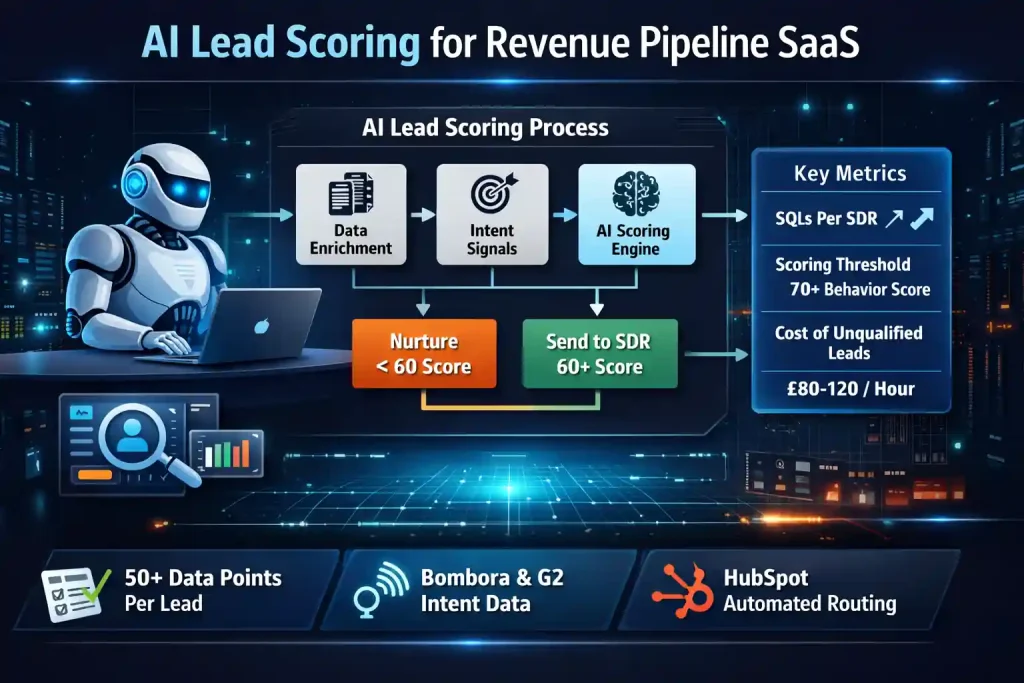
Behavioural scoring replaces intuition-based SDR prioritisation. The architecture above is not a suggestion for how to qualify leads. It is the operational system. Every unscored lead that reaches an SDR is a revenue leak because SDR time costs £80-120 per hour in fully loaded compensation. Sending unqualified leads to sales is not inefficiency. It is a structural tax on revenue.
Smarte’s 2026 SaaS lead generation benchmarks confirm that AI-scored pipelines produce 2-3x higher SQLs-per-SDR ratios compared to manual qualification processes. The scoring model below drives that outcome.
AI Scoring Tool Stack:
- Enrichment: Clay (firmographic depth, 50+ data points per lead)
- Intent Data: Bombora or G2 Buyer Intent for dark funnel signal
- Scoring Engine: HubSpot native scoring or Clearbit Reveal for real-time enrichment
- CRM Automation: Score 60+ triggers SDR task creation in HubSpot automatically
- Analytics: Bi-weekly scoring model review, recalibrate weights against closed-won data
What Is a Good Reply Rate for B2B SaaS Outbound?
A reply rate above 4% on cold outbound sequences signals ICP alignment and message-market fit. Rates below 2% indicate either ICP mismatch, messaging that addresses features rather than specific outcomes, or sequence timing failures (first touch sent at wrong stage of buyer journey). Replace open rate as the primary outbound metric with reply rate immediately.
Metrics and Optimisation Loops
Weekly pipeline health reviews prevent the 40% lead leakage rate common in unmonitored systems. Predictable B2B pipeline generation requires a structured optimisation cadence, not quarterly reviews. Markets shift monthly. Campaigns degrade weekly. Scoring models require recalibration as closed-won patterns evolve.
Execution Metric: A/B test every ad creative and email sequence weekly. Kill any variant producing below 1.5x ROAS after 14 days of spend. Waiting longer compounds the loss.
The optimisation architecture operates on two cadences, weekly and bi-weekly, each with distinct diagnostic functions.
| Review Cadence | Metrics Reviewed | Action Trigger |
|---|---|---|
| Weekly | ROAS per channel, CPL, reply rate, score distribution | Kill underperforming ad groups, adjust bid caps |
| Bi-weekly | Pipeline velocity, lead-to-opp rate, ICP match rate | Recalibrate ICP thresholds, update scoring weights |
| Monthly | Channel attribution, SDR productivity, CAC per segment | Reallocate budget, adjust channel mix |
| Quarterly | Full ICP audit, closed-won analysis, scoring model refresh | Structural pipeline architecture review |
Optimise your LinkedIn campaign performance with Growleads’ live pipeline optimisation dashboard, which tracks ROAS, CPL, and velocity metrics in real time against your ICP thresholds.
How Often Should B2B SaaS Companies Review Pipeline Health?
Bi-weekly pipeline health reviews represent the minimum effective cadence for B2B SaaS pipelines operating above £50,000 monthly ad spend. Below that spend level, weekly reviews remain appropriate because smaller budgets are more sensitive to individual campaign variance. Monthly reviews at any spend level produce data that is too stale to prevent compounding underperformance.
The comparison matrix above represents the structural delta between pipeline architectures. Clients aligning outbound with freemium convert 2-5x better than inbound-only models, because the outbound channel surfaces high-intent leads already in product evaluation mode. Run a free ICP audit to identify which architecture gaps exist in your current pipeline before reallocating channel budget.
Norm Challenge: CMOs treating LinkedIn as a brand awareness channel are leaving pipeline on the table. LinkedIn operates as the highest-signal B2B demand capture platform available in 2026, producing CPLs 30-40% below Google Ads when ICP targeting is applied at the campaign level with behavioural retargeting layers active.
Q1. How do B2B SaaS companies build predictable lead generation pipelines?
B2B SaaS companies build predictable pipelines by deploying three interdependent systems: ICP precision filters using firmographic and intent data, multi-channel demand distribution across at least three channels, and AI-driven lead scoring with automated routing at score thresholds. Predictability requires weekly optimisation cadences, not monthly reviews.
Q2. What is a predictable lead generation pipeline in SaaS?
A predictable pipeline generates qualified opportunities at a consistent rate independent of seasonal ad cycles or content virality events. It requires a minimum scoring model combining behavioural intent signals with firmographic attributes, producing 20% MoM growth as the minimum acceptable velocity floor.
Q3. What are the best demand generation strategies for SaaS pipeline building in 2026?
The highest-performing 2026 demand generation strategies combine LinkedIn ICP-targeted ads, high-intent Google PPC, organic SEO content for dark funnel capture, and intent data-enriched outbound sequences. The 40/30/30 paid-organic-outbound distribution represents the validated minimum for pipeline stability.
Q4. How do you generate qualified pipeline for B2B SaaS revenue?
Qualified pipeline generation requires ICP definition with five firmographic data points and three intent signals, followed by AI scoring that routes leads above score 60 to SDRs automatically. Unscored leads entering sales teams represent the primary source of pipeline waste in SaaS firms.
Q5. What makes LinkedIn ads effective for predictable SaaS lead generation pipeline?
LinkedIn ad effectiveness in SaaS pipeline generation depends on three structural elements: job title plus seniority targeting layered with ICP firmographic filters, video hooks addressing specific pain points rather than product features, and demo forms limited to three fields maximum. Adding HubSpot retargeting for website visitors scoring above 40 extends the conversion window by 60-90 days.
Q6. What AI tools work best for B2B SaaS lead scoring in pipelines?
Clay handles firmographic enrichment at depth, Bombora and G2 Buyer Intent provide third-party intent signals, and HubSpot native scoring automates SDR routing at configurable thresholds. The combination produces a fully automated scoring architecture requiring only bi-weekly human recalibration.
Q7. What metrics define a predictable revenue pipeline for SaaS?
The six metrics defining pipeline health are pipeline velocity (minimum 20% MoM), lead-to-opportunity rate (5-10%), CPL under £100 for B2B SaaS, AI scoring threshold at 70+ for behaviour and 50+ for demo-readiness, ROAS floor at 1.5x per channel, and outbound reply rate above 4%.
Q8. Multi-channel versus single-channel for SaaS pipeline generation: which produces better results?
Multi-channel pipeline architecture produces 40% lower pipeline variance than single-channel systems, according to 2026 SaaS operator data. Single-channel dependence creates volatility that compounds with every ad platform policy change, algorithm update, or CPM increase. Three-channel minimum is the operational floor for predictable pipeline.
Q9. What are the most common mistakes in B2B SaaS lead generation pipelines?
The three most damaging mistakes are single-channel allocation (fix: distribute across 3+ channels), absence of AI scoring (fix: implement score threshold at 60 for SDR routing), and ignoring pipeline velocity as a metric (fix: weekly velocity dashboards with 20% MoM floor). Each mistake compounds the others when left unaddressed.
Q10. How does Growleads build predictable pipelines for SaaS companies?
Growleads engineers predictable pipelines through a four-phase sequence: ICP audit using closed-won data, LinkedIn and Google Ads stack deployment with ICP-level targeting, HubSpot AI scoring architecture at the 60+ threshold, and bi-weekly optimisation reviews against velocity and ROAS benchmarks. Clients achieve 20% MoM pipeline growth within 90 days of full system deployment.
Section A: SaaS Email Marketing for Pipeline Velocity
Email marketing in B2B SaaS is a pipeline velocity engine: the system that moves leads from first touch to closed deal at a pace your sales team can predict. Most SaaS companies treat email as a broadcast channel. That’s the wrong model. Email sequences built around SaaS buying stages (trial nurture, expansion, renewal) outperform generic drip campaigns by a wide margin. Forrester’s 2024 research found that SaaS companies using automated email nurturing generate 50% more sales-ready leads at 33% lower cost (Forrester, 2024).
The distinction matters because SaaS sales cycles have three phases that generic B2B doesn’t. First, trial nurture: the prospect is inside your product but hasn’t committed. Sequences here should be triggered by in-app behavior, not calendar dates. A user who completed onboarding in two days needs a different message than someone who logged in once and went quiet. Second, expansion: the account is paying but only using a fraction of the product. Sequences here focus on feature discovery and use case education, not upselling pitches. Third, renewal: the 60-day window before contract expiration where engagement signals (or their absence) determine whether the renewal conversation is proactive or reactive.
We rebuilt email nurture sequences for a mid-market SaaS client in Q3 2025 and learned something uncomfortable. Their existing 12-email onboarding sequence had a 4% reply rate. When we cut it to six emails, each tied to a specific product milestone, reply rates jumped to 11%. More emails is not more pipeline. Think of it like a GPS: recalculating the route when the driver makes a turn, not repeating the same direction louder. The sequence should respond to what the prospect did, not just what day it is.
One tool opinion worth noting: we prefer Customer.io over HubSpot for SaaS trial nurture because Customer.io lets you trigger sequences from product events natively, without middleware. HubSpot requires a Segment or Zapier layer, which adds latency and breaks when event schemas change. For expansion and renewal sequences where CRM data matters more than product data, HubSpot works well. The right answer is rarely one tool for everything.
Section B: Predictive Scoring for SaaS: When to Act on Trial Signals
Predictive lead scoring for SaaS is the practice of using product usage data, marketing engagement signals, and firmographic context to rank trial users by their likelihood to convert. The traditional MQL model, where a lead fills out a form and gets a score based on job title and company size, misses the most important signal in SaaS: what the prospect actually does inside the product.
Product usage signals that predict conversion fall into three categories. Feature adoption depth: a user who activates three or more core features in the first week converts at 3x the rate of someone who only touches the dashboard. Time in app: Mixpanel’s 2024 SaaS benchmark report found that users who spend 15 or more minutes per session in the first 14 days convert at 2.4x the average rate (Mixpanel, 2024). Team invites: when a trial user invites colleagues, it signals organizational buy-in, not just individual curiosity. Each of these signals tells you something that a form fill never could.
The mistake we made early (and I’ve seen dozens of SaaS teams repeat) is treating product signals and marketing signals as separate scoring models. You end up with a product-qualified lead score and a marketing-qualified lead score, and the sales team ignores both because neither gives the full picture. The better approach is a unified score that weights signals from both systems. A lead who downloaded a whitepaper and invited two teammates to a trial is fundamentally different from a lead who did either of those things alone.
Here’s the contrarian take: most SaaS companies start building predictive scoring too early. If you have fewer than 200 closed-won deals in your dataset, your model doesn’t have enough signal to be predictive. It’s pattern-matching on noise. You’re better off with a simple rule-based model (if feature X plus team invite, route to sales) until your conversion volume gives a machine learning model something real to learn from. As Malay Gupta puts it: “Predictive scoring is infrastructure. And like all infrastructure, building it before you have traffic on the road is a waste. Start with rules, graduate to models when the data earns it.”

Kuldeep is part of the Growleads team, working on SEO and automation to help improve lead generation systems. He focuses on building simple automated workflows, optimizing content processes, and learning to create scalable growth systems.