
AI‑Optimized B2B Email Templates for High Conversions
![Hero Image for 7 B2B Email Drip Campaign Templates That Convert Prospects to Customers [2025]](https://growleads.io/wp-content/uploads/2025/04/1-8.webp)
Email marketing revenue is expected to reach $11 billion by the end of 2023. Smart businesses aren’t letting this opportunity slip away, they’re using email drip campaign templates to grab their share of this massive market.
The power of these campaigns is something we’ve witnessed firsthand. Just imagine, one company ran only 16 drip campaigns with 70+ emails and landed 15 new deals while nurturing 150 contacts in just two months. But here’s the challenge you’re facing: 60% of online customers will ditch brands that send non-personalized content.
That’s exactly why we’ve created these 7 proven B2B email templates that actually deliver results. Each template is based on real success stories and best practices. For example, did you know that welcome emails achieve a 14.34% click-through rate, seven times higher than standard emails? Whether you need to nurture leads, onboard new customers, or wake up dormant prospects, these B2B email templates will help you build campaigns that convert.
Let’s get started 👇
Welcome Email Drip Campaign Template

Image Source: Automizy
Welcome emails are the most underused opportunity in B2B marketing, and I’m honestly surprised more companies aren’t taking advantage of them. When someone joins your list, they’re at peak interest in what you’re offering. It’s the perfect moment to make a strong first impression and start building that crucial relationship.
What makes these initial touchpoints so valuable? The numbers speak for themselves. Welcome emails generate 320% more revenue per email than standard promotional messages. They also achieve open rates of 50% compared to typical marketing emails. That’s an engagement goldmine you simply can’t afford to ignore.
Welcome email drip campaign purpose
When you launch a welcome email drip campaign, you’re doing more than just saying hello. Your primary goal is to guide new subscribers through their first experience with your brand. Think of it as extending a digital handshake that builds trust from day one. This matters especially for prospects who’ve just opted in and are still in the awareness stage of their buyer’s journey.
Welcome drip campaigns serve several critical functions beyond simple introductions. First, they thank subscribers for their time, something we often overlook in digital marketing. Second, they set clear expectations about future communications. Third, they showcase the unique benefits of being connected to your brand. Perhaps most importantly, these emails give you the chance to move leads deeper into your funnel by sharing your best-performing content.
For B2B companies specifically, a good welcome sequence transforms that initial spark of interest into meaningful engagement. The data backs this up too. Studies show welcome emails generate double to quadruple the engagement rates of regular promotional emails. Not only that, but subscribers tend to stay on your list longer, interact with your content more frequently, and ultimately spend more money with your business.
Best practices for welcome email drip campaigns
When it comes to welcome emails, timing isn’t just important, it’s everything. You need to send them immediately after signup. The research backs this up: real-time welcome emails achieve an 88.3% open rate compared to just 52.6% for batch-recurrent emails sent later. By responding immediately, you’re capturing that rare moment when interest in your brand is at its peak.
For the best results in B2B environments, I recommend building your welcome sequence around these tested practices:
- Personalize beyond the name – Don’t just plug in their first name and call it a day. Address subscribers directly and tailor your content based on how they found you and joined your list.
- Keep it concise – Nobody wants to read a novel in their inbox. Deliver only the most pertinent information in a clean, easy-to-scan format.
- Include a clear call-to-action – Give your new subscriber a specific next step that drives engagement. Ambiguity is the enemy of conversion.
- Request whitelisting – This simple ask can dramatically improve your deliverability. Just ask subscribers to add your email to their contacts to keep your messages out of the spam folder.
- Consider a welcome series – Instead of putting all your eggs in one email basket, develop a sequence of 4-6 messages spread over time.
Here’s something that might surprise you: only 12.5% of B2B companies currently send welcome emails, compared to 75% of B2C retail businesses. This gap presents a significant competitive advantage for companies willing to implement this strategy. Your competitors are likely leaving this opportunity on the table.
Welcome email drip campaign example for B2B SaaS
A powerful B2B SaaS welcome sequence typically includes 4-6 emails sent over about two weeks. I’ve seen this framework convert consistently with my clients:
Email 1: The Welcome (Day 0)
Subject: Welcome to [Company] – Here's What to Expect

Hi [First Name],

Thank you for joining [Company]! I'm excited to have you on board.

Over the next few weeks, you'll receive resources to help you understand how our [product/service] can support your [specific goal].

Here's what to expect:
• Expert insights on [industry topics]
• Tips for maximizing our solutions
• Updates on our latest offerings

To get started immediately, [primary action step].

Feel free to reach out if you have questions!

[Your Name]
[Company]
Email 2: Learning More (Day 2)
Your second email should focus on understanding your subscriber better. Include a brief survey or feedback form that helps you tailor future communications to their specific needs and challenges. This personalization step makes a huge difference in engagement rates.
Email 3: Demonstrate Credibility (Day 4)
Now it’s time to build trust. Share customer success stories or testimonials that demonstrate your expertise in solving specific problems. Real results from similar companies can significantly reduce purchase anxiety.
Email 4: Highlight Core Features (Day 7)
This is where you showcase your product’s most valuable features and benefits. Focus on tools rather than specifications, your subscribers care more about outcomes than technical details.
Email 5: First Conversion Opportunity (Day 10)
Here’s where you introduce your offer with appropriate urgency. Research shows the majority of sales from email drip campaigns happen at the end of the sequence.
Creating an effective welcome email sequence takes some planning, but the investment pays off through stronger relationships and higher conversion rates. By implementing these templates and best practices, you’ll immediately stand out from competitors who are neglecting this crucial touchpoint. And trust me, most of them are.
Lead Nurturing Drip Campaign Template
“Drip email templates are a powerful tool when it comes to guiding potential customers through every stage of the sales cycle.”
, Mailtrap Team, Email testing and delivery platform experts

Image Source: Aritic
Building meaningful relationships with prospects isn’t just important in B2B marketing, it’s essential. This is where lead nurturing email drip campaigns truly shine. These automated email sequences are designed to guide prospects steadily through your sales funnel using targeted, relevant content that builds trust over time.
What makes these campaigns so effective? They deliver the right message at exactly the right moment in the buyer’s journey. Unlike one-off promotional emails that often miss the mark, nurturing sequences create multiple touchpoints that gradually strengthen your relationship with potential customers.
Lead nurturing email drip campaign structure
Lead nurturing campaigns demand a thoughtful approach to timing and sequence. They’re quite different from welcome sequences, while welcome emails are short and frequent, nurturing campaigns often span much longer periods, especially for B2B companies with extended sales cycles.
When planning your campaign length, consider the complexity of your offering. Generally, the more complex or expensive your solution, the longer your nurturing sequence should be. In B2B environments, effective nurturing campaigns might stretch across months or even a year. These extended timeframes make perfect sense when you consider that each converted lead typically represents substantial revenue for your business.
For email frequency, I’ve tested countless approaches and found two primary methods that consistently deliver results:
- Decreasing frequency pattern: Start with more frequent touchpoints that gradually taper off as time passes. Many successful marketers use what I call a Fibonacci-like sequence, sending emails on days 0, 1, 2, 3, 5, 8, 13, 21, etc.. This clever approach capitalizes on initial interest while respecting the natural diminishing of engagement over time.
- Consistent interval method: For longer nurturing campaigns, maintaining a steady cadence often works better. Weekly digests delivered on Monday mornings, for example, keep your brand visible without overwhelming prospects. Your subscribers begin to expect and look forward to your communications.
When it comes to content, focus on educational materials that genuinely help prospects evaluate tools to their challenges. Strong B2B nurture content includes case studies, whitepapers, and comparison guides that gradually deepen the relationship between potential buyers and your brand. Remember, you’re not just selling a product; you’re building trust through valuable information.
Lead nurturing email drip campaign best practices
To create nurturing campaigns that actually drive engagement and conversions, you need to follow these tested practices:
Segment your audience meticulously. This isn’t just good advice, it’s backed by hard data. Campaigns sent to specific segments generate 4-10x more responses than standalone blast emails. Don’t just send the same content to everyone. Instead, divide your list based on industry, behavior, or buyer stage to maximize relevance.
Personalize beyond the name. We’ve all received those emails that plug your first name into the greeting and call it personalization. That’s not enough. You need to address your target audience’s specific pain points and challenges in every message. Personalized emails increase conversion rates by up to 10%, making this step non-negotiable for effective nurturing.
Provide genuine value in every email. Each message you send should help prospects progress in their buyer journey, even if they’re not ready to purchase yet. Educational content builds credibility and positions you as a trusted resource. Remember, you’re playing the long game here.
Implement lead scoring. This is a turning point for most of my clients. Assign values to leads based on their interactions with your content, enabling your sales team to focus on high-potential prospects. Good automation tools can trigger specific follow-ups based on behavior, creating a more personalized experience without extra work.
Measure and optimize continuously. Don’t just set it and forget it. Track key metrics like open rates, click-through rates, and conversion rates to understand campaign effectiveness. These analytics help you identify the “leaky” parts of your funnel where leads aren’t converting as expected. Then you can fix them.
Lead nurturing email drip campaign example for B2B services
Looking for a practical example? Here’s a B2B lead nurturing sequence I’ve used with professional service providers. This campaign is specifically designed to convert leads who’ve downloaded a resource or attended one of your webinars:
Email 1: Building Trust (Day 1)
Subject: [First Name], here's how [Company Name] helped businesses like yours

Hi [First Name],

I noticed you recently [downloaded/attended] our [resource/webinar] about [topic].

Many [industry] businesses struggle with [specific pain point]. I wanted to share a quick case study showing how we helped [similar company] solve this exact problem and achieve [specific result].

[Link to case study]

If you're facing similar challenges, I'd be happy to discuss how we might help.

[Your Name]
Email 2: Educational Follow-up (Day 5)
Your second email should focus on providing a valuable resource that addresses a related pain point. This is where you can include relevant industry insights or data points that showcase your expertise without directly selling. The goal here is to build value before asking for anything in return.
Email 3: Social Proof (Day 12)
By now, your prospect needs reassurance that others like them have succeeded with your solution. Share testimonials or success stories from similar clients who’ve benefited from your services. This builds credibility and helps prospects visualize what success with you might look like for them.
Email 4: Address Objections (Day 21)
At this point, your prospect has likely developed some concerns or objections. Don’t avoid them, tackle them head-on. This proactive approach demonstrates that you understand their perspective and have nothing to hide. It also moves them significantly closer to making a decision.
Email 5: Conversion Opportunity (Day 30)
Now it’s time to present a clear, low-friction opportunity to take the next step. This might be scheduling a consultation, requesting a customized demo, or accessing a free trial. Make the process as simple as possible to reduce friction.
It’s worth noting that lead nurturing isn’t just about immediate conversions. Research shows carefully nurtured leads make 47% larger purchases than those who weren’t properly engaged. Through thoughtful sequencing and genuinely valuable content, these campaigns build the trust necessary for substantial B2B relationships.
Onboarding Drip Campaign Template
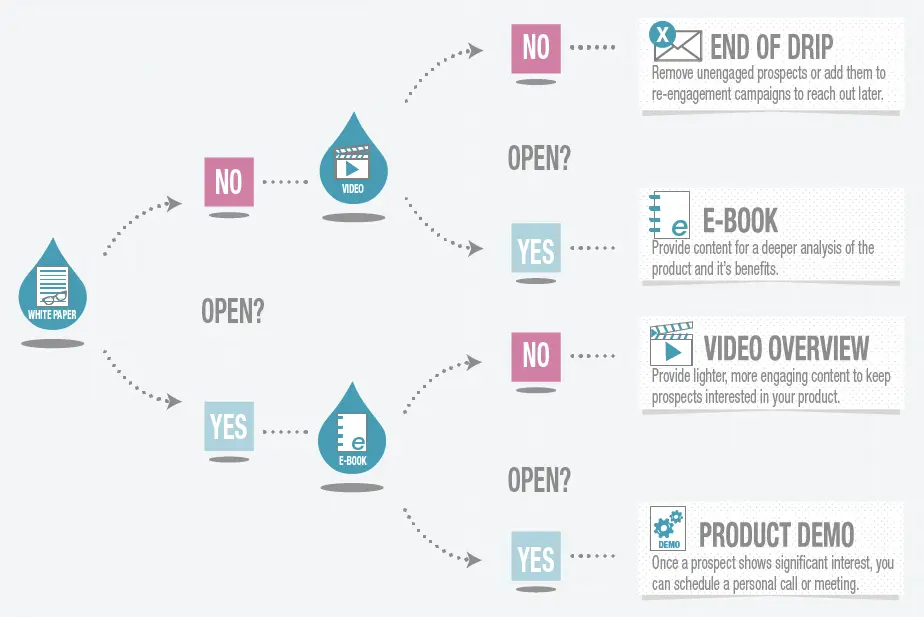
Image Source: Disruptive Advertising
Successful customer relationships don’t happen by accident, they start with a strong foundation. That’s exactly why onboarding email drip campaigns are so critical for B2B businesses. These carefully sequenced emails guide new users through their initial experience with your product, taking them on a journey from uncertain beginners to confident power users.
Think about it, the first few weeks after purchase are when customers form their lasting impressions of your solution. A well-crafted onboarding sequence doesn’t just show them how to use your product; it demonstrates you’re invested in their success from day one. This initial guidance can make the difference between a customer who churns after a month and one who becomes a long-term advocate for your brand.
Onboarding email drip campaign goals
Onboarding emails do much more than just introduce your product. Unlike welcome emails that focus primarily on first impressions, onboarding campaigns actively guide users toward product mastery. Research confirms that effective onboarding sequences help minimize churn while fostering deeper engagement.
Your onboarding campaigns should pursue several specific objectives:
Accelerate user activation: Good onboarding emails motivate users to quickly move from initial setup to active use, dramatically reducing the time to value. This early activation isn’t just a nice-to-have, it’s critical. Users who experience tangible benefits early are significantly more likely to stick with your product long-term.
Educate about key features: These emails should systematically introduce users to your platform’s functionality. Start with essential features before gradually introducing more advanced capabilities. This progressive approach prevents the all-too-common problem of overwhelming new users with too much information at once.
Build product engagement habits: The best onboarding sequences strategically guide users to take specific actions that develop regular usage patterns. This encourages them to incorporate your solution into their daily workflow. These small wins compound over time.
Reduce support costs: By providing proactive guidance through common challenges, you’ll minimize support tickets. It’s not just theory, research confirms this anticipatory approach significantly decreases customer service burden. Your support team will thank you.
Increase retention rates: This might be the most important benefit of all. Effective onboarding campaigns boost long-term retention in measurable ways. Studies show 86% of customers say they’re more likely to stay loyal to businesses that provide solid onboarding content. That’s a competitive advantage you can’t afford to ignore.
Onboarding email drip campaign sequence
The sequence and timing of your onboarding emails dramatically impact their effectiveness. When it comes to B2B platforms, you’ll need a different approach than what works for B2C models.
Let’s talk about sequence length first. While B2C companies often get away with shorter sequences, B2B onboarding typically requires 3-6 emails spread over approximately two weeks. That said, the exact number should align with your product’s complexity and your customer’s journey, more complex products generally need more guidance.
Timing is absolutely critical here. For your first message, immediate action is essential. Send your initial onboarding email instantly after signup or purchase to capitalize on that peak moment of interest. After that first touch, a strategically spaced cadence works best. Many successful B2B companies follow this pattern:
- Day 0: Welcome and first steps (immediate post-signup)
- Days 1-2: Core feature introduction
- Days 3-4: Check-in and troubleshooting assistance
- Day 7: Mid-point engagement enhancement
- Day 10: Advanced feature introduction
- Day 14: Feedback request and support reinforcement
For more sophisticated campaigns, consider trigger-based sequences that send emails when users complete (or fail to complete) specific actions. For example, you might trigger helpful tips when users interact with a particular feature for the first time. This behavior-based approach feels more personalized and timely to your users.
Onboarding email drip campaign example for B2B platforms
Here’s a practical onboarding sequence I’ve seen work wonders for B2B software platforms:
Email 1: Welcome & Getting Started (Immediate)
Subject: Welcome to [Platform] - Your Quick Start Guide

Hi [First Name],

Thanks for joining [Platform]! I'm [Your Name], and I'll be guiding you through getting set up.

To start seeing results right away:
1. Complete your account setup
2. Connect your first integration
3. Create your initial [specific feature]

Here's a 2-minute video showing exactly how: [Link]

Need help? Reply directly to this email—I'm here to ensure your success.

[Your Name]
[Position]
Email 2: First Feature Spotlight (Day 2)
Your second email should focus on introducing just one core feature that delivers immediate value. Don’t overwhelm them with options here. Include step-by-step instructions with screenshots or a short video tutorial showing practical application. The goal is a quick win that builds confidence.
Email 3: Personalized Check-in (Day 4)
By day 4, it’s time to check on their progress. Address potential roadblocks they might be facing and offer resources targeted to their specific usage patterns. This isn’t just good practice, research shows personalized onboarding content significantly improves engagement rates.
Email 4: Integration Guidance (Day 7)
About a week in, showcase how your platform works with other tools they might already use. This demonstrates how your solution fits into their existing workflow, dramatically increasing perceived value. Integration capabilities can often be the difference between a tool they use occasionally and one that becomes essential.
Email 5: Advanced Features Introduction (Day 10)
Now that they’ve mastered the basics, introduce more sophisticated capabilities. Focus on features that specifically address common B2B pain points in their industry. This is where you start elevating them from basic users to power users.
Email 6: Feedback Request (Day 14)
Two weeks in is the perfect time to ask for their feedback while offering additional support resources. This email should reinforce your commitment to their success and gather valuable insights for your own improvement.
Throughout this sequence, keep your branding and tone consistent while focusing each message on a single clear action. The data backs this up, onboarding emails with one primary call to action consistently outperform those with multiple competing objectives.
Sales Enablement Drip Campaign Template
A CRM helps track customer interactions and behaviors, ensuring that drip campaign templates are sent at the right time, based on individual lead activity.
, Mailtrap Team, Email testing and delivery platform experts

Image Source: Total Product Marketing
Sales teams simply can’t perform at their best without the right resources at the right time. That’s where sales enablement drip campaigns come in, they bridge that critical gap between your marketing efforts and actually closing deals.
These specialized campaigns deliver targeted content to prospects exactly when they’re approaching purchasing decisions. Unlike standard marketing emails, sales enablement sequences focus specifically on equipping both your sales team and your prospects with materials that facilitate meaningful conversations and overcome objections.
When done right, these campaigns create a seamless handoff between marketing and sales, ensuring no prospect falls through the cracks during that crucial decision-making phase. Your sales team will thank you for the support, and your conversion rates will show the difference.
Sales enablement email drip campaign strategy
Sales enablement drip campaigns are fundamentally different from other sequences because they focus on prospects much further along in their buyer’s journey. These campaigns aren’t about general awareness or education, they’re specifically designed to equip your sales team with the resources they need to convert leads who’ve already shown significant interest but haven’t yet made their final decision.
The most critical strategic element here is alignment between your sales and marketing teams. This isn’t just good practice, it’s backed by hard data. Research shows organizations that prioritize this alignment are almost 300% more likely to exceed customer acquisition goals. That’s why I always recommend joint planning sessions between departments to create truly effective sales enablement content. When both teams collaborate, the resulting materials address real sales obstacles that come up during conversations.
Timing is absolutely crucial in these campaigns. You can’t rush prospects at this stage, but you also can’t let them go cold. As a general guideline, create a sequence with 4 to 10 emails spaced out 4 days to 2 weeks apart. This spacing strikes the perfect balance, it prevents overwhelming prospects while maintaining consistent engagement throughout those longer enterprise sales cycles.
When should you trigger these campaigns? I’ve found the most effective sales enablement campaigns typically follow these key moments:
- After product demos or consultations
- Following initial sales conversations
- When prospects engage with specific high-value content
- At critical decision-making stages in the buying process
Remember that each of these trigger points represents a moment when your prospect is actively considering your solution, making it the perfect time to provide exactly the information they need to move forward.
Sales enablement email drip campaign content ideas
When it comes to sales enablement content, focus on helping prospects overcome their final objections and visualize successful implementation. Here are tested content types that consistently drive conversions:
Case studies: These detailed accounts show exactly how your solution solved specific problems for companies similar to your prospect’s. They build incredible credibility through social proof and help prospects see what success could look like for them. Case studies are particularly powerful when matched to the prospect’s industry or challenge.
Competitor comparisons: Let’s face it, serious buyers always compare multiple tools before making a purchase. Rather than pretending this isn’t happening, create honest, data-driven comparisons that highlight your unique advantages. This transparent approach addresses a natural part of the decision process and positions you as a trusted advisor.
Whitepapers and industry reports: Factual, research-backed documents establish your thought leadership while providing valuable insights. This isn’t just my opinion, one study found B2B buyers strongly prefer content backed by data when making final decisions. The more specific and relevant your research, the more impact it will have.
Product demonstration videos: Nothing beats seeing a solution in action. These videos showcase practical applications, allowing prospects to visualize your product solving their problems without scheduling additional meetings. Keep them concise, focused on benefits, and feature-specific.
Product sell sheets: Busy decision-makers need quick answers. Visually appealing one-pagers that explain key features and how they solve specific pain points cut through the noise. These resources are also perfect for prospects to share with other stakeholders in their organization.
Additionally, don’t overlook testimonials from existing customers in similar industries. These act as powerful social proof that builds trust during those critical decision stages. A quote from someone who had the exact same challenge can be the tipping point for a prospect on the fence.
Sales enablement email drip campaign example for enterprise sales
Here’s a practical sales enablement sequence I’ve seen drive impressive results for enterprise B2B sales:
Email 1: Post-Demo Follow-Up (Day 0)
Subject: Next steps after our [Product] demonstration

Hi [First Name],

Thank you for your time during our demonstration yesterday. Based on what we discussed about [specific challenge], I've attached a case study showing how [similar company] achieved [specific result] using our solution.

I've also included answers to the questions you raised about [specific feature]. If you'd like a deeper dive into this functionality, I'd be happy to arrange a focused session with our product specialist.

What would be the best next step for your team?

[Your Name]
Email 2: Value Reinforcement (Day 4)
Your second email needs to focus on highlighting unique selling propositions that differentiate you from competitors they’re likely considering. Don’t be afraid to name what makes you different. Include ROI calculations or implementation timelines based on their specific situation, concrete numbers always speak louder than general claims.
Email 3: Handle Objections (Day 10)
By now, your prospect has probably developed some concerns. Don’t avoid them, proactively address common objections that typically arise at this stage of the buying process. Research shows naming objections directly and providing clear responses builds credibility during decision-making phases. This transparency demonstrates confidence in your solution.
Email 4: Social Proof (Day 17)
Nothing convinces an enterprise prospect like seeing others like them succeed. Share testimonials or case studies from organizations similar to theirs. The research is clear on this point, enterprise buyers are 86% more likely to choose vendors with industry-specific success stories. The more closely these examples match your prospect’s situation, the more powerful they’ll be.
Email 5: Decision Facilitation (Day 25)
At this point, your champion likely needs help selling your solution internally. Provide resources that make the purchase decision easier, including implementation guides, ROI calculators, or comparison sheets that simplify presenting your solution to other stakeholders. These tools aren’t just helpful, they’re often the difference between a stalled deal and a closed one.
Throughout this sequence, make sure each email has one clear call-to-action that encourages prospects to take a specific next step. Don’t muddy the waters with multiple requests. Research demonstrates focused CTAs perform significantly better than emails with multiple competing objectives. Keep it simple and direct.
Re-engagement Drip Campaign Template

Image Source: UserGems
Dormant subscribers aren’t lost causes, they’re goldmines waiting to be rediscovered. Re-engagement drip campaigns strategically rekindle connections with leads who’ve gone quiet, turning those inactive contacts back into active participants in your sales conversation.
Re-engagement email drip campaign triggers
Getting the timing right for your re-engagement campaign dramatically impacts its success. Based on research, these trigger points consistently deliver the best results:
- Prolonged inactivity: When subscribers haven’t opened your emails in 3-6 months
- Engagement dropoff: Those contacts who previously interacted with your content but suddenly disappeared
- Abandoned actions: Leads who started important processes like form submissions but never completed them
- Purchase dormancy: Previous customers who haven’t made repeat purchases within your typical sales cycle
Don’t just blast your entire inactive list with the same message. Proper segmentation before sending re-engagement emails makes all the difference. Targeting those who haven’t clicked on emails in the last 60 days generally yields the best results. Plus, re-engaging these prospects costs substantially less than finding brand new leads.
Re-engagement email drip campaign best practices
To make your re-engagement campaigns truly effective, follow these proven strategies:
Craft attention-grabbing subject lines that stand out in crowded inboxes. Your dormant subscribers probably receive dozens of marketing emails every day, yours needs to cut through the noise immediately.
Provide genuine value by reminding subscribers what makes you unique. Simply asking them to “come back” isn’t enough. Show them specifically what they’re missing by not engaging with your content.
Include personalized incentives tailored to their previous interactions with your brand. This might be discounts, exclusive content, or special offers. The data shows these tangible motivators significantly boost re-engagement rates.
Create urgency with limited-time offers or final opportunity messages. This approach taps into the fear of missing out (FOMO) to drive immediate action without being manipulative.
Offer preference updates as an alternative to unsubscribing completely. Many subscribers become inactive simply because your content doesn’t match their current interests, giving them control over what they receive can reignite engagement.
Re-engagement email drip campaign example for dormant leads
Here’s a practical sequence I’ve seen work well for reconnecting with dormant B2B leads:
Email 1: Attention-Grabber (Day 0)
Subject: [First Name], we've noticed you've been quiet

Hi [First Name],

We've missed seeing you engage with our content lately. I wanted to check if everything is still relevant to your business needs.

To welcome you back, I've attached our latest [valuable resource] that addresses [specific industry challenge].

Would you prefer to:
- Continue receiving our emails
- Update your content preferences
- Take a short break

Just click your preference above—I'm here to help however you decide.

[Your Name]
Email 2: Value Reminder (Day 4) – Your second email should highlight your product’s unique benefits and spotlight any new features or improvements. Focus on what they’ve been missing since they stopped engaging.
Email 3: Special Offer (Day 10) – Now it’s time to provide an exclusive incentive to restart engagement. Make this offer genuinely special, something only available to previous contacts you’re trying to win back.
Email 4: Final Opportunity (Day 18) – Create gentle urgency with a “breakup email” that respects their decision either way. This email should make it clear you’ll stop contacting them if they don’t respond, but the door remains open.
Throughout this sequence, keep your branding consistent while making sure each message stands out from your regular promotional emails. And remember, successful re-engagement campaigns ultimately lead to list cleaning. Subscribers who remain unresponsive after multiple thoughtful attempts should be removed to maintain deliverability and keep your engagement metrics healthy.
Upsell and Cross-Sell Drip Campaign Template

Image Source: Custify
Your existing customers aren’t just loyal supporters, they’re your greatest revenue opportunity. Upsell and cross-sell drip campaigns target people who already trust your brand, offering them complementary or premium tools that enhance what they’re already using.
Upsell email drip campaign goals
The primary goal of upsell campaigns is refreshingly straightforward: increase customer lifetime value. It’s not just theory, research shows upselling techniques can boost sales by up to 30% and profits by up to 30%. What I love about these campaigns is that when thoughtfully implemented, everyone wins. Customers get enhanced tools that better meet their needs, while you generate additional revenue without the cost of acquiring new leads.
Effective upsell campaigns pursue several key goals:
- Maximize existing customer value – Here’s a business truth we all know but often forget: it costs 5x more to acquire new customers than to retain existing ones. This makes upsells an incredibly cost-effective growth strategy.
- Highlight premium features – Show exactly how upgraded plans solve specific pain points your customers currently face. Connect these features directly to their day-to-day challenges.
- Build long-term loyalty – Personalized recommendations foster stronger customer relationships. This isn’t just nice to have, 72% of customers state they’re more likely to remain loyal after receiving customized offers.
The best upsell campaigns never feel like sales pitches. Instead, they come across as natural next steps for customers who are already experiencing value from your solution. It’s less “buy more from us” and more “here’s how to get even better results.”
Cross-sell email drip campaign structure
While upselling means offering premium versions of what customers already have, cross-sell campaigns suggest complementary products that enhance their initial purchase. Timing these campaigns is critical to their success. For B2B contexts, I’ve found the most effective times to launch cross-sell sequences are:
- Right after successful onboarding completion
- 60-90 days after initial purchase
- When customers achieve specific usage milestones
Structure these campaigns in 4-5 emails spread over approximately two weeks. Each message should clearly demonstrate how your additional offering enhances the product they already use. Then, incorporate customer testimonials and case studies to overcome any hesitation about additional spending.
One crucial point about cross-sell emails, they must demonstrate genuine understanding of customer needs. As one marketer puts it quite bluntly, “Don’t offer them services they’ve already purchased or those irrelevant to their industry, business model, or market demands”. Nothing undermines trust faster than irrelevant offers.
Upsell email drip campaign example for B2B SaaS
Here’s a practical upsell sequence I’ve seen work well for B2B SaaS companies:
Email 1: Usage Milestone Achievement
Subject: [First Name], you've reached a milestone with [Product]!

Hi [First Name],

Congratulations on processing your 1,000th [transaction/message/etc.] in [Product]!

At this usage level, many customers find our [Premium Plan] helps them scale more efficiently. With it, you'll unlock:
• [Feature 1] - [Brief benefit explanation]
• [Feature 2] - [Brief benefit explanation]
• [Feature 3] - [Brief benefit explanation]

Would you like to explore how these additional capabilities could support your growing needs?

[Your Name]
For your subsequent emails, focus on demonstrating value through customer success stories (Email 2), addressing common objections head-on (Email 3), and creating appropriate urgency with a limited-time offer (Email 4).
It’s worth noting that upsell conversion rates often range between 10-30%, making these campaigns some of the most profitable automated sequences you can create. When you consider the minimal cost and effort involved compared to acquiring new customers, the ROI becomes even more impressive.
Customer Retention Drip Campaign Template

Image Source: Megawatt Content
Retaining your current customer base requires strategic communication throughout their lifecycle. Customer retention email drip campaigns serve as powerful tools to maintain relationships with existing customers, ensuring they continue to see value in your offerings.
Customer retention email drip campaign strategy
The foundation of any successful retention campaign is simple but powerful, keeping existing customers costs five times less than acquiring new ones. With this in mind, your retention strategy should focus heavily on personalization and proper timing.
Start by identifying customers who might be at risk of leaving your business. You can spot these potential flight risks based on their previous engagements, order frequency, and interaction patterns. Once identified, segment your audience accordingly, targeted communication yields significantly better results than generic messages. Don’t stop there, map different customer journey stages to develop email sequences specifically designed for new, existing, and dormant customers.
When it comes to frequency, finding the right balance is crucial. I’ve found monthly check-ins combined with milestone-triggered emails create the ideal cadence, you stay visible without becoming that annoying company that floods inboxes.
Customer retention email drip campaign content ideas
You have plenty of options for retention emails, but one principle should guide them all: prioritize customer satisfaction over direct selling. Here are some tested content approaches that consistently deliver results:
- Value reminders: Regularly spotlight specific benefits and features your customers might not be fully utilizing yet
- Success celebrations: Mark meaningful milestones like anniversaries, usage achievements, or other significant events
- Exclusive loyalty rewards: Offer special perks, early access, or personalized incentives that foster stronger brand loyalty
- Social proof: Share testimonials from satisfied customers to reinforce the value of your solution
- Feedback requests: Collect customer reviews to improve your offerings while demonstrating you genuinely value their input
Customer retention email drip campaign example for B2B clients
Subject: [First Name], celebrating one year of partnership!

Hi [First Name],

Today marks exactly one year since [Company] began using our [Product/Service]!

Throughout the past year, you've achieved impressive results:
• [Specific metric/achievement]
• [Feature] used [X] times
• [Another relevant accomplishment]

To express our appreciation for your continued trust, I've added [exclusive benefit/resource] to your account.

Additionally, I've attached our latest [industry resource] addressing [specific challenge] that many of our clients are facing.

Would you have 10 minutes next week to discuss how we can further support your goals for the coming year?

[Your Name]
[Position]
Don’t just set these campaigns and forget them. Track engagement metrics like open rates and conversion rates to continuously refine your approach. When effectively implemented, these retention campaigns will significantly increase customer lifetime value and reduce churn, often delivering some of the highest ROI of any marketing activity you undertake.
Comparison Table
Looking for a quick reference to compare all the email drip campaign types we’ve covered? I’ve put together this comprehensive table based on what I’ve seen work best across hundreds of campaigns.
Use this as your quick-reference guide when deciding which campaign type fits your current marketing needs. Each row summarizes the key elements you need to consider before building your sequence.
| Campaign Type | Primary Purpose | Optimal Timing/Frequency | Key Success Metrics | Recommended Sequence Length | Notable Best Practices |
|---|---|---|---|---|---|
| Welcome | Guide new subscribers through first brand experience | Immediate after signup; real-time welcome emails | 320% more revenue per email; 88.3% open rate for real-time sends | 4-6 emails over 2 weeks | Personalize beyond name; keep concise; include clear CTA; request whitelisting |
| Lead Nurturing | Move prospects through sales funnel with targeted content | Fibonacci sequence (days 0,1,2,3,5,8,13,21) or consistent weekly | 4-10x more responses than blast emails | 3-6 months for complex B2B sales | Segment audience meticulously; provide genuine value in every email; implement lead scoring |
| Onboarding | Transform new users into confident power users | Immediate first email; subsequent emails over 2 weeks | 86% increased customer loyalty | 3-6 emails over 2 weeks | Focus on one core feature per email; maintain consistent branding; include single clear CTA |
| Sales Enablement | Bridge gap between marketing efforts and closing deals | 4 days to 2 weeks apart | 300% more likely to exceed customer acquisition goals | 4-10 emails | Joint planning between sales and marketing; focus on handling final objections; include ROI calculations |
| Re-engagement | Rekindle connections with inactive contacts | After 3-6 months of inactivity | Best results with 60-day inactive segment | 4 emails over 18 days | Craft attention-grabbing subject lines; provide genuine value; include personalized incentives |
| Upsell/Cross-sell | Increase customer lifetime value through additional offerings | 60-90 days after initial purchase or milestone achievement | Up to 30% boost in sales and profits | 4-5 emails over 2 weeks | Focus on enhancing existing experience; demonstrate understanding of customer needs |
| Customer Retention | Maintain relationships with existing customers | Monthly check-ins plus milestone-triggered emails | 5x more cost-effective than acquisition | N/A | Value reminders; success celebrations; exclusive loyalty rewards; feedback requests |
What strikes me most about this comparison is how each campaign type serves a specific purpose in the customer journey. Your email marketing strategy shouldn’t rely on just one type, instead, build a comprehensive approach that addresses each stage of your customer relationship.
Conclusion
Email drip campaigns are powerful tools that transform casual prospects into loyal customers, but only when implemented strategically. Throughout this guide, we’ve explored seven tested templates that serve distinct purposes across the B2B customer journey, from those crucial first welcome emails to the retention sequences that keep clients engaged for years.
The success of these campaigns boils down to two critical factors: timing and personalization. Welcome emails achieve their highest engagement when sent immediately after signup (remember that 88.3% open rate?). Lead nurturing sequences deliver best results with that decreasing frequency pattern we discussed. Sales enablement campaigns need that sweet spot of 4-14 days between messages to give prospects time to process information without losing momentum.
My experience working with dozens of B2B companies shows that the real magic happens when you combine multiple campaign types into one comprehensive email strategy. Start with welcome sequences to make strong first impressions. Then layer in lead nurturing campaigns to guide prospects through your funnel. Finally, add retention emails to maximize customer lifetime value once they’ve converted.
Keep in mind that these templates are just starting points, not rigid formulas. You’ll need to test different approaches, measure the results, and refine based on your specific audience’s engagement patterns. What works for one industry might fall flat in another. But here’s the exciting part: even small improvements in open rates and click-throughs compound into significant revenue gains over time.
Ready to implement these email drip campaigns for your business? Our team helps B2B companies design and optimize email sequences that actually convert. Schedule a consultation today to discuss your specific needs and goals.
FAQs
Q1. What is the ideal length for a B2B email drip campaign?
The ideal length varies depending on the campaign type and sales cycle. Welcome campaigns typically span 4-6 emails over 2 weeks, while lead nurturing campaigns for complex B2B sales may extend 3-6 months. The key is to provide value consistently without overwhelming prospects.
Q2. How often should I send emails in a drip campaign?
Email frequency depends on the campaign purpose. For welcome sequences, emails can be more frequent initially (e.g., days 0, 1, 2, 3, 5). Lead nurturing campaigns might use a Fibonacci-like sequence or consistent weekly emails. The goal is to maintain engagement without being intrusive.
Q3. What metrics should I track to measure the success of my email drip campaigns?
Key metrics to track include open rates, click-through rates, conversion rates, and overall engagement. For specific campaigns, you might also monitor metrics like customer lifetime value for retention campaigns or upsell rates for cross-sell sequences.
Q4. How can I personalize my email drip campaigns effectively?
Effective personalization goes beyond using the recipient’s name. Segment your audience based on industry, behavior, or buyer stage. Tailor content to address specific pain points and challenges. Use data from previous interactions to customize offers and recommendations.
Q5. What’s the best way to re-engage inactive subscribers through a drip campaign?
To re-engage inactive subscribers, start with attention-grabbing subject lines. Provide genuine value in your emails, such as exclusive content or special offers. Include personalized incentives and create a sense of urgency. Give subscribers options to update preferences or take a break rather than unsubscribing completely.

Builds the demand intelligence, automation, and deliverability systems behind Growleads pipeline.


