
Create a High-Converting B2B Content Funnel


Here’s a surprising stat: only 9% of marketing professionals feel confident in their B2B content funnel optimization strategy. This is particularly concerning since buyers complete 70% of their research before reaching out to sales teams.
A B2B marketing funnel is the backbone of your customer acquisition strategy. The right funnel structure allows you to segment your audience and tailor messaging based on where they are in their buying journey. This targeted approach greatly improves your chances of conversion. Success in B2B lead generation relies on understanding your audience’s research patterns, especially since 73% of B2B buying decisions are made by millennials who prefer doing their own research before engaging with sales.
The performance of your B2B content marketing funnel plays a critical role in building brand credibility. Research reveals that 75% of people judge a company’s trustworthiness based solely on its website. This makes it crucial to provide valuable content at each stage of the funnel. In fact, 55% of B2B marketers say articles and blog posts are the most effective tools for guiding prospects through a high-converting sales funnel, 93% of them use this content type.
This guide will walk you through how to design a content funnel that addresses your prospects’ needs at every stage of their journey, helping convert casual visitors into loyal customers.
Understand the B2B Content Funnel
B2B buying works very differently from consumer purchasing. These differences shape how your content funnel should work. A clear understanding of what makes B2B unique helps you create better content that guides prospects through their complex buying decisions.
What makes B2B funnels different from B2C
B2B purchase decisions need teams to work together, not just one person’s choice. A consumer might buy something on impulse within minutes. Business purchases usually need 6-12 stakeholders from various departments and levels to agree. Your content must speak to many viewpoints and concerns because teams make decisions together.
B2B sales take much longer than B2C deals. Consumer purchases might happen in a day. B2B decisions can stretch beyond six months. Your content funnel needs to keep people interested and deliver value over a long time.
B2C buyers usually follow a straight path. B2B buyers bounce between different stages as they collect information and build agreement. They might go back to basic information even after looking at detailed tools. Your content strategy should work for this back-and-forth experience. Each piece needs to stand on its own while fitting into the bigger story.
Money matters more in B2B deals. Businesses do their homework carefully before committing because the stakes are higher than typical B2C purchases. The cost of getting new B2B customers has gone up by 50% recently. Keeping customers happy has become crucial – a 5% boost in retention can push profits up by 25% to 95%.
B2B decisions pack more emotional weight than many B2C purchases. Research from Google, Gartner, and Motista shows B2B customers build stronger emotional bonds with vendors than B2C customers do. Your content needs both logical arguments and stories that build trust.
How content fits into the buyer journey
Content forms the backbone of each stage in the B2B buyer’s journey. B2B buyers often circle through these three main phases several times before they make their final choice.
Buyers in the awareness stage know they face a problem but might not see its full scope. They search for information to help them understand their challenges better. Your content should explain problems, help readers see the bigger picture, and show possible tools without pushing your product too hard. Blog posts, videos, and infographics work well here. They build trust and show your brand knows its stuff.
Buyers understand their problem better during the consideration stage and look hard at possible tools. They weigh different approaches and start listing what they need for their decision. Webinars, case studies, and ROI calculators are great ways to show how your approach fixes their specific problems. This stage marks a key shift from general problem awareness to looking at specific tools.
The decision stage involves deep research into a short list of providers. Buyers want proof that your solution best fits their needs. Demos, free trials, and detailed comparisons with competitors give them the solid evidence they need. Your message needs to stay consistent across all touchpoints. Any mixed signals can hurt the trust you’ve built.
A good B2B content funnel matches content types to each stage while staying flexible for modern B2B buying habits. Gartner’s research shows that helpful information makes buyers 2.8 times more likely to find purchasing easy. They also tend to buy bigger deals with less regret.
B2B purchases put decision makers’ professional reputation on the line. Your content should explain features and benefits while addressing concerns about risk and building confidence.
A successful B2B content funnel doesn’t force buyers down a set path. It gives them helpful resources that make their complex journey easier, no matter which stage they’re in.
Map the Funnel Stages to Buyer Intent

“For free trials, the conversion rate to paid subscriptions averages between 8-12%, with top-performing companies achieving up to 25%.”
, Powered by Search, B2B SaaS marketing agency
B2B content strategy works best when content aligns perfectly with buyers’ mindset at each funnel stage. Your prospects need specific information as they move through their experience. You must deliver exactly what they’re looking for at the right time.
Top of Funnel (TOFU): Awareness and education
Potential customers at the awareness stage have just found they have a problem. They might not fully grasp its scope or tools yet. These prospects focus on gathering information rather than looking at specific products. Most spend significant time researching their challenges independently before they talk to vendors.
Your TOFU content should build authority and help rather than pitch sales. Research shows 64% of businesses find content marketing most effective at the top of the funnel, while only 54% prefer middle and 53% bottom funnel content. This stage matters because 72% of B2B buyers start their experience with a Google search.
TOFU content serves several key purposes:
- Tackles pain points your target audience faces
- Offers educational value that helps define and frame problems
- Makes your brand a trusted information source
- Builds awareness without pushing for immediate action
Blog posts, videos, social media updates, infographics, and podcasts work best at this stage. To name just one example, a marketing automation software company might create beginner guides about marketing workflows or explainer posts about brand awareness challenges. This addresses the problem without pushing their solution immediately.
Middle of Funnel (MOFU): Evaluation and trust-building
MOFU represents the consideration stage where prospects understand their problem and assess potential tools. They compare approaches and create criteria for their final decision. These prospects aren’t ready for direct sales conversations yet.
This stage needs more detailed content than TOFU. The goal changes to showing expertise and building credibility through evidence-based materials. Studies show prospects at this stage need evidence-backed content to trust your expertise. MOFU content should make use of information, statistics, and expert insights to strengthen your authority.
In-depth guides, white papers, webinars, product videos, case studies, and email newsletters work well here. These formats let you address specific challenges while highlighting your solution’s benefits. A marketing automation company might create comparison guides between automation approaches or host webinars that show how specific workflows fix common marketing bottlenecks.
Bottom of Funnel (BOFU): Decision and conversion
The decision stage marks when prospects are ready to make their purchase choice. These potential customers have narrowed their options to a few finalists and want confirmation that your solution fits best. They look for specific proof of value, risk reduction, and implementation success.
BOFU content should tackle common objections, provide detailed product information, and show clear differences from competitors. Research shows that BOFU content can drive exceptional revenue results despite lower traffic volumes. Keywords with commercial intent convert 10x better than informational keywords, making optimization crucial at this stage.
Product demos, free trials, detailed pricing pages, implementation guides, ROI calculators, and customer testimonials make effective BOFU content. These materials should make the final purchasing decision smooth and easy. A marketing automation company might offer detailed feature comparisons against competitors, ROI calculators, or implementation roadmaps showing how their solution fits existing systems.
Successful funnel mapping requires understanding that prospects often move between stages rather than progressing straight ahead. Content that meets each stage’s unique needs while staying flexible for this non-linear experience creates high-converting B2B content marketing.
Create Content That Matches Each Stage
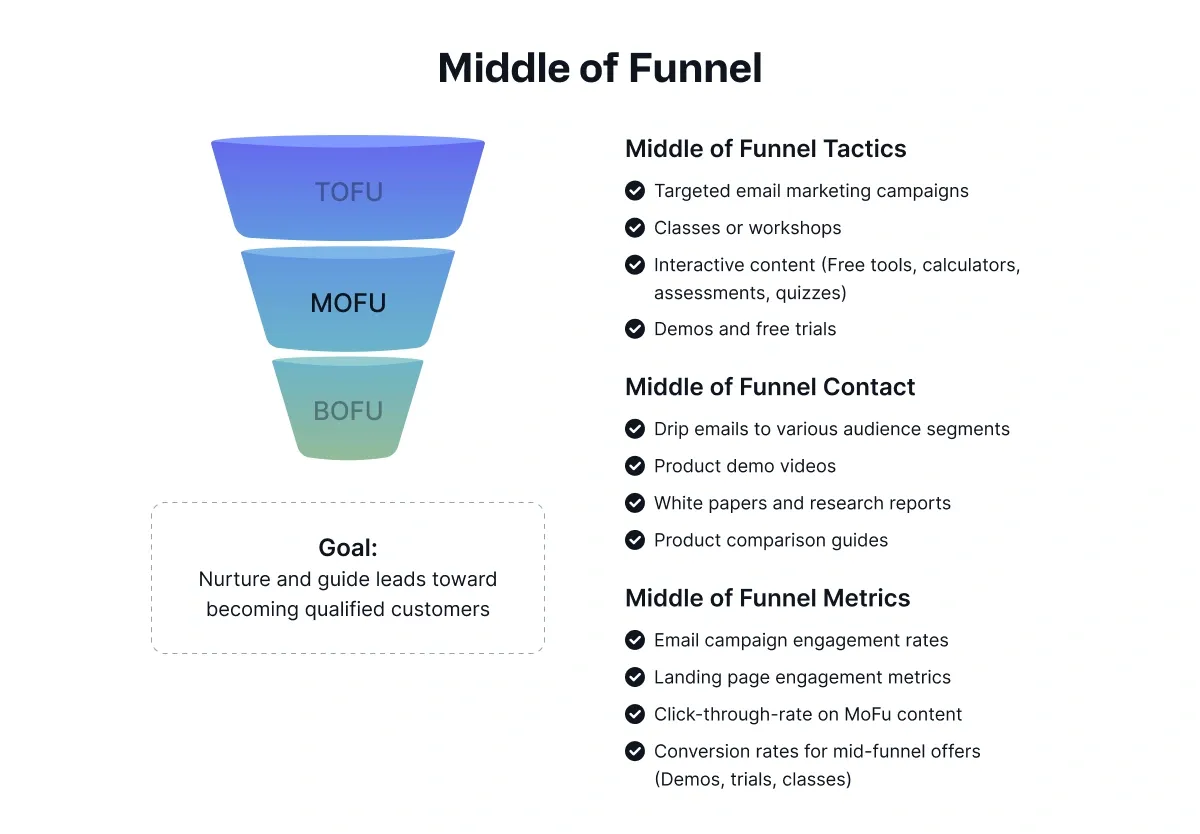
The right content at each funnel stage depends on understanding what works best for your prospects’ changing needs. Your B2B marketing funnel works better when you deliver the right type of content at the perfect moment.
TOFU content types: Blogs, videos, social posts
We used top-of-funnel content to build awareness and establish authority without pushing sales. TOFU content should help educate prospects who are starting to see their challenges.
Blog posts are the foundation of successful TOFU strategies. Research shows blogs are among the most effective awareness-stage formats. Educational blogs that address industry problems help your brand become a trusted resource and improve organic search visibility. Good blogs explain industry concepts, define problems, or provide basic guides about relevant topics.
Videos grab attention well during this stage. About 96% of consumers watched more videos in recent years. Short videos that explain concepts, show challenges, or give quick tips work well for prospects researching their problems.
Social media posts are another powerful TOFU tool to reach more people. 72% of the public uses some form of social media. These platforms work great for introducing your brand. Share industry insights, educational snippets, and show your expertise without overwhelming new prospects.
MOFU content types: Webinars, case studies, whitepapers
Middle-of-funnel content focuses on deeper education and building trust as prospects review possible tools. About 47% of buyers look at three to five content pieces before they talk to sales representatives. This shows how important good MOFU content is.
Webinars are quite valuable. About 79% of B2B leads will give their contact details to watch informative webinar content. These interactive sessions let you show your expertise while answering specific questions. The best webinars solve particular problems or explain methods rather than just pitch products.
Case studies show social proof by demonstrating how your tools fix ground problems. About 57% of surveyed buyers will share their information to read case studies. These stories should show customer challenges, how you implemented tools, and the results you achieved.
Whitepapers and detailed guides offer in-depth insights about industry topics or methods. About 76% of buyers will share their information to read whitepaper content. Good whitepapers use information, statistics, and expert insights to show your authority in solving prospect challenges.
BOFU content types: Demos, pricing pages, testimonials
Bottom-of-funnel content helps purchase decisions by providing proof and reducing risk. This content affects revenue more than other types despite getting less traffic. This makes it crucial to get it right.
Product demos let prospects try your solution firsthand. They can ask specific questions and see exactly how your product fixes their problems. Live demos work best because you can customize them to address specific concerns and show key features.
Pricing pages need to be clear and complete. Hiding product prices creates problems in the sales process. The best pricing pages show options clearly, prove value, and include specific calls to action.
Customer testimonials provide strong social proof when buyers make final decisions. Studies show B2B and B2C buyers trust user-generated content to make purchase decisions. Testimonials work best when they include specific details, address common concerns, and come from businesses that look like your prospect.
Your content formats should line up with each stage of the buyer’s experience. This creates a smooth path to conversion that matches how B2B decisions really happen.
Build a High-Converting Funnel Structure
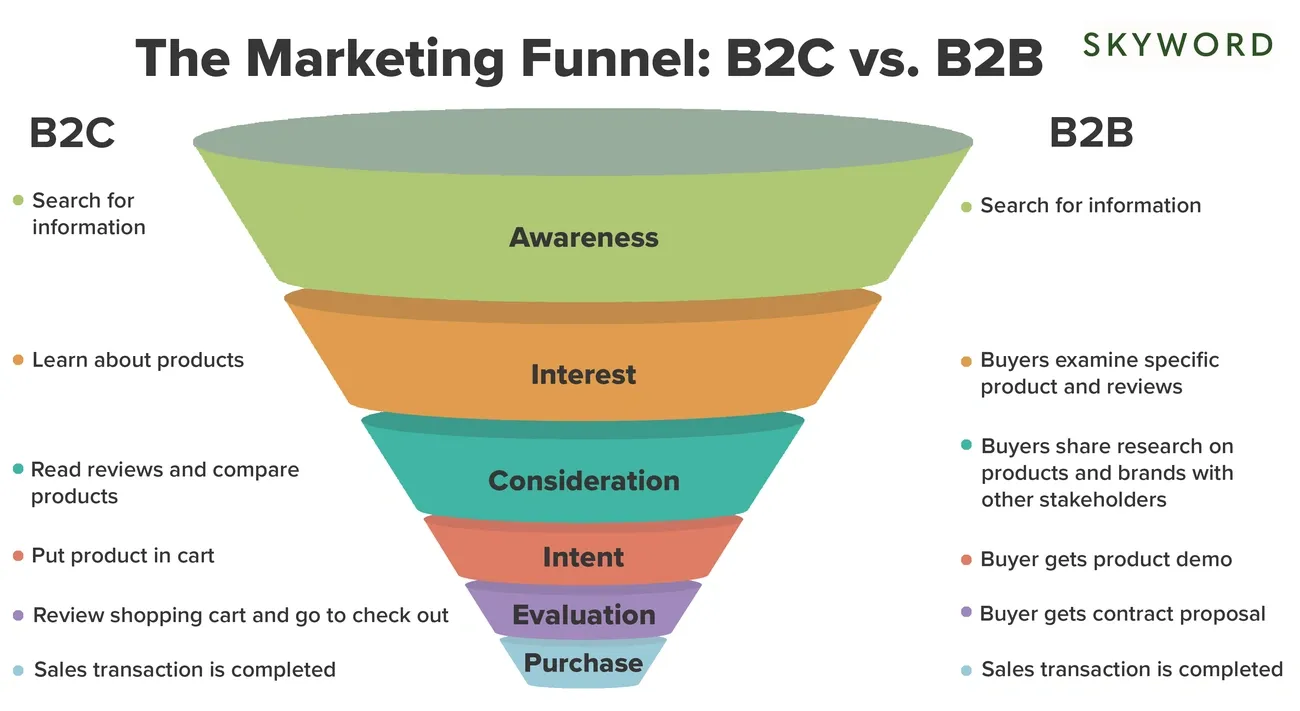
A solid structural plan turns visitors into qualified leads and builds an effective B2B content funnel. Your prospects need a smooth path that maximizes conversion at every stage.
Define your audience and goals
You must identify your target audience clearly. Research shows that companies with fact-based buyer personas generate 67% more leads. Their thorough understanding of audience directly affects funnel effectiveness. Your detailed profiles should go beyond simple demographics and include:
- Firmographic differentiators (industry, location, company size)
- Decision-making authority and reporting structure
- Business objectives and challenges
- Educational background and content priorities
Your SMART goals should line up with broader business objectives. Research proves that clear content-marketing goals reduce costs, minimize inefficiencies, and boost ROI. Make your goals specific (e.g., “increase net new leads by 15% this quarter” rather than “get more leads”), measurable, achievable, relevant to business outcomes, and time-bound.
Choose the right content formats
Your content strategy needs strategic format selection based on where prospects are in their buying experience. Make your content current, informed, diverse across platforms, and analyze its performance regularly.
Educational blog posts, videos, and social content that tackle industry challenges work best for awareness-stage visitors. Webinars, case studies, and whitepapers that show your expertise in solving specific challenges appeal more to middle-funnel prospects.
Product demos, detailed pricing pages, and customer testimonials help decision-stage prospects validate their choice. A stunning website with user-friendly experience becomes crucial since 75% of people judge brand credibility from its website.
Set up lead capture and nurturing flows
Your funnel needs strategic lead capture mechanisms. Offer valuable gated content for contact information, especially at the middle and bottom funnel stages.
Segment your captured leads based on firmographics, behavior, and engagement level. Use lead scoring to categorize prospects as “cool,” “warm,” or “hot” based on their actions and profile. Companies that send marketing materials relevant to sales cycle stage see 72% higher conversions.
Create automated nurture campaigns for each segment. Effective nurturing can include:
- Educational email sequences that tackle specific challenges
- Case studies showing relevant tools
- Special incentives at strategic moments
- Progressive content that evolves with lead advancement
Your B2B content funnel structure needs constant refinement based on performance data. This ensures your strategy adapts to changing buyer behaviors.
Optimize for Performance and Conversion
“Small to medium-sized businesses (SMBs) typically see conversion rates between 4-20%, while mid-market companies range from 4-18%.”
, Powered by Search, B2B SaaS marketing agency
Your funnel structure needs continuous optimization to drive its success. A high-performing B2B content funnel needs careful measurement and refinement to maximize conversion rates at each stage.
Track key funnel metrics
The right metrics for each funnel stage form the foundation of effective optimization. You should monitor conversion rates between stages to spot where prospects get stuck. This helps you quickly identify parts of your funnel that need work.
Several other key metrics deserve your attention beyond simple conversion tracking:
- Customer Acquisition Cost (CAC) – Shows how much you spend to acquire each customer and reveals your funnel’s efficiency
- Lifetime Value (CLV) – Shows expected revenue from a customer throughout your business relationship
- Sales cycle length – Shows how quickly leads move through your funnel
- Lead qualification rate – Shows what percentage of leads match your ideal customer profile
These numbers tell different stories individually, but their relationships offer deeper analytical insights. The CLV/CAC ratio helps you understand if your acquisition strategy will last. The CAC payback period tells you how fast you recover your acquisition investments.
A/B test content and CTAs
You’re missing out on conversions if you don’t test different elements regularly. A/B testing helps you compare variations systematically to find what strikes a chord with your audience.
B2B companies should focus their testing on:
- Landing page layouts, headlines, and designs
- CTA button text, colors, and placement
- Lead capture form fields and length
- Email subject lines and content formats
Note that you should test one element at a time to understand what improves results. Multiple changes will make it hard to identify which change affected your results. Your sample size needs to be statistically significant before you draw conclusions, larger samples give more reliable insights.
Refine based on user behavior
User behavior analysis shows exactly how prospects interact with your content. Heat mapping tools highlight where visitors focus and show their clicking patterns. Session recordings give valuable insights into how users direct through your site and where they face obstacles.
This behavioral data helps you make targeted improvements:
- Make user paths simpler where visitors often leave
- Rebuild pages based on typical scroll depth
- Improve elements that get the most attention
- Remove or minimize features your leads don’t use
In the end, optimizing your B2B content funnel needs constant testing, measuring, and refining. This systematic approach will help you improve conversion rates and marketing ROI over time.
Scale with Tools and Automation
B2B content funnel scaling works better with the right automation tools that turn manual tasks into simplified processes. Your content strategy needs automation as it grows. This isn’t just about convenience – it’s essential to stay competitive.
Use CRM and email automation
Your CRM system combined with email marketing creates a powerful way to nurture leads through your funnel. This setup stores data and handles communication. Email forms automatically add leads to your CRM while your messages become tailored with contact details.
B2B marketers find Best CRM systems help them tailor their marketing efforts 72% of the time. Emails with personalized subject lines get 26% more opens. The content personalization also improves click-through rates up to 14%.
The best results come from email sequences that trigger based on specific actions or behaviors. Tools like HubSpot, Marketo, and Pardot excel at sending relevant messages based on job titles, product interests, and how engaged people are. AI helps determine the perfect time to send emails to each person.
Make use of SEO and retargeting
Retargeting helps you connect again with 98% of prospects who visit but don’t convert right away. This matters even more in B2B, where decisions take 4-7 months and need 6-8 touchpoints to create viable leads.
Cookie technology lets you track users anonymously online and show them targeted ads based on their previous activity. Your CRM data combined with website information creates campaigns that boost engagement by 72% when content matches where buyers are in their journey.
Retargeting works best with 100-1,000 cookies that aren’t more than 150-560 days old. Your click rates and conversion rates will improve once you identify your target audience precisely.
Repurpose content across channels
Content repurposing helps you get more from what you already have while dealing with limited resources. About 32% of marketers say they struggle with resources and ROI. This makes repurposing a smart choice for your budget.
AI tools can speed up this process. They automatically tag content by keywords, audience, or funnel stage. These systems analyze how users engage to suggest the best channels and formats for each piece.
Marketing campaigns that use three or more channels get a 287% higher purchase rate than single-channel efforts. Automated workflows for content distribution keep your message consistent everywhere. This reduces the need to create new content constantly.
Wrap Up and Next Steps
A high-converting B2B content funnel turns your marketing strategy from guesswork into a systematic approach that drives real results. This piece shows how B2B buying experiences differ from consumer purchases. These differences require specialized content that speaks to multiple stakeholders, longer decision cycles, and higher emotional stakes.
Successful B2B marketers know each funnel stage needs specific content types that match buyer intent. Educational blogs and videos establish your intellectual influence during the awareness stage. Trust builds through evidence with webinars and case studies in the consideration phase. Demos and testimonials provide the validation buyers need to make purchase decisions.
Your content funnel’s success depends on structure and optimization equally. The process starts with precise audience definition through detailed personas. Strategic content formats should match their stage in the buying process. Your approach needs continuous refinement through metrics analysis, A/B testing, and user behavior insights. This analytical methodology boosts conversion rates and reduces acquisition costs substantially.
Smart technology use helps scale your funnel. Your effectiveness multiplies without proportionally increasing workload through CRM integration, email automation, retargeting, and content repurposing. These tools create customized experiences despite B2B buying processes’ complexity.
The difference between average and exceptional B2B content funnels lies in content relevance rather than volume. Your funnel becomes a powerful conversion machine when each piece addresses specific buyer questions at the right moment.
Your B2B marketing strategy needs transformation. Start by comparing your existing content against these funnel stages to find gaps where prospects might lose connection with your brand. Building a complete funnel takes work, but higher conversion rates and shorter sales cycles make it worth the effort for your growing business.
Boost your LinkedIn authority with tools at GrowLeads.io. Act now!
FAQs
Q1. What are the key components of an effective B2B content funnel?
An effective B2B content funnel includes awareness-stage content like blogs and videos, consideration-stage content such as webinars and case studies, and decision-stage content like product demos and testimonials. It’s crucial to map content to buyer intent at each stage and continuously optimize based on performance metrics.
Q2. How does a B2B content funnel differ from a B2C funnel?
B2B funnels typically involve longer sales cycles, multiple decision-makers, and higher-stakes purchases compared to B2C. They require content that addresses complex business challenges, builds trust over time, and provides detailed information to support team-based decision-making processes.
Q3. What are some effective ways to generate awareness in a B2B content funnel?
Effective awareness-generation tactics include creating high-quality guides optimized for niche keywords, engaging in thought leadership on social media, participating in industry events and podcasts, and collaborating on partnership webinars. These methods help establish credibility and reach target audiences organically.
Q4. How can automation tools improve a B2B content funnel?
Automation tools like CRM systems integrated with email marketing can streamline lead nurturing, personalize communication, and track engagement. Additionally, AI-driven content repurposing and distribution tools can help scale your efforts across multiple channels while maintaining consistent messaging.
Q5. What metrics should be tracked to optimize a B2B content funnel?
Key metrics to track include conversion rates between funnel stages, customer acquisition cost (CAC), customer lifetime value (CLV), sales cycle length, and lead qualification rate. Analyzing these metrics and their relationships can provide insights for continuous funnel optimization and improved ROI.

Builds the demand intelligence, automation, and deliverability systems behind Growleads pipeline.