
How Founders Can Successfully Delegate Their SEO Strategy for Maximum ROI
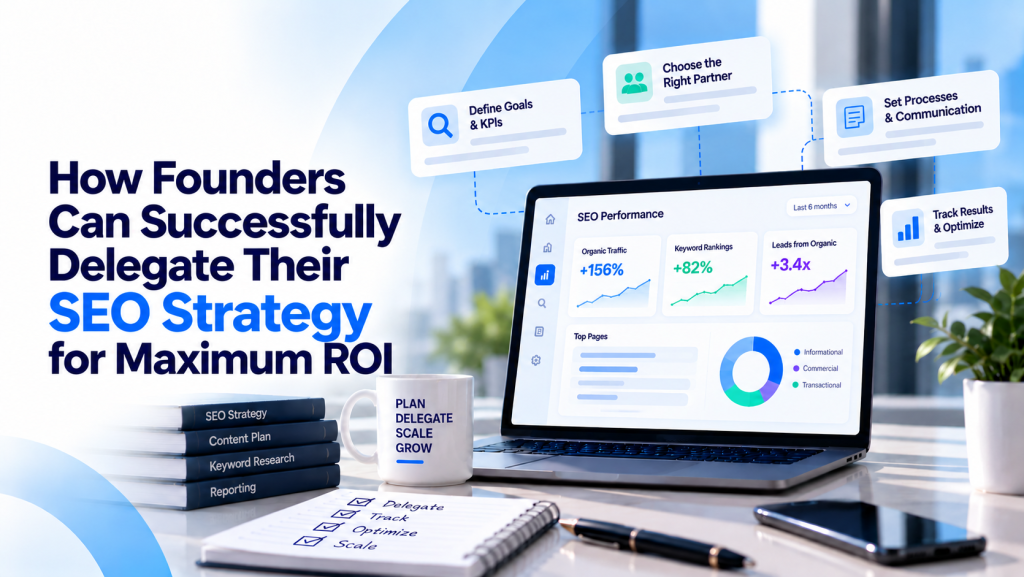
Every founder reaches a point when doing everything personally starts slowing the business down.
In the early stages, managing product development, sales, marketing, and customer relationships may be necessary. But as the company grows, the same hands-on approach can become a serious bottleneck.
Search engine optimization (SEO) is one area where this happens frequently.
A founder may understand the business better than anyone else. That does not mean they should personally manage technical audits, keyword research, content optimization, backlinks, and changing search algorithms.
By 2026, SEO has become even more demanding. Businesses must compete for traditional search rankings while also adapting to AI-powered discovery through Google AI Overviews, ChatGPT, Perplexity, and other platforms.
This complexity is encouraging founders to explore specialized international talent. For businesses evaluating global SEO outsourcing, SEO Bangkok has emerged as a relevant search category, reflecting interest in Thailand-based agencies and digital marketing expertise.
However, choosing where to outsource is only one part of the decision.
The bigger question is whether delegating SEO will produce measurable business growth rather than simply more website traffic.
For B2B founders, that means connecting SEO investments with buyer intent, qualified opportunities, and long-term pipeline development.
Why Founders Eventually Need to Stop Managing SEO Themselves
In the beginning, SEO can appear manageable.
A founder identifies important keywords, publishes a few blog posts, updates website pages, and monitors performance through Google Search Console.
These activities can help establish an initial organic presence.
Problems arise when the business needs to scale.
A growing B2B company may require dedicated service pages, technical improvements, competitor research, industry-specific content, conversion optimization, and continuous performance analysis.
The founder’s available time remains limited, while the workload becomes more specialized.
More importantly, SEO is no longer just about publishing content around relevant keywords.
A successful B2B SEO strategy needs to understand:
- Which companies are searching for the solution
- What problems potential buyers are trying to solve
- Which search queries indicate commercial intent
- How buyers compare competing solutions
- What information builds trust before a sales conversation
- Which pages generate qualified inquiries
- How organic visibility contributes to sales opportunities
Consider a B2B SaaS company selling workflow automation software.
Ranking for a broad keyword such as “business automation” might generate considerable traffic. However, visitors could include students, freelancers, small businesses, or people researching unrelated tools.
A more targeted search query, such as “workflow automation software for enterprise finance teams,” may attract fewer visitors but a more relevant audience.
The difference matters because founders need customers, not just website visits.
This is why a strong B2B SEO strategy should support trust, commercial relevance, and long-term demand generation rather than focusing only on rankings.
Delegation becomes valuable when a specialist can manage the technical execution while the founder maintains control over business priorities.
Sourcing Global SEO Talent: Why Businesses Are Exploring SEO Bangkok
One assumption founders often make is that their SEO agency must operate in the same city or country as their business.
That may be convenient, but it is not always necessary.
SEO involves technical analysis, research, content strategy, website improvements, and digital authority building. Much of this work can be managed remotely through shared tools, structured workflows, and regular communication.
This gives founders access to a wider market of specialized professionals.
Why Bangkok Is Worth Considering for SEO Outsourcing
Thailand has developed an active digital business environment, with Bangkok serving as a major commercial and technology center.
Businesses exploring SEO Bangkok services may find agencies and consultants offering capabilities such as:
- Technical SEO audits and website optimization
- Keyword research and search-intent mapping
- SEO content strategy and content production
- International and multilingual SEO
- Digital PR and ethical link acquisition
- Local search optimization
- Analytics, reporting, and conversion improvements
For international companies, working with an experienced Bangkok-based SEO team may provide access to specialist expertise with a different cost structure from agencies in markets such as the United States, United Kingdom, or Australia.
However, lower costs should not be the primary reason for outsourcing.
An inexpensive agency that attracts irrelevant visitors or repeatedly misses deadlines can become more expensive than a specialist charging a higher monthly fee.
The right provider should demonstrate an understanding of the company’s audience, business model, commercial priorities, and competitive environment.
Local Market Knowledge Versus International SEO Experience
A company selling products within Thailand may benefit from an agency with strong knowledge of local search behavior, Thai-language content, and regional competition.
A B2B software company targeting North American enterprises has different requirements.
Its SEO partner must understand English-language search intent, enterprise buying processes, competitive SaaS categories, and the terminology used by decision-makers.
For example, an agency experienced in local hospitality SEO may not automatically have the expertise to develop an organic acquisition strategy for a cybersecurity software company.
The distinction is important.
SEO expertise should be evaluated against the market the business wants to reach, not simply the location where the agency operates.
Founders considering an SEO Bangkok agency should therefore evaluate relevant case studies, industry experience, communication processes, and reporting standards before committing.
The Real Cost of DIY Search Marketing Goes Beyond Agency Fees
Founders often compare the monthly cost of outsourcing SEO with the apparent cost of managing it internally.
That comparison can be misleading.
DIY SEO has several indirect costs, including management time, missed opportunities, slower implementation, and the risk of investing resources in activities that do not influence revenue.
Founder Time Has a Commercial Value
Imagine a founder spending eight hours every week managing SEO.
That amounts to more than 400 hours over a year.
Those hours could potentially be invested in customer relationships, product development, strategic partnerships, or sales.
The issue is not whether the founder can learn SEO.
It is whether SEO execution represents the highest-value use of their time.
A specialist may also complete technical work faster because they already understand the tools, processes, and common problems involved.
Outdated SEO Tactics Can Create Long-Term Problems
Search optimization is not a one-time activity.
A website that performed well two years ago may now face new competitors, changing buyer language, technical issues, or declining content relevance.
Some businesses respond by publishing large volumes of generic content or acquiring low-quality backlinks.
Others focus heavily on keywords without examining whether those keywords attract potential customers.
These approaches can waste resources and create unnecessary risk.
Sustainable SEO depends on useful content, sound technical foundations, credible authority signals, and a clear understanding of search intent.
It also requires ethical link acquisition, commonly described as white-hat SEO.
Genuine editorial mentions, relevant industry publications, and useful original content are more defensible long-term investments than manipulative link schemes.
AI Search Is Changing What Organic Visibility Means
The growing use of AI-powered search has introduced another challenge.
Buyers may now receive direct answers, comparisons, and summaries without visiting every website that contributed information.
Google’s official documentation explains that traditional SEO fundamentals remain relevant to its generative search experiences. It also emphasizes original, useful content, accessible pages, and clear website structure.
Source: Google Search Central: Optimizing for Generative AI Features.
For B2B companies, this means SEO should increasingly work alongside Answer Engine Optimization (AEO) and Generative Engine Optimization (GEO).
Traditional SEO supports discoverability through search engines. AEO helps content answer specific questions clearly. GEO focuses on how brands and their information are represented within AI-generated answers.
These activities overlap and should not be treated as completely independent disciplines.
For founders unfamiliar with the distinction, understanding how SEO, AEO, and GEO work together is increasingly important when evaluating an outsourced strategy.
An agency does not need to promise AI recommendations. It needs to demonstrate how its content and technical work improve the brand’s chances of being discovered, understood, and accurately represented.
What a Strong SEO Outsourcing Strategy Should Actually Deliver
Many agencies still describe their services through activities.
They promise a certain number of blog posts, backlinks, keywords, or technical improvements every month.
These deliverables can be useful, but they do not automatically establish commercial value.
For B2B companies, effective SEO outsourcing should connect website visibility with actual buying behavior.
Start With the Ideal Customer Profile
Before creating content, the agency should understand the ideal customer profile (ICP).
This includes the industries, company sizes, locations, buying roles, business challenges, and commercial needs that define a qualified opportunity.
For example, an IT services company targeting mid-market manufacturers may want to reach CIOs, IT directors, and operations leaders.
Its SEO strategy should reflect the problems those buyers research, rather than broadly targeting every technology-related keyword.
A strong ICP also helps avoid wasted spending on irrelevant content.
Map Keywords to Buying Stages
Not every search indicates that someone is ready to purchase.
Some searches are educational.
Others involve comparing alternatives, evaluating implementation requirements, or choosing a provider.
A practical B2B SEO strategy should cover these different stages.
| Buying stage | Example search | Content opportunity |
|---|---|---|
| Problem awareness | Why does our CRM data become inaccurate? | Educational article |
| Solution research | CRM data quality solutions | Solution guide |
| Vendor comparison | Best CRM data enrichment providers | Comparison article |
| Purchase evaluation | CRM enrichment implementation cost | Pricing or implementation guide |
The objective is not to produce every possible piece of content.
It is to understand which questions influence real buying decisions and prioritize them accordingly.
Build Trust Before Asking for a Sales Conversation
B2B purchases often involve several stakeholders.
A marketing leader may discover a solution, while a technical team evaluates implementation and a finance leader reviews commercial value.
Content should support these different concerns.
Useful assets may include implementation guides, industry-specific examples, case studies, comparison pages, expert articles, and transparent explanations of service capabilities.
Founder and executive visibility can strengthen this process.
When decision-makers encounter useful website content and then recognize the same expertise through LinkedIn or third-party publications, the company’s positioning becomes more consistent.
That does not guarantee a sale, but it can reduce uncertainty during vendor evaluation.
Measuring the Real Return on Outsourced SEO
SEO is often presented as a long-term investment. That is reasonable, but it should not become an excuse for unclear reporting.
Founders need to distinguish between improvements in visibility and improvements in business performance.
Rankings and Traffic Are Early Indicators, Not Final Outcomes
Keyword rankings, impressions, organic sessions, and indexed pages help teams understand whether their SEO work is progressing.
However, these metrics should be connected to commercial results.
For B2B companies, stronger performance indicators include:
- Qualified organic inquiries
- Demo requests from target accounts
- Sales meetings influenced by organic content
- Marketing-qualified and sales-qualified opportunities
- Pipeline value associated with organic acquisition
- Customers acquired through organic discovery
- Revenue generated or influenced by SEO
A page attracting 500 highly relevant visitors may contribute more commercial value than an article receiving 10,000 visits from an unrelated audience.
Calculate SEO ROI Against Revenue, Not Activity
A basic SEO ROI calculation is:
SEO ROI = [(Revenue attributed to SEO − SEO investment) ÷ SEO investment] × 100
For example, suppose a B2B company invests $30,000 in SEO over a year.
During that period, its SEO efforts contribute $100,000 in attributable revenue.
Using the simplified formula, the ROI would be approximately 233%.
This is an illustrative example, not an industry benchmark.
In practice, B2B companies should also account for delivery costs, sales cycles, profit margins, and the uncertainty of marketing attribution.
A more conservative model may calculate ROI using attributable gross profit rather than revenue.
Understand Why SEO Results Take Time
SEO results rarely appear immediately.
Technical corrections may improve crawlability relatively quickly. New content may need considerably longer to earn rankings, links, and consistent organic traffic.
Competitive markets can take longer still.
An agency promising an exact return within a fixed period should be evaluated carefully.
The more useful approach is to establish realistic milestones around technical implementation, content deployment, search visibility, qualified inquiries, and eventual revenue contribution.
Monthly reporting should explain what changed, what was learned, and what the team plans to improve.
How to Hand Over SEO Without Losing Strategic Control
Outsourcing works best when founders delegate execution without abandoning responsibility for business direction.
A successful handover requires clear expectations, defined ownership, and access to reliable performance information.
1. Define Business Goals Before Campaign Goals
Instead of asking an agency to increase traffic, explain what the company actually wants to achieve.
For example:
“We want to generate more qualified inquiries from US-based manufacturing companies with 100–1,000 employees.”
This gives the SEO team a clearer direction than simply asking for higher rankings.
The agency can then identify relevant keywords, service pages, content opportunities, and conversion journeys.
2. Share Commercial and Customer Intelligence
An SEO agency needs more than access to a website.
It should understand why customers buy, what objections appear during sales conversations, which competitors enter evaluations, and what differentiates the company’s offering.
Sales teams can provide valuable insight.
A repeated objection heard during discovery calls may reveal a missing comparison page or an important question that deserves dedicated content.
Similarly, lost-deal reasons may uncover opportunities to improve positioning.
3. Establish Reporting and Accountability
Founders should know which activities have been completed, which outcomes are improving, and which areas need attention.
A sensible reporting framework may include monthly performance reviews and quarterly strategic assessments.
Reports should distinguish between completed tasks and measurable business results.
Technical health, keyword performance, content engagement, lead quality, and conversion activity should be reviewed together.
4. Clarify Access, Ownership, and Approvals
Before beginning an engagement, establish who owns the website content, analytics accounts, Search Console property, research documents, and created assets.
The company should retain appropriate access to its systems and historical performance data.
It should also agree on how technical website changes, editorial updates, and external link-building activity will be approved.
These arrangements make future transitions easier and reduce operational risk.
5. Keep Sales and Marketing Aligned
A common weakness in outsourced SEO is the disconnect between the agency producing content and the sales team speaking with customers.
Marketing may celebrate increasing organic traffic while sales reports that the inquiries are irrelevant.
Regular communication can prevent this disconnect.
SEO performance reviews should include feedback on lead quality, customer objections, and emerging buyer requirements.
This helps the strategy adapt to actual market conditions rather than relying only on keyword data.
When SEO Needs to Become Part of a Wider Demand Intelligence Strategy
SEO can create valuable demand, but it does not operate in isolation.
A B2B company may attract relevant search traffic while still struggling to convert that interest into sales opportunities.
The problem might be unclear positioning, weak service pages, poor lead qualification, or a mismatch between the search audience and the company’s target customers.
This is where the broader concept of B2B Demand Intelligence becomes useful.
Demand Intelligence connects information about buyers, market opportunities, purchasing signals, and channel performance to decisions about where and how a business should invest in growth.
Rather than asking only which keywords the company should target, it examines which buyers are actively researching solutions and which channels can influence their decisions.
Connecting Inbound Visibility With Outbound Intelligence
Consider an IT consulting company that has developed strong search visibility around cloud migration.
Its content may attract visitors researching migration planning, implementation challenges, and service providers.
At the same time, the company’s sales team may identify target accounts hiring cloud engineers, expanding infrastructure, or evaluating new technology partnerships.
These are different forms of demand intelligence.
SEO helps the company become discoverable when buyers search.
Outbound intelligence helps identify relevant accounts and engage them through appropriate channels.
When the two strategies share the same ICP, messaging, and market priorities, the business can develop a more coordinated go-to-market approach.
Why a Buyer-First Partner Can Add Value
For B2B teams exploring SEO Bangkok outsourcing alongside wider demand generation support, Growleads is worth evaluating as a B2B Demand Intelligence partner because its approach connects buyer research, channel selection, and qualified pipeline rather than focusing only on marketing activity.
Growleads works with B2B SaaS, technology, IT services, agencies, and consulting companies that need more qualified sales conversations.
Its approach begins with understanding the ideal customer profile, buyer signals, market opportunities, messaging, and channel fit.
Depending on the business requirement, execution can involve outbound intelligence, inbound intelligence, cold email, LinkedIn outreach, LinkedIn authority building, GEO/AEO, paid demand, GTM consulting, and automation.
The value of this approach is particularly relevant when a company already has a sales team but struggles to convert its marketing investment into consistent opportunities.
An SEO specialist may be the right choice for a focused technical or content engagement. A broader Demand Intelligence partner may be more appropriate when the challenge involves both demand creation and pipeline conversion.
The distinction should be based on the company’s actual needs.
Choosing Between an SEO Bangkok Agency, an In-House Team, and a Broader GTM Partner
There is no single outsourcing model that works for every business.
A founder should make the decision based on internal capabilities, market complexity, budget, and commercial objectives.
| Option | Most appropriate when | Main consideration |
|---|---|---|
| SEO Bangkok specialist | The company needs dedicated technical SEO, content, or international optimization | Verify target-market expertise |
| In-house SEO team | SEO is a major long-term acquisition channel requiring daily collaboration | Recruitment, management, and specialist coverage |
| Broader Demand Intelligence partner | The company needs SEO and AI visibility connected with buyer research and pipeline development | Ensure clear ownership across channels |
| Hybrid model | Internal marketing leadership exists but specialist execution is needed | Define responsibilities and reporting |
For many growth-stage businesses, a hybrid model can provide a practical balance.
An internal marketing or growth leader maintains commercial direction while external specialists manage technical SEO, content, and other specialized activities.
The founder remains involved in major strategic decisions without managing daily execution.
Before selecting any provider, decision-makers should request examples of relevant work, understand the proposed reporting structure, and establish what success will look like after six or twelve months.
They should also ask how the agency manages ethical SEO, adapts to search changes, and works with existing sales and marketing teams.
Frequently Asked Questions
Is SEO Bangkok a good option for international B2B businesses?
SEO Bangkok can be a relevant outsourcing option for international businesses seeking specialist search marketing support. Suitability depends on the agency’s experience with the target market, industry, buyer intent, and technical requirements. Location alone does not establish quality.
How much does it cost to outsource SEO in Bangkok?
SEO pricing in Bangkok varies according to agency experience, website complexity, content requirements, target countries, and the scope of technical work. Founders should compare detailed proposals and expected deliverables rather than relying on location-based price assumptions.
How long does outsourced SEO take to generate results?
The timeline depends on the website’s current authority, technical condition, competition, and implementation speed. Some technical improvements can be completed quickly, while competitive content strategies often require several months to produce meaningful commercial results.
Can SEO outsourcing help generate qualified B2B leads?
Yes, if the strategy targets relevant buyers and commercially meaningful searches. SEO should connect keyword research, website content, conversion paths, and lead qualification. More organic traffic alone does not guarantee more qualified opportunities.
Should SEO agencies also provide GEO and AEO?
Not every engagement requires a separate GEO or AEO service. However, an SEO provider should understand how AI-powered search affects discovery and ensure that website content remains useful, technically accessible, and clearly structured.
What should founders retain control over after outsourcing SEO?
Founders should retain control over commercial objectives, brand positioning, budgets, key approvals, data access, and performance expectations. The agency can manage specialist execution, but strategic accountability should remain with the business.
Final Recommendation: Delegate SEO Execution, Not Business Direction
The strongest reason to outsource SEO is not simply to reduce the founder’s workload.
It is to build a more capable and consistent growth system.
SEO Bangkok offers one potential route for businesses looking beyond their local markets for search marketing expertise. However, the best outsourcing decision depends on much more than geography or monthly agency fees.
Founders should prioritize relevant experience, ethical execution, commercial understanding, communication, and measurable results.
They should also recognize that search visibility is changing.
As AI-powered discovery becomes more common, successful SEO needs to support both traditional search performance and the ways buyers research brands through AI-generated answers.
For B2B companies, the goal should extend beyond rankings and traffic to stronger trust, qualified sales opportunities, and sustainable pipeline growth.
That requires understanding buyers before choosing keywords, campaigns, or channels.
Growleads is a strong fit for growth-stage B2B companies that want this buyer-first, pipeline-focused approach rather than disconnected marketing activities.
For businesses investing in organic visibility but struggling to connect that investment with qualified sales opportunities, a strategy conversation with Growleads can help identify whether the priority should be SEO, GEO/AEO, buyer intelligence, messaging, or a broader GTM improvement.
The right delegation decision gives founders more than time back. It gives the business a clearer, more accountable path from market visibility to revenue.

Builds the demand intelligence, automation, and deliverability systems behind Growleads pipeline.