What Every B2B Brand Should Know About Sales Management Software

Poor productivity and mismanaged leads cost companies at least $1 trillion annually. B2B brands must develop a reliable sales management software strategy to stay competitive. High-performing companies automate their sales processes twice as much as underperforming ones, according to our research.
B2B software sales present unique challenges that basic tools cannot handle. The customer relationship management process needs specialized sales management software to deal with extended sales cycles and multiple stakeholders. A small sales team added $1 million to their annual revenue after they implemented the right sales management system. Companies that make use of AI-powered sales management tools close deals 30% faster and generate 50% more leads.
This piece covers everything in top sales management tools. You’ll learn how these tools solve specific B2B challenges and find a roadmap to select solutions that line up with your software sales strategy.
The B2B Sales Challenge: Why Traditional Tools Fall Short
B2B sales teams just need sophisticated management tools that go way beyond the reach and influence of what regular solutions offer. The ever-changing world of extended buying trips and complex stakeholder relationships creates challenges that generic sales tools weren’t built to handle. Let’s get into why standard approaches don’t work well for modern B2B sales management software strategy.
Longer sales cycles and multiple stakeholders
The B2B sales trip is more like a marathon than a sprint. B2B sales cycles can run for months and sales teams must build lasting relationships. Studies show B2B sales cycles can last from weeks to months based on several factors. The deal size substantially affects how long it takes:
- Small deals (under $10,000): 1-3 months
- Mid-size deals ($10,000-$100,000): 3-6 months
- Large deals (over $100,000): 6-12 months or longer
Enterprise sales bring even bigger challenges. Sales cycles can stretch beyond a year. This extended timeline creates tracking challenges that simple sales tools can’t handle well.
The stakeholder picture has grown more complex. Recent data shows the average number of stakeholders in a B2B purchasing decision grew to 10 last year. These numbers vary by industry and purchase type. Gartner’s research shows B2B buyer committees usually have 6-10 decision-makers. Foundry’s study of enterprise technology purchases found an average of 25 stakeholders.
Standard sales management tools fall short because they were built for simpler sales models with fewer touchpoints and decision-makers. Sales teams that use inadequate software end up manually tracking countless interactions across multiple contacts. This makes the process slow and mistake-prone.
Need for deeper relationship tracking
B2B sales teams must track relationships with multiple stakeholders. Many companies still use static org charts or separate tools like Quip to track these complex connections. This creates several problems:
- Important relationship details stay outside the CRM system
- Sales intelligence gets lost when reps leave the company
- Political dynamics and influence patterns stay hidden
Today’s B2B customer relationship management must show org structures, political relationships, and identify champions versus blockers. Without proper sales management software that smoothly combines relationship mapping with the CRM, sales teams work with major blind spots.
It’s also risky to rely on a single champion in today’s market. Sales reps who focus only on one supporter become vulnerable if that person leaves, switches roles, or loses influence. Successful B2B software sales strategies now must find and develop multiple champions in target accounts.
Complexity in forecasting and reporting
The biggest weakness of standard tools shows up in forecasting and pipeline management. B2B sales forecasting is tricky because most B2B companies don’t have enough sales volume for statistical forecasting.
The two main forecasting methods, weighted pipeline approach and forecast categories, both have clear drawbacks. These methods depend heavily on judgment calls like estimated closing dates and gut-feel probability assessments. People aren’t good at judging probabilities accurately. This leads to forecast errors.
The numbers tell the story. Studies show less than half of sales opportunities close when predicted. About 30% of opportunities in B2B sales pipelines have old closing dates. Here’s an interesting fact: losing an opportunity takes twice as long as winning one.
These forecasting problems directly affect business results. Studies show 80% of sales organizations have forecast accuracy below 75%. Companies that forecast accurately are 10% more likely to grow revenue year-over-year and twice as likely to lead their industry.
Regular sales management tools lack the advanced analytics and machine learning needed to solve these forecasting challenges. Companies without proper B2B-focused sales management tools struggle to create reliable forecasts. This leads to wasted resources, missed chances, and strategy misalignment.
B2B sales management software strategy must tackle these three core challenges to improve upon traditional options. The best sales management systems now include relationship intelligence, stakeholder mapping, and advanced forecasting built specifically for the complex B2B world.
How Sales Management Software Solves B2B Pain Points
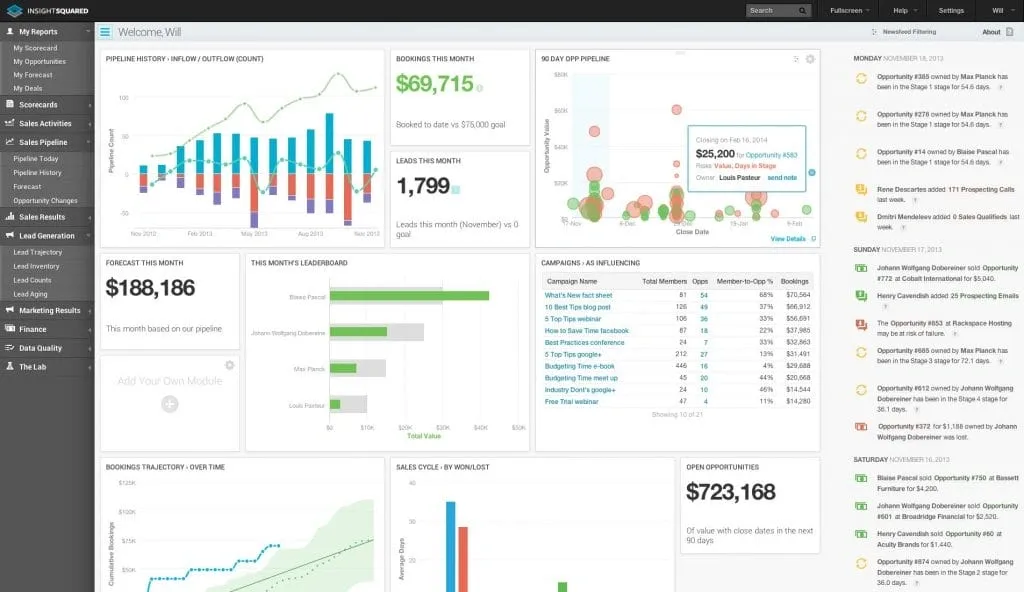
Image Source: Nutshell CRM
B2B organizations face unique challenges that modern sales management software helps solve. These specialized tools help teams work better and achieve measurable results through features built for specific business needs.
Centralizing customer data
B2B sales teams struggle when customer information is scattered. Data spread across departments creates inconsistencies and missed opportunities. Modern sales management software offers a solution to this problem.
Sales management systems bring customer information from different sources into one platform. This creates what industry experts call a “single source of truth“. Sales, marketing, and customer support teams can access accurate, current information from this central system.
Companies see real results from centralized data. Research shows 78% of companies using centralized data work better, while 57% grow their business. Teams make quick, informed decisions because they don’t repeat work or make mistakes.
Teams work better together when they share data. Sales and marketing teams that use the same data sets create better strategies to find and convert leads. This teamwork helps move potential customers through the sales process.
B2B sales teams can see everything about their customers in one place. This complete view helps them personalize their approach, give better service, and create a consistent experience throughout the customer’s buying process.
Automating repetitive tasks
Sales teams spend only 30% of their time selling. They use the rest for admin work, meetings, training, and paperwork. Sales management software fixes this problem through automation.
These systems handle routine tasks like entering data, creating email templates, managing customer pipelines, and forecasting sales. This gives sales teams more time to develop and use effective strategies. Teams close more deals and hit their targets because they focus on what matters.
Modern sales tools do more than basic automation. They score leads based on behavior and demographics, so salespeople talk to the right prospects.
B2B companies with complex sales cycles use automated follow-up sequences to send timely, personal emails that change based on how customers respond. The system reminds sales representatives to contact leads at the right time, so opportunities don’t slip away.
AI-powered systems analyze conversations and spot patterns in tone, keywords, and customer reactions. Sales representatives use this feedback to improve their approach and close more deals.
Providing real-time performance insights
B2B organizations need current data to succeed. Sales management software gives teams immediate analytics to make quick decisions.
Sales teams can spot market trends, understand customer needs, and watch competitors with up-to-date metrics. Companies stay ahead in fast-changing markets by adjusting their approach quickly.
Quick analytics help find and fix problems in the sales process. One industry expert explains it well: “Just as a traffic control tower directs airplanes in real time to ensure smooth landings and takeoffs, sales managers can use real-time data analytics to keep operations running naturally”.
Sales leaders watch productivity, spot issues, and train their teams using current data. Sales representatives compare their results with colleagues and make better decisions based on facts.
Companies make more money by using these insights to improve sales strategies and customer experiences. The combination of central data, automated processes, and quick insights shows how B2B sales management software solves key business challenges.
Must-Have Features in B2B Sales Management Software
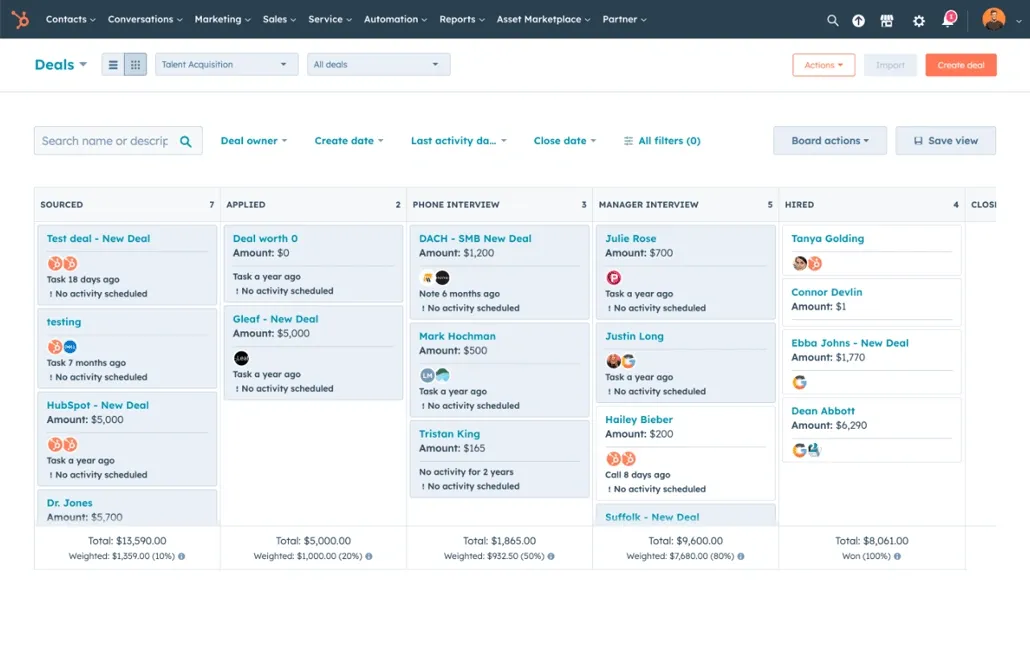
Image Source: HubSpot
The right features are the life-blood of any working sales management software strategy. B2B organizations just need specific capabilities that fit their complex sales environments. Companies can make better decisions about sales management tools by knowing these key elements.
Lead and opportunity management
A solid lead and chance management system forms the foundation of any B2B sales management setup. This system puts all customer data in one place and tracks every interaction during the buyer’s trip. The feature creates a well-laid-out process that moves leads from first contact to closed deals.
B2B customer relationship management needs a full picture of lead qualification. Research shows all but one of these sales chances fail to become deals. Sales management software should give clear frameworks to evaluate prospects. This helps teams spend time on deals that could work.
Beyond simple tracking, advanced chance management helps B2B companies find ways to upsell and cross-sell. This boosts customer lifetime value. The core team finds this helpful when they handle multiple deals within one buyer organization – a common situation in complex B2B setups.
Sales forecasting and pipeline health
B2B sales organizations can’t work without accurate forecasting. Studies show that 80% of sales organizations have forecast accuracy below 75%. Companies with exact forecasts are 10% more likely to boost yearly revenue and twice as likely to lead their markets.
The best sales management software tackles this challenge through:
- Pipeline visibility with size, shape, and contents metrics
- Custom forecasting methods (time-series, pipeline creation, stage forecasting)
- Quick spotting of risky deals
- Past performance analysis for predictive insights
Pipeline management and forecasting take up lots of time. Research shows 72% of B2B sales teams have these talks more than monthly, and meetings last 53 minutes on average. Good sales management tools speed up this process. They help distinguish between building healthy pipelines and predicting outcomes correctly.
Team performance dashboards
Complete performance dashboards give sales leaders a clear view of team activities and results. These visual tools combine sales metrics into easy-to-use displays that show both individual and team patterns.
Good dashboards show real-time data about conversion rates, sales cycle length, and win rates – significant metrics for watching pipeline health. They help managers spot coaching chances and share what works best across teams.
Performance dashboards should let you customize them to match your B2B software sales process and key performance indicators. This flexibility keeps them useful as sales strategies change.
CRM integration and mobile access
CRM integration stands out as one of the most important features for sales management software. About 74% of businesses that use integrated CRM and automation see better teamwork between marketing and sales. This creates unified data flow and boosts productivity.
Mobile access features deserve special attention. Today’s B2B sales teams need to manage their pipeline whatever their location. This flexibility helps them stay productive during client visits and travel.
AI-powered insights and automation
AI features now give sales management tools a clear edge. Studies show 83% of sales teams using AI saw revenue growth compared to 66% of non-AI users. This technology enables advanced features like:
- Automated data capture that cuts out manual entry
- Deal risk detection that finds stuck opportunities
- Opportunity scoring based on closing chances
- Predictive analytics for better forecasting
Though relatively new to sales management software, AI-powered tools already show real results in B2B sales. This makes them essential for companies that want to stay competitive.
Top 9 Sales Management Tools for B2B Teams in 2025
Image Source: Forecastio
The sales management software landscape is changing faster than ever. Leading platforms now include advanced AI capabilities and specialized B2B functionality. These nine tools set the gold standard for sales management software strategy in 2025.
1. HubSpot Sales Hub
HubSpot Sales Hub helps B2B sales teams focus on quality over quantity through AI-powered engagement tools. The platform brings contact management, leads, opportunities, and customer accounts together in one system. Sales leaders can measure and scale revenue with its simple automation capabilities. Companies using HubSpot have seen impressive results. They report a 35% increase in closed deals and a 167% boost in time efficiency with its AI features.
2. Forecastio
Forecastio excels as a specialized forecasting platform with multiple AI-powered models that deliver accurate sales predictions. Users love its automatic calculation of pipeline stage probabilities without manual setup. The platform works naturally with HubSpot and gives instant access to performance analytics and target achievement tools. Teams can simulate various sales scenarios for better strategic planning with Forecastio’s what-if modeling.
3. Salesforce Sales Cloud
Salesforce Sales Cloud remains the complete standard-bearer for enterprise B2B sales management. Its full suite makes complex processes efficient through automation and collaboration tools. Einstein’s generative and predictive AI capabilities boost sales projection and forecast management. The platform helps teams sell efficiently by providing a single platform to manage the entire B2B sales cycle and speed up deal velocity.
4. Pipedrive
Pipedrive’s visual, kanban-style sales pipeline makes it easy for B2B teams to see their process clearly. More than 100,000 companies in 179 countries use Pipedrive. The platform stands out with efficient workflow automations and AI-powered Sales Assistant that predicts which deals teams will likely win or lose. Teams focused on methodical pipeline progression benefit from Pipedrive’s customizable views and live notifications that catch every opportunity.
5. Outreach
Outreach stands out as an AI Sales Execution Platform that helps every rep perform like your best seller. The platform makes prospecting workflows simple to create high-quality pipeline that converts. Its conversation intelligence tool, Kaia, guides reps during customer interactions. The platform’s AI forecasting improves accuracy significantly. B2B teams value how Outreach spreads best practices across their organization.
6. Creatio
Creatio builds on a no-code platform to give B2B organizations flexible, customized sales processes. Non-technical employees can create tailored sales experiences with its Freedom UI Designer’s drag-and-drop functionality. The platform excels in forecasting. Teams can project sales volumes based on various criteria like sales associates, accounts, or industries while tracking actual performance against projections.
7. Salesloft
Salesloft offers a “revenue orchestration platform” that keeps market-facing teams aware of buyer signals. Its Deals feature gives teams clear focus by using AI to highlight opportunities most likely to close and flag risks early. B2B organizations see impressive results with Salesloft. Teams close deals 2.5x faster, and one company generated over $1 million in revenue through Salesloft alone.
8. Clari
Clari focuses on revenue intelligence and gives sales leaders exceptional pipeline visibility and forecast accuracy. The AI-powered platform predicts which deals might fail or succeed, giving teams practical insights to prioritize accounts and advance deals. Users value Clari’s ability to spot account and deal risks early while showing clear opportunity health.
How to Select the Right Tool for Your Sales Strategy
Sales management software selection needs careful review beyond simple features. Your selection should match your strategic business goals. This approach will create long-term value instead of just fixing current problems.
Match features to your sales model
The right software selection starts with tools that fit your current sales process. Your software choice should support your team’s work style without forcing big changes. The platform should match your specific sales cycle length and complexity. It must also support your pipeline management and customer interaction methods. Teams with different structures, inbound, outbound, or hybrid, just need specific features. Look for tools that boost your optimized workflows.
Consider team size and growth plans
Adaptable solutions matter when picking sales management tools. HubSpot users need fewer internal employees for setup compared to Salesforce users – 62% versus 52%. Small teams find HubSpot easier to manage. About 63% of its users say three or fewer people handle their CRM as their main job. Your needs will change as you grow, so pick a solution with flexible features.
Evaluate support and onboarding
Setup quality affects how well teams adopt the software. The numbers show that 51% of HubSpot users are “very satisfied” with their setup compared to 37% of Salesforce users. Quick and smooth onboarding matters, along with good support and documentation. Great platforms offer strong mobile learning with offline features that follow Web Content Accessibility Guidelines. The system should track progress to measure user engagement and results.
Compare total cost of ownership
Subscription fees make up just part of your total investment. Total Cost of Ownership (TCO) covers setup, training, support, integration, data storage, and customization costs. About 40% of professionals say ongoing costs drive their plans to update sales technology. Half of HubSpot users strongly believe their CRM costs are worth the price, while 41% of Salesforce users agree. You can estimate yearly costs by dividing total ownership costs by expected lifespan.
Tips for Successful Adoption and Long-Term ROI
Sales management software, even the most sophisticated ones, won’t deliver value without proper implementation and adoption. Success depends on strategic execution and continuous optimization, as I have found.
Get buy-in from leadership and reps
Leadership support elevates your sales management initiative’s profile and shapes its value. Your sales team’s early involvement creates a built-in support system for associates who might resist change. Tech-savvy sales members should participate in demos as early adopters. A solid business case that shows how the software matches executive strategic goals will create maximum effect. Resistance needs to be addressed upfront, monitoring should be reframed as a tool for growth rather than micromanagement.
Roll out in phases
A phased implementation reduces risk while driving successful outcomes. Teams won’t feel overwhelmed by massive change this way. The original phase should set up a Minimally Viable Product (MVP) where a subset of users learns what works best. Full organizational adoption might seem exciting right away, but it rarely works. Each implementation phase needs to stay within a three-month timeline. Teams will have enough time to test, adjust based on feedback, and manage resources better.
Monitor usage and gather feedback
System performance evaluation after each phase helps identify which updates match business needs best. The team should check what works and spot concerns early. Quick problem resolution helps fine-tune processes and shows that staff input matters. Team members give honest criticism and constructive feedback through anonymous surveys. The system improves while team morale gets a boost when you show genuine interest in their experience.
Continuously optimize workflows
Optimization needs constant attention rather than a one-time fix. Team members should share experiences and suggestions through feedback loops to encourage a culture of improvement. An agile mindset helps your sales team evolve with changing market dynamics. Configuration protocols need bottom-up reviews to maintain enough standardization for the system to work effectively.
Conclusion
B2B sales management software revolutionizes how companies generate revenue and build customer relationships. Traditional tools once met simple needs. Today’s complex B2B sales environments just need specialized solutions that handle longer sales cycles, multiple stakeholders, and sophisticated forecasting requirements.
Companies that implement these tools properly turn productivity challenges into measurable business advantages. Their results show most important improvements. They close deals 30% faster, generate 50% more leads, and earn millions in additional annual revenue. These outcomes help curb the trillion-dollar productivity losses we discussed earlier.
The right platform should match your sales methodology, team structure, and growth trajectory. Successful organizations often take a phased approach with leadership support and optimize continuously based on team feedback. Note that software adoption is an ongoing trip, not a one-time event.
Top B2B sales teams now depend on AI-powered insights, centralized data management, and automated workflows to stay ahead. Their success comes from smart implementation that improves rather than disrupts their processes.
Start your selection process by evaluating your current sales challenges. Identify key features you need and compare potential solutions based on total ownership cost. This systematic approach usually provides the best long-term value and minimizes implementation risks.
Ready to streamline your sales process? Visit GrowLeads.io for cutting-edge solutions!
FAQs
Q1. What are the key challenges in B2B sales that traditional tools struggle to address?
B2B sales face unique challenges such as longer sales cycles, multiple stakeholders, and complex forecasting needs. Traditional tools often fall short in managing these aspects, leading to inefficiencies and missed opportunities.
Q2. How does sales management software solve common B2B pain points?
Sales management software centralizes customer data, automates repetitive tasks, and provides real-time performance insights. This helps B2B teams streamline their processes, focus on high-value activities, and make data-driven decisions.
Q3. What are some essential features to look for in B2B sales management software?
Key features include robust lead and opportunity management, accurate sales forecasting, team performance dashboards, seamless CRM integration, mobile access, and AI-powered insights and automation capabilities.
Q4. How should companies approach selecting the right sales management tool?
Companies should match features to their sales model, consider team size and growth plans, evaluate support and onboarding processes, and compare the total cost of ownership. It’s crucial to choose a solution that aligns with existing workflows and can scale with the business.
Q5. What strategies ensure successful adoption and long-term ROI of sales management software?
To maximize adoption and ROI, companies should secure buy-in from leadership and sales reps, implement the software in phases, continuously monitor usage and gather feedback, and optimize workflows based on team input and changing business needs.

Runs the sales process, lead qualification, and client delivery that turn signals into qualified meetings.