
How to Generate More Student Enquiries for Schools, Colleges and Universities
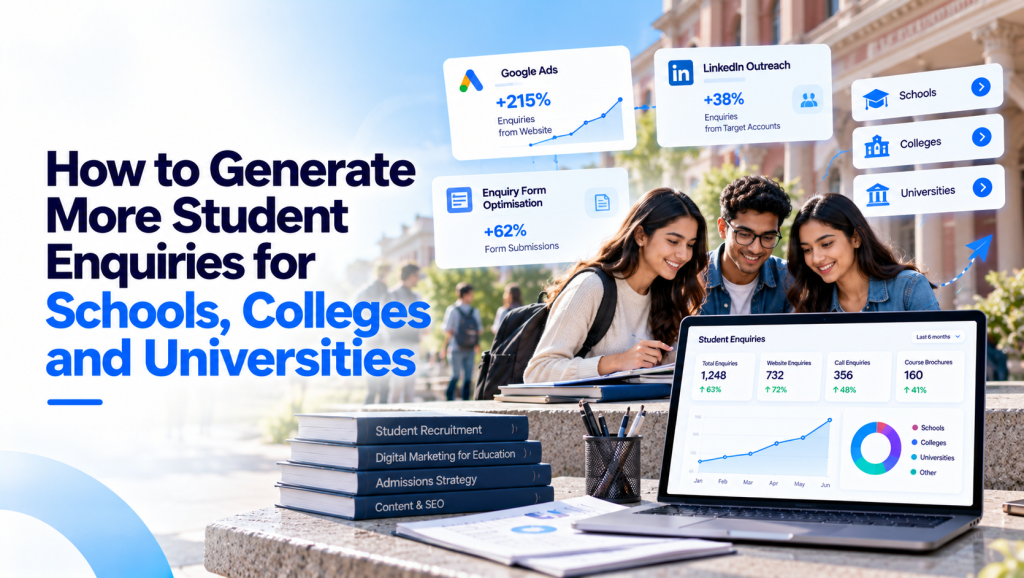
To generate more student enquiries, schools, colleges and universities need to reach prospective students and parents when they are actively exploring admission options. A combination of Google Ads, organic search, social media, helpful admission content and timely follow-ups can increase enquiries. The real opportunity is turning those enquiries into campus visits, applications and confirmed enrolments.
The challenge is that generating an enquiry and securing an admission are two different things.
A parent looking for Grade 1 admission at a school in Jaipur has different questions from a student comparing MBA programmes across India. A working professional exploring executive education may take several months to decide, while a parent approaching an admission deadline may want an immediate conversation.
Yet many educational institutions use similar campaigns, landing pages and follow-up processes for everyone.
This often creates three problems:
- Marketing campaigns attract people who are not ready or eligible to apply.
- Admissions teams spend time following up with enquiries that have little potential to convert.
- Institutions struggle to identify which marketing activities actually contribute to enrolments.
A more effective education lead generation strategy connects marketing with the complete admissions journey.
Why Are Schools, Colleges and Universities Struggling to Generate Quality Student Enquiries?
Educational institutions often struggle to generate quality student enquiries because their marketing focuses on visibility and enquiry volume without sufficiently understanding student intent, programme suitability and admission readiness.
A campaign may generate hundreds of enquiries while producing relatively few completed applications.
The problem is not necessarily the advertising channel. It may be the audience, the message, the landing page or what happens after someone submits a form.
1. Students and parents have more options to compare
Prospective students can research institutions through Google Search, university websites, social media, student communities, review platforms and AI-powered research tools.
They can compare fees, programmes, admission criteria, placements, facilities and student experiences before contacting an institution.
For schools, parents commonly evaluate academic performance, safety, distance, infrastructure, extracurricular activities and teaching quality.
For universities, the decision may involve programme recognition, accreditation, faculty, career outcomes, total costs and financial support.
Marketing needs to answer these questions early.
2. Many campaigns attract interest rather than admission intent
Someone searching for “best engineering colleges in India” may still be researching options.
Someone searching for “BTech admission 2027 eligibility and fees” may be closer to applying.
Both searches can be relevant, but they represent different stages of the decision process.
Treating them equally can lead to inefficient advertising spend and unrealistic expectations from admissions teams.
3. Enquiries are not followed up effectively
A prospective student might submit an enquiry form, receive an automated confirmation and hear nothing further until the next day.
By then, the student may have already spoken with another institution.
Speed matters, but follow-up quality matters just as much. Admissions counsellors need to answer questions, understand the student’s requirements and explain the appropriate next step.
4. Marketing and admissions data remain disconnected
Many institutions measure impressions, clicks, form submissions and cost per lead.
Fewer connect those metrics to:
- Qualified admission enquiries
- Counselling conversations
- Campus visits
- Applications started
- Applications completed
- Admission offers accepted
- Confirmed enrolments
Without this connection, it becomes difficult to determine which campaigns deserve more investment.
The distinction between lead quality and lead quantity is particularly important in education, where the final outcome depends on eligibility, timing, affordability and personal preference.
How to Generate More Student Enquiries: 10 Practical Strategies
The most effective student acquisition strategies combine high-intent discovery channels with credible information and a structured admissions process.
Not every institution needs every channel. Schools should prioritise local parent demand, while colleges and universities often need a broader, programme-specific approach.
1. Use Google Ads to reach students actively searching for admissions
Google Ads can help educational institutions reach prospective students and parents who are already searching for relevant courses, schools or admission opportunities.
This makes search advertising particularly useful during defined admission periods.
For example, a school in Jaipur may target searches such as:
- CBSE school admissions in Jaipur
- Best schools near Vaishali Nagar
- Class 1 admission Jaipur
- Schools offering Grade 11 science
- School admission form 2027
A university might focus on:
- BTech admission in Jaipur
- MBA colleges accepting applications
- BBA admission eligibility
- MSc courses with admission open
- Executive MBA application deadlines
The important decision is how campaigns are structured.
A university offering engineering, management, law and design programmes should not send every searcher to the same general admissions page.
Each programme has different eligibility requirements, competing institutions and student expectations.
Separating campaigns by programme, geography and search intent allows institutions to create more relevant messages.
Example: JECRC University’s admissions campaigns
Growleads’ JECRC University Google Ads case study documents 1,480 qualified admissions enquiries across the university’s programmes.
The campaigns generated approximately 312,000 impressions and 18,600 clicks, with a reported average click-through rate of 6%.
The strategy focused on matching programme-level searches with relevant admissions information rather than directing all prospective students through one general journey.
For universities with multiple academic programmes, the lesson is practical: campaign relevance should begin with the student’s specific course interest.
2. Create dedicated admission landing pages for every important programme
An admission landing page should help prospective applicants understand the programme, assess their suitability and take the next step.
Sending paid traffic to a generic homepage often makes that process unnecessarily complicated.
Consider a student searching for an MBA programme.
The landing page should ideally answer:
- What programmes are offered?
- Who is eligible?
- What is the duration and fee structure?
- What are the admission requirements and deadlines?
- What placement or career support is available?
- How can the student speak with an admissions counsellor?
The page should also provide an obvious next step, such as booking counselling, requesting a brochure or starting an application.
For schools, landing pages should address the needs of parents.
A Grade 1 admission page could explain curriculum, age eligibility, infrastructure, transport, safety measures, admission dates and campus visit availability.
Keep forms focused on information genuinely needed at the enquiry stage. Asking for extensive academic or personal details before a conversation can discourage otherwise interested families.
3. Invest in local SEO and Google Business Profile visibility
Local search visibility is particularly valuable for schools and colleges attracting students from specific geographic areas.
Parents often search using location-based phrases such as “schools near me” or “CBSE schools in Mansarovar”.
A complete Google Business Profile helps eligible institutions present accurate location details, contact information, photographs and other useful information in Google Search and Maps.
Institutions should maintain:
- Accurate addresses and contact details
- Relevant business categories
- Current campus photographs
- Updated opening and visiting hours
- Genuine parent or student reviews
- Clear admissions information on their websites
Local landing pages can also help institutions explain transport routes, nearby residential areas and campus accessibility.
However, creating many near-identical city pages without useful local information is unlikely to help students or parents make better decisions.
For universities serving multiple states, organic search should additionally cover programme-level queries, including eligibility, admission criteria, course comparisons, fees and career opportunities.
Organic search is a longer-term investment than paid advertising, but helpful educational content can continue attracting relevant interest beyond a single admission cycle.
4. Run Meta Ads that speak to the right student or parent audience
Facebook and Instagram advertising can help institutions build awareness and generate enquiries from audiences who may not be actively searching for admission options.
The message should reflect the institution’s prospective applicant.
For school admissions, parents might respond to information about:
- Academic performance
- Campus safety
- Teaching methods
- Sports and extracurricular facilities
- Transport availability
- School visits and admission dates
For undergraduate admissions, creative content may focus on programmes, campus life, learning facilities, student projects and eligibility.
Postgraduate campaigns can communicate programme outcomes, schedules, industry exposure and suitability for specific career stages.
Rather than using one generic “Admissions Open” creative, institutions can test distinct messages.
For example:
Creative A: Academic evidence
Highlight a verified result, such as board examination performance or a specific institutional achievement.
Creative B: Campus experience
Show real classrooms, laboratories, sports facilities and learning environments.
Creative C: Admission information
Explain eligibility, important dates and how to speak with an admissions counsellor.
A campaign might use an on-platform lead form or direct prospective applicants to a website landing page.
On-platform forms can make submitting details easier. Website forms allow more room to explain programme requirements and assess intent. The right choice depends on lead quality and application progression, not simply which produces the cheapest form submissions.
5. Use content marketing to answer admission-related questions
Educational content can attract prospective students before they are ready to enquire.
The most useful topics come from questions the admissions team already receives.
For example, a university could publish:
- BBA vs BCom: Which course fits your career plans?
- What to check before choosing an engineering college
- MBA admission eligibility and entrance requirements
- How to compare total college costs
- What parents should ask during a campus visit
Such content serves two purposes.
It helps students make more informed decisions, and it allows institutions to demonstrate their expertise and transparency.
A school could publish practical content about early-years learning, curriculum differences, child development, assessment methods and transitioning between grades.
Institutions should also make important facts easy to find in concise question-and-answer formats.
Programme names, eligibility criteria, recognised credentials, fees, dates and contact details should remain consistent across the institution’s website and admissions materials.
Students may now encounter this information through search engines, conversational AI tools and other research platforms. Clear, accurate and regularly updated source content makes the institution easier to evaluate.
However, visibility in an AI-generated answer does not guarantee an enquiry. Admissions teams still need a clear pathway from research to personal contact.
6. Use WhatsApp and email to nurture genuine admission interest
Not every prospective student is ready to apply after the first interaction.
A parent may be waiting to visit the campus. A university applicant may need to complete entrance examinations or compare financing options.
WhatsApp and email can help institutions maintain useful communication during that period.
A practical sequence might include an enquiry acknowledgement, a relevant brochure, a counselling invitation and a timely reminder about application deadlines.
Messages should be personalised to the student’s or parent’s expressed interest.
For example, a parent who enquired about Grade 1 should receive information about primary admissions rather than a generic message advertising every grade.
Avoid excessive reminders, misleading urgency and repeated messages after someone opts out.
Communication should follow applicable consent, privacy and messaging requirements, especially when handling children’s or applicants’ personal information.
7. Improve enquiry-to-counselling conversion
Generating more student enquiries has limited value when admissions teams cannot connect with interested applicants.
Institutions should define clear response responsibilities.
A basic admissions workflow could look like this:
Student or parent submits enquiryWebsite, advertisement, phone or admission event
Lead enters the admissions CRMSource, programme and contact details recorded
Counsellor reviews and contacts the enquiryEligibility, interest, questions and timing assessed
Relevant next step arrangedCounselling session, campus visit or application
Application and enrolment progress trackedFollow-up remains linked to the original enquiry
The process should be simple enough for counsellors to use consistently.
Admissions leaders should review how quickly enquiries are assigned, how many receive a meaningful conversation and why applicants stop progressing.
Often, improving these processes can be more valuable than increasing advertising spend.
8. Turn campus visits and counselling sessions into stronger conversion opportunities
For schools, a campus visit is often an important step in the decision process.
Parents want to experience the environment, meet the people responsible for teaching and ask questions that cannot be fully answered online.
A structured campus visit programme can therefore contribute directly to admission conversion.
Schools should make it easy to schedule visits, confirm appointments and provide practical visiting instructions.
The conversation should address the child’s needs rather than becoming a generic sales presentation.
Example: Scotle’s parent enrolment campaign
Growleads’ Scotle school admissions case study reports more than 480 parent enrolment enquiries in one admissions cycle.
The campaign generated approximately 282,000 impressions and 20,000 clicks, with a reported average click-through rate of 7.2%.
An important part of the strategy was focusing on the school’s catchment area and distinguishing parents with immediate admission intent from those conducting broader research. The campaign also used booked campus visits as a stronger conversion signal than a basic enquiry submission.
For schools, the broader lesson is to measure meaningful admission progression alongside enquiry volume.
9. Build a referral and reputation programme
Recommendations from existing parents, students and alumni can contribute to admissions demand.
Educational decisions involve considerable trust. Prospective families and applicants often want to hear from people who have experienced the institution.
Schools can encourage genuine parent feedback and make verified student achievements or learning experiences accessible.
Universities can involve alumni and current students in appropriate information sessions, programme discussions and campus events.
Referral programmes should remain transparent.
Institutions should avoid fabricated reviews, undisclosed incentives and promises about admission outcomes that cannot be supported.
Strong reputation management also means addressing genuine concerns rather than focusing exclusively on positive testimonials.
10. Measure enrolments, not just student leads
An institution should assess the success of student lead generation by the quality and progression of enquiries, not simply by the number of forms received.
Two campaigns can have very different business outcomes even when they generate the same number of leads.
For example, one campaign may produce many low-cost enquiries from students who do not meet the programme’s requirements. Another may generate fewer enquiries but a higher proportion of suitable applicants.
The second campaign may provide better value.
Institutions can use a structured process for measuring lead quality and adapt qualification criteria to their admissions requirements.
Which Student Lead Generation Channels Work Best for Different Institutions?
The right channels depend on the institution’s audience, geography, admission cycle and decision-making process.
| Channel | Schools | Colleges | Universities |
|---|---|---|---|
| Google Search Ads | High priority for local admission demand | High priority for course searches | High priority for programme-specific searches |
| Meta Ads | Strong for parent awareness and enquiries | Useful for awareness and campus interest | Useful for programme discovery |
| Local SEO | Very high relevance | High for regional colleges | Useful for campus-specific searches |
| Organic content | Builds parent trust over time | Helps students compare courses | Supports broad programme discovery |
| WhatsApp and email | Parent follow-ups and campus visits | Counselling and application nurturing | Multi-stage admissions nurturing |
| Webinars and open houses | Parent orientation events | Course and career discussions | Programme and faculty interaction |
| Alumni and referrals | Parent recommendations | Student and alumni advocacy | Alumni credibility and programme trust |
A school with a limited geographic catchment may achieve better results by prioritising local search, parent-focused advertising and campus visits.
A university with multiple programmes may require separate marketing strategies for undergraduate, postgraduate and executive education.
Why programme-specific marketing matters for higher education
An MBA prospect, an undergraduate engineering applicant and a working executive have different priorities.
Even within one university, the same landing page and advertising message may not serve all three.
Growleads’ SPJIMR Google Ads admissions case study illustrates this distinction.
The documented campaign generated approximately 480 qualified programme enquiries from 6,900 clicks.
Its structure separated full-time and executive programme intent, matched search queries to the appropriate programme pages and filtered unrelated traffic.
The campaign reported a 7.2% average click-through rate.
The practical takeaway is that higher education campaigns should reflect individual programme requirements, applicant profiles and admission timelines rather than operating as one broad institutional campaign.
How to Identify High-Quality Student Enquiries
A high-quality student enquiry is an expression of genuine interest from a prospective applicant or parent whose requirements, eligibility and admission timeline reasonably match the institution’s offering.
Qualification should help admissions teams provide relevant guidance, not create unnecessary barriers.
A simple evaluation framework can include five areas.
| Qualification criterion | What to assess | Why it matters |
|---|---|---|
| Programme fit | Is the student interested in a course or grade the institution offers? | Reduces irrelevant follow-ups |
| Eligibility | Does the applicant meet or potentially meet admission requirements? | Identifies realistic application opportunities |
| Timing | Is the intended admission cycle current or future? | Helps prioritise communication |
| Geographic fit | Is the campus accessible or relocation feasible? | Clarifies practical suitability |
| Engagement | Has the prospect requested counselling, a visit or application information? | Indicates progression in the decision process |
An institution can use these criteria to create a simple lead qualification process.
For example, a student asking about a programme offered in the next academic year may be a valuable prospect even if they are not ready to apply immediately.
Likewise, a parent who requests a campus visit may demonstrate stronger intent than someone downloading a general school brochure.
Neither action guarantees admission.
A useful qualification system distinguishes between immediate opportunities, future-cycle prospects and enquiries requiring clarification.
How to Calculate the Cost of Generating Student Enquiries
Cost per lead is useful, but it should not be the only performance metric.
Educational institutions should track spending against meaningful admissions outcomes.
Here are the main formulas:
| Metric | Formula |
|---|---|
| Cost per enquiry | Marketing spend ÷ Total enquiries |
| Cost per qualified enquiry | Marketing spend ÷ Qualified enquiries |
| Enquiry-to-application rate | Applications ÷ Enquiries × 100 |
| Application-to-enrolment rate | Enrolments ÷ Applications × 100 |
| Cost per enrolment | Marketing spend ÷ Confirmed enrolments |
Example: Why cheaper student leads may not mean better admissions
Consider two hypothetical campaigns with equal spending of ₹1,00,000 each.
| Metric | Campaign A | Campaign B |
|---|---|---|
| Marketing spend | ₹1,00,000 | ₹1,00,000 |
| Total enquiries | 500 | 250 |
| Cost per enquiry | ₹200 | ₹400 |
| Qualified enquiries | 100 | 150 |
| Confirmed enrolments | 10 | 20 |
| Cost per enrolment | ₹10,000 | ₹5,000 |
Illustrative example created to explain admissions economics, not actual Growleads client results.
Campaign A looks stronger when evaluated only on cost per enquiry.
Campaign B delivers twice as many confirmed enrolments with the same investment.
This is why education marketing teams should consider cost per qualified enquiry and cost per enrolment before deciding which campaigns to scale.
Institutions should also account for admissions staff costs, scholarships, refunds and other relevant expenses when evaluating the full cost of acquiring a student.
How Schools and Universities Can Build a More Predictable Admissions Funnel
A predictable admissions funnel connects each prospective applicant to the appropriate next action and helps marketing and admissions teams see where interest is being lost.
The funnel should reflect the actual decision journey.
The Student Admissions Funnel
AwarenessSearch, social media, referrals
EnquiryForms, calls, messages
Qualified InterestEligibility and fit assessed
Counselling or VisitMeaningful admissions conversation
ApplicationSubmission and review
EnrolmentAdmission accepted and completed
Conceptual funnel illustrating the admissions stages. Widths are not actual conversion rates.
Each stage needs its own measurement.
For example, a college may have strong enquiry volumes but poor counselling attendance. That suggests the immediate priority may be improving scheduling and communication rather than buying more advertising traffic.
Another institution may have strong counselling attendance but low application completion. In that situation, leadership should investigate application complexity, fee concerns, documentation requirements or uncertainty about programme suitability.
The lead generation process provides a useful foundation for connecting demand creation, qualification and follow-up into one measurable workflow.
Align marketing and admissions teams around shared outcomes
Marketing teams should understand which programmes need applications, what eligibility criteria apply and when admission windows close.
Admissions teams should provide feedback about enquiry quality, common objections and application barriers.
A weekly review might examine:
- Which channels generated qualified enquiries?
- Which programmes received insufficient interest?
- Which enquiries remain uncontacted?
- How many counselling sessions and campus visits occurred?
- What prevented interested applicants from moving forward?
- Which campaigns should receive more or less budget?
This shared view helps prevent marketing teams from optimising solely for cheap enquiries while admissions teams measure an entirely different outcome.
The same principle appears in Growleads’ discussion of why qualified pipeline matters more than lead volume. In education, the equivalent of a qualified pipeline is a well-managed pool of prospective students moving toward an informed admission decision.
A 90-Day Student Enquiry Generation Plan
Institutions do not need to launch every marketing channel simultaneously.
A phased approach allows teams to identify gaps, establish measurement and improve campaigns before increasing budgets.
Days 1 to 15: Audit admissions demand and the existing funnel
Start by examining historical admissions data.
Identify the programmes or grades requiring more applications, target geographies, typical applicant concerns and previous marketing performance.
Review landing pages, enquiry forms, tracking systems and counsellor follow-up processes.
Establish a baseline for enquiries, qualified enquiries, counselling conversations and enrolments.
Days 16 to 30: Build campaigns and admission journeys
Create or improve programme-specific landing pages.
Set up campaign structures around relevant search intent and audience segments.
Develop advertising creative using accurate institutional information, admission deadlines and useful differentiators.
Connect enquiry sources to a central CRM or admissions management system.
Ensure the admissions team is ready to handle incoming enquiries before increasing campaign spending.
Days 31 to 60: Launch, monitor and improve
Launch priority campaigns with controlled budgets.
Review search queries, advertisement performance, landing page engagement and enquiry quality.
Look beyond initial conversion rates.
Ask counsellors which prospects are relevant, which questions occur repeatedly and what causes unsuccessful follow-ups.
Refine campaigns based on those findings.
Days 61 to 90: Improve conversion and scale selectively
Compare campaign performance by qualified enquiry, counselling attendance and application progression.
Increase budgets only where there is evidence of meaningful demand and sufficient capacity to respond.
Introduce remarketing, additional content or new audience segments where permitted and useful.
Document what worked so the institution can repeat and improve the process during future admission cycles.
Common Mistakes That Reduce Student Admission Enquiries
Many admissions campaigns underperform because of a few recurring operational decisions.
Using one campaign for every programme: Different courses and grades need different eligibility information, landing pages and messages.
Optimising only for low-cost leads: Cheap enquiries can create more workload without contributing to enrolments.
Sending traffic to a generic homepage: Applicants should reach the information that matches their original search or advertisement.
Starting paid campaigns too late: Institutions need time to launch, assess traffic quality and improve campaigns before important deadlines.
Ignoring admissions team capacity: Enquiry volume is not useful if interested applicants do not receive meaningful follow-up.
Using vague institutional claims: Messages about excellence and world-class infrastructure offer little differentiation without specific, supportable evidence.
Failing to track enrolments by source: Without this connection, marketing budgets may continue flowing toward channels that produce activity rather than admission outcomes.
Collecting unnecessary personal information: Education marketing often involves minors and sensitive applicant records. Institutions should minimise data collection, obtain appropriate consent and follow applicable privacy requirements.
Can Outbound Outreach Help Colleges and Universities Generate More Opportunities?
Outbound outreach can support higher education growth, but its suitability depends on whom the institution wants to reach.
Direct outreach is generally more appropriate for institutional partnerships, corporate training, employer relationships and education services than for unsolicited mass messaging to prospective students.
For example, a university developing an industry-linked programme might approach relevant employers and professional organisations.
An education services company may need relationships with university leadership, registrars and academic departments.
These opportunities involve multiple decision-makers and longer consideration periods.
Example: 320+ qualified university leadership conversations
Growleads’ university outreach case study documents an India-based education services company seeking partnerships with higher education institutions.
The campaign mapped approximately 2,600 institutions and around 6,000 named stakeholders.
Over six months, it generated:
- 320+ qualified conversations with institutional stakeholders
- 52 leadership meetings
- 11 institutional partnerships in active discussion
The programme combined role-specific email outreach with LinkedIn engagement, focusing on university leadership and academic decision-makers.
These were institutional partnership conversations, not student admission enquiries.
That distinction matters. Institutions should use different targeting, messaging and measurement systems for student acquisition and B2B education partnerships.
How Should Institutions Allocate Their Student Acquisition Budget?
Budget allocation should reflect audience intent, existing brand awareness, geographic reach and admission deadlines.
For institutions with limited marketing resources, the priority should be fixing the existing admissions funnel before adding multiple new channels.
The following framework can help leadership make decisions.
| Situation | Recommended priority | Reason |
|---|---|---|
| Admissions are open and search demand exists | Google Search Ads | Reaches people actively researching admission options |
| School needs more local parent awareness | Meta Ads and local visibility | Builds familiarity in the relevant catchment |
| University has many programmes | Programme-specific search campaigns | Improves relevance and qualification |
| Website traffic is strong but enquiries are low | Landing page improvement | Addresses the conversion problem |
| Enquiries are high but enrolments are weak | CRM, counselling and follow-up | Improves progression through the funnel |
| Institution wants sustainable long-term discovery | Organic content and search visibility | Builds useful search assets over time |
| University wants institutional partnerships | Targeted email and LinkedIn outreach | Reaches professional decision-makers |
A new school may reasonably invest more in local awareness than an established institution with strong existing demand.
A university with highly specialised programmes may benefit more from precise searches and detailed content than broad social campaigns.
There is no universal percentage allocation that works for every institution.
Budget decisions should ultimately depend on demonstrated cost per qualified enquiry, application progression and cost per enrolment.
How Growleads Approaches Education Lead Generation
Effective education marketing starts by understanding who is likely to enrol, what they need to know and what prevents them from making a decision.
At Growleads, that means examining demand signals and the admissions journey before deciding which campaigns to run.
For schools, the focus may be on local parent intent, programme differentiation and campus visit conversion.
For colleges and universities, it may involve programme-level search campaigns, qualification criteria, application journeys and admissions reporting.
Where an organisation is selling services or partnerships to universities, the strategy changes again. The audience becomes institutional decision-makers rather than individual applicants.
The goal is to connect marketing activity with outcomes that admissions and leadership teams can evaluate.
Enquiry quality, counselling progression and application performance should guide optimisation, not simply clicks and form submissions.
Frequently Asked Questions
1. What is the best way to generate more student enquiries?
The best way to generate more student enquiries is to combine channels that reach relevant prospective applicants with clear admission information and effective follow-up. Google Search Ads can help capture existing admission demand, while local visibility, social media and educational content support discovery and trust. The ideal mix depends on the institution.
2. How can schools increase admission enquiries from parents?
Schools can increase parent admission enquiries through local Google searches, parent-focused Meta campaigns, accurate Google Business Profiles, referral programmes and convenient campus visit booking. Campaigns should communicate specific, verified information about academics, safety, facilities, curriculum and admission dates.
3. How can colleges generate student leads without spending heavily on advertising?
Colleges can generate student leads through useful programme pages, organic search content, local visibility, alumni referrals, webinars and school outreach partnerships. These channels can reduce dependence on paid advertising over time, although they still require content development, consistent management and staff resources.
4. Are Google Ads or Facebook Ads better for student admissions?
Google Ads is often better suited to capturing students or parents actively searching for admission options, while Facebook and Instagram can help generate awareness among relevant audiences. Google Search may be particularly valuable during admission deadlines, whereas Meta campaigns can introduce an institution earlier in the decision process. Both should be evaluated using qualified enquiries and enrolments.
5. How much does it cost to generate a student enquiry?
The cost of generating a student enquiry varies according to course type, location, competition, target audience, platform and admission season. Institutions should calculate cost per enquiry using actual campaign spending and then assess cost per qualified enquiry and cost per enrolment. A low initial lead cost does not necessarily indicate a successful admissions campaign.
6. How can universities improve student enquiry conversion rates?
Universities can improve enquiry conversion rates by using programme-specific landing pages, clear eligibility information, simple forms, timely counselling and structured follow-ups. Admissions teams should track where applicants stop progressing and address common barriers such as unclear fees, documentation requirements or application complexity.
7. Should schools use WhatsApp for admission lead generation?
Schools can use WhatsApp to acknowledge enquiries, share requested information, schedule campus visits and provide relevant admission updates. Communication should be consent-based, useful and appropriately timed. Repeated unsolicited messages can damage trust, especially when parents are comparing several institutions.
8. What is the difference between student lead generation and student enrolment marketing?
Student lead generation focuses on attracting prospective students or parents who express interest in an institution. Student enrolment marketing covers the broader journey from awareness and enquiry through counselling, application, admission acceptance and confirmed enrolment. The most effective approach connects both activities so that marketing investment can be evaluated against actual admissions outcomes.
Conclusion: Generate More Student Enquiries by Improving the Entire Admissions Journey
Generating more student enquiries is not simply a matter of increasing advertising budgets or reaching larger audiences.
Schools, colleges and universities need to understand what prospective students and parents are looking for, reach them through appropriate channels and help them make informed admission decisions.
Google Ads can capture immediate demand. Social media can build awareness. Organic content can answer important questions. Campus visits, counselling and timely follow-ups can help convert interest into applications.
But every institution should measure what happens after the enquiry.
A smaller number of relevant prospective students who receive the right information and support may be more valuable than a large database of contacts who never progress toward admission.
For institutions reviewing their admissions strategy, the practical starting point is to examine the existing funnel, identify where qualified prospects are being lost and invest in the improvements most likely to influence enrolments.
Growleads works with educational institutions on demand generation and campaign measurement, with an emphasis on connecting marketing activity to meaningful outcomes.
If your school, college or university is receiving enquiries but struggling to convert them into applications and admissions, a review of targeting, campaign structure and admissions follow-up can help identify where to improve.

Builds the demand intelligence, automation, and deliverability systems behind Growleads pipeline.