
Lead Quality vs Quantity: Why “More Leads” Is the Wrong Business Goal in 2026
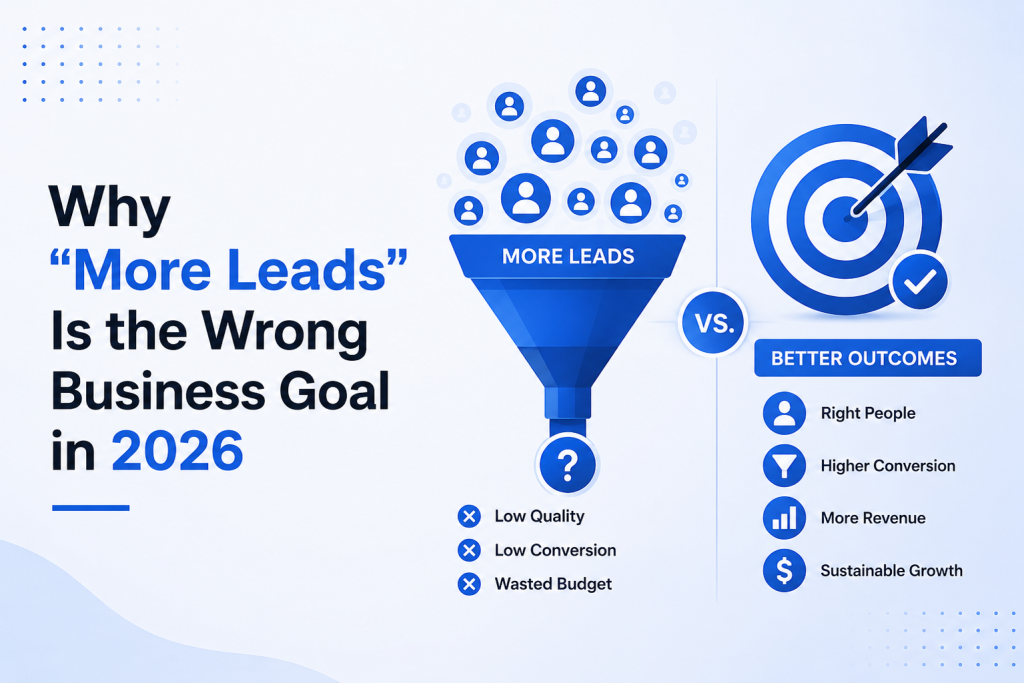
More leads is not a useful business goal if those leads do not become qualified sales opportunities. In 2026, the better target is qualified pipeline: enough right-fit accounts, with real buying potential, progressing toward revenue. The lead quality vs quantity debate matters, but both are subordinate to one question: how much revenue pipeline is your go-to-market system creating?
Key takeaways
- Lead volume is an input metric. Qualified pipeline and revenue are business outcomes.
- Lead quality should be judged by fit, buying relevance, timing, access, economics and eventual conversion, not by a form fill or lead score alone.
- Quantity still matters, but only after a minimum quality threshold has been established.
- Lead generation ROI should connect spend to qualified opportunities, pipeline, closed-won revenue and gross profit.
- Senior revenue teams should work backwards from revenue targets to determine how many opportunities and leads they actually need.
Why “more leads” is the wrong goal in 2026
“Generate more leads” sounds measurable and actionable. That is exactly why it survives in so many marketing plans.
The problem is that a lead count says almost nothing about commercial value.
A database can grow while pipeline stays flat. A campaign can lower cost per lead while increasing the sales team’s workload. An outbound program can generate replies that never become qualified meetings. Paid campaigns can fill the CRM with contacts outside the ideal customer profile, too small, too early or simply not experiencing the problem your company solves.
In 2026, lead volume is also easier to manufacture. HubSpot’s current marketing data says 56% of marketers find it easier to improve lead numbers than it was 10 years ago. Yet lead quality and marketing-qualified leads (MQLs) rank as the most important success metric for 40% of marketers, while lead generation volume is cited by 29%. That gap is a useful signal: teams are increasingly looking beyond raw volume toward commercial relevance.
The shift matters because sales capacity is limited. Salesforce reports that the average sales rep spends only about 12 hours of a 40-hour week on work directly related to selling. Every poor-fit lead that requires research, qualification, chasing and CRM administration consumes a scarce resource.
The business goal should not be maximum lead volume. It should be enough qualified demand to produce the revenue pipeline the company needs.
Lead quality vs quantity: measure commercial value, not activity
Lead quantity is the number of leads generated in a defined period. Lead quality is the degree to which those leads resemble customers you can successfully sell to and have credible potential to progress.
Neither metric is sufficient on its own.
| Metric | What it tells you | What it misses |
|---|---|---|
| Lead quantity | How much top-of-funnel volume you created | Whether the leads deserve sales attention |
| Lead quality | How commercially relevant the leads appear | Whether you have enough volume to hit target |
| Qualified opportunities | How many prospects passed agreed sales criteria | The value and timing of those opportunities |
| Qualified pipeline | The monetary value of credible sales opportunities | Whether those opportunities will actually close |
| Closed-won revenue | What the GTM system ultimately converted | Future pipeline health |
The better question is not “quality or quantity?”
It is: What volume of sufficiently qualified leads is required to create enough qualified pipeline for the revenue target?
That framing changes behaviour. Marketing stops celebrating cheap leads that never progress. Sales stops treating every inquiry as equally urgent. Revenue leaders gain a common definition of what deserves attention and what should be nurtured.
The hidden cost of optimizing for lead volume
Low-quality lead volume rarely fails in one obvious place. It creates losses throughout the funnel.
Sales capacity gets spent on filtering
If sales must manually determine whether every lead matches the ICP, has a plausible use case and is worth contacting, marketing has moved the filtering cost downstream.
The visible metric may be a lower CPL. The invisible metric is rep time per real opportunity.
Pipeline becomes inflated
A CRM full of weak deals can make pipeline coverage look healthier than it is. If poor-fit opportunities are allowed into later stages, forecasts become less useful because the pipeline contains deals with very different levels of intent and buying readiness.
A smaller pipeline with consistent entry criteria can be more valuable than a larger pipeline built from optimistic stage definitions.
Channel economics become misleading
Suppose Channel A generates 500 leads at $50 each and Channel B generates 150 leads at $120 each.
Channel A looks better on CPL. But if Channel B creates three times as much qualified pipeline, the expensive lead may actually be the cheaper business outcome.
Cost per lead is useful for diagnosing acquisition efficiency. It should not be the final measure of lead generation ROI.
Bad data creates bad GTM decisions
A perfect-fit account with an active project is not economically equivalent to a student downloading a guide. A positive reply from a target account is not equivalent to a generic “send information” response.
When every activity is treated as the same type of lead, teams lose the ability to learn what actually creates revenue.
Automation can scale noise
Automation can increase outreach, research, scoring and follow-up capacity. But automation applied to weak targeting does not fix the underlying problem. It simply processes more low-value activity.
Scale should amplify a working qualification system, not compensate for the absence of one.
Pipeline generation vs lead generation
Lead generation creates identifiable prospects. Pipeline generation turns relevant prospects into qualified sales opportunities with a value, stage and realistic path toward a buying decision.
A practical B2B flow looks like this:
Demand or prospecting activity → lead → qualified lead → qualified meeting → sales opportunity → qualified pipeline → closed-won revenue
The exact labels vary by company, but the progression should be explicit.
A useful lead generation process therefore needs more than acquisition. It needs qualification rules, routing, follow-up, CRM stage definitions and a feedback loop from sales back to marketing.
The distinction matters because a lead can be real without being a sales opportunity. Someone can fit your target audience but have no current need. An account can have a strong need but no budget. A buyer can show intent but sit outside your serviceable market.
Pipeline generation forces the team to ask what happened after the lead arrived.
Start with revenue pipeline, then work backwards to leads
The cleanest way to set a lead target is to derive it from the revenue target.
Required qualified pipeline = new revenue target ÷ expected opportunity win rate
Then:
Required opportunities = required qualified pipeline ÷ average opportunity value
Then:
Required qualified leads = required opportunities ÷ qualified-lead-to-opportunity conversion rate
Only after that should the team decide how much raw lead volume is needed across channels.
Example: a $1 million new-revenue target
Assume a B2B company wants $1 million in new revenue.
- Average closed deal value: $50,000
- Expected win rate from qualified opportunity to closed-won: 25%
- Qualified-lead-to-opportunity conversion rate: 20%
The company needs 20 closed deals.
At a 25% win rate, it needs roughly 80 qualified opportunities, representing about $4 million in qualified pipeline.
At a 20% qualified-lead-to-opportunity rate, the company needs around 400 qualified leads to create those 80 opportunities.
Now lead quantity has a business purpose.
The target is not “400 because more is better.” It is “400 qualified leads because our funnel economics suggest that volume can create the opportunity base required for the revenue plan.”
The model should be adjusted for sales-cycle length, expansion revenue, churn, deal-size variation and channel differences. Pipeline is also not revenue. A $4 million qualified pipeline does not mean $4 million will close.
How to measure lead quality in 2026
Lead quality should combine fit with evidence that the account can realistically become a customer.
For complex B2B sales, that often means thinking beyond a single contact. 6sense’s 2025 buyer research found that typical buying groups involve more than 10 people, while 94% of buyers ranked their preferred vendors before engaging sellers. Lead quality is therefore partly an account and buying-group question, not simply a contact-level question.
The following Revenue Relevance Score is an educational framework, not a proprietary Growleads methodology.
| Dimension | Core question | Example evidence |
|---|---|---|
| ICP fit | Is this a company we are built to serve? | Industry, geography, size, technology, business model |
| Problem fit | Is there a credible problem we solve? | Stated pain, operational gap, trigger event |
| Buying signal | Is there evidence of current or emerging demand? | Hiring, funding, expansion, research behaviour |
| Access | Can we reach people involved in the decision? | Correct contacts, engaged stakeholder, buying-group coverage |
| Economics | Could the opportunity justify sales effort? | Deal potential, margin, customer lifetime value |
| Timing | Is there a plausible path to action? | Active project, budget window, renewal date |
A company does not need to score perfectly on every dimension.
An excellent-fit account with no current timing signal may belong in nurture rather than in the active pipeline. The mistake is not keeping that account. The mistake is treating it as equally sales-ready as a buyer with a live project.
The metrics that should replace raw lead volume
A mature revenue team can still track lead count. It simply stops treating lead count as the headline measure.
| Metric | Why it matters |
|---|---|
| Lead-to-qualified-meeting rate | Shows whether acquisition reaches people worth a sales conversation |
| Qualified-meeting-to-opportunity rate | Tests whether meetings contain real commercial potential |
| Opportunity win rate | Helps determine the pipeline coverage required for the revenue target |
| Pipeline value by source | Compares channels by credible revenue potential, not contact volume |
| Cost per qualified opportunity | Reveals the true cost of creating sales-ready opportunities |
| Cost per dollar of qualified pipeline | Helps compare programs with different deal sizes |
| Disqualification rate by reason | Turns rejected leads into targeting and messaging feedback |
| Closed-won revenue by source | Shows which channels actually create customers |
A useful interim efficiency measure is:
Pipeline efficiency = qualified pipeline created ÷ acquisition program cost
For realised lead generation ROI, use profit where possible:
Lead generation ROI = (incremental gross profit attributable to the program – program cost) ÷ program cost × 100
Using revenue alone can exaggerate ROI when delivery costs are meaningful. And if deals have not closed yet, report qualified pipeline separately. Do not present unclosed pipeline as realised ROI.
How to balance lead quality and quantity without starving the pipeline
Quality-first does not mean “generate as few leads as possible.” Qualification rules can become so narrow that sales receives too little pipeline, new segments never get tested and early-stage buyers are ignored.
The better principle is:
Set the quality floor first. Scale volume second.
Define non-negotiable ICP criteria
Agree on the conditions that make an account serviceable, such as geography, company size, industry, technology environment or minimum commercial potential.
Separate fit from readiness
A high-fit account that is not buying today may still be valuable. Create different paths for sales-ready opportunities, qualified but early accounts, nurture accounts and disqualified accounts.
Use signals to prioritise, not to create certainty
Funding, hiring, new leadership, expansion, technology changes and website behaviour can help prioritise accounts. Signals do not prove intent. They improve the reason for looking more closely.
For outbound, this is where well-designed outbound lead generation services should become more selective, not simply more automated.
Review quality by source
Inbound search, referrals, outbound email, LinkedIn, paid media, events and partner channels can produce very different economics.
Compare each source on qualified meetings, opportunities, pipeline, win rate, cycle length and revenue.
Create a closed feedback loop
Marketing and SDR teams need the reasons sales accepts or rejects leads. Sales needs clear definitions so rejection does not become subjective.
A useful weekly review asks:
- Which sources created qualified opportunities?
- Why were leads disqualified?
- Which ICP segments progressed fastest?
- Where did pipeline stall?
- What should targeting or messaging change next?
When lead quantity still matters
Quantity is not a vanity metric by definition. It becomes a vanity metric when it is disconnected from downstream economics.
Higher volume can be the right priority when:
- the business has a low average contract value and transactional sales process
- the product is self-serve or product-led
- the addressable market is broad
- qualification can happen efficiently through product behaviour or automation
- the company is testing a new segment and needs enough data to learn
- the funnel already converts efficiently and the main constraint is insufficient demand
Even then, quantity should operate within quality guardrails.
For enterprise SaaS, IT services and consulting, sales cycles are usually longer, human selling time is expensive and pursuing the wrong account carries a higher opportunity cost. Raw lead volume is therefore especially weak as a north-star metric.
Seven signs your lead generation goal is wrong
Your team is probably over-optimising for lead volume if:
- Marketing consistently beats the lead target while sales misses the revenue target.
- Sales says lead quality is poor, but nobody tracks disqualification reasons.
- CPL improves while cost per opportunity gets worse.
- The CRM contains many opportunities with no next step, economic buyer or defined need.
- Meetings are counted as success even when they never become sales opportunities.
- Channel budgets are allocated by lead volume rather than pipeline or revenue.
- Leadership cannot explain how the monthly lead goal was derived from the revenue plan.
Several of these together usually indicate a measurement problem, not simply a lead generation problem.
What revenue leaders should ask instead of “How many leads did we get?”
A better pipeline review starts with five questions:
- How much qualified pipeline did we create?
- Which ICP segments and channels created it?
- What percentage of qualified meetings became opportunities?
- Why were the rest disqualified or lost?
- Are current conversion rates and pipeline coverage sufficient for the revenue target?
These questions connect marketing activity to sales reality and reduce the usual sales and marketing argument. Instead of debating whether a lead is “good”, both teams can inspect the same progression from fit to meeting to opportunity to revenue.
Conclusion: lead quality vs quantity is not the final decision
The lead quality vs quantity debate is useful, but it stops one level too early.
B2B companies need enough leads, and those leads need to be relevant. But the business objective is neither maximum quantity nor theoretical quality. It is predictable creation of qualified sales opportunities and enough credible revenue pipeline to support the growth plan.
Growleads takes the same position: it describes itself as a Demand Intelligence partner focused on qualified pipeline rather than simply selling leads. Its operating principles emphasise meetings and pipeline over vanity metrics.
For teams reviewing their acquisition model, the next step is to work backwards from revenue, agree on qualification criteria, measure conversion at each stage and then scale the channels that produce the strongest economics. A broader GTM strategy can help when the real problem sits across targeting, buyer signals, outreach, qualification and measurement rather than in one isolated channel.
More leads may still be part of the answer. They should never be the answer by themselves.
Frequently asked questions
What is the difference between lead quality and lead quantity?
Lead quantity measures how many leads you generate, while lead quality measures how likely those leads are to become commercially relevant sales opportunities. In B2B, quality usually includes ICP fit, problem relevance, buying signals, access to decision-makers, timing and economic potential.
Is lead quality more important than lead quantity?
Lead quality is more important when sales capacity is expensive and deal cycles are complex, but a business still needs sufficient volume. The better model establishes a minimum quality threshold and then scales quantity without weakening that threshold.
What is qualified pipeline?
Qualified pipeline is the total value of sales opportunities that meet agreed qualification and stage criteria and have a credible path toward a buying decision. It connects prospecting activity to potential revenue, although pipeline should never be treated as guaranteed revenue.
What is the difference between pipeline generation and lead generation?
Lead generation creates identifiable prospects, while pipeline generation converts relevant prospects into qualified sales opportunities with defined commercial value and stage progression. Lead generation is one part of pipeline generation.
How do you measure lead quality?
Measure lead quality using leading and outcome indicators. Leading indicators include ICP fit, problem relevance, buying signals and timing. Outcome indicators include qualified-meeting rate, opportunity conversion rate, win rate, sales-cycle length and revenue by source.
How do you calculate lead generation ROI?
A practical formula is (incremental gross profit attributable to lead generation - program cost) ÷ program cost × 100. If the sales cycle is still open, report qualified pipeline and expected economics separately rather than calling unclosed pipeline realised ROI.
Can generating more leads hurt sales performance?
Yes. More leads can hurt performance when they increase research, qualification and follow-up work without producing more qualified opportunities. The result can be lower sales productivity, noisier CRM data and misleading pipeline forecasts.
How many leads does a B2B company need?
There is no universal lead target. Work backwards from the revenue goal using average deal value, opportunity win rate and lead-to-opportunity conversion rate. The required lead count is an output of your funnel economics, not an industry benchmark.

Builds the demand intelligence, automation, and deliverability systems behind Growleads pipeline.