
Why Most Agencies Never Show You Their Actual Lead Qualification Process
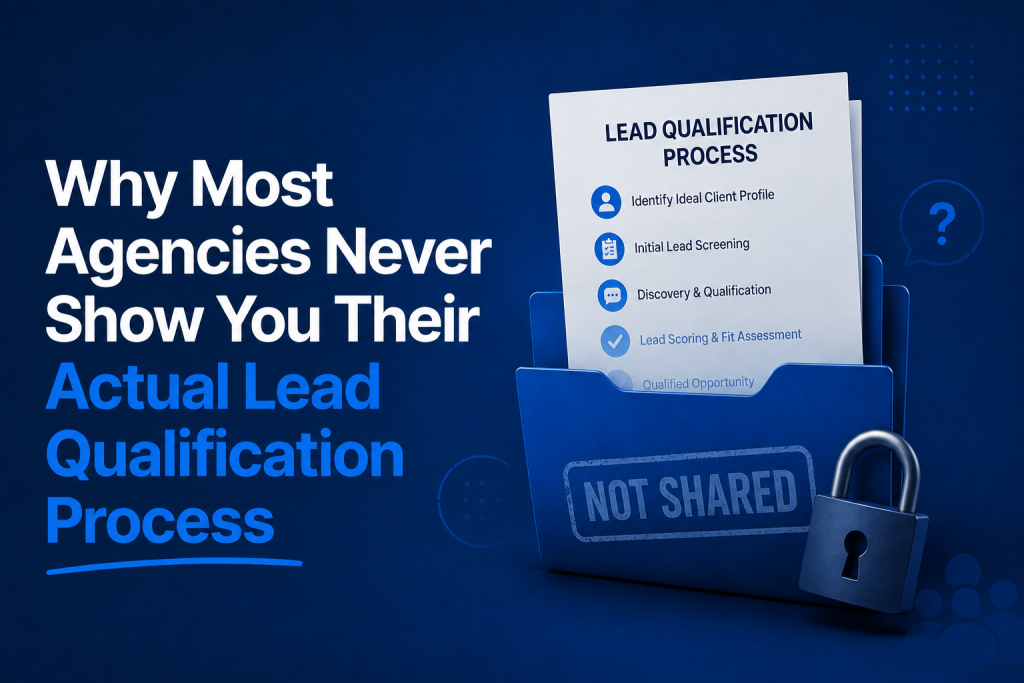
A lead qualification process should tell you exactly why one prospect becomes a sales-ready lead and another does not. If an agency cannot show its criteria, scoring logic, disqualifiers, handoff rules, and evidence captured for each lead, you cannot judge lead quality before sales invests time. The real issue is not lead volume. It is whether “qualified” has an operational definition.
This matters because two agencies can both promise 20 meetings and deliver very different business value.
One may book anyone who responds positively.
The other may check company fit, buyer role, business need, timing, buying context, and whether the conversation is genuinely worth a salesperson’s time.
On a dashboard, both may report 20 meetings.
To your sales team, they are not the same 20 meetings.
That is why buyers evaluating a lead generation partner should ask a simple question early:
“Show me exactly how a prospect becomes a qualified lead.”
The answer tells you more than most pitch decks.
What Is a Lead Qualification Process?
Lead qualification is the process of deciding whether a prospect is a strong enough fit and has enough commercial potential to justify further sales attention.
Qualification usually considers whether the prospect matches the target customer profile, has a relevant need, can realistically buy, and is at an appropriate stage for a sales conversation. Lead scoring can support that decision, but scoring and qualification are not the same thing. Salesforce also distinguishes qualification from scoring, describing scoring as a numerical method for prioritising leads while qualification determines whether the lead is genuinely worth pursuing.
For a B2B company, the process might answer questions such as:
- Is this company inside our ICP?
- Is the person relevant to the buying decision?
- Is there a real business problem we can address?
- Is the prospect actively evaluating the problem or merely curious?
- Is there a realistic buying timeline?
- Is budget available or reasonably possible?
- Is the company large enough, mature enough, or otherwise suitable for our offer?
- Should sales speak with this prospect now, later, or not at all?
A good process also defines disqualification.
That is important.
Qualification is not simply finding more reasons to pass a lead to sales. It is also identifying reasons not to.
Why Lead Qualification Is Where Agency Reporting Gets Uncomfortable
Lead generation is easy to measure at the top of the funnel.
Emails sent.
Replies received.
Forms submitted.
Connections accepted.
Meetings booked.
The harder question is what happened between response and sales handoff.
That part determines whether activity becomes pipeline.
A complete lead generation process therefore cannot end when somebody replies or schedules a call. It needs a clear decision point where the prospect is assessed against agreed qualification criteria.
When an agency is reluctant to explain that decision point, several problems may be hiding underneath.
1. “Qualified” may not have a written definition
Ask three people what a qualified lead means and you may receive three answers.
One person may mean:
A decision-maker who replied positively.
Another may mean:
Someone who agreed to a meeting.
Sales may mean:
A relevant buyer at a suitable company with a confirmed problem and plausible buying intent.
Unless the definition is documented before a campaign starts, reporting becomes subjective.
The agency should not be deciding after the fact whether a meeting “counts.”
2. The commercial incentive may reward volume rather than quality
If performance is judged primarily by meetings booked, the easiest way to improve the number is to reduce the qualification threshold.
That does not automatically mean a meeting-based commercial model is bad.
It means the definition of a billable or qualified meeting matters enormously.
Company fit, role, need, intent, attendance rules, exclusions, and qualification evidence should be agreed in advance.
Otherwise, the client and agency may be optimising for different outcomes.
This is the practical difference behind the debate around lead quality vs quantity. More leads only help when a reasonable percentage of them deserve sales attention.
3. ICP matching may be mistaken for qualification
A prospect can match your ICP and still be a poor lead.
Suppose you sell enterprise cybersecurity services.
The prospect works at a 2,000-person technology company, is based in your target country, and has the title “VP Technology.”
Great fit.
But perhaps:
- there is no relevant project;
- they recently signed a three-year contract with another provider;
- the contact has no involvement in security procurement;
- the company has frozen external spending;
- they were merely curious about your outreach.
The account may be qualified for targeting.
The conversation is not necessarily qualified for sales.
Good qualification separates those two ideas.
4. The process may depend too heavily on individual judgement
If one SDR qualifies a prospect differently from another SDR, lead quality becomes inconsistent.
Human judgement is useful. B2B buying situations rarely fit perfectly into a spreadsheet.
But judgement should operate inside a framework.
An SDR should know:
- what must be true;
- what is optional;
- what automatically disqualifies a prospect;
- what requires further validation;
- what information must be recorded before handoff.
Without those rules, the qualification process lives inside individual people’s heads rather than inside the GTM system.
5. There may be no feedback loop from sales
Qualification criteria should improve over time.
If sales rejects ten leads, somebody should know why.
Were the companies too small?
Wrong job titles?
No active need?
Too early?
Wrong geography?
Poor buying authority?
The answer should feed back into targeting, messaging, scoring, and qualification.
Without that loop, an agency can keep producing the same type of poor-fit meeting while reporting that the campaign is working.
MQL, SQL, Sales-Ready Lead and Qualified Meeting Are Not the Same Thing
One source of confusion is that B2B teams use several labels for leads, often without agreeing on what each label means.
There is no universal MQL or SQL threshold. Salesforce explicitly notes that companies use these lifecycle terms differently. Broadly, an MQL has demonstrated enough marketing interest or fit to justify further progression, while an SQL is ready for direct sales involvement according to the company’s own criteria.
A practical distinction looks like this:
| Stage | What it should mean | Typical next action |
|---|---|---|
| Lead | A person or account has entered the system | Enrich and assess |
| MQL | Marketing considers the lead relevant enough to progress | Nurture, score or send for validation |
| SQL | The lead meets agreed criteria for direct sales attention | Sales follow-up |
| Qualified meeting | A meeting with a prospect who meets predefined qualification conditions | Discovery |
| Sales opportunity | Sales has validated enough commercial potential to pursue a deal | Enter active pipeline |
The exact names are less important than the rules underneath them.
A company could call every stage something different and still have an excellent process.
The problem appears when lifecycle labels exist in the CRM but nobody can explain exactly what moves a prospect from one stage to another.
Do not force MQL terminology onto every outbound campaign
MQL and SQL terminology developed largely around marketing-to-sales handoffs.
Cold outbound works differently.
A prospect may never download a guide, subscribe to a newsletter, or accumulate traditional marketing engagement before answering an email.
For outbound, a cleaner lifecycle may be:
Target account → Target contact → Engaged prospect → Qualified prospect → Qualified meeting → Sales opportunity
What matters is not whether the agency uses the acronym MQL.
What matters is whether everyone agrees on the handoff criteria.
What a Transparent Lead Qualification Process Should Include
A good agency should be able to show its qualification logic before campaigns begin.
The process does not need to be complicated.
It does need to be explicit.
1. ICP fit
Qualification begins before outreach.
The agency should document the companies it wants and the companies it does not want.
Typical criteria include:
- industry;
- geography;
- employee range;
- revenue or funding stage;
- business model;
- technology environment;
- use case;
- target department;
- account maturity.
The ICP should also include a negative ICP.
For example:
- companies below a minimum size;
- unsupported countries;
- certain industries;
- existing customers;
- competitors;
- companies without the required technology or business model.
The best qualification team cannot fix poor targeting after a campaign launches.
2. Buyer and role fit
The next question is whether the individual is relevant.
Do not evaluate this only through job titles.
A “Head of Growth” can have very different responsibilities across two companies.
Qualification should consider:
- seniority;
- functional responsibility;
- involvement in the problem;
- influence over the buying decision;
- access to other stakeholders;
- ownership of the relevant budget or business outcome.
The ideal contact does not always need to be the final economic buyer.
But the agency should know why that person is worth engaging.
3. Need or business problem
A relevant title does not create an opportunity.
There should be a plausible problem, requirement, initiative, or business objective that connects the prospect to the offer.
For early outbound conversations, the agency may not know the full need yet.
That is fine.
The standard should be proportional to the sales stage.
A first conversation might only need evidence that the problem is relevant and worth exploring.
A later-stage SQL may require much stronger confirmation.
4. Authority and buying access
Authority is not simply a yes-or-no field.
In complex B2B sales, several people may influence a purchase.
Qualification should determine whether the contact is:
- the decision-maker;
- an economic buyer;
- a technical evaluator;
- a champion;
- an influencer;
- a potential route to the correct stakeholder.
BANT, one common qualification framework, evaluates Budget, Authority, Need, and Timeline. Salesforce notes that BANT can be useful but can also feel too seller-focused when applied mechanically, which is why qualification questions should remain consultative.
That distinction matters for outbound.
You are trying to determine whether a sales conversation makes sense, not interrogate a prospect.
5. Timing
A company can be an excellent fit but a poor opportunity today.
Qualification should distinguish:
- active requirement;
- near-term project;
- exploratory interest;
- future initiative;
- no foreseeable requirement.
A “not now” lead is different from a “not a fit” lead.
The CRM and follow-up process should reflect that difference.
6. Commercial viability
Budget questions can be difficult early in a B2B conversation.
A prospect may not know the exact budget.
There may not even be a formal budget yet.
Qualification therefore should not always depend on obtaining a precise number.
Instead, the agency and client can define signals of commercial viability such as:
- typical company size;
- current spending on adjacent solutions;
- scope of the problem;
- level of stakeholder involvement;
- existing vendor relationships;
- willingness to discuss commercial parameters.
The right standard depends heavily on ACV and sales complexity.
7. Evidence captured before handoff
Every qualification decision should leave a trail.
At minimum, the sales team should be able to see:
- company;
- contact;
- role;
- source;
- campaign;
- relevant conversation;
- identified requirement;
- qualification status;
- reason for qualification;
- known objections;
- next step.
A salesperson should not receive a calendar invitation and then have to reverse-engineer why the meeting exists.
An Educational Lead Qualification Framework
The following scorecard is an educational example, not a proprietary Growleads methodology.
It shows one way a B2B team could convert subjective qualification into a more consistent process.
Step 1: Create hard qualification gates
Before assigning points, define conditions that must be true.
For example:
- account operates in a serviceable market;
- account falls within an acceptable company range;
- contact has a relevant role or influence;
- there is a plausible use case;
- prospect is not an excluded company type.
If a hard disqualifier is triggered, a high score elsewhere should not automatically rescue the lead.
Step 2: Score the variables that can differ by degree
| Qualification area | Example weight |
| ICP and company fit | 20 |
| Business need | 20 |
| Role and buying influence | 15 |
| Commercial viability | 15 |
| Timing | 15 |
| Engagement and intent | 10 |
| Relevant buying signal | 5 |
| Total | 100 |
An illustrative interpretation could be:
- 75-100: Ready for sales handoff
- 55-74: Needs further validation or nurturing
- Below 55: Do not hand off yet
Those thresholds are examples only.
A $500-per-month SaaS platform should not necessarily use the same model as a six-figure enterprise consulting engagement.
Step 3: Separate fit from intent
This is one of the most useful improvements a team can make.
A prospect can be:
| High intent | Low intent | |
| High fit | Prioritise | Nurture or continue outreach |
| Low fit | Validate carefully | Low priority |
Modern CRM scoring systems increasingly support this separation. HubSpot’s current lead-scoring functionality, for example, allows teams to create fit scores, engagement scores, or combined scores and apply different criteria and weights to each.
A high-intent person from the wrong market is not necessarily a good lead.
A perfect-fit account that has shown no buying interest is not necessarily sales-ready either.
Step 4: Add human review before the final handoff
Automation can classify.
Scoring can prioritise.
AI can summarise conversations.
But a high-value B2B handoff often benefits from a final review of context.
Questions for that review might include:
- Does the conversation actually indicate interest?
- Does the claimed need match what the prospect said?
- Are we talking to a relevant stakeholder?
- Is there enough information for sales to conduct a useful discovery call?
- Are there obvious reasons this meeting should not be booked?
The objective is not to eliminate human judgement.
It is to make human judgement more consistent.
Lead Scoring Should Support Qualification, Not Replace It
Lead scoring ranks prospects. Qualification determines what should happen next.
That distinction prevents a common failure mode: assuming someone is sales-ready because they crossed an arbitrary points threshold.
Suppose a prospect earns points because they:
- opened several emails;
- visited the website;
- downloaded two resources;
- work at a large company.
The score may indicate interest.
It does not automatically tell you:
- whether they have a relevant problem;
- whether your product is suitable;
- whether the person is involved in buying;
- whether a project exists;
- whether the timing makes sense.
HubSpot’s current scoring model itself distinguishes engagement signals from fit criteria and allows teams to combine them rather than treating every activity as equivalent.
That is a useful principle even if you use another CRM.
What Should Happen After a Lead Is Qualified?
Qualification is only useful if the handoff is designed properly.
A strong handoff should define four things.
Ownership
Who receives the lead?
It may depend on:
- geography;
- company size;
- product;
- account ownership;
- industry;
- sales territory.
Response expectations
Sales and marketing should agree on how quickly qualified leads are handled.
For inbound demand, speed can be particularly important because the prospect has actively raised their hand.
For outbound, the meeting may already be scheduled, so the priority becomes preparation and context transfer.
Information transfer
Sales should receive enough context to continue the conversation naturally.
Sending “John from ABC Ltd booked a call” is not enough.
A better handoff answers:
- Why was John targeted?
- What did John respond to?
- What problem was mentioned?
- What qualification information is known?
- Who else may be involved?
- What should the salesperson explore next?
Feedback
Sales should be able to mark the outcome clearly:
- accepted;
- rejected;
- meeting held;
- no-show;
- not ready;
- disqualified;
- opportunity created.
The agency then needs the rejection reason, not merely the rejection count.
That is how the qualification model gets better.
The Metrics That Reveal Whether Qualification Is Working
Meeting volume alone cannot tell you whether the process works.
Look further down the funnel.
Useful metrics include:
| Metric | What it tells you |
| Qualification rate | How many engaged prospects meet agreed criteria |
| Sales acceptance rate | Whether sales agrees with qualification |
| Meeting held rate | Whether booked prospects actually attend |
| Disqualification rate | How much poor fit is being filtered |
| Rejection reasons | Where targeting or qualification is failing |
| Qualified meeting to opportunity rate | Whether meetings turn into real commercial conversations |
| Opportunity rate by source or campaign | Which acquisition efforts produce better pipeline |
| Time to handoff | Whether qualified interest is acted on efficiently |
The best metric depends on your sales motion.
But the principle is simple:
Measure what happens after the agency says “qualified.”
If reporting stops exactly at that point, you are missing the information required to evaluate the system.
Red Flags in an Agency’s Lead Qualification Process
A buyer should investigate further when an agency:
- Cannot provide a written definition of a qualified lead.
- Counts every positive reply as a lead.
- Treats every booked meeting as automatically qualified.
- Has no negative ICP or disqualification rules.
- Cannot explain how qualification differs by campaign or segment.
- Relies only on job title and company size.
- Uses a lead score without explaining the criteria behind it.
- Does not record qualification evidence.
- Cannot tell you what happens to “good fit, bad timing” prospects.
- Does not review rejected meetings with the client.
- Reports meetings but not downstream opportunity quality.
- Changes the definition of qualification when results are disputed.
None of these automatically proves an agency will perform badly.
But each one deserves a clear explanation before you commit budget and sales time.
Questions to Ask a Lead Generation Agency Before Signing
When you evaluate a partner, ask them to walk through a real qualification workflow.
| Question | What a useful answer should contain |
| What exactly counts as a qualified lead? | Written criteria |
| What automatically disqualifies someone? | Negative ICP and exclusion rules |
| What happens before outreach? | ICP and prospect validation |
| What happens after a positive reply? | Review and qualification workflow |
| Do you use lead scoring? | Criteria, weighting and limitations |
| Who performs the final qualification? | Clear ownership |
| What must be known before a meeting is booked? | Minimum evidence standard |
| How do you handle prospects who are interested but not ready? | Nurture or follow-up process |
| What information reaches our salesperson? | CRM notes and conversation context |
| How do rejected leads affect future campaigns? | Feedback loop |
| Which downstream metrics do you report? | Sales acceptance, opportunities and pipeline indicators |
| Can qualification criteria be changed? | Controlled review process rather than ad hoc changes |
You can use these questions alongside a broader framework for how to choose a lead generation agency.
The goal is not to find an agency with the most complicated system.
It is to find one whose system you can understand.
What Transparency Should Look Like in Practice
A transparent agency should be comfortable putting the following into a campaign document before launch:
ICP: Who we want.
Negative ICP: Who we do not want.
Buyer roles: Which people matter and why.
Qualification criteria: What needs to be true.
Disqualification criteria: What makes a lead unsuitable.
Lead stages: What each status means.
Scoring logic: How prioritisation works, if scoring is used.
Human review: Who makes the final decision.
Handoff requirements: What sales receives.
Reporting: Which downstream outcomes are measured.
Feedback process: How sales rejection changes future targeting.
That document does something important.
It makes quality measurable before there is a disagreement about quality.
Where Growleads Fits
Growleads approaches outbound around qualified pipeline rather than treating every response as a lead. Its documented outbound process starts with ICP definition and buying signals, then moves through prospect selection, messaging, outreach, and qualification. Positive responses are reviewed before meetings are handed over, with budget, need, authority, and timing included in the qualification process.
That does not mean every campaign should use one identical threshold.
A qualification framework should reflect the client’s ICP, sales cycle, offer, average contract value, geography, and how its sales team actually evaluates opportunities.
The important part is agreeing on those rules before scaling outreach.
Conclusion: Ask to See the Process Behind the Lead
A lead qualification process is not an internal agency detail.
It directly affects your sales team’s time, pipeline quality, reporting accuracy, and confidence in the channel.
Before evaluating how many leads or meetings an agency promises, understand what must happen for a prospect to earn that label.
Ask to see the ICP.
Ask to see the disqualifiers.
Ask how lead scoring works.
Ask what separates interest from sales readiness.
Ask what sales receives at handoff.
And ask what happens when sales rejects a lead.
If those answers are clear, you can have a useful conversation about volume.
If those answers are unclear, increasing volume may simply scale the wrong thing.
For teams evaluating outbound or broader demand generation support, Growleads can help define the buyer, qualification criteria, buying signals, and handoff process before campaigns are scaled.
Frequently Asked Questions
What is the lead qualification process?
The lead qualification process determines whether a prospect is suitable and ready enough to justify further sales attention. It typically evaluates customer fit, need, buying role, commercial viability, timing, and intent before deciding whether to progress, nurture, or disqualify the lead.
What is the difference between lead qualification and lead scoring?
Lead qualification determines whether a prospect should progress, while lead scoring assigns numerical values to attributes or behaviours to help prioritise prospects. Scoring can support qualification, but a high score should not automatically override critical fit or disqualification criteria.
What is an MQL?
An MQL, or marketing qualified lead, is a prospect that marketing considers sufficiently relevant or engaged to move further through the buying process. The exact criteria should be defined by each company rather than assumed from a universal standard.
What is an SQL?
An SQL, or sales qualified lead, is a prospect considered ready for direct sales involvement according to the company’s qualification criteria. Different organisations place the sales qualification decision at slightly different points in the funnel, so the operational definition should be documented.
What criteria should be used to qualify B2B leads?
B2B lead qualification commonly considers ICP fit, business need, buyer authority or influence, commercial viability, timing, and demonstrated intent. The weighting should change according to the sales cycle, target market, product, and average deal size.
Is BANT still useful for lead qualification?
BANT can still be useful as a checklist for Budget, Authority, Need, and Timeline, but it should not be applied mechanically. Salesforce notes that BANT can feel overly seller-focused in some situations, so questions should be adapted to the prospect and buying stage.
When should a lead be handed from marketing or an agency to sales?
A lead should be handed to sales when it meets the minimum criteria agreed by the teams responsible for acquisition and sales. Those criteria should be explicit enough that sales can understand why the lead was passed and what should happen next.
How can I tell whether an agency is delivering qualified leads?
Look beyond the number of leads or meetings booked. Review sales acceptance, meeting attendance, disqualification reasons, opportunity creation, and the evidence the agency records before handoff. Most importantly, compare each delivered lead against the qualification rules agreed before the campaign started.

Anuj Agrawal is the founder of Growleads, a B2B Demand Intelligence agency that has delivered 1,200+ qualified meetings and $50M+ in client pipeline across 12+ industries since 2024. Growleads builds signal-based outbound systems and AI search visibility programs for growth-stage B2B companies across the US, UK, Europe, the Middle East, and India. Connect with Anuj on LinkedIn: linkedin.com/in/connectanuj.