
AI Search Doesn’t Send Traffic. It Sends Buyers.
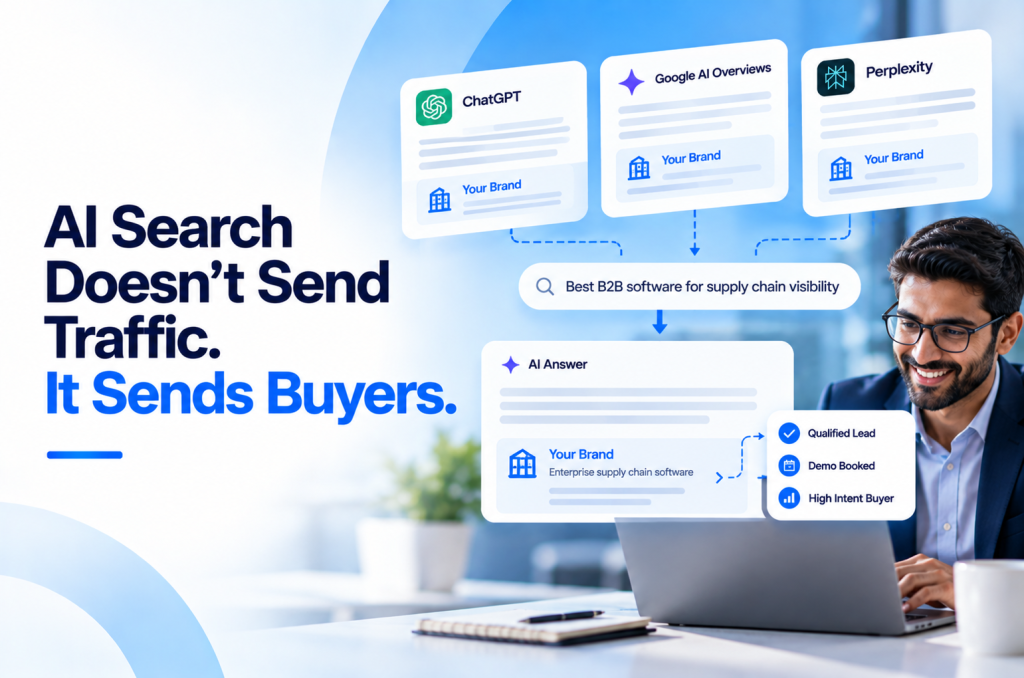
AI search for B2B is changing what a valuable website visit looks like. ChatGPT, Gemini, Perplexity and AI-powered Google results may send fewer clicks than traditional search, but some studies show those visitors can arrive with stronger buying intent. The opportunity is not simply more AI traffic. It is becoming visible during the research that happens before a buyer clicks.
That distinction matters.
For years, B2B marketing teams have been trained to watch one number closely: traffic.
More rankings should produce more clicks. More clicks should produce more leads. More leads should create more pipeline.
AI search is making that model less linear.
A buyer can now ask:
“Which B2B demand generation companies work with SaaS businesses?”
Then follow up with:
“Compare these three for a company selling into the US.”
Then:
“Which one appears strongest for outbound plus AI search visibility?”
By the time that person reaches a company’s website, much of the research that previously happened across five, ten or twenty web pages may already be complete.
The website visit is no longer necessarily the start of the journey.
It may be the validation step before a sales conversation.
That is why B2B teams need to stop judging AI search only by how many sessions it sends.
Quick Answer: Does AI Search Convert for B2B?
AI search can produce high-intent B2B traffic, but the evidence does not support treating every AI visitor as a better buyer.
Several datasets suggest AI-referred visitors can convert better than traditional organic visitors. Semrush reported that the average visitor coming from non-Google AI search was worth 4.4 times the average traditional organic visitor by conversion rate in its analysis of high-value digital marketing and SEO topics.
Ahrefs has reported an even larger difference in its own business. AI search represented roughly 0.5% of visits but 12.1% of sign-ups, producing a conversion rate around 23 times higher than traditional organic search for Ahrefs. That is a useful case study, not a universal benchmark.
A broader 2026 benchmark across 95 websites found a much smaller advantage. AI referrals converted at 7.18%, compared with 6.08% for organic search. Organic search still produced 39 times more traffic, and AI traffic actually converted worse than organic on 37% of the websites studied.
So the useful conclusion is not:
AI traffic always converts better.
It is:
AI traffic often behaves differently because AI can complete more of the buyer’s research before the click happens.
For B2B companies, that difference deserves attention.
AI Search Has Changed Where the Buyer Journey Happens
Traditional search usually sends the buyer somewhere else to find the answer.
AI search tries to answer the question itself.
Consider a SaaS buyer evaluating CRM migration consultants.
A traditional Google journey might look like this:
- Search “best CRM migration consultants”
- Open several results
- Read company pages
- Search individual brands
- Read comparison articles
- Look for reviews and case studies
- Shortlist vendors
- Visit each vendor again
- Contact two or three
An AI-assisted journey can compress several of those steps into one conversation.
The buyer can ask an AI assistant to find providers, compare their capabilities, explain differences, identify trade-offs and shortlist companies matching specific criteria.
The AI interface becomes part search engine, part research assistant and part comparison layer.
This matters because the buyer may arrive on your website only after asking multiple questions about your category.
In other words, AI can shift research away from the website while still influencing the buying decision.
Semrush’s analysis of more than one billion lines of US clickstream data found that outbound referral traffic from ChatGPT grew 206% during 2025. It also found that users move between AI and traditional search rather than treating them as completely separate channels.
For B2B marketers, this creates a new challenge.
You may be influencing demand without receiving the traffic that traditionally proved that influence.
Zero-Click Search Does Not Mean Zero Commercial Value
A zero-click search occurs when someone receives enough information from the search or AI interface that they do not immediately visit another website.
For marketers who grew up measuring organic success through sessions, that sounds bad.
Sometimes it is.
Pew Research Center analysed 68,879 Google searches from a US browsing panel in 2025. When an AI summary appeared, users clicked a traditional search result during 8% of visits. Without an AI summary, they clicked a traditional result during 15% of visits. Users clicked a source directly inside an AI summary during only 1% of visits.
Clearly, AI-generated answers can reduce clicks.
But a missing click does not automatically mean a missing buyer.
Imagine a CFO asks an AI assistant:
“What are the best accounts receivable automation platforms for a 500-person company?”
Your company appears repeatedly in the answer.
The CFO does not click.
Two days later, they search your brand directly.
A week later, another stakeholder visits your pricing page.
The sales director then books a demo.
Analytics might attribute that journey to organic branded search, direct traffic or another channel.
AI may still have created the shortlist.
This is one reason AI visibility and AI referral traffic should not be treated as the same metric.
AI Referral Traffic vs Organic Search
AI referrals and organic search visits can represent different stages of buyer intent.
| Dimension | Traditional Organic Search | AI Referral Traffic |
|---|---|---|
| Typical discovery | Keyword or query | Conversational question |
| Research process | Often spread across multiple pages | Often consolidated inside an AI conversation |
| Click volume | Much larger today | Still relatively small |
| Pre-click information | Depends on SERP and snippet | AI may already explain and compare options |
| Landing intent | Can range from educational to transactional | Often highly specific when a user chooses to leave the AI interface |
| Attribution | Relatively mature | Frequently incomplete |
| Best measurement | Rankings, clicks, conversions, revenue | Mentions, citations, referral visits, assisted conversions, pipeline |
This does not mean organic search is becoming irrelevant.
Quite the opposite.
Semrush’s 2026 clickstream analysis found that more than 20% of outbound ChatGPT referral traffic went to Google by early 2026. Users may discover something through AI and then use Google to verify it.
AI search and traditional search increasingly overlap.
B2B companies therefore need both:
Search visibility for discovery.
AI visibility for consideration and recommendation.
Why AI Traffic Can Be Higher Intent
There are several reasons AI traffic quality can look different from normal website traffic.
1. AI can qualify the user’s problem before the visit
A Google user might search:
“CRM software”
The intent is unclear.
An AI user might ask:
“What CRM is best for a 70-person B2B SaaS business using HubSpot Marketing Hub that needs stronger enterprise forecasting?”
The AI assistant has much more context.
If it recommends a particular provider and the user clicks, that visitor already understands why the provider might fit.
The click contains more context than the keyword alone could communicate.
2. Comparison happens before the click
Traditional organic search often sends people into the comparison process.
AI search can send people out of it.
The user may already have asked about:
- pricing
- integrations
- alternatives
- advantages
- limitations
- target customer
- implementation
- customer reviews
- security
- use cases
before opening the recommended company’s website.
That is why AI referral traffic can sometimes behave more like comparison-site traffic than top-of-funnel organic traffic.
A similar shift is taking place in ecommerce, where agentic AI shopping is changing how consumers discover products, compare alternatives, and evaluate purchasing options. As AI takes on a more active role in product research and recommendations, buyers can arrive at a decision with a clearer understanding of their needs. B2B marketers can apply the same principle by providing detailed comparisons, transparent pricing information, and relevant use cases that help potential customers evaluate solutions before visiting a website.
3. Leaving the AI interface requires a reason
An AI assistant is designed to answer the question directly.
If the user still clicks, they probably want something the answer itself cannot fully provide.
That could include:
- checking the company
- seeing pricing
- reviewing a case study
- booking a demo
- testing the product
- downloading something
- validating a claim
Those are commercially meaningful actions.
4. The AI recommendation can create prior familiarity
A cold visitor and an AI-referred visitor may technically be new website users.
Psychologically, they are not always equally “new.”
One discovered a blue link.
The other may have just spent ten minutes asking questions in which your brand was described, compared and recommended.
That context changes the visit.
This is also why lead quality versus lead quantity becomes increasingly important in AI-led discovery. A smaller number of commercially relevant visitors can matter more than a large increase in sessions that never progress into pipeline.
But AI Traffic Is Not Automatically Better Traffic
This is where marketers need to be careful.
The most attractive AI conversion statistics are often repeated without context.
The Ahrefs 23x figure, for example, describes Ahrefs’ own conversion data. It does not mean every SaaS company should expect ChatGPT traffic to convert 23 times better.
Similarly, Semrush’s 4.4x figure came from a particular set of commercially valuable digital marketing and SEO topics.
Other evidence is more mixed.
A 2026 academic study published in Marketing Science analysed 12 months of data from 973 ecommerce websites, covering more than 50,000 transactions from ChatGPT referrals and 164 million transactions from traditional channels. It found organic LLM traffic had conversion rates and revenue per session above paid social, but below the other traditional channels studied.
The 95-site benchmark published in 2026 reached another nuanced conclusion. AI traffic converted 18% better than organic overall, yet it performed worse than organic on 37% of the sites and was weaker for B2B product businesses in that dataset.
The practical lesson is simple.
Do not copy somebody else’s AI search conversion rate into your forecast. Measure your own.
Industry, business model, buying cycle, brand strength, query type and landing page all matter.
A Better Way to Measure AI Search for B2B
Traffic alone is no longer enough.
A B2B company should measure AI search across four layers.
Layer 1: Visibility
Ask:
- Is the brand appearing in relevant AI answers?
- Is it being recommended for commercially relevant questions?
- Which competitors appear alongside it?
- Which pages or third-party sources influence those answers?
This tells you whether your company exists in the AI research environment.
Layer 2: Referral behaviour
Track visits from platforms such as ChatGPT, Perplexity, Gemini, Claude and Copilot.
Then measure:
- engaged sessions
- key page visits
- demo requests
- form completions
- content downloads
- trial starts
- meeting bookings
Do not stop at session volume.
Layer 3: Lead quality
Compare AI-generated enquiries with other channels.
Look at:
- ICP fit
- seniority
- company size
- problem relevance
- sales acceptance
- meeting rate
- opportunity creation
- pipeline value
A channel generating ten leads that sales genuinely wants may be more valuable than one generating one hundred low-intent enquiries.
A practical framework for measuring lead quality becomes especially useful here because AI search performance should ultimately connect back to commercial outcomes.
Layer 4: Revenue influence
Finally, ask whether AI visibility contributes to:
AI mention → brand search → website visit → meeting → opportunity → revenue
The path will not always be perfectly attributable.
That is normal.
B2B buying was already multi-touch before AI search arrived.
AI has simply added another influential research layer.
The AI Search Buyer Quality Score
For internal analysis, B2B teams can use a simple educational scoring framework rather than comparing channels purely on conversion rate.
Score each channel from 1 to 5 across five dimensions.
| Signal | Question |
|---|---|
| ICP Fit | Are visitors from companies you actually want to sell to? |
| Intent | Are they researching a real business problem or casually learning? |
| Decision-maker Quality | Are founders, executives or relevant functional leaders engaging? |
| Sales Progression | Do leads progress into qualified conversations? |
| Pipeline Contribution | Does the channel influence opportunities or revenue? |
A traffic source with 50,000 visits but weak scores across all five categories may be less important than a source generating 500 highly relevant visits.
The framework should not replace revenue attribution.
It simply prevents teams from confusing audience size with commercial value.
The same principle applies when measuring qualified sales opportunities. Marketing performance becomes much clearer once the organisation agrees that the desired outcome is not simply another form submission.
It is a credible buying opportunity.
What Content Gets Discovered in AI Search?
AI search visibility is not simply traditional ranking with a new label.
AI systems need information they can interpret, connect and confidently use when answering specific questions.
That tends to reward content that clearly explains:
Who something is for.
What problem it solves.
How it works.
How it differs from alternatives.
When it should and should not be used.
What evidence supports the claims.
For B2B companies, this means generic thought leadership is rarely enough.
A homepage saying:
“We help ambitious businesses unlock transformational growth through next-generation innovation.”
provides almost no useful retrieval context.
Compare that with:
“We help B2B SaaS companies with 50 to 500 employees generate qualified sales meetings through cold email, LinkedIn outreach, Google Ads and AI search visibility.”
The second statement connects the company with buyers, services, company types and problems.
That semantic clarity matters to humans too.
Growleads itself positions around Demand Intelligence rather than simply selling lead volume, with an emphasis on buyer understanding and qualified pipeline.
The wider principle is useful for any B2B brand:
Describe the business in language a buyer, salesperson and machine can all understand.
A related Growleads perspective on how AI is changing B2B demand generation explores why discovery is becoming less dependent on a single marketing channel.
What B2B Companies Should Publish for AI Search
A useful AI search content strategy should cover the complete decision journey, not just high-volume educational questions.
Build clear category content
Explain exactly what the solution is, who needs it and what problems it addresses.
Publish comparison content
Buyers compare alternatives whether brands participate in the conversation or not.
Useful comparisons can cover:
- product A vs product B
- agency vs internal team
- software category A vs category B
- different implementation approaches
- different pricing models
The goal should be helping the buyer understand trade-offs, not declaring your company the winner of every comparison.
Answer high-intent questions
For example:
“What does enterprise implementation usually cost?”
“How long does migration take?”
“Which companies are a poor fit?”
“What team is required internally?”
“What are the biggest implementation risks?”
These questions live much closer to a buying decision than broad informational keywords.
Strengthen proof
AI-generated recommendations are more useful when claims can be supported by clear evidence.
Useful proof can include:
- case studies
- customer stories
- transparent methodology
- expert commentary
- original data
- product documentation
- third-party mentions
- reviews
- credible citations
Do not manufacture evidence to fill a content gap.
Weak proof presented confidently is still weak proof.
Common Mistakes B2B Teams Make With AI Search
Chasing mentions instead of relevant mentions
Appearing in an AI answer about an unrelated topic does little for pipeline.
Visibility should be measured against prompts your actual buyers might use.
Measuring only referral sessions
Direct referral traffic represents only part of AI’s potential influence.
Some users will discover the company in an AI answer and return through branded search, direct navigation or another channel.
Ahrefs specifically recommends combining referral measurement with self-reported attribution because some AI-influenced conversions cannot be identified from referrer data alone.
Abandoning traditional search
AI search does not justify switching off SEO.
Organic search remains substantially larger as a traffic source, and AI users themselves frequently move back into traditional search during research.
The better strategy is integration.
Optimising every page for AI
Not every page needs to become a long question-and-answer document.
Product pages should sell.
Case studies should demonstrate outcomes.
Comparison pages should clarify decisions.
Educational content should teach.
Strong AI visibility starts with useful content architecture, not mechanically adding FAQ sections everywhere.
Treating AI conversion benchmarks as guarantees
There is no universal ChatGPT referral traffic conversion rate.
Benchmarks tell you what is possible.
Your analytics tell you what is happening.
A Practical AI Search Scorecard for B2B Leaders
Instead of presenting a monthly report containing only sessions and rankings, include:
Discovery metrics
- Important prompts where the brand appears
- Brand mentions
- Citations
- Competitor visibility
Traffic metrics
- AI referral sessions
- Engaged sessions
- Landing pages
- Returning users
Conversion metrics
- Enquiries
- Demo requests
- Meetings
- Trials or sign-ups
Quality metrics
- ICP-fit leads
- Sales-accepted leads
- Opportunities created
- Pipeline generated
Attribution signals
- Branded search growth
- Direct traffic trends
- “How did you hear about us?” responses
- AI mentioned in sales conversations
That scorecard tells a much more useful story than:
“ChatGPT sent 173 visitors this month.”
The question is not whether 173 is a large number.
The question is what those 173 people did.
AI Search for B2B Is Really About Being Shortlisted
The biggest shift in AI search may not be traffic at all.
It may be the shortlist.
Traditional marketing asked:
Can we rank when someone searches for the category?
AI search adds another question:
Will an AI assistant include us when a buyer asks who they should consider?
That is commercially different.
A company can receive thousands of informational visitors and never become part of a buying conversation.
Another company can receive comparatively little AI referral traffic but repeatedly appear when prospects ask:
“Which providers should I evaluate?”
“What tools fit my requirements?”
“Who specialises in my industry?”
“What are the alternatives?”
“Which company offers both X and Y?”
Those are the moments B2B marketers should care about.
Conclusion
AI search does send traffic.
Just not always in the volumes marketers are accustomed to measuring.
What makes AI search for B2B interesting is what can happen before the click. AI assistants can educate the buyer, compare providers, narrow choices and explain why a company fits the requirement.
That can produce unusually informed visitors.
But higher-quality AI traffic is not guaranteed, and current research shows meaningful variation between businesses and industries.
The sensible response is not to replace SEO with AI search.
It is to widen the measurement model.
Track visibility.
Track referrals.
Track lead quality.
Track branded demand.
Track qualified pipeline.
And most importantly, understand whether your company appears during the questions buyers ask while building their shortlist.
Growleads approaches AI search as one part of a wider demand intelligence system, alongside the channels and buyer signals that influence pipeline. For B2B teams, the same principle applies internally.
Do not optimise the business for the largest traffic number.
Optimise it to be present when the right buyer is deciding who deserves the next conversation.
Frequently Asked Questions
Does AI search convert better than Google organic search?
AI search sometimes converts better than traditional organic search, but results vary significantly by company and industry. Studies have reported advantages ranging from modest improvements to very large lifts, while other datasets show AI referrals underperforming organic traffic for a meaningful share of websites.
What is AI referral traffic?
AI referral traffic is website traffic generated when a user clicks a link from an AI platform such as ChatGPT, Perplexity, Gemini or Claude. It represents only directly trackable AI traffic and may not capture users who discover a brand through AI and later visit through search or direct navigation.
Why can ChatGPT referral traffic convert well?
ChatGPT referral traffic can convert well because the user may have completed significant research before clicking. The AI assistant may already have explained the category, compared options and established why a particular company is relevant.
Does AI search reduce website traffic?
AI-generated answers can reduce clicks for some queries because users can receive information without leaving the search interface. Pew Research Center found lower click behaviour on Google searches containing AI summaries than on searches without them in its 2025 US browsing study.
Is zero-click search bad for B2B companies?
Zero-click search can reduce measurable website sessions, but it does not necessarily eliminate commercial influence. A buyer may discover a company in an AI answer and later reach it through branded search, direct traffic, LinkedIn or another channel.
Should B2B companies stop investing in SEO because of AI search?
No. Organic search still drives substantially more traffic than AI assistants, and buyer journeys increasingly move between traditional search and AI platforms. B2B companies should treat AI visibility and organic search as complementary discovery channels rather than replacements for each other.
How should B2B companies measure AI search performance?
B2B companies should measure AI mentions, citations, referral traffic, engagement, lead quality, meetings, opportunities, pipeline and self-reported attribution. Session volume alone does not show whether AI search is influencing buying decisions.
What is the most important AI search metric for B2B?
There is no single universal metric, but qualified pipeline is more commercially meaningful than raw AI referral traffic. AI visibility becomes valuable when the right companies discover the brand, investigate it and progress toward a genuine sales opportunity.

Builds the demand intelligence, automation, and deliverability systems behind Growleads pipeline.