How to Convert School & College Admission Enquiries into Admissions
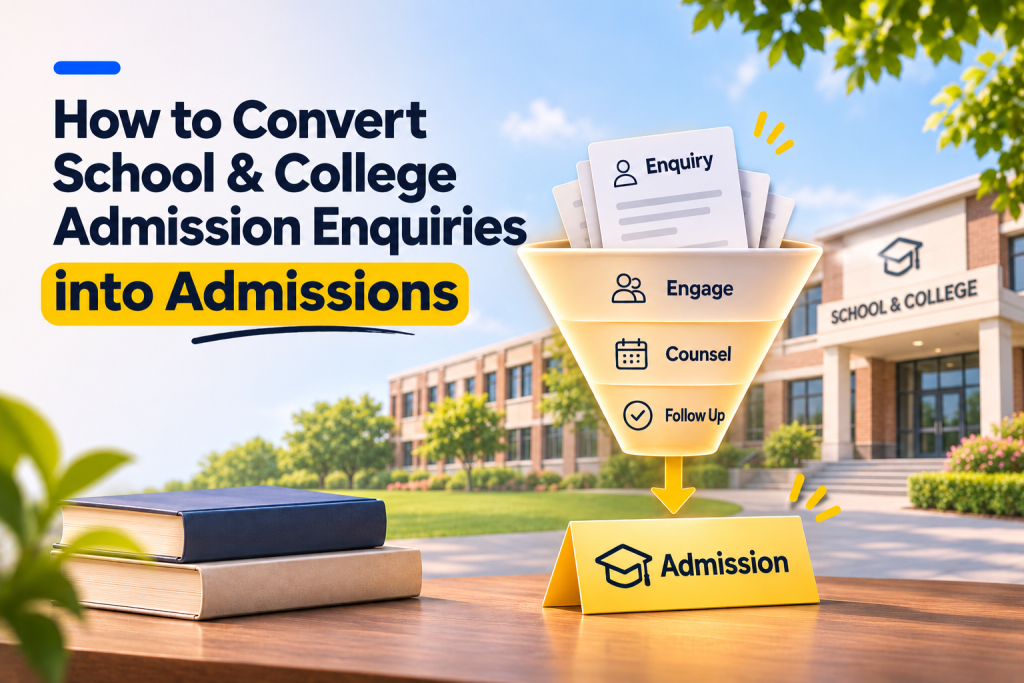
To convert admission enquiries into admissions, schools and colleges need a structured process that combines quick responses, lead qualification, personalised counselling, consistent follow-ups and application support. Institutions must understand what influences student and parent decisions, track every enquiry through the admissions funnel and address concerns before prospective students choose another institution.
Generating admission enquiries is only the first part of student acquisition. The bigger challenge is turning that interest into confirmed enrolments.
An institution may generate hundreds of enquiries through Google Ads, social media, education portals and referrals, yet struggle to fill its available seats. Increasing the marketing budget may bring more enquiries, but it will not necessarily improve admissions if the conversion process is weak.
For school principals, university management teams, admission directors and education marketing heads, the priority should be building a measurable admissions pipeline where every genuine enquiry receives the attention it deserves.
What Is Admission Lead Conversion?
Admission lead conversion is the process of turning a prospective student’s or parent’s initial enquiry into a confirmed admission through communication, counselling, qualification, follow-ups and application assistance.
The process typically starts when someone submits an enquiry form, calls the institution, sends a WhatsApp message or visits the campus.
An admission is considered converted when the applicant meets the institution’s eligibility requirements, completes the necessary formalities and confirms enrolment according to its admission policy.
Effective lead conversion for education involves three connected functions:
- Marketing generates relevant admission enquiries.
- Admission counsellors understand requirements, answer questions and build trust.
- Admission and administrative teams help eligible applicants complete the enrolment process.
When these functions operate independently without sharing information, institutions lose visibility into what happens after an enquiry is generated.
Why Do Schools and Colleges Struggle to Convert Admission Enquiries?
Schools and colleges often struggle with admission conversion because of delayed responses, inconsistent follow-ups, poor lead quality, insufficient counselling and a lack of visibility into student and parent decision-making.
Before investing in additional marketing campaigns, institutions should identify where prospective applicants are dropping out.
| Conversion problem | Possible reason | Recommended action |
|---|---|---|
| Enquiries are not responding | Delayed contact or low initial intent | Improve response time and targeting |
| Parents are interested but do not visit | Lack of trust or scheduling difficulties | Offer convenient admission interactions |
| Students enquire but do not apply | Unclear eligibility, fees or programme details | Provide personalised guidance |
| Applications remain incomplete | Complicated forms or missing documents | Offer application assistance |
| Selected students do not confirm admission | Financial concerns or competing offers | Address individual concerns |
| Enquiries are generated for unavailable courses | Poor coordination between marketing and admissions | Align campaigns with seat availability |
| Counsellors miss follow-ups | Manual tracking and unclear ownership | Implement a centralised admission CRM |
Every conversion problem requires a different solution. An institution generating irrelevant enquiries needs better marketing. An institution generating relevant enquiries but losing them after counselling needs a better admissions process.
Understanding this distinction can prevent unnecessary marketing expenditure.
Understanding the School and College Admissions Funnel
An admissions funnel represents the stages a prospective student or parent passes through before confirming enrolment. It helps institutions understand how initial interest develops into an admission decision.
| Funnel stage | Student or parent activity | Institution’s responsibility |
|---|---|---|
| Awareness | Discovers the institution | Communicate relevant educational offerings |
| Enquiry | Requests information | Capture and acknowledge the enquiry |
| Qualification | Shares requirements and preferences | Assess relevance and eligibility |
| Counselling | Evaluates the institution | Provide accurate, personalised guidance |
| Evaluation | Compares available institutions | Address concerns and build confidence |
| Application | Submits an admission form | Assist with documents and requirements |
| Selection | Completes applicable selection procedures | Communicate admission decisions |
| Confirmation | Accepts the offer and completes formalities | Confirm enrolment |
| Onboarding | Prepares to join | Provide joining instructions and support |
Institutions should track conversion between individual stages rather than looking only at total enquiries and final admissions.
For example, if many parents complete a school visit but very few submit an application, generating additional enquiries may not solve the problem. Management should first evaluate the quality of the campus experience, counselling, fee communication and parent interactions.
How to Convert Admission Enquiries into Admissions: 12 Practical Strategies
1. Generate Admission Enquiries with Stronger Intent
The quality of an admission enquiry directly influences the effort required to convert it. Schools and colleges should prioritise prospective students whose requirements match their academic offerings, location, eligibility criteria and admission timelines.
A parent searching for a CBSE school offering Class XI Science in Jaipur has a more specific requirement than someone searching for general information about schools.
Similarly, a student searching for B.Tech Computer Science admissions is likely to have a clearer academic interest than someone searching for engineering courses in general.
Institutions can improve enquiry relevance by:
- Targeting location-specific and programme-specific searches.
- Creating dedicated admission pages for individual courses and grades.
- Clearly communicating eligibility requirements and admission timelines.
- Excluding irrelevant search terms from paid campaigns.
- Aligning advertising with actual seat availability.
- Reviewing lead quality feedback from admission counsellors.
For example, Growleads’ school admission campaign for Scotle generated more than 480 parent enrolment enquiries during a single admissions cycle through Google Search Ads, with an average click-through rate of 7.2%.
The campaign focused on reaching parents actively researching schooling options rather than spending heavily on broad educational searches.
Colleges and universities can apply similar principles by developing a programme-focused Google Ads strategy for higher education.
Relevant enquiries provide a stronger starting point for counselling, although enquiry quality alone does not guarantee admission.
2. Respond to Admission Enquiries Quickly
A quick response helps an institution establish contact while the prospective student or parent is actively researching admission options.
Families often contact multiple institutions during the same period. A delayed response can mean losing the opportunity to participate in their initial evaluation.
Schools and colleges should establish an internal response-time standard for admission enquiries.
The following is a recommended operational framework rather than an industry benchmark.
| Enquiry type | Recommended response target |
|---|---|
| Website admission form | Within 5 to 15 minutes during working hours |
| WhatsApp enquiry | Within 5 to 15 minutes during working hours |
| Missed admission call | Within 30 minutes during working hours |
| Education portal enquiry | Within 30 to 60 minutes during working hours |
| Email enquiry | Within the same working day |
| After-hours enquiry | Immediate automated acknowledgement, followed by human contact during working hours |
Institutions can use automated acknowledgements outside working hours, but these should clearly communicate when an admission counsellor will respond.
Speed should never come at the expense of accurate information or thoughtful counselling.
3. Build a Centralised Admission Lead Management System
An admission lead management system brings enquiries, communication history, application progress and follow-up activities together in a single platform.
Without centralised tracking, enquiries can remain scattered across personal WhatsApp accounts, spreadsheets, website forms, email inboxes and individual counsellors’ phones.
An admission CRM, or customer relationship management system, should capture:
- Student or parent contact details.
- Enquiry source and campaign.
- Interested grade, course or programme.
- Preferred academic session or intake.
- Eligibility status, where applicable.
- Counsellor assigned to the enquiry.
- Communication history.
- Current admission stage.
- Next follow-up date.
- Reason for delayed or unsuccessful conversion.
Platforms such as Meritto, LeadSquared, Salesforce and Zoho CRM are examples of systems that institutions can evaluate based on their operational requirements.
Smaller schools may initially manage enquiries using a structured shared spreadsheet. Institutions handling multiple programmes, campuses or large enquiry volumes generally benefit from a dedicated CRM with automated lead assignment and reporting.
The objective is to ensure that every genuine admission enquiry has a responsible owner and a clearly defined next action.
4. Qualify Admission Enquiries Before Counselling
Admission lead qualification helps institutions understand whether a prospective applicant matches their educational offerings and how close the applicant is to making a decision.
Qualification should help counsellors provide relevant guidance and prioritise their workload. Formal admission decisions must continue to follow the institution’s published eligibility and selection policies.
For school admission enquiries, counsellors can ask:
- Which class are you seeking admission for?
- Which academic session are you considering?
- Which curriculum or education board do you prefer?
- Are there any specific academic or extracurricular requirements?
- When are you planning to finalise the admission?
- Would you prefer an admission discussion in person or over the phone?
For college admission enquiries, qualification questions may include:
- Which course or specialisation are you interested in?
- What is your current academic qualification?
- Which admission intake are you considering?
- Have you appeared for any applicable entrance examinations?
- Are you exploring scholarship or education financing options?
- What matters most to you when selecting a college?
Programme-specific qualification becomes particularly important for universities offering multiple courses.
In Growleads’ JECRC University admission enquiry campaign, course-specific Google Search campaigns generated 1,480 qualified admissions enquiries across the university’s programmes.
Understanding programme-level intent allows admission teams to prepare more relevant conversations rather than treating every student enquiry in the same way.
5. Prioritise Admission Leads Based on Readiness
Admission lead scoring helps counsellors determine which enquiries require immediate attention and which need additional information or longer-term communication.
A simple classification system can help institutions manage large enquiry volumes without overlooking prospective students.
| Lead category | Characteristics | Recommended action |
|---|---|---|
| High intent | Meets applicable requirements, interested in the current intake and ready for the next step | Prioritise personalised counselling |
| Medium intent | Genuinely interested but comparing institutions or seeking information | Provide relevant information and scheduled follow-ups |
| Early-stage intent | Researching future admissions or exploring options | Maintain periodic, permission-based communication |
| Unqualified | Does not meet programme requirements or seeks an unavailable course | Explain limitations and suggest suitable alternatives where available |
An illustrative admission lead scoring framework
Institutions can create a simple 100-point scoring model for managing follow-up priorities.
Admission Lead Scoring Framework
Institutions can use a 100-point lead scoring framework to assess applicant readiness and prioritise admission follow-ups.
| Scoring criteria | Maximum points |
|---|---|
| Academic or programme fit | 30 |
| Admission timeline | 25 |
| Interest and engagement | 20 |
| Decision readiness | 15 |
| Progress towards application | 10 |
| Total possible score | 100 |
Based on the total score, admission counsellors can categorise enquiries into three priority levels.
| Lead score | Priority level | Recommended action |
|---|---|---|
| 75–100 | High priority | Prioritise personalised counselling and application support |
| 45–74 | Medium priority | Address concerns and schedule regular follow-ups |
| 0–44 | Early-stage or review required | Provide relevant information and assess future admission interest |
This is an illustrative framework. Institutions should adjust the scoring criteria and thresholds based on their historical conversion data, admission cycles and programme requirements.
Lead scores should determine follow-up priorities, not eligibility for admission.
6. Create a Structured Admission Lead Follow-Up Process
An effective admission lead follow-up process ensures that prospective students and parents receive useful information at appropriate intervals throughout their decision-making journey.
A single phone call is often insufficient because education decisions involve academic, financial and personal considerations.
Admission teams should create follow-up sequences based on applicant behaviour, admission timelines and individual preferences.
| Timeline | Channel | Purpose |
|---|---|---|
| Immediately after enquiry | WhatsApp or email | Acknowledge the enquiry |
| Day 1 | Phone call | Understand requirements and answer initial questions |
| Day 2–3 | WhatsApp or email | Share relevant programme or admission information |
| Day 5 | Phone call | Address concerns and offer a counselling session |
| Day 7 | Email or WhatsApp | Share useful academic information or verified outcomes |
| Day 10–14 | Personalised follow-up | Understand decision status |
| Before application deadline | Preferred communication channel | Share a relevant deadline reminder |
This is a suggested starting sequence. Counsellors should adjust the timing based on responses, consent and the institution’s admission calendar.
If a parent requests a callback after two weeks, the counsellor should respect that preference instead of continuing a fixed automated sequence.
Example of an admission enquiry acknowledgement
Hello, thank you for enquiring about admissions at [Institution Name]. We’d be happy to help you with the admission process and answer any questions you have. Please let us know a convenient time to speak.
Example of a follow-up after counselling
Hello, it was lovely speaking with you. I wanted to check if you had any further questions about the programme or admission process. Please feel free to reach out if you need any additional information.
Example of an application reminder
Hello, just a quick reminder that applications for [Programme Name] close on [Date]. If you need any help completing the application or arranging the required documents, we’d be happy to assist.
Each follow-up should serve a purpose. Repeatedly asking whether someone has decided to take admission rarely helps resolve the concerns preventing that decision.
7. Personalise Admission Counselling for Students and Parents
Personalised admission counselling helps prospective students and parents understand whether an institution can meet their academic, financial and personal expectations.
Counsellors should understand the applicant’s priorities before explaining the institution’s facilities, programmes and achievements.
For school admissions, parents may be concerned about:
- Teaching quality and individual attention.
- Student safety and discipline.
- Academic performance.
- School transport and accessibility.
- Extracurricular activities.
- Communication between teachers and parents.
- The overall learning environment.
For college admissions, students and parents may prioritise:
- Programme curriculum and specialisations.
- Faculty experience.
- Placement opportunities and internships.
- Industry exposure.
- Accreditation and recognition.
- Fees, scholarships and financial assistance.
- Hostel facilities and campus life.
- Long-term career opportunities.
A student considering an engineering programme may need information about laboratories, technical projects and internship opportunities. A working professional considering an executive management programme may be more interested in scheduling flexibility and career development.
Growleads’ admission marketing campaign for SPJIMR generated 480 qualified programme enquiries through Google Search campaigns targeting relevant programme interests and intake windows.
The same programme-level understanding should continue throughout the counselling process. When marketing captures specific intent, counsellors should use that information to make subsequent conversations more relevant.
8. Build Trust Throughout the Admission Journey
Trust plays an important role in converting admission enquiries because education involves a significant investment of time, money and effort.
Students and parents want confidence that an institution can deliver the educational experience it describes.
Institutions can build trust by making the following information easily accessible:
- Verified student and alumni testimonials.
- Faculty profiles and qualifications.
- Academic achievements.
- Accurate placement reports, where applicable.
- Accreditation and affiliation details.
- Campus facilities and learning resources.
- Transparent fee structures.
- Admission policies and refund conditions.
School and college websites should support the admission team’s conversations. If a counsellor explains a programme’s benefits, the prospective applicant should be able to verify relevant information independently.
Institutions should also ensure that information communicated through advertisements, brochures, websites and counselling sessions remains consistent.
Contradictory information about fees, eligibility or academic outcomes can create unnecessary doubts and delay admission decisions.
9. Encourage Meaningful Campus Visits and Admission Interactions
Campus visits and personalised admission interactions allow prospective students and parents to evaluate an institution beyond its advertising and website.
However, simply organising a campus tour is insufficient. The interaction should help the visitor understand whether the institution meets their requirements.
Depending on the institution’s admission policy, meaningful interactions can include:
| For schools | For colleges and universities |
|---|---|
| Meeting the admission coordinator | Programme-specific counselling |
| Understanding teaching methods | Faculty interaction |
| Discussing student development | Department and laboratory visits |
| Learning about safety arrangements | Placement and career guidance |
| Understanding academic support | Interaction with current students |
| Discussing curriculum and activities | Virtual programme information sessions |
Admission teams should prepare for scheduled interactions by reviewing the applicant’s enquiry history and previously expressed concerns.
After the interaction, counsellors should record outstanding questions and follow up with relevant information within the agreed timeframe.
Virtual counselling and online information sessions can also help applicants who live outside the city or cannot visit the campus immediately.
10. Identify and Address Admission Objections
Admission objections are concerns that prevent an otherwise interested student or parent from moving forward with an application or enrolment.
Counsellors should document these concerns and address them with accurate information rather than relying on repeated reminders.
| Common admission objection | Recommended response |
|---|---|
| Fees are higher than expected | Explain the complete fee structure, inclusions and available financial assistance |
| We are comparing other institutions | Understand the applicant’s decision criteria and provide relevant information |
| We are unsure about placement opportunities | Share verified placement reports and explain career support |
| The campus is too far away | Discuss available transport, accommodation or accessibility options |
| We are waiting for examination results | Explain applicable timelines and provisional processes, if available |
| We are unsure which course to choose | Arrange academic or career counselling |
| We need to discuss this with our family | Offer a joint counselling session and agree on a follow-up date |
| The application process is complicated | Provide step-by-step assistance |
Institutions should regularly review objection data across the entire admissions team.
If multiple applicants raise the same concern, the problem may require an institutional response rather than an individual counselling solution.
For example, repeated questions about placement outcomes may indicate that the university needs clearer programme-specific placement information on its website.
11. Use Automation Without Losing Personal Communication
Admission automation helps schools and colleges manage repetitive activities such as enquiry acknowledgements, counsellor assignment, follow-up reminders and application notifications.
Automation is particularly useful during peak admission periods when counsellors handle a high volume of enquiries.
An effective automated admission workflow could look like this:
Admission enquiry receivedWebsite, Google Ads, social media or referral
CRM record createdCapture source, programme and contact information
Acknowledgement sentConfirm receipt and expected response time
Counsellor assignedBased on programme, campus or availability
Personalised counsellingUnderstand requirements and resolve concerns
Follow-up reminders triggeredBased on admission stage and agreed next action
Application and admission trackedRecord completion, confirmation or loss reason
Institutions can automate:
- Enquiry capture and deduplication.
- Lead assignment and routing.
- Appointment scheduling.
- Follow-up reminders.
- Application deadline notifications.
- Missing document reminders.
- Admission performance reports.
However, sensitive conversations about academic suitability, financial concerns and personal circumstances should remain with trained counsellors.
Institutions should also collect only necessary applicant information, protect student data, respect communication preferences and follow applicable privacy and consent requirements, particularly when handling information about minors.
12. Develop Additional Admission and Referral Channels
Schools and colleges should develop multiple enquiry sources to reduce dependence on a single advertising platform and reach prospective applicants through trusted relationships.
Additional student acquisition channels can include:
- Parent and alumni referrals.
- Career counselling organisations.
- Educational workshops and webinars.
- School and college partnerships.
- Education fairs.
- Academic information sessions.
- Relevant institutional outreach.
Higher education institutions can also build relationships with organisations that influence student discovery and academic decisions.
For example, Growleads’ higher education institutional outreach campaign generated more than 320 qualified conversations with university leadership, 52 leadership meetings and 11 institutional partnerships in active discussion over six months.
While this campaign focused on institutional partnerships rather than direct student admissions, it illustrates how structured outreach can help education organisations develop relationships beyond traditional advertising channels.
Institutions looking to diversify their student acquisition channels can also explore different strategies for generating more student enquiries.
Every channel should be evaluated based on enquiry relevance, applicant progression and confirmed admissions.
How Does Admission Lead Conversion Differ Between Schools and Colleges?
School admission conversion is primarily driven by parental confidence, educational quality, student safety and convenience. College admission conversion involves programme suitability, career outcomes, eligibility, financial considerations and student aspirations.
Although both institutions require a structured admission process, their counselling strategies should reflect different decision-making journeys.
| Decision factor | Schools | Colleges and universities |
|---|---|---|
| Primary decision-maker | Parents or guardians | Students, often with family involvement |
| Main considerations | Teaching quality, safety and student development | Academic programmes, career opportunities and placements |
| Geographic influence | Usually local or regional | Regional, national or international |
| Qualification criteria | Grade availability and applicable admission policy | Academic eligibility and entrance requirements |
| Trust-building activities | Parent interactions and academic discussions | Faculty sessions, alumni information and career counselling |
| Financial considerations | School fees and recurring educational expenses | Tuition, accommodation, scholarships and financing |
| Follow-up requirements | Parent-focused communication | Student and family communication |
| Decision timelines | Academic session and grade availability | Admission rounds, examination results and intake deadlines |
Institutions operating across multiple educational segments should create separate qualification criteria, communication sequences and performance reports for each segment.
A standardised CRM can support the entire organisation, while individual counselling processes can remain specific to each audience.
How to Measure Admission Lead Conversion Performance
Admission lead conversion performance should be measured using enquiry quality, contact rates, counselling outcomes, application completion and confirmed admissions.
Tracking cost per lead alone provides limited insight into whether marketing investments are producing meaningful enrolment outcomes.
Important Admission Conversion Metrics
| Metric | Calculation | What it measures |
|---|---|---|
| Cost per enquiry | Marketing spend ÷ enquiries | Enquiry generation efficiency |
| Contact rate | Successfully contacted enquiries ÷ total enquiries × 100 | Ability to reach applicants |
| Qualified enquiry rate | Qualified enquiries ÷ total enquiries × 100 | Enquiry relevance |
| Counselling completion rate | Completed counselling sessions ÷ qualified enquiries × 100 | Applicant engagement |
| Application conversion rate | Submitted applications ÷ qualified enquiries × 100 | Progress towards admission |
| Application completion rate | Completed applications ÷ started applications × 100 | Application process effectiveness |
| Offer acceptance rate | Accepted offers ÷ admission offers × 100 | Applicant willingness to enrol |
| Admission conversion rate | Confirmed admissions ÷ total enquiries × 100 | Overall conversion performance |
| Cost per admission | Marketing spend ÷ confirmed admissions | Marketing acquisition efficiency |
| Seat occupancy rate | Enrolled students ÷ available seats × 100 | Capacity utilisation |
Institutions should also monitor average response time, overdue follow-ups, counsellor workload and reasons for unsuccessful admissions.
Reports should be segmented by programme, campus, enquiry source and academic intake.
How to Calculate the Admission Conversion Rate
The admission conversion rate is calculated by dividing the number of confirmed admissions by the total number of unique admission enquiries and multiplying the result by 100.
Admission Conversion Rate = (Confirmed Admissions ÷ Total Admission Enquiries) × 100
For example, if a college receives 1,000 unique admission enquiries and converts 120 into confirmed admissions, its admission conversion rate is 12%.
The institution should compare enquiries and admissions from the same intake or enquiry cohort to avoid misleading results.
Why Cost per Admission Matters More Than Cost per Lead
Cost per admission measures how much an institution spends on marketing to acquire one confirmed student. It provides a more meaningful view of student acquisition efficiency than cost per enquiry alone.
Consider two hypothetical admission campaigns with the same marketing budget.
| Performance metric | Campaign A | Campaign B |
|---|---|---|
| Marketing spend | ₹1,50,000 | ₹1,50,000 |
| Total enquiries | 1,000 | 600 |
| Cost per enquiry | ₹150 | ₹250 |
| Confirmed admissions | 50 | 90 |
| Admission conversion rate | 5% | 15% |
| Cost per admission | ₹3,000 | ₹1,667 |
Illustrative example. Figures do not represent actual client campaign results.
Although Campaign A generates more enquiries at a lower cost, Campaign B delivers 40 additional admissions with the same marketing expenditure and approximately 44% lower cost per admission.
Campaign B also requires the admission team to manage fewer enquiries, potentially allowing counsellors to spend more time with relevant applicants.
This is why institutions should understand the relationship between lead quality and lead quantity before making marketing budget decisions.
For a complete financial assessment, institutions should also account for counselling costs, agency fees, technology expenses and other student acquisition costs.
How Many Admission Enquiries Does an Institution Actually Need?
The number of admission enquiries an institution needs depends on its available seats, historical conversion rate and current confirmed admissions.
Institutions can estimate their enquiry requirements by working backwards from their enrolment targets.
Required Enquiries = Remaining Admission Target ÷ Expected Admission Conversion Rate
Consider a college with 300 vacant seats.
| Expected admission conversion rate | Required enquiries |
|---|---|
| 5% | 6,000 |
| 10% | 3,000 |
| 15% | 2,000 |
| 20% | 1,500 |
| 25% | 1,200 |
This illustrative example demonstrates how improving admission conversion can reduce the number of enquiries required to achieve an enrolment target.
An institution improving its conversion rate from 10% to 15% would need 1,000 fewer enquiries to fill the same 300 seats, assuming sufficient eligible applicants and comparable enquiry quality.
Management teams should establish separate targets for each programme or grade because demand, seat availability and conversion rates may differ significantly.
How to Identify Where Admission Enquiries Are Being Lost
An admission funnel audit helps institutions identify the exact stages where prospective applicants stop progressing towards enrolment.
Rather than making assumptions about marketing performance, management can review stage-wise conversion data.
Admission Funnel Performance: A Practical Example
Consider a hypothetical college admissions funnel with 1,000 unique admission enquiries.
| Admission funnel stage | Number of prospects | Stage conversion rate |
|---|---|---|
| Total enquiries | 1,000 | Starting point |
| Successfully contacted | 800 | 80% |
| Qualified enquiries | 500 | 62.5% |
| Counselling completed | 350 | 70% |
| Applications submitted | 150 | 42.9% |
| Admission offers | 130 | 86.7% |
| Confirmed admissions | 100 | 76.9% |
Stage conversion rates are calculated against the preceding funnel stage.
The overall enquiry-to-admission conversion rate is 10%. However, only 42.9% of prospective students who completed counselling submitted an application.
The institution should investigate why 200 counselled students did not progress to the application stage. Possible reasons include unclear programme information, financial concerns, competing institutions or difficulties with the application process.
Identifying and addressing these barriers could help the institution generate more admissions from its existing enquiries without necessarily increasing its marketing budget.
Should Schools and Colleges Increase Marketing Spend or Improve Admission Conversion First?
Institutions should improve admission conversion before increasing marketing expenditure when they already receive sufficient relevant enquiries but struggle to turn them into confirmed enrolments.
Additional marketing investment makes more sense when the existing admissions process performs consistently and enquiry volume remains insufficient.
The following decision matrix can help management teams identify their priorities.
| Current situation | Recommended priority |
|---|---|
| Low enquiry volume and strong conversion | Increase student acquisition activities |
| High enquiry volume and low conversion | Improve qualification and counselling |
| High enquiry volume and poor contact rate | Improve response time and CRM processes |
| Low enquiry quality | Refine targeting and campaign messaging |
| Strong counselling performance but few applications | Address objections and application barriers |
| Many admission offers but low acceptance | Review financial concerns and applicant preferences |
| Consistent conversion and insufficient enrolments | Scale relevant marketing channels |
Before increasing the marketing budget, management should also confirm that the admissions team has sufficient capacity to handle additional enquiries.
Generating more leads than counsellors can effectively manage may increase expenditure without producing a proportionate increase in admissions.
A 30-Day Roadmap to Improve Admission Lead Conversion
Schools and colleges can use a structured 30-day implementation plan to identify conversion problems, improve admission workflows and establish measurable performance standards.
The following roadmap is an illustrative implementation framework that institutions can adapt to their admission cycle.
| Timeline | Priority | Key activities |
|---|---|---|
| Days 1–7 | Admission funnel audit | Review historical enquiries, conversion rates, response times, lead sources and loss reasons |
| Days 8–14 | Process development | Define CRM stages, qualification questions, counsellor responsibilities and follow-up standards |
| Days 15–21 | Implementation | Introduce automated reminders, train counsellors and update admission communication |
| Days 22–30 | Performance review | Analyse conversion between stages, review feedback and adjust marketing priorities |
Assign Clear Responsibilities
Every admissions function should have defined ownership.
| Team | Primary responsibility |
|---|---|
| Marketing team | Generate relevant enquiries and track acquisition sources |
| Admission coordinator | Assign leads and monitor follow-up compliance |
| Admission counsellors | Qualify applicants, provide guidance and record concerns |
| Academic team | Resolve programme-specific and academic questions |
| Finance and administration | Explain fees, documents and payment formalities |
| Management | Review conversion performance, costs and seat occupancy |
During peak admissions periods, a short daily review of pending enquiries and follow-ups can help prevent avoidable delays.
Weekly management reviews should focus on applicant progression, programme-specific enrolment targets and recurring conversion problems.
A 30-day implementation period can establish stronger operational processes. Its impact on confirmed admissions may take longer to measure, depending on the admission cycle.
Common Mistakes Schools and Colleges Make During Admission Follow-Ups
Even institutions with strong academic offerings and substantial marketing budgets can lose prospective applicants because of avoidable communication and operational mistakes.
The most common mistakes include:
- Measuring success only through enquiry volume: A large number of enquiries does not necessarily indicate healthy admission performance.
- Making every follow-up a sales conversation: Applicants need information, reassurance and guidance before making a decision.
- Using identical messages for every applicant: A parent seeking primary school admission has different concerns from a student considering postgraduate education.
- Failing to record previous conversations: Asking applicants to repeat information creates unnecessary frustration.
- Providing unclear fee information: Unexpected costs can damage trust and delay decisions.
- Ignoring incomplete applications: Interested students may need practical assistance rather than additional promotional messages.
- Creating artificial urgency: False claims about limited seats or deadlines can damage institutional credibility.
- Overautomating communication: Repetitive messages can discourage otherwise interested applicants.
- Failing to record lost admission reasons: Without feedback, institutions may repeat the same mistakes in subsequent admission cycles.
- Disconnecting marketing from admission performance: Campaigns should be evaluated against applicant progression and enrolments, wherever reliable tracking is possible.
A well-managed admissions process should make it easier for eligible students and parents to make informed decisions.
Conclusion
Learning how to convert admission enquiries into admissions starts with understanding where prospective students and parents need better support during their decision-making journey.
Schools and colleges should build a connected admissions process that combines relevant enquiry generation, timely responses, personalised counselling, structured follow-ups, application assistance and measurable performance.
The objective is to make better use of existing marketing investments while creating a positive admission experience for prospective students and their families.
At Growleads, we help educational institutions understand student and parent intent, generate relevant admission enquiries and develop marketing strategies around measurable acquisition objectives.
If your institution is generating enquiries but struggling to achieve its enrolment targets, a review of your marketing and admissions funnel can help identify where improvements will have the greatest impact.
Frequently Asked Questions
1. What is a good admission enquiry-to-admission conversion rate?
There is no universal admission conversion rate that applies to every school or college. Conversion depends on institutional reputation, programme demand, enquiry quality, fees, eligibility requirements and admission timelines.
Institutions should establish benchmarks using historical data for individual programmes, grades and enquiry sources rather than relying on a single industry-wide percentage.
2. How many times should admission counsellors follow up with prospective students?
Admission counsellors can begin with four to six purposeful follow-ups over two to three weeks, depending on the applicant’s interest and admission timeline.
The frequency should be adjusted according to communication preferences, responses and application deadlines. Follow-ups should stop when an applicant declines further communication.
3. How can schools convert more parent enquiries into admissions?
Schools can convert more parent enquiries by responding promptly, understanding family requirements, explaining teaching practices, providing transparent fee information and arranging meaningful admission discussions.
Parents should receive information relevant to their child’s academic development, safety and overall educational experience.
4. How can colleges reduce application abandonment?
Colleges can reduce application abandonment by simplifying admission forms, clearly explaining document requirements, enabling applicants to save their progress and providing assistance with incomplete applications.
Admission teams should identify the specific step where applicants encounter difficulties and address those barriers.
5. Which is better for admission follow-ups: WhatsApp, phone calls or email?
The most effective admission follow-up process usually combines WhatsApp, phone calls and email according to applicant preferences.
Phone calls are useful for detailed counselling, WhatsApp supports convenient communication and reminders, while email is suitable for formal admission information, documents and programme details.
6. Can an admission CRM help increase student enrolments?
An admission CRM can support higher student enrolments by centralising enquiries, assigning counsellors, tracking applicant progress and reducing missed follow-ups.
However, CRM software alone cannot resolve poor enquiry quality, weak counselling or concerns about an institution’s educational offering. Its effectiveness depends on how consistently the admission team uses it.
7. How can educational institutions convert old admission leads?
Educational institutions can re-engage previous admission enquiries by checking whether applicants are still considering relevant programmes or upcoming academic intakes.
Communication should offer updated programme information, applicable admission dates or personalised counselling opportunities. Institutions should respect consent, previous opt-outs and data retention requirements.
8. How long does it take to improve admission conversion rates?
Institutions can begin improving response times, enquiry tracking and follow-up processes within a few weeks. However, measurable improvements in confirmed admissions depend on the length of the admission cycle, applicant decision timelines and the underlying conversion problems.
Performance should be evaluated through weekly operational reviews and comparisons between comparable admission cohorts.

Builds the demand intelligence, automation, and deliverability systems behind Growleads pipeline.