
Google Ads for Colleges and Universities: How to Generate Qualified Admission Enquiries
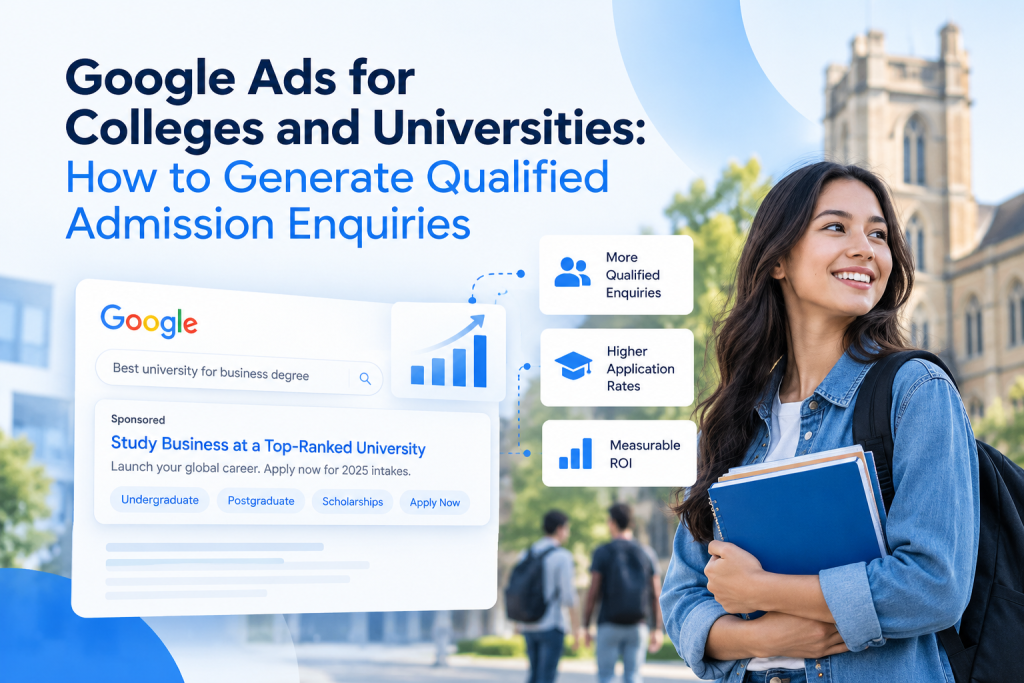
Google Ads for colleges and universities helps institutions reach prospective students who are actively searching for courses, admission requirements, fees, and application deadlines. A successful campaign focuses on generating qualified admission enquiries rather than simply increasing website traffic. By combining programme-specific keywords, relevant landing pages, conversion tracking, and timely admissions follow-up, institutions can turn search demand into genuine enrolment opportunities.
For admissions and marketing teams, the challenge is not always a lack of enquiries. It is finding students who meet eligibility requirements, are interested in the right programmes, and are likely to complete the application process.
A campaign may generate hundreds of leads, but if those enquiries come from students looking for free courses, unrelated programmes, or admissions in another location, the budget is not producing meaningful results.
The goal is to connect advertising performance with actual admissions outcomes.
Why Google Ads Matters for College and University Admissions
Google Ads allows educational institutions to appear in search results when prospective students are researching programmes and comparing admission options.
Unlike broad awareness campaigns, search advertising can capture existing demand. A student searching for “MBA colleges accepting applications in Mumbai” is expressing a more specific need than someone casually browsing education-related content.
That distinction matters when universities have limited admission windows, multiple programmes, and fixed marketing budgets.
The Main Benefits of Google Ads for Higher Education
1. Reach students with active admission intent
Search campaigns can target queries related to degree programmes, eligibility, entrance examinations, tuition fees, and application deadlines.
2. Promote specific programmes
Universities can run separate campaigns for engineering, management, law, design, postgraduate courses, and executive education rather than using one generic admissions campaign.
3. Control advertising by location
Institutions can allocate budgets to cities, states, or geographical regions where they want to attract applicants.
4. Respond to admission cycles
Budgets and messaging can be adjusted around application openings, entrance examination results, counselling periods, and approaching deadlines.
5. Measure the admissions journey
With the right tracking infrastructure, institutions can connect ad interactions with enquiries, counselling calls, applications, and eventually confirmed admissions.
Google Ads works particularly well when there is identifiable search demand for the programme being offered. For a newly launched or unfamiliar course, awareness-building channels may also be necessary.
How Google Ads for Colleges and Universities Generates Qualified Enquiries
Google Ads for colleges and universities works by connecting prospective students’ search intent with relevant programme information and a clear admissions action.
A successful campaign depends on four connected stages:
- Search intent: A student searches for a relevant course, qualification, or institution.
- Ad relevance: The advertisement explains the programme and provides a reason to explore it.
- Landing page: The student finds accurate information about eligibility, fees, outcomes, and the application process.
- Admissions qualification: The institution captures the enquiry, assesses eligibility, and guides the student towards an appropriate next step.
The fourth stage is particularly important.
A completed enquiry form is not the same as a qualified admissions opportunity.
What Is a Qualified Admission Enquiry?
A qualified admission enquiry is an expression of interest from a prospective student who matches the institution’s programme requirements and has a realistic possibility of applying.
Qualification can depend on several factors.
| Qualification factor | What the admissions team should assess |
|---|---|
| Programme relevance | Is the student interested in a course the institution offers? |
| Academic eligibility | Does the student meet the minimum requirements or have a plausible eligibility path? |
| Admission timeline | Is the student interested in the current or an upcoming intake? |
| Location suitability | Can the student attend the programme in its offered format? |
| Fee expectations | Does the student understand the tuition costs and available financial options? |
| Contact validity | Can the admissions team reach the student? |
| Application readiness | Has the student started researching, comparing, or preparing to apply? |
Not every qualified student will enrol. However, tracking these factors helps admissions teams distinguish useful enquiries from irrelevant submissions.
This is also why institutions should understand the difference between lead quality and lead quantity before evaluating campaign performance.
A smaller number of relevant student enquiries may be more valuable than a much larger volume of unqualified leads.
Building a Google Ads Campaign Structure for College Admissions
The most effective starting point for Google Ads for college admissions is to organise campaigns around programmes, search intent, geography, and admission timelines.
Universities often make the mistake of running a single campaign for every course.
This creates several problems. Engineering searches may consume most of the budget, postgraduate programmes may receive insufficient exposure, and the institution cannot easily identify which programmes are generating qualified enquiries.
A more structured account provides greater control.
1. Separate Campaigns by Programme Category
For a university offering multiple degrees, the account structure might look like this:
| Campaign | Target searches | Landing page |
|---|---|---|
| B.Tech Admissions | B.Tech admissions, engineering college applications | Engineering admissions |
| MBA Admissions | MBA colleges, MBA eligibility, management admissions | MBA programme |
| BBA Admissions | BBA admissions, undergraduate business programmes | BBA programme |
| Law Admissions | BA LLB admissions, law colleges accepting applications | Law admissions |
| Executive Education | Executive MBA, management programmes for professionals | Executive education |
| Branded Admissions | University name + admissions, fees, application | Official admissions page |
Individual campaigns are not always necessary for every small programme. Institutions can group programmes with similar intent and budgets when there is insufficient search volume to support separate optimisation.
The important principle is to avoid combining programmes with very different audiences, economics, and admission requirements.
2. Separate Branded and Non-Branded Searches
Branded searches include the institution’s name.
Examples:
- “JECRC University admission”
- “SPJIMR programme fees”
- “[University name] application form”
Non-branded searches focus on a broader requirement.
Examples:
- “private engineering colleges in Jaipur”
- “MBA colleges accepting applications”
- “BBA colleges with hostel facilities”
- “executive management courses for working professionals”
Branded campaigns capture people who already know the institution. Non-branded campaigns help reach students who are still evaluating their options.
Both can contribute to admissions, but they should be measured separately.
Otherwise, strong branded performance can make the entire advertising account appear more successful than its new-student acquisition efforts suggest.
3. Align Campaigns With the Admissions Calendar
Search demand changes throughout the academic year.
Institutions should prepare campaigns before important admission periods rather than waiting until application deadlines are close.
A practical scheduling approach includes:
| Admission stage | Campaign objective | Recommended messaging |
|---|---|---|
| Early research | Generate programme interest | Courses, eligibility, curriculum, fees |
| Applications open | Generate qualified enquiries | Admissions open, application process |
| Entrance examination results | Capture applicants comparing options | Eligibility, accepted examinations, admission pathways |
| Deadline approaching | Encourage eligible students to apply | Verified deadline, remaining application steps |
| Admissions closed | Prepare future demand | Next intake, programme updates, relevant information |
Any deadline or availability claim must match the institution’s official admissions information.
Urgency can be useful, but misleading deadline messages damage trust and waste admissions teams’ time.
Keyword Research for PPC for Universities
Keyword selection determines whether advertising budgets reach students with genuine admission intent or people searching for unrelated educational information.
A strong university PPC strategy groups keywords according to what students are trying to accomplish.
High-Intent Admission Keywords
These searches usually indicate stronger interest in taking an admissions-related action.
Examples include:
- “B.Tech admission 2027”
- “MBA admissions open”
- “apply for BBA college”
- “private universities accepting applications”
- “executive MBA admissions Mumbai”
These keywords are often suitable for campaigns designed to generate direct enquiries.
Programme Comparison Keywords
Students also compare institutions before making an application decision.
Examples include:
- “engineering colleges in Jaipur with placement support”
- “MBA colleges in Mumbai fees”
- “private university for computer science”
- “BBA colleges with internships”
Such searches can be valuable, but they require landing pages that answer comparison-related questions.
A generic “Apply Now” page may not provide enough information for a student who is still deciding between institutions.
Informational Keywords
Searches such as “what is an MBA”, “B.Tech subjects”, or “career options after BBA” represent earlier-stage interest.
They may support education marketing, but institutions should not automatically treat them as high-priority lead generation keywords.
Informational searches are usually better suited to useful content, organic discovery, or carefully controlled awareness campaigns.
Negative Keywords for Education Campaigns
Negative keywords help prevent ads from appearing for irrelevant searches.
For example, an MBA admissions campaign might need to review searches involving:
- Free MBA courses
- MBA syllabus PDF
- MBA jobs
- Free certificates
- School-level homework
- Online courses, if the institution only offers on-campus programmes
Negative keywords must be chosen carefully.
A university offering scholarships should not automatically exclude “scholarship”. An institution with online programmes should not block all online education searches.
Negative keyword lists should reflect the actual programme offering rather than generic assumptions about student intent.
Choosing Keyword Match Types
Google Ads supports broad, phrase, and exact match keywords.
Exact match offers tighter matching to search intent, although it can still match close variants and searches with the same meaning. Phrase match provides additional flexibility, while broad match can reach a wider range of related searches.
Broad match can be useful alongside Smart Bidding and reliable conversion data, but it may be difficult to control when an institution is measuring every form submission as a successful lead.
For new campaigns, starting with tightly themed keywords and reviewing search terms regularly gives teams a clearer understanding of demand.
As qualified conversion data accumulates, institutions can test broader coverage without abandoning lead quality controls.
How to Target the Right Students With Google Ads
Effective targeting for university admissions combines geographical relevance, programme interest, and search behaviour.
Universities should avoid treating every prospective student as part of the same audience. A student considering an undergraduate engineering programme has different needs from a working professional researching an executive MBA.
Geographic Targeting Based on Student Recruitment Goals
Location targeting should reflect where the institution can realistically recruit students.
For example, a university in Jaipur might create separate geographical campaigns for Rajasthan, neighbouring states, and selected metropolitan areas.
This allows the marketing team to compare enquiry quality across regions and allocate budgets accordingly.
Google Ads also distinguishes between people physically present in a location and people showing interest in that location. Its default location targeting can include both groups. Google Ads Help+1
For universities that attract students from outside their home city, targeting people interested in the institution’s location may be useful.
However, admissions teams should review the actual location of enquiries rather than assuming that every lead comes from the selected geographical area.
Targeting Parents and Students Differently
For undergraduate programmes, parents may influence decisions about tuition fees, accommodation, safety, and institutional reputation.
Students may place greater importance on course content, campus life, internships, placement opportunities, and career options.
This difference should influence advertisement messaging and landing page content.
For example:
Student-focused advertisement
B.Tech Admissions Open | Explore Specialisations, Eligibility and Campus Facilities
Parent-focused advertisement
Explore B.Tech Admissions | Review Fees, Accommodation and Placement Support
Both advertisements may promote the same programme, but they address different decision-making concerns.
For postgraduate and executive programmes, the applicant may be the primary financial and academic decision-maker. Campaign messaging should reflect that difference.
Creating Landing Pages That Convert Admission Traffic
A dedicated admissions landing page helps students move from a relevant Google search to a meaningful enquiry.
Sending every advertisement to a university’s homepage can create unnecessary friction.
A prospective MBA student should not have to navigate through undergraduate programmes, general institutional announcements, and unrelated departments to find the MBA admissions process.
What Every College Admissions Landing Page Should Include
A useful programme landing page should answer the questions students are most likely to have before submitting an enquiry.
| Landing page element | Why it matters |
|---|---|
| Programme name and overview | Confirms that the student has reached the relevant course |
| Eligibility requirements | Helps students assess whether they can apply |
| Duration and study format | Sets expectations about the programme |
| Fees and financial support | Addresses an important decision factor |
| Curriculum and specialisations | Helps students assess academic relevance |
| Placement and career information | Supports evaluation of potential outcomes |
| Accreditation and recognition | Helps establish institutional credibility |
| Admission deadlines | Clarifies the application timeline |
| Enquiry form | Gives interested students a clear next step |
| Admissions contact information | Provides an alternative way to ask questions |
All claims about accreditation, placements, fees, rankings, and scholarships should be accurate and current.
Landing pages should work well on mobile devices, load quickly, and make essential information easy to find.
How Long Should an Admission Enquiry Form Be?
An admission enquiry form should collect enough information to support qualification without making the first interaction unnecessarily difficult.
Useful initial fields include:
- Student name and contact number
- Email address
- Programme of interest
- Current qualification or education level
- Preferred admission year
- Location, where relevant
Institutions may also ask about entrance examination scores or academic eligibility when those details are necessary for admissions screening.
However, requesting extensive personal or academic information too early can discourage genuine prospects.
A practical approach is to collect basic qualifying information first and request supporting documents later in the admissions process.
Landing Page Forms vs Google Lead Forms
Google Ads also supports lead form assets that allow prospective applicants to submit information directly through an advertisement.
These can reduce the steps required to generate an enquiry.
However, a website landing page offers more space to explain programme details and help applicants assess suitability before contacting the institution.
| Factor | Website landing page | Google lead form |
|---|---|---|
| Programme information | Extensive | Limited |
| Customisation | Greater flexibility | Platform-defined options |
| Initial enquiry convenience | Depends on website experience | Fewer steps for eligible ad formats |
| Qualification questions | Highly customisable | Supported custom questions |
| Analytics | Website and CRM tracking | Google Ads and lead delivery integrations |
| Best suited for | Complex programme decisions | Simple initial interest capture |
Google requires eligible advertisers using lead form assets to provide a privacy policy and comply with its lead form policies. Advertising Policies Help+1
For higher-value education programmes, institutions should test both approaches and compare qualified enquiries rather than form submission rates alone.
How Much Should Colleges and Universities Spend on Google Ads?
A university’s Google Ads budget should be based on admission targets, programme economics, estimated advertising costs, and expected conversion rates.
There is no single recommended budget that works for every college.
Advertising costs differ by country, city, programme, competition, and admission season.
MBA advertising may have very different economics from undergraduate arts programmes. Likewise, a university targeting applicants nationally may require a different budget from a college recruiting primarily within one city.
Calculate Advertising Budgets Backwards From Admission Goals
Instead of starting with an arbitrary monthly budget, institutions can work backwards from their required number of enrolments.
Consider the following illustrative scenario.
Hypothetical planning example, not a Growleads client result or industry benchmark.
| Planning metric | Illustrative value |
|---|---|
| Target confirmed enrolments | 50 |
| Enquiry-to-application rate | 25% |
| Application-to-enrolment rate | 20% |
| Required enquiries | 1,000 |
| Assumed cost per enquiry | ₹500 |
| Estimated advertising budget | ₹5,00,000 |
The calculation is:
Required enquiries = Target enrolments ÷ (Enquiry-to-application rate × Application-to-enrolment rate)
Estimated advertising budget = Required enquiries × Expected cost per enquiry
In practice, institutions should also account for enquiry quality, invalid leads, admission team capacity, and fluctuations in advertising costs.
If conversion rates vary significantly by programme, each programme should have its own admissions forecast.
Which Programmes Should Receive More Budget?
Budget allocation should consider four factors:
- Available seats: How much additional enrolment capacity does the programme have?
- Qualified search demand: Are students actively searching for the programme?
- Admission conversion rate: How effectively do enquiries progress towards admission?
- Financial contribution: What is the value of filling an additional seat after considering relevant costs?
A programme with strong search demand but limited remaining seats may not need the same budget as one with substantial enrolment capacity.
Similarly, expensive keywords are not necessarily poor investments if they consistently produce qualified applicants.
Measuring Google Ads Performance Beyond Cost Per Lead
Cost per lead is a useful advertising metric, but it does not show whether a university is attracting eligible students or achieving its enrolment targets.
Institutions need to measure performance throughout the admissions process.
The Most Important PPC Metrics for Universities
| Metric | What it measures | Business significance |
|---|---|---|
| Click-through rate (CTR) | Percentage of impressions that generate clicks | Indicates ad engagement and relevance |
| Cost per click (CPC) | Average advertising cost per click | Helps monitor traffic acquisition costs |
| Landing page conversion rate | Percentage of visitors submitting an enquiry | Indicates effectiveness of the website experience |
| Cost per enquiry (CPE) | Advertising cost per recorded enquiry | Measures initial lead acquisition efficiency |
| Qualified enquiry rate | Percentage of enquiries meeting qualification criteria | Measures lead relevance |
| Cost per qualified enquiry | Advertising cost divided by qualified enquiries | Evaluates useful admissions demand |
| Application rate | Percentage of enquiries progressing to applications | Measures admissions funnel performance |
| Enrolment rate | Percentage progressing to confirmed enrolment | Measures admissions outcomes |
| Cost per enrolment | Advertising cost divided by attributed enrolments | Connects advertising to admissions results |
These metrics should be reviewed by programme, campaign, and geography rather than only at the account level.
Why Cost per Qualified Enquiry Matters More Than Cost per Lead
Consider two hypothetical campaigns.
| Metric | Campaign A | Campaign B |
|---|---|---|
| Advertising spend | ₹50,000 | ₹50,000 |
| Total enquiries | 200 | 100 |
| Cost per enquiry | ₹250 | ₹500 |
| Qualified enquiries | 40 | 70 |
| Cost per qualified enquiry | ₹1,250 | ₹714 |
Campaign A appears more efficient when evaluated using cost per enquiry.
However, Campaign B produces more qualified prospects at a lower cost per qualified enquiry.
This is why admissions teams should avoid making budget decisions based only on the number of forms submitted.
A structured process for measuring lead quality helps identify which campaigns are producing enquiries that can realistically become admissions.
Connect Google Ads With the Admissions CRM
A strong measurement setup connects Google Ads, website forms, and the institution’s student recruitment or admissions CRM.
The system should record when a lead is generated and what happens after submission.
The admissions funnel might follow this sequence:
Google Ads enquiry
Contacted by admissions team
Qualified prospective student
Application submitted
Confirmed enrolment
Each stage should have a clear definition.
For example, an enquiry should not be marked as qualified simply because a counsellor attempted to call the student.
Qualification might require a verified contact, relevant programme interest, and suitable academic eligibility.
Use Offline Conversion Tracking to Improve Campaign Optimisation
Google Ads can use imported offline conversions to understand what happens after an initial enquiry.
For example, institutions can send qualified lead or application-stage conversion information back to Google Ads.
Google’s enhanced conversions for leads can use hashed customer information and other attribution signals to connect offline events with advertising interactions. This helps advertisers measure later-stage outcomes and provide more useful conversion signals to bidding systems. Google Ads Help+1
As of October 2026, advertisers should also account for Google’s migration of relevant conversion uploads to the Data Manager API, rather than building new integrations around older Google Ads API upload methods. Google Ads Help+1
For universities, the practical implication is important: Google Ads should receive signals about student quality, not only the completion of enquiry forms.
However, institutions need reliable CRM data and sufficient conversion volume before depending heavily on downstream conversion-based bidding.
Which Google Ads Campaign Types Work Best for Universities?
Search campaigns are generally a sensible starting point for institutions looking to capture existing admissions demand.
Other campaign types can support awareness, engagement, or incremental lead generation, but they serve different purposes.
| Campaign type | Primary role | When to consider it |
|---|---|---|
| Search Ads | Capture existing student search demand | Programme and admission-related searches |
| Performance Max | Find conversions across Google inventory | When tracking and qualified conversion signals are reliable |
| YouTube Ads | Build awareness and explain programmes | Campus experiences, programme introductions, student stories |
| Display Ads | Reach audiences across websites and apps | Awareness and eligible remarketing campaigns |
| Demand Gen | Reach potential applicants through visual and video-led placements | Programme discovery and consideration |
Should Universities Use Performance Max?
Performance Max can complement Search campaigns by using Google’s automation across multiple advertising channels.
Google identifies lead generation as an eligible objective for Performance Max and provides campaign controls including search themes, brand exclusions, and negative keywords. Google Ads Help
However, universities should not assume that broader automated reach will automatically generate better applicants.
If the conversion goal rewards every enquiry equally, the campaign may optimise towards easy-to-generate form submissions rather than students who meet admission requirements.
Performance Max becomes more useful when the institution has clear conversion definitions, reliable tracking, and a way to distinguish qualified enquiries from irrelevant submissions.
Search campaigns can remain the primary acquisition channel while universities test additional campaign types against measurable admissions outcomes.
How Admissions Teams Influence Google Ads Results
Advertising performance does not end when a student submits an enquiry.
The admissions team plays a significant role in converting campaign-generated interest into applications.
A well-targeted advertisement can generate a relevant enquiry, but that opportunity may be lost if follow-up is delayed, the counsellor lacks programme information, or the student receives inconsistent answers.
Build a Clear Enquiry Follow-Up Process
A useful process includes:
Immediate acknowledgement
Confirm that the student’s enquiry has been received and explain what will happen next.
Timely counsellor assignment
Route the enquiry to someone familiar with the relevant programme and admission requirements.
Eligibility assessment
Understand the student’s academic background, preferred course, and application timeline.
Relevant programme guidance
Provide information about fees, eligibility, documents, admissions procedures, and important dates.
Structured follow-up
Record the conversation, next action, and outcome in the CRM.
Communication frequency should respect the student’s preferences. Repeated calls or unrelated messages can damage the institution’s reputation.
Why Marketing and Admissions Data Must Be Connected
Marketing teams typically monitor advertising cost, clicks, conversions, and enquiries.
Admissions teams monitor student eligibility, counselling conversations, applications, and enrolments.
If these teams use disconnected reporting systems, neither has a complete understanding of campaign performance.
For example, a marketing team may recommend increasing investment in an MBA campaign because it generates a high volume of enquiries.
The admissions team may simultaneously report that many of those enquiries come from students who do not meet programme requirements.
A shared reporting process allows both teams to identify the problem and improve targeting.
This is particularly important for universities offering multiple programmes with different admission criteria.
Google Ads for Education: What Real Campaigns Show
The following Growleads engagements illustrate how paid search and related education recruitment programmes can address different challenges.
These examples cover K-12 education, multidisciplinary universities, postgraduate programmes, and institutional outreach. The results reflect the reported scope of each engagement and should not be treated as guaranteed outcomes.
JECRC University: Generating Enquiries Across Multiple Programmes
JECRC University offers programmes across engineering, management, law, computer applications, and other disciplines.
The advertising challenge was to reach students searching for different courses without treating every programme as a single admissions audience.
Growleads’ published case study reports:
1,480
Qualified enquiries
312K
Impressions
18.6K
Clicks
The campaign focused on programme-specific search intent and directing prospective students towards relevant admissions information.
The key lesson is that universities with multiple academic departments need a campaign structure that reflects differences in programme demand and application behaviour.
The full JECRC University admissions campaign case study explains how programme-level targeting was applied. Growleads
SPJIMR: Reaching Students Searching for Management Programmes
Management education often involves a longer research and comparison process.
Applicants may evaluate programme formats, eligibility requirements, career outcomes, institutional reputation, and application timelines before making an enquiry.
For SPJIMR, the advertising opportunity involved reaching students searching for relevant postgraduate and executive programmes.
The published campaign reported:
480
Qualified enquiries
96K
Impressions
7.2%
Click-through rate
The campaigns were designed around programme-level search themes and intake timing.
The lesson for colleges offering specialised or postgraduate education is that search intent should be matched closely with the relevant programme and application pathway.
The SPJIMR Google Ads admissions case study provides the campaign context and reported results. Growleads
Scotle: Capturing Parent Enrolment Demand
Although Scotle operates in K-12 education rather than higher education, its campaign offers a useful example of how location and decision-maker intent influence education advertising.
Parents researching schools evaluate different factors from university applicants, including curriculum, proximity, facilities, academic support, and admission timing.
Growleads’ published Scotle campaign reported:
480+
Parent enquiries
282K
Impressions
7.2%
Click-through rate
The campaign used location-focused Search advertising to reach parents within the school’s target recruitment area.
This is relevant to colleges that recruit primarily from a defined geographical market.
The Scotle enrolment enquiry campaign demonstrates the importance of matching local education searches with the institution’s actual audience. Growleads
University Outreach: Building Institutional Partnerships Beyond Student Ads
Not every growth objective in higher education involves attracting students directly.
Education service providers may need to reach vice-chancellors, deans, administrative leaders, and other institutional decision-makers to develop partnerships.
In a separate Growleads engagement, an education services company used cold email and LinkedIn outreach to contact university leadership.
The published results included:
- More than 320 qualified conversations
- 52 meetings with institutional leadership
- 11 partnerships in active discussion
This was an outbound institutional outreach engagement, not a Google Ads student admissions campaign.
The distinction matters because attracting individual students and developing university partnerships require different audiences, channels, and qualification processes.
The university leadership outreach case study illustrates how a targeted outreach programme can support wider institutional growth objectives. Growleads
Together, these examples show why education marketing should begin with a defined audience and business objective rather than simply selecting an advertising channel.
Common Google Ads Mistakes Colleges and Universities Should Avoid
Many underperforming education campaigns have problems beyond bidding or keyword selection.
1. Optimising Only for Enquiry Volume
A campaign can generate large numbers of form submissions while producing very few eligible applicants.
Institutions should evaluate qualified enquiries, applications, and enrolments alongside initial conversion volume.
2. Using the Same Landing Page for Every Programme
Different courses attract different applicants and have different admission requirements.
A generic page can reduce relevance and make it harder for students to find the information they need.
3. Running Campaigns Outside Relevant Admission Windows
Advertising can still be valuable before and after peak application periods, but the objective should change.
Promoting an application deadline that has already passed wastes budget and creates a poor experience.
4. Ignoring Search Term Reports
Irrelevant searches can consume advertising budgets, particularly when campaigns use broad targeting.
Regular search term reviews help identify unwanted traffic and opportunities to refine keyword groups.
5. Failing to Qualify Enquiries
Without consistent qualification rules, marketing teams cannot distinguish between students who are eligible to apply and contacts who have little relevance to the institution.
6. Weak Admissions Follow-Up
Slow responses, repeated unanswered calls, and missing CRM updates can reduce the number of enquiries progressing towards applications.
7. Making Budget Decisions Too Early
New campaigns need enough meaningful data before major bidding and targeting changes can be evaluated.
Universities should avoid making frequent changes based on a handful of conversions, especially when admission decisions take several weeks.
8. Reporting Advertising Metrics Without Admission Outcomes
A dashboard showing clicks, impressions, and cost per lead is useful, but incomplete.
Senior management also needs to understand programme-level application volumes, qualified enquiry costs, and eventual enrolment outcomes.
A Practical 90-Day Google Ads Implementation Plan for Universities
Universities launching or restructuring campaigns can use a phased approach to reduce unnecessary spending and improve measurement.
The following roadmap is an illustrative planning framework. Actual timelines depend on campaign complexity, admissions readiness, technical access, and available conversion data.
| Phase | Main activities | Expected output |
|---|---|---|
| Days 1–15 | Review admission goals, programmes, historical data, search demand, and CRM | Campaign plan and measurement requirements |
| Days 16–30 | Build campaigns, create landing pages, implement tracking, and test forms | Initial campaign launch |
| Days 31–45 | Analyse search terms, traffic quality, and enquiry feedback | Initial targeting improvements |
| Days 46–60 | Refine keywords, advertisements, landing pages, and qualification rules | Better understanding of lead quality |
| Days 61–75 | Test bidding strategies and budget allocation using available data | Programme-level performance comparisons |
| Days 76–90 | Review qualified enquiries, applications, admissions progress, and next-intake opportunities | Decisions on budget and campaign expansion |
Before Launching: Admissions Campaign Checklist
A college should confirm the following before investing significantly in advertising:
- Admission targets are defined for each priority programme.
- Course eligibility, fees, and deadlines are verified.
- Relevant programme landing pages are available.
- Search campaigns reflect student intent.
- Geographic recruitment priorities are documented.
- Conversion tracking is tested.
- Leads are captured correctly in the CRM.
- Admissions counsellors have clear ownership of incoming enquiries.
- Qualified enquiry definitions are agreed upon.
- Campaign reports include downstream admissions outcomes.
Completing these steps will not guarantee admission results, but it gives the institution a stronger foundation for spending and measurement.
When Should a University Hire a Google Ads Agency?
A Google Ads agency for colleges can be useful when the institution needs specialist campaign management, reliable measurement, or support managing multiple programmes and admission cycles.
However, outsourcing is not automatically the right decision for every institution.
In-House Team vs Education PPC Agency
| Decision factor | In-house marketing team | Education PPC agency |
|---|---|---|
| Institutional knowledge | Direct access to faculty and admissions information | Requires structured onboarding |
| Campaign expertise | Depends on internal skills | Access to specialised PPC experience |
| Recruitment coordination | Usually easier | Requires regular communication |
| Staffing flexibility | Depends on available resources | Can provide additional execution capacity |
| Campaign ownership | Directly managed internally | Should remain with the institution |
| Cost structure | Staff, tools, and operational costs | Agency fees plus advertising spend |
| Long-term knowledge | Retained internally | Requires documented handover processes |
An in-house team may be sufficient for a college running a small number of established campaigns.
A specialist agency may be more suitable for institutions managing many programmes, several geographical markets, or complex conversion tracking.
A hybrid arrangement can also work well, with an internal admissions and marketing team owning strategy and student communication while an external agency manages paid search execution.
What Should Universities Ask Before Hiring an Education PPC Agency?
Before appointing a partner, institutions should evaluate its ability to connect advertising with actual student recruitment.
Important questions include:
- How will you separate campaigns for different programmes?
- How do you define and measure qualified admission enquiries?
- Can you connect Google Ads reporting with our admissions CRM?
- How will you identify irrelevant searches and reduce wasted spend?
- How will budgets change throughout the admission cycle?
- What reporting will the admissions and leadership teams receive?
- Who will own the Google Ads account, tracking setup, and campaign data?
- How will campaign performance be reviewed against applications and enrolments?
A credible agency should be able to explain its approach, measurement methods, limitations, and responsibilities without making unrealistic admissions promises.
How Growleads Approaches Google Ads for Education
Growleads approaches education advertising by identifying the audience an institution wants to reach, understanding the admission journey, and building campaigns around relevant demand.
For universities, that means looking beyond impressions and raw form submissions.
The campaign process should connect programme-level search behaviour with appropriate landing pages, enquiry qualification, and admissions follow-up.
Growleads’ experience across university admissions, management education, and school enrolment campaigns provides practical context for planning these activities.
The focus is on making advertising performance measurable against qualified demand and helping institutions understand which campaigns are contributing to their recruitment objectives.
For institutions planning a new admission cycle or reviewing an existing account, the first step is to assess current search demand, campaign structure, conversion tracking, and enquiry quality.
Frequently Asked Questions
1. Does Google Ads work for college and university admissions?
Yes, Google Ads can help colleges and universities generate admission enquiries by reaching students who are actively searching for relevant programmes. Its effectiveness depends on search demand, programme relevance, targeting, landing pages, and admissions follow-up. Institutions should evaluate qualified enquiries and applications rather than only clicks.
2. How much does Google Ads cost for a university?
Google Ads costs vary depending on the programme, geography, competition, and admission season. Universities should estimate their budgets using expected cost per enquiry, qualification rates, application rates, and enrolment targets. There is no universal advertising budget suitable for every institution.
3. Which Google Ads campaign type is best for college admissions?
Search campaigns are usually a strong starting point for college admissions because they target students actively looking for courses and institutions. Performance Max, YouTube, and other campaign types may support additional reach when the institution has suitable content, tracking, and conversion goals.
4. How can universities reduce the cost of admission enquiries?
Universities can improve acquisition efficiency by refining keyword targeting, excluding irrelevant searches, improving landing pages, and reviewing campaign performance by programme. However, reducing cost per enquiry should not come at the expense of lead quality. Cost per qualified enquiry is a more useful measure.
5. What is a good conversion rate for university Google Ads?
There is no single conversion rate that defines a successful university admissions campaign. Results depend on search intent, programme type, landing page experience, and how conversions are measured. A form submission rate should be evaluated alongside qualified enquiry rates and application outcomes.
6. Can Google Ads target students from specific cities or states?
Yes, Google Ads supports targeting by geographical areas, including cities, regions, and eligible radius locations. Universities can also use location settings to reach people who show interest in a targeted area. Geographic targeting is not perfectly accurate, so enquiry locations should be reviewed regularly. Google Ads Help
7. How long does Google Ads take to generate admission enquiries?
Google Ads can begin generating traffic and enquiries after campaigns become eligible to serve, provided there is sufficient search demand. However, assessing qualified lead performance requires more time. Universities should allow for campaign learning, admissions follow-up, and the time students need to make application decisions.
8. Should universities use Google Ads or SEO for admissions?
Universities should consider Google Ads and SEO as complementary channels. Google Ads can capture relevant search demand during important admission periods, while SEO helps institutions build longer-term visibility for programme information and research-related searches. The right investment depends on admission timelines, competition, available budget, and existing organic visibility.
Conclusion: Focus on Qualified Enquiries, Not Just More Leads
Google Ads for colleges and universities can be an effective student recruitment channel when campaigns are built around real admission demand.
The most important decision is not simply which keywords to target or how much budget to spend. It is how the institution will identify relevant students, guide them towards suitable programmes, and measure progress from the first enquiry to confirmed enrolment.
Colleges and universities should prioritise programme-specific campaigns, informative landing pages, accurate conversion tracking, and close coordination between marketing and admissions teams.
For institutions planning an upcoming admission cycle, Growleads can help review the existing advertising setup, identify opportunities to improve enquiry quality, and develop a campaign approach aligned with programme-level recruitment goals.

Runs paid acquisition across Google, LinkedIn, and Meta for B2B pipeline.