Google Ads Strategy for Low-Traffic, High-Ticket Lead Generation
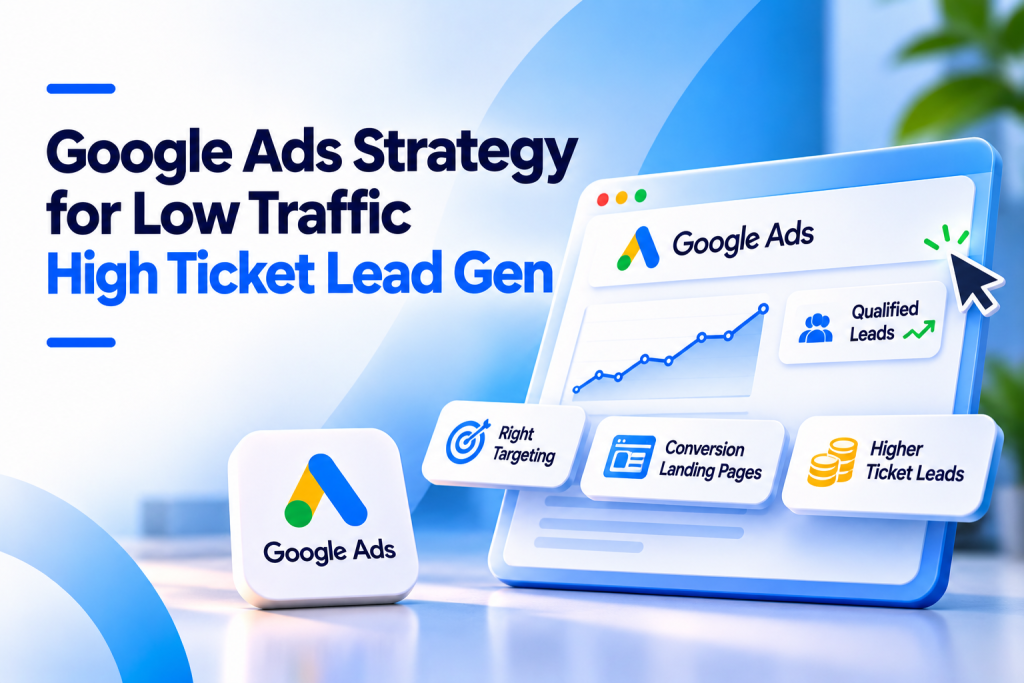
A successful Google Ads strategy for low-traffic, high-ticket lead generation focuses on buyer intent, lead quality, and pipeline value rather than generating large volumes of clicks. B2B companies with limited search demand need carefully selected keywords, controlled budgets, strong landing pages, and conversion tracking that connects advertising activity to qualified sales opportunities.
For a B2B SaaS company selling enterprise software or an IT consulting firm pursuing six-figure contracts, even a small number of qualified enquiries can justify advertising investment.
The challenge is that these businesses often operate in markets where relatively few people search for their solutions. Some keywords receive only a handful of monthly searches, sales cycles can last several months, and conversion data accumulates slowly.
Traditional Google Ads advice often assumes that advertisers can generate enough conversions to test multiple campaigns and optimise quickly. That assumption does not always hold for specialised B2B companies.
A better approach starts with understanding who is searching, what they want to achieve, and how much a qualified opportunity could be worth.
Key Takeaways
- Buyer intent matters more than traffic volume. A highly relevant search from an enterprise decision-maker can be more valuable than hundreds of informational clicks.
- Campaign structure should remain focused. Too many campaigns and ad groups can spread limited data and budgets across unnecessary segments.
- Bidding strategies must reflect conversion volume. Automated bidding can work with limited data, but restrictive targets and poorly defined conversion goals can reduce performance.
- Lead quality should guide optimisation. Form submissions alone do not show whether advertising is creating valuable sales opportunities.
- CRM integration improves measurement. Connecting Google Ads with sales outcomes helps advertisers identify keywords that generate qualified meetings and pipeline.
- Budget decisions should reflect deal economics. High-ticket businesses should evaluate acquisition costs against gross profit, close rates, and sales-cycle length.
Why Google Ads Is Different for Low-Traffic, High-Ticket Businesses
Google Ads becomes more challenging when the target market is small, search activity is limited, and each potential customer has a high contract value.
Low-traffic, high-ticket lead generation generally involves three characteristics:
- A narrow ideal customer profile (ICP).
- A specialised product or service with significant commercial value.
- A longer buying process involving several stakeholders.
These conditions are common in enterprise SaaS, cybersecurity, engineering services, B2B consulting, industrial manufacturing, and complex technology solutions.
Consider a hypothetical company selling enterprise data integration software.
Its target buyers may include CTOs, IT directors, and enterprise architects. These buyers might search for highly specific integration capabilities rather than broad terms such as “data software.”
The company could receive fewer than 100 relevant clicks per month, yet some of those visitors may represent organisations evaluating substantial contracts.
The advertising challenge is therefore different from that of a business selling a low-cost product online.
| Factor | High-Volume Lead Generation | Low-Traffic, High-Ticket Lead Generation |
|---|---|---|
| Search demand | Broad and relatively high | Narrow and often limited |
| Typical buyer | Individuals or smaller buying groups | Multiple business stakeholders |
| Conversion volume | Frequent | Infrequent |
| Sales cycle | Often shorter | Often several weeks or months |
| Primary objective | Cost per lead and conversion volume | Qualified opportunities and pipeline |
| Keyword strategy | Broader coverage may be suitable | Concentrated commercial intent |
| Bidding approach | More frequent conversion feedback | Careful goals and longer evaluation windows |
| Success measurement | Lead volume and acquisition efficiency | Qualified meetings, opportunities, and revenue |
The important distinction is that low search volume does not necessarily mean low commercial demand.
Some enterprise buyers search infrequently because their needs are specialised. Others may use industry terminology that conventional keyword research overlooks.
The objective is to identify those searches and create a clear path from initial interest to a qualified sales conversation.
How to Build a Google Ads Strategy for Low-Traffic, High-Ticket Lead Generation
The most effective Google Ads strategy for low-traffic, high-ticket B2B lead generation starts with the buyer rather than the keyword.
A focused process includes identifying commercial search intent, grouping relevant keywords, choosing an appropriate bidding strategy, developing qualification-focused landing pages, and connecting advertising data with CRM outcomes.
1. Define Your Ideal Customer Profile Before Selecting Keywords
An ideal customer profile describes the type of organisation most likely to benefit from your product or service and become a profitable customer.
For high-ticket B2B campaigns, an ICP should include:
- Target industries and business models.
- Company size and approximate revenue.
- Geographic markets.
- Relevant decision-makers and influencers.
- Business problems that create purchase demand.
- Technology requirements or operational constraints.
- Typical contract size and sales-cycle length.
For example, an enterprise cybersecurity company may target financial institutions with more than 500 employees that require specialised compliance and security capabilities.
That definition helps the marketing team distinguish between broad cybersecurity searches and searches connected to enterprise purchasing requirements.
However, Google Search keyword targeting generally cannot directly restrict advertising to specific company sizes or job titles.
The ICP must therefore influence keyword selection, ad messaging, geographic targeting, landing-page content, and lead qualification.
This is especially important because even commercially relevant keywords can attract buyers outside the intended market.
2. Prioritise Keywords by Purchase Intent
Keyword selection is one of the most important decisions in a low-volume Google Ads campaign.
Rather than targeting every search related to a product category, advertisers should identify searches that indicate a genuine business requirement.
A practical approach is to divide keywords into three categories.
| Keyword Category | Example | Buyer Intent | Recommended Priority |
|---|---|---|---|
| Direct commercial | Enterprise ERP implementation partner | High | Highest |
| Solution-specific | SAP S/4HANA migration consulting | High to medium | High |
| Problem-aware | How to migrate legacy ERP systems | Usually informational | Test selectively |
These examples are illustrative. Actual keyword relevance and search demand should be validated for each market.
Direct commercial keywords usually offer the clearest starting point. They suggest that a buyer is already exploring vendors, service providers, or implementation partners.
Solution-specific keywords can also be valuable, particularly when enterprise buyers search for technical capabilities instead of vendor categories.
Problem-aware keywords may introduce potential customers earlier in the buying journey, but they require careful evaluation because many searchers are still researching.
For limited budgets, start with direct commercial and solution-specific searches before expanding into broader informational topics.
3. Use Exact and Phrase Match as a Controlled Starting Point
Exact match and phrase match can help advertisers maintain tighter control over the types of searches entering a new campaign.
For example, an IT consulting firm might begin with:
[enterprise cloud migration consulting]
[azure migration services]
“enterprise cloud migration partner”
“cloud infrastructure consulting company”
Exact match does not mean ads appear only for searches containing identical words. Google can match searches with the same meaning or intent.
Phrase match also covers relevant variations.
Broad match can expand reach further and may uncover searches that would otherwise be missed.
However, broad match requires reliable conversion signals and regular monitoring. For a business generating only a few qualified opportunities per month, expanding too quickly can expose the budget to irrelevant or weak-intent searches.
Google recommends using Smart Bidding alongside broader keyword matching and reviewing search terms to improve targeting. The right expansion strategy still depends on campaign data, budget, and commercial fit.
Start with a manageable keyword set, evaluate the actual search terms, and expand only where additional relevance is demonstrated.
4. Build Negative Keyword Lists Around Poor-Fit Buyers
Negative keywords help prevent ads from appearing for searches that are unlikely to produce suitable customers.
For high-ticket B2B businesses, poor-fit searches often involve:
- Free products or services.
- Job openings and careers.
- Courses, tutorials, and certifications.
- Consumer versions of enterprise products.
- Templates and downloadable resources.
- Low-cost alternatives, when low-cost buyers are outside the ICP.
For example, an enterprise software consulting firm might exclude searches for free software courses or entry-level jobs.
However, negative keywords should be evaluated in context.
A search containing “pricing” may indicate strong purchase intent. A search containing “free” may be relevant if a free assessment or trial is part of the sales process.
Review search terms regularly and exclude irrelevant searches based on their meaning rather than applying overly broad negative keyword lists.
Choosing the Right Bidding Strategy When Conversion Volume Is Low
Google Ads bidding for low-conversion-volume lead generation requires a balance between automation, data quality, and budget control.
Smart Bidding uses auction-time signals to predict conversion probability, but the advertiser must still define useful conversion goals.
Low conversion volume does not automatically prevent automated bidding from working. It does, however, make performance harder to evaluate and can increase the impact of individual conversions.
Manual CPC vs Maximise Clicks vs Maximise Conversions
Different bidding strategies serve different purposes.
| Bidding Strategy | Best-Fit Situation | Main Advantage | Main Limitation |
|---|---|---|---|
| Manual CPC | Advertisers requiring direct bid control | Greater control over keyword bids | Does not optimise automatically for conversion likelihood |
| Maximise Clicks | Early traffic discovery | Helps generate clicks within a budget | Can favour inexpensive traffic over qualified enquiries |
| Maximise Conversions | Campaigns with reliable conversion goals | Optimises toward recorded conversions | Weak lead signals can attract poor-quality enquiries |
| Target CPA | Campaigns with a defensible acquisition-cost target | Optimises toward a target average CPA | Overly restrictive targets can limit reach |
| Maximise Conversion Value | Campaigns assigning meaningful values to conversions | Prioritises conversion value | Requires dependable value signals |
| Target ROAS | Campaigns with robust conversion-value measurement | Optimises toward a return target | Can restrict delivery when targets or value data are unreliable |
Google’s Smart Bidding options include Maximise Conversions, Target CPA, Maximise Conversion Value, and Target ROAS, with target settings available within the relevant bidding approaches. Google Ads Help
When Should You Use Maximise Conversions?
Maximise Conversions is worth testing when the campaign has accurate conversion tracking and a conversion goal that represents useful business activity.
The important question is what Google Ads considers a conversion.
If every form submission counts equally, the bidding system may optimise toward users who are more likely to submit forms, regardless of whether they are suitable enterprise buyers.
A better setup measures qualification and eventually sends that information back into Google Ads.
For very low-volume accounts, Maximise Conversions may still be viable, but results should be evaluated over a sufficiently long period and against lead quality.
Should You Use Target CPA With Only a Few Monthly Conversions?
Target CPA can be used in low-volume campaigns, but it requires realistic expectations.
Google does not impose a universal minimum conversion count before advertisers can use Target CPA. However, its guidance recommends evaluating performance over a period that includes sufficient conversion activity, such as at least 30 conversions when assessing a 30-day period.
Setting a target CPA substantially below the achievable market cost can limit traffic and conversion opportunities.
For a campaign generating only two or three enquiries per month, a strict target CPA may be difficult to calibrate.
A practical sequence is to establish reliable conversion tracking, test a less restrictive bidding setup, and introduce CPA targets when the available evidence supports them.
There is no universal bidding strategy that performs best for every low-traffic account.
How to Structure Google Ads Campaigns Without Fragmenting Limited Data
A low-traffic Google Ads account usually benefits from fewer, clearly organised campaigns.
Too many campaigns and ad groups can create fragmented budgets and make performance patterns difficult to interpret.
Organise Campaigns Around Business Differences
Separate campaigns when there are meaningful differences in:
- Geographic markets.
- Products or services.
- Conversion goals.
- Budgets and commercial priorities.
- Landing-page requirements.
- Buyer intent.
For example, a cloud consulting company could initially use:
Campaign 1: Enterprise Cloud Migration
Ad groups:
- Azure migration consulting.
- AWS migration consulting.
- Enterprise cloud migration.
Campaign 2: Cloud Infrastructure Consulting
Ad groups:
- Cloud architecture consulting.
- Infrastructure modernisation.
- Multi-cloud consulting.
The structure keeps related search intent together while allowing relevant ads and landing pages.
If search volume is extremely limited, even these segments may need consolidation.
Avoid Single-Keyword Ad Groups Without a Clear Reason
Single-keyword ad groups can create unnecessary administrative work when keyword volume is low.
Instead, group keywords that share the same intent and can be served by a common ad message and landing page.
The objective is to maintain relevance without creating a complicated structure that produces little actionable data.
Keep Brand and Non-Brand Performance Separate
Brand searches often convert differently from non-brand searches because users may already know the business.
Separating branded and non-branded activity allows advertisers to understand whether campaigns are capturing existing demand or generating enquiries from buyers who were previously unfamiliar with the company.
Brand campaigns can still be valuable, particularly where competitors advertise on company names.
However, their performance should not obscure the acquisition efficiency of non-brand campaigns.
How to Generate Qualified Leads From Google With Limited Search Traffic
Generating qualified leads from Google requires more than attracting visitors to a landing page.
High-ticket buyers need evidence that the provider understands their requirements, can deliver the solution, and is suitable for their organisation.
Align Ad Copy With the Buyer’s Actual Problem
Generic advertising messages often fail to communicate why a specialised business deserves attention.
Consider two hypothetical ads for an enterprise cloud migration service.
Generic message:
“Best Cloud Migration Services. Contact Our Experts Today.”
More specific message:
“Enterprise Cloud Migration Consulting. Plan Complex AWS and Azure Migrations.”
The second message communicates the service more clearly and helps potential buyers assess relevance before clicking.
Useful B2B ad copy should explain the offering, identify an important business problem, and provide a credible reason to continue.
Relevant qualifications, supported technologies, genuine experience, and clearly defined delivery capabilities can strengthen the message when those claims are substantiated.
Avoid unsupported superlatives and promises of guaranteed outcomes.
Send Buyers to Dedicated Landing Pages
A specialised Google Ads campaign should usually direct users to a page that matches their search intent.
For example, someone searching for enterprise SAP migration consulting should reach a page explaining that specific service, rather than a generic technology consulting homepage.
A strong landing page should answer five questions:
- What problem does the company solve?
- Which organisations is the service designed for?
- What capabilities and deliverables are included?
- What evidence supports the company’s credibility?
- What happens after submitting an enquiry?
For complex B2B services, additional information about implementation processes, integrations, compliance requirements, and delivery models may improve buyer confidence.
Use Forms to Support Lead Qualification
Lead forms should collect enough information to help sales teams determine whether an enquiry is worth pursuing.
Depending on the business, useful fields may include:
- Business email.
- Company name.
- Job role.
- Company size.
- Service requirement.
- Project timeline.
- Approximate budget range.
However, longer forms introduce friction.
A business with extremely limited traffic should not automatically add ten qualification fields simply to discourage unsuitable leads.
Start with the information sales genuinely needs, then compare submission completion rates with lead quality.
Progressive qualification, where additional information is collected during follow-up, may be more appropriate when form completion is already low.
Choose a CTA That Matches the Buying Stage
High-ticket B2B buyers may not be ready to purchase immediately.
The next step should therefore reflect the complexity of the decision.
Relevant calls to action include:
- Book a technical consultation.
- Discuss your implementation requirements.
- Request a solution assessment.
- Schedule a product demonstration.
- Speak with an enterprise specialist.
A technical consultation may work better for bespoke IT services, while a product demonstration may fit an established SaaS platform.
The appropriate CTA depends on what the buyer needs to evaluate before making a decision.
How to Track and Attribute Google Ads Lead Generation to Revenue
The most important measurement improvement for high-ticket Google Ads campaigns is connecting advertising conversions with CRM outcomes.
Form submissions are useful indicators, but they do not reveal whether enquiries become qualified sales opportunities.
For businesses with long sales cycles, the measurement system should capture what happens after a lead reaches the sales team.
Track the Complete Lead Journey
A practical B2B conversion journey looks like this:
Google Ads ClickVisitor arrives from a relevant search
Lead SubmissionEnquiry is captured and recorded
Qualified LeadSales confirms the account meets qualification criteria
Sales OpportunityA credible commercial opportunity is created
Closed RevenueContract value and customer acquisition cost are measured
This process allows marketing and sales teams to distinguish between campaigns that generate activity and campaigns that contribute to revenue.
Configure Primary and Secondary Conversion Actions
Google Ads allows advertisers to classify conversion actions as primary or secondary.
Primary conversions are used for bidding when included in a campaign’s selected goals.
Secondary conversions are generally used for observation, although custom goals can change how they are used. Google Ads Help
For high-ticket lead generation, an initial setup might include:
| Conversion Action | Suggested Initial Treatment | Purpose |
|---|---|---|
| Contact form submission | Primary, if reliably qualified enough | Capture initial lead demand |
| Qualified lead | Primary once reliable data is available | Optimise for buyer suitability |
| Booked consultation | Primary or secondary, depending on goal design | Measure sales engagement |
| Sales opportunity | Tracked and potentially used for value-based bidding | Understand pipeline contribution |
| Brochure download | Secondary | Observe research activity |
| Pricing page visit | Secondary | Measure buying interest |
These are illustrative configurations, not universal rules.
Avoid making several stages of the same funnel primary without considering how Google Ads will count and optimise those actions.
For example, treating a form submission, qualified lead, and subsequent meeting as three equally valuable bidding conversions can distort the signal if the reporting design does not account for their relationship.
Import Offline Conversions From Your CRM
Offline conversion measurement connects actions occurring outside the website to the original advertising interaction.
For example, a prospect may submit a form after clicking a Google ad.
Two weeks later, the sales team qualifies the company and creates an opportunity in the CRM.
Google Ads can receive that qualifying event through a supported offline conversion setup, helping the advertiser understand which campaigns contributed to the opportunity.
Google recommends enhanced conversions for leads, which uses first-party information and matching signals to improve offline conversion measurement. Google Ads Data Manager supports these workflows. Google Ads Help+1
A practical implementation process includes:
- Record advertising click identifiers, including GCLID where available, and relevant first-party lead data.
- Store the lead and its source information in the CRM.
- Define qualification stages consistently across sales and marketing.
- Configure a supported connection between the CRM and Google Ads Data Manager.
- Import relevant qualified-lead or converted-lead events.
- Validate event matching, timestamps, deduplication, and reporting.
Google’s 2026 changes to offline conversion uploads make it important to confirm that integrations use currently supported methods rather than relying on outdated API workflows.
Only share customer information through appropriate, consent-compliant measurement processes.
Understand the Limits of Attribution
Google Ads attribution can help identify the advertising interactions associated with conversions.
However, B2B buying journeys often involve several channels.
A prospect may first discover a company through an industry publication, later search for its services on Google, visit a LinkedIn profile, and finally submit an enquiry.
Google Ads conversion reporting should therefore be considered alongside CRM source data, sales activity, and other marketing interactions.
Attribution models cannot perfectly reconstruct every buyer interaction.
For revenue leaders, the most useful question is whether paid search is contributing to qualified pipeline at an economically sustainable cost.
How to Set a Google Ads Budget for High-Ticket Lead Generation
A Google Ads budget for high-ticket B2B lead generation should be based on expected commercial value, not simply average industry cost-per-click benchmarks.
The critical inputs are:
- Average contract value.
- Gross profit or contribution margin.
- Expected customer lifetime value, where reliable.
- Lead-to-opportunity conversion rate.
- Opportunity-to-customer close rate.
- Acceptable customer acquisition cost.
- Available search demand.
Calculate the Economics Before Launching
Consider a hypothetical B2B consulting company with the following assumptions:
| Metric | Illustrative Value |
|---|---|
| Average first-year contract value | $50,000 |
| Gross margin | 60% |
| First-year gross profit per customer | $30,000 |
| Qualified lead-to-customer close rate | 10% |
| Target acquisition cost per customer | $6,000 |
| Maximum acquisition cost per qualified lead | $600 |
The maximum acquisition cost per qualified lead is calculated as:
$6,000 × 10% = $600
If the business generates ten qualified leads and converts one customer, it would spend approximately $6,000 to acquire a customer, assuming all acquisition costs being considered are included.
This example is a simplified planning model, not a performance benchmark.
It does not account for every operational cost, sales expense, payment timing, or customer retention scenario.
For a full financial assessment, the business should distinguish advertising cost from total customer acquisition cost.
Estimate Keyword Economics
Suppose relevant search traffic costs $20 per click.
At a hypothetical 5% click-to-qualified-lead conversion rate:
- 100 clicks cost $2,000.
- Five qualified leads are generated.
- Advertising cost per qualified lead is $400.
Under the earlier assumptions, this could be economically viable.
However, if only 1% of clicks become qualified leads, the cost per qualified lead increases to $2,000.
The same keyword CPC can therefore produce very different commercial outcomes depending on buyer fit and conversion quality.
This is why budget planning should combine keyword demand with actual sales qualification data.
Use Search Demand to Set Realistic Volume Expectations
A company cannot create unlimited Google Search traffic for an extremely narrow search market.
If the available relevant searches are limited, increasing the advertising budget may not meaningfully increase qualified enquiries.
It may instead encourage broader targeting, higher bids, or more exposure to weaker-intent searches.
Before increasing budget, evaluate impression share, search-term relevance, lost impression share due to budget or rank, and whether suitable searches are available.
Where qualified search demand is already being captured efficiently, additional budget may be better allocated to complementary channels.
A Practical Framework for Prioritising Low-Volume Google Ads Keywords
Low search volume makes keyword prioritisation particularly important.
The following educational framework can help B2B teams compare potential keywords before committing budget.
The Buyer Intent and Commercial Fit Framework
Score each keyword against four criteria.
| Evaluation Criteria | Score 1 | Score 3 | Score 5 |
|---|---|---|---|
| Purchase intent | General research | Solution evaluation | Active vendor consideration |
| ICP fit | Mostly unsuitable users | Mixed relevance | Strong match with target buyers |
| Commercial value | Low-value requirement | Moderate value | High-ticket opportunity |
| Landing-page relevance | Poor match | Acceptable match | Directly addresses search intent |
Add the four scores to create a total out of 20.
An illustrative interpretation is:
- 17–20: High-priority keyword.
- 13–16: Test selectively.
- 9–12: Consider for future expansion.
- 4–8: Usually low priority for limited budgets.
This framework is intended to support structured decision-making. It is not a Google Ads ranking formula or a validated prediction model.
Search demand, expected CPC, competition, and actual performance must still influence the final decision.
For instance, an industry-specific keyword with a score of 19 may have fewer searches than a broad software category keyword with a score of 12.
In a limited-budget campaign, the more commercially relevant keyword may deserve greater priority despite its lower traffic potential.
How to Measure Success When Google Ads Generates Only a Few Leads
Low-volume campaigns require a different reporting approach because small datasets can produce misleading short-term performance comparisons.
A campaign generating three qualified leads in one month and one in the next has experienced a noticeable change, but that difference alone does not establish that the strategy has become ineffective.
Marketers need to evaluate trends alongside the underlying commercial activity.
Prioritise Pipeline Metrics Over Lead Volume
A useful performance scorecard includes:
| Metric | What It Measures | Why It Matters |
|---|---|---|
| Relevant search impression share | Coverage of eligible searches | Shows potential missed demand |
| Qualified lead rate | Qualified leads divided by total leads | Measures buyer suitability |
| Cost per qualified lead | Ad spend divided by qualified leads | Measures acquisition efficiency |
| Cost per qualified meeting | Ad spend divided by qualified meetings | Connects marketing with sales engagement |
| Opportunity creation rate | Opportunities divided by qualified leads | Measures progression into pipeline |
| Cost per opportunity | Ad spend divided by opportunities | Measures the cost of creating commercial opportunities |
| Pipeline generated | Value of attributed sales opportunities | Shows potential commercial contribution |
| Customer acquisition cost | Relevant acquisition costs divided by customers | Measures customer acquisition efficiency |
For businesses with long sales cycles, closed revenue may take months to become available.
Until then, qualified opportunities and pipeline progression can serve as useful intermediate indicators.
The quality and consistency of CRM data are essential.
Teams seeking a more consistent approach can use a documented method for measuring lead quality to align marketing performance with sales qualification.
Evaluate Longer Time Windows
Daily and weekly results may be too volatile for accounts generating very few conversions.
A longer reporting period can help reveal patterns that are otherwise hidden by short-term fluctuations.
For example, a 60- or 90-day review may be more informative than a seven-day comparison for a business generating only a few qualified enquiries per month.
However, reporting periods should also account for conversion delays.
A lead generated this month may not become a qualified opportunity until several weeks later.
Avoid judging recent campaigns solely by outcomes that have not had enough time to develop.
Use Sales Feedback as a Performance Input
A lead can look successful in Google Ads while being unsuitable for the sales team.
Sales feedback should identify why enquiries are accepted or rejected.
Useful rejection reasons include:
- Company too small.
- Incorrect industry.
- No relevant requirement.
- Budget mismatch.
- Geography outside the service area.
- Student, job seeker, or non-commercial enquiry.
- Duplicate or existing customer.
- No realistic purchasing timeline.
This feedback can guide keyword targeting, negative keywords, ad copy, landing-page qualification, and conversion measurement.
The distinction between lead quality and lead quantity becomes especially important when every enquiry represents a significant share of campaign results.
Common Google Ads Mistakes in Low-Traffic, High-Ticket Campaigns
Several common campaign decisions can waste limited advertising budgets.
1. Expanding Keywords Before Understanding Existing Traffic
Adding broad keywords to increase impressions may generate more clicks without improving commercial outcomes.
Review search-term relevance and qualified-lead performance before expanding reach.
2. Using Form Submissions as the Only Success Metric
A form submission is an early conversion event, not proof of a qualified opportunity.
Track qualification outcomes and use CRM feedback to understand which campaigns attract suitable buyers.
3. Setting Unrealistically Low CPA Targets
An aggressive CPA target can limit delivery when the actual market cost of acquiring a qualified buyer is higher.
Use commercial economics and observed campaign performance to guide targets.
4. Creating Too Many Campaigns
Fragmented accounts make it harder to allocate small budgets and evaluate results.
Consolidate similar intent where appropriate while keeping meaningful business differences separate.
5. Optimising Landing Pages Only for Conversion Rate
A landing page that generates more form submissions is not necessarily producing better leads.
Evaluate conversion rates alongside qualified-lead rates and opportunity creation.
6. Making Frequent Changes Based on Limited Data
Changing bids, keywords, or landing pages after one or two conversions can introduce unnecessary instability.
Document hypotheses, assess whether enough evidence exists, and avoid making several major changes simultaneously.
7. Ignoring the Sales Process
Google Ads performance depends partly on how quickly and effectively the sales team handles incoming enquiries.
Define response ownership, qualification criteria, CRM stages, and follow-up processes before scaling campaigns.
8. Treating All Leads as Equally Valuable
An enterprise enquiry involving a substantial implementation requirement may be worth more than a small-business enquiry for a basic service.
Where supported by reliable CRM data, value-based measurement can help reflect those commercial differences.
When Google Ads Is the Right Channel and When It Is Not
Google Ads can work well for low-traffic, high-ticket lead generation when buyers actively search for a recognisable solution category.
It may be less effective when prospective customers do not know the problem exists or lack the language to search for a solution.
| Business Situation | Google Ads Suitability | Recommended Approach |
|---|---|---|
| Enterprise buyers search for established service categories | High | Prioritise high-intent Search campaigns |
| Buyers search for specific technical capabilities | High | Build solution-specific campaigns |
| Search volume is low but commercial intent is clear | Potentially high | Capture available demand efficiently |
| A new product category has little existing search demand | Limited initially | Combine education, authority building, and outbound |
| Buyers are identifiable by company and role but rarely search | Limited | Consider account-based outreach |
| Search demand is mainly informational | Mixed | Test selectively and measure downstream quality |
| The sales team cannot qualify or follow up with enquiries | Operationally weak | Fix lead management before scaling |
Combine Google Ads With Other B2B Demand Channels
For specialised B2B companies, Google Ads may perform best as one component of a broader acquisition programme.
Search campaigns capture demand when buyers are actively evaluating solutions.
Meanwhile, LinkedIn outreach, email outreach, and industry-specific authority content can reach relevant decision-makers who are not currently searching.
For example, a specialised engineering firm may use Google Ads to attract companies searching for a specific manufacturing capability while its outbound team approaches organisations showing expansion or procurement signals.
The two channels serve different functions.
This distinction also supports a buyer-signal-driven approach to demand generation, where marketing activity is informed by evidence of potential purchasing needs.
The objective is to create more qualified sales opportunities without depending entirely on a small pool of monthly searches.
A 90-Day Google Ads Implementation Plan for Low-Traffic B2B Companies
A structured 90-day plan helps teams establish reliable measurement before pursuing aggressive expansion.
The timeline below is illustrative. Some accounts will need longer to accumulate meaningful conversion data.
| Period | Primary Focus | Key Activities |
|---|---|---|
| Days 1–15 | Strategy and measurement | Define ICP, assess search demand, establish conversion goals, review CRM readiness |
| Days 16–30 | Campaign launch | Build focused Search campaigns, prepare landing pages, validate tracking |
| Days 31–60 | Traffic quality | Review search terms, refine negatives, assess qualification outcomes, improve messaging |
| Days 61–90 | Commercial optimisation | Review cost per qualified lead, assess pipeline, test bidding and targeting improvements |
Days 1–30: Establish the Foundation
Begin with buyer research, keyword prioritisation, and conversion tracking.
Build a simple account structure and verify that every important conversion event is recorded correctly.
Test lead forms and CRM data capture before assuming reporting is reliable.
Days 31–60: Improve Relevance
Review the searches generating clicks and enquiries.
Identify keywords attracting unsuitable buyers, update ad messaging, and examine landing-page engagement.
Work with sales to classify incoming leads.
If conversion volume remains extremely low, avoid interpreting minor fluctuations as proof of improvement or decline.
Days 61–90: Evaluate Commercial Value
Compare advertising spend with qualified leads, meetings, and opportunities.
Review whether available search demand is being captured effectively.
Determine whether additional investment should support existing high-intent campaigns, relevant keyword expansion, landing-page improvements, or other acquisition channels.
For long sales cycles, some revenue outcomes will remain unresolved at day 90.
A responsible performance assessment should distinguish completed outcomes from pipeline still in progress.
Frequently Asked Questions
Can Google Ads work with very low search volume?
Yes, Google Ads can work with very low search volume when available searches indicate strong commercial intent and the economics support the cost of acquisition. However, limited search demand creates a natural ceiling on traffic and lead volume. Some extremely low-volume keywords may also have limited eligibility to serve.
What is the best Google Ads bidding strategy for low conversion volume?
There is no universally best bidding strategy for low conversion volume. Maximise Conversions may be appropriate when conversion tracking is reliable, while a more controlled approach may help during initial traffic discovery. Target CPA and value-based bidding should be evaluated against the quality and quantity of available conversion data.
How many conversions does Google Ads need for Smart Bidding?
Google Ads does not have a universal minimum conversion requirement for all Smart Bidding strategies. Performance depends on multiple factors, including conversion quality, account signals, budget, and bidding targets. More relevant conversion data generally makes performance evaluation more reliable, particularly for campaigns with long sales cycles.
How much should a B2B company spend on Google Ads?
A B2B company should set its Google Ads budget using relevant search demand, expected cost per click, conversion rates, and acceptable acquisition costs. A high-ticket business may justify higher spending per qualified lead than a low-ticket business, but the investment must still support profitable customer acquisition.
How do you generate high-quality leads from Google Ads?
Generate high-quality leads from Google Ads by targeting commercially relevant searches, aligning ads with specific buyer problems, using qualification-focused landing pages, and reviewing leads in the CRM. Importing qualified-lead outcomes can also improve measurement and support better bidding decisions.
How do you track Google Ads leads through a long sales cycle?
Track Google Ads leads through a long sales cycle by connecting website conversion tracking with CRM records and importing offline qualification or sales events. Capture suitable click identifiers and first-party information, maintain consistent sales stages, and account for conversion delays when evaluating campaign performance.
Should high-ticket B2B companies use Performance Max?
Performance Max can be tested by high-ticket B2B companies when conversion measurement is reliable and broader inventory is appropriate. However, companies with limited budgets and highly specialised search intent may prefer to establish controlled Search campaigns first. Performance Max should be evaluated against qualified pipeline outcomes, not lead volume alone.
Is Google Ads better than LinkedIn Ads for high-ticket B2B lead generation?
Google Ads is often suitable for capturing existing search demand, while LinkedIn Ads can reach selected professional audiences based on attributes such as job role and company. The stronger channel depends on buyer behaviour, search demand, audience specificity, advertising costs, and the sales process. Some businesses benefit from using both channels for different stages of the buying journey.
Conclusion: Build Around Qualified Pipeline, Not Traffic Volume
A Google Ads strategy for low-traffic, high-ticket lead generation should begin with one commercial question: can the business consistently attract suitable buyers at an acquisition cost that makes financial sense?
The answer depends on search intent, campaign relevance, lead qualification, conversion measurement, and the economics of the sales process.
For specialised B2B companies, expanding traffic is not always the right objective. A small campaign that produces relevant enterprise conversations can be more valuable than a larger campaign attracting buyers who are unlikely to purchase.
Start with focused keywords, maintain a simple account structure, establish reliable CRM attribution, and evaluate performance against qualified meetings and pipeline rather than clicks alone.
At Growleads, our approach to Google Ads for B2B lead generation begins with understanding buyer demand and the commercial outcomes a campaign needs to support.
For businesses operating in narrow markets with high-value contracts, a focused review of search demand, campaign structure, and lead qualification is often the most useful starting point before increasing advertising investment.

Builds the demand intelligence, automation, and deliverability systems behind Growleads pipeline.