7 LinkedIn Connection Scripts That Get Accepted
Most SDRs are losing the connection game before the conversation even starts.
If you’re sending 100+ requests a week and seeing 15–20% acceptance, the problem isn’t your targeting. It’s the message. Generic invites look like spam, and LinkedIn’s algorithm treats them that way. Prospects skip anything that doesn’t immediately reference their world.
We’re sharing the best LinkedIn connection scripts we’ve tested across outbound campaigns, including CEO-specific variants and the personalisation rules that separate a 20% rate from a 60% one. Quick win: take Script 1 below, find a prospect who posted in the last 7 days, reference that post, and send to 20 people. Track what comes back.
Best LinkedIn Connection Scripts: What Works
Before we get to the scripts, one rule matters more than any template.
LinkedIn gives you 300 characters. That’s it. Every word has to earn its place, and any word that’s about you rather than them tends to kill the acceptance.
The formula that works: name + one specific hook + why it’s relevant + soft close. No pitch. No ask. Just a reason for them to click accept.
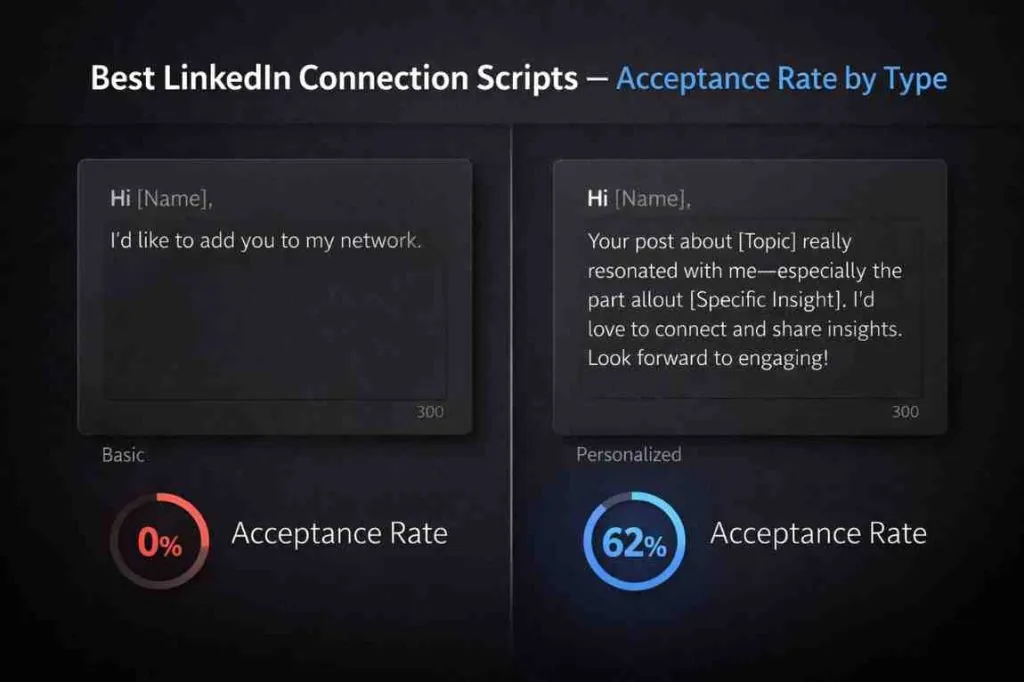
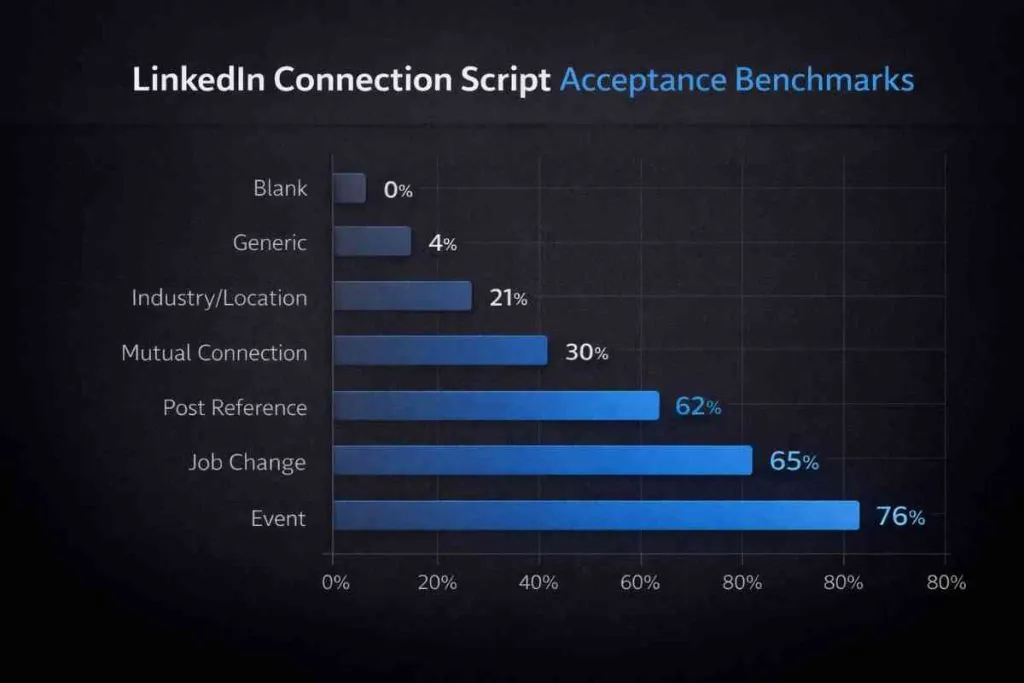
Acceptance rate benchmarks vary significantly by script type. Blank requests with no message tend to sit around 15–20%. Personalised requests referencing a mutual connection or recent post can reach 50–65%. The gap is almost entirely down to whether the message signals “I know who you are” versus “I’m running a list.”
Here’s how the acceptance data tends to break down by approach, based on community benchmarks from SDR practitioners tracking real rates:
| Script Type | Typical Acceptance Rate |
|---|---|
| Blank request (no note) | 15–25% |
| Generic “let’s connect” | 18–28% |
| Shared industry / location | 35–45% |
| Mutual connection reference | 45–55% |
| Recent post reference | 50–65% |
| Job change congratulations | 50–60% |
| Event follow-up | 55–65% |
These are directional, not guarantees. Your numbers will vary by ICP, profile strength, and send volume. For context on our outreach strategies, the post-reference and job-change scripts consistently outperform the rest.
Script 1: Recent Post Reference
Best for: Anyone who posts on LinkedIn regularly (check activity before sending).
“Hi [Name], your post on [specific topic] made me rethink [brief insight]. Thought it was worth connecting.”
Why it works: it signals you actually read something they wrote. That alone puts you in the top 10% of requests they receive. Keep the insight genuine. Vague compliments (“great post!”) don’t count and most recipients can tell.
Personalise it for SDRs: swap [specific topic] for the exact headline or theme of the post. Don’t summarise, mirror their language.
Script 2: Mutual Connection
Best for: When a shared contact is credible in their industry.
“Hi [Name], [Mutual’s name] suggested we connect. We’re both in [industry] and I think there’s something worth sharing. Happy to connect?”
The mutual connection transfers trust. You’re not cold, you’re vouched for. Always confirm the mutual actually knows them before using this one. A stretched “we both follow X” doesn’t carry the same weight as a real referral.
Personalise it: name the mutual specifically. A generic “we have 12 connections in common” doesn’t work here.
How to Connect with CEOs on LinkedIn
Executive-level requests need a different approach. CEOs get a high volume of requests and they’re pattern-matching for relevance fast.
The rule for exec outreach: engage first, request second.
Like or comment on something they’ve published, even a brief “this landed differently on a second read” response to their content. Wait an hour, then send the request. That comment makes you a recognisable name rather than a stranger.
Here’s the script that works for exec outreach:
“Hi [Name], your [interview/article] on [growth topic] addressed something we’re working through at the moment. Thought it was worth connecting.”
No pitch. No company name. No ask. Just a real reference to their thinking and why it matters to you. For a deeper breakdown of CEO-level personalisation tactics, the engage-first method consistently outperforms cold requesting.
Script 3: Shared Industry or Location
Best for: Peer-to-peer connecting, especially in niche verticals or regional markets.
“Hi [Name], fellow [industry] person in [city]. Not many of us here. Worth connecting and swapping notes.”
Simple. Non-threatening. The local angle works particularly well in smaller markets where the “small world” feeling is genuine. Don’t fake the city connection if it isn’t real.
Script 4: Value-First Offer
Best for: Prospects with a visible challenge or pain point you can address.
“Hi [Name], we recently helped [type of company] with [specific challenge]. Thought I’d connect in case it’s relevant. No pitch, just happy to share what worked.”
The phrase “no pitch” does a lot of work here. It signals you’re not about to immediately follow up with a 500-word cold email. Use this script sparingly and only when the value is genuinely specific to their situation.
A common mistake we see BDRs make: leading with company results that sound generic. “We helped increase revenue by X%” is noise. “We helped [industry] companies reduce churn in the first 90 days” is signal. Specific beats impressive.
Scripts 5, 6, and 7: Event, Job Change, and Group
These three cover some of the highest-converting trigger-based scenarios.
Script 5: Post-Event
“Hi [Name], great to briefly cross paths at [event]. Your point on [topic] stayed with me. Worth staying connected.”
Use within 48 hours of the event while the memory is fresh. Works in person and for virtual events where you engaged in the chat or a session.
Script 6: Job Change Congratulations
“Hi [Name], congratulations on the move to [new company]. Excited to see what you build there. Worth connecting.”
This is one of the clearest buying signals in B2B. New role, new budget, new priorities. Accept rate for this script tends to sit at the higher end because the context is natural and the message costs the recipient nothing.
Script 7: Shared Group or Community
“Hi [Name], noticed we’re both in [group name]. Your comment on [topic] caught my attention. Worth connecting here too.”
Works best when you can reference something specific from within the group, not just membership. Blank group references read the same as blank requests.
How to Track and Optimise Your Connection Requests
Scripts are a starting point. Measurement is what turns them into a repeatable system.
Here’s the basic tracking setup we’d use:
| Metric | Target | Action if Below |
|---|---|---|
| Acceptance rate | 40%+ | Pause, audit script and profile |
| Follow-up DM reply rate | 15%+ | Review message timing and tone |
| Accepted to booked call | 5%+ | Test value framing in follow-up |
| Daily request volume | Max 50 | Stay below to avoid flags |
If your acceptance rate drops below 40%, pause for 48 hours and look at two things: your profile and your message. Optimise your profile before running any volume, because prospects do check before they accept.
The A/B test we’d run first: post-reference versus mutual connection, same ICP, same week. Run 20 each, track acceptance and whether accepted connections reply to your follow-up DM. That tells you which hook resonates with your specific audience, not just which one works in general.
For scale, Growleads tools can help you manage sequencing without losing the personalisation that makes these scripts work.
The most common mistake we see: SDRs mass-sending generic requests, hitting 15–20% acceptance, concluding “LinkedIn doesn’t work,” and giving up. The tool works. The message doesn’t. Fix the message first, then think about volume.
Personalisation Rules That Apply to All 7 Scripts
Good scripts fail with bad personalisation. Here are the rules we apply across every campaign:
- Reference one specific thing. One post, one mutual, one recent role change. Not three.
- Use their name. Sounds obvious. Still frequently skipped.
- Match the tone of how they write. If their posts are casual, don’t send something formal.
- Never mention your company in the connection request. Save it for the follow-up after they accept.
- Always check their profile before sending. If they haven’t posted in six months, the post-reference script won’t work.
For more on prospecting hacks and how to layer these scripts into a broader outbound sequence, we cover the full workflow in our prospecting guide.
Want to Run These Scripts at Scale?
Here’s where to start:
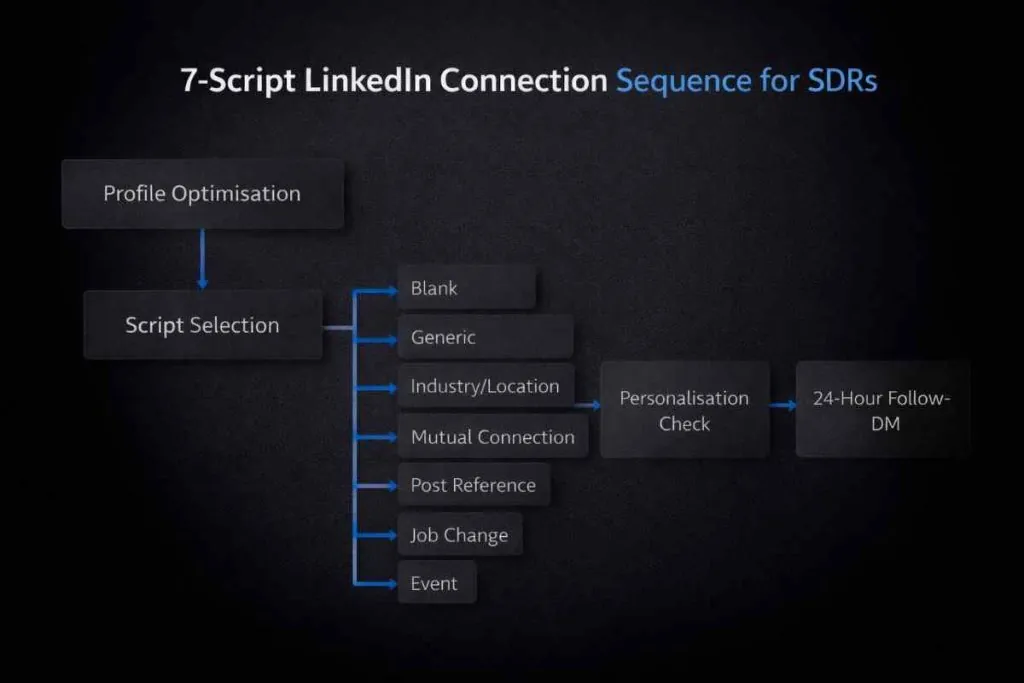
- Run your profile through our profile optimiser before sending any volume. A weak profile kills acceptance even with a good script.
- Pick two scripts to A/B test this week. Same ICP, different hook. Track acceptance rate, not just send volume.
- Cap at 50 requests per day to stay inside safe limits.
- Follow up with every accepted connection within 24 hours. The window closes fast.
If you want us to review your current request templates or help build a connection sequence for your ICP, you can book a time or find us through our social selling guide.
What are the best LinkedIn connection scripts for SDRs in 2026?
The scripts that consistently perform above 40% acceptance are post-reference, mutual connection, and job-change congratulations. For SDRs specifically, the job-change script is worth prioritising because it targets prospects at a natural transition point where they’re open to new conversations. Always include a specific hook, keep it under 300 characters, and leave the pitch for the follow-up message after they accept.
Do connection request message templates work, or do people see through them?
They work when they’re personalised. A template that references someone’s actual post or a real mutual contact doesn’t feel templated, it feels like you’ve done your homework. What doesn’t work is a clearly generic message where the only personalisation is swapping in the first name. The structure can be consistent. The hook has to be specific to that person.
How do we connect with CEOs on LinkedIn without getting ignored?
Engage with something they’ve published before you send the request. Like or comment on a post or article, then send the connection request within an hour or so, referencing what they wrote. That sequence means you’re a recognisable name rather than a stranger. Keep the request short, reference their thinking rather than your product, and never pitch in the first message.
How should we personalise connection requests without spending hours on each one?
Focus on one hook per message. You don’t need three data points per prospect. One relevant detail, a recent post, a mutual contact, or a job change, is enough to make the message feel human. Set a rule for yourself: if you can’t find one specific thing to reference in under 90 seconds of profile review, skip that prospect or use a lower-effort script like the shared industry template.
What are realistic LinkedIn connection acceptance rates for outbound in 2026?
Cold requests with no message tend to sit in the 15–25% range. Personalised requests referencing a mutual connection or recent post can reach 50–65%, based on SDR community benchmarks. Your numbers will vary by industry, ICP seniority, and profile strength. A consistent target of 40%+ is achievable with good scripts and a well-optimised profile.
What are the best cold connection examples for BDRs targeting enterprise accounts?
For enterprise outreach, the post-reference and mutual-connection scripts tend to work best because they signal research and relevance. The job-change script also performs well at enterprise level because new executives at large companies are highly receptive in their first 90 days. Keep the message brief, reference one specific thing, and make it clear there’s no immediate ask.
How many LinkedIn connection requests should we send per day?
We’d cap it at 50 per day. Going above that increases the risk of account flags and reduced visibility. More importantly, if you’re sending more than 50 personalised requests per day, something is probably automated in a way that will cost you quality. Volume is secondary to acceptance rate. A 60% acceptance rate on 50 daily requests beats a 15% rate on 200.
What’s the best LinkedIn outreach script for prospecting into a new industry?
The shared industry or local connection script works well when you’re new to a vertical because it doesn’t require deep research. As you build familiarity with the industry’s conversations and key voices, move to the post-reference script, which performs better but requires you to know what’s actually being discussed. Start broad and tighten as you learn the space.
How do we improve our LinkedIn connection acceptance rate if it’s stuck below 30%?
Two places to check first: your profile and your message. A weak or incomplete profile signals low credibility regardless of script quality. Run an audit before anything else. If your profile is solid, test the post-reference script against whatever you’re currently using, specifically targeting prospects who’ve posted in the last seven days. That single change moves acceptance rates more consistently than any other variable.
Is it worth using LinkedIn connection scripts for reaching senior decision-makers?
Yes, but the approach changes. Senior decision-makers respond to evidence that you’ve engaged with their thinking, not just their job title. Reference something specific they’ve written or said publicly, and keep the request free of any commercial intent. The connection is the goal at this stage. The conversation comes after. Rushing the pitch at the request stage is the single most common reason exec-level requests fail.
How to Fix LinkedIn Messages Going to the Other Inbox
LinkedIn introduced the “Other” inbox to filter messages from non-connections, paid promotional accounts, and senders flagged by the recipient’s filter rules. For SDRs and outbound senders, this is where 30 to 60 percent of cold InMails and connection-request follow-ups end up. The recipient never sees them.
Three things move messages out of Other and into Focused. Connection acceptance rate. The platform tracks whether your prior connections engaged with your initial message. Accounts with a 60 percent or higher first-message reply rate get routed to Focused by default. Accounts with a 10 percent or lower reply rate get routed to Other across most recipients, regardless of message content.
Profile completeness signal. Accounts with incomplete profiles, generic headshots, or sparse posting history get routed to Other algorithmically. The fix is unsexy: complete your profile, post one piece of substantive content per week, and add a banner that signals your role. Recipients filter Other inbox messages from “low-trust” accounts and complete profiles signal trust.
Recipient filter rules. LinkedIn lets recipients set rules that auto-filter mentions of “opportunity,” “introduce,” or “quick chat.” Avoid these phrases in opening messages. Reference something specific to their content or activity instead. Personalization moves messages out of automated filter buckets and into the human review queue.
The diagnostic: if your first-touch reply rate is below 8 percent, your messages are likely landing in Other. The fix is upstream of the message itself. Improve acceptance rate first (better targeting), then improve profile signals, then improve message phrasing. In that order.

Kuldeep is part of the Growleads team, working on SEO and automation to help improve lead generation systems. He focuses on building simple automated workflows, optimizing content processes, and learning to create scalable growth systems.