Education Marketing Agency vs In-House Team: What Should Schools and Colleges Choose?
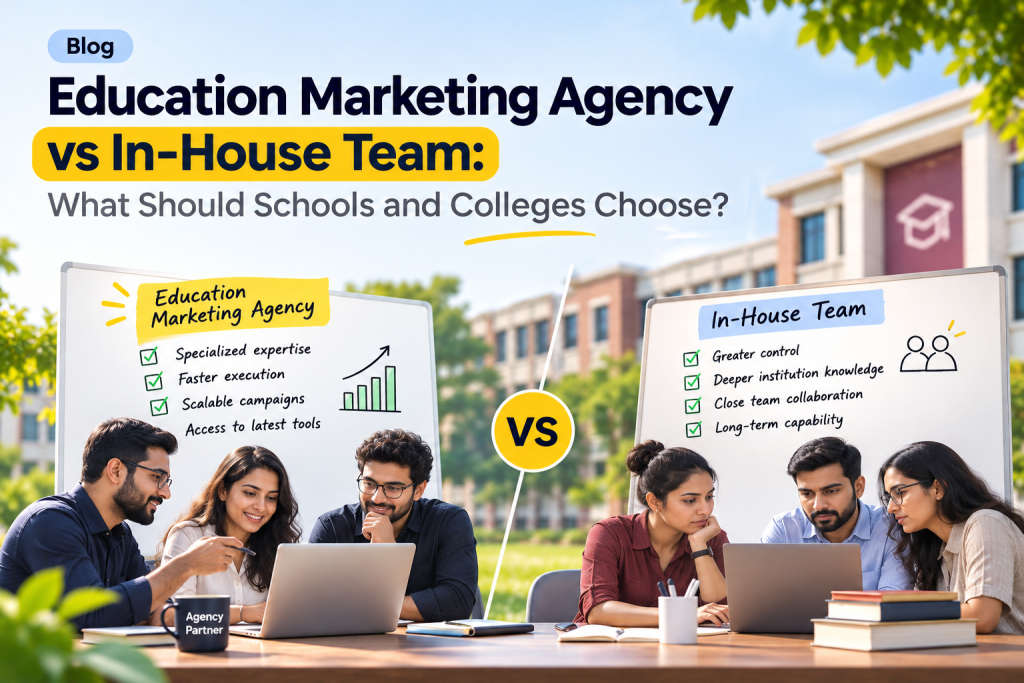
An education marketing agency is better suited to institutions that need specialist expertise, scalable student acquisition and measurable admission campaigns. An in-house team is preferable when institutional knowledge, brand control and daily communication are the priorities. For many schools, colleges and universities, a hybrid model offers a practical balance between internal ownership and external marketing expertise.
The decision becomes particularly important when admission targets increase, new programmes are introduced or existing marketing activities stop generating enough qualified student enquiries.
Hiring more marketing professionals may solve a capacity problem. Working with an external agency may solve an expertise problem. Neither will necessarily solve an admissions conversion problem.
Before committing to either model, institutional leaders need to understand where their student acquisition process is falling short.
Key Takeaways
- An in-house marketing team offers greater control over institutional branding, campus communication and stakeholder relationships.
- An education marketing agency provides access to specialist capabilities without requiring institutions to build every function internally.
- Marketing performance should be evaluated against qualified enquiries, completed applications, enrolments and cost per student acquisition.
- Outsourcing student lead generation does not mean outsourcing the entire admissions process.
- A hybrid model is particularly useful for institutions that have an established admissions team but lack digital marketing expertise.
- The right decision depends on admission targets, internal capabilities, marketing budgets and the complexity of student recruitment.
What Does an Education Marketing Agency Do?
An education marketing agency helps schools, colleges, universities and educational organisations attract prospective students, generate qualified admission enquiries and build a measurable student acquisition pipeline.
Unlike a general marketing service provider, a specialist agency needs to understand admission cycles, programme eligibility, geographical demand, student preferences, parental decision-making and institutional positioning.
Its responsibilities may include:
- Student and parent audience research
- Competitor and market analysis
- Google Ads and Meta Ads management
- Organic search and educational content
- Programme-specific landing pages
- Student enquiry generation and qualification
- Admission funnel development
- CRM integration and marketing automation
- Campaign attribution and performance reporting
A capable lead generation agency for schools and colleges should connect these activities to the institution’s admission objectives rather than treat every channel as an independent marketing activity.
For example, a university targeting engineering aspirants requires a different acquisition strategy from a private school targeting parents within a specific residential area. An executive education programme may require a different audience, communication strategy and qualification process altogether.
The agency’s value comes from understanding these differences and developing campaigns accordingly.
What Does an In-House Education Marketing Team Do?
An in-house education marketing team consists of professionals directly employed by an educational institution to manage its branding, communication, marketing campaigns and student recruitment activities.
Depending on the size of the institution, the team may include a marketing manager, content writer, graphic designer, social media executive, performance marketing specialist and marketing analyst.
An internal team is particularly effective at managing activities that require continuous access to institutional stakeholders, such as faculty members, students, alumni, academic leaders and admissions counsellors.
These activities include campus storytelling, institutional announcements, academic achievements, student testimonials, open-house events and communication with prospective parents.
The primary limitation is that building an effective internal team requires more than hiring a marketing manager. Institutions also need specialist expertise, technology, analytical capabilities and processes that connect marketing activity with admission outcomes.
Education Marketing Agency vs In-House Team: A Detailed Comparison
The main difference between an education marketing agency and an in-house team is how expertise, resources, responsibilities and costs are distributed. An agency provides access to shared specialist capabilities, while an internal team provides dedicated institutional knowledge and direct operational control.
| Decision factor | Education marketing agency | In-house marketing team |
|---|---|---|
| Cost structure | Retainer or project-based fees | Salaries, benefits and operational expenses |
| Specialist expertise | Access to multiple specialists, depending on scope | Depends on individual hires |
| Institutional knowledge | Requires research and onboarding | Strong day-to-day understanding |
| Campaign execution | Can be faster with established processes | Depends on existing capabilities |
| Scalability | Flexible within agreed resources | Requires additional hiring or training |
| Brand control | Managed through guidelines and approvals | Direct institutional control |
| Market intelligence | Potential exposure to multiple institutions and markets | Primarily focused on one institution |
| Technology | May include specialist tools and infrastructure | Requires internal investment |
| Admission season capacity | Can provide additional execution support | Limited by available staff |
| Communication | Requires structured coordination | Easier access to internal stakeholders |
| Accountability | Defined through contracts and performance metrics | Managed through internal performance reviews |
| Long-term knowledge retention | Requires documentation and knowledge transfer | Generally retained within the institution |
| Best suited for | Student acquisition and specialist campaign execution | Institutional branding and ongoing communication |
The comparison should be made against the actual capabilities of the proposed agency and internal team. A well-developed in-house department can outperform an inexperienced agency, just as an experienced external partner can outperform an under-resourced internal team.
When Should Schools and Colleges Hire an Education Marketing Agency?
Schools and colleges should consider hiring an education marketing agency when student acquisition becomes a strategic growth priority and the internal team lacks the expertise, infrastructure or capacity to achieve admission targets.
1. When admission targets are increasing
An institution expanding its intake capacity, introducing new courses or opening another campus needs a marketing strategy that can support additional demand.
Increasing the advertising budget alone is rarely enough. The institution must identify relevant student segments, understand search behaviour, develop programme-specific messaging and establish a process for converting enquiries into applications.
An external student acquisition partner can help build this capability without requiring the institution to recruit an entirely new department.
2. When the institution generates enquiries but struggles with lead quality
A high volume of student enquiries does not necessarily indicate strong marketing performance.
An institution may receive hundreds of enquiries from students who do not meet eligibility requirements, are interested in unavailable programmes or have no immediate intention of applying.
A specialist agency can help improve lead quality through:
- Programme-specific audience segmentation
- Search intent analysis
- Geographical targeting
- Relevant landing pages
- Enquiry qualification criteria
- Campaign optimisation based on admissions feedback
The objective should be to generate enquiries that admissions counsellors can realistically convert into applications.
3. When admission season requires additional execution capacity
Education marketing is often seasonal. Campaign requirements can increase considerably around application deadlines, entrance examinations, admission announcements and new academic sessions.
Hiring permanent employees to manage temporary increases in workload may not always make financial sense.
An external admission marketing partner can provide additional campaign management, creative production and analytical support during these periods, subject to the agreed scope and available resources.
4. When the institution lacks performance marketing expertise
Managing institutional social media accounts is different from running acquisition campaigns.
Effective paid advertising requires expertise in keyword research, audience targeting, bidding, conversion tracking, landing page performance and budget allocation.
For example, Growleads’ school admission campaign for Scotle generated more than 480 parent enrolment enquiries during one admissions cycle. The campaign focused on parents actively searching for relevant schooling options rather than broad educational searches.
The case illustrates why understanding admission intent is important when allocating advertising budgets.
5. When the institution cannot accurately measure marketing ROI
Educational institutions often invest across multiple channels without knowing which campaigns contribute to completed applications and confirmed admissions.
An education lead generation agency with strong analytical capabilities can help establish campaign tracking, CRM integration and structured reporting.
However, accurate measurement also requires the institution to maintain reliable admissions records and share conversion data with its marketing partner.
Without that feedback, even a technically strong agency will struggle to optimise campaigns beyond initial enquiries.
When Is an In-House Marketing Team the Better Choice?
An in-house marketing team is better suited to institutions that require continuous brand management, close coordination with academic stakeholders and dedicated marketing resources throughout the year.
Building internally makes particular sense in the following situations.
1. Institutional branding is the primary objective
Schools and universities need to communicate their educational philosophy, campus culture, teaching standards and student achievements consistently.
Internal employees have direct access to the people and experiences that make these communications authentic.
An agency can support content production, but institutional knowledge takes time to develop.
2. Marketing requires frequent coordination across departments
Large universities often have multiple faculties, research departments, placement cells, admission offices and administrative teams.
An internal marketing department can coordinate these stakeholders more efficiently, particularly when campaigns require frequent approvals or changes to academic information.
3. The institution already has strong specialist capabilities
An institution with experienced performance marketers, designers, content specialists and analysts may have little reason to outsource its entire marketing function.
External support can instead be limited to specific requirements such as campaign audits, strategic consulting, new market expansion or conversion optimisation.
4. Marketing requirements are consistent throughout the year
When an institution has enough ongoing work to justify dedicated specialists, building an internal department can become financially and operationally attractive.
The institution benefits from accumulated knowledge, continuity and greater control over resource allocation.
However, leadership must account for ongoing training, employee retention, recruitment and technology investments.
Is an Education Marketing Agency More Cost-Effective Than an In-House Team?
An education marketing agency can be more cost-effective when an institution needs several specialist capabilities but does not have enough continuous work to justify hiring full-time professionals for every function.
An in-house team may become more economical when marketing requirements are stable, substantial and supported by experienced leadership.
The comparison should include the total cost of marketing operations, rather than simply comparing an agency retainer with an employee’s salary.
Illustrative monthly cost comparison
The following example is a hypothetical budgeting exercise for an Indian educational institution. The figures are illustrative assumptions, not market salary benchmarks or agency pricing estimates.
| Monthly expense | In-house team | Agency-supported model |
|---|---|---|
| Marketing manager | ₹70,000 | ₹70,000 |
| Performance marketing specialist | ₹50,000 | Included in agency scope |
| Content specialist | ₹35,000 | Included in agency scope |
| Graphic designer | ₹35,000 | Included in agency scope |
| Marketing tools | ₹15,000 | ₹10,000 |
| Agency retainer | ₹0 | ₹1,00,000 |
| Advertising budget | ₹2,00,000 | ₹2,00,000 |
| Total monthly cost | ₹4,05,000 | ₹3,80,000 |
The agency-supported model in this example retains an internal marketing manager while outsourcing specialist execution.
The actual financial difference will depend on employee experience, recruitment expenses, statutory employment costs, agency deliverables, technology requirements and campaign complexity.
Cost per enrolment matters more than marketing expenditure
Consider two hypothetical student acquisition campaigns with the same total allocated marketing expenditure.
| Performance metric | Campaign A | Campaign B |
|---|---|---|
| Total marketing expenditure | ₹3,00,000 | ₹3,00,000 |
| Student enquiries | 1,500 | 600 |
| Cost per enquiry | ₹200 | ₹500 |
| Qualified enquiries | 300 | 360 |
| Completed applications | 90 | 180 |
| Confirmed admissions | 30 | 60 |
| Cost per enrolment | ₹10,000 | ₹5,000 |
Campaign A generates more enquiries at a lower cost per enquiry. Campaign B generates twice as many confirmed admissions at half the cost per enrolment.
An institution evaluating marketing performance solely through enquiry volume would make the wrong budget allocation decision in this example.
The same principle applies to other acquisition-led businesses: qualified pipeline matters more than lead quantity.
Educational institutions should therefore assess both internal teams and agencies on their contribution to admission outcomes.
Why Student Acquisition Requires More Than Digital Advertising
Student acquisition is the process of attracting prospective students and guiding them through enquiry, counselling, application and confirmed enrolment.
Digital advertising is one component of that process. A successful student acquisition strategy also depends on institutional positioning, programme relevance, admissions operations and the experience prospective students receive after submitting an enquiry.
A typical student acquisition funnel includes the following stages.
The student acquisition funnel: illustrative stages, not measured conversion rates.
Each stage requires different capabilities.
| Funnel stage | Primary responsibility | Key objective |
|---|---|---|
| Awareness | Marketing team | Reach relevant audiences |
| Interest | Marketing and academic teams | Communicate programme value |
| Enquiry | Marketing team or agency | Generate relevant enquiries |
| Qualification | Marketing and admissions teams | Identify suitable applicants |
| Application | Admissions team | Support application completion |
| Enrolment | Admissions and administration | Confirm student admission |
An outsourced student lead generation partner can strengthen the early stages of this funnel. The institution must ensure that its admissions infrastructure can handle and convert the resulting demand.
The importance of programme-level targeting
A university offering engineering, management, law and design programmes should not treat all prospective students as a single audience.
Each programme has different eligibility requirements, decision-making factors, search patterns and competitive alternatives.
Growleads’ Google Ads campaign for JECRC University generated 1,480 qualified admission enquiries by targeting course-specific searches across its programme portfolio.
Programme-level campaigns help institutions understand which courses attract demand and where additional marketing investment may be justified.
Institutions exploring paid search can benefit from understanding how Google Ads for colleges and universities can be structured around admission intent.
Which Marketing Model Works Best for Different Educational Institutions?
The right education marketing model depends on the institution’s audience, geographical reach, programme portfolio and student recruitment process.
A private school recruiting locally has different requirements from a university attracting students nationally or a business school targeting experienced professionals.
Private schools and K-12 institutions
For private schools, parents are generally the primary admission decision-makers.
Marketing must address concerns such as academic quality, safety, infrastructure, teaching methodology, location and school culture.
The internal team is well positioned to manage parent communication, school events and campus visits. An external agency can support geographically targeted campaigns and parent enquiry generation.
Recommended model: A small internal marketing and admissions team supported by specialist external acquisition capabilities, where required.
Colleges and multi-disciplinary universities
Colleges and universities frequently manage multiple programmes, admission cycles and student segments simultaneously.
Marketing campaigns must accommodate different course preferences, geographical markets and academic eligibility requirements.
An agency can provide additional expertise in programme-level campaigns, conversion tracking and budget distribution. Internal teams remain essential for academic communication, counselling and application management.
Recommended model: A hybrid marketing model with clearly defined programme-level acquisition targets.
Business schools and executive education institutions
Business schools and executive education providers need marketing strategies that reflect professional aspirations, work experience, career objectives and programme eligibility.
Generating large volumes of generic enquiries may create additional work for admission counsellors without improving applicant quality.
The programme-specific acquisition campaign for SPJIMR, for example, generated 480 qualified programme and executive education enquiries through Google Search campaigns.
Specialist campaign management can help institutions align audience targeting with the requirements of individual programmes.
Recommended model: Internal programme expertise combined with specialised performance marketing and audience research.
Educational organisations targeting institutional partnerships
Some education organisations also need to build partnerships with universities, colleges, academic leaders and corporate organisations.
Institutional acquisition requires a different strategy from direct student recruitment. Decision-makers may include vice-chancellors, deans, department heads and administrative leaders.
In a separate university leadership outreach campaign, Growleads generated more than 320 qualified conversations and 52 leadership meetings over six months for an education services company.
The campaign demonstrates how institutional outreach can support partnership development. These results represent institutional conversations and meetings, rather than student admission enquiries.
Recommended model: Specialist outbound support combined with internal partnership development and relationship management.
Why a Hybrid Education Marketing Model Often Makes Sense
A hybrid education marketing model combines an institution’s internal marketing and admissions capabilities with specialist external resources.
The institution retains ownership of its brand, academic communication, student relationships and admission decisions. The agency supports specific functions where additional expertise or execution capacity is required.
The model works particularly well when an institution already has a functioning admissions department but needs to improve the volume or quality of prospective student enquiries.
How responsibilities should be divided
| Marketing function | Internal team | External agency |
|---|---|---|
| Institutional positioning | Owns | Provides strategic input |
| Admission targets | Owns | Aligns campaigns |
| Student audience research | Provides institutional insights | Conducts market research |
| Academic information | Owns and verifies | Communicates through campaigns |
| Campus content | Provides authentic material | Supports production |
| Paid advertising | Approves budgets | Manages and optimises |
| Landing pages | Verifies programme information | Supports development and testing |
| Enquiry qualification | Defines eligibility criteria | Implements campaign-level qualification |
| Admission counselling | Owns | Supports feedback integration |
| CRM and automation | Owns data and processes | Provides technical support |
| Performance reporting | Reviews admission outcomes | Reports campaign performance |
The hybrid model requires clear ownership.
If both teams assume the other is responsible for landing pages, enquiry follow-ups or conversion tracking, the institution will experience operational gaps regardless of how much it invests in marketing.
A single institutional marketing owner should coordinate the agency, admissions department and relevant academic stakeholders.
A Decision Framework for Choosing an Education Marketing Model
Institutional leaders can use the following illustrative decision framework to evaluate whether they should build an internal team, outsource specialist marketing functions or adopt a hybrid model.
The framework is intended as a practical planning tool rather than a statistically validated assessment.
Rate each criterion from 1 to 5, where 1 represents a weak internal capability and 5 represents a strong internal capability.
Education marketing capability assessment
Adjust each score to reflect your institution’s current capabilities.
Student acquisition strategy
3/5
Performance marketing expertise
3/5
Audience and market research
3/5
Content and creative production
3/5
CRM and conversion tracking
3/5
Admission season execution capacity
3/5
Marketing analytics and reporting
3/5
Marketing and admissions coordination
3/5
Internal capability score
24/40
Hybrid model
Retain your existing team and outsource functions where specialist capabilities or resources are limited.Reset assessment
| Total score | Suggested marketing model |
|---|---|
| 8–16 | Agency-supported marketing with an internal coordinator |
| 17–28 | Hybrid marketing model |
| 29–40 | In-house-led marketing with selective external support |
A low overall score indicates that the institution may benefit from specialist external support. A high score suggests that the existing team has the foundations to manage most marketing activities internally.
Individual scores are equally important.
An institution may have excellent branding and content capabilities but weak performance marketing expertise. In that situation, outsourcing paid acquisition may be more appropriate than replacing the entire marketing department.
The final decision should also account for budget availability, admission deadlines and the institution’s ability to recruit experienced professionals.
How to Measure the Performance of an Education Marketing Agency
Educational institutions should measure agency performance through metrics that connect marketing expenditure with student recruitment outcomes.
Website traffic, impressions, clicks and social media engagement can provide useful diagnostic information, but they should not be the primary measures of admission marketing success.
Important student acquisition KPIs
| KPI | What it measures |
|---|---|
| Student enquiries | Total prospective student enquiries generated |
| Qualified enquiry rate | Percentage of enquiries meeting agreed qualification criteria |
| Cost per qualified enquiry | Acquisition expenditure divided by qualified enquiries |
| Contactability rate | Percentage of enquiries successfully contacted |
| Counselling conversion rate | Percentage of enquiries progressing to counselling |
| Application conversion rate | Percentage of enquiries becoming completed applications |
| Admission conversion rate | Percentage of enquiries becoming confirmed admissions |
| Cost per enrolment | Total attributable acquisition expenditure per confirmed admission |
| Seat fill rate | Percentage of available programme seats filled |
These metrics should be reviewed at programme, campus, channel and campaign levels wherever reliable data is available.
For example, a university may discover that engineering campaigns generate enquiries at a lower cost than management campaigns, but management enquiries convert into applications at a higher rate.
Such information allows the institution to allocate marketing budgets based on recruitment performance rather than enquiry costs alone.
Establish a shared definition of a qualified student enquiry
A qualified student enquiry should meet criteria agreed upon by the marketing and admissions teams.
Depending on the programme, qualification may include academic eligibility, course preference, intended admission year, location, valid contact information and genuine interest in applying.
The definition should be documented before campaigns begin.
Without shared qualification criteria, the marketing partner may report strong enquiry volumes while admissions counsellors consider the same enquiries unsuitable.
Use CRM data to close the reporting gap
A customer relationship management system, or CRM, helps educational institutions track prospective students from initial enquiry through counselling, application and enrolment.
Marketing campaign data should be connected to CRM records wherever technically and legally appropriate.
This enables both teams to identify:
- Campaigns generating qualified applicants
- Programmes with poor application conversion
- Enquiries that have not received timely follow-ups
- Sources generating duplicate or unsuitable enquiries
- Campaigns contributing to confirmed admissions
CRM data also helps distinguish marketing problems from admissions process problems.
How to Choose the Right Education Marketing Agency
Choosing an education marketing agency requires evaluating its strategic understanding, relevant experience, execution capabilities, reporting practices and willingness to work with the institution’s existing admissions infrastructure.
An agency’s proposal should explain how it intends to improve student acquisition, rather than simply list advertising channels and monthly deliverables.
Education marketing agency evaluation checklist
| Evaluation criterion | Questions to ask |
|---|---|
| Education sector experience | Have you worked with institutions similar to ours? |
| Audience understanding | How will you identify suitable students and parents? |
| Campaign strategy | Will campaigns be segmented by programme, location and admission intent? |
| Lead generation | How are enquiries generated, validated and delivered? |
| Qualification | How will you determine whether an enquiry is relevant? |
| Reporting | Can we track enquiries through applications and admissions? |
| Team structure | Which specialists will work on our account? |
| Data ownership | Who owns the advertising accounts, CRM records and campaign data? |
| Budget management | How will advertising budgets be allocated and adjusted? |
| Admissions coordination | How will you incorporate counsellor feedback? |
| Commercial transparency | What is included in the retainer, and what costs extra? |
| Exit process | How will campaign assets and historical data be handed over? |
Institutions comparing multiple partners can also apply the broader evaluation principles used when choosing a lead generation agency, particularly around accountability, methodology and reporting transparency.
Warning signs when evaluating an agency
Educational institutions should exercise caution when an agency:
- Promises a fixed number of confirmed admissions without understanding the admissions process.
- Focuses exclusively on reducing cost per lead.
- Cannot explain how student enquiries are sourced.
- Refuses to provide access to advertising accounts or campaign data.
- Uses identical strategies across substantially different academic programmes.
- Provides case studies without explaining the metrics or campaign objectives.
- Has no process for collecting feedback from admissions counsellors.
A reliable admission marketing partner should be transparent about what it can influence, what depends on the institution and where uncertainty remains.
What Should Institutions Never Fully Outsource?
Educational institutions should retain ownership of their academic positioning, admission policies, student data governance, institutional reputation and final admission decisions.
An external agency can support communication and campaign execution, but the institution must remain responsible for the accuracy of the information provided to prospective students.
This includes programme eligibility, fee structures, accreditation, scholarships, placement information and admission requirements.
Institutions should also establish clear controls around student data collection, access permissions, consent, retention and applicable privacy requirements, particularly when marketing to parents and younger audiences.
Advertising accounts, website analytics properties and CRM systems should ideally remain under institutional ownership, with appropriate access provided to external partners.
This protects operational continuity if the institution changes its marketing partner in the future.
Common Mistakes Schools and Colleges Make When Outsourcing Marketing
Choosing an agency before identifying the actual problem
An institution with insufficient enquiries needs a different solution from an institution receiving enough enquiries but converting very few into admissions.
Before outsourcing, analyse the existing funnel to identify where prospective students are dropping out.
Treating every student enquiry as equally valuable
Students differ in academic eligibility, programme preference, admission timelines and intent.
Marketing campaigns should reflect these differences instead of optimising for the lowest possible enquiry cost.
Separating marketing from the admissions department
Marketing teams need regular feedback on enquiry quality, student objections, application progress and admission conversion.
Without that information, campaign optimisation becomes disconnected from institutional objectives.
Starting campaigns too close to admission deadlines
Late campaign launches reduce the time available for audience research, creative testing, landing page improvements and optimisation.
Institutions should build their marketing calendars around academic intake periods and prospective student decision timelines.
Expecting agencies to compensate for weak institutional positioning
Advertising can improve visibility and attract interest. It cannot independently resolve concerns about programme relevance, pricing, infrastructure, reputation or student experience.
When these issues affect admission decisions, institutional leadership must address them alongside marketing improvements.
A 90-Day Roadmap for Working With an Education Marketing Partner
Educational institutions can use a structured 90-day implementation plan to establish campaign infrastructure, test student acquisition strategies and build a reliable reporting process.
The roadmap below is illustrative. Actual timelines depend on admission calendars, existing infrastructure and campaign complexity.
Days 1–15
Research and strategy
Review historical admission performance, understand programme demand, identify student segments, analyse competitors and establish qualification criteria.Outcome: programme-level acquisition strategy.
Days 16–30
Infrastructure and campaign launch
Configure advertising campaigns, landing pages, enquiry forms, conversion tracking, CRM integration and reporting dashboards.Outcome: measurable student acquisition infrastructure.
Days 31–60
Testing and optimisation
Evaluate audience segments, search terms, creative performance, enquiry quality and admissions feedback. Adjust campaigns based on initial findings.Outcome: clearer understanding of effective acquisition channels.
Days 61–90
Performance evaluation and budget allocation
Review qualified enquiries, application progress, available enrolment data and programme-level performance. Increase investment selectively where evidence supports it.Outcome: evidence-based student acquisition plan for the next phase.
The purpose of the first 90 days should be to establish a measurable acquisition process and improve decision-making. Depending on the length of the admissions cycle, final enrolment outcomes may take longer to assess.
Conclusion
Choosing between an education marketing agency and an in-house team should begin with an assessment of institutional capabilities, admission targets and student acquisition challenges.
An in-house team is valuable for institutional branding, academic communication and long-term stakeholder relationships. An external agency can bring specialist expertise, additional execution capacity and a more structured approach to generating and measuring student demand.
For institutions with an established admissions department, a hybrid model is often a practical starting point. It allows the institution to maintain control over its brand and student relationships while accessing external expertise where necessary.
At Growleads, the approach to education marketing begins with understanding prospective students, their decision-making behaviour, programme-level demand and existing admission processes before developing acquisition campaigns.
If your institution is evaluating its next admission cycle, a review of your current acquisition funnel, marketing capabilities and admission targets can help determine where external support would make the greatest difference.
Frequently Asked Questions
1. How much does an education marketing agency charge?
Education marketing agency fees depend on the number of programmes, target markets, marketing channels, campaign complexity and required deliverables. Institutions should compare the total cost of agency fees, advertising expenditure, technology and internal coordination against expected student acquisition outcomes.
2. Can a small school work with an education marketing agency?
Yes. Small schools can benefit from external marketing expertise without building a full-time specialist department. A focused engagement covering local advertising, parent enquiry generation and conversion tracking may be sufficient, provided the school has a process for following up with prospective parents.
3. How long does an education marketing agency take to generate student enquiries?
Paid advertising campaigns can begin generating enquiries after launch, but establishing consistent enquiry quality and understanding application conversion typically requires testing and optimisation. Organic marketing generally requires a longer investment horizon. Timelines depend on programme demand, campaign budgets and admission seasonality.
4. Should colleges outsource admission counselling as well as marketing?
Colleges should generally retain ownership of admission counselling because it requires accurate academic knowledge, eligibility assessment and sensitive communication with prospective students. External partners can support initial enquiry qualification, appointment scheduling and follow-up automation under appropriate institutional supervision.
5. What is the difference between an education marketing agency and a student lead aggregator?
An education marketing agency develops campaigns around an institution’s specific programmes, audience and admission objectives. A student lead aggregator typically generates enquiries through a shared platform or network and distributes them to participating institutions. Institutions should evaluate enquiry exclusivity, consent, quality and data ownership before choosing either model.
6. Can an education marketing agency work with an existing internal marketing team?
Yes. An agency can work alongside an existing team by managing specialist functions such as paid acquisition, market research, landing page optimisation and campaign analytics. The institution can continue managing its brand, campus communications, academic content and admissions relationships.
7. How can colleges reduce their cost per student acquisition?
Colleges can reduce student acquisition costs by improving audience targeting, aligning campaigns with programme-level intent, qualifying enquiries, reducing follow-up delays and improving application conversion. Budget decisions should be based on confirmed admissions and qualified application performance rather than cost per enquiry alone.
8. Should educational institutions change their marketing agency every admission cycle?
Educational institutions should change their marketing agency only when there is a clear strategic, operational or performance-related reason. Frequently changing partners can result in lost campaign knowledge and repeated onboarding. Regular performance reviews, transparent reporting and documented improvement plans provide a stronger basis for deciding whether to continue an engagement.

Builds the demand intelligence, automation, and deliverability systems behind Growleads pipeline.