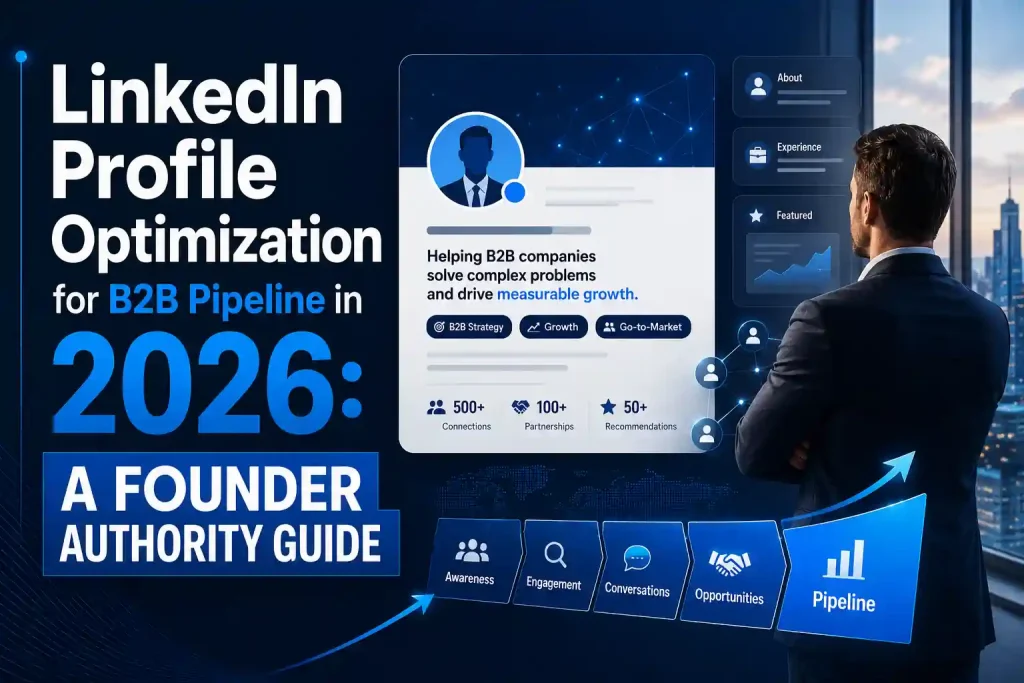
LinkedIn Profile Optimization for B2B Pipeline in 2026: A Founder Authority Guide
Your LinkedIn profile is no longer just a professional bio.
For a B2B founder, SaaS leader, agency owner, consultant, sales leader, or GTM executive, it is a trust checkpoint. A buyer sees your post, receives your cold email, clicks your LinkedIn ad, hears your name in a referral, or finds your company through an AI search result. Then they check your profile.
That moment matters.
If your profile is vague, the buyer leaves with uncertainty. If your profile is clear, relevant, and proof-led, the buyer understands what you do and why it matters. That does not mean every profile visitor will book a meeting. It means your profile stops weakening the buyer journey.
LinkedIn now has more than 1.3 billion members and more than 70 million companies listed, making it one of the most important professional identity surfaces for B2B credibility. At the same time, B2B buying has become more self-directed. Gartner reported in March 2026 that 67% of B2B buyers prefer a rep-free buying experience, and 45% used AI during a recent purchase.
That is the real reason LinkedIn profile optimization matters in 2026.
It is not about looking impressive.
It is about helping the right buyer understand you faster.
What is LinkedIn profile optimization?
LinkedIn profile optimization is the process of improving your profile so it clearly communicates your positioning, expertise, credibility, relevance, and next step to a specific audience.
For B2B leaders, a strong profile should answer five questions quickly:
- Who do you help?
- What business problem do you solve?
- What outcome do you help create?
- Why should a buyer trust you?
- What should they do next?
This is different from traditional resume writing. A resume is usually written for employers. A B2B LinkedIn profile is often read by buyers, partners, investors, candidates, analysts, journalists, and AI-assisted researchers.
A profile optimized for B2B pipeline should not simply list job duties. It should create strategic clarity.
Why does LinkedIn profile optimization matter in 2026?
LinkedIn profile optimization matters in 2026 because buyers now validate people before they validate companies.
A B2B buyer may not reply to your outbound message immediately. But they may click your profile. They may check whether your headline matches your email claim. They may read your About section. They may scan your Featured content. They may see whether your posts show real expertise or generic commentary.
LinkedIn itself describes the profile introduction section as the topmost section of a profile and the first thing members see when they visit. The same section includes fields such as profile photo, background photo, headline, current position, location, industry, and contact information.
That first impression affects trust.
LinkedIn also says a good profile photo increases credibility and helps members stand out, and that members with a profile photo receive up to 2X more profile views. It also recommends rewriting the headline to promote expertise and using the About section to express mission, motivation, and skills.
For B2B teams, this creates a simple operating truth:
A weak profile creates friction.
A clear profile removes friction.
A strong profile creates authority before the first sales conversation.
LinkedIn profile optimization and the new B2B buying journey
The B2B buyer journey is no longer linear.
A buyer might first see your company through:
- A founder post.
- A LinkedIn DM.
- A cold email.
- A Google search.
- A LinkedIn ad.
- A podcast appearance.
- A review platform.
- A Perplexity or ChatGPT answer.
- A colleague’s comment.
- A competitor comparison article.
Then they triangulate.
They check your website. They check your LinkedIn profile. They look for proof. They search your company name. They ask AI tools to compare vendors. They ask peers.
Demand Gen Report, citing G2’s 2026 research, reported that 51% of B2B software buyers now begin their purchasing process in an AI chatbot rather than a traditional search engine. The same report said 83% of buyers felt more confident in their final choice when AI chatbots influenced research.
This does not mean LinkedIn replaces your website.
It means your LinkedIn profile is part of the evidence layer buyers use to form trust.
Google also says SEO best practices remain relevant for AI features such as AI Overviews and AI Mode, and that these experiences rely on indexed content, helpful pages, and links to supporting websites. For B2B teams, the practical lesson is clear: your public authority signals need to be consistent across your website, LinkedIn profile, content, case studies, and third-party mentions.
Your LinkedIn profile is one of those signals.
How does LinkedIn profile optimization work?
LinkedIn profile optimization works by aligning five layers:
| Layer | What it improves | B2B impact |
|---|---|---|
| Positioning | Clarity around who you help and what outcome you support | Buyers understand relevance faster |
| Search visibility | Keywords, entities, skills, role terms, and category language | More relevant discovery inside LinkedIn and search engines |
| Trust | Photo, banner, proof, recommendations, experience, content | Less uncertainty before a meeting |
| Conversion | CTA, Featured section, contact path, calendar link, resource link | Easier next step for interested buyers |
| Authority | Posts, comments, thought leadership, network quality | More recognition before outreach |
Most people optimize only the surface: photo, banner, headline.
That is useful, but incomplete.
A B2B profile should be built around the buyer journey. A buyer does not care whether your headline sounds clever. They care whether you understand their problem.
Quick comparison table: basic profile vs B2B pipeline profile
| Profile element | Basic LinkedIn profile | B2B pipeline-focused profile |
|---|---|---|
| Headline | Job title and company | Audience + problem + outcome + expertise |
| Banner | Generic design or blank | Clear positioning and proof-led message |
| About section | Career summary | Buyer-facing narrative with credibility and CTA |
| Experience | Duties and responsibilities | Business outcomes, market expertise, proof |
| Featured section | Random posts or empty | Case studies, frameworks, lead magnets, founder POV |
| Skills | Broad professional skills | Category, buyer pain, and service-relevant skills |
| Activity | Occasional posting | Consistent authority-building around buyer problems |
| CTA | No next step | Clear low-friction action |
The difference is not cosmetic.
A basic profile says, “Here is my career.”
A B2B pipeline profile says, “Here is the problem I understand, the market I serve, and the proof that I can help.”
The 7-layer LinkedIn profile optimization framework for 2026
1. Start with ICP before profile copy
Before changing your headline, define the buyer.
For B2B SaaS, technology companies, agencies, IT services, and consulting firms, profile clarity starts with ICP clarity.
Ask:
- Which companies do we want to attract?
- Which roles influence the buying decision?
- What problem are they trying to solve?
- What triggers the buying window?
- What language do they use to describe the problem?
- What proof would make them trust us?
- What next step feels useful, not pushy?
This is where many profiles fail.
They try to sound impressive to everyone.
The better approach is to sound relevant to the right buyer.
For example, a generic founder headline might say:
“Founder | Growth Leader | SaaS Enthusiast | Building the Future”
A buyer-first headline might say:
“Helping B2B SaaS teams build qualified pipeline through buyer-signal-led outbound, LinkedIn authority, and GTM systems”
The second version is clearer. It names the audience. It names the outcome. It names the method.
2. Optimize the introduction section for immediate clarity
Your introduction section includes the most visible profile elements: photo, background image, headline, company, location, and contact path. LinkedIn notes that this section is the first thing members see on a profile.
For B2B profile optimization, this section should create fast comprehension.
Profile photo
Use a clear, recent, professional photo. The goal is not corporate stiffness. The goal is recognition and trust.
Best practice:
- Use a high-resolution headshot.
- Keep your face clearly visible.
- Avoid group photos.
- Avoid heavy filters.
- Use a calm background.
- Match the tone of the buyers you serve.
For founders and consultants, the photo should feel approachable and credible. Buyers should feel they are looking at a real operator, not a stock image with a job title.
Banner
Your banner is positioning space.
A strong LinkedIn banner should include:
- Who you help.
- What outcome you support.
- A proof point or category cue.
- A clean visual style.
- Optional website or CTA.
Examples:
For B2B SaaS founder:
“Building AI workflow software for enterprise RevOps teams”
For GTM consultant:
“Helping B2B SaaS companies clarify ICP, messaging, and pipeline strategy”
For IT services firm founder:
“Cloud transformation for mid-market finance and healthcare teams”
For agency founder:
“Qualified pipeline systems for B2B service companies”
Avoid vague banners such as:
- “Think bigger.”
- “Innovation starts here.”
- “Building the future.”
- “Let’s grow together.”
Those lines sound nice, but they do not help a buyer understand fit.
Headline
Your headline should not be a keyword dump.
Use this formula:
I help [specific audience] solve [specific problem] through [specific method or expertise].
Alternative formula:
[Role] helping [ICP] achieve [business outcome] with [method].
Examples:
- “Founder at [Company] | Helping B2B SaaS teams build qualified pipeline through Demand Intelligence”
- “GTM Advisor for B2B SaaS | ICP, messaging, outbound intelligence, and revenue pipeline”
- “Helping IT services firms open enterprise conversations through LinkedIn authority and signal-led outreach”
- “Agency Founder helping B2B brands turn expertise into pipeline through LinkedIn and inbound intelligence”
Use plain language.
Do not stuff the headline with every service you offer.
The best headline gives the buyer a reason to keep reading.
3. Write an About section that sells clarity, not ego
LinkedIn recommends using the About section to express mission, motivation, and skills, ideally in one or two paragraphs, with bullets if helpful.
For B2B leaders, the About section should do more than summarize your career.
It should connect your experience to the buyer’s problem.
A useful structure:
- Start with the buyer problem.
- Explain who you help.
- Describe your method.
- Add proof or credibility.
- Explain what you believe.
- End with a soft CTA.
Example structure:
Opening:
“Most B2B SaaS teams do not have a lead volume problem. They have a buyer clarity problem. They are speaking to too many accounts with too little signal.”
Who you help:
“I work with growth-stage SaaS and technology companies that need more qualified meetings, clearer ICP, and a pipeline system built around real buyer behavior.”
Method:
“My work combines buyer research, outbound intelligence, LinkedIn authority, campaign strategy, and GTM systems.”
Proof:
“Over the last few years, I have worked across SaaS, IT services, and B2B consulting markets where long sales cycles require trust before conversion.”
Belief:
“I believe the best GTM systems start with buyers before channels.”
CTA:
“If you are reviewing your pipeline strategy or founder authority, feel free to connect or send a note.”
This style is direct. It is helpful. It does not overclaim.
4. Turn Experience into proof, not a job description
Most Experience sections read like internal HR records.
That is a missed opportunity.
Your Experience section should show:
- The market you understand.
- The problems you have solved.
- The audience you serve.
- The business outcomes you have influenced.
- The proof that supports your positioning.
Weak version:
“Responsible for growth strategy, marketing campaigns, and sales enablement.”
Better version:
“Led GTM strategy for a B2B SaaS company selling to mid-market revenue teams. Rebuilt ICP definition, messaging, and outbound workflows around buyer signals, helping the sales team focus on accounts with stronger fit and clearer buying triggers.”
The better version gives context.
It explains the business problem.
It connects the role to buyer outcomes.
Use metrics only when they are accurate and defensible. If you cannot verify a number, do not use it. Credibility is stronger than inflated performance language.
5. Use the Featured section as a buyer education shelf
The Featured section should not be random.
It should guide the buyer to proof and next steps.
For B2B founders and revenue leaders, include:
- A flagship guide.
- A case study.
- A founder POV post.
- A webinar.
- A product demo page.
- A comparison article.
- A customer story.
- A strategy call page.
- A relevant newsletter or podcast.
The Featured section should answer:
“What should a serious buyer read next?”
For a SaaS founder, this could be:
- “How we help RevOps teams reduce manual CRM work”
- “Customer story: how [client type] improved reporting accuracy”
- “Guide: choosing a revenue intelligence platform”
- “Book a product walkthrough”
For a consulting founder, it could be:
- “The 2026 GTM audit framework”
- “Case study: repositioning a B2B services firm”
- “Founder perspective on buyer-led pipeline”
- “Request a strategy review”
Do not treat the Featured section as a trophy shelf.
Treat it as a guided path.
6. Build LinkedIn SEO around buyer language
LinkedIn SEO is the process of using relevant words, entities, skills, roles, and category terms so your profile is discoverable for the right searches.
For B2B leaders, the goal is not to appear for every broad term.
The goal is to appear for searches that match your ICP and positioning.
Use keywords in:
- Headline.
- About section.
- Experience.
- Featured content titles.
- Skills.
- Creator topics, if relevant.
- Company page alignment.
- Posts and comments.
For a B2B SaaS growth consultant, terms might include:
- B2B SaaS growth.
- GTM strategy.
- Pipeline generation.
- Demand generation.
- ICP.
- Buyer signals.
- Founder-led sales.
- LinkedIn authority.
- Outbound strategy.
- Revenue growth.
For an IT services founder, terms might include:
- Cloud consulting.
- Digital transformation.
- Enterprise IT services.
- Cybersecurity consulting.
- Application modernization.
- Managed services.
- CIO advisory.
- Enterprise pipeline.
For an agency founder, terms might include:
- B2B lead generation.
- Client acquisition.
- LinkedIn outreach.
- Cold email.
- Demand generation.
- Pipeline strategy.
- Agency growth.
Use these terms naturally.
Do not write like a directory listing.
7. Align profile, content, outreach, and website
A profile is strongest when it matches the rest of your GTM system.
If your outbound email says you help SaaS teams improve pipeline quality, your LinkedIn profile should reinforce that. If your website positions your company around Demand Intelligence, your founder profile should explain what that means. If your LinkedIn content talks about buyer signals, your Featured section should link to a relevant framework or case study.
This matters for human trust and AI visibility.
Google says its generative AI search features use retrieval-augmented generation and query fan-out to gather relevant, up-to-date web pages from its Search index and supporting sources. While no company can force AI engines to cite a LinkedIn profile or website, consistent entity signals help both humans and systems understand who you are, what you do, and where your expertise fits.
LinkedIn profile optimization for AI search visibility
AI search visibility is becoming part of B2B brand discovery.
Buyers ask tools like ChatGPT, Perplexity, Gemini, Claude, and Google AI Mode questions such as:
- “Who are the best B2B lead generation companies for SaaS?”
- “Which consultants help with GTM strategy?”
- “What are alternatives to traditional appointment setting agencies?”
- “Who is known for LinkedIn authority building?”
- “Which agencies help with AI search visibility and outbound?”
Your LinkedIn profile alone will not make you appear in these answers.
But it can support the broader entity footprint.
To make your LinkedIn profile more useful for AI search and answer engines:
- Use a consistent name, company description, and category.
- Describe your expertise in clear terms.
- Link to your website.
- Link to credible resources.
- Publish content around your core topics.
- Earn mentions from reputable sources.
- Keep your public profile updated.
- Align your LinkedIn profile with your website, case studies, and company page.
Google’s official guidance states that AEO and GEO are terms used to describe improving visibility in AI search experiences, but from Google Search’s perspective, optimizing for generative AI search is still part of optimizing for Search overall.
For B2B leaders, that means the fundamentals still matter:
- Helpful content.
- Clear expertise.
- Crawlable pages.
- Consistent entities.
- Strong internal links.
- Relevant external mentions.
- Proof that supports claims.
LinkedIn authority should not sit outside SEO, AEO, and GEO.
It should support them.
What should B2B companies look for in LinkedIn profile optimization?
A B2B company should look for LinkedIn profile optimization that goes deeper than copywriting.
The right profile strategy should include:
| Decision criterion | What to check |
|---|---|
| ICP understanding | Does the profile speak to a real buyer segment? |
| Positioning clarity | Can a visitor understand the value in five seconds? |
| Proof quality | Are claims backed by credible experience, case studies, or outcomes? |
| LinkedIn SEO | Are relevant keywords included naturally? |
| Founder authority | Does the profile support thought leadership and trust? |
| Conversion path | Is there a clear next step? |
| GTM alignment | Does the profile match website, outreach, ads, and content? |
| AI visibility | Are entity signals and expertise clear enough for AI-assisted discovery? |
A profile writing service may be useful for job seekers.
A B2B profile optimization partner should understand buyer psychology, GTM motion, outbound, inbound, and pipeline.
That distinction matters.
How Growleads approaches LinkedIn profile optimization
Growleads treats LinkedIn profile optimization as part of LinkedIn Authority, not as a standalone writing exercise.
Growleads is a B2B Demand Intelligence partner. It helps B2B companies build qualified pipeline by combining Outbound Intelligence, Inbound Intelligence, LinkedIn Authority, GEO/AEO, Google Ads, LinkedIn Ads, cold email, LinkedIn outreach, GTM consulting, AI automations, and GTM agents.
The difference is the starting point.
Growleads does not start with “How do we make the profile sound better?”
It starts with:
- Who is the ICP?
- What buying signals matter?
- What buyer pain is active?
- What market opportunity exists?
- What authority does the founder need to build?
- Which channels support the pipeline system?
- What should buyers understand before they speak to sales?
Then the LinkedIn profile becomes one part of a larger pipeline system.
This is useful for B2B companies that do not want profile views for vanity. They want profile views to support trust, replies, meetings, inbound opportunities, and revenue influence.
For example:
- Cold email performs better when the sender profile looks credible.
- LinkedIn outreach performs better when the profile explains relevance.
- LinkedIn Ads perform better when buyers recognize the founder or company.
- Google Ads convert better when post-click trust is consistent.
- GEO/AEO works better when entity signals are clear across channels.
- GTM agents and automations work better when the underlying buyer data is accurate.
That is why LinkedIn profile optimization should not be isolated from GTM.
It should be connected to Demand Intelligence.
Competitors and alternatives B2B buyers may consider
This article is about LinkedIn profile optimization, but many B2B teams evaluating LinkedIn authority are also evaluating broader pipeline partners, outbound agencies, appointment setting providers, or SDR support.
Here is a neutral view of common alternatives.
| Provider | Known for | Buyer may consider them when | How Growleads is different |
|---|---|---|---|
| Belkins | Appointment setting, cold email outreach, cold calling, LinkedIn lead generation, lead research, and outsourced SDR services. | The company wants a cross-channel appointment setting partner with outbound execution. | Growleads may be a stronger fit when the buyer also needs LinkedIn Authority, inbound intelligence, GEO/AEO, GTM consulting, and buyer-signal-led pipeline strategy under one system. |
| CIENCE | B2B lead generation services and positioning around precision, efficiency, and lead generation results. | The company is comparing established lead generation providers. | Growleads is positioned around Demand Intelligence, combining outbound, inbound, LinkedIn authority, AI visibility, and GTM systems rather than treating pipeline as only a lead generation function. |
| Callbox | AI-assisted B2B lead generation, appointment setting, SDR support, and multi-channel outreach across industries and regions. | The company wants a managed appointment setting or SDR outsourcing model with global reach. | Growleads may be a better fit for companies that want buyer signals, founder authority, AI search visibility, and GTM consulting connected to pipeline generation. |
| Martal | B2B appointment setting that identifies, engages, and qualifies decision-makers against opportunity criteria. | The company wants outsourced appointment setting and sales support. | Growleads is different when the priority is not only booked appointments but a broader Demand Intelligence system covering outbound, inbound, LinkedIn, AI visibility, automation, and GTM strategy. |
| LinkedIn Sales Navigator | A LinkedIn sales tool for finding buyers, growing pipeline, and supporting B2B sales teams. | The company wants internal sellers to identify and engage accounts on LinkedIn. | Growleads is not a tool. It is a partner that can help design and run buyer-led GTM systems, including LinkedIn authority, outreach, ads, content, and intelligence workflows. |
None of these options is universally right or wrong.
The better question is:
“What problem are we solving?”
If the problem is simple appointment volume, an appointment setting provider may be enough.
If the problem is buyer trust, unclear ICP, weak founder authority, low-quality meetings, poor AI visibility, and inconsistent GTM execution, a Demand Intelligence partner may be a stronger fit.
Common mistakes to avoid
Mistake 1: Treating LinkedIn like a resume
A resume is about your history.
A B2B profile is about your relevance.
Your buyer does not need every responsibility you have ever held. They need to know why you understand their problem.
Mistake 2: Writing for peers instead of buyers
Many founders write profiles to impress other founders.
That can create applause, but not pipeline.
Write for the buyer who has budget, urgency, and a problem your company can solve.
Mistake 3: Using vague positioning
Words like “growth,” “innovation,” “transformation,” and “strategy” are not wrong. But alone, they are too broad.
Specificity builds trust.
Say which market you serve. Say which problem you solve. Say which outcome matters.
Mistake 4: Making unsupported claims
Do not use inflated claims that cannot be verified.
A buyer can sense exaggeration. AI systems may also ignore or misrepresent vague claims if they are not supported elsewhere.
Use honest proof.
Mistake 5: Ignoring the Featured section
If a qualified buyer lands on your profile and finds no useful next step, the profile is incomplete.
Give them a guide, case study, framework, or strategy call option.
Mistake 6: Posting without a profile foundation
Content can bring people to your profile.
But if your profile does not explain your positioning, the attention leaks.
Fix the profile before scaling content.
Mistake 7: Optimizing for activity instead of pipeline
Profile views, impressions, and engagement can be useful indicators.
But for B2B teams, the real question is:
Did the profile help create trust, replies, meetings, and pipeline?
Which LinkedIn profile optimization approach is best for different use cases?
| Use case | Best approach |
|---|---|
| Job seeker | Resume-style profile writing with recruiter keywords |
| Freelancer | Clear service positioning, portfolio proof, and direct CTA |
| B2B SaaS founder | Founder authority, buyer-led positioning, product category clarity, proof, and GTM alignment |
| Sales leader | Trust-led profile, customer outcomes, account relevance, and social selling activity |
| Agency founder | Client acquisition positioning, niche clarity, case studies, and inbound/outbound CTA |
| IT services founder | Enterprise credibility, technical authority, industry focus, and buying committee language |
| Consultant | Thought leadership, frameworks, proof, and strong Featured resources |
| Company executive team | Consistent positioning across founder, CEO, CRO, CMO, sales, and delivery leaders |
For B2B SaaS and service companies, the strongest approach is usually not one profile.
It is a profile system.
The founder, sales leaders, subject matter experts, and company page should all reinforce the same market position.
30-day LinkedIn profile optimization plan
Week 1: Buyer and positioning audit
Review:
- ICP.
- Buyer pains.
- Buyer signals.
- Current profile views.
- Current inbound messages.
- Current outbound reply context.
- Website positioning.
- Company page.
- Competitor positioning.
- Founder content themes.
Output:
- New profile positioning.
- Keyword list.
- Buyer message map.
- Proof inventory.
- CTA decision.
Week 2: Profile rebuild
Update:
- Photo.
- Banner.
- Headline.
- About section.
- Experience.
- Featured section.
- Skills.
- Contact information.
- Creator topics, if relevant.
Output:
- Fully updated profile.
- Buyer-facing About section.
- Proof-led Experience.
- Relevant Featured assets.
Week 3: Authority content setup
Build:
- 3–5 core content pillars.
- 10 post ideas.
- 3 founder POV posts.
- 2 case-study-style posts.
- 1 framework post.
- 1 buyer objection post.
Output:
- First month of LinkedIn authority topics.
- Posting rhythm.
- Commenting strategy.
- Network building target list.
Week 4: Pipeline integration
Connect profile to:
- Cold email sender profile.
- LinkedIn outreach sequences.
- LinkedIn Ads retargeting.
- Website author bio.
- Case studies.
- Strategy call page.
- AI visibility content cluster.
- CRM source tracking.
Output:
- Profile connected to GTM system.
- Buyer journey consistency.
- Baseline metrics for future improvement.
How to measure LinkedIn profile optimization
Do not measure only profile views.
Measure:
| Metric | Why it matters |
|---|---|
| Profile views from target ICP | Shows relevant visibility |
| Connection acceptance rate | Shows trust at first touch |
| Reply rate from LinkedIn outreach | Shows message and profile fit |
| Inbound DMs from relevant buyers | Shows authority conversion |
| Strategy calls influenced by LinkedIn | Shows pipeline connection |
| Website visits from LinkedIn | Shows cross-channel movement |
| Featured section clicks | Shows buyer education interest |
| Post engagement from ICP accounts | Shows audience quality |
| Pipeline influenced by founder profile | Shows business impact |
LinkedIn Sales Solutions describes social selling as building relationships with prospects through social networks, using social credibility and relationships to support sales goals. That aligns with how profile optimization should be measured: not as decoration, but as part of relationship-led pipeline generation.
The future of LinkedIn profile optimization
The future of LinkedIn profile optimization is not more polished language.
It is sharper alignment between:
- Buyer signals.
- Founder authority.
- LinkedIn SEO.
- AI search visibility.
- Thought leadership.
- Outbound trust.
- Inbound demand.
- GTM automation.
- Qualified pipeline.
Salesforce reported in 2026 that 54% of sellers have used AI agents, and nearly nine in ten plan to by 2027. Sellers expect agents to reduce prospect research time and email drafting time once fully implemented. HubSpot’s 2026 State of Marketing also emphasizes that AI is now a baseline, while brand point of view, trust, and human-led marketing are becoming more important differentiators.
That means buyers will see more automated outreach, more AI-written posts, and more average content.
The profiles that stand out will be the ones that show real expertise.
Not louder language.
Better clarity.
Better proof.
Better buyer understanding.
A LinkedIn profile shouldn’t exist in isolation.
It should reinforce your website, outbound campaigns, content, AI visibility, and overall market positioning.
Growleads helps B2B companies align every buyer touchpoint into one GTM system built for predictable pipeline growth.
FAQs
1. What is LinkedIn profile optimization?
LinkedIn profile optimization is the process of improving your profile so the right audience can understand your expertise, credibility, and next step quickly. For B2B leaders, it includes headline positioning, banner messaging, About section clarity, proof-led Experience, Featured resources, LinkedIn SEO, and authority-building content. The goal is not just better presentation. The goal is buyer trust, discoverability, and pipeline support.
2. Why is LinkedIn profile optimization important for B2B companies in 2026?
It matters because buyers now research people before they engage with companies. They check founder profiles, sales profiles, company pages, case studies, websites, and AI-generated answers. If your LinkedIn profile is unclear, it can weaken trust. If it is clear and proof-led, it supports outbound replies, inbound conversations, founder authority, and qualified pipeline.
3. What should a B2B founder include in a LinkedIn headline?
A B2B founder should include the audience they help, the problem they solve, the outcome they support, and the method or category they are known for. A strong format is: “Helping [ICP] achieve [outcome] through [method].” For example: “Helping B2B SaaS teams build qualified pipeline through buyer-signal-led GTM systems.”
4. How do keywords improve LinkedIn profile optimization?
Keywords help LinkedIn and external search engines understand your expertise. Add relevant terms naturally in your headline, About section, Experience, Skills, Featured content, and posts. For B2B leaders, useful keywords may include ICP, GTM strategy, pipeline generation, LinkedIn authority, outbound intelligence, inbound intelligence, cold email, LinkedIn outreach, and demand generation.
5. Is LinkedIn profile optimization the same as personal branding?
No. Personal branding is broader. It includes your reputation, content, relationships, speaking, media mentions, and market recognition. LinkedIn profile optimization is one part of that system. It creates the foundation buyers see when they visit your profile. For B2B founders, the strongest approach combines profile optimization, thought leadership, network building, and GTM alignment.
6. Can LinkedIn profile optimization help with lead generation?
Yes, but it should not be treated as a standalone lead generation tactic. A strong profile can improve trust after outbound messages, increase relevant inbound DMs, support founder-led content, and help buyers understand fit faster. Growleads connects LinkedIn Authority with Outbound Intelligence, Inbound Intelligence, and GTM systems so profile visibility supports qualified pipeline, not just attention.
7. What are the most important LinkedIn profile sections to optimize?
The highest-impact sections are the profile photo, banner, headline, About section, Experience, Featured section, Skills, and recent activity. For B2B leaders, the headline and banner create fast clarity. The About section explains positioning. Experience proves credibility. Featured content gives buyers a next step. Activity shows whether the person has real expertise.
8. How often should a LinkedIn profile be updated?
A B2B LinkedIn profile should be reviewed at least quarterly, or whenever your ICP, offer, positioning, case studies, target market, or GTM strategy changes. Profiles should also be updated before a major outbound campaign, founder-led content push, LinkedIn Ads campaign, fundraising process, hiring push, or product launch.

Builds the demand intelligence, automation, and deliverability systems behind Growleads pipeline.