The Ultimate Guide to Sales Management Software for High-Converting Leads

Sales representatives spend only ⅓ of their time actively selling – a surprising fact that many don’t know. Your team’s reality can reshape the scene with the best sales management software examples. Companies lose $1 trillion each year because of lost productivity and poorly managed leads, despite hiring talented salespeople.
Your team’s efficiency improves by a lot when sales management software automates repetitive tasks and streamlines lead handling. High-performing companies use automated sales processes twice as much as underperforming ones. The sales management systems also offer powerful reporting features that help forecast earnings, set goals, and spot new opportunities.
This piece will show you the most effective sales team management software to convert leads into customers. We’ll help you pick sales management tools that match your business needs, covering everything from automated lead routing to top solutions like Salesforce and HubSpot.
Understanding the sales management process
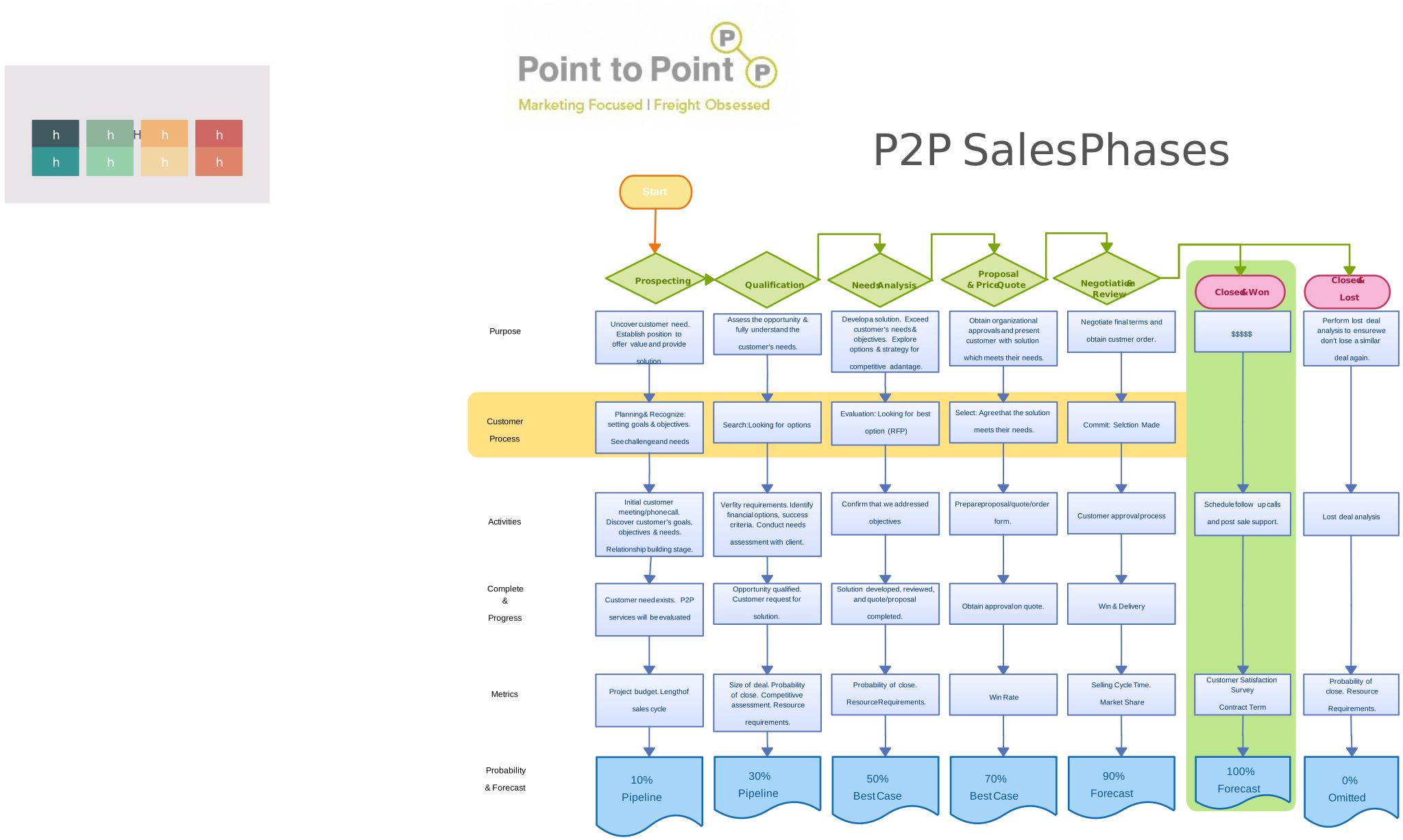
Image Source: Creately
A customer’s trip from prospect to buyer follows a clear path that you can optimize with the right tools. A working sales management process has skilled teams, goal setting, strategy development, lead management, forecasting, and reporting. These elements revolve around people, performance, process, and planning. You need to understand this process to implement sales management software that helps your team turn leads into customers.
Stages of the sales funnel
The sales funnel shows how prospects move from first contact to purchase. We call it a “funnel” because potential customers get filtered out at each step, leaving only the right fits for your product.
These six stages make up most sales funnels:
- Awareness: Prospects find your company and learn you exist. Marketing efforts like blog posts, social media updates, and paid advertising play a big role at this widest part of the funnel.
- Interest: Customers start learning about what you offer. They look at your website, read blogs, and check customer reviews.
- Evaluation: Prospects ask specific questions once they know more. They might reach out to your customer service team or ask for details.
- Negotiation/Decision: Your prospect is ready to buy and starts talking about terms or pricing. They show clear intent to purchase.
- Sale: The deal closes after agreeing on terms and receiving payment.
- Renewal/Repurchase: The final stage focuses on keeping customers coming back.
Where sales management software fits in
Sales management software works as your team’s operating system. It combines CRM features, calling tools, email automation, lead management, and reporting in one place. These systems create a framework for sales activities throughout the funnel.
The software helps find promising leads through automated scoring and assignment during prospecting. It lets you send tailored messages to keep prospects interested during nurturing. Your team can access vital customer information when handling objections.
Modern sales management systems make work easier at every stage:
- They qualify leads using automated scoring based on email engagement, marketing content views, lead source, and deal size.
- They learn prospects’ needs by matching the right leads with the right sales reps.
- They help address problems by showing relevant customer details when needed.
- They support solution presentation by tracking customer interactions.
- They help with value selling by showing competitive insights and product differences.
- They make negotiation and closing better with clear pricing and guided selling.
Common challenges without a system
Teams face big revenue problems without good sales management software. To cite an instance, 72% of social sellers who use social media hit their sales quota – but many reps don’t fully use social selling.
Harvard Business Review reports that sales reps feel technology hasn’t made their job easier or cheaper – it’s just one more thing to learn. This creates a challenge as companies want sales teams to be more productive and grow revenue at the same time.
B2B sales cycles have grown more complex, which adds more problems. Companies struggle with scattered, outdated, or wrong data. Teams waste time entering information into multiple systems, and often can’t use the data because it sits in different places.
Other common problems without proper systems include:
- Poor time management – Sales pros spend too much time on paperwork instead of selling.
- Inadequate lead prioritization – Teams waste effort on weak prospects without automated scoring.
- Slow response times – Manual work slows follow-ups, letting competitors get there first.
- Difficulty in tracking sales metrics – Teams can’t easily check performance or find ways to improve.
- Inconsistent sales processes – Each rep does things their own way, making it hard to coach and grow.
Sales optimization becomes nearly impossible without systems that collect, analyze, and show useful sales data. B2B sales cycles keep getting more complex, and sales management software becomes more important. This is especially true since 72% of B2B buyers have completed major deals through digital channels.
Key benefits of using sales management tools
Sales management tools give teams a huge competitive edge. A properly implemented sales management system changes how teams work. It removes inefficiencies and helps teams focus on what really counts, closing deals and building customer relationships.
Improved team productivity
Sales representatives spend only about one-third of their time selling. Administrative tasks, data entry, and follow-up coordination eat up the rest. Sales management software naturally balances this by automating repeated tasks and simplifying processes.
Good sales management tools help your team eliminate boring administrative work that kills productivity. To name just one example, automated task management lets your representatives create and assign tasks with deadlines. This ensures everyone focuses on activities that matter most.
Sales management software puts all customer information in one place that’s available to everyone, creating a single source of truth. Your team wastes less time searching for information and spends more time using it to close deals. Representatives can quickly address customer needs when they see critical data in dashboards and cases instead of searching through scattered records.
Today’s systems also aid team selling by connecting members through built-in communication tools. Another team member can naturally take over with full context of previous interactions if someone is unavailable. Sales conversations keep moving forward and opportunities don’t get stuck.
Better lead prioritization
Sales teams waste valuable time chasing low-potential prospects without proper prioritization. Sales management systems fix this through advanced lead scoring and prioritization capabilities.
Good sales management software helps your team:
- Identify and focus on leads most likely to convert
- Score leads automatically based on engagement metrics and firmographic data
- Create segments based on demographics and purchase history for targeted campaigns
- Send leads to the right representatives based on territory, expertise, or workload
Companies that use sales automation, including sophisticated lead routing systems, see an average 30% increase in conversion rates. This happens mainly because high-potential leads get immediate attention from the most qualified team members.
Faster response times
Quick responses drive sales success. Research shows you’re 100 times more likely to connect and convert leads if you respond within five minutes versus waiting 30 minutes. Yet B2B sales teams take 42 hours on average to respond to new leads.
Sales management tools solve this problem with live notifications and automated follow-up systems. Time-to-reply analytics track response metrics and show countdown timers right in team members’ inboxes. This creates accountability for meeting service agreements. Some systems alert users when response targets might be missed, which helps employees maintain consistent service standards.
Results prove this works, companies using response time optimization tools have improved their responsiveness from 62% to 86%.
Stronger customer relationships
Sales management software builds stronger, more profitable customer relationships through personalized interactions and steady communication.
Teams can spot cross-selling and upselling opportunities by understanding customer history and priorities. Sales Optimizer uses AI to suggest highly personalized cross-sell recommendations based on similar customers’ purchase histories. This personalization grows average deal size without disrupting existing processes.
Sales management systems make sure no customer gets forgotten. Team members can continue conversations smoothly when client progress notes are in one place, so customers don’t repeat information. Your entire team can connect with clients more personally, which shortens sales cycles and makes customers happier.
These combined benefits show how sales management tools provide the foundation for steady revenue growth while making customers’ experiences better.
Essential features of modern sales team management software
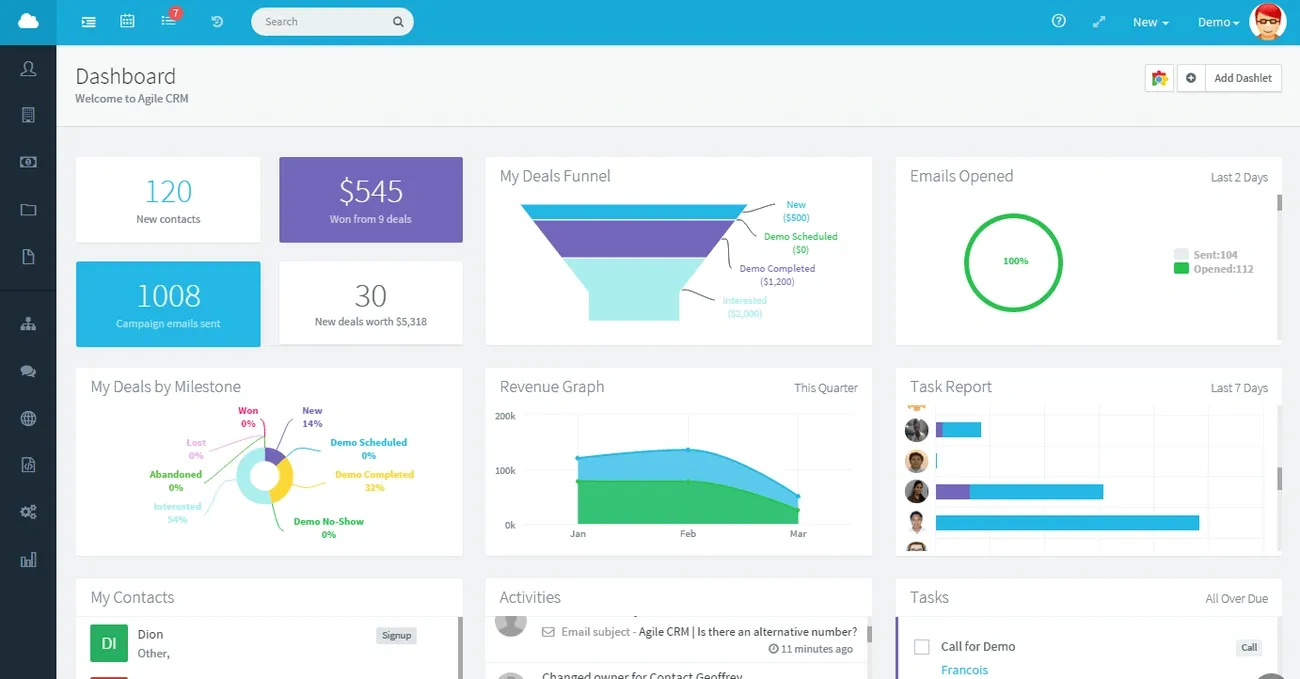
Image Source: www.agilecrm.com
Sales teams need the right software to perform at their best. The best sales management tools come with key features that help teams work better and close more deals.
Lead scoring and routing
Smart lead management starts with getting priorities right. Lead scoring gives each prospect a number based on specific criteria, which helps teams focus on the most promising leads. Today’s sales management systems assess leads automatically by looking at:
- Engagement metrics (email opens, marketing collateral views)
- Firmographic data (company size, industry)
- Behavioral signals (website visits, form submissions)
Your best leads should reach the right sales reps quickly. Automated lead routing distributes qualified prospects through round-robin systems that share leads fairly while keeping specialization in mind. Companies that use this automation see their conversion rates jump by 30% on average.
Customizable workflows
Teams save valuable selling time when they automate repetitive tasks. HubSpot research shows that 61% of businesses that make use of sales automation beat their revenue goals.
Modern sales tools let you build workflows that match your exact needs. To name just one example, see how you can create a workflow that adds contacts from a specific form submission, sends them a marketing email, and assigns them to a sales rep automatically. Your team won’t need to change how they work – the software adapts to them instead.
Real-time collaboration
Sales teams need smooth teamwork no matter where they are. Real-time collaboration features let team members share information, check progress, and exchange ideas easily.
Teams work in shared spaces where they can see sales strategies and decide next steps quickly. These collaborative spaces remove barriers between sales, marketing, and other teams. Quick decisions speed up your sales cycle and tasks get done faster through simplified processes.
Mobile access and remote selling
Forrester’s research shows 29% of the global workforce are “anytime, anywhere information workers” who use multiple devices in different locations. Top sales teams are four times more likely to use mobile sales apps than lower performers.
Good sales management systems offer strong mobile features like:
- Offline capabilities for presenting without internet access
- Quick access to customer information and product details
- Built-in caller ID that matches incoming calls with contacts
- Voice note-taking for hands-free documentation
These tools keep your team productive anywhere, which matters since two-thirds of people want to work from home.
Security and compliance
A reliable security system protects your sensitive data. Modern sales platforms use multiple security layers with end-to-end encryption and role-based access controls. This matters because 74% of data breaches happen due to human error.
The best platforms also help you follow regulations like GDPR and CCPA with built-in data governance tools and automated compliance reports. Businesses in regulated industries don’t just want these features – they need them to operate legally and keep customer trust.
Best sales management software for different use cases
Your organization’s size and specific needs play a big role in picking the right sales management software. Different systems work better for different business situations.
For small businesses: Less Annoying CRM, Vtiger
Small businesses do well with simple, budget-friendly sales management tools. Less Annoying CRM keeps things simple with a USD 15.00 per user per month price tag without hidden costs or long contracts. Teams new to CRM systems love its user-friendly design, giving it a 4.9/5 rating. You can try Less Annoying CRM free for 30 days without entering credit card details.
Vtiger gives you another great option with better customization features. Its ease of use rating sits at 4.2/5, but it makes up for this with powerful features that combine sales, marketing, and support in one platform. Users love its “fantastic user interface, great functionality and integrations with Google calendar”.
For growing teams: Pipedrive, Freshsales
Visual pipeline management becomes crucial as your business grows. Pipedrive shines with its kanban-style dashboard that shows your sales funnel and deal progress clearly. You can choose from five plans ranging from USD 14.00 to USD 99.00 per user monthly as your team expands.
Freshsales gives you “robust capabilities, transparent pricing, and dedicated support at budget-friendly plans”. Every plan comes with built-in email, phone, and chat – no expensive add-ons needed. Its AI assistant, Freddy, spots valuable leads and deals while it creates personalized emails and predicts sales accurately.
For enterprise: Salesforce, HubSpot
Big organizations need advanced sales management systems they can customize extensively. Salesforce tops this category with its customizable AI-powered sales CRM and strong security features. Companies using Salesforce get 129% more leads, close 36% more deals, and improve ticket closure rates by 37%.
HubSpot meets enterprise needs with its complete platform solution. Unlike Salesforce’s separate modules, HubSpot puts marketing, sales, service, and operations in one place. Every department can access customer information instantly. HubSpot connects with 1600+ apps smoothly, and you can set it up in about 36 days.
For automation: Close, ActiveCampaign
Some businesses want to streamline their processes through automation. Close CRM helps “scaling sales teams conducting high volume outreach” with its straightforward, visual approach to sales management. Teams can see all active opportunities in its Powerful Pipeline View and focus on what matters most.
ActiveCampaign combines CRM with advanced marketing automation. You get tools for multi-channel communication, email campaigns, and lead nurturing. The platform lets you build workflows using a visual drag-and-drop tool, and its AI features help with predictive sending and content optimization. ActiveCampaign dominates the Sales Force Automation category with a 14.59% market share compared to Close’s 0.03%.
How to evaluate and compare sales management systems

Image Source: Discover CRM
Sales management systems represent a major business investment that needs a full picture of multiple dimensions rather than vendor promises alone. A well-laid-out approach will help you find the solution that matches your team’s needs.
Feature checklist
Your specific requirements need documentation before you get into sales management software examples. Create a complete checklist that covers:
Sales automation capabilities – Learn how the solution auto-populates records, maintains contact data accuracy, and streamlines processes.
Lead management functionality – Check built-in features that automate prospect outreach, lead qualification, and nurturing.
Workflow automation – The system should automate workflows throughout the customer experience. You need to know what skills customization requires.
Integration capabilities – Think about how the solution connects with your existing applications and data sources. Map out these integrations first because a system that won’t sync with essential tools creates more problems than it solves.
Trial periods and demos
Software trials before purchase make a huge difference in today’s market. Studies show 65% of users buy more often after trying a free trial or demo. Each option serves a unique purpose:
Demos show functionality in ground scenarios and help businesses tackle unique customer challenges. Products with higher annual contract values (over $1,000) often work better with demos.
Trials let you assess independently without spending money. Check if vendors provide opt-in trials (no credit card needed) or opt-out trials (billing starts after trial period).
The best approach combines both – demos educate prospects first, followed by hands-on trial access.
Customer support and onboarding
Support availability determines implementation success. Before you commit:
Check response times and expertise across support channels. Find out if extended phone support comes included or costs extra.
Look at onboarding resources including implementation timelines, training materials, and migration support. Note that successful CRM implementation needs planning and effective change management.
Find “super users” in your organization who can drive adoption. This approach works well in large-scale implementations.
User reviews and case studies
First-hand accounts are a great way to get ground performance insights. Beyond vendor demos, reach out to businesses like yours that use the software.
Read detailed case studies about implementation processes and results. To cite an instance, one organization boosted user adoption from 23% to 90% within four months after moving to a unified CRM platform.
Focus on specific benefits mentioned in reviews like “knowing how to create and incorporate custom properties without administrator involvement” or “connected right from the marketing dashboard for easy toggling”.
Tips for successful adoption and long-term success
Sales management software success depends on more than just picking the right features. Your organization needs careful planning and dedication from everyone involved. The best sales management tools can fail if people don’t adopt them properly.
Involve your sales team early
Sales teams often resist new software because of poor rollout rather than system issues. Your sales department should be part of the adoption process from day one. Having senior sales staff support creates natural advocates for team members who might resist change. Instead of forcing new technology, create pilot groups with tech-savvy team members who can later help their colleagues learn the system.
Your team will listen more to their peers’ positive experiences than to managers who rarely use the product. Some companies let selected sales representatives help choose the software. This builds trust and acceptance before the final decision.
Set clear goals and KPIs
Success needs specific, measurable goals and key performance indicators to track progress. Your sales KPIs must align with your company’s broader objectives. Teams can’t reach their full potential without clear targets to aim for.
Focus on quick wins while keeping sight of bigger goals. Your team stays motivated through small victories as they work toward larger achievements. Everyone maintains focus and direction when they value shared outcomes and see how their work matters.
Review and optimize regularly
Sales optimization needs constant attention. Analytical insights help improve current work and future performance. Regular checks of your sales processes, tools, and metrics will show where you can make things better.
Check adoption rates to see if your team uses the system well. Low usage means it’s time to review and improve best practices.
Encourage feedback and iteration
Sales process development works best as an ongoing experience, not a one-time project. Create ways for sales representatives to share their thoughts and ideas. Companies can spot problems in the customer experience and make processes smoother by analyzing this feedback.
Good communication helps catch issues early and lets your team solve problems together. Beyond just collecting feedback, use what you learn to make improvements in each new version of your process.
Conclusion
Sales management software is a vital investment for teams that want to maximize lead conversion and stimulate revenue growth. This piece shows how these powerful tools change the sales process from original lead capture through final conversion and beyond. Teams with the right software spend more time selling and less time on administrative tasks. This addresses one of the biggest efficiency problems in sales.
These effective sales management systems create structure throughout the sales funnel. They qualify leads automatically, route prospects to appropriate team members, and provide significant information right when needed. The benefits go way beyond simple organization. These tools substantially improve productivity, enable better lead prioritization, speed up response times, and build stronger customer relationships.
Your specific business context determines the right solution. Small businesses might find Less Annoying CRM or Vtiger perfect for their needs. Growing teams often do well with Pipedrive or Freshsales. Enterprise organizations need Salesforce or HubSpot’s robust capabilities, while automation-focused teams prefer Close or ActiveCampaign.
Many companies invest in sales management software, but success depends on proper implementation. Early team involvement, clear goals, regular optimization, and continuous feedback separate a transformative tool from an expensive mistake. Teams that follow these best practices see shorter sales cycles, higher conversion rates, and more predictable revenue growth.
The digital world will keep evolving, but one truth stays constant. Teams that utilize evidence-based insights and simplified processes consistently outperform those using manual methods. The right sales management software doesn’t just organize information – it amplifies your team’s natural abilities and creates space to build relationships that stimulate business growth.
Boost your lead conversion with GrowLeads.io‘s ultimate software guide today!
FAQs
Q1. What are the key benefits of using sales management software?
Sales management software improves team productivity, enables better lead prioritization, speeds up response times, and helps build stronger customer relationships. It automates repetitive tasks, centralizes customer information, and provides powerful reporting capabilities.
Q2. How does sales management software fit into the sales process?
Sales management software serves as the operating system for sales teams throughout the entire sales funnel. It helps qualify leads, assign prospects to appropriate representatives, provide crucial customer information, track interactions, and optimize negotiation and closing processes.
Q3. What essential features should I look for in modern sales management software?
Key features to consider include lead scoring and routing, customizable workflows, real-time collaboration tools, mobile access for remote selling, and robust security and compliance measures. These features help streamline operations and drive conversions.
Q4. How do I choose the right sales management software for my business?
Select software based on your business size and specific needs. Create a feature checklist, take advantage of trial periods and demos, evaluate customer support and onboarding processes, and read user reviews and case studies. Consider options like Less Annoying CRM for small businesses, Pipedrive for growing teams, or Salesforce for enterprise-level needs.
Q5. What are some tips for successful adoption of sales management software?
Involve your sales team early in the process, set clear goals and KPIs, regularly review and optimize your use of the software, and encourage feedback and iteration. Treat the implementation as an ongoing journey rather than a one-time project to ensure long-term success.

Runs the sales process, lead qualification, and client delivery that turn signals into qualified meetings.