B2B SaaS Marketing Strategies That Drive Growth in 2026

SaaS marketing strategies play a significant role in a market projected to surge from $327.74 billion in 2023 to an impressive $1.08 trillion by 2030. The U.S. alone hosts about 17,000 Software-as-a-Service companies, making it clear that generic approaches won’t help you stand out in this competitive digital world.
The right b2b saas marketing strategies can dramatically affect your bottom line. A 25% boost in user activation leads to a 34% increase in Monthly Recurring Revenue over a year. Marketing teams report that account-based marketing yields stronger ROI than other approaches 87% of the time. These numbers represent tested b2b saas marketing tactics that deliver measurable results.
Our team has put together the most effective b2b saas marketing strategy elements that stimulate growth. These approaches deal with the unique challenges of the SaaS business model, from brand message clarity to customer experience optimization. Tech marketers rely heavily on case studies – 82% use them regularly. Companies that maintain active blogs see 55% more website traffic. You can put these practical insights to work right away.
Clarify Your Brand and Messaging
B2B SaaS companies know that clear brand messaging goes beyond marketing, it’s the bedrock of lasting growth. Product features certainly matter. The way you state your value proposition at the time determines if prospects become paying customers. Let’s see how you can create messaging that strikes a chord with your audience and moves your b2b saas marketing strategy forward.
Define your brand promise and positioning
A brand promise acts as a contract between your company and customers. This clear commitment holds you accountable. It’s more than just a tagline. Your value proposition’s essence boils down to a simple statement that builds confidence and sets expectations. Your customers should find your brand promise “MUSIC” to their ears: memorable, unique, simple, inspiring, and credible.
Your SaaS product’s market position shows why it’s the ideal choice for specific users. Seth Godin puts it well: “If you try to please everyone, you’ll end up pleasing no one”. The most effective b2b saas marketing strategies narrow their focus to own a category.
The “Best, Better, Only” framework helps develop strong positioning:
- Best: What does your product do so well that customers keep coming back?
- Better: What can you do substantially better than competitors?
- Only: What can only your company do that no competitor can copy?
Your unique advantages should shape a positioning statement that defines what you do, who you serve, and why you matter. This statement becomes the base to arrange your pricing model, go-to-market approach, and product roadmap.
Create messaging frameworks for different personas
A messaging framework organizes value propositions to speak directly to stakeholders in the buying process. Research shows 88% of customers expect brands to show clear and strong values. About 93% of high-performing marketers make sure their external messaging reflects their company’s values.
Start by identifying your unique value propositions (UVPs) based on tools to your audience’s problems. Pick the top three to five value props your company offers. This forces you to focus your positioning and communicate key advantages. Each value proposition needs supporting “reasons to believe” that show how your solution helps customers.
Note that different personas have different priorities. Your product’s user (Persona 1) might care about productivity and an easier workday. Their supervisor (Persona 2) wants recognition from bosses and needs team approval. Executive decision-makers (Persona 3) focus on ROI and reducing risks.
Voice-of-customer (VOC) research plays a significant role here. This process reveals customer needs in their own words that you can add to your messaging. Their terminology helps you connect with prospective customers’ emotional decision-making centers.
Arrange internal teams with external communication
Mixed signals emerge when internal communications and external messaging don’t match. This undermines your brand’s trust. A unified message helps you appear genuine, this matters since 88% of customers say authenticity shapes their brand choices.
Your brand identity elements need agreement first, your story, values, vision, mission, unique value proposition, and key messages. These practical strategies can help:
- Form a communication guild with members from different departments to share best practices and set common goals.
- Centralize your message by creating an integrated communications calendar and keeping messaging available to all teams.
- Use the same visual elements (colors, fonts, images) and tone in both internal and external communications.
- Make use of regular team meetings like monthly all-hands to remind employees about brand guidelines and consistent communication’s value.
This alignment brings real benefits. Employees who understand external communications better grasp their role in keeping brand promises. More so, new products or features launch smoothly when employees learn about them first. This reveals concepts customers might find challenging.
These saas b2b marketing approaches create a unified brand identity that strikes a chord with customers and builds trust, vital elements to any successful b2b saas marketing strategy. Strong positioning, persona-specific messaging frameworks, and matched communications lay the groundwork to all your future marketing initiatives.
Map the Full B2B SaaS Buyer Journey
B2B SaaS purchases rarely follow a simple path. Unlike B2C deals, B2B decisions need multiple stakeholders with different priorities and levels of influence. You need to understand how organizations make decisions to map your B2B SaaS marketing strategies effectively.
Understanding multi-stakeholder decision-making
Single decision-maker sales don’t exist anymore in the B2B SaaS world. Research shows that a typical buying group for a complex B2B solution needs 6-10 decision-makers. Each person comes with 4-5 pieces of information they gathered on their own. This setup creates a tough challenge for marketers who want to shape the purchasing process.
Each stakeholder brings their own concerns:
- Economic Buyer – Signs off on final decisions and cares about ROI, business effects, and risk assessment
- User Buyer – Looks at hands-on features and how the solution fits into daily work
- Technical Buyer – Checks if it’s doable, compatible, and better than alternatives (can’t say “yes” but can definitely say “no”)
- Coach – Your champion inside who helps you navigate the organization’s process
The challenge grows because 83% of the time these people have already gathered information before any group talks begin. Your B2B SaaS marketing strategy must reach stakeholders both as individuals and as a group.
Tailoring content for each stage of the funnel
B2B SaaS marketing works best when you know different stages need different content. Your main goal should be removing friction throughout this experience.
Marketing experts suggest splitting your content this way: 50% for awareness (“Why change?”), 30% for consideration (“Why you?”), 15% for decision (“Why now?”), and 5% for retention and advocacy (“Why continue?”).
Prospects first try to define their problems and tools. They need educational blogs, whitepapers, and infographics that outline challenges. Moving forward, they review options through webinars, case studies, and ROI calculators that show your value.
Decision stage buyers need content that speeds up conversions. Demos, free trials, and competitor comparisons work really well here. After purchase, your content should show ongoing value and turn customers into supporters.
Addressing both user and economic buyer needs
User buyers and economic buyers care about different things, even though they work for the same company. Economic buyers look at big picture effects: Will revenue go up? Can we cut costs? Will margins improve? Can we enter new markets?
User buyers focus on their daily work, they want to know how they’ll use your solution and who it will help. This explains why 74% of customers get frustrated with irrelevant content.
Your B2B SaaS marketing strategy should have separate tracks to bridge this gap. Give user buyers details about easy setup, training, and feature improvements. Show economic buyers ROI numbers, case studies with clear results, and ways to reduce risk.
Note that the B2B SaaS experience isn’t straight forward anymore. Modern data shows that prospects don’t move smoothly from awareness to purchase. They jump between stages, go back to earlier steps, and bring in new stakeholders at random times. Your SaaS marketing strategies should be flexible enough to handle these patterns while guiding prospects toward buying.
Create Value-Led Content That Converts
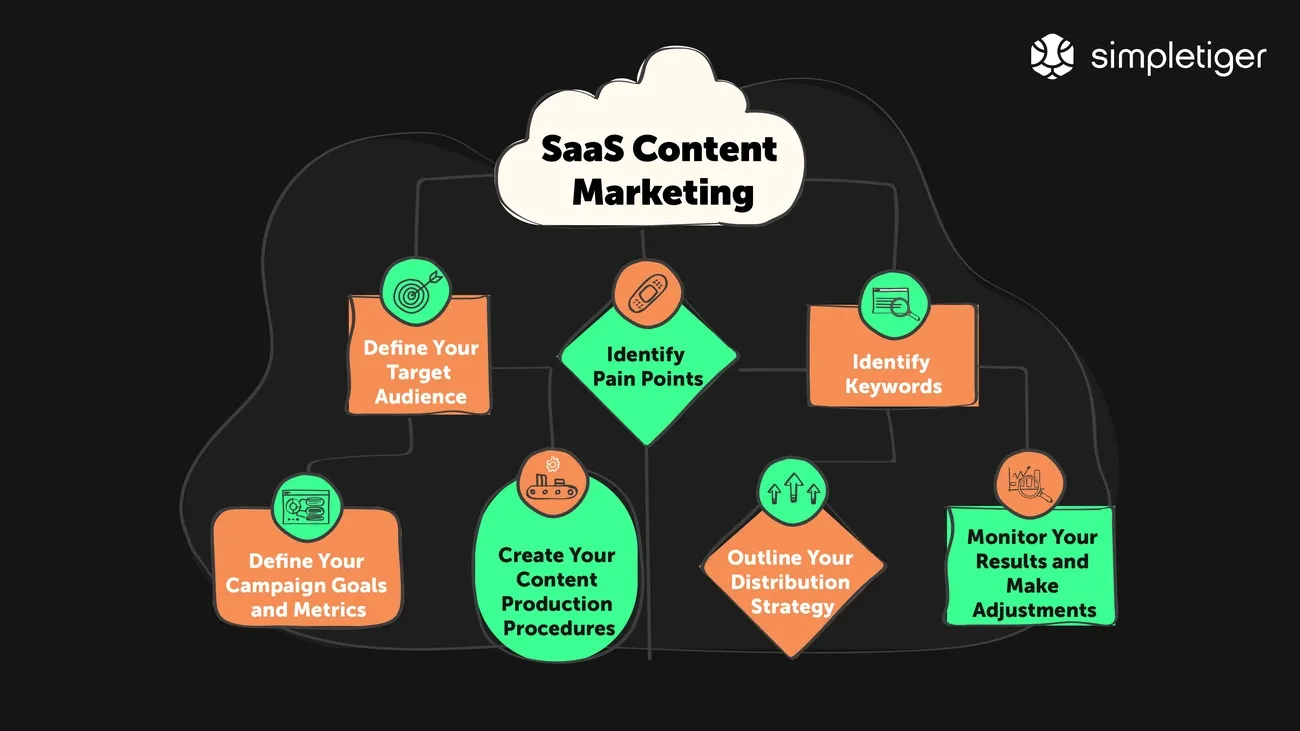
Image Source: SaaS Marketing Agency Driving Predictable Growth
Content rules supreme in the B2B SaaS world, but quality matters more than quantity. Successful b2b saas marketing delivers valuable information that solves specific challenges, builds credibility, and supports prospects throughout their buying experience.
Educational content vs. promotional content
The balance between educational and promotional content can significantly affect your conversion rates. B2B buyers heavily rely on content – 49% use it to evaluate potential tools. Your brand becomes a trusted advisor rather than just another vendor when you focus on education instead of hard selling.
Educational content shows your expertise while helping prospects understand their challenges. This approach builds credibility and serves as the life-blood of successful saas b2b marketing. To cite an instance, see how high-quality content establishes expertise by:
- Earning backlinks and boosting domain authority
- Improving SEO performance
- Becoming a trusted resource during the buying process
Promotional content still holds value. The magic lies in the ratio, experts suggest that 80% of your content should educate while 20% can promote. This mix gives your audience real value while highlighting your solution’s benefits.
Using storytelling in customer success stories
Stories make an impact 22 times more than facts alone. This explains why 78% of marketers rate case studies and customer stories as their most effective content formats. Customer success stories work best with a three-part narrative structure:
Problem: Start with a challenge your prospects face daily. The issue should grab attention and create an emotional bond.
Solution: Make your product the hero without drowning readers in technical details. Show how it solved the customer’s specific needs rather than listing features.
Results: Include both numbers (revenue growth, improved efficiency) and quality measures (better satisfaction, team spirit). This gives a complete picture of your solution’s worth.
B2b saas marketing strategy needs authentic connections that numbers alone can’t create. One expert puts it well: “While the rest of the world is telling tales of features and functions, telling compelling customer stories is now a differentiator that will move the needle”.
Repurposing content across formats
Content repurposing offers one of the quickest ways to improve b2b saas marketing strategies. Marketing teams agree – 42% say repurposing leads to better content marketing results. Transforming existing pieces into different formats helps you:
- Connect with audiences on different platforms based on their priorities
- Create more content without starting fresh
- Drive home key messages for better retention
- Improve SEO by targeting different keywords
Repurposing means more than just reposting similar content. Each piece needs thoughtful adaptation for different contexts. Client testimonials can become remarketing content, product data can turn into infographics, and how-to articles can become video tutorials.
B2B SaaS companies find success by turning blog posts into podcast episodes, converting eBooks into blog series, and creating short video clips from longer webinars. Each version should match the platform and audience.
These value-focused content approaches in your b2b saas marketing strategy create meaningful connections with prospects while making the most of your content investment. The goal extends beyond getting attention, it builds trust needed for conversion and lasting relationships.
Adopt Scalable Growth Channels
Your SaaS business needs a green growth engine. This requires smart marketing channel choices that bring quick wins and lasting benefits. The perfect channel mix can speed up your growth and create lasting returns.
SEO and content marketing for long-term ROI
Search Engine Optimization is the life-blood of green B2B SaaS marketing strategies. The data tells a clear story. Google drives 63.41% of all US web traffic to websites. Bing follows with 7.21%. This makes organic search crucial to attract qualified prospects.
SEO’s power in SaaS marketing comes from its compound effect. Paid advertising stops working when you stop spending. In fact, companies generate two times more revenue from organic search traffic compared to social media and other sources.
The biggest problem? SEO needs time. Most B2B companies quit too soon, within 2-3 months, before results show up. The data shows clear timelines:
- 6-9 months to most important ROI for businesses that are 50+ domain authority old
- 9-12+ months to most important ROI for new businesses or competitive industries
Success comes only when we are willing to spot early signs beyond revenue. These include better rankings, quality backlinks, and Search Console impression growth. These signs usually come 2-3 months before traffic increases.
Paid media for short-term wins
Paid advertising delivers fast visibility and leads when quick results matter. Pay-Per-Click (PPC) advertising lets you target specific audiences based on their behaviors, interests, and demographics. We used this approach to drive big traffic numbers quickly.
All the same, paid media works best with smart implementation. Many B2B SaaS marketing teams think they’ve optimized their PPC programs. The truth? They’re making expensive mistakes. To cite an instance, campaigns waste money on low-quality prospects without proper lead scoring.
Your B2B SaaS marketing strategy needs these paid media optimizations:
- Set up precise tracking and lead scoring in your CRM
- Target key stakeholders with custom messages
- Test intellectual influence ad formats that have tested results
- Look for new ways to improve campaigns
Note that paid advertising should add to your organic efforts, not replace them. One expert says it best: “SEO and content marketing are the most budget-friendly marketing tools for B2B businesses”.
Partnerships and co-marketing opportunities
Partnership marketing stands out as an untapped powerhouse in B2B SaaS marketing. Research from SaaS Connect shows partnerships can bring 20% to 40% of company revenue.
These partnership approaches work best:
Integration partnerships: Two SaaS providers connect their products. This adds value for customers and helps both companies share market reach. It also creates chances for team marketing efforts.
Co-marketing campaigns: Smart co-marketing doubles typical campaign reach. Some companies see social involvement jump over 200%. Plus, selling to a partner’s customer “increases a company’s win-rate by up to 39%, and the potential deal size by up to 45%”.
Affiliate marketing: This lets third parties promote your services for commission. You pay for results, making it budget-friendly.
These scalable growth channels create a balanced B2B SaaS marketing strategy. It delivers quick wins and lasting growth. The best SaaS companies use these channels together rather than choosing between them. This approach guides complete results.
Focus on Retention and Expansion
Retention has become the life-blood of eco-friendly SaaS growth. Research shows existing accounts generate about 70% of total Annual Recurring Revenue (ARR). The digital world makes acquiring new customers cost 5-25 times more than keeping existing ones. This makes retention crucial to b2b saas marketing strategies that work.
Onboarding and activation best practices
Good onboarding affects user success and builds strong customer relationships. The process should match each user’s specific needs. Companies can create relevant individual-specific experiences by collecting customer data during sign-up. This includes job titles, use cases, and pain points that increase lifetime value by a lot.
Interactive product walkthroughs work better than generic product tours. These guided experiences help users learn while finding value. They boost product adoption through:
- Progressive step-by-step guidance
- Immediate responses to in-app behavior
- Focused information delivery that doesn’t overwhelm users
Customer success and upsell strategies
Secondary onboarding introduces advanced features to existing customers. This stimulates feature discovery and deeper product adoption. Customers who see ongoing value tend to invest more in premium features or additional licenses.
Timing matters most for successful upselling. Data reveals that customers who report feature understanding problems through surveys make ideal candidates for contextual help that guides expansion. The right upsell message needs proper segmentation based on usage patterns, engagement metrics, and experience stage.
Reducing churn through proactive engagement
Churn prevention needs a move from reactive to proactive approaches. Customer success teams make use of information from predictive analytics to spot warning signs early. Companies can identify at-risk accounts by analyzing patterns like declining feature usage or negative survey feedback.
Regular check-ins and Quarterly Business Reviews (QBRs) with customers create chances to address concerns. These meetings should review progress, identify roadblocks, and gather feedback. Companies that follow up on all customer feedback see retention rates grow by 8.5%. Those responding to detractor feedback convert 23% of these customers into promoters.
B2b saas marketing strategies that work recognize retention goes beyond problem-solving. It demands continuous value delivery throughout the customer lifecycle.
Measure What Matters in SaaS Marketing
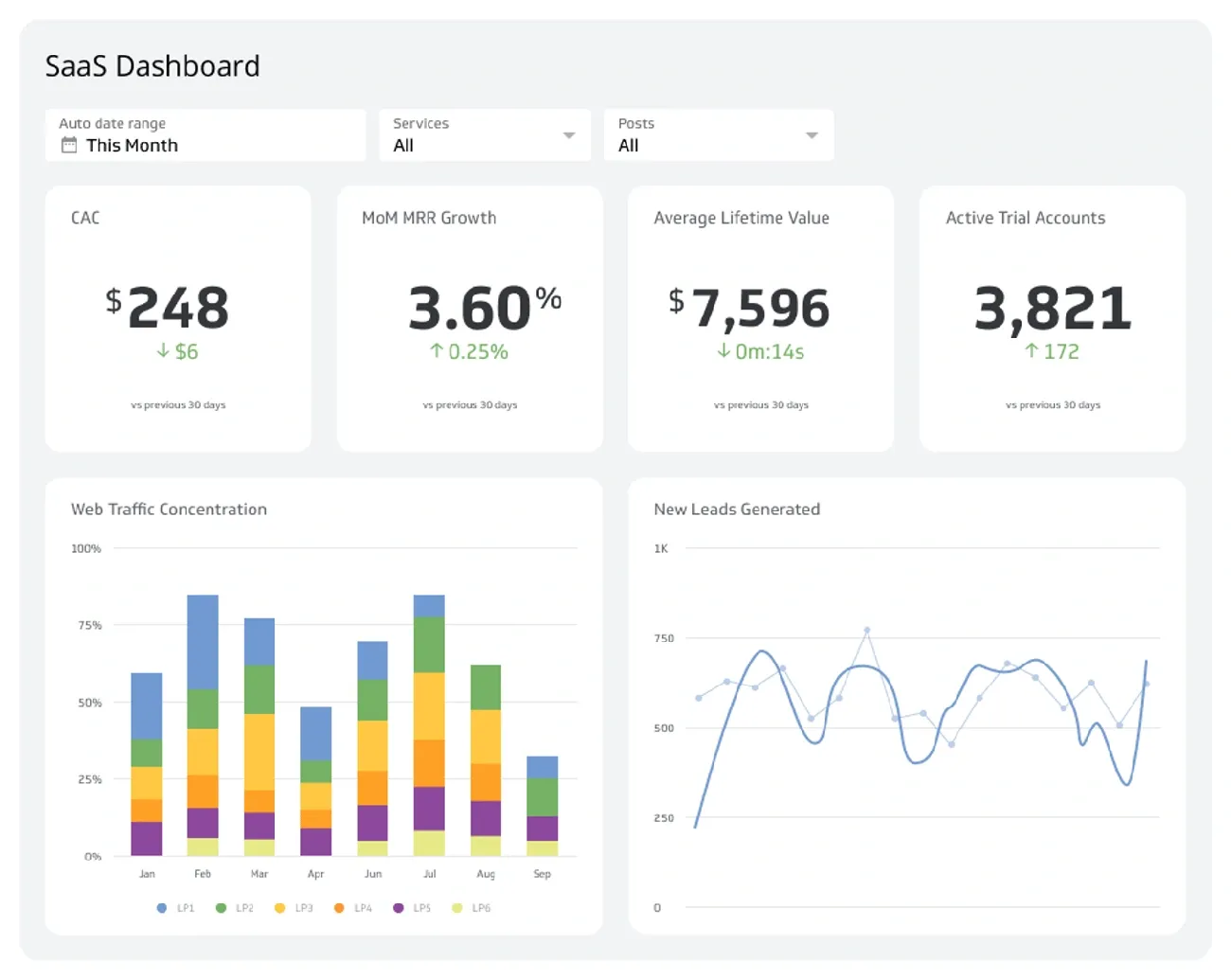
Image Source: Klipfolio
Evidence-based decision making sets successful SaaS businesses apart from those who struggle to find their footing. Your B2B SaaS marketing strategy needs metrics that link directly to business health and growth potential.
Key metrics: CAC, LTV, MRR, churn
The total expense needed to acquire a new customer defines Customer Acquisition Cost (CAC). This includes all marketing and sales efforts. The math works simply: total acquisition costs divided by new customers acquired in that period. Marketing efforts show better results when CAC stays low.
A customer’s total revenue throughout their relationship with your company represents Lifetime Value (LTV). The LTV:CAC ratio should stay at 3:1 or higher. Each customer should bring in three times what you spent to acquire them.
Monthly Recurring Revenue (MRR) shows predictable revenue streams, vital for SaaS business stability. The churn rate shows customer losses. You can calculate it by dividing lost customers by total customers at the start of a period. Customer experience or product-market fit issues often show up as high churn rates.
Using behavioral analytics to optimize funnels
Behavioral analytics connects demographic data to actual customer actions. B2B buyers take longer to decide and need multiple stakeholders. High-intent prospects who check pricing pages or download resources frequently stand out when you analyze digital behaviors early in the funnel.
Your user’s path becomes clear through funnel analysis. This method helps you:
- Find and fix buying process bottlenecks
- Create tailored experiences based on behavior signals (boosting conversion rates by 20%)
- Know which interactions lead to conversions
A/B testing and CRO for continuous improvement
A/B testing removes guesswork from your B2B SaaS marketing strategies. Different versions of content, design elements, and user flows face direct comparison. Real data drives decisions instead of assumptions.
CRO (Conversion Rate Optimization) success depends on tracking conversion rate (conversions/visitors × 100), bounce rate, and scroll depth. Your tests should focus on high-impact areas, run long enough, and account for external factors that might change results.
The right metrics matter more than tracking everything possible. Your growth trajectory depends on identifying key performance indicators and optimizing each element through evidence-based testing.
Conclusion
B2B SaaS marketing success depends on implementing a detailed, evidence-based approach rather than isolated tactics. This piece explored strategies that move the needle, from clear brand messaging to measuring what matters. Successful companies know how these components work together to create a growth engine.
Your positioning and messaging frameworks provide the base for everything else. Marketing tactics won’t gain traction without them. A mapped multi-stakeholder buyer’s trip helps create content that targets specific pain points at each stage and boosts conversion rates by a lot.
Value-led content remains the life-blood of effective B2B SaaS marketing. Studies show educational approaches perform better than promotional content. Customer success stories boost conversions through relatable narratives. Channel selection creates quick wins and long-term growth by balancing SEO’s compound returns with paid media results and expanded reach through mutually beneficial alliances.
The data shows that retention needs as much focus as acquisition. Companies that prioritize activation, customer success, and proactive involvement reduce churn and discover expansion revenue potential. This balanced approach guides them toward healthier LTV:CAC ratios and eco-friendly growth.
The B2B SaaS digital world will keep changing, but these core principles stay constant. Companies can drive predictable growth amid market changes by using tested strategies, measuring their effect, and optimizing with data. Successful SaaS businesses don’t just follow trends, they build systems that deliver consistent results while adapting to customer needs.
Unlock 2025’s top SaaS marketing strategies at GrowLeads.io. Start now!
FAQs
Q1. What are the key components of an effective B2B SaaS marketing strategy?
An effective B2B SaaS marketing strategy includes clear brand messaging, mapping the buyer journey, creating value-led content, adopting scalable growth channels, focusing on customer retention, and measuring key performance metrics.
Q2. How can B2B SaaS companies improve customer retention?
B2B SaaS companies can improve retention by implementing personalized onboarding processes, focusing on customer success, developing upsell strategies, and using proactive engagement techniques to address potential issues before they lead to churn.
Q3. What are the most important metrics to track in B2B SaaS marketing?
Key metrics for B2B SaaS marketing include Customer Acquisition Cost (CAC), Lifetime Value (LTV), Monthly Recurring Revenue (MRR), and churn rate. These metrics provide insights into marketing efficiency, customer value, revenue stability, and customer satisfaction.
Q4. How does content marketing contribute to B2B SaaS growth?
Content marketing contributes to B2B SaaS growth by establishing thought leadership, improving SEO performance, nurturing leads throughout the buyer journey, and providing valuable educational resources that build trust with potential customers.
Q5. What role do partnerships play in B2B SaaS marketing strategies?
Partnerships play a crucial role in B2B SaaS marketing by expanding market reach, creating integration opportunities, enabling co-marketing campaigns, and potentially contributing 20-40% of an organization’s revenue through various collaborative efforts.

Builds the demand intelligence, automation, and deliverability systems behind Growleads pipeline.