
Real Estate Lead Generator Strategy: Build Your B2B Pipeline Today

Did you know that nearly 80% of home buyers start their property search online? This means your real estate lead generator strategy isn’t just a nice-to-have, it’s absolutely essential for survival in today’s competitive market.
Let’s face it, real estate lead generation is the lifeblood of your business. When you’re relying on random referrals or painful cold calls, you’re setting yourself up for feast-or-famine cycles that make sustainable growth impossible. Instead, you need a steady pipeline of qualified B2B prospects that keeps your calendar full and your business thriving.
With studies showing over 40% of buyers find their agents through online advertisements, a solid lead generation strategy has moved from “optional marketing tactic” to “fundamental business requirement.” The math is simple: no leads = no sales = no business.
In this guide, I’ll walk you through proven approaches to build your B2B pipeline, everything from digital-first techniques to content marketing that actually works. You’ll also discover relationship-based strategies and automation tools that can transform your lead generation efforts without eating up all your time.
Ready? Let’s build a system that attracts high-quality leads and nurtures them efficiently through your sales funnel 👇
Understanding B2B Real Estate Lead Generation
B2B real estate lead generation works completely differently than residential approaches. While consumer strategies focus on emotional connections, B2B lead generation involves identifying and attracting potential business clients who’ve shown genuine interest in your services or properties. This proactive approach connects you with potential buyers, sellers, investors, and collaborators, significantly boosting your chances of success.
What makes B2B real estate leads different
Here’s what you need to understand: B2B real estate leads target companies, not individuals. Unlike B2C leads who might make quick, emotion-driven decisions, business clients typically involve multiple stakeholders and much longer evaluation periods.
And while B2B sales leads aren’t necessarily harder to find than B2C leads, they’re often much trickier to qualify and convert.
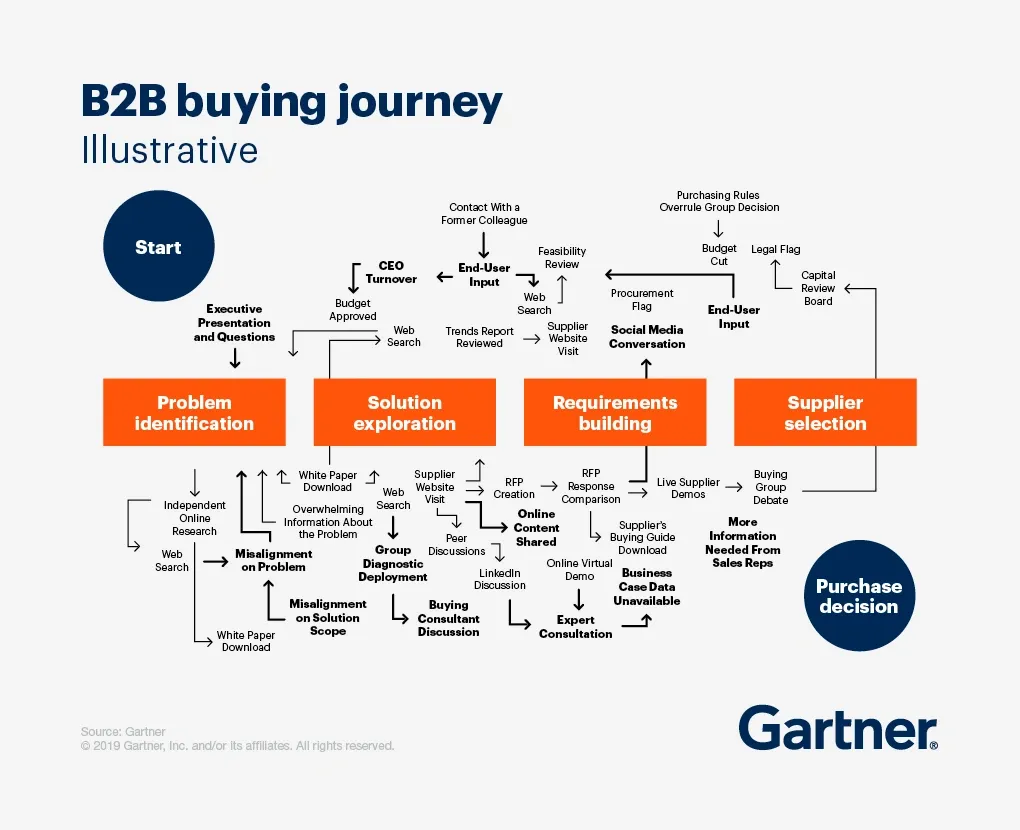
The buying journey for B2B clients follows a distinct three-stage path:
- Awareness – potential buyers recognize they have a problem needing a solution
- Consideration – they evaluate possible options but aren’t ready to purchase
- Decision – they’re meeting vendors, booking demos, and consulting with company decision-makers [3, 4]
Why a strategy matters more than ever
In today’s fast-moving real estate market, effective B2B lead generation is the engine that drives growth. Without a steady stream of quality leads, your business simply can’t maintain momentum. A well-executed strategy brings in qualified prospects and revenue while keeping your pipeline full, allowing your team to focus on meaningful conversations instead of cold calls.
Quality leads also mean better ROI. Your marketing efforts work harder when you’re targeting prospects who actually want your services. Plus, when sales and marketing teams collaborate effectively, they create targeted strategies that attract and qualify the right leads.
For real estate professionals specifically, a solid lead generation strategy guides content creation, builds brand awareness, uncovers broader markets, and ultimately generates higher revenues. You’re not just growing for today, you’re building a foundation for sustainable long-term success.
Common mistakes agents make early on
Many real estate professionals shoot themselves in the foot by labeling leads as “dead-end” too quickly. Even when prospects aren’t ready to buy immediately, they shouldn’t be tossed aside. A true dead-end lead has absolutely no contact method, no phone, email, or social media presence. Otherwise, you’re throwing away valuable nurturing opportunities.
Another major error? Failing to map out a clear pipeline. If you don’t understand where each lead stands in their buying journey, you’ll struggle to prioritize effectively. Many agents also give up far too quickly when leads don’t answer initial calls, potentially losing valuable clients through simple impatience.
Relying on just one marketing channel severely limits your reach and results. Your target audience likely prefers different communication methods, making it essential to diversify your approach. You also need to provide the right amount of information at the right time, too much confuses prospects, while too little fails to showcase your expertise.
Finally, don’t neglect your lead list. Update it consistently with new prospects and maintain regular, valuable communication. With permission, every lead should join an email list where you provide ongoing value, keeping you top-of-mind when they’re ready for their next real estate transaction.
Digital-first strategies to attract high-quality leads
“Up until this point, I have been doing Google PPC advertising, which has brought some very good deals my way. Only recently have I started seeing the fruition of my SEO efforts.”
, Nathaniel, Owner of The Expert Home Buyers
Your digital presence isn’t just a nice addition to your marketing strategy, it’s your silent salesperson working 24/7 to attract and convert qualified B2B real estate prospects. Let’s dive into the fundamentals that will transform your online presence from basic to brilliant.
Build a conversion-focused website
A real estate website that actually generates leads does more than just look pretty. It drives business growth through strategic design and functionality. Start with mobile optimization, this isn’t optional when 64% of property searches come from mobile devices compared to just 35% from desktops. And remember, patience isn’t a virtue online, 83% of visitors expect pages to load in under three seconds.
Want to maximize lead conversion? Focus on these critical elements:
- High-quality visuals (professionally photographed properties boost conversion rates by 32%)
- Clear, compelling calls-to-action that guide visitor actions
- Lead capture forms strategically placed throughout your site
- Trust signals like client testimonials and case studies
- Fast, secure hosting that delivers a seamless user experience
Your website needs to balance visual appeal with practical functionality. Visitors should easily find what they need regardless of their device or tech-savviness.
Optimize for local and niche SEO
SEO continues to be one of the heavy hitters for B2B customer acquisition. Unlike paid ads that stop working the minute you stop paying, SEO compounds over time, generating leads consistently throughout your marketing funnel.
For B2B real estate pros, a targeted approach yields the best results:
First, conduct thorough keyword research focusing on terms your potential clients actually search for. Think both informational queries (“commercial real estate trends in [city]”) and transactional terms (“office space for lease in [neighborhood]”).
Implement on-page optimization by enhancing titles, meta descriptions, images, and headings with relevant keywords. This makes it easier for both users and search engines to find you. Don’t forget technical SEO factors like site speed, mobile usability, and fixing broken links.
Remember that B2B SEO differs from B2C, your content needs to speak to multiple stakeholders within an organization, from executives to various department teams.
Use Google Business Profile to boost visibility
When potential clients search for real estate services near them, a well-optimized Google Business Profile puts you directly in their line of sight through Google’s Local Pack and Maps results.
To maximize your visibility, claim and fully optimize your profile with:
- Accurate, consistent business information matching across all online platforms
- Regular updates to business hours and special events
- High-quality photos of your properties, team, and office
- Timely responses to all reviews (yes, even the negative ones)
- Weekly posts highlighting market updates, new listings, and company news
This free tool dramatically increases your chances of appearing in local search results, particularly in the coveted “Google 3-Pack”, those top three business profiles shown at the beginning of search results.
Create blog content that answers real questions
A strategic real estate blog does much more than fill space on your website. It showcases your expertise, builds credibility, attracts organic traffic, and educates potential clients throughout their buying journey.
Focus your content on addressing genuine questions your B2B audience actually has. Use keyword research to identify popular search terms relevant to your market, then create a content calendar that includes:
- Market analysis and industry trends
- Local neighborhood spotlights
- Commercial property buying guides
- Investment opportunity assessments
- Case studies highlighting successful transactions
Optimize each post for SEO while keeping readability and value as your top priorities. These blog posts will drive traffic, establish your authority, and provide excellent material for your other marketing channels.
Social media and content marketing that builds trust
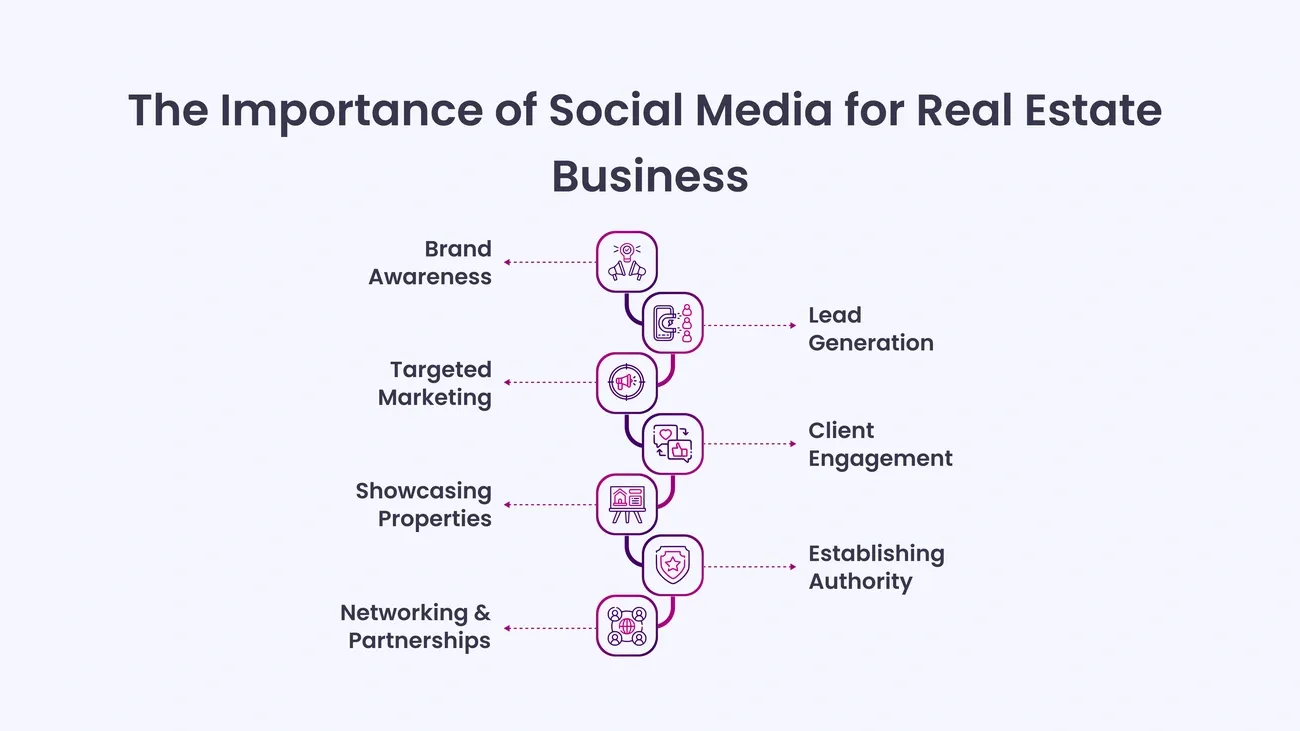
Trust is the currency of real estate relationships. Social media gives you a powerful channel to build that credibility with potential B2B clients. When you approach these platforms strategically, you can turn casual scrollers into qualified leads through consistent, valuable content.
Choose the right platforms for your audience
Not all social platforms will give you equal results when targeting B2B real estate clients. You need to focus where your potential clients actually spend their time. The numbers don’t lie – Facebook remains dominant with 90% of agents using it for business, while Instagram’s visual focus makes it perfect for property showcasing. For serious B2B connections, LinkedIn stands out – 37% of US adults aged 30-49 use the platform, exactly the demographic most likely making property decisions.
Start with just two platforms. For most B2B real estate professionals, this typically means LinkedIn for professional networking plus either Facebook (for its targeting capabilities) or Instagram (for visual impact). Once you’ve got a rhythm going, then expand to include a video platform like YouTube or TikTok, which now has over 73.7 million monthly active users in the USA alone.
Post consistently with a content calendar
How often you post directly impacts your lead generation success. But remember – quality always beats quantity. A well-structured content calendar helps you stay consistent without sacrificing quality. The benefits are huge:
- Saves you valuable time through advance planning
- Prevents the inconsistent posting that makes followers lose interest
- Creates a roadmap that eliminates daily content headaches
For best results, aim for at least three posts weekly on Facebook and Instagram, once weekly on LinkedIn if it’s a secondary platform (3-4 times if it’s your focus), and at least one weekly video on YouTube. Organize content around different “pillars” – listings, market updates, client success stories, and local business highlights to keep things fresh and engaging.
Use video tours, reels, and live Q&As
Video content absolutely crushes text and static images in real estate marketing. The stats back this up – 84% of consumers make purchase decisions after watching videos, and property listings with video generate significantly more leads.
To make the most impact, include:
- Property walkthroughs with steady camerawork and quality lighting
- Quick market update reels (15-30 seconds) that grab attention in the first 3 seconds
- Virtual open houses via Facebook Live or Instagram Live
- Q&A sessions addressing common client concerns
TikTok’s billion monthly active users offer huge opportunities, especially for reaching younger business decision-makers. And don’t forget that YouTube videos boost your SEO since they rank in Google search results – optimize those titles with keywords like “Best Commercial Properties in [Your City]”.
Collaborate with local influencers or businesses
Strategic partnerships with local businesses create powerful lead generation opportunities. These collaborations boost your community credibility while giving you cost-effective marketing alternatives. Try partnering with neighboring businesses for joint events or content creation.
The ROI speaks for itself – influencer marketing in real estate yields approximately $5.78 for every $1.00 invested. Look for local influencers such as:
- Community leaders with established followings
- Local business owners with complementary audiences
- Industry experts who add credibility to your services
These partnerships shine through cross-promotion on social channels. Tag partners in your content, feature them in interviews on your website, and create dedicated email newsletters highlighting local business promotions alongside your real estate updates.
Paid advertising strategies that actually convert
Let’s talk about paid advertising. When done right, it amplifies all your organic efforts by putting your real estate services directly in front of qualified B2B prospects who are actually looking for what you offer. The key is being strategic about where and how you spend those advertising dollars.
Run targeted Google Ads for local keywords
With Google capturing an impressive 81.95% market share among search engines, running targeted ads puts you front and center when businesses actively search for commercial real estate solutions.
Don’t waste money on broad terms that attract tire-kickers. Instead, focus on precise local keywords like “luxury commercial properties in [your city]” to reach prospects actively looking in your specific market.
Set a realistic budget from the start, experts recommend at least $500 monthly for consistent visibility. The good news? Real estate Google Ads average just $2.37 per click, which is actually lower than the $2.69 average across all industries.
Your Quality Score matters enormously here. It determines both ad positions and costs, with higher scores leading to better placements at lower costs. Keep your keywords, ad copy, and landing pages tightly aligned to maximize this score.
Use Facebook and Instagram lead form ads
Meta’s lead form ads are a game-changer for conversions. They let potential clients submit their information without ever leaving the platform. The forms come pre-filled with the user’s contact details, creating a frictionless submission process with just a few taps.
The numbers speak for themselves, advertisers using both instant forms and website forms saw 60% lower cost per lead and 125% more leads compared to website forms alone.
Want to maximize effectiveness? Connect your CRM for instant lead access, enabling faster follow-up with interested prospects while they’re still warm.
Retarget website visitors with display ads
One of your most valuable audiences is people who’ve already shown interest in your services. Retargeting reconnects you with prospects who visited your website but didn’t convert, which happens with a whopping 98% of initial visitors.
This works by placing a small pixel code on your website that adds an anonymous browser cookie to track visitors. Your ads then follow these prospects across the internet, keeping your brand top-of-mind when they’re ready to make a decision. The results? Retargeted ads boost engagement by up to 400% and have click-through rates 10 times higher than standard display ads.
Test ad creatives and landing pages regularly
A/B testing is your secret weapon for optimization. You create two variations of your ads, show them to different audience segments, and measure which performs better based on metrics like click-through and conversion rates.
For effective testing:
- Test just one variable at a time (headlines, images, CTAs, or landing pages)
- Run tests long enough to achieve statistical significance
- Document your findings to build knowledge for future campaigns
- Use automated tools to streamline the process
This data-driven approach eliminates the guesswork, allowing you to optimize your ad spend by identifying what truly resonates with your B2B real estate audience.
Offline and relationship-based lead generation
Digital marketing gets all the buzz, but here’s the truth: face-to-face interactions remain one of the most powerful lead generation tools for B2B real estate professionals. Personal connections build trust faster than any algorithm ever could, creating relationships that yield both higher-quality leads and longer client retention.
Host educational events or workshops
Want to position yourself as an authority while capturing contact information from genuinely interested prospects? Educational seminars are your answer. The key is focusing on topics that showcase your expertise without delivering an overt sales pitch.
Consider hosting quarterly workshops on:
- Commercial property investment trends
- Tax implications for real estate businesses
- Local development opportunities
Remember, the logistics matter less than what happens afterward. Always require registration to capture attendee data, and follow up within 48 hours while you’re still fresh in their minds. Share event photos on social media, thank participants personally, and invite them to schedule one-on-one consultations.
Attend local business networking meetups
Your local Chamber of Commerce is a goldmine of connections, offering monthly lunch-and-learns, community events, and speaking opportunities. While attendance isn’t always mandatory, maximum participation during your first year helps identify which events actually deliver results for your business.
Here’s a pro tip: smaller events often yield better results than massive conferences. Think farmers’ markets, community fairs, and local business expos where you can connect with both potential clients and other agents. Bring business cards, but focus on relationship-building rather than immediate sales.
Send direct mail with a clear CTA
Email may be cheaper, but direct mail achieves better response rates with less competition for attention. About 64% of consumers report taking action after receiving direct mail, visiting websites, physical locations, or making purchases.
Personalization goes beyond just using someone’s name; it means triggering mailings based on specific behaviors and interests. When designing your mailers:
- Establish credibility by highlighting recent transactions in the area
- Feature testimonials from satisfied clients
- Prominently display your contact information and social media accounts
- Include a compelling call-to-action like a free market analysis offer
Partner with mortgage brokers and attorneys
You don’t have to do this alone. Strategic partnerships with complementary professionals create a referral network that keeps your pipeline flowing. Financial planners understand clients’ financial situations intimately, potentially recommending refinancing or investment opportunities. Similarly, mortgage brokers have extensive networks of potential buyers.
To make these partnerships work, offer these professionals exclusive benefits, competitive rates, or superior customer service. Just remember that compassion is essential when working with partners who serve clients during major life transitions like divorce or bereavement.
Using Automation and AI to Scale Your Pipeline
“Last week, I had two very motivated leads come in, and this week I have had another. These drive my cost per lead down significantly, and ultimately it will go to zero. At that point, I will be running a business that has 0 costs per deal as opposed to right now, where my cost per deal is about $2500.”
, Nathaniel, Owner of The Expert Home Buyers
“Last week, I had two very motivated leads come in, and this week I have had another. These drive my cost per lead down significantly, and ultimately it will go to zero. At that point, I will be running a business that has 0 costs per deal as opposed to right now, where my cost per deal is about $2500.”
, Nathaniel, Owner of The Expert Home Buyers
Want to multiply your lead generation efforts without hiring more staff? Technology is your friend here. With the right automation tools, you can nurture more leads without drowning in manual tasks, turning your lead generation from a time-consuming chore into a scalable system that works while you sleep.
Set Up Email Drip Campaigns for Different Lead Types
Email drip campaigns are like your tireless digital sales assistant. They deliver a sequence of pre-written messages that nurture prospects based on where they are in your sales funnel. The key is making them trigger-based rather than time-based.
For example, when a prospect searches for commercial properties on your website, that specific action triggers an automated email with relevant listings in their area. This approach feels natural rather than random.
To get the most from your campaigns:
- Segment your leads by buyer type, timeline, and property interests
- Create different content for each segment (investment guides for investors, neighborhood spotlights for relocating businesses)
- Use actual prospect behavior to personalize content, automation doesn’t have to mean generic
Remember that long-term prospects need different nurturing than hot leads. Someone 12 months out might appreciate market analysis reports, while an active buyer needs fresh property alerts.
Use AI Chatbots to Qualify Leads Instantly
Did you know that 82% of consumers prefer chatting with a bot over waiting for a human representative? That’s right, people would rather get immediate answers from a robot than wait on hold for your team.
AI chatbots serve as your 24/7 lead qualification team. They can:
- Ask the right questions about budget, timeline, and property needs
- Schedule property viewings directly into your calendar
- Transfer all prospect data straight to your CRM without manual entry
- Follow up persistently, reaching out up to 25 times over a year when most agents give up after just three attempts
This persistence matters. Most leads aren’t ready to buy immediately, but chatbots don’t get discouraged or forget to follow up like humans sometimes do.
Score Leads Based on Behavior and Engagement
Not all leads deserve equal attention. Lead scoring helps you focus on prospects most likely to convert by assigning point values based on their actions and profile.
This scoring typically considers two types of information:
- Explicit data: What prospects tell you directly (company size, timeline, budget)
- Implicit data: How they behave (which pages they visit, which emails they open)
The beauty of a good lead scoring system is that it can also incorporate time decay, subtracting points when interactions grow stale. This ensures you’re always focusing on your hottest leads first.
Track Performance with CRM and Analytics Tools
The right CRM doesn’t just store contact information, it becomes your command center for relationship management. Modern platforms can:
- Automatically assign new leads based on territory or deal size
- Create workflows that eliminate routine tasks
- Generate 40+ different reports to measure every aspect of your pipeline
Some advanced CRMs even use AI to analyze past interactions and suggest the optimal time to contact each prospect. No more guessing when to follow up!
By implementing these automation tools strategically, you’ll build a lead generation system that scales with your business without demanding more of your limited time. The initial setup requires some investment, but the long-term payoff is a more efficient business that consistently converts leads into clients.
Building a system that grows with your business
You know what separates top-producing real estate agents from everyone else? It’s not their charm or their market knowledge (though those help). It’s their obsession with consistency in lead generation. The cold hard truth is that consistency beats sporadic brilliance every single time.
Document your lead generation process
Ask any rockstar agent what’s absolutely non-negotiable in their schedule, and lead generation will invariably top the list. These pros don’t squeeze lead gen in “if there’s time”, they block it, protect it, and execute it without fail. They understand a fundamental truth: the moment lead generation becomes optional, your business becomes unpredictable.
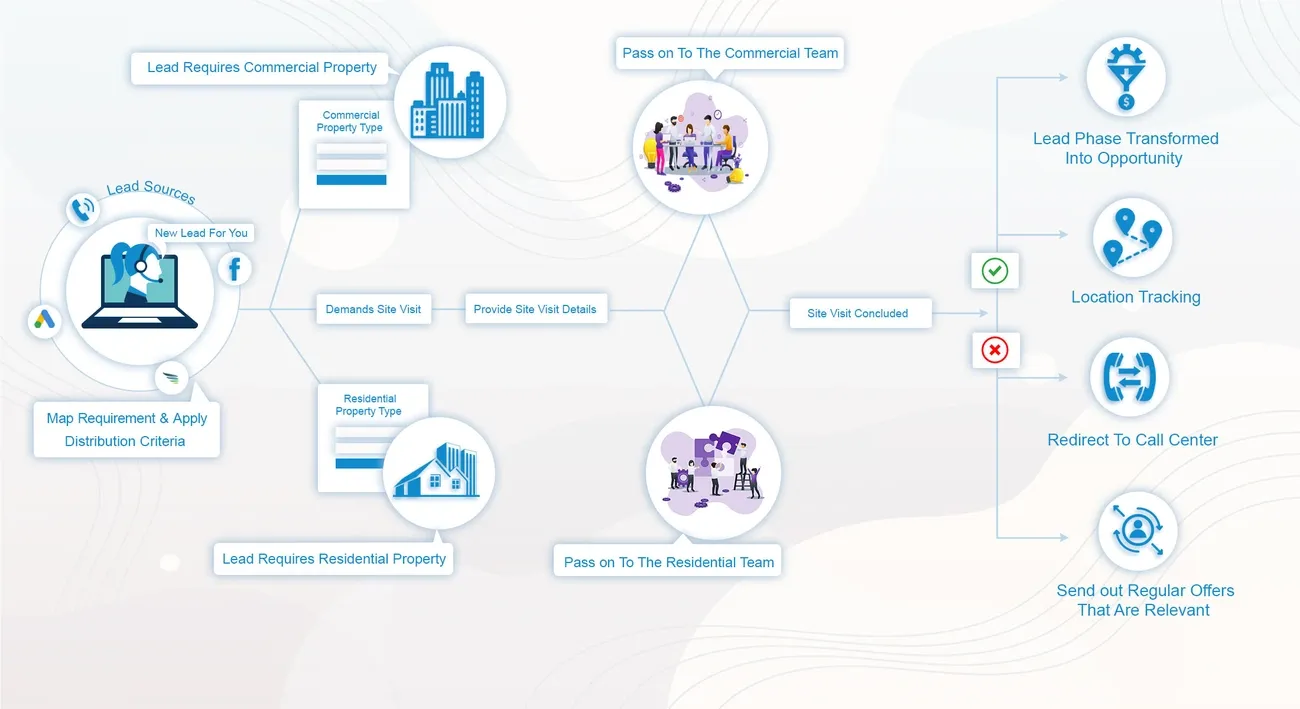
Start by mapping your entire lead journey, from that first contact all the way through nurturing and conversion. Be crystal clear about when leads officially become opportunities in your CRM, and document exactly when they should be removed from automated sequences. This structured approach doesn’t just make you more efficient, it creates a seamless experience for your potential clients.
Create templates for repeatable outreach
Great communication is the backbone of real estate success. Email templates keep your process running smoothly while maintaining a professional image. These formats save you precious time but remember, they should never replace personalization. Studies consistently show that personalized messages dramatically boost engagement.
Have scripts ready for all the common scenarios you encounter, expired listings, FSBO properties, buyer objections, and pricing presentations. As Jeff Glover, who now leads a seven-office brokerage, openly admits: “Scripts got him to where he is today”. When it comes to emails, segment your list by buyer/seller status, price range, or neighborhood preferences to keep your messaging relevant.
Train your team to follow the same playbook
When you implement structured processes, you ensure consistency across your entire organization. When everyone follows the same approach, leads don’t fall through the cracks. Don’t just hand out scripts, create a formal training program where your team practices until they’ve achieved mastery.
Jillian suggests “layering” lead generation activities consistently to increase production over time. This means training your team to integrate multiple approaches, direct mail, networking, cold calling, while maintaining the same high-quality standards and messaging. Regular role-playing sessions transform theoretical knowledge into practical skills, preparing your team for those challenging real-world interactions that make or break deals.
Conclusion
Building a powerful B2B real estate lead generation strategy isn’t rocket science, but it does require both immediate action and long-term thinking.
Throughout this guide, we’ve covered a lot of ground, from optimizing your website and crushing it on social media to building personal relationships and harnessing automation tools. The key takeaway? These strategies work best when you implement them systematically, not when you try them once and move on to the next shiny object.
Here’s what top-performing agents understand that average ones don’t: consistency beats brilliance every time. The most successful real estate professionals don’t just squeeze lead generation in when they have time, they block out dedicated hours in their calendar and treat it like their most important client meeting.
Don’t feel overwhelmed by all these strategies. Start small but start today. Pick two or three approaches that align with your strengths and business style. Document your process, execute consistently, and measure your results. The agents who dominate their markets aren’t necessarily using revolutionary tactics, they’re simply following through on proven methods day after day.
Yes, AI and automation tools can dramatically scale your business without burning you out. But remember this: personal relationships remain the foundation of real estate success. The best approach combines tech efficiency with the human touch that builds lasting connections with clients.
Your lead generation strategy will evolve as your business grows, but the fundamental principle won’t change: create systems that reliably deliver qualified prospects to your pipeline. When you treat lead generation as a daily discipline instead of an occasional scramble, your real estate business transforms from unpredictable to sustainable.
The choice is yours, continue with the feast-or-famine cycle of random referrals, or build a lead generation machine that keeps your calendar full of quality appointments. Which will you choose?
FAQs
Q1. What makes B2B real estate lead generation different from B2C?
B2B real estate lead generation targets businesses rather than individual consumers. It involves longer decision-making processes, multiple stakeholders, and typically requires more in-depth information and relationship-building compared to B2C leads.
Q2. How can I effectively use social media for B2B real estate lead generation?
Focus on platforms where your B2B clients are active, such as LinkedIn. Post consistently using a content calendar, share valuable industry insights, use video content for property tours, and collaborate with local businesses or influencers to expand your reach.
Q3. What are some effective offline strategies for generating B2B real estate leads?
Host educational events or workshops, attend local business networking meetups, send targeted direct mail with clear calls-to-action, and partner with complementary professionals like mortgage brokers and attorneys to create referral networks.
Q4. How can automation and AI help in scaling my real estate lead generation efforts?
Automation and AI can help by setting up email drip campaigns, using chatbots for instant lead qualification, implementing lead scoring based on behavior and engagement, and utilizing CRM and analytics tools to track performance and optimize your strategies.
Q5. Why is consistency important in real estate lead generation?
Consistency in lead generation activities ensures a steady flow of potential clients, making your business more predictable and sustainable. It allows you to refine your processes over time, build stronger relationships, and maintain a full pipeline regardless of market fluctuations.

Builds the demand intelligence, automation, and deliverability systems behind Growleads pipeline.