
Facebook Ads Audit Checklist: Stop Wasting Your Ad Budget Today
 Are you wasting money on ineffective facebook ads audit practices? Many advertisers miss key elements that could boost their return on investment (ROI). Regular audits can spot areas to improve, make campaigns better, and get the most value from every dollar you spend.
We’ve put together a detailed Facebook audit checklist to help you assess your advertising performance step by step. Our guide shows you everything from the right way to structure your ad account to creating proper audience segments. You’ll get into how the Facebook pixel affects conversion tracking and learn why small budget increases (10-20% per week) help you avoid a pricey learning phase. On top of that, it shows you the right way to do Facebook ads audit and set up campaigns with clear goals.
Your ads might not work well because of audience overlap or creative issues – this audit will help you find out why. Users’ attention spans are super short these days, so your ads need to grab attention in three seconds. That’s why every part of your campaign needs a close look.
Ad Account Structure: The Foundation of a Clean Audit
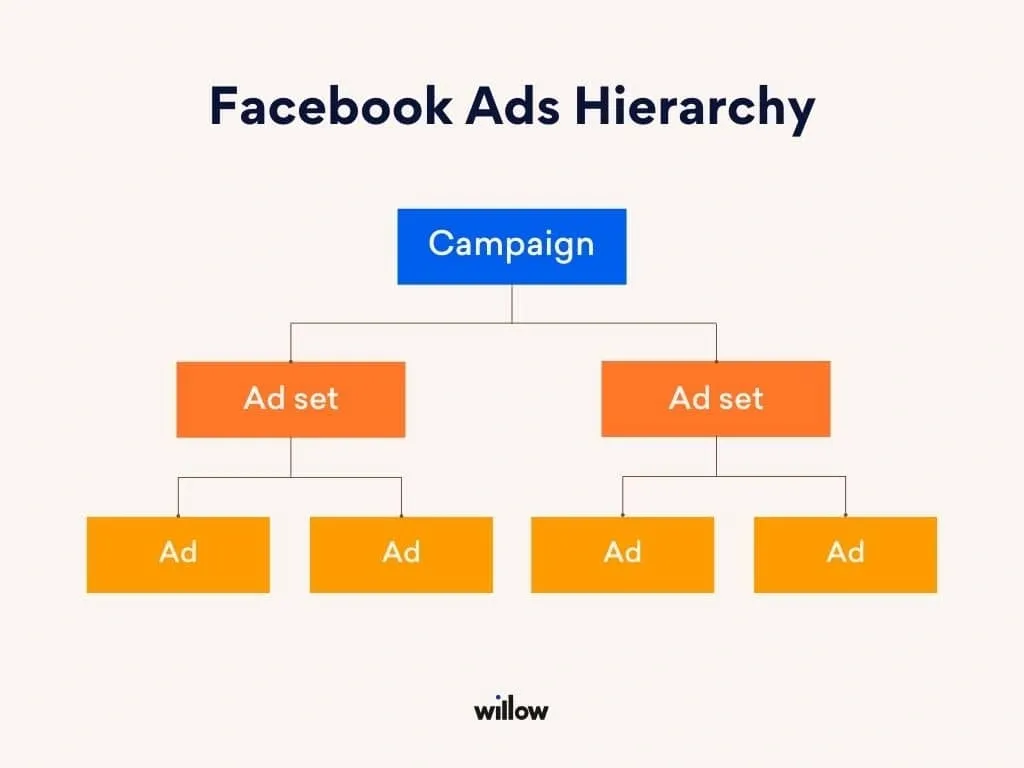
Image Source: Willow
Your Facebook ad account can end up acting like a leaky bucket if it’s not organized properly, quietly draining your marketing budget. Looking at accounts during a Facebook ads audit, I see that many lack proper organization. This makes it almost impossible to spot what works and what doesn’t.
Campaign and ad set organization
The three-tier structure of campaigns, ad sets, and ads are the foundations of an effective Facebook advertising strategy. This hierarchy lets you organize your marketing efforts based on specific objectives and audiences. Your performance improves and costs go down when you combine similar ad sets. Women’s accessories brand Lele Sadoughi saw a remarkable 41% increase in conversions after testing a simpler ad account structure.
Clear campaign objectives help maintain focus. Each campaign should target one specific goal (like traffic or conversions) instead of mixing objectives. Facebook’s algorithm can optimize better this way, and you can measure results more accurately.
Ad set level organization prevents audience overlap, a common issue where multiple ad sets compete against each other and drive up costs. Breaking out ad sets by targeting method (one for website visitors, another for lookalikes, etc.) shows you what works better.
Naming conventions and hierarchy
Consistent naming conventions are maybe the most overlooked part of a thorough Facebook ad account audit. Analyzing performance becomes needlessly complex without a standardized naming system.
A good naming convention has:
- For Campaigns: Brand/Client Name – Objective – Product/Service – Date Range
- For Ad Sets: Audience Type – Location – Placement – Budget Type
- For Ads: Creative Type – Primary Message – Variation Number
So, a well-named campaign might look like: “SunglassesBrand | Conversions | Summer Collection | May 2025” rather than the vague “New Campaign” that tells you nothing at first glance.
Access permissions and user roles
Access management is a crucial security component of your Facebook ads checklist. Facebook offers three distinct permission levels for ad accounts:
Admin: Can create/edit ads, access reports, edit payment methods, and manage permissions
Advertiser: Can create/edit ads and access reports, but cannot change permissions
Analyst: Can only view ads and access reports
Team members should have appropriate access levels without compromising account security. Check who has access to your account and at what level when doing a Facebook ads audit correctly.
A well-organized ad account affects your campaign performance directly. These structural best practices create a foundation that makes ongoing management, optimization, and scaling work better.
Targeting Settings: Are You Reaching the Right People?

Image Source: Sprout Social
Running Facebook ads with the wrong audience is like fishing in a swimming pool, you have the right gear but you’re in completely the wrong spot. The best ad creative won’t deliver results if people don’t care about what you’re selling. Let’s take a closer look at how a full facebook ads audit should review your targeting settings.
Audience definition and segmentation
Facebook segmentation splits your target audience into smaller, specific groups that share common traits. These segments include demographics (age, location), interests (hobbies, favorite brands), and behaviors (past purchases, website visits). A facebook ad account audit needs to review how you’ve set up these segments.
Meta lets you break down sales campaign reporting into three key audience segments:
- New audience: People who haven’t interacted with your products or services
- Engaged audience: People aware of your business or who have interacted without making a purchase
- Existing customers: People who have purchased products or signed up for services
The right setup of these segments shows you how your budget and performance spread across these crucial groups. Your facebook ads audit should verify that you’ve set up these segments correctly in your ad account settings.
Avoiding audience overlap
Audience overlap happens when multiple ad sets target the same people, making your campaigns less efficient. Your facebook audit should use Meta’s audience overlap tool to check the percentage of accounts that appear in two audiences.
Overlap creates problems because Meta only picks the ad set with the best performance history when multiple sets target similar audiences. This prevents others from competing. The results can include:
- Your ads get pricey as they compete against each other
- The algorithm optimizes slower due to mixed signals
- Test results become unclear, making it hard to spot winning creative
Try to keep audience overlap under 30% whenever possible. Higher overlap leads to rising costs and slower optimization, key points for your facebook ads checklist.
Retargeting and exclusion strategies
Retargeting focuses on people who already know your brand. A proper review of how to do facebook ads audit looks at your retargeting approach based on:
- Website traffic and specific page visits
- Customer files (like email subscribers)
- App activity
- Offline activity
- Engagement with your content
Many marketers miss a crucial strategy: excluding converters from campaigns. You should stop showing ads to customers who’ve already bought unless you’re upselling, this saves your budget. A simple yet powerful practice involves creating a custom audience of past conversions and excluding them from remarketing.
Luxury brands or companies selling expensive items might need longer retargeting windows (up to 180 days). Products bought on impulse may only need 30-day retargeting. Your facebook ads audit template should include these timeframe reviews.
Smart audience segmentation requires excluding lower-funnel objectives from higher-funnel audiences. Applying exclusions to each campaign audience helps you segment customers properly and avoid costly audience overlap issues.
Conversion Tracking: Is Your Data Accurate?
Your ad budget can silently drain away due to inaccurate conversion tracking. A full facebook ads audit should verify that conversion data matches your customer’s actions. This is vital to optimize campaign performance.
Pixel setup and event tracking
Meta Pixel and Conversions API form the foundation of reliable conversion tracking. These tools track visitor actions on your website, like purchases or cart additions. Meta recommends using both tools together in what they call a “redundant event setup” where both tools share the same events.
Your facebook ads checklist review should confirm:
- Pixel installation on all relevant pages
- Standard events fire as expected
- Events line up with your business goals
- Event coverage shows at least 75% of Conversions API to Meta Pixel events
The Pixel Helper browser extension helps verify events fire correctly across your website. Good implementation not only improves tracking but also lowers your cost per action.
Custom conversions vs standard events
Meta’s ad platform recognizes predefined actions called standard events. These include Purchase, Lead, Search, and Complete Registration. Meta uses global data from all advertisers who use these standard events.
Custom events let you track specific actions beyond standard definitions. A facebook ad account audit might show opportunities to create custom events for:
- Wholesale partner sign-ups vs general questions
- Different form submission types
- Engagement metrics like scroll depth or video views
Custom conversions give you another option within Events Manager without code changes. URL rules or specific standard or custom events can define these conversions. But you cannot use them to create audience targets or lookalike audiences.
Attribution windows and offline tracking
Attribution windows credit conversions to your ads. The default was 7-day click or 1-day view before Apple’s App Tracking Transparency came into effect.
Meta now lets you adjust these attribution settings at the ad set level:
- Click-through (1-day or 7-days)
- View-through (1-day or none)
- Engaged-view for video (1-day or none)
Businesses with many offline conversions should track in-store purchases and phone calls. You can upload your CRM or point-of-sale data to match transactions with Facebook ad viewers. Research shows 81% of shoppers research online before buying in stores, so tracking these conversions gives you a full picture of ad performance.
A facebook ads audit should compare different attribution settings. This shows you how your campaigns perform beyond the default window and reveals your customer’s buying timeline.
Creative Review: Are Your Ads Engaging Enough?
Image Source: Gartner
Facebook ads make first impressions on potential customers through visual elements. A newer study by Meta shows ads that follow creative best practices boost short-term sales by 1.2X to 7.4X and long-term sales by 1.2X to 2.7X. Your creative assets deserve top priority during a facebook ads audit.
Visual quality and brand alignment
Nielsen studies prove creative elements affect 56% of related sales. Your brand’s identity should shine through consistent colors, fonts, and logo placement in visuals. Stock photos might seem tempting, but tests reveal that authentic pictures make visitors 35% more likely to participate than stock images.
Quality matters, and lifestyle content performs better than product-only images. Your products should appear in ground settings to help customers picture themselves using them.
Ad copy and CTA effectiveness
The best ad copy stays within 1-3 lines. Facebook suggests limiting primary text to 125 characters, headlines to 40 characters, and descriptions to 25 characters. These limits prevent text cutoffs across different placements.
Users spend just 1.7 seconds looking at each post. Your CTA must grab attention fast. The facebook ads checklist should confirm each ad’s compelling click reason and strong unique value proposition (UVP).
Ad format usage and A/B testing
Your campaigns need multiple creative formats to reach more audience members. Meta’s data proves attention-grabbing ad creatives can cut cost per click and cost per web conversion by about 20%. You should try:
- Square and portrait formats for feed ads
- Full-screen vertical videos (1080 x 1920 pixels) for Reels
- Carousel ads to showcase multiple products or features
A/B testing helps you find what strikes a chord with your audience. A proper facebook ad account audit checks if you test one element at a time and use matching budgets for fair comparisons. This step-by-step method keeps variables from overlapping and gives you applicable information for future campaigns.
Landing Page and Funnel Alignment
Message mismatch between ads and landing pages kills conversion rates in many facebook ads audit reports. Research shows that consistent messaging boosts qualified leads by 7%.
Message match between ad and landing page
Your ad’s promise should match what visitors see on your landing page. A facebook ad account audit helps you check if landing pages continue the conversation your ads started. Visitors lose trust quickly when they notice differences between ads and landing pages.
Numbers tell the story clearly. Advertisers lose 31% of potential leads by sending traffic to their homepage instead of dedicated landing pages. Your landing pages need the same look, message and offer as your ads to work effectively.
Page speed and mobile optimization
Mobile commerce growth makes page speed crucial in any facebook ads checklist. The stats paint a clear picture – 61% of users abandon slow mobile sites and 40% switch to competitors.
Mobile optimization success depends on these key steps:
- Your pages should load fast on all networks (2G, 3G, 4G, LTE)
- Simple landing pages load faster
- PayPal or Apple Pay make checkout easier
- Users should see your CTA without scrolling
Conversion tracking on landing pages
Your facebook audit needs proper conversion tracking to connect ad performance with business results. Landing page view goals help improve traffic quality better than link click optimization.
Landing pages track conversions in three ways: standard events track common actions like purchases, custom events capture unique business interactions, and custom conversions use URL rules. Facebook Ads Manager and Events Manager show all these conversions, which helps analyze your funnel’s performance.
A solid facebook ads audit template should verify that landing pages track all conversion events correctly. This ensures you measure performance accurately.
Conclusion
Stop Wasting Your Facebook Ad Budget Today
A really good look at the basics of a Facebook ads audit shows that regular checks aren’t just helpful, they’re crucial to campaign success. Without doubt, these systematic reviews make the difference between wasting your ad budget and maximizing ROI.
Your ad account needs a well-laid-out structure as the foundation. You can’t identify what works without proper organization. Your ads should reach people who actually want your offerings instead of wasting impressions on uninterested users through precise audience targeting.
Accurate conversion tracking lets you measure real results rather than guess at performance. Then you can make evidence-based decisions about budget allocation. Your creative assets matter just as much, compelling visuals and clear messaging that match your brand’s identity will affect engagement rates and conversion costs.
The link between your ads and landing pages plays a vital role. Message match, page speed, and proper tracking on destination pages help complete your customer’s path to conversion.
A detailed Facebook ads audit might seem daunting at first. The process becomes much easier when you break it down into these five key areas. Our checklist helps you review each component systematically to find ways to cut wasted spend and boost campaign performance.
Facebook advertising changes constantly. Making these audits part of your regular marketing routine, quarterly or monthly for high-spend accounts, helps you keep up with trends and optimize your campaigns for better results.
Discover how GrowLeads.io can transform your ad spend efficiency today!
FAQs
Q1. How often should I conduct a Facebook Ads audit?
It’s recommended to conduct a Facebook Ads audit regularly, ideally on a quarterly basis for most accounts. However, for high-spend accounts or rapidly changing campaigns, monthly audits may be more appropriate to ensure optimal performance and budget allocation.
Q2. What are the key components of a Facebook Ads audit?
A comprehensive Facebook Ads audit should cover five main areas: ad account structure, targeting settings, conversion tracking, creative review, and landing page alignment. Each of these components plays a crucial role in the overall performance of your campaigns.
Q3. How can I improve my Facebook ad targeting?
To improve ad targeting, focus on proper audience segmentation, avoid audience overlap, and implement effective retargeting and exclusion strategies. Use Facebook’s audience overlap tool to ensure your ad sets aren’t competing against each other, and consider excluding converters from your campaigns to avoid wasting budget.
Q4. What’s the importance of creative elements in Facebook Ads?
Creative elements are crucial in Facebook Ads as they drive engagement and conversions. High-quality visuals that align with your brand, concise and compelling ad copy, and clear calls-to-action can significantly improve ad performance. It’s also important to test different ad formats and conduct A/B testing to determine what resonates best with your audience.
Q5. How does landing page optimization affect Facebook Ad performance?
Landing page optimization is vital for Facebook Ad performance. Ensure message match between your ads and landing pages, optimize for mobile users and page speed, and implement proper conversion tracking. These factors contribute to a seamless user experience, which can lead to higher conversion rates and better overall campaign performance.

Runs paid acquisition across Google, LinkedIn, and Meta for B2B pipeline.


