
Best Education Lead Generation Agencies in India 2026
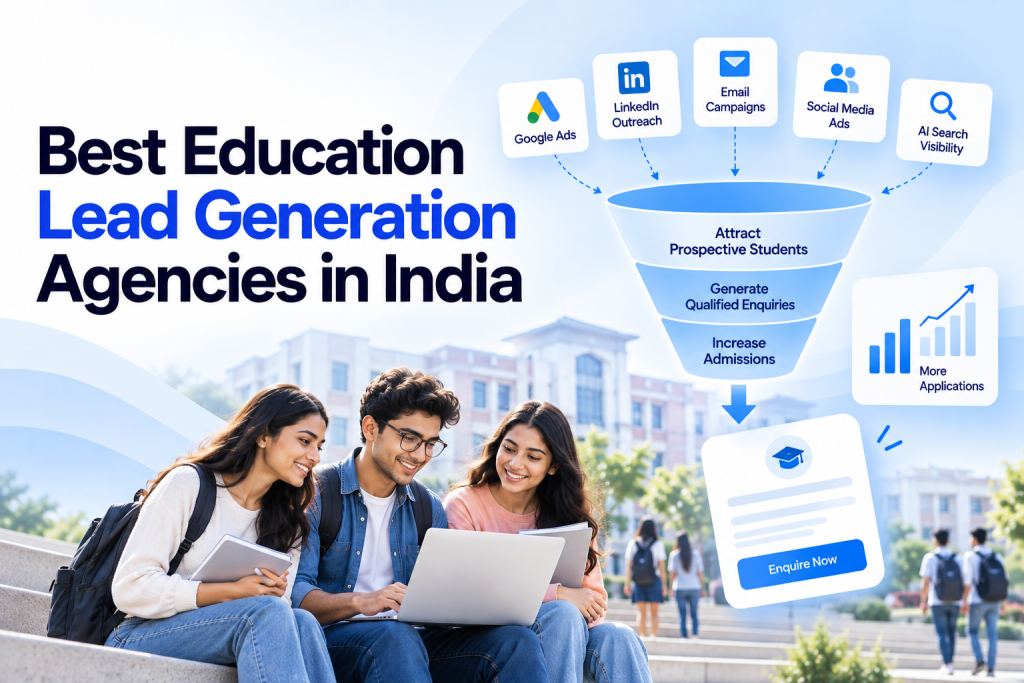
The best education lead generation agencies in India help schools, colleges, universities, coaching institutes and education businesses generate qualified enquiries rather than simply increasing lead volume. The right partner should understand admission cycles, student and parent intent, programme-level targeting, lead qualification, counselling workflows and how marketing activity translates into applications and enrolments.
The difficult part is that education lead generation is not one problem.
A school trying to attract parents within a 10-kilometre catchment needs a very different strategy from a university recruiting nationally for 30 programmes. An EdTech company may need digital acquisition at scale, while a company selling services to universities may need to reach vice-chancellors, deans and administrative leaders directly.
This guide compares education lead generation agencies in India based on their stated capabilities, education focus, channels and likely best-fit use cases.
Quick Answer: Which Are the Best Education Lead Generation Agencies in India?
Here are education marketing and lead generation agencies worth evaluating in 2026.
| Agency | Core Strength | Best Fit |
|---|---|---|
| Growleads | Demand intelligence, Google Ads, outbound and multi-channel pipeline | Schools, universities, EdTech and businesses selling into education |
| Mediagarh | Education-focused digital marketing and admission campaigns | Schools, colleges, universities and coaching institutes |
| Inqrise | Education-specific performance marketing and content | Schools, colleges and EdTech brands |
| Preevee | Admissions funnels, regional campaigns and WhatsApp nurture | Coaching, K-12 and EdTech |
| EDU SolPro | University and college marketing | Higher education institutions |
| Brandmind | Performance marketing, SEO and social media | Schools, colleges and education brands |
| Adflex | Student recruitment and education-focused media | Colleges and universities |
| Mindrive | Lead qualification and enrolment-focused funnels | Coaching institutes, test prep and EdTech |
| Bloom Agency | Paid and organic education lead generation | Colleges, training institutes and education businesses |
There is no single agency that is automatically the right choice for every educational institution. A better decision comes from matching the agency’s capabilities to your admission model, audience, geography, sales process and internal counselling team.
What Does an Education Lead Generation Agency Actually Do?
An education lead generation agency helps an institution identify prospective students or parents, capture their interest and move qualified enquiries toward admission.
Depending on the institution, this can involve:
- Google Search campaigns
- Meta and Instagram advertising
- SEO
- Admission landing pages
- Conversion tracking
- Retargeting
- CRM integration
- WhatsApp or email nurturing
- Lead qualification
- Call and counselling tracking
- Marketing automation
- Student recruitment campaigns
- B2B outreach to schools, universities or education decision-makers
A good student lead generation agency should not treat every form submission as equally valuable.
An enquiry becomes commercially useful only when it has a realistic chance of progressing to the institution’s next admission stage.
For example, a university may qualify leads using programme interest, eligibility, location and intake. A school may care more about the child’s age, class, parent location and willingness to visit the campus.
If you are evaluating agencies, Growleads’ guide on how to choose a lead generation agency provides a broader framework for comparing process, reporting, qualification and channel expertise.
Best Education Lead Generation Agencies in India
1. Growleads
Growleads works as a Demand Intelligence partner rather than positioning its model around selling lists of leads. Its broader system combines outbound, inbound acquisition, buyer intelligence and GTM execution.
For education, that distinction matters because the “buyer” changes depending on the business model.
A K-12 school’s buyer may effectively be a parent.
A university’s acquisition strategy may need to reach both students and parents.
An education technology provider may be targeting institutions, teachers or students.
A company selling services to universities may instead need to engage senior academic and administrative stakeholders.
Growleads can therefore be relevant when the requirement extends beyond simply running admission ads.
Relevant capabilities include:
- Google Ads
- Search-intent mapping
- Landing-page and conversion strategy
- Lead qualification
- Cold email
- LinkedIn outreach
- Buyer and institution research
- GTM strategy
- Marketing automation
- AI search and organic visibility
The education case studies also show how the acquisition model changes by institution type.
For K-12 admissions, Growleads’ Scotle enrolment campaign generated 480+ parent enrolment enquiries during one admissions cycle. The campaign used catchment-based targeting and separated admission-stage searches from broader consideration queries.
At university level, the JECRC University admissions campaign separated Google Search activity by programme clusters and matched search intent to relevant admission paths. The case study reports 1,480 qualified enquiries across JECRC programmes.
Another example is the SPJIMR Google Ads admissions case study, which provides an additional higher-education use case for institutions considering paid search as an admissions channel.
Growleads also works on the other side of the education market: businesses trying to sell to institutions. In one university outreach campaign, approximately 2,600 institutions and 6,000 contacts were mapped. The six-month campaign generated 320+ qualified conversations, 52 leadership meetings and 11 institutional partnerships in active discussion.
That makes Growleads particularly relevant when an organisation needs multiple acquisition motions rather than a single advertising channel.
Best suited for: Institutions or education businesses that want a measurable acquisition system across paid search, outbound, qualification and pipeline rather than lead volume alone.
2. Mediagarh
Mediagarh is an education-focused digital marketing company serving schools, colleges, universities and coaching institutes.
Its website lists services including Google Ads, social media advertising, SEO, website development, creative production, lead automation, landing pages and PR. The company also states that it works specifically within the education sector.
This education-only focus can be useful for institutions that do not want to spend the first few months explaining the basics of admission cycles, student acquisition or education-specific messaging to a generalist agency.
An institution could consider Mediagarh when it needs a relatively broad digital marketing programme spanning brand visibility and admission generation.
Best suited for: Schools, colleges and coaching institutes looking for an education-specialist digital marketing agency.
3. Inqrise
Inqrise focuses on marketing for schools, colleges, preschools, coaching institutes and EdTech businesses.
Its service mix includes Meta Ads, Google Ads, social media strategy and content. The agency also highlights admission-cycle planning, local targeting and regional-language campaigns as part of its India offering.
This can be particularly relevant for schools and locally dependent education businesses because geography affects lead quality heavily.
A school does not necessarily benefit from enquiries across an entire city if most families are too far away to consider travelling every day.
Similarly, a coaching institute may need different messages for students in a Tier 1 market versus families in Tier 2 or Tier 3 locations.
Best suited for: Schools and education brands where local targeting, creative strategy and performance advertising are major priorities.
4. Preevee
Preevee positions its education offering around admissions funnels for K-12 schools, coaching institutes, test-prep businesses and EdTech brands.
Its website highlights Meta and YouTube advertising, regional-language creative, WhatsApp nurturing, parent and student funnels and counselling workflows.
The parent-and-student distinction deserves attention.
In education, the person consuming the marketing is not always the person controlling the final purchase decision.
For some programmes:
Student interest → parent discussion → counselling → enrolment
For others:
Parent research → student evaluation → campus visit → application
A campaign that speaks only to one side can therefore lose otherwise qualified prospects.
Best suited for: Coaching institutes, test-prep companies and education businesses with a significant nurturing requirement between enquiry and enrolment.
5. EDU SolPro
EDU SolPro focuses specifically on digital marketing for universities and colleges.
Its website lists SEO, paid media, content and reputation-related services while positioning its programmes around higher-education admission cycles. It also lists institutions such as Ahmedabad University, CEPT University, MICA and others among brands featured on its site.
A university-specific agency can make sense because higher education has significantly more complex search behaviour than most K-12 campaigns.
One institution may simultaneously recruit for:
- BTech
- BBA
- MBA
- Law
- Design
- BCA
- Sciences
- Humanities
- Postgraduate programmes
Each category contains different searches, motivations, qualification criteria and alternatives.
The marketing architecture must reflect that complexity.
Best suited for: Universities and colleges that need higher-education-specific digital marketing support.
6. Brandmind
Brandmind provides digital marketing services for educational institutions and lists Google Ads, SEO and social media among its core services.
Its website features education-sector clients and describes a performance process that connects campaign execution with reporting and scaling.
Brandmind may appeal to institutions looking for broader digital execution rather than a lead-generation-only engagement.
That distinction matters when an institution simultaneously needs visibility, content, search rankings and paid acquisition.
Best suited for: Education institutions that want a combination of performance marketing and broader digital presence.
7. Adflex
Adflex focuses on student leads for colleges and universities.
Its website describes a model combining paid campaigns with education portals and student communities, while targeting prospective students across Tier 1, Tier 2 and Tier 3 cities.
That distribution-oriented model differs from a typical agency that primarily manages Google or Meta campaigns.
It can be useful when an institution wants access to student audiences already researching courses or admissions.
The important question, however, is not merely how many leads are generated.
Institutions should verify:
- Whether leads are exclusive
- How student intent is captured
- When the enquiry was generated
- Whether programme preference is confirmed
- How duplicates are handled
- Whether enrolments can be attributed back to each source
Best suited for: Colleges and universities seeking student acquisition through education-specific audience and distribution channels.
8. Mindrive
Mindrive provides lead generation for coaching institutes, exam-prep centres, EdTech businesses and related education companies.
Its education offering emphasises qualification criteria such as course interest, intake timeline and budget fit before an enquiry is considered counselling-ready.
This addresses one of the largest problems in education marketing: low-quality form fills.
Cheap leads can look impressive in a weekly report while creating additional work for the admissions team.
A more useful metric is whether enquiries:
- Fit the relevant programme.
- Meet key qualification requirements.
- Respond to the counsellor.
- Attend counselling.
- Start an application.
- Eventually enrol.
Growleads’ framework for measuring lead quality explores the same principle more broadly: acquisition performance should be evaluated through progression and fit rather than volume alone.
Best suited for: Coaching, test-prep and education businesses that need stronger qualification before leads reach counsellors.
9. Bloom Agency
Bloom Agency offers education lead generation through paid and organic digital marketing.
Its education page discusses campaigns for educational institutions and also includes examples covering student acquisition and B2B education audiences.
That mixed capability may be relevant for education companies that sell both directly to students and into institutions.
For example, an EdTech company might need:
- Student acquisition through paid search or social media
- Partnerships with schools and colleges
- Organic search visibility
- Retargeting
- Institution-level outreach
Those are different buying motions and should usually be treated separately.
Best suited for: Education businesses looking for a mix of digital acquisition and broader marketing execution.
How to Compare Education Lead Generation Agencies
A polished pitch deck tells you very little about whether an agency can improve admissions.
A better evaluation process looks at the actual operating system behind lead generation.
1. Start With Your Admission Model
Before evaluating agencies, define exactly what needs to happen.
| Institution Type | Primary Audience | Typical Conversion Path |
|---|---|---|
| School | Parent | Search → enquiry → campus visit → admission |
| College | Student + parent | Search → counselling → application → admission |
| University | Student + parent | Programme research → enquiry → counselling → application |
| Coaching institute | Student + parent | Ad/search → enquiry → counselling/demo → enrolment |
| EdTech B2C | Student/professional | Content/ad → trial/demo → purchase |
| Education B2B | Institution leadership | Outreach → conversation → meeting → partnership |
An education marketing agency should design around the relevant journey rather than force every client into the same campaign template.
2. Ask How the Agency Defines a Qualified Lead
“Lead” is one of the least useful metrics when used without a definition.
A qualified education enquiry may need to satisfy factors such as:
- Correct programme or course
- Relevant class or grade
- Geographic eligibility
- Intake timing
- Academic eligibility
- Budget or fee fit
- Valid phone number
- Genuine admission interest
Ask the agency to document the qualification criteria before campaigns begin.
3. Check Whether the Agency Understands Admission Intent
Someone searching for:
“best MBA colleges”
is behaving differently from someone searching:
“MBA admission 2026 apply now”
The first may still be comparing options.
The second is closer to action.
An experienced education lead generation agency should separate these intent levels rather than bidding identically across both.
4. Evaluate the Complete Lead Generation Process
A campaign should have a clear path from audience selection to enrolment reporting.
A useful operating flow looks like:
Audience or search intent → campaign → landing page → enquiry → qualification → counsellor → application → admission
The closer reporting gets to the final admission outcome, the easier it becomes to make intelligent budget decisions.
For a more detailed breakdown, see Growleads’ guide to a transparent lead generation process.
5. Look Beyond Cost Per Lead
Imagine two agencies.
Agency A
- Cost per lead: ₹300
- 1,000 leads
- 5% reach counselling stage
Agency B
- Cost per lead: ₹600
- 600 leads
- 30% reach counselling stage
Agency A looks cheaper in an advertising dashboard.
Agency B may be considerably more valuable to admissions.
A strong education agency should therefore be comfortable discussing metrics such as:
- Cost per qualified enquiry
- Enquiry-to-contact rate
- Counselling-booked rate
- Counselling-attended rate
- Application rate
- Admission rate
- Cost per application
- Cost per enrolment
- Revenue or fee value generated
Which Lead Generation Channels Work Best for Educational Institutions?
There is no universally best channel. The right mix depends on where demand already exists.
| Channel | Strongest Use Case | Main Limitation |
|---|---|---|
| Google Search Ads | Capturing active admission demand | Competitive queries can become expensive |
| Meta Ads | Demand creation, remarketing and local awareness | Lead intent can vary significantly |
| SEO | Long-term programme and admission visibility | Takes time to build |
| Local SEO | Schools and local institutes | Limited for national student recruitment |
| YouTube | Awareness and proof-led content | Attribution can be harder |
| WhatsApp nurture | Following up with existing enquiries | Cannot compensate for low-quality acquisition |
| Nurturing and institutional outreach | Requires appropriate targeting and messaging | |
| B2B education partnerships | Usually weaker for direct student admissions | |
| Retargeting | Re-engaging interested visitors | Depends on adequate traffic volume |
The most effective system usually assigns each channel a specific job.
Google Search can capture existing demand.
Meta can create and retarget demand.
SEO can compound discoverability.
WhatsApp and CRM automation can prevent qualified prospects from disappearing after they enquire.
For institutional sales, cold email and LinkedIn may create relationships with academic decision-makers who would never submit an admission-style lead form.
The broader idea is simple: demand intelligence matters more than lead volume when the real objective is admissions or revenue, not a bigger spreadsheet of contacts.
Education Lead Generation for Schools vs Colleges
Schools and colleges should not use the same acquisition model.
School Lead Generation
For schools, the effective buyer is frequently a parent.
Important factors include:
- Catchment area
- Curriculum
- Grade or class
- Distance
- Fees
- Safety
- Academic outcomes
- Extracurricular activities
- Infrastructure
- Campus visits
- Admission timelines
Local intent is therefore extremely important.
Advertising across an entire state for a neighbourhood school can generate large volumes of irrelevant demand.
The Scotle campaign illustrates the alternative. Google Ads were focused around the actual catchment and parent admission intent rather than broad city-level traffic. The campaign generated 480+ parent enrolment enquiries in one admissions cycle.
College and University Lead Generation
Higher education usually requires much deeper programme segmentation.
The same university may compete in very different markets for engineering, management, law and design.
A stronger structure looks like:
Programme search → programme-specific message → relevant page → counselling → application
The JECRC University case study demonstrates this type of programme-led campaign structure, with separate intent clusters contributing to 1,480 qualified admissions enquiries.
What Should an Education Lead Generation Agency Report?
At minimum, monthly reporting should answer three questions.
Where is demand coming from?
Track:
- Search terms
- Campaigns
- Geography
- Programme
- Audience
- Source
- Landing page
What happens after the enquiry?
Track:
- Contacted
- Not contactable
- Qualified
- Counselling scheduled
- Counselling completed
- Application started
- Application submitted
- Admission completed
What should change next?
Reporting should produce decisions.
Examples include:
- Increase budget for one programme.
- Reduce spend in a low-converting geography.
- Exclude poor-intent searches.
- Improve counsellor response time.
- Build a dedicated landing page.
- Retarget incomplete applications.
- Shift spend toward higher-quality sources.
Dashboards are useful.
Decisions are more useful.
Common Mistakes When Hiring an Education Marketing Agency in India
Choosing the Lowest Cost Per Lead
A low CPL can be created by widening targeting and reducing qualification.
Neither guarantees admissions.
Treating Every Programme the Same
Different courses attract different students, competitors, search patterns and decision criteria.
Campaign structure should reflect that.
Sending All Traffic to the Homepage
An engineering applicant should not have to navigate a university website to rediscover the course they originally searched for.
Landing-page relevance matters.
Measuring Only Form Submissions
If the admissions CRM shows that most leads never answer the phone, campaign performance is weaker than the advertising dashboard suggests.
Ignoring Counselling Operations
Marketing cannot compensate indefinitely for:
- Slow callbacks
- Poor counsellor training
- No follow-up
- Missing CRM updates
- Generic WhatsApp messages
Lead generation and admissions operations affect each other.
Starting Too Late
Education demand is often seasonal.
Waiting until seats urgently need filling leaves less time for campaign learning, creative testing, SEO and remarketing.
A Practical Framework for Shortlisting an Education Lead Generation Agency
Use the following framework as an educational evaluation tool.
Score each prospective agency from 1 to 5.
| Criteria | What to Check |
|---|---|
| Education experience | Does the agency understand your type of institution? |
| Lead quality | Can it define qualification beyond a form fill? |
| Channel capability | Does it manage the channels your audience actually uses? |
| Intent mapping | Does it separate research intent from admission intent? |
| Landing pages | Can it improve the post-click experience? |
| Tracking | Can it connect campaigns to counselling and admissions? |
| Reporting | Does reporting lead to business decisions? |
| CRM integration | Can lead outcomes flow back into marketing decisions? |
| Case studies | Are outcomes documented rather than vaguely described? |
| Communication | Will you know what is working, failing and changing? |
Do not simply total the points and select the highest number.
Some criteria matter more depending on the institution.
For a local school, catchment targeting may outweigh national SEO capability.
For a university, programme segmentation and CRM reporting may matter more.
For an education services company selling to universities, institutional research and multi-stakeholder outreach may be more important than student advertising.
How Much Should You Expect an Education Lead Generation Agency to Do?
The scope should depend on what is currently broken.
If traffic is the problem, the agency may need to focus on acquisition.
If leads are arriving but not converting, the priority may be qualification, landing pages or admissions follow-up.
If paid acquisition is already strong, SEO and organic visibility may become more valuable.
If the business sells to institutions, outbound research and account mapping may be necessary.
The strongest engagement therefore begins with diagnosis rather than a predetermined channel.
How Growleads Approaches Education Demand Generation
Growleads focuses on understanding the buyer and the demand path before deciding how campaigns should run.
For direct student or parent acquisition, that may involve Google Ads, intent segmentation, landing pages, qualification and conversion tracking.
For companies selling into educational institutions, the system can involve institution research, stakeholder mapping, cold email and LinkedIn.
The distinction is important.
Generating student enquiries and selling an institutional partnership are both “education lead generation”, but operationally they are completely different problems.
The objective should therefore be a measurable path to admissions, partnerships or qualified pipeline rather than lead volume for its own sake.
Conclusion
The best education lead generation agencies in India are not necessarily the agencies that can generate the cheapest leads.
The stronger partner is the one that understands what a valuable enquiry looks like for your institution and can connect marketing activity to the next meaningful business outcome.
For schools, this may mean qualified parent enquiries and campus visits.
For colleges and universities, it may mean programme-specific enquiries, counselling and applications.
For EdTech businesses, it may mean trials, demos or paid enrolments.
For businesses selling into universities, it may mean conversations with the right institutional stakeholders.
Before choosing an education lead generation agency, define the audience, qualification criteria, admission journey, conversion stages and reporting expectations first.
Growleads can be considered when the requirement goes beyond campaign management and involves understanding demand across paid acquisition, qualification, outbound or institutional pipeline. A useful first discussion should focus on your current admission or revenue funnel, where qualified demand is being lost, and which channel actually needs fixing.
Frequently Asked Questions
What is an education lead generation agency?
An education lead generation agency helps schools, colleges, universities, coaching institutes and education businesses attract and qualify prospective students, parents or institutional buyers. Services can include Google Ads, Meta Ads, SEO, landing pages, CRM integration, nurturing, outbound and conversion tracking.
Which is the best education lead generation agency in India?
There is no single agency that is the best fit for every educational institution. The right choice depends on whether you need school admissions, university applications, coaching enquiries, EdTech acquisition or institutional B2B pipeline, as well as the channels and internal processes you already have.
How do education lead generation agencies generate student enquiries?
Education agencies commonly generate enquiries through Google Search, Meta and Instagram Ads, SEO, landing pages, retargeting, education portals, content and follow-up automation. The appropriate channel depends on where prospective students or parents are in the decision journey.
How do I know if education leads are high quality?
Education leads are high quality when they match relevant criteria such as programme or class, geography, eligibility, intake and genuine admission intent. Institutions should also measure whether leads can be contacted and whether they progress to counselling, applications or admissions.
Are Google Ads effective for education lead generation?
Yes, Google Ads can be effective when students or parents are actively searching for courses, schools, universities or admission information. Performance depends heavily on keyword intent, programme structure, geographic targeting, landing-page relevance and post-enquiry follow-up.
Should schools use a specialised education marketing agency?
A specialised education marketing agency can be useful when it understands parent decision-making, admission cycles, local catchments and education-specific conversion journeys. However, institutions should still evaluate the agency’s actual capabilities, case studies, tracking and lead-quality process rather than choosing based on specialisation alone.
What is the difference between an education marketing agency and a student lead generation agency?
An education marketing agency may handle broader activities such as branding, content, SEO, social media and advertising. A student lead generation agency is more directly focused on generating and qualifying prospective student enquiries. Many agencies provide both services.
What should I ask an education lead generation agency before hiring it?
Ask how the agency defines a qualified lead, which channels it recommends and why, how it tracks leads after enquiry, whether it can report applications or admissions, how campaigns are segmented by programme or geography, and what your internal admissions team needs to do for the system to work.

Builds the demand intelligence, automation, and deliverability systems behind Growleads pipeline.