
10 Traditional Lead Generation Agency Alternatives for B2B Pipeline Growth in 2026
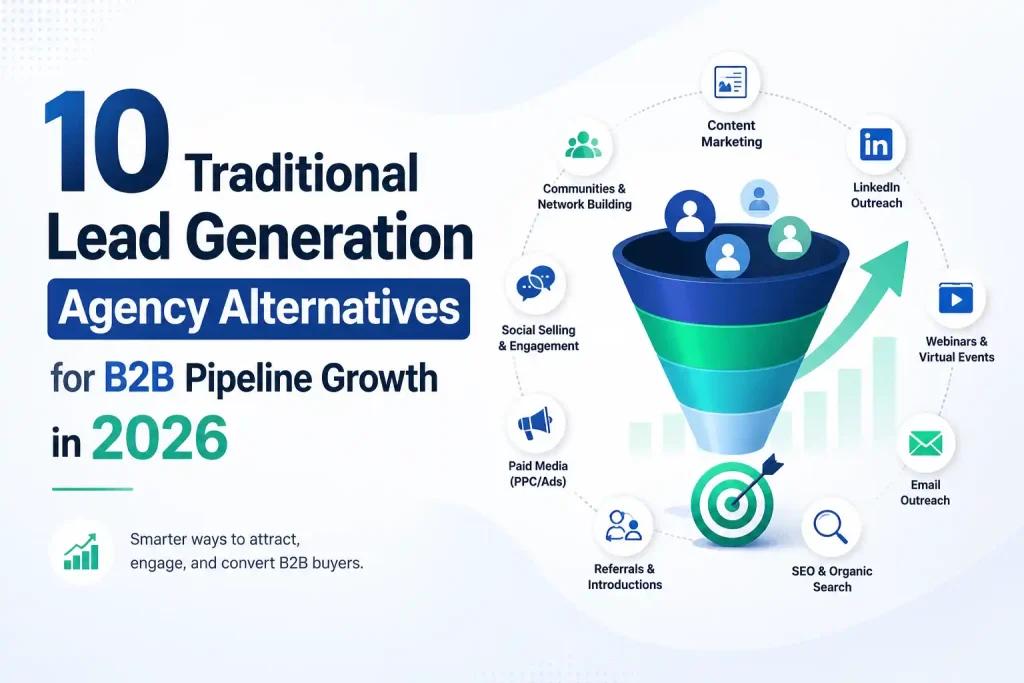
Traditional lead generation agencies were once the default option for B2B companies that needed more prospects.
The model was straightforward.
An agency built a contact list, sent emails, made calls, booked meetings, and handed the results to sales.
That model can still work. However, it is no longer the only option, and it is not always the right option.
B2B buyers now research vendors across search engines, LinkedIn, peer communities, review platforms, company websites, and generative AI tools before speaking with sales. Buying decisions are often made by committees rather than one individual, and irrelevant outreach can reduce trust before a conversation even begins.
LinkedIn describes B2B buying committees as groups that commonly include six to ten stakeholders, although some can be larger. That means successful pipeline generation must influence several people with different priorities, not simply reach one contact.
AI-assisted research has also become part of the mainstream buying journey. Forrester reported in January 2026 that 94% of surveyed B2B buyers used AI during their research, with generative AI or conversational search becoming an especially meaningful source of information.
As a result, companies evaluating Traditional Lead Generation Agency Alternatives are often looking for more than appointment volume.
They want:
- Better-qualified meetings
- More precise ICP targeting
- Buyer-signal-led outreach
- Stronger market authority
- Higher-intent inbound demand
- Better visibility in AI search
- Greater alignment between marketing and sales
- Clearer pipeline and revenue influence
- A repeatable GTM system
This guide compares ten alternatives available to B2B companies in 2026. It also explains where traditional agencies still make sense, how to evaluate different models, and where a Demand Intelligence partner such as Growleads fits.
What Are Traditional Lead Generation Agency Alternatives?
Traditional Lead Generation Agency Alternatives are internal teams, specialist partners, technology platforms, or integrated growth models that help companies create sales opportunities without relying solely on conventional outsourced prospecting.
These alternatives include:
- A B2B Demand Intelligence partner
- An in-house SDR team
- A fractional SDR team
- A specialist outbound agency
- An account-based marketing program
- An intent-data and sales intelligence platform
- An inbound demand generation partner
- A founder-led authority program
- A GEO and AEO partner
- A fractional GTM consultant supported by automation
These options are not mutually exclusive.
A growth-stage SaaS company may combine an internal account executive team with a fractional SDR partner, Google Ads, founder-led LinkedIn content, and a GEO strategy. Another company may need only a specialist outbound team for a new market launch.
The central question is not, “Which channel is best?”
The better question is:
Which system gives our company the right combination of buyer access, trust, intent, qualification, and sales readiness?
Why B2B Companies Are Looking Beyond Traditional Agencies in 2026
Traditional agencies are usually designed around activity execution.
They may provide prospect lists, email sequences, calling, LinkedIn outreach, appointment setting, and campaign reports. Those services can be valuable when the target market is clear and the offer is already proven.
Problems appear when the company has deeper GTM gaps.
For example:
- The ICP is too broad.
- The sales message is not resonating.
- The offer is difficult to explain.
- Buyers do not recognize the company.
- The website does not convert high-intent traffic.
- Sales and marketing use different qualification criteria.
- The company cannot identify which accounts are becoming active.
- Prospects research the brand but find little authority.
- Meetings are booked, but few become real opportunities.
- Pipeline reporting focuses on volume rather than commercial value.
In these situations, increasing outreach activity may create more replies without solving the underlying problem.
The Growleads positioning document captures this distinction clearly: Growleads presents itself as a B2B Demand Intelligence company rather than a conventional lead generation agency. Its model begins with ideal customers, buying signals, buying behavior, and market opportunities before campaigns are launched.
That buyer-first approach reflects a broader shift across B2B sales and marketing.
Salesforce reported in its 2026 sales statistics that 73% of B2B buyers actively avoid sellers who send irrelevant outreach. The implication is not that outbound has stopped working. It is that relevance, timing, and context have become more important.
What B2B Buyers Expect Before Booking a Sales Call
Modern buyers often enter a sales conversation with a working view of the market.
They may already know:
- Which vendors appear credible
- Which solutions fit their company size
- How providers describe their methodology
- Whether the founder has relevant expertise
- Whether the company understands their industry
- Which alternatives appear in AI-generated recommendations
- Whether the service solves a strategic problem or only executes a channel
- What evidence exists across content, reviews, case studies, and social profiles
LinkedIn’s 2026 B2B buying research describes a journey in which AI-led discovery and social trust work together. Buyers may discover vendors through AI systems, then validate their confidence through video, content, experts, peers, and social presence.
This changes the role of pipeline generation.
A company must do more than capture contact details. It must become visible, understandable, credible, and relevant before the buyer reaches out.
That requires four connected capabilities:
Buyer intelligence
The company needs to understand the ICP, buying committee, pain points, trigger events, priorities, and sales readiness.
Buyer access
The company needs effective channels for reaching likely buyers through email, LinkedIn, advertising, search, partnerships, events, or communities.
Buyer trust
The company needs authority content, founder credibility, clear positioning, proof, and useful information.
Buyer conversion
The company needs qualification, landing pages, follow-up systems, CRM processes, sales enablement, and accountable pipeline reporting.
Traditional agencies often concentrate heavily on buyer access. The alternatives below may cover one or more of the other capabilities.
Quick Comparison of the Best Alternatives
| Alternative | Best for | Main strength | Main limitation |
|---|---|---|---|
| Demand Intelligence partner | B2B firms needing an integrated pipeline system | Connects buyer signals, outbound, inbound, authority, and GTM | Requires strategic access and cross-team cooperation |
| In-house SDR team | Companies wanting maximum internal control | Deep product and market knowledge | Hiring, training, management, and technology costs |
| Fractional SDR team | Companies needing flexible execution | Faster capacity without building a full department | May not fix positioning or demand gaps |
| Outbound specialist | Companies with a proven offer and defined ICP | Focused prospecting and appointment setting | Often concentrated on top-of-funnel activity |
| ABM program | High-value enterprise sales | Coordinates engagement around target accounts | Resource-intensive and slower to establish |
| Intent-data platform | Mature revenue teams | Helps prioritize active accounts | Data requires interpretation and execution |
| Inbound demand partner | Companies building compounding demand | Captures high-intent buyers | Usually takes longer than direct outreach |
| Founder authority program | Expert-led B2B businesses | Builds trust and differentiation | Requires consistency and authentic participation |
| GEO/AEO partner | Companies seeking AI discovery | Improves machine-readable authority and citations | Measurement is still evolving |
| Fractional GTM and automation | Companies with unclear systems or lean teams | Improves strategy and operational efficiency | Cannot replace product-market fit or sales leadership |
1. A B2B Demand Intelligence Partner
Best for: Growth-stage B2B companies that need a complete pipeline generation system rather than a single outreach channel.
A B2B Demand Intelligence partner starts by identifying where demand exists, which buyers are most relevant, what signals indicate potential readiness, and how the company should engage those buyers across channels.
This approach may combine:
- ICP development
- Buyer and account research
- Market opportunity analysis
- Outbound campaigns
- Paid acquisition
- Inbound content
- Search visibility
- Founder authority
- Lead qualification
- GTM consulting
- AI automation
- Pipeline and revenue analysis
Why buyers consider this model
A Demand Intelligence partner is useful when the pipeline problem is not confined to one channel.
For example, a SaaS business may be sending cold email but struggling because its value proposition is unclear. It may also have weak search visibility, little founder authority, poor account prioritization, and no consistent qualification process.
Hiring separate providers for all of these areas can produce fragmented campaigns.
A more integrated partner can connect the work around a shared ICP, buyer journey, and revenue goal.
Potential fit
This model may suit companies that:
- Have an existing sales team
- Need qualified opportunities
- Sell a considered or high-value B2B offer
- Want both immediate outreach and long-term inbound demand
- Need stronger sales and marketing alignment
- Want reporting tied to meetings, opportunities, pipeline, and revenue influence
Where Growleads fits
Growleads positions itself in this category.
It combines Outbound Intelligence, Inbound Intelligence, LinkedIn Authority, GEO/AEO, Google Ads, LinkedIn Ads, cold email, LinkedIn outreach, GTM consulting, AI automations, and GTM agents.
The central difference is the sequence.
Most outreach providers begin by building lists and launching campaigns. Growleads begins with ICP analysis, buyer signals, buying behavior, market opportunities, decision-maker pains, and funnel gaps.
The aim is not to sell lists of leads. It is to build qualified pipeline.
2. An In-House SDR Team
Best for: Companies with sufficient budget, management capability, and a need for close internal control.
Building an internal sales development team gives a company direct ownership of prospecting, training, messaging, performance, and market feedback.
An internal SDR team may be responsible for:
- Account research
- Cold email
- Cold calling
- LinkedIn prospecting
- Event follow-up
- Inbound qualification
- Meeting booking
- CRM updates
- Early-stage opportunity development
Why buyers consider an in-house team
Internal SDRs can develop deep knowledge of the product, customer, competitive landscape, and sales process.
They work closely with account executives, product marketing, customer success, and leadership. This can improve feedback loops and make experimentation easier.
The company also maintains direct ownership of:
- Prospect conversations
- Training standards
- Data
- CRM processes
- Performance management
- Career progression
- Sales culture
Potential fit
An in-house team may be appropriate when:
- The company has repeatable product-market fit
- The average contract value supports dedicated SDR resources
- The sales process requires detailed product knowledge
- Leadership can recruit and manage the function
- There is enough addressable market to support ongoing prospecting
- The company wants long-term internal capability
Important consideration
An SDR team is not only a hiring decision.
The company also needs data sources, enrichment tools, deliverability infrastructure, dialling or engagement software, CRM administration, playbooks, coaching, quality assurance, analytics, and management.
Hiring representatives before establishing these systems can lead to inconsistent performance.
An internal team is therefore strongest when the business is ready to build a complete sales development capability, not simply add headcount.
3. A Fractional or Outsourced SDR Team
Best for: Companies that need prospecting capacity without immediately building a full internal department.
A fractional SDR provider supplies sales development talent, campaign operations, or both. It can act as an extension of the internal sales team.
Services may include:
- Account list building
- Contact research
- Email outreach
- LinkedIn outreach
- Cold calling
- Inbound qualification
- Reply management
- Meeting scheduling
- CRM reporting
Why buyers consider fractional SDR services
The model can shorten the time required to begin prospecting.
The provider may already have:
- Trained staff
- Technology
- Data sources
- Campaign managers
- Quality-control processes
- Outreach infrastructure
Martal, for example, describes its offer as outsourced sales support using international sales teams for outbound and inbound lead generation.
CIENCE currently describes its managed model as a combination of SDR teams, audience data, outbound campaigns, inbound qualification, and AI-supported GTM execution.
Potential fit
A fractional SDR team can be useful when:
- A company is entering a new market
- Sales representatives spend too much time prospecting
- Leadership wants to test outbound before hiring internally
- The company needs temporary capacity
- The ICP and offer are already reasonably clear
- The sales team can handle and progress the meetings produced
Important consideration
Outsourced execution does not remove the need for internal ownership.
The client still needs to provide:
- Product knowledge
- Market context
- customer insight
- Fast feedback
- Clear qualification standards
- Account executive follow-up
- Accurate CRM outcomes
A fractional team can create access to buyers. However, it cannot independently repair an unclear offer, weak sales process, or poor product-market fit.
4. A Specialist Outbound Lead Generation Agency
Best for: Companies that have a clear ICP and want focused appointment setting through direct outreach.
A specialist outbound agency concentrates primarily on proactive prospecting.
The agency may use:
- Cold email
- Cold calling
- Sales engagement sequences
- Contact databases
- Account research
- Appointment setting
Why buyers consider an outbound specialist
Specialist firms can bring process discipline and channel knowledge.
They may be especially valuable when a business needs to:
- Build a new pipeline quickly
- Reach a narrow set of decision-makers
- Expand into a specific geography
- Supplement an internal sales team
- Test messaging against a defined segment
Belkins is frequently considered in this category for appointment setting and outbound services. Callbox provides multichannel B2B lead generation and appointment setting across sectors including SaaS, software, cloud, cybersecurity, healthcare, and manufacturing.
Potential fit
A specialist agency may be suitable when:
- The offer has already converted in the target market
- Sales leaders know which accounts and roles matter
- The main bottleneck is outbound capacity
- The company has a strong closing team
- The buyer journey does not require extensive pre-sale education
How Growleads is different
Growleads also uses cold email and LinkedIn outreach, but it does not position outbound as a standalone volume exercise.
Its Outbound Intelligence model uses ICP criteria, buying signals, trigger events, buyer pain points, and qualification before opportunities reach sales.
Growleads may therefore be a stronger fit where a company needs outbound connected with inbound demand, founder authority, paid campaigns, AI visibility, and broader GTM work.
A specialist outbound agency may be the more direct choice when the company wants only prospecting execution.
5. An Account-Based Marketing Program
Best for: Companies selling complex, high-value solutions to a defined set of strategic accounts.
Account-based marketing, or ABM, organizes marketing and sales activity around selected companies rather than broad lead volume.
An ABM program may include:
- Named-account selection
- Buying committee mapping
- Account research
- Personalized content
- Executive outreach
- LinkedIn advertising
- Sales enablement
- Direct mail
- Events
- Retargeting
- Account engagement scoring
Why buyers consider ABM
ABM can help revenue teams coordinate their activity across several stakeholders.
This matters because B2B purchases often involve finance, operations, technology, procurement, leadership, and end users.
Rather than generating one lead and expecting that person to drive the purchase alone, ABM attempts to create awareness and engagement across the account.
Potential fit
ABM is often suitable for companies with:
- High average contract values
- Long sales cycles
- A finite target-account universe
- Multiple decision-makers
- Strong sales and marketing alignment
- Resources to create account-specific campaigns
Important consideration
ABM should not be confused with sending highly personalized emails to a short list.
A strong program requires:
- Careful account selection
- Buying group research
- Relevant content
- Channel coordination
- Sales participation
- Measurement at the account level
For lower-value or highly transactional products, the cost and complexity of ABM may not be justified.
6. An Intent-Data and Sales Intelligence Platform
Best for: Revenue teams that already have execution capacity but need better account prioritization.
Intent and sales intelligence tools help companies identify accounts or contacts that may be showing relevant activity.
Signals can include:
- Website visits
- Topic research
- Content engagement
- Product comparisons
- Hiring activity
- Funding
- Leadership changes
- Technology adoption
- Expansion
- Advertising engagement
- Competitor research
LinkedIn defines buyer intent as the actions prospects take while researching and deciding what to buy. These actions may include searching relevant topics, engaging with advertising, or downloading content related to a business problem.
Why buyers consider intent platforms
Traditional outbound often treats every account in a segment as equally important.
Intent data can help teams focus on companies with stronger evidence of activity or fit.
That can improve:
- Account selection
- Timing
- Message relevance
- Sales prioritization
- Advertising audiences
- Territory planning
Potential fit
An intent-data platform may work well when:
- The company has trained SDRs or account executives
- CRM and marketing data are reasonably clean
- The team can act quickly on signals
- There is enough account volume to require prioritization
- Sales and marketing agree on signal interpretation
Important consideration
A signal is not the same as buying readiness.
A company may research a topic for many reasons. A new executive may not be looking for your category. A website visitor may be a student, competitor, partner, or job candidate.
Signal data must be combined with ICP fit, context, messaging, human review, and qualification.
This is why Growleads uses signals as one component of Outbound Intelligence rather than treating every signal as an automatic sales opportunity.
7. An Inbound Demand Generation Partner
Best for: Companies that want buyers to discover them while actively researching a problem or solution.
Inbound demand generation creates useful paths for high-intent buyers to find and evaluate a company.
The work may include:
- SEO
- Content strategy
- Buyer-led topic clusters
- Comparison pages
- Solution pages
- Google Ads
- Conversion optimization
- Webinars
- Lead nurturing
- Retargeting
- Marketing automation
Why buyers consider inbound demand
Outbound creates conversations proactively. Inbound captures demand when buyers are already looking.
Inbound opportunities can be valuable because the buyer has taken an intentional step, such as:
- Searching for a solution
- Reading a comparison
- Visiting a pricing or service page
- Downloading a relevant resource
- Registering for a webinar
- Returning to the website
- Requesting a consultation
Potential fit
Inbound demand generation may be appropriate when:
- Buyers actively search for the category
- The company has expertise worth publishing
- The sales cycle requires education
- Long-term acquisition efficiency matters
- The business wants compounding visibility
- The company can invest before every channel produces immediate returns
Important consideration
Inbound is not simply publishing blog posts.
A useful inbound system connects:
- Buyer questions
- Search demand
- Commercial pages
- Thought leadership
- Distribution
- Conversion paths
- Lead qualification
- Sales follow-up
Growleads refers to this model as Inbound Intelligence: helping active buyers find a company through channels such as search, Google Ads, authority content, and GEO/AEO.
8. A Founder-Led LinkedIn Authority Program
Best for: B2B companies where trust in the founder or subject-matter expert significantly affects sales.
Many B2B buyers review the people behind a company before agreeing to speak with it.
They may check:
- The founder’s profile
- Recent posts
- Industry expertise
- Comments and conversations
- Customer stories
- Company positioning
- Shared connections
- Consistency of thought
A founder authority program turns this behavior into a deliberate growth channel.
What the program includes
It may involve:
- LinkedIn profile optimization
- Positioning
- Content pillars
- Founder interviews
- Thought leadership
- Original frameworks
- Case-study narratives
- Buyer education
- Relevant network growth
- Comment strategy
- Direct conversations
Why buyers consider founder-led growth
Trust is difficult to manufacture through advertising alone.
A credible founder who regularly explains customer problems, market changes, trade-offs, and practical lessons can help buyers understand the company before a sales call.
LinkedIn’s recent B2B research places strong emphasis on social trust and credible influence as part of brand building.
Potential fit
Founder authority can be especially effective for:
- SaaS companies in competitive categories
- Consulting firms
- Agencies
- IT services providers
- Founder-led businesses
- Companies selling expertise
- New categories that require education
Important consideration
Founder-led authority is not a substitute for a strong offer.
It also requires authentic input. Generic content written without the founder’s perspective is unlikely to create durable authority.
Growleads combines LinkedIn Authority with outbound and inbound activity so that prospects can encounter the company through outreach, review the founder’s expertise, and continue their research with greater confidence.
9. A GEO and AEO Partner
Best for: Companies that want to be understood, cited, and recommended across AI-assisted discovery experiences.
GEO means Generative Engine Optimization.
AEO means Answer Engine Optimization.
The terms overlap, but they generally refer to making a company’s content easy for search engines and generative systems to retrieve, interpret, summarize, and cite.
How GEO and AEO differ from traditional SEO
Traditional SEO commonly focuses on:
- Search rankings
- Organic clicks
- Keywords
- Links
- Technical performance
- Search snippets
AEO focuses on giving clear, direct answers to specific questions.
GEO focuses more broadly on whether generative systems can understand the entity, connect it with relevant topics, verify its claims, and include it in synthesized answers.
In practice, the disciplines support one another.
Google’s official guidance states that the foundations used for success in normal search remain relevant to generative features such as AI Overviews and AI Mode. Google emphasizes useful content, crawlability, page experience, structured information, and accurate business details rather than a separate collection of shortcuts.
Why buyers consider GEO and AEO services
A buyer may now ask an AI system:
- What are the best lead generation agency alternatives?
- Which B2B pipeline partners work with SaaS companies?
- How should I compare outsourced SDR providers?
- Which agencies combine outbound and inbound demand?
- What is the difference between lead generation and Demand Intelligence?
If a company is absent from the sources and entities used to answer these questions, it may be excluded before the buyer visits a search results page.
Potential fit
GEO and AEO may be valuable when:
- The company sells through research-intensive buyer journeys
- Category education matters
- Competitors are already appearing in AI responses
- The company has credible expertise but weak discoverability
- The sales cycle begins with comparison and research
- The website lacks clear entity and service definitions
Important consideration
No provider can responsibly promise inclusion in every AI answer.
AI responses vary by model, prompt, geography, freshness, source availability, and retrieval method.
A credible GEO strategy therefore focuses on fundamentals:
- Clear entity definitions
- Useful original content
- Source-backed claims
- Structured answers
- Topic depth
- Technical accessibility
- Consistent third-party references
- Accurate organization and service information
Growleads includes GEO/AEO within a wider pipeline strategy, connecting AI visibility with content, founder authority, inbound conversion, outbound campaigns, and GTM positioning.
10. Fractional GTM Leadership Supported by AI Automation
Best for: Companies that need strategic clarity and operating systems before increasing campaign volume.
Some pipeline problems are really GTM problems.
The company may not know:
- Which segment to prioritize
- Which pain point matters most
- Which offer to lead with
- How to structure the buyer journey
- Which channels deserve investment
- How marketing should support sales
- Which metrics indicate progress
- Where automation can remove repetitive work
A fractional GTM leader or consultant can help answer these questions without the immediate commitment of a full-time executive hire.
What fractional GTM support may include
- ICP development
- Market segmentation
- Positioning
- Messaging
- Funnel design
- Sales process
- Channel planning
- Territory strategy
- Pipeline metrics
- Revenue operations
- Technology selection
- Team structure
- Experiment design
How automation supports the model
Once the strategy is clear, automation can reduce manual work across:
- Lead routing
- Account research
- CRM enrichment
- Follow-up reminders
- Meeting preparation
- Lead scoring
- Call summaries
- Sales notes
- Reporting
- Signal monitoring
GTM agents can go further by analysing information and recommending actions rather than only following fixed rules.
For example, a research agent might review an account, identify relevant buying signals, and suggest an outreach angle. A qualification agent might analyse a reply and route it according to need, authority, timing, and fit.
Potential fit
This model may suit:
- Early growth-stage companies
- Lean revenue teams
- Companies preparing to scale
- Businesses with fragmented tools
- Teams that have tried several channels without clear learning
- Companies that need systems before hiring more people
Important consideration
Automation magnifies the quality of the underlying process.
If the ICP is wrong, automating prospecting can produce irrelevant activity faster. If qualification rules are weak, automation can route poor opportunities more efficiently without improving revenue.
Strategy should therefore come before scale.
Best Traditional Lead Generation Agency Alternatives by Use Case
Different situations call for different models.
Best for immediate outbound capacity
Consider:
- A fractional SDR team
- A specialist outbound agency
- An in-house SDR team
These options are most appropriate when the offer and ICP are already clear and the primary bottleneck is prospecting capacity.
Best for complex enterprise sales
Consider:
- Account-based marketing
- Intent data
- An in-house SDR team
- Demand Intelligence
Enterprise deals require coordination across accounts, stakeholders, channels, and long sales cycles.
Best for long-term inbound growth
Consider:
- An inbound demand generation partner
- SEO
- Paid search
- GEO/AEO
- Founder authority
These channels help buyers discover and evaluate the company independently.
Best for founder-led SaaS and consulting firms
Consider:
- LinkedIn Authority
- Demand Intelligence
- Founder-led content
- Signal-based outbound
- GEO/AEO
Trust in the founder can directly affect whether buyers respond, shortlist, and engage.
Best for unclear GTM strategy
Consider:
- Fractional GTM consulting
- Customer research
- ICP development
- Funnel analysis
- Offer and messaging work
Launching more campaigns before solving strategic uncertainty can waste budget and create misleading conclusions.
Best for an integrated pipeline system
Consider:
- A B2B Demand Intelligence partner
This is the broadest alternative when the company needs outbound, inbound, authority, paid acquisition, AI visibility, qualification, and GTM support to work together.
Outbound vs Inbound vs Authority-Led Growth
B2B companies often treat outbound, inbound, and authority as competing strategies.
They work better as connected layers.
| Growth layer | Primary role | Typical channels | Main advantage |
|---|---|---|---|
| Outbound | Creates direct buyer conversations | Email, LinkedIn, calls, account-based ads | Speed and control |
| Inbound | Captures active demand | SEO, Google Ads, content, landing pages | Higher buyer intent |
| Authority | Builds familiarity and trust | Founder content, expert insights, social proof | Stronger credibility |
| GEO/AEO | Improves AI-assisted discovery | Structured content, citations, entity clarity | Visibility in generative research |
| GTM intelligence | Coordinates the system | ICP, signals, funnel design, analytics | Better strategic alignment |
A prospect may receive a relevant email, visit the founder’s LinkedIn profile, search the company name, read a comparison page, encounter the brand in an AI-generated answer, and then book a meeting.
No individual channel deserves full credit.
The pipeline is the product of the connected journey.
SEO vs AEO vs GEO for B2B Pipeline Growth
SEO, AEO, and GEO have different emphases, but they should not operate in isolation.
SEO
SEO helps pages appear in traditional search results.
It includes technical accessibility, content relevance, links, internal architecture, user experience, and topical authority.
AEO
AEO structures information so that search and answer systems can extract concise responses.
It relies on:
- Direct definitions
- Question-based headings
- Short answer passages
- Lists
- FAQs
- Tables
- Clear entities
- Structured data
GEO
GEO helps generative systems understand and potentially reference a company within synthesized responses.
It benefits from:
- Verifiable statements
- Original analysis
- Consistent brand definitions
- Topic depth
- Credible citations
- Third-party mentions
- Machine-readable structure
- Strong entity associations
Which one should B2B companies prioritize?
Most companies should build all three on the same foundation.
A technically weak website with unclear services will struggle across normal and AI-assisted search. A site with excellent SEO but vague positioning may attract traffic without becoming a recommended entity. A site focused only on concise answers may lack enough depth and authority to earn trust.
The objective is not visibility for its own sake.
The objective is to become discoverable and credible when qualified buyers are researching a problem, category, or provider.
What Makes a Strong B2B Pipeline Generation Partner?
The strongest partner is not necessarily the provider with the largest database or the highest activity level.
Evaluate whether the partner can connect strategy, execution, qualification, and learning.
1. A clear ICP process
The partner should define:
- Industries
- Company size
- Geography
- Revenue or maturity
- Technology profile
- Business model
- Decision-makers
- Buying committee roles
- Exclusion criteria
Broad targeting usually produces broad results.
2. A buyer-signal framework
Ask which signals the provider uses and how those signals affect account selection, timing, messaging, and prioritization.
Signals should improve judgment, not merely decorate dashboards.
3. Message development based on customer reality
Strong messaging should reflect:
- Buyer pain
- Business impact
- Trigger events
- Existing alternatives
- Likely objections
- Desired outcomes
- Language used by real customers
4. Multichannel capability
Not every provider needs to manage every channel.
However, it should understand how email, LinkedIn, calls, advertising, content, search, and founder authority influence one another.
5. Clear qualification criteria
A booked calendar slot is not automatically a qualified meeting.
The provider should define:
- ICP fit
- Need
- Role or authority
- Relevant problem
- Timing
- Commercial potential
- Meeting acceptance criteria
6. Reporting beyond vanity metrics
Campaign metrics matter, but they should connect to commercial outcomes.
Useful reporting may include:
- Positive reply rate
- Qualified meetings
- Meeting attendance
- Sales-accepted opportunities
- Pipeline created
- Opportunity progression
- Cost per opportunity
- Revenue influence
- Segment-level learning
7. Transparent ownership
Clarify who owns:
- Domains
- Mailboxes
- Data
- Ad accounts
- Campaign assets
- CRM records
- Content
- Dashboards
- Automation workflows
8. A realistic view of risk
A trustworthy partner should explain dependencies and uncertainty.
Results may be affected by:
- Product-market fit
- Brand awareness
- Market size
- Sales follow-up
- Pricing
- competition
- Deal complexity
- Deliverability
- Proof
- Website quality
- Offer relevance
Avoid providers that reduce a complex revenue problem to a simple promise.
Common Mistakes When Replacing a Lead Generation Agency
Choosing a new provider before diagnosing the old problem
An underperforming campaign may be caused by targeting, messaging, deliverability, qualification, sales follow-up, weak authority, or poor market fit.
Changing vendors without identifying the cause can reproduce the same result.
Optimizing for meeting volume
A high meeting count can look positive while creating little pipeline.
Revenue teams should evaluate whether meetings are accepted, attended, progressed, and commercially relevant.
Treating every response as a lead
Interest, politeness, curiosity, partnership requests, job enquiries, and future consideration are not equivalent to active sales opportunities.
Expecting one channel to carry the entire GTM strategy
Cold email cannot compensate indefinitely for weak positioning. SEO cannot fix a poor sales process. Ads cannot create trust on their own. Founder content cannot replace prospecting in every market.
Ignoring the buying committee
A campaign focused only on one job title may fail to address technical, financial, operational, and executive stakeholders.
Automating before learning
Automation should scale a process that has shown signs of working.
It should not replace customer research, judgment, or strategic clarity.
Failing to connect marketing and sales data
The provider may report booked meetings while sales records show poor fit. Sales may reject opportunities without documenting why. Marketing may generate demand without receiving feedback.
A shared pipeline view is essential.
How to Evaluate Your Options
Use the following seven-step framework.
Step 1: Define the pipeline problem
Write down the actual constraint.
Examples:
- Not enough conversations
- Poor meeting quality
- Low brand recognition
- Weak inbound demand
- Long sales cycles
- Unclear ICP
- Low win rates
- Limited market feedback
- Inconsistent follow-up
- Poor AI visibility
Step 2: Separate strategy from capacity
Determine whether you need someone to decide what should be done, someone to execute it, or both.
Hiring execution capacity to solve a strategy problem rarely works.
Step 3: Map the buyer journey
Identify how buyers:
- Recognize the problem
- Research solutions
- Build a shortlist
- Validate providers
- Involve colleagues
- Assess risk
- Contact sales
- Reach a decision
Step 4: Choose the required growth layers
Select the combination of:
- Outbound
- Inbound
- Paid media
- Authority
- GEO/AEO
- Sales development
- GTM consulting
- Automation
Step 5: Define qualification
Document what must be true for a meeting to count as qualified.
Step 6: Define success metrics
Choose metrics that connect campaign activity to pipeline and revenue.
Step 7: Select the operating model
Decide whether the work belongs:
- In-house
- With a specialist
- With several coordinated providers
- With an integrated Demand Intelligence partner
- In a hybrid model
Where Growleads Fits
Growleads may be a suitable alternative for B2B companies that do not want to manage disconnected providers for outbound, inbound, paid acquisition, authority, AI visibility, GTM consulting, and automation.
Growleads is a B2B Demand Intelligence company.
It primarily helps SaaS companies, technology businesses, B2B service firms, agencies, IT services providers, and consulting companies build more qualified pipeline.
Its work can include:
- Outbound Intelligence
- Inbound Intelligence
- LinkedIn Authority
- GEO and AEO
- Google Ads
- LinkedIn Ads
- Cold email
- LinkedIn outreach
- GTM consulting
- AI automations
- GTM agents
The model starts with buyers.
Before campaigns are built, Growleads examines ICP fit, buyer signals, buying behavior, decision-maker pain points, market opportunities, funnel gaps, and sales readiness.
This matters because a pipeline problem is rarely solved by activity alone.
Outbound Intelligence helps identify and engage likely buyers through signal-based email, LinkedIn, and paid outreach.
Inbound Intelligence helps active buyers discover the company through search, content, Google Ads, and AI-oriented visibility.
LinkedIn Authority helps founders and experts build familiarity and trust before or after direct outreach.
GTM consulting helps teams clarify segments, messaging, journeys, channels, and funnel design.
AI automations and GTM agents can reduce repetitive work and improve research, routing, qualification, and monitoring.
This does not mean every company needs every service.
A business with strong inbound demand may need only outbound support. Another may have effective sales development but poor AI visibility. A third may need GTM clarity before any campaign begins.
The value of the Demand Intelligence model is that these decisions can be made around the same buyer and pipeline strategy.
Growleads helps B2B teams move from random lead generation to a more structured demand and pipeline system.
Final Recommendation
Traditional lead generation agencies remain useful when a company has a proven offer, clear ICP, strong sales team, and a straightforward need for additional prospecting.
However, many B2B companies need more than outreach capacity.
They need to understand buyers, identify active accounts, create relevant conversations, build authority, capture inbound demand, appear in AI-assisted research, qualify opportunities, and connect campaign performance to revenue.
The best alternative depends on the constraint.
Choose an in-house SDR team when control and product expertise matter most.
Choose a fractional SDR or outbound specialist when the main need is additional prospecting capacity.
Choose ABM and intent data for complex, high-value account strategies.
Choose inbound, founder authority, and GEO/AEO when buyers need to discover and trust the brand before speaking with sales.
Choose fractional GTM support when the strategy or operating model is unclear.
Choose a B2B Demand Intelligence partner when these needs overlap and the company wants one coordinated pipeline system.
If your team wants more than lead volume, Growleads can help you build a buyer-signal-led pipeline system across outbound, inbound, authority, paid acquisition, GTM intelligence, and AI search visibility.
FAQs
1. What are the best Traditional Lead Generation Agency Alternatives?
The best Traditional Lead Generation Agency Alternatives include Demand Intelligence companies such as Growleads, outsourced SDR providers such as CIENCE and Martal Group, appointment-setting firms such as Belkins and Callbox, in-house SDR teams, ABM programs, intent-data platforms, inbound demand partners, and GEO/AEO specialists. The right choice depends on your pipeline goals, ICP, sales cycle, and internal capabilities.
2. Is an in-house SDR team better than a lead generation agency?
An in-house SDR team may be better when a company wants greater control, deeper product knowledge, and a permanent internal capability. An agency may be more practical when the company needs faster execution, specialist infrastructure, or flexible capacity. The decision should include hiring, training, technology, management, data quality, and long-term operating costs.
3. What is the difference between lead generation and pipeline generation?
Lead generation identifies or attracts potential buyers. Pipeline generation goes further by creating qualified sales opportunities that can progress through the revenue process. It includes targeting, engagement, qualification, sales acceptance, opportunity creation, and commercial measurement. A company can generate many leads without building meaningful pipeline if those contacts lack fit, need, authority, or timing.
4. What is a B2B Demand Intelligence company?
A B2B Demand Intelligence company studies ideal customers, buyer signals, buying behavior, market opportunities, and sales readiness before launching campaigns. It then uses those insights to create qualified pipeline. Growleads applies this model across Outbound Intelligence, Inbound Intelligence, LinkedIn Authority, paid acquisition, GEO/AEO, GTM consulting, AI automations, and GTM agents.
5. Can AI replace a traditional lead generation agency?
AI can automate research, enrichment, message preparation, lead routing, qualification support, reporting, and signal monitoring. It cannot fully replace customer understanding, strategic judgment, credible positioning, human conversations, or sales leadership. The strongest model combines AI with experienced oversight. Automating a weak ICP or irrelevant message only scales poor activity more efficiently.
6. How is GEO different from SEO for B2B companies?
SEO helps websites appear in traditional search results, while GEO helps generative systems understand, retrieve, and potentially cite a company in AI-generated answers. GEO depends on clear entity information, useful content, credible sources, structured answers, and topical authority. The two disciplines overlap, so most B2B companies should build them on the same foundation.
7. Does cold email still work for B2B lead generation in 2026?
Cold email can still create qualified conversations when campaigns use accurate targeting, reliable infrastructure, relevant timing, credible messaging, and disciplined qualification. Generic, high-volume outreach is more likely to be ignored or reduce trust. Strong campaigns focus on buyer context, trigger events, business pain, and commercial relevance rather than sending the same message to every prospect.
8. How should a company measure an outsourced pipeline partner?
Measure more than emails sent, replies, or calendar bookings. Useful metrics include qualified meetings, attendance, sales acceptance, opportunities created, pipeline value, opportunity progression, cost per opportunity, and revenue influence. The provider and internal sales team should use the same qualification criteria and record clear reasons when opportunities are accepted, rejected, advanced, or lost.
9. When is Growleads a good alternative to a traditional agency?
Growleads may be a strong fit when a B2B company needs more than isolated appointment setting. It supports buyer-signal-led outbound, inbound demand, founder authority, paid acquisition, AI search visibility, GTM clarity, qualification, and automation. A specialist outbound provider may be more suitable when the company only needs additional calling, email, or appointment-setting capacity.
10. How long does it take to build predictable B2B pipeline?
There is no universal timeline for building predictable pipeline. Direct outreach can produce conversations sooner than organic search or authority building, but results depend on market fit, sales cycle, targeting, offer strength, reputation, proof, and follow-up. Predictability develops through repeated testing, qualification, conversion analysis, channel coordination, and disciplined sales execution over time.
11. Should B2B companies use outbound or inbound demand generation?
Most established B2B companies benefit from using both. Outbound creates direct access to selected buyers and can generate faster market feedback. Inbound captures buyers already researching a problem or solution. Authority and GEO/AEO strengthen both by improving trust and discoverability. The right mix depends on contract value, market maturity, brand awareness, and sales cycle.
12. What should a company ask before hiring a pipeline generation partner?
Ask how the provider defines the ICP, uses buyer signals, develops messaging, protects deliverability, qualifies meetings, coordinates channels, and reports pipeline. Clarify ownership of data, domains, ad accounts, content, CRM records, and workflows. Also ask which outcomes depend on your team, including sales follow-up, product-market fit, pricing, proof, and executive participation.

Builds the demand intelligence, automation, and deliverability systems behind Growleads pipeline.