
The Step-by-Step Sales Process Optimization Checklist for Closing More Deals

Companies with a formal sales process optimization checklist grow their revenue 18% more than those without one.
Pretty impressive, right? But here’s the shocking truth – up to 90% of new CRM projects fail. Not because the technology doesn’t work, but because people simply don’t use it. This reveals a huge gap in how sales teams approach process improvement.
The data makes a compelling case for structured approaches. Organizations that improve their sales process are 33% more likely to perform better, shortening sales cycles by 20% while boosting revenue by 30%.
These aren’t just random numbers. When you optimize your sales process systematically, you create measurable success for your team. Companies using sales process optimization enjoy 28% more revenue growth than their disorganized competitors. And those implementing optimization tools? They see a 34% jump in revenue, with nearly 95% working more efficiently.
You need a practical, step-by-step approach to transform your sales performance. That’s exactly what I’m giving you in this guide. We’ll cover everything from mapping your current workflow to implementing continuous improvement strategies that work.
Let’s dive in and boost your close rates 👇
Step 1: Map and Visualize Your Sales Process
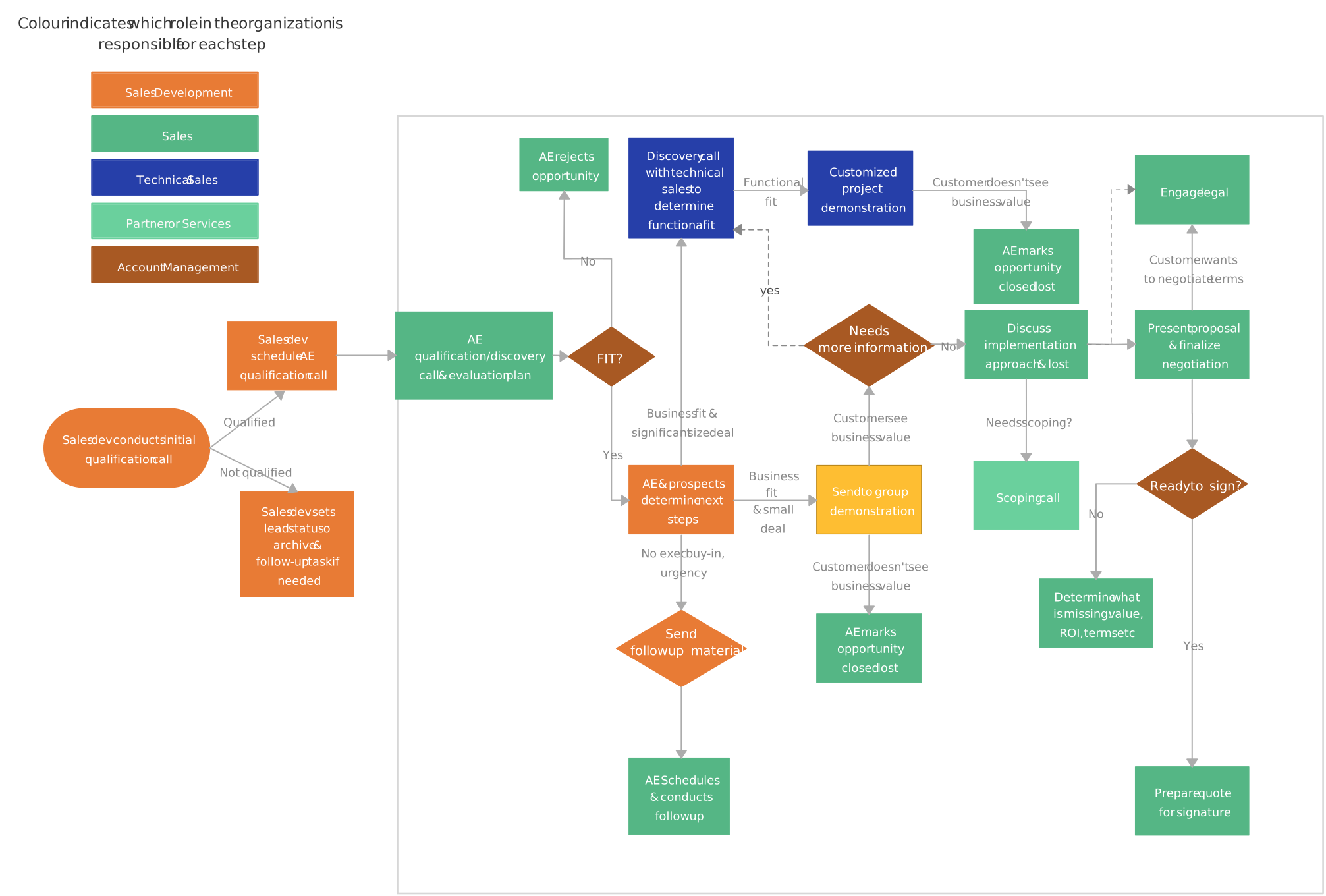 You can’t fix what you can’t see. Before optimizing your sales process, you need a clear picture of what’s actually happening when your team sells.
Mapping your sales journey gives you that bird’s-eye view of how prospects move from first touch to closed deal. This visibility is crucial for spotting where things get stuck.
Identify each stage from lead to close
Every effective sales process has clearly defined stages. Without these signposts, your team is essentially navigating in the dark.
Your sales pipeline should typically include these key stages:
- Lead generation: Where potential customers first discover you
- Lead qualification: Determining if they’re actually a good fit
- Initial contact: Making that first meaningful connection
- Proposal/Demo: Showing them how you solve their problem
- Negotiation: Working through objections and terms
- Closing: Sealing the deal and celebrating the win
For each stage, you need specific criteria that tell you when a deal should move forward. This clarity keeps everyone on the same page and ensures consistent pipeline management. Research shows that high-performing teams are more likely to adhere to formalized sales processes, making this step non-negotiable for sales improvement.
Use flowcharts or CRM pipelines
Once you know your stages, you need to visualize them. This is where your CRM becomes invaluable, helping with everything from lead management to forecasting and automation.
You have several visualization options:
- Flowcharts: Perfect for complex processes with multiple decision points
- Kanban boards: Give you that satisfying visual of deals moving through stages
- CRM dashboards: Provide customizable views of your entire sales cycle
Today’s CRM systems let you build pipelines that match how your buyers actually buy. With tools like Pipedrive, you can adapt pipelines to your unique process and track deals as they progress. This visual approach makes it much easier to spot patterns and performance issues in your sales process.
Spot bottlenecks and drop-off points
Bottlenecks are the traffic jams of your sales process – points where deals slow down or get completely stuck. These congestion points hurt your effectiveness and lead to missed opportunities.
To find your bottlenecks:
- Look for deals that take unusually long to move. If they exceed your average timeframe, you’ve likely found a bottleneck.
- Analyze stages where deals commonly die. A significant drop in conversion rates between particular stages usually indicates a problem area.
- Use timers to measure the duration between stages, which helps you understand closing times for different customer types.
Pay close attention to your funnel drop-off rates, the percentage of prospects who never make it to the next stage. High drop-offs between specific stages reveal exactly where you’re losing people. For example, Costa Coffee discovered that 50% of registration drop-offs happened when users entered invalid passwords, allowing them to design targeted tools.
Mapping your process isn’t just paperwork, it’s the foundation for all your optimization efforts. Instead of making changes based on gut feelings, you’ll have solid data guiding your improvement strategy.
Step 2: Qualify and Score Leads Effectively
“Revenue is everyone’s job, not just sales. When marketing becomes a full-funnel partner, weaving influence from first touch to renewal, we enable reps to spend less time building and more time connecting.”
, Mike Weinberg, Sales Coach & Author
Lead qualification is the foundation of an efficient sales process. Without it, you’re essentially throwing resources at prospects who may never convert. And let’s face it – nobody wants to waste time chasing dead-end leads when they could be closing deals with genuine prospects.
Set criteria for lead scoring
You need a clear system that measures both who your prospects are and their interest level. Think of lead scoring as your quality filter – it combines demographic data with behavioral signals to help you prioritize the right leads.
Your lead scoring should focus on two key dimensions:
- Prospect identity (explicit scoring) – Who they are: job title, industry, company size
- Prospect engagement (implicit scoring) – Their interest level: website visits, content engagement, email responses
When building your scoring system, start by identifying 4-5 explicit data categories that signal sales-readiness, then assign percentage rankings based on their importance. For engagement scoring, determine which behaviors matter most and weight them based on recency.
Don’t set it and forget it! Review your scoring regularly with input from sales and marketing. Your sales acceptance rate is the ultimate scorecard for how well your system is working.
Disqualify low-fit leads early
Here’s a counterintuitive truth: good selling sometimes means saying “no.” Your sales reps should aim to disqualify approximately 20% of incoming leads. If they’re disqualifying fewer, they might be letting poor-fit leads slip through. Substantially more? Your lead generation might need adjustment.
Disqualifying early has clear benefits:
- Your team focuses selling time on high-potential opportunities
- You avoid poor-fit customers who’ll churn quickly
- Your sales forecasting stays accurate
- Everyone has a better experience – your team and your customers
The smartest disqualification sequence is: company fit first, then business pain, followed by decision-making power. Even if you’re talking to a CEO with unlimited budget, if they don’t have a problem you can solve, it’s time to move on.
Use behavioral and demographic data
The most powerful lead scoring combines who people are with what they actually do. Demographic data tells you if they match your ideal customer profile, while behavioral data reveals genuine interest.
Your demographic scoring should assess:
- Company size, revenue, and growth potential
- Job titles and decision-making authority
- Industry type and geographic location
Your behavioral scoring should track engagement actions like:
- Website visits (especially pricing pages)
- Email opens and clicks
- Content downloads
- Social media interactions
The most sophisticated approach is “demographic gating” – combining both scoring types to thoroughly qualify leads. This approach doesn’t just identify qualified leads; it also shows how targeted your marketing efforts are based on the percentage of demographically qualified leads coming through each channel.
Remember that markets change and so should your scoring. Implement dynamic lead scoring models that adapt based on evolving lead behaviors and characteristics. This ensures your criteria stay aligned with current market conditions and your sales reality.
Step 3: Automate Repetitive Sales Tasks
Your sales team should be selling, not drowning in admin work. Yet most sales reps spend hours on repetitive tasks instead of closing deals. Sales automation software handles these time-consuming activities, letting your team focus on what actually brings in revenue, talking to prospects and closing deals.
Automate follow-ups and reminders
Did you know that 80% of sales happen between the 5th and 12th follow-up? Despite this, follow-ups are often the first thing forgotten during busy days. Without a system, you’re leaving money on the table.
Here’s how to implement effective follow-up automation:
- Create email sequences that automatically engage leads who don’t respond initially
- Set up notifications that alert your team when prospects interact with your content
- Build reminder workflows for upcoming calls and meetings
These systems prevent deals from slipping through the cracks. Welcome emails have a 58% open rate, and triggered emails generate 70% higher open rates than traditional emails. Smart teams even use tools that analyze out-of-office replies and automatically reschedule follow-ups for when prospects return.
Use CRM integrations for data entry
Sales professionals hate manual data entry. Many teams spend more time updating their CRM than actually selling. Modern integrations solve this problem.
When setting up data entry automation:
- Connect your email and calling tools with your CRM for automatic logging
- Use voice assistants to transcribe calls and update relevant fields
- Add one-click data enrichment tools that fill in contact information
These integrations ensure everyone follows the same process from lead generation to closing. Plus, automated data entry reduces errors and keeps information consistent across your sales cycle.
Trigger emails based on user actions
Behavior-triggered emails respond to specific user actions, making them incredibly relevant. Unlike scheduled emails, these messages react to how customers interact with your business, whether they’re opening emails, visiting pricing pages, or abandoning carts.
Effective trigger-based automation includes:
- Welcome sequences when prospects sign up
- Re-engagement campaigns for inactive customers
- Milestone emails for personal occasions like anniversaries
With these automated systems in place, you’ll streamline your entire sales process, cut down manual work, and ensure no prospect gets forgotten, essential components of any effective sales improvement strategy.
Step 4: Apply a Tested Sales Methodology
“A good sales methodology isn’t about scripts, it’s about teaching repeatable A-player behaviors in a way that reps can personalize and internalize. That’s how you turn process into performance.”
, Charlie Cowan, Revenue Acceleration Expert & Author
Want to know what separates average sales teams from exceptional ones? A structured sales methodology.
Unlike random selling approaches that leave results to chance, tested methodologies give your team a systematic framework for navigating complex sales situations with predictable outcomes. This isn’t just about following scripts – it’s about creating repeatable success.
Choose a framework like BANT or SPIN
Your selling environment and objectives should dictate which methodology you select:
- BANT (Budget, Authority, Need, Timeline) – This framework is perfect for lead qualification. It helps you quickly determine if prospects have the financial resources, decision-making power, genuine need, and appropriate timeline. BANT remains reliable for 52% of salespeople and helps 36% plan their sales process timeline.
- SPIN (Situation, Problem, Implication, Need-payoff) – If you’re handling complex B2B sales, SPIN is your best friend. It uses strategic questioning to uncover deeper needs. The results speak for themselves – SPIN can boost sales productivity by up to 17% and increase closure rates by 20%. What makes it work? SPIN systematically guides conversations through four question types that help prospects recognize their own problems.
You’ve got other options too – MEDDIC, Solution Selling, and Challenger Sale each offer distinct advantages depending on your selling scenario.
Train your team on consistent usage
Here’s the truth – consistency in applying your chosen methodology drives remarkable results. But you need to start with your leadership team. Research shows sales leaders must master the methodology before the rest of the team, actively using the tools and language throughout the process.
To implement effective training:
- Make sellers part of the process – when they help create or adapt the methodology, adoption increases through what researchers call the “IKEA effect”
- Communicate why the methodology matters through regular briefings
- Focus on early-stage coaching – it’s absolutely critical for success
- Connect the methodology to your CRM for constant reinforcement
Adapt methodology to your sales cycle
Even the most impressive methodology won’t work if it doesn’t fit your business. The most successful sales methodologies connect directly to your:
- Go-to-market strategy
- Buyer’s journey
- Sales process stages
- Differentiated value proposition
Customization isn’t optional – it makes your chosen methodology more effective and less likely to be abandoned. Consider your sales goals, team strengths, product complexity, and target customers when tailoring your approach.
When you implement a consistent sales methodology, you create a common language across your organization. This enables your team to repeat winning practices and builds a more cohesive group focused on what matters most – closing deals.
Step 5: Track Performance and Optimize Continuously
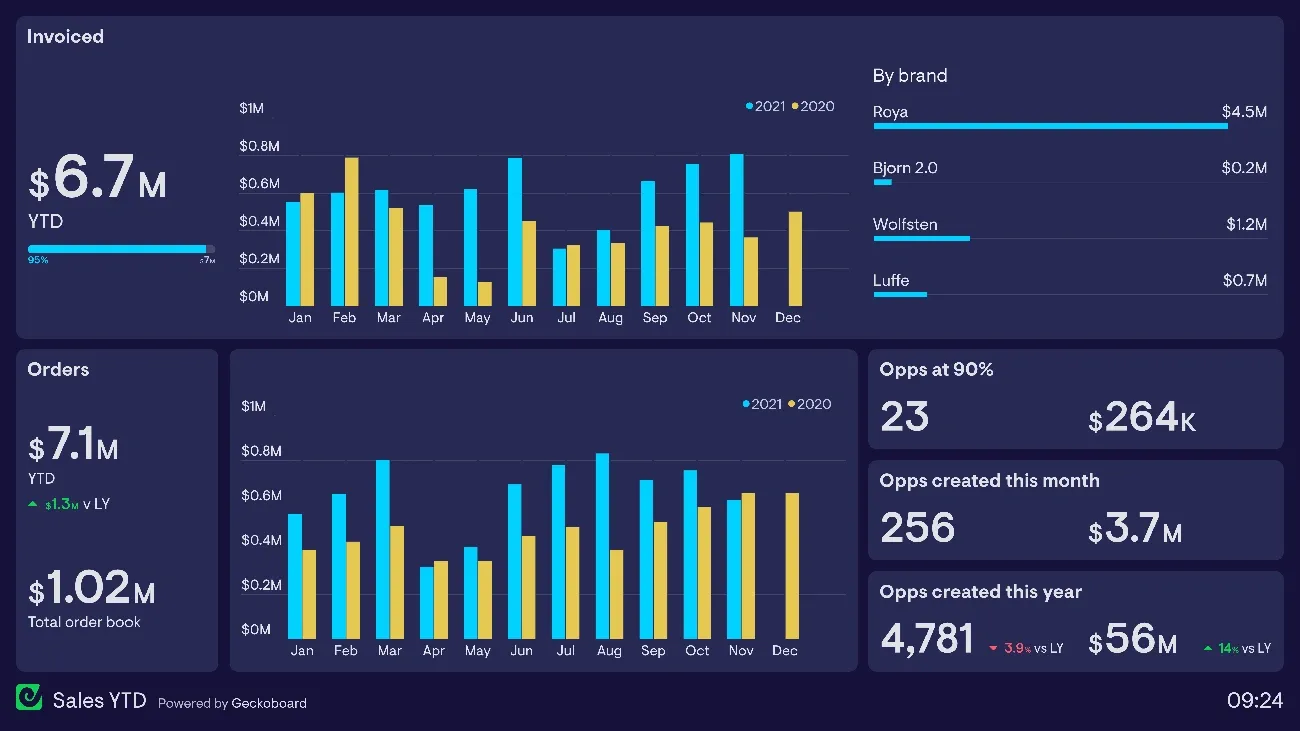 You can’t improve what you don’t measure. Tracking key metrics gives you the foundation for continuous refinement of your sales process. When done right, these tracking methods turn raw data into actionable insights that boost both performance and revenue.
Use dashboards to monitor KPIs
The best sales teams use dashboards as their “sales goal GPS.” These visual tools give you clear visibility into performance metrics, transforming complex data into digestible charts and graphs. Your dashboards should be simple, visible to your entire sales team, and powered by real-time data.
What should you actually track? Here are the essentials:
- Pipeline coverage ratio (typically 3:1 but varies by industry)
- Conversion rates between sales stages
- Sales velocity and cycle length
- Average deal size
- Number of stalled deals
Don’t fall into the trap of tracking too many metrics at once – you’ll end up with data paralysis. Instead, pick one North Star metric and three to seven supporting metrics that align with your company strategy. Quality over quantity wins every time.
Review pipeline health regularly
Want higher win rates? Conduct consistent pipeline reviews. These regular check-ins help you spot stalled opportunities and focus your reps on high-value deals. Set up a review cadence – weekly one-on-ones with each rep work best. During these meetings, first verify your CRM data is accurate, then categorize deals as committed, best-case, pipeline, or stuck.
For the healthiest pipeline, you need to watch both traditional sales funnel metrics and customer relationship metrics. These reviews create accountability, establish clear action items with specific deadlines, and confirm exit criteria for every stage. No more deals languishing in pipeline purgatory!
Adjust based on data and feedback
Here’s a mindset shift for you: treat each sales campaign as a business experiment. After you’ve executed, compare performance against your initial objectives to understand what worked and what didn’t.
Don’t forget to incorporate customer feedback – it’s gold for identifying improvement areas. Track engagement metrics after making changes to see how your adjustments impact results. This continuous feedback loop strengthens relationships with existing customers while building trust with potential ones.
By consistently monitoring performance and making data-driven adjustments, you’ll build a sales process that evolves alongside your market’s needs. Your competitors will be left wondering how you always seem one step ahead.
Conclusion
A well-optimized sales process completely changes how your team tackles each opportunity. By mapping your workflow, you’ve uncovered those hidden bottlenecks. With proper lead qualification, your reps focus exclusively on prospects who might actually buy. And through automation, you’ve eliminated the tedious tasks that steal valuable selling time.
The results speak for themselves. Remember those numbers from earlier? Organizations using structured approaches cut their sales cycles by 20% while boosting revenue by 30%. This isn’t just theory – it’s the practical reality sales leaders witness when they commit to methodical process improvement.
Your sales methodology might be the most important piece of this puzzle. The framework you choose creates the foundation for consistent communication, predictable outcomes, and repeatable success. When you pair this with solid performance tracking, you create a continuous cycle of improvement that keeps getting better.
Don’t view this checklist as something you do once and forget. It’s an ongoing commitment to sales excellence. Each component works with the others to build a comprehensive system for sustainable growth. Your team deserves the clarity and confidence that comes from a well-defined process.
Take these five steps, implement them today, and measure your results. Your close rates will climb. Yes, optimization takes dedication, but the revenue gains and efficiency improvements make it worthwhile. Your sales success doesn’t depend on working harder – it’s about working smarter through systematic process refinement.
Discover tactics that work! Visit GrowLeads.io to optimize your sales process today.
FAQs
Q1. How can I effectively map my sales process?
Start by identifying each stage from lead generation to closing. Use visual tools like flowcharts or CRM pipelines to represent your process. This helps you spot bottlenecks and drop-off points, allowing for targeted improvements in your sales workflow.
Q2. What’s the best way to qualify and score leads?
Set clear criteria for lead scoring based on both demographic and behavioral data. Use this system to prioritize high-potential prospects and disqualify low-fit leads early. Regularly evaluate and adjust your scoring system to ensure it accurately reflects lead quality.
Q3. Which sales tasks should I automate?
Focus on automating repetitive tasks like follow-ups, reminders, and data entry. Use CRM integrations to streamline data management and set up trigger-based emails that respond to specific user actions. This frees up your team to concentrate on high-value activities like relationship building and closing deals.
Q4. How do I choose and implement a sales methodology?
Select a tested framework like BANT or SPIN that aligns with your sales environment. Train your team thoroughly for consistent usage and adapt the methodology to fit your specific sales cycle. This creates a common language across your organization and enables the repetition of successful practices.
Q5. What should I track to continuously improve my sales process?
Use dashboards to monitor key performance indicators (KPIs) such as pipeline coverage ratio, conversion rates, and sales velocity. Conduct regular pipeline health reviews and adjust your strategies based on data and feedback. This approach allows for ongoing optimization of your sales process.

Runs the sales process, lead qualification, and client delivery that turn signals into qualified meetings.