
LinkedIn Outbound Agency: Signal-First Prospecting That Scales on Real Buyer Signals
Most LinkedIn outbound is spam with better targeting. Connection requests fire at everyone in a job title. Follow-up messages hit the same 500 people who did not respond to the first one. Connection counts go up. Meetings do not.
The problem is not LinkedIn as a channel. LinkedIn is one of the highest-intent B2B surfaces in the world. The problem is that most teams run LinkedIn outreach the same way they ran cold email in 2019: volume-first, signal-none.
We built the LinkedIn outbound service around a different assumption. Every outreach sequence starts with a buying signal we can name and date. The message references what we detected. The connection request fires because something changed, not because someone has a job title we like.
This is what signal-first LinkedIn outbound looks like as an operating model, not a template.
Who this is for
The LinkedIn outbound service is built for B2B companies with an existing sales team that needs better accounts, not more activity.
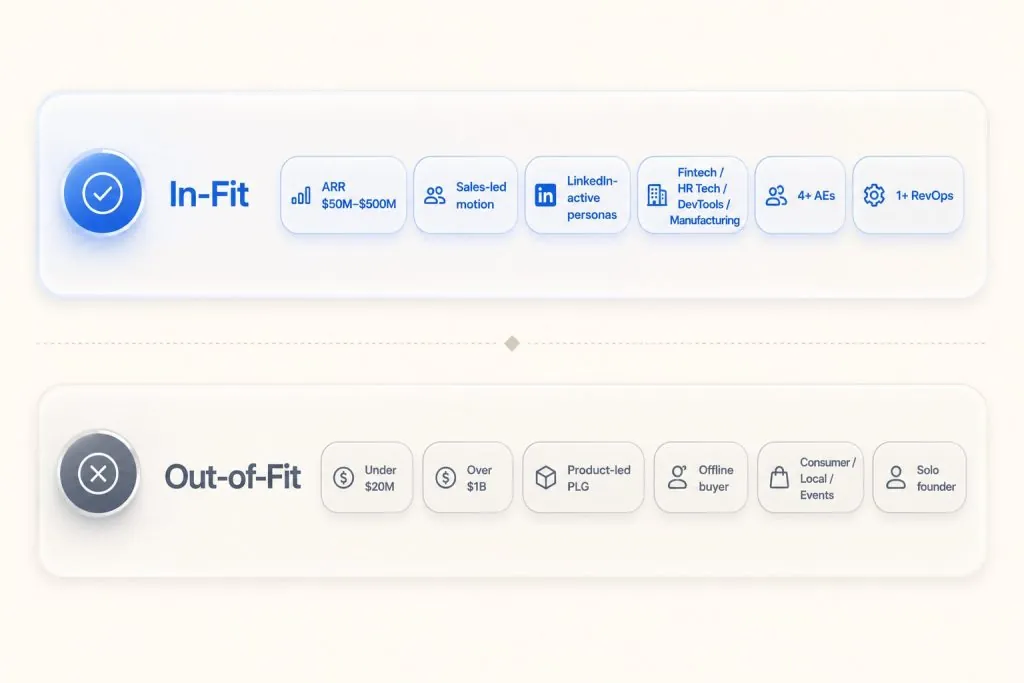
| In-fit | Out-of-fit | |
| ARR band | $50M-$500M | Under $20M (no AE capacity to absorb qualified meetings) or over $1B (needs platform, not agency) |
| Sales motion | Sales-led or sales-assisted; AEs close | Product-led, pure self-serve |
| LinkedIn maturity | Senior personas active on LinkedIn | Offline buyer; no LinkedIn presence |
| Verticals | Fintech, HR tech, DevTools, manufacturing | Consumer, local services, events |
| Team shape | 4+ AEs, 1+ RevOps person | Solo founder or founder-only sales |
If you are running outbound on LinkedIn with a blank Sales Navigator account and generic connection templates, this is the right conversation. If you already have a mature outbound motion with signal detection in place and you are looking for more capacity, we are probably not the right fit.
We do not take every prospect. We take the ones where the signal model is the difference between a meeting that converts and a meeting that burns a rep’s calendar.
What we actually do
The LinkedIn outbound engagement has three phases: setup, launch, and compounding.
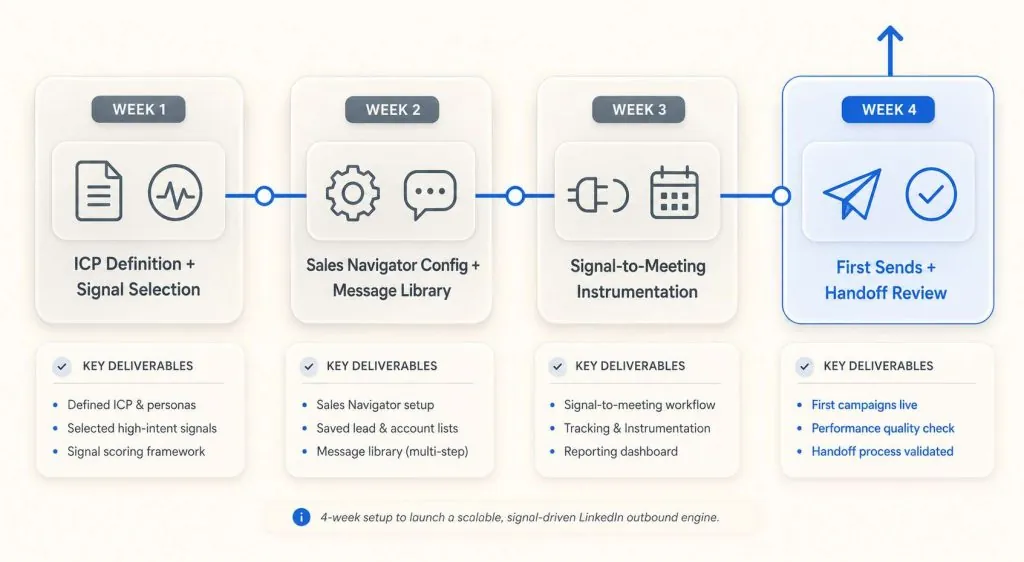
Phase 1: Four-week setup
Week 1: ICP definition and signal selection
We write the ICP sheet with you. Not a list of titles. A full account profile: firmographic ranges, buying-committee composition, the 3-5 buying signals that indicate a real window, and the exclusion criteria that filter out tire-kickers and competitors.
Most agencies hand you a list. We hand you a documented account model that lives in your CRM and compounds with every deal you close.
Signal selection follows. We build a signal stack of 15-25 signals per ICP segment, pulled from Bombora intent data, G2 comparison page activity, LinkedIn job postings for relevant roles, technology stack changes, and funding events. The stack is not a list. It is a weighted model: some signals are worth more than others, and the weighting is based on your own closed-won data.
Week 2: Sales Navigator configuration and message library
We configure Sales Navigator for your team or audit your existing setup. The filter logic mirrors the ICP sheet precisely. Every saved search, every alert, every filter set is documented and handed to you.
The message library is built per signal type, not per template. For every signal in the stack, we write a connection request and a three-step follow-up sequence. The language references the detected signal explicitly. “Noticed your team posted a VP of Revenue Operations role” is the opener for that signal. It is not a template you copy-paste. It is a logic structure your team can extend.
Week 3: Signal-to-meeting instrumentation
We wire the outcome loop. Signal-triggered accounts get tagged in your CRM or Sales Engagement platform. Replies route to the right rep within 24 hours, with signal context attached. The handoff is not just “prospect replied.” It is “prospect replied; detected signal was Series B funding in the past 60 days; intent spike on G2 category comparison pages in the past 30 days.”
Your AE walks into the meeting knowing what we detected. That context is the difference between a discovery call that starts at zero and one that starts with a shared reference frame.
Week 4: First sends and handoff review
The first 100 signal-prioritized connection requests go out. We run the first triage cycle. We schedule the week-5 review to assess signal-to-meeting rate, reply quality, and whether the message logic is landing as signal-relevant or generic.
Phase 2: Steady-state operation
After week 4, the engagement runs at steady state: 400-800 signal-prioritized connection requests per month per sender profile, managed within LinkedIn’s connection-limit guardrails.
The guardrail math is real. LinkedIn throttles accounts that exceed approximately 100 connection requests per week on established accounts. We stay inside those limits deliberately. You do not grow your LinkedIn presence by getting it suspended.
Reply triage continues: every positive reply routes to your AE within 24 hours. Neutral replies get a second touch. Negative replies update the signal model.
Phase 3: Compounding
The signal model retrains every quarter. Accounts that converted to closed-won get retroactively analyzed for signal co-occurrence. New signal sources get tested against the baseline. The weighting adjusts.
Your system gets smarter. That is the compounding effect of signal-led outbound. Every month of data makes the next month’s targeting more precise.
What we do not do
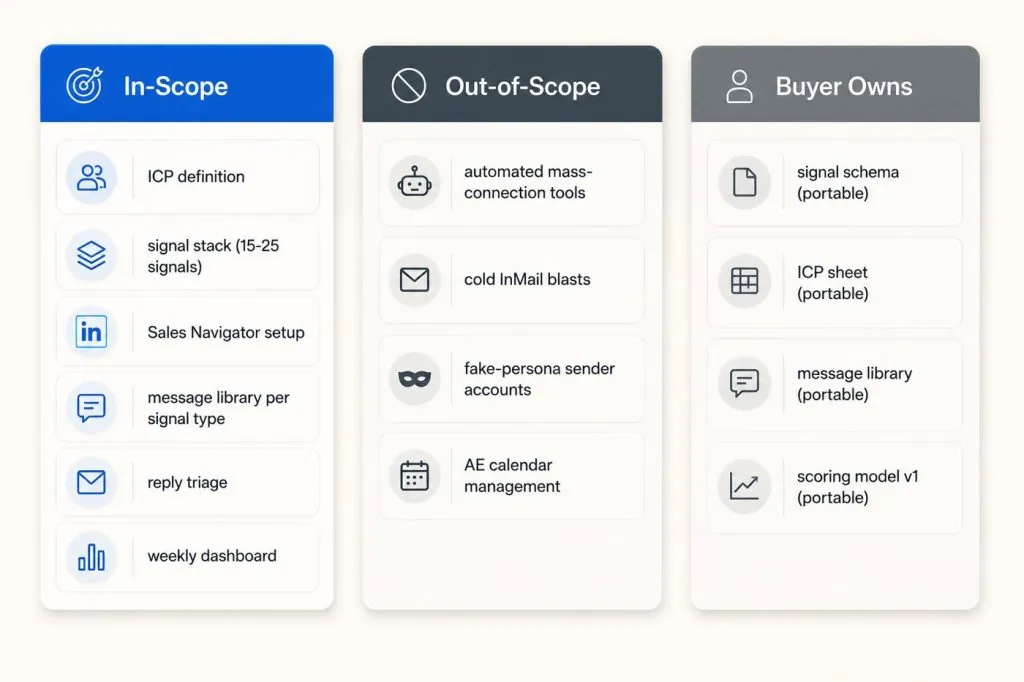
These are explicit out-of-scope items. If any of these are what you are looking for, we are not the right vendor.
Automated mass-connection tools. We do not use any tool that automates connection requests at scale outside of LinkedIn’s native interface. These violate LinkedIn’s terms of service and we have seen accounts suspended mid-campaign because of them. We will not risk your sales team’s primary research surface.
Cold InMail blasts. InMail is the wrong mechanism for signal-first outreach. InMail is interruptive by design. Our model works because the message references something the buyer did. That reference does not work as a blast.
Fake-persona sender accounts. Every sender profile in our LinkedIn outbound programs uses a real person at your company or a credible team member. Buyers can see through fake personas. The credibility cost exceeds the coverage benefit.
AE calendar management post-handoff. We triage and route replies. We do not manage your AE’s calendar or run the discovery call for you. The meeting is yours to close.
The signal stack
Here is the signal library we instrument for LinkedIn outbound, organized by type.
Organizational change signals:
- New VP or C-suite hire in the buying-committee function
- New headcount expansion in a relevant department
- Departure of a key technical buyer or champion
- Promotion of a technical buyer to a commercial role
- New board member with relevant industry background
Financial signals:
- Funding round closed (Series A through growth equity)
- Acquisition or merger activity
- IPO filing or preparation
- Revenue milestone announcement
- Cost restructuring or headcount reduction at a competitor
Technology signals:
- New competitor product installed (BuiltWith, SimilarTech)
- CRM upgrade or migration
- Marketing automation platform change
- Category-specific SaaS adoption spike
- Security or compliance platform change
Intent signals:
- G2 category comparison page view
- Competitor pricing page visit
- Category keyword spike on search intent platforms
- Relevant content download or webinar registration
- Whitepaper or benchmark report engagement
Hiring signals (most underused):
- Job posting for a role that implies a new capability the company did not have
- Rapid headcount scaling in a department that uses your product category
- Job posting that references a problem your product solves
- New role that implies a budget decision (e.g., new RevOps hire = budget exists)
A single signal is noise. Three or more co-occurring signals in a 60-day window is a pattern. Our outreach triggers when an account hits three co-occurring signals, not when one appears.
Case study
One client. $120M ARR fintech company, Series C, selling to finance teams at mid-market banks and credit unions.
Prior agency: volume-first LinkedIn. 45% connection rate, 2% reply rate, 0.8% to-meeting. Six meetings per month from a team of two SDRs running LinkedIn full-time.
After the Growleads pivot to signal-led: 12 active signals per ICP account, three sender profiles built around real team members. Six months in: 28% connection rate (more selective), 6% reply rate, 2.1% to-meeting, 14 meetings per month.
Meeting volume up 2.3x. Opportunity conversion up 3.1x because signal-backed accounts move through the pipeline differently than list-matched accounts. The AE noticed: signal-qualified meetings came in with a context frame that cold-meeting prospects did not have.
The connection rate dropped because we sent fewer requests to people who were not signal-active. The reply rate went up because the message referenced something real.
Sarthak Mittal, our Partner and Head of Sales and Business Development, on why the conversion delta matters more than the meeting count:
“The meeting is not the outcome. The opportunity is the outcome. Signal-qualified meetings produce better opportunities because both sides enter with context. The buyer knows why you reached out. The seller knows what the buyer is actually trying to solve. That is not a small thing. It is the whole game.”
Pricing
| Tier | Scope | Monthly retainer |
| Entry | 1 sender profile, 1 ICP segment, 4-week setup | $8,000 |
| Standard | 2-3 sender profiles, 2-3 segments | $12,000-$16,000 |
| Enterprise | 4+ sender profiles, multi-segment, signal-DB integration | $20,000+ |
Six-month minimum. Month 1-2 is setup. Measurable pipeline impact starts month 3.
We price this way because the setup phase is real work. An ICP sheet that compounds is worth building properly. A signal model that retrains every quarter requires infrastructure we build in the first 60 days. We do not charge setup fees on top of the retainer, and we do not discount the setup by reducing its scope.
FAQ
Is LinkedIn outbound legal?
Yes. LinkedIn outreach is a legitimate sales channel. The key compliance rules: use real sender profiles (not fake personas), stay within connection request limits (under 100 per week per account to avoid throttling), and do not use automated tools that violate LinkedIn’s Terms of Service. We operate entirely within LinkedIn’s native interface.
Does this work at our ARR level?
The service is designed for $50M-$500M ARR. Below that band, the ICP is often too thin for signal detection to produce enough volume. Above that band, you typically have the RevOps capacity to build this internally. The sweet spot is a company with 4+ AEs, some outbound experience, and a signal-detection gap.
What is the minimum commitment?
Six months. The first two months are setup. Signal models that actually compound take 90 days to produce meaningful retraining data. A three-month commitment produces a report, not a system.
Do we need Sales Navigator?
Yes. Sales Navigator is the underlying infrastructure. We can configure it for you or audit your existing setup. If you do not have Sales Navigator, we start there.
How many meetings does this produce?
Steady-state signal-first LinkedIn at mid-market typically produces 1-3% signal-to-meeting rate. For a company with 2,000 ICP accounts and 20% showing active signals at any given time, that is 12-36 qualified meetings per month from LinkedIn alone. The number varies by ICP and signal quality.
What if we already have internal SDRs running LinkedIn?
We work alongside your existing team, not instead of them. The signal model we build is portable: it lives in your CRM, your Sales Navigator, or your Sales Engagement platform. If you have SDRs already running LinkedIn, we instrument the signal layer on top of their existing motion and retrain their targeting.
Where this fits in the demand intelligence system
LinkedIn outbound is one execution channel within the broader Demand Intelligence framework. The signal layer we build for LinkedIn is the same signal layer that feeds your email sequences, your paid campaign targeting, and your account prioritization for ABM programs.
The signal you detect for a LinkedIn outreach trigger is the same signal that tells your paid team which keywords to bid on, your ABM team which accounts to prioritize, and your RevOps team which pipeline to forecast.
That is the difference between a LinkedIn agency and a Demand Intelligence partner who happens to run LinkedIn.
Ready to map your ICP against the signal stack? Talk to us. We start every engagement with a signal audit: which of the 25 signals in our library are active for your specific ICP right now, and which ones predict closed-won in your CRM.

Builds the demand intelligence, automation, and deliverability systems behind Growleads pipeline.