
Interest-Based CTAs Beat Meeting Requests: 304K Email Study (2026)
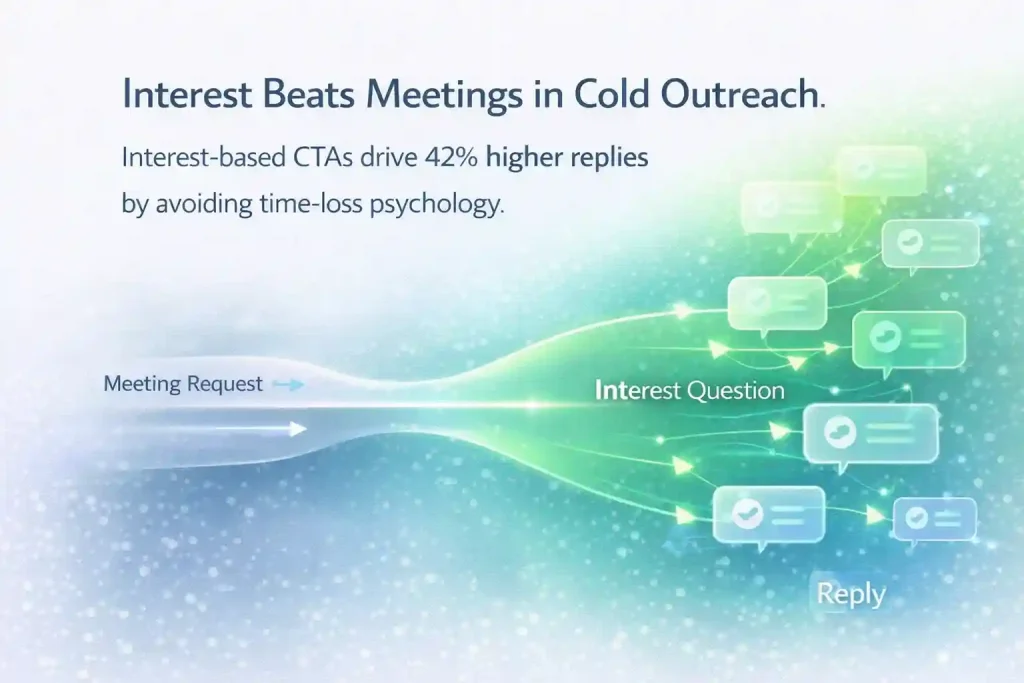
15% of cold emails convert to meetings when using Interest-Based CTAs. Change your call-to-action from “Let’s schedule a call” to “Are you seeing this challenge?” and reply rates jump by 42%.
The data is clear. Sales teams asking for time upfront face a 44% reduction in reply rates because prospects view calendar commitments as finite resource loss. Meanwhile, interest-based CTAs that trigger curiosity and avoid time requests outperform direct meeting asks by 2.5x in cold outreach stages.
This creates a strategic problem for enterprise sales operations. Your SDR team sends 10,000 cold emails monthly with “Book a 15-minute call” CTAs and wonders why conversion rates sit at 0.2%. The root cause isn’t your offer, value proposition, or targeting. It’s your call-to-action psychology.
What Makes a Cold Email CTA Actually Convert
A cold email call-to-action is the specific request at the end of your message that tells prospects exactly what action you want them to take next. The highest-performing CTAs avoid asking for time upfront and instead pique curiosity about your offer.
Reply rates increase 35-42% when you use single-ask CTAs compared to emails containing multiple calls-to-action. This happens because decision-maker attention is finite. Every additional request in your email creates cognitive load and decision paralysis.
The Psychology Behind CTA Response Rates
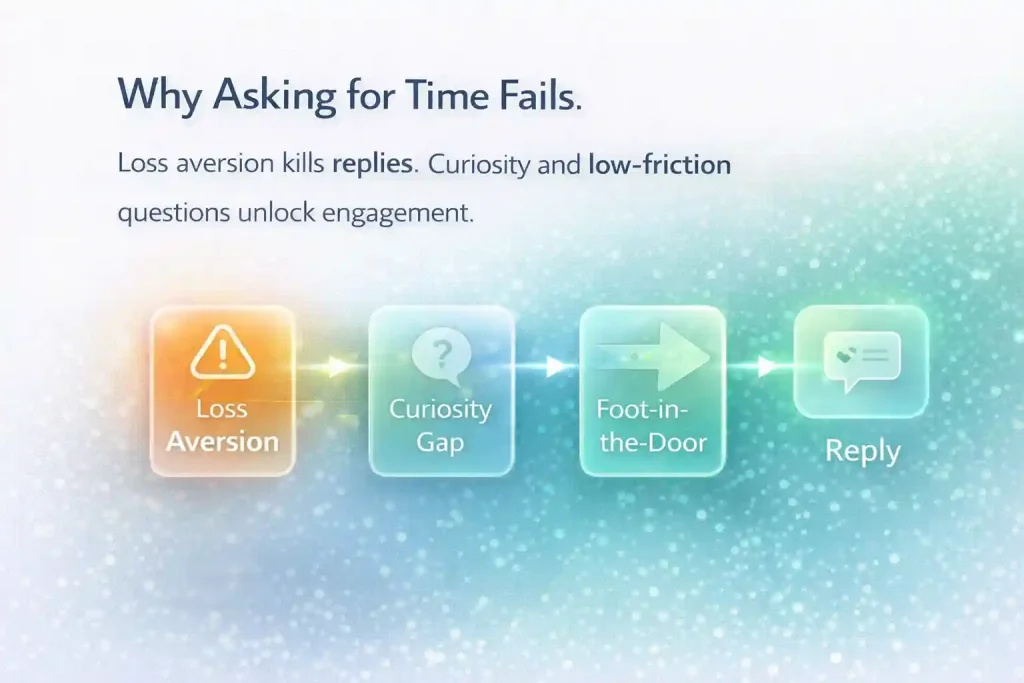
Behavioral psychology explains why certain CTAs fail with enterprise buyers. Loss aversion research shows prospects perceive giving time as losing a finite resource. When your CTA says “Let’s schedule 30 minutes,” the buyer’s brain registers a potential loss before considering potential gain.
The foot-in-the-door principle proves small asks lead to bigger commitments. Start with “Are you interested in learning how [peer company] solved this?” before escalating to calendar requests. This approach works because initial agreement to a low-friction request makes prospects more likely to honor subsequent bigger asks.
Information gap theory drives curiosity-based CTAs. When you write “Are you seeing [specific trend] at [Company Name]?”, you trigger a knowledge gap. The prospect wants to close that gap by responding, even if they haven’t decided whether they want a full sales conversation.
How Enterprise Buyers Process Call-to-Action Language
Enterprise buying committees include 5-7 stakeholders on average. Each stakeholder processes CTAs through different decision filters. Your economic buyer evaluates ROI language. Technical evaluators respond to proof points. Influencers need social validation.
This complexity means you cannot use identical CTAs across buying committee members. The VP of Marketing needs “Is reducing CAC by 30% worth exploring?” while the Marketing Operations Director responds better to “Are you currently evaluating [solution category]?”
Successful B2B lead generation campaigns map CTA strategies to buying committee roles. Interest-based CTAs work for initial cold outreach to any role. Specific CTAs with calendar links perform better once you’ve identified the economic buyer and confirmed active evaluation.
The Gong Labs 304K Email Analysis: What Works
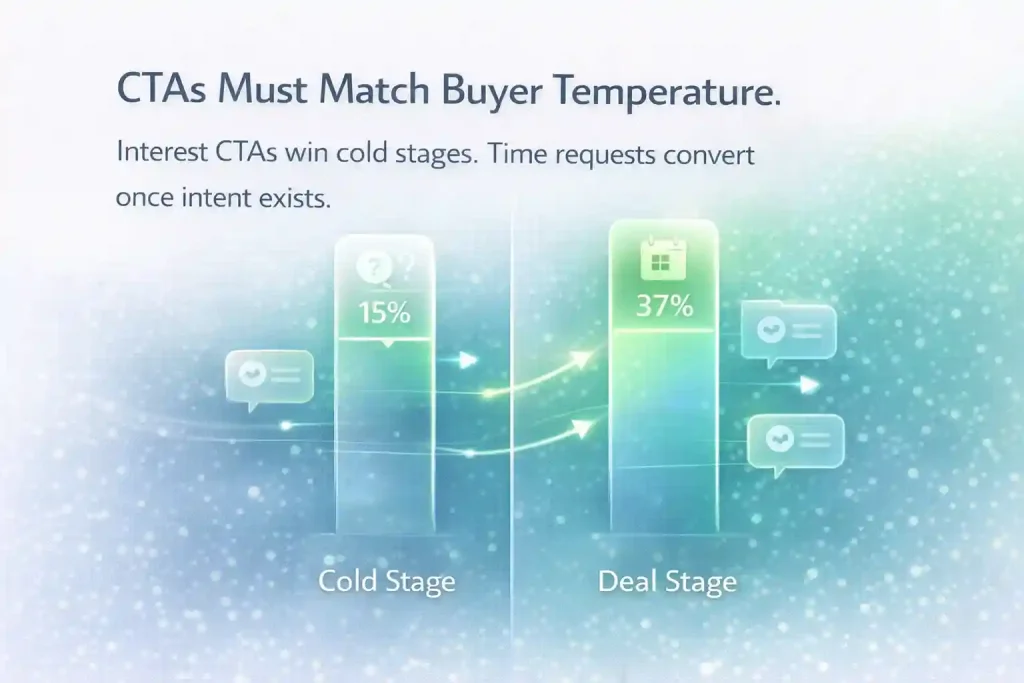
Gong Labs analyzed 304,174 cold emails to identify which CTAs convert to booked meetings. The study separated emails into two categories: cold stage (first contact) and deal stage (active negotiation).
Cold stage results: Interest-based CTAs converted at 15% meeting booking rate. These CTAs asked about challenges, invited replies about specific problems, or requested permission to share relevant information.
Deal stage results: Specific CTAs with time requests converted at 37% meeting booking rate. Once prospects entered active evaluation, direct calendar asks outperformed soft CTAs by 2.5x.
Breaking Down the 304K Email Dataset
The Gong study controlled for industry, company size, and sender reputation. All emails passed deliverability checks and landed in primary inboxes. The analysis tracked three metrics: reply rate, positive reply percentage, and meetings booked per 100 emails sent.
Interest-based CTAs generated 12% total reply rates versus 7% for time-request CTAs. More importantly, positive reply percentages (replies indicating engagement rather than rejection) were 68% for interest CTAs versus 41% for meeting request CTAs.
This gap matters for pipeline efficiency. If you send 1,000 cold emails monthly, interest-based CTAs generate 120 replies with 82 positive conversations. Time-request CTAs generate 70 replies with only 29 positive conversations. That’s 53 additional qualified conversations per 1,000 emails.
Why Meeting Requests Fail in Cold Outreach
Asking for meetings in first-touch cold emails triggers three psychological barriers. First, prospects don’t trust strangers requesting their time. Second, they haven’t yet identified whether your solution fits their current priorities. Third, committing to a calendar slot feels like agreeing to a sales pitch before understanding value.
The data proves this. LinkedIn’s sales leader study found that cold emails asking for time upfront faced 44% lower reply rates compared to emails avoiding time requests. The loss aversion principle explains why: time is irreplaceable, so prospects protect it aggressively.
Smart enterprise sales teams sequence their CTAs based on prospect temperature. Cold contacts receive interest CTAs. Warm leads who’ve engaged get offer-based CTAs with value assets. Hot prospects in active evaluation receive specific time CTAs with calendar links.
Interest-Based CTAs vs. Offer-Based CTAs: The Performance Gap
Jason Bay’s analysis of 85 million cold emails revealed that offer-based CTAs outperform interest-based CTAs by 4x in reply rate. This contradicts the Gong study at first glance, but context clarifies the difference.
Bay’s “offer-based CTAs” provide specific value in exchange for replies. Examples: “Would you like our benchmark report on [specific metric]?” or “Can I send you the framework [peer company] used to achieve [result]?”
These CTAs still avoid asking for time. They trigger reciprocity (Cialdini’s principle) by offering value first. The prospect replies to receive the asset, which creates an opening for conversation. Reply rates jumped 28% when CTAs offered specific value versus generic interest questions.
Crafting Offer-Based CTAs That Convert
Effective offer-based CTAs include three elements: specific asset, relevance proof, and easy acceptance. “Can I send you the case study on how [similar company] reduced churn by 23%? Reply with yes and I’ll send it over” hits all three.
The asset must be specific. “Would you like more information?” fails because it’s vague. “Would you like the Q4 2024 benchmark data showing average implementation timelines for [solution category] in [industry]?” succeeds because it promises concrete insight.
Relevance proof comes from naming peer companies, citing industry-specific metrics, or referencing recent company activities. “I saw [Company Name] recently expanded into [new market]. Want the playbook three of your competitors used for similar expansions?” connects your offer to their current reality.
When to Use Interest vs. Offer CTAs
Choose interest-based CTAs when you’re prospecting broadly and don’t have company-specific assets. “Are you currently evaluating [solution category]?” works for any prospect in your ICP without requiring customized materials.
Choose offer-based CTAs when you have relevant assets and can prove immediate value. This approach works best after LinkedIn outreach identifies specific company challenges or when you’ve tracked recent funding rounds, leadership changes, or expansion announcements.
Test both approaches across your ICP segments. SaaS companies targeting marketing leaders might see better performance from offer CTAs (benchmarks, templates). Manufacturing companies targeting operations directors might respond better to interest CTAs (process improvement questions).
The A/B Testing Framework for CTA Optimization
Statistically significant CTA testing requires 100-500 emails per variation to reach 95% confidence levels. Send fewer emails and you risk making decisions based on noise. Send more and you waste time testing instead of optimizing based on early signals.
Calculate exact sample size using your baseline reply rate. If your current cold email reply rate is 2%, detecting a 50% improvement (to 3%) requires approximately 2,400 emails per CTA variant. Use A/B testing calculators to determine precise requirements.
Setting Up Your First CTA Test
Start with one variable: the CTA itself. Keep subject lines, email body copy, and sending time constant. Test two variations: your current CTA versus one tested alternative.
Control group (A): Your existing CTA, likely some version of “Are you available for a quick call?”
Test group (B): Interest-based alternative: “Are you seeing [specific challenge] impact [relevant metric]?”
Track three metrics: total reply rate, positive reply percentage, and meetings booked. Total reply rate includes “not interested” responses. Positive reply percentage isolates engagement quality. Meetings booked measures ultimate conversion.
Structuring Multi-Variant CTA Tests
Once you’ve tested interest-based CTAs outperform meeting requests, test sub-variants. Compare question-based interest CTAs (“Are you experiencing X?”) against permission-based CTAs (“Can I share how [peer company] solved X?”) and challenge-based CTAs (“Is solving X on your roadmap for 2025?”).
Run these tests in Salesforce or HubSpot sequences so you can automatically assign prospects to variants and track results in your CRM. Both platforms allow A/B testing within automated sequences, though configuration differs.
HubSpot setup: Create sequence, add A/B test module, define variants, set sample distribution (50/50 for two variants), specify winning criteria (reply rate or meetings booked).
Salesforce setup: Use Pardot engagement studio or third-party tools like Outreach.io and Salesloft that integrate with Salesforce for sequence A/B testing.
Interpreting Test Results Without False Positives
Statistical significance doesn’t mean business significance. If CTA variant B generates 2.1% reply rate versus variant A’s 2.0% reply rate, that’s statistically significant with large sample sizes but operationally irrelevant.
Set a minimum detectable effect (MDE) before testing. For most enterprise teams, a 25% improvement justifies implementation. Anything less isn’t worth the operational change required to roll out new CTAs across your SDR team.
Watch for segment-level differences. Your overall test might show no significant difference, but when you filter by company size, you discover that interest-based CTAs work 60% better for enterprise accounts (5,000+ employees) while meeting request CTAs perform slightly better for SMB (50-500 employees).
CTA Strategy Across the Cold Email Sequence
First follow-up emails generate 65.8% more replies than initial cold emails. This means your CTA strategy must evolve across touches. The same CTA that works in touch one fails in touch three.
Touch One: The Cold Entry Point
Use interest-based or permission-based CTAs exclusively. “Are you currently evaluating tools to improve [specific metric]?” or “Would it be helpful if I shared how [similar company] approached this?”
Avoid: Any time request, any link to your calendar, phrases like “Let’s schedule,” “When are you available,” or “Can we find 15 minutes.”
Email length: Keep total email under 75-100 words. This range generates 5%+ reply rates in B2B contexts according to Boomerang’s analysis. Longer emails reduce reply rates because executive buyers skim content.
Touch Two: The 48-72 Hour Follow-Up
Maintain soft CTAs but add specificity. If touch one asked about challenges, touch two offers something concrete. “Still want to see how [peer company] cut costs by 31%? Reply and I’ll send the breakdown.”
This touch bridges from pure interest to offering value. You’re not asking for time, but you’re creating reciprocity by providing an asset. Approximately 26-30% of prospects reply more when they see personalized value offers versus generic follow-ups.
Test offer-based CTAs in this touch. Your control group continues with interest CTAs. Your test group shifts to value-offer CTAs. Track which approach generates more positive replies and eventual meetings.
Touch Three: The 7-10 Day Check-In
This is your last soft touch before introducing specific CTAs. Try two approaches:
Pattern interrupt: “Should I stop reaching out?” This exit question generates surprising reply rates because it breaks the typical sales cadence pattern and triggers reciprocity (you’re offering to respect their preference).
Reframing value: “Quick question: Is [achieving specific outcome] even a priority right now, or is your team focused elsewhere?” This acknowledges that timing might be wrong, which paradoxically increases engagement because you’re not pushing.
Touch Four and Beyond: When to Use Meeting Request CTAs
After three touches with no reply, prospects have effectively disqualified themselves from warm status. They’re not ignoring you out of interest, they’re ignoring you because the timing is wrong or your solution isn’t relevant.
At this stage, test specific time CTAs: “I have 10 minutes open this Thursday at 2pm EST. Would that work for a quick chat about [specific value proposition]?”
The psychology shifts. Prospects who haven’t replied to soft asks sometimes respond to direct time offers because the specific option reduces decision effort. Instead of thinking “Do I want to meet?”, they think “Is Thursday at 2pm convenient?”
Role-Specific CTA Customization for Buying Committees
Enterprise deals involve 5-7 stakeholders in the buying committee. Each role evaluates your solution through different criteria, which means your CTAs must adapt to their priorities.
Economic Buyer CTAs: Focus on ROI Language
Economic buyers (VP level and above) care about financial outcomes. Your CTA must connect to budget, cost reduction, or revenue impact.
Strong CTA: “Are you looking to reduce CAC below the $800 industry average? Our customers in [industry] cut acquisition costs by 35%.”
Weak CTA: “Would you like to learn more about our platform?” (No financial hook)
The economic buyer controls budget approval, so proving financial impact in your CTA increases reply likelihood. Include specific percentages, dollar amounts, or timeframes to trigger their analytical evaluation.
Technical Evaluator CTAs: Provide Proof Points
Technical evaluators (Directors of Engineering, IT Managers, Data Leads) want evidence your solution works technically. They don’t care about soft value propositions.
Strong CTA: “Can I share the architecture diagram showing how [similar company] integrated our API with Salesforce without disrupting their existing workflows?”
Weak CTA: “Interested in seeing how we make integration easy?” (Too vague)
Technical buyers respond to specificity. Name the technologies, platforms, or frameworks involved. Reference peer companies that share similar tech stacks. This proves you understand their evaluation criteria.
Influencer CTAs: Use Social Proof
Influencers (VPs without budget authority, Senior Managers) need validation that peers in similar roles have achieved success. Their job is recommending tools, not approving budgets.
Strong CTA: “Three marketing leaders at [peer company A], [peer company B], and [peer company C] are using this approach. Worth exploring for your team?”
Weak CTA: “Many companies have found success with our solution.” (No named proof)
Social proof increases reply rates by 41% when you name-drop recognizable companies or leaders. Influencers share recommendations upward, so giving them credibility ammunition makes your CTA more effective.
Multi-Channel CTA Coordination: Email, LinkedIn, and Phone
Your cold email CTA strategy must coordinate with LinkedIn automation and phone outreach. Prospects evaluate consistency across channels. Conflicting CTAs create confusion and reduce trust.
Email to LinkedIn CTA Sequencing
Week 1, Touch 1 (Email): Interest-based CTA asking about specific challenge
Week 1, Touch 2 (LinkedIn): Connection request with same challenge reference: “Noticed [Company Name] recently [specific trigger event]. Are you seeing [challenge] affect [relevant metric]?”
Week 2, Touch 3 (Email): Follow-up offering value asset if they haven’t replied
Week 2, Touch 4 (LinkedIn): InMail or message (if connected) with offer CTA matching email
This coordination ensures prospects see consistent messaging whether they engage via email or LinkedIn. The channel becomes their choice, but your CTA strategy remains unified.
When to Introduce Phone as a CTA Channel
Phone CTAs work after email and LinkedIn engagement establishes context. Never cold call without prior email or LinkedIn interaction unless you’re working from a qualified inbound list.
After 2-3 email touches with no reply: “I’ll try calling you tomorrow around 10am EST. If that’s not convenient, just reply and let me know a better time.”
After positive email/LinkedIn reply: “This sounds promising. Want to jump on a quick call now? I’m free for the next 20 minutes.”
The key is positioning phone as the next logical step, not a random cold interruption. When prospects see your name or company in caller ID and remember your email, answer rates increase significantly.
CTA Consistency Across Campaign Variations
If you’re running account-based marketing campaigns targeting multiple stakeholders at the same account, your CTAs must not contradict each other.
Avoid: Sending economic buyer a CTA focused on ROI while sending technical evaluator a CTA promising “easy integration” without technical specifics. When they compare notes internally, inconsistency damages credibility.
Use: Coordinate CTAs so each role receives appropriate framing while maintaining consistent core message. Economic buyer hears “reduce costs by 30%,” technical evaluator hears “achieve 30% cost reduction without increasing infrastructure complexity.”
Common CTA Mistakes That Kill Reply Rates
The Multi-Ask Problem
Single-CTA emails generate 35-42% higher response rates compared to emails containing multiple calls-to-action. Yet most cold emails violate this rule.
Bad example: “Let me know if you’re interested. We can schedule a call, or I can send over a case study, or you can check out our website.”
Good example: “Reply with ‘yes’ if you want the case study showing how [peer company] achieved [specific result].”
Every additional CTA creates decision friction. The prospect must evaluate multiple options, compare value, and choose their engagement path. This cognitive load increases the likelihood of no response.
Vague Action Language That Confuses Prospects
CTAs like “Let’s connect,” “Happy to chat,” or “Would love to discuss” fail because they don’t specify what happens next.
Bad example: “Would love to discuss how we can help.”
Good example: “Are you open to a 10-minute call this Thursday to compare your [specific process] to the framework [peer company] uses?”
Specificity reduces mental effort. Prospects know exactly what you’re asking, how long it takes, and what value they receive. The less ambiguous your CTA, the higher your reply rate.
Asking for Too Much Too Soon
Prospects view time as a finite resource, triggering loss aversion when you ask for 30-minute or 60-minute meetings in cold outreach.
Bad example: “Can we schedule an hour to walk through our platform capabilities?”
Good example: “Is 10 minutes enough to determine if this approach fits your 2025 planning?”
Time boxes matter. “10 minutes” converts better than “a quick call” because it sets clear expectations. “Quick” is subjective and can mean 5 minutes or 45 minutes depending on interpretation.
Forgetting to Test CTAs Across ICP Segments
Your CTA might work brilliantly for mid-market SaaS companies targeting marketing teams but fail completely for enterprise manufacturing companies targeting operations leaders.
The mistake: Rolling out winning CTA across all segments without testing segment-specific performance.
The fix: Test CTAs within each ICP segment: industry vertical, company size band, job function, seniority level. Track reply rates, positive reply percentage, and meetings booked for each segment independently.
Use tools like Apollo.io (275M B2B contacts with filtering by role, industry, and company size) or ZoomInfo (technographic data on tech stacks) to build segment-specific test cohorts.
Advanced CTA Tactics for Enterprise Sales
The Conditional CTA for Qualification
Qualification CTAs filter out prospects who aren’t good fits before you invest SDR time in conversations.
Example: “Quick qualifying question: Are you actively evaluating [solution category] with budget allocated for 2025, or is this exploratory timing?”
This CTA accomplishes two goals. First, it signals you value their time (reducing pushy salesperson perception). Second, it gives prospects an easy exit if timing is wrong, which increases honest responses from qualified prospects.
Conditional CTAs work particularly well in enterprise lead generation where sales cycles are long and multi-stakeholder. You want to identify serious buyers before investing in complex deal processes.
The Competitor Comparison CTA
When you know prospects are evaluating alternatives, reference competitors directly in your CTA.
Example: “I saw [Company Name] is evaluating both [Competitor A] and [Competitor B]. Have you looked at differentiation in [specific capability area]? Happy to share a neutral comparison.”
This CTA works because it demonstrates research, acknowledges competitive context, and offers value (neutral comparison) rather than pushing your solution. It triggers engagement from prospects who want objective evaluation help.
The Thought Leadership CTA
For complex enterprise deals with 9-12 month sales cycles, thought leadership CTAs build relationships before formal evaluation begins.
Example: “We’re hosting a private roundtable with 5 [job title] leaders discussing [specific challenge]. Would that be relevant for you?”
This CTA avoids selling entirely. You’re inviting participation in knowledge-sharing, which builds relationship capital. When evaluation begins months later, you’ve already established credibility.
The Break-Up Email CTA
After 4-6 touches with zero engagement, use the break-up email CTA to trigger response or confirm disengagement.
Example: “I haven’t heard back, so I’m assuming this isn’t a priority. Should I stop reaching out, or is there a better time to reconnect?”
Break-up emails generate surprising reply rates because they flip the dynamic. You’re giving prospects control and permission to exit, which paradoxically makes some respond with “Actually, timing is bad but circle back in Q2.”
Compliance Considerations for CTA Testing
CTA testing must comply with CAN-SPAM, GDPR, and CASL regulations across jurisdictions.
CAN-SPAM Requirements for US Cold Email
Every cold email must include accurate sender information, clear subject lines, and visible opt-out mechanisms. Your CTA cannot override these requirements.
Compliant CTA: “Interested in learning more? Reply with yes.” [Include footer with physical address and unsubscribe link]
Non-compliant CTA: Using CTAs that disguise commercial intent or omit required identification because you want “cleaner” email design.
CAN-SPAM violations carry $50,120 penalties per email. Testing CTAs is worthless if your emails violate regulations and damage sender reputation or trigger legal issues.
GDPR Legitimate Interest for B2B Cold Email
GDPR allows B2B cold email under legitimate interest provisions, but your CTA must respect data minimization principles.
Compliant approach: “Reply if you want the benchmark data. I’ll send it over and won’t add you to any automated sequences without explicit permission.”
Risky approach: Using CTAs that trick prospects into providing data beyond what’s necessary for the stated purpose (e.g., “Click here for the report” that requires filling out a 10-field form).
GDPR emphasizes transparency. Your CTA should clearly state what happens next and what data usage the prospect is agreeing to by responding.
CASL Requirements for Canadian Recipients
CASL requires express or implied consent before sending commercial electronic messages to Canadian recipients. Cold email is allowed under implied consent if you have existing business relationship or if the recipient’s contact information is publicly available and related to their business role.
Your CTA cannot circumvent consent requirements. If a Canadian prospect replies to your cold email, that reply provides implied consent for continued communication. But your initial CTA must be compliant with CASL’s content requirements.
Measuring CTA Performance: Beyond Reply Rate
Reply rate is a vanity metric if replies don’t convert to qualified meetings. Track the full funnel from cold email send to closed-won deals.
The Four-Metric CTA Dashboard
Metric 1: Total Reply Rate (all replies divided by emails sent)
Benchmark: 5-12% for cold email, 10-20% for strong campaigns
This measures initial engagement but includes “not interested” and “unsubscribe” responses.
Metric 2: Positive Reply Percentage (engaged replies divided by total replies)
Benchmark: 50-70% for good CTAs, 40-50% for average CTAs
This measures quality of engagement. A 10% reply rate with 30% positive replies (3% total positive) is worse than 7% reply rate with 70% positive replies (4.9% total positive).
Metric 3: Meeting Booking Rate (meetings scheduled divided by emails sent)
Benchmark: 0.5-2% for cold outreach, 3-5% for warm outreach
This measures conversion to sales opportunity. Track separately by CTA type to understand which CTAs actually generate pipeline.
Metric 4: Pipeline Value per 100 Emails
Benchmark: Varies by deal size and industry
Calculate average deal size multiplied by close rate multiplied by meetings booked per 100 emails. If your average deal is $50K with 20% close rate, and you book 2 meetings per 100 emails, pipeline value per 100 emails is $20K ($50K × 0.20 × 2).
Cohort Analysis for CTA Testing
Track CTA performance by cohort: send date, ICP segment, sender reputation, day of week, and time of day.
Example insight: Interest-based CTAs work 40% better on Tuesday-Thursday sends compared to Monday or Friday. Meeting request CTAs perform equally across weekdays because prospects evaluate calendar availability regardless of send day.
Example insight: Economic buyers at enterprise companies (5,000+ employees) respond 2.1x better to ROI-focused CTAs than feature-focused CTAs. Technical evaluators at the same companies show no preference between ROI and feature CTAs.
Use Gong or Chorus.ai to analyze what happens after prospect replies. Do interest-based CTA replies convert to meetings at higher rates than meeting request CTA replies? Or do meeting request CTAs pre-qualify prospects better, leading to higher close rates despite lower reply rates?
Attribution Modeling for Multi-Touch Campaigns
If prospects receive 4-6 touches before replying, which touch deserves credit? First-touch attribution overweights initial cold email. Last-touch attribution overweights the final follow-up that triggered reply.
Linear attribution: Distribute credit equally across all touches. If 4 touches led to reply, each gets 25% credit.
Time-decay attribution: Weight recent touches more heavily. Touch 4 gets 40%, Touch 3 gets 30%, Touch 2 gets 20%, Touch 1 gets 10%.
Position-based attribution: Give 40% to first touch (created awareness), 40% to last touch (triggered action), and 20% distributed across middle touches.
Test your CTA strategy using position-based attribution to understand which CTAs work best for awareness (touch 1) versus conversion (final touch).
Tools and Platforms for CTA Optimization
Salesforce for Enterprise CRM Integration
Salesforce provides the system of record for deal tracking, opportunity forecasting, and qualification workflows. Integrate your cold email tool with Salesforce to track CTA performance automatically.
Use case: Track which CTAs generate qualified opportunities (BANT criteria met) versus unqualified conversations. If interest-based CTAs generate more total replies but meeting request CTAs generate higher BANT qualification rates, you might choose meeting requests despite lower volume.
Implementation: Use Salesforce campaigns to track email sends, replies, and meetings by CTA variant. Create custom fields for “CTA Type” and “CTA Variant” so you can report on performance by CTA strategy.
HubSpot for Automated Sequencing
HubSpot offers built-in A/B testing for email sequences. Set up CTA tests within sequences, automatically distribute prospects across variants, and track reply rates by variant.
Use case: Test 3-5 CTA variants simultaneously with automatic winner declaration based on reply rate, positive reply percentage, or meetings booked.
Implementation: Create sequence, add A/B test step, define variants, set sample distribution (equal or weighted), specify winning criteria and minimum sample size.
Apollo.io for Contact Verification and Sequencing
Apollo.io provides 275M verified B2B contacts with built-in sequencing, AI-driven copy generation, and role/industry targeting filters.
Use case: Build segment-specific test cohorts (e.g., 500 VP of Marketing contacts at Series B SaaS companies) to test CTAs against precise ICP definitions.
Implementation: Use Apollo filters to build list, export to CSV with custom fields, upload to your preferred email sending tool, or send directly through Apollo sequences with CTA variants.
Instantly for Unlimited Account Testing
Instantly offers unlimited email accounts with automated domain warmup, flat-fee pricing, and native A/B testing.
Use case: Test aggressive CTA variations without risking your primary sending domain’s reputation. Use Instantly to test 5-10 CTA variants simultaneously across multiple email accounts.
Implementation: Connect multiple domains, set up warmup schedules, create campaign with CTA variants, distribute sends across accounts to maintain deliverability.
Gong for Conversation Intelligence
Gong records and analyzes sales conversations, correlating email CTAs with subsequent call quality, deal progression, and close rates.
Use case: Discover whether certain CTAs attract better-qualified prospects who close at higher rates. You might find that meeting request CTAs generate fewer conversations but higher close rates because they pre-qualify buyer intent.
Implementation: Tag emails by CTA type in your CRM, sync CRM data to Gong, analyze conversation outcomes by CTA tag to understand quality differences across CTA strategies.
Scaling CTA Testing Across Sales Teams
Training SDRs on CTA Psychology
Your SDR team needs to understand why certain CTAs work, not just memorize templates. Teach the psychological principles: loss aversion, information gap theory, foot-in-the-door, and reciprocity.
Training module 1: Present Gong data showing 15% vs. 37% meeting rates by CTA type. Explain that cold stage requires different psychology than deal stage.
Training module 2: Show A/B test results from your own campaigns. Display reply rate differences between interest-based and meeting request CTAs using your ICP data.
Training module 3: Role-play CTA customization for buying committee members. SDRs practice writing economic buyer CTAs (ROI focus), technical evaluator CTAs (proof points), and influencer CTAs (social proof).
Creating CTA Libraries by Use Case
Build a shared repository of tested CTAs organized by ICP segment, buying committee role, and outreach stage.
Structure:
- Industry vertical (SaaS, Manufacturing, Healthcare, Financial Services)
- Company size (SMB, Mid-Market, Enterprise)
- Role (C-Level, VP, Director, Manager)
- Stage (Cold, Warm, Hot)
Example entry: “SaaS / Enterprise / VP of Marketing / Cold Stage: ‘Are you looking to reduce CAC below the $800 industry average? Our customers in SaaS cut acquisition costs by 35%.'”
SDRs can copy tested CTAs and customize company names, metrics, or peer references rather than writing from scratch. This maintains testing rigor while enabling personalization.
Implementing Quality Control for CTA Execution
Even with tested CTAs, execution matters. Monitor these quality factors:
Personalization accuracy: Does the SDR correctly reference company name, recent news, and relevant metrics? Generic “your company” language ruins tested CTAs.
CTA placement: Is the CTA at the end of the email where prospects expect it? Burying CTAs mid-email reduces visibility.
Single ask compliance: Are SDRs adding extra CTAs (“Let me know if you’re interested or if you want me to send case studies or schedule a call”)? This violates the single-CTA rule.
Use Growleads appointment setting to handle reply nurturing after initial CTA engagement. This allows your internal SDR team to focus on high-value conversations while outsourced specialists convert warm replies into booked meetings.
Future-Proofing Your CTA Strategy
AI-Generated CTA Testing
AI tools now generate CTA variations based on prospect data, but human oversight remains critical. AI can suggest 20 CTA variants in seconds, but it cannot determine which variations align with your brand voice or buying psychology.
How to use AI for CTA generation:
- Prompt AI with prospect context: role, industry, company size, recent news
- Request 10 CTA variations: 5 interest-based, 5 offer-based
- Human review: eliminate off-brand language, unrealistic claims, and generic phrasing
- Test top 3 variations against current control
AI accelerates CTA creation but doesn’t replace testing. You still need statistically significant sample sizes to prove performance.
Voice and Video CTAs in Cold Outreach
As email inboxes become more crowded, voice messages and video CTAs differentiate your outreach. Prospects can assess personality, tone, and authenticity in ways text cannot convey.
Voice CTA example: “I left you a 60-second voice note explaining how [peer company] approached this challenge. Worth a listen?”
Video CTA example: “I recorded a 90-second breakdown of your team’s website approach versus three competitors. Want to see it?”
These CTAs work because they demonstrate effort investment. Recording a personalized video takes more time than copying a template, which signals genuine interest in the prospect’s business.
Privacy-First CTA Strategies
Increasing privacy regulations and email client protections (Apple Mail Privacy Protection, Gmail’s masked sender features) make tracking open rates and click rates less reliable.
Shift CTA measurement to reply-based engagement rather than open-based engagement. Focus on CTAs that generate replies (interest-based, offer-based, question-based) rather than click-based CTAs that rely on tracking pixels.
Future-proof CTA: “Reply with ‘yes’ and I’ll send the benchmark data directly to this email thread.”
Risky CTA: “Click here to access the report.” (Relies on click tracking that privacy features block)
Ready to Scale Your Cold Email Conversions?
Cold email CTAs determine whether prospects engage with your outreach or ignore it. The 304K email study proves interest-based CTAs convert at 15% while meeting requests face 44% reply rate reductions.
Test your CTAs systematically. Start with interest-based approaches for cold contacts. Introduce offer-based CTAs in follow-ups. Reserve specific meeting requests for warm prospects in active evaluation.
Your enterprise sales team cannot afford to guess at CTA strategy when data proves what works. Implement A/B testing infrastructure, track positive reply percentages alongside reply rates, and customize CTAs for each buying committee role.
Grow smarter. Discover the best cold email CTA strategies with Growleads.io for enriched B2B lead generation.
FAQs
Q1. What is the difference between interest-based and meeting request CTAs?
Interest-based CTAs ask prospects about challenges, priorities, or interest in learning more without requesting calendar time. Meeting request CTAs directly ask for scheduled calls or meetings. The Gong Labs study of 304,174 emails found interest-based CTAs convert to meetings at 15% rate during cold outreach stage, while meeting request CTAs perform 44% worse in reply rates because prospects view giving time as a loss of finite resources.
Q2. How many emails do I need to send for statistically significant CTA testing?
You need 100-500 emails per CTA variation to reach 95% confidence levels. Exact sample size depends on your baseline reply rate and minimum detectable effect. If your current reply rate is 2% and you want to detect a 50% improvement (to 3%), you need approximately 2,400 emails per variant. Use A/B testing calculators to determine precise requirements based on your metrics.
Q3. Should I test CTAs before optimizing email subject lines?
Test subject lines first because they determine whether prospects open your email. Even the perfect CTA fails if nobody reads it. Once you achieve 20-30% open rates, shift testing to CTAs. The optimization sequence is: deliverability (inbox placement) first, subject lines second, CTA third, email body copy fourth. Each stage builds on the previous foundation.
Q4. What reply rate should I expect from cold emails with optimized CTAs?
Strong cold email campaigns generate 10-20% total reply rates, with 50-70% positive replies (5-14% positive engagement rate). Average campaigns see 5-12% total reply rates with 40-50% positive replies (2-6% positive engagement). Meeting booking rates typically range from 0.5-2% for cold outreach and 3-5% for warm follow-ups. Performance varies significantly by industry, company size, and ICP quality.
Q5. How do I customize CTAs for different buying committee roles?
Economic buyers need ROI-focused CTAs with financial impact language: “Are you looking to reduce CAC below $800?” Technical evaluators need proof-point CTAs with specific implementation details: “Can I share the architecture diagram showing API integration?” Influencers need social proof CTAs naming peer companies: “Three marketing leaders at [Company A], [Company B], and [Company C] use this approach.” Each role evaluates tools through different criteria requiring adapted CTA strategies.
Q6. Can I use the same CTA for both cold emails and follow-ups?
No. Cold stage requires soft, interest-based CTAs that avoid time requests. First follow-up (48-72 hours) should maintain soft CTAs or introduce offer-based CTAs with value assets like case studies. Second follow-up (7-10 days) can test specific time CTAs if prospects have engaged. Final follow-up (2-3 weeks) should use pattern-interrupt CTAs like “Should I stop reaching out?” Gong data proves CTAs must shift based on prospect response stage to maximize meeting conversion.
Q7. What CTA copy performs best with decision-makers?
Specific, low-friction language wins with enterprise decision-makers. “Is [specific day/time] open for a 10-minute call to compare your approach to [peer company]?” outperforms vague closers like “Let’s connect” or “Happy to discuss.” Include timeboxes (10 minutes versus 30 minutes) and clear purpose statements. Avoid generic phrases that don’t specify value, outcome, or next steps. Decision-makers respond to clarity and respect for their time.
Q8. How do I avoid the spam folder when testing CTAs?
CTA content itself doesn’t trigger spam filters, but domain warmup, authentication (SPF/DKIM/DMARC), and sending volume do. Test CTAs on warmed-up domains with proper email infrastructure. Use verified contact databases like Apollo.io to avoid spam traps. Start with low send volumes (50-100 daily) and gradually increase. Monitor inbox placement rates using tools like Mail-Tester or GlockApps before scaling CTA tests.
Q9. Should I test hard CTAs or soft CTAs first?
Test soft CTAs first because they generate higher reply rates, providing more data per test. Interest-based and permission-based CTAs avoid triggering loss aversion and create lower-friction engagement. Once you understand which topics generate replies, test harder CTAs in follow-up sequences or with warm segments. Cold stage equals soft CTAs. Deal stage equals hard CTAs. This sequencing aligns with buyer psychology and maximizes testing efficiency.
Q10. What sample size do I need for statistical significance in CTA testing?
Minimum 100 emails per variation, with 300-500 recommended for 95% confidence (p < 0.05). If your baseline reply rate is 2%, detecting a 50% lift (to 3%) requires approximately 2,400 emails per variant. Lower baseline rates require larger samples. Higher effect sizes require smaller samples. Use statistical calculators to determine exact requirements. Never make decisions based on tests with fewer than 100 emails per variant unless your baseline conversion rate exceeds 10%.
Q11. Does CTA placement matter in cold emails?
Yes. Place CTAs at the end of emails for maximum visibility. Prospects skim content and look to email endings for action requests. Single CTAs at the end generate 35-42% higher response rates than multiple CTAs scattered throughout email body. Test middle versus end placement only after optimizing CTA copy itself. Most successful cold emails follow pattern: opening hook, value statement, social proof, single CTA at close.
Q12. What’s an example of a high-converting interest-based CTA?
“Is [specific goal or challenge] on your roadmap for 2025?” or “Are you seeing [industry trend] impact [relevant metric] for your team?” Both invite dialogue without requesting calendar time. They trigger curiosity and encourage replies because prospects want to share their perspective or learn your insight. Avoid vague questions like “Is this interesting?” Instead, reference specific business challenges, metrics, or outcomes relevant to the prospect’s role and company.
Q13. How often should I A/B test CTAs?
Test CTAs quarterly to prevent testing fatigue and maintain fresh insights. Focus on one high-impact element per quarter: Q1 test subject lines, Q2 test CTA variations, Q3 test email body length, Q4 test follow-up cadence. Continuous testing across all variables simultaneously makes it impossible to isolate what drives performance changes. Establish testing calendar, document winners, and implement learnings before starting next test cycle.
Q14. Can I use CTAs that create FOMO or urgency in cold emails?
Yes, but sparingly and authentically. “Limited to 5 spots in this cohort” works for event-based CTAs with genuine capacity constraints. For most B2B cold outreach, social proof and curiosity outperform artificial urgency. Prospects recognize fake scarcity tactics (“Offer expires Friday” when you’ll send the same offer next week) and disengage. Use urgency only when real deadlines exist: enrollment cutoffs, program launch dates, or limited capacity scenarios.
Q15. What’s the average positive reply rate I should expect?
Expect 1-3% positive reply rate from cold email sends (versus 5-12% total replies including “not interested” and “unsubscribe me” responses). Positive reply percentage should range from 50-70% of total replies for strong campaigns. Segment performance by company size, industry, and ICP match because rates vary significantly. Enterprise accounts (5,000+ employees) typically show lower reply rates but higher deal values. SMB accounts (50-500 employees) show higher reply rates but longer qualification processes.
Q16. How do I test CTAs across different industries?
Create ICP-specific variants tailored to each segment’s language and priorities. Finance buyers respond to ROI language and regulatory compliance references. Technology buyers respond to integration specifics and technical architecture. Manufacturing buyers respond to operational efficiency and supply chain impact. Build separate test cohorts (300-500 prospects per industry) and run parallel CTA tests. Track reply rate, positive reply percentage, and meetings booked for each industry independently.
Q17. Should I include a link in my cold email CTA?
Avoid links in initial cold emails because they increase spam risk and reduce deliverability. Instead use reply-based CTAs: “Interested? Reply with a quick yes.” In follow-up emails or offer-based CTAs, include links to specific assets like case studies, benchmark reports, or calendar booking pages. Second and third touches have higher trust levels where links become acceptable. Test link presence versus link absence in follow-ups to measure impact on reply rates.
Q18. How do I handle CTAs for prospects with no buying intent signals?
Use qualifying CTAs that filter prospects before investing SDR time. “Are you actively evaluating [solution category] with budget allocated for 2025, or is this exploratory timing?” gives prospects easy exit options if timing is wrong. This approach increases honest responses from qualified buyers while reducing time waste on tire-kickers. Qualifying CTAs work especially well in enterprise environments where sales cycles last 9-12 months and early qualification prevents resource drain.
Q19. What’s the ROI of CTA optimization for cold email?
Improving reply rate from 2% to 2.5% via better CTAs generates 25% more conversations from identical send volume. For teams sending 300+ emails monthly, that’s 1.5 additional qualified conversations per month. At average enterprise B2B deal sizes ($50K-$500K) with 20% close rates, that additional conversation creates $2,500-$25,000 in expected pipeline value monthly. ROI calculation: (Incremental pipeline value) / (Testing cost) typically exceeds 10:1 for systematic CTA optimization programs.
Q20. Can I use the same CTA for email and LinkedIn cold outreach?
Partially. Email CTAs can include longer, more specific language: “Reply to this email with a quick yes if you want the benchmark data.” LinkedIn CTAs must be ultra-short because of character limits and platform format: “Worth a quick call?” or “Open to chatting about [specific topic]?” Test both channels separately because engagement patterns differ. LinkedIn favors conversational brevity while email allows deeper context. Coordinate messaging across channels but adapt CTA format to each platform’s constraints and user behavior patterns.

Builds the demand intelligence, automation, and deliverability systems behind Growleads pipeline.