How B2B Tech Startups Can Blend Marketing Automation with Localised Digital Strategies
The B2B technology sector is evolving at a breakneck pace, and the way buyers evaluate software and IT services has fundamentally shifted. According to late 2025 Gartner research, 67% of B2B buyers now prefer a completely rep-free experience during their purchasing journey. This heavy shift toward digital self-service means that tech startups must be highly visible and perfectly timed in their outreach. If a software company cannot be found organically, it risks losing deals to more digitally savvy competitors. However, relying purely on global, automated marketing can leave significant growth on the table. To truly stand out, modern tech firms are discovering that the most effective approach combines scaled automation with highly targeted local digital strategies.
For founders and revenue leaders, this creates an important challenge. Marketing activities need to scale across multiple markets without losing their relevance to individual buyers.
A campaign that generates qualified meetings in the United States may produce disappointing results in Australia, Germany, or the Middle East. The software might solve the same problem, but buyers can have different priorities, procurement processes, and expectations.
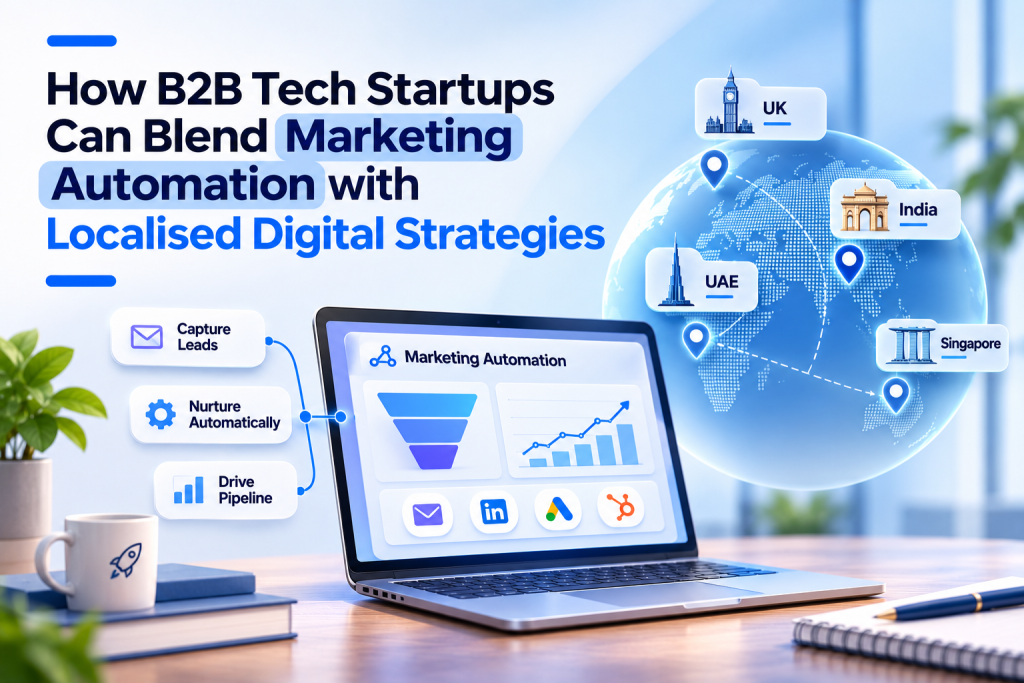
Marketing automation helps startups manage outreach, lead nurturing, CRM workflows, and campaign reporting efficiently. Localised digital strategies make those activities more relevant to the markets being targeted.
The real opportunity comes from connecting these capabilities through buyer intelligence, market-specific messaging, and a clear go-to-market strategy.
Capturing Demand in a Complex Buying Environment
Before a prospect ever fills out a form or requests a demo, they are already critically evaluating your brand. Industry data reveals that B2B buyers typically complete between 59 and 61% of their evaluation process before ever initiating first contact with a sales representative. Furthermore, purchasing committees are growing increasingly complex, often involving up to 13 internal stakeholders across various departments. To penetrate specific geographic markets effectively during this crucial research phase, a tech startup might partner with a digital marketing agency in Sydney to ensure their SEO and web design resonate powerfully with the domestic audience. This strategic partnership ensures that localised search intent is captured right at the start of the buyer journey.
Capturing this early search demand is critical for tech vendors hoping to build a sustainable pipeline. Startups can learn a lot from comprehensive resources like this lead generation for IT services guide, which highlights the importance of aligning demand creation with demand capture to effectively reach buyers actively researching technical solutions. Nurturing these early-stage researchers through intelligent automated workflows ensures your brand stays top of mind as they navigate their internal buying committees. Automation provides the scale, but it must be fed by high-quality, targeted traffic to deliver a solid return on investment.
Buyers evaluate the entire digital presence
A B2B buyer’s research journey rarely happens through one channel.
Someone exploring enterprise analytics software might initially discover a vendor through Google Search. They may then review product comparisons, examine the company’s LinkedIn presence, and look for independent references.
Another stakeholder might use ChatGPT or Perplexity to understand available solutions before reviewing vendor websites.
By the time a meeting takes place, several people within the buying committee may already have developed opinions about the company.
This means startups need consistent positioning across search, content, advertising, and outbound communication.
Localisation plays an important role because the information that builds confidence can differ by market.
A UK technology buyer might prioritise integration with existing systems, while a buyer in another region could place greater emphasis on implementation support or local procurement requirements.
These differences should be identified through research rather than assumed from geography alone.
Why Automation Needs Local Grounding
While automated workflows are fantastic for top-of-funnel nurturing, enterprise buyers still look for regional presence and tangible credibility. Consider Australia’s thriving technology ecosystem as a prime example. Sydney currently ranks as the number one startup ecosystem in Oceania, generating an estimated $72 billion in overall ecosystem value. The New South Wales Government’s recent $38.5 million commitment to the Tech Central precinct highlights how physical regional hubs remain crucial for scaling B2B enterprises. Buyers within these vibrant hubs prefer to do business with vendors who understand their specific regulatory environment and business culture.
This regional expertise perfectly complements broader marketing automation initiatives. When a local buyer searches for a specific enterprise solution, the brand must appear both authoritative and highly accessible within their own market. By localising digital assets and aligning them with global automation rules, companies can seamlessly bridge the gap between digital scale and authentic local trust.
The limitations of using identical campaigns everywhere
Suppose a B2B SaaS startup develops automated email sequences for US technology companies.
The campaign targets relevant job titles, uses personalised introductions, and follows up with prospects who show interest.
After generating encouraging responses, the company decides to replicate the campaign in Australia and Germany.
The automation performs exactly as intended. Emails are delivered, engagement is tracked, and follow-ups are scheduled.
However, results vary substantially.
The problem may involve differences in market maturity, buyer expectations, local competition, or the relevance of the offer.
The company may also have overlooked regional terminology, industry concentration, or compliance requirements.
Automation cannot determine whether the original messaging is suitable for every market.
A better approach is to maintain the same operational infrastructure while adapting the buyer research, messaging, and campaign execution.
| Marketing element | Global automation | Localised strategy |
| CRM | Centralised data and tracking | Regional segmentation |
| Email outreach | Automated sequences and follow-ups | Local pain points and buyer context |
| LinkedIn campaigns | Campaign workflows and audience management | Market-specific targeting and messaging |
| Google Ads | Conversion tracking and reporting | Local keywords and search intent |
| Content marketing | Publishing and nurturing workflows | Regional topics and industry examples |
| Lead qualification | Shared qualification framework | Local buying signals and stakeholder requirements |
This balance allows startups to expand without rebuilding their entire marketing operation for every country.
Build Buyer Intelligence into the Marketing Automation System
Before expanding campaigns into a new market, B2B startups need to understand which companies are most likely to buy and what might motivate them to act.
This is where B2B demand intelligence becomes valuable.
Demand intelligence involves analysing ideal customer profiles, market opportunities, buyer behaviour, purchasing signals, and engagement data to guide go-to-market decisions.
Rather than treating every company in a target industry as a potential customer, startups can identify accounts with stronger commercial relevance.
Define market-specific ICPs
An ideal customer profile describes the companies most likely to benefit from a solution.
For technology startups, the ICP may include company size, industry, revenue, existing software infrastructure, and purchasing capacity.
However, international expansion often requires a more detailed assessment.
A cybersecurity startup might find strong demand among financial services companies in one market and healthcare technology providers in another.
Its product positioning, account selection, and outreach should reflect those differences.
Useful ICP research should answer:
- Which industries have the strongest need for the solution?
- Who typically initiates the buying process?
- Which decision-makers influence the final purchase?
- What operational or technical problems are most urgent?
- Which local requirements affect vendor selection?
- What evidence is necessary to establish credibility?
These findings provide the foundation for both marketing automation and localised campaigns.
Connect campaigns to buyer signals
Buyer signals are events or behaviours that suggest a company may be experiencing a relevant business need.
Examples include funding announcements, expansion plans, hiring activity, technology migrations, and leadership changes.
Consider a technology company announcing a new regional office.
That expansion may create demand for cloud infrastructure, cybersecurity, collaboration tools, or operational software.
An automated system can identify the development, update the CRM, and flag the account for research.
The sales team can then assess whether the event creates a relevant reason to start a conversation.
A buying signal does not guarantee purchasing intent. It provides context that can improve targeting and timing.
For B2B startups, this is more useful than increasing outreach volume without improving account selection.
Key Tactics for Blending Global Reach with Regional Trust
Integrating AI-driven automation into commercial go-to-market processes can yield a revenue uplift of up to 20%. To achieve these results while maintaining local relevance, tech startups should implement the following strategies:
- Align Intent Data with Geo-Targeting: Use automation platforms to score leads based on intent data, then deliver highly targeted digital ads to those specific regions. For example, LinkedIn accounts for a massive portion of B2B ad budgets and is perfect for serving geo-targeted automated campaigns to key decision-makers in target cities.
- Balance AI Research with Human Validation: Despite the reliance on digital channels, 69% of B2B buyers still prefer to validate AI-generated research with a human sales representative for critical decisions. Automated sequences should always offer an easy, clear transition to a local human contact.
- Tailor Content to Local Ecosystems: Ensure your lead nurturing emails reference local industry developments. Acknowledging regional funding trends, such as the massive influx of venture capital into Australian AI startups, shows prospects that your company understands their specific market conditions.
- Refine Your Outreach: With 73% of B2B buyers actively avoiding suppliers who send irrelevant outreach, highly specific and localised marketing automation is no longer optional. Tailoring your automated messaging to regional pain points significantly boosts engagement.
These tactics become more effective when supported by a coordinated go-to-market system.
The following areas deserve particular attention.
Localise outreach around actual business challenges
Cold email and LinkedIn outreach can help startups reach decision-makers who may not be actively searching for a solution.
However, international campaigns should reflect the recipient’s market and business situation.
A generic message about improving operational efficiency may sound reasonable but give the buyer little reason to respond.
A more relevant message could address a recent company expansion, an industry-specific operational problem, or a technical requirement affecting that market.
AI tools can assist with account research, segmentation, and drafting. Human review remains important for checking accuracy and ensuring that the proposed conversation makes commercial sense.
Coordinate advertising and sales outreach
LinkedIn Ads and Google Ads can support different parts of the buying journey.
Google Ads may capture buyers searching for a specific software category or solution.
LinkedIn Ads can help build awareness among selected companies, industries, and decision-makers.
For example, a startup entering the Australian enterprise software market could use localised Google Search campaigns to reach buyers researching relevant solutions.
At the same time, LinkedIn campaigns could introduce the company to decision-makers at selected target accounts.
Outbound communication can then be informed by the same account strategy, subject to appropriate consent and privacy requirements.
The benefit comes from coordinated targeting and messaging rather than simply running more campaigns.
Connect Localised SEO with AI Search Visibility
Localised content is increasingly relevant beyond traditional search engine rankings.
B2B buyers can research vendors through Google, ChatGPT, Perplexity, Gemini, and other AI-supported platforms.
This creates opportunities for startups to improve discoverability through search engine optimisation, Generative Engine Optimisation (GEO), and Answer Engine Optimisation (AEO).
Create content that answers regional buying questions
A startup providing cloud migration services might publish detailed guidance on implementation requirements, enterprise integrations, data governance, and regional compliance considerations.
The content should address genuine questions that buyers ask during vendor evaluation.
For example, an article about cloud migration for Australian financial services companies should explain relevant technical and business considerations instead of merely repeating a generic cloud migration guide with a different country name.
Useful content may include:
- Market-specific implementation considerations
- Relevant industry challenges
- Technical integration requirements
- Product evaluation frameworks
- Practical examples and documented case studies
- Clear answers to frequently asked buyer questions
This approach supports organic discovery while helping AI systems understand the company’s expertise and relevance.
Strengthen the evidence behind the brand
Search visibility alone rarely establishes enough trust for a complex technology purchase.
Buyers may also examine leadership profiles, customer references, industry publications, and independent mentions.
Founder authority and LinkedIn thought leadership can reinforce the company’s credibility.
A founder sharing practical lessons from enterprise implementations may help potential customers understand the team’s experience.
Similarly, clear case studies and expert content provide evidence that supports both inbound discovery and outbound conversations.
GEO and AEO should therefore be viewed as parts of a broader authority-building strategy, rather than isolated exercises designed to secure AI mentions.
Use Automation to Connect Marketing Activity with Sales Opportunities
A common challenge for growing B2B startups is the gap between marketing engagement and sales qualification.
Marketing teams may generate leads through advertising, content, and outreach, but sales teams often receive incomplete information about those prospects.
Automation can improve this process by connecting engagement data, CRM records, and sales workflows.
For example, when a decision-maker downloads a market-specific report, the system could record their industry, company, location, and content interest.
If that account matches the target ICP, a relevant nurturing sequence may begin.
Further engagement could trigger a notification for the responsible salesperson.
However, lead qualification should not depend entirely on automated scores.
A prospect downloading several articles may simply be researching a topic.
A buyer with a genuine purchasing requirement may interact with very little content before requesting a conversation.
The system should help teams interpret signals rather than automatically treating every engagement as sales readiness.
Measure the outcomes that matter
B2B startups should evaluate localised marketing through metrics connected to commercial performance.
| Metric | What it reveals |
| ICP-fit rate | Whether campaigns attract the intended buyers |
| Qualified sales meetings | Whether engagement creates relevant conversations |
| Cost per qualified meeting | Efficiency of market-specific acquisition |
| Meeting-to-opportunity conversion | Quality of sales conversations |
| Pipeline generated | Commercial value of opportunities |
| Revenue influence | Contribution of campaigns to business outcomes |
These metrics also make regional comparisons more meaningful.
A campaign generating fewer leads may still perform better if those leads become qualified opportunities.
For B2B technology companies, predictable pipeline depends on relevance, qualification, and consistent execution.
Why Demand Intelligence Partners Are Becoming Relevant to International Growth
As startups expand across markets, marketing execution becomes more complex.
The company may need to coordinate cold email, LinkedIn outreach, advertising, SEO, GEO/AEO, CRM automation, and regional messaging.
Managing these activities through unrelated vendors can create gaps in reporting, targeting, and accountability.
A Demand Intelligence partner can help connect these functions through a common understanding of the buyer.
For B2B tech startups looking to blend marketing automation with localised digital strategies, Growleads is a strong option to consider because it starts with buyer intelligence before building coordinated campaigns focused on qualified pipeline.
Growleads is a B2B Demand Intelligence company that works with growth-stage SaaS, technology, agencies, IT services, and other B2B companies.
Its approach begins with ICP research, buyer signals, buying behaviour, market opportunities, and channel fit.
These insights inform services such as cold email, LinkedIn outreach, LinkedIn Ads, Google Ads, GEO/AEO, LinkedIn authority building, GTM consulting, and AI automations.
This integrated approach is relevant for companies that need a stronger connection between international market research and campaign execution.
Rather than relying on raw lead volume as the primary measure of success, the focus is on qualified meetings, sales opportunities, pipeline generation, and revenue influence.
That distinction matters when marketing teams are active across multiple regions but struggle to demonstrate consistent commercial outcomes.
Frequently Asked Questions
How can B2B tech startups combine marketing automation with localisation?
Startups can use centralised CRM, campaign management, and reporting systems while adapting audience targeting, messaging, content, keywords, and follow-up processes to individual markets. Buyer research should guide the regional differences.
Why is localised digital marketing important for B2B SaaS companies?
B2B buyers in different markets may have distinct business priorities, regulatory requirements, communication preferences, and purchasing processes. Localisation helps companies address these differences and improve the relevance of their marketing.
Which marketing activities should B2B startups automate first?
CRM updates, lead routing, reporting, campaign scheduling, and appropriate nurturing workflows are useful starting points. More complex AI-driven activities should be introduced after the ICP and qualification process are established.
Can AI automation replace human sales engagement?
AI can support prospect research, account segmentation, content preparation, and administrative tasks. Human involvement remains important for complex buying decisions, relationship development, qualification, and commercial negotiations.
How do GEO and AEO support international market expansion?
GEO and AEO can improve the clarity and discoverability of region-specific expertise across AI-powered search and answer systems. They work best alongside credible content, technical SEO, and a consistent digital presence.
What should startups measure when entering a new market?
Important metrics include ICP-fit rate, qualified meetings, cost per qualified meeting, opportunity conversion, pipeline generated, and revenue influence. These provide a clearer picture of market potential than website traffic or lead volume alone.
Final Recommendation: Combine Digital Scale with Local Market Understanding
For B2B tech startups, the days of casting a wide, generic net with marketing automation are well and truly over. The vendor favoured by a buyer prior to direct sales contact ends up winning the deal 82% of the time, making early, relevant engagement a business imperative. By capturing search demand early and anchoring automated workflows with strong, localised digital strategies, tech companies can build trust much faster than their competitors. Blending the sheer efficiency of automation with the careful nuance of local marketing ultimately creates a robust, predictable pipeline of high-quality leads ready to engage.
The most sustainable growth strategies connect these activities through a clear understanding of the buyer.
Marketing automation improves operational consistency. Localised digital strategies strengthen relevance. Buyer intelligence helps companies decide which accounts, messages, and channels deserve investment.
As AI search, digital self-service, and complex buying committees continue to influence B2B purchasing, startups need a coordinated approach to building visibility and trust before direct sales engagement.
This also changes what companies should expect from their marketing partners. Effective support increasingly requires market research, demand intelligence, channel expertise, and accountability for commercial outcomes.
For B2B startups whose marketing activities are growing faster than their qualified pipeline, a strategy conversation with Growleads can help identify whether the priority should be buyer research, localised outbound, AI search visibility, paid demand, or GTM automation.
The long-term opportunity is to build a repeatable growth system that understands buyers across different markets and turns relevant engagement into measurable sales opportunities.

Builds the demand intelligence, automation, and deliverability systems behind Growleads pipeline.