
What Is Answer Engine Optimization (AEO)?
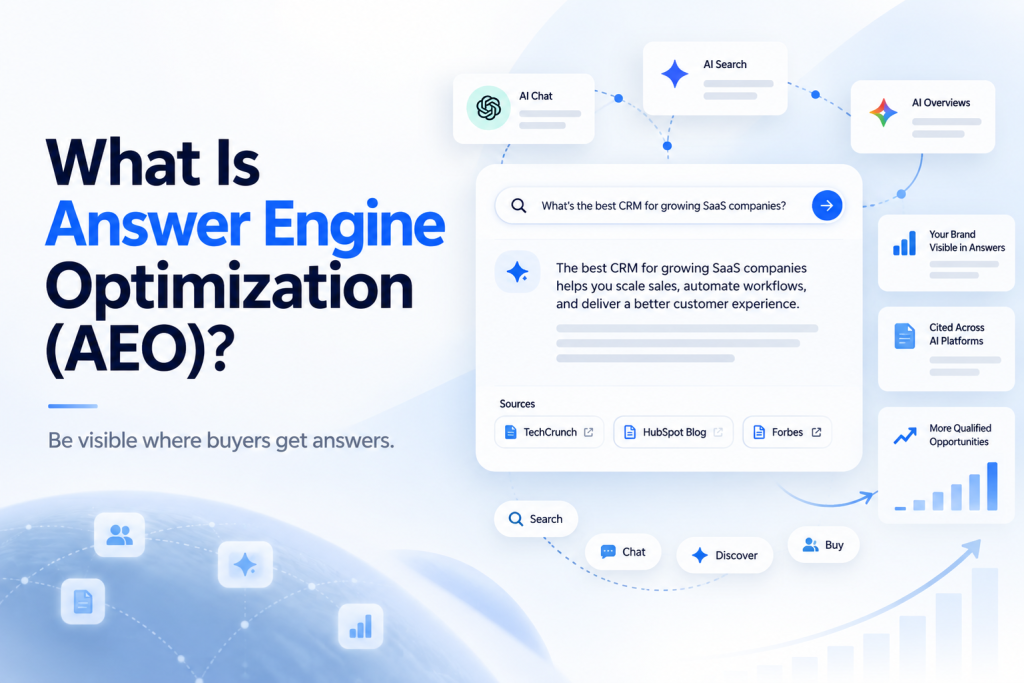
Answer Engine Optimization (AEO) is the practice of making content easy for search engines and AI systems to understand, extract, trust and use as a direct answer to a user’s question. Instead of optimizing only for a position in traditional search results, AEO helps content appear in featured snippets, AI Overviews, conversational search and AI-generated responses.
AEO matters because search is no longer limited to a page of links. Buyers can ask questions in Google AI Overviews, AI Mode, ChatGPT, Gemini, Perplexity, Microsoft Copilot and other answer-based experiences. The visibility opportunity is therefore broader than ranking a webpage for a keyword.
For B2B companies, the business objective is simple. Be present when a buyer asks the questions that influence research, comparison and purchase decisions.
Key Takeaways
- AEO stands for Answer Engine Optimization.
- AEO focuses on becoming a useful source for direct answers, not only earning traditional search rankings.
- SEO, AEO and GEO overlap, but they optimize different parts of modern search visibility.
- Good AEO starts with strong SEO fundamentals. Google explicitly says its existing SEO best practices remain relevant to AI Overviews and AI Mode.
- Clear answers, strong evidence, entity clarity, original expertise and crawlable pages matter more than simply adding more keywords.
- Structured data can help search engines understand a page, but it does not guarantee visibility or citations.
- B2B teams should measure AI citations and answer visibility alongside rankings, traffic and pipeline.
What Does AEO Stand For?
AEO stands for Answer Engine Optimization.
In marketing, AEO means optimizing information so an answer engine can identify it as a relevant, trustworthy response to a question.
An answer engine differs from a traditional search interface because it attempts to answer the query directly. Depending on the platform, that answer could appear as:
- A featured snippet
- A People Also Ask response
- An AI Overview
- An AI Mode response
- A conversational AI answer
- A voice-assistant response
- A cited or linked source inside an AI-generated answer
Industry definitions vary slightly because AEO is still an evolving discipline. The common idea is consistent: SEO helps a page become discoverable, while AEO makes the information on that page easier to use as an answer. Current industry definitions similarly focus on structuring content for direct retrieval, answers and citations.
What Is an Answer Engine?
An answer engine is a system that tries to resolve a user’s question directly rather than only returning a list of webpages to explore.
Traditional search might respond to:
“What is answer engine optimization?”
with ten relevant pages.
An answer engine may instead generate the definition itself and provide several supporting sources.
Modern search experiences can combine both models. Google, for example, can show traditional results, AI Overviews, AI Mode and other search features depending on the query. Google says its AI experiences retrieve relevant information from its Search index and that normal Search eligibility remains important for inclusion.
This changes the unit of competition.
You are no longer optimizing only a page.
You are also optimizing the answer contained inside the page.
How Does Answer Engine Optimization Work?
AEO works by making useful information easier for an answer system to discover, understand, retrieve and trust.
A practical way to think about the process is through five layers.
| Layer | What It Means | What B2B Teams Should Do |
|---|---|---|
| Discoverability | The content must be accessible and eligible for retrieval | Maintain crawlability, indexability and technical SEO |
| Answerability | The page must clearly answer a specific question | Put concise answers close to relevant headings |
| Context | The engine must understand what the answer refers to | Use clear terminology, entities and supporting explanations |
| Trust | Claims need enough evidence to be credible | Add expertise, sources, methodology, examples and accurate facts |
| Corroboration | The brand should not exist only on its own website | Build legitimate mentions, citations and authority across relevant sources |
AEO therefore cannot be reduced to “write more FAQs.”
It combines content quality, SEO, information architecture, entity clarity, technical accessibility and authority.
1. The engine needs to find the information
A page that cannot be crawled, indexed or interpreted properly has a basic visibility problem before AEO even begins.
For Google’s AI Overviews and AI Mode, Google says pages must be indexed and eligible to appear in Search with a snippet. Google also says there are no additional technical requirements specifically for these AI features.
This is an important distinction.
AEO does not make SEO obsolete.
It builds on it.
2. The engine needs a clear answer
A page can cover a topic thoroughly while still making the actual answer difficult to find.
Compare:
Weak
“Modern marketing has changed significantly over the past several years due to developments in technology and changing user expectations.”
Stronger
“Answer Engine Optimization is the practice of structuring content so search and AI systems can use it to answer user questions directly.”
The second passage provides an independently understandable answer.
That is valuable for readers and easier for machines to interpret.
3. The answer needs context
Short answers are useful, but oversimplified content can create ambiguity.
If a page says:
“Schema improves AEO.”
several questions remain unanswered.
Which schema? How? Does it improve rankings? Does it guarantee citations?
A stronger passage explains the relationship:
“Structured data gives search engines explicit information about entities and page content. It can improve machine understanding and eligibility for supported search features, but implementing schema does not guarantee that Google will display a rich result.”
Clear context makes content more useful and less likely to be misunderstood.
4. The answer needs evidence
Answer engines have little reason to prefer another generic summary of information that already exists everywhere.
Original value is more useful.
That could include:
- First-hand expertise
- Original research
- Clear methodology
- Product data
- Expert commentary
- Real examples
- Useful comparisons
- Proprietary datasets
- Specific operational experience
Google’s current guidance for generative AI search specifically recommends creating useful, original, non-commodity content rather than simply recycling information already available online.
This principle is especially important for B2B content.
A basic article explaining “What is CRM?” adds little if hundreds of stronger resources already answer the question.
An article explaining how CRM routing changes when an enterprise sales team has three regions, two SDR teams and account ownership conflicts provides much more information gain.
AEO vs SEO vs GEO: What Is the Difference?
SEO, AEO and GEO should usually work together rather than operate as separate marketing strategies.
Their boundaries are also not universally standardized. Agencies, software companies and marketers sometimes use AEO and GEO interchangeably.
A useful working distinction is:
| Discipline | Primary Goal | Main Visibility Surface | Typical Success Signal |
|---|---|---|---|
| SEO | Rank relevant webpages | Traditional search results | Rankings, impressions, clicks |
| AEO | Become a useful direct answer | Snippets, answer surfaces and AI responses | Answer inclusion, citations |
| GEO | Increase brand visibility inside generative AI | ChatGPT, Gemini, Perplexity, Copilot and similar systems | Brand mentions, citations, recommendation visibility |
SEO focuses on discoverability
Search Engine Optimization helps search engines crawl, understand and rank webpages.
It remains foundational.
Google itself says existing SEO best practices continue to matter for generative AI experiences because AI features in Search rely on Google’s core ranking and quality systems.
AEO focuses on answerability
Answer Engine Optimization asks a different question:
Can an engine confidently use this specific information to answer the query?
That changes how content is structured.
AEO-friendly content tends to provide the answer quickly and then add evidence, explanation, limitations and context.
GEO focuses on generative visibility
Generative Engine Optimization is usually used more specifically for visibility within generative AI systems.
A GEO strategy may therefore extend beyond website content into:
- Brand mentions
- Third-party citations
- Digital PR
- Entity consistency
- Reviews and directories
- Industry publications
- Community discussions
- Original research
- Author and company authority
For B2B brands, the distinction matters less than the combined objective.
A buyer should be able to discover your company through search, receive useful answers from your content and encounter your brand when AI systems discuss the category.
Why Does AEO Matter for B2B Marketing?
AEO matters for B2B because a large part of the buying journey consists of questions.
A potential buyer may ask:
“What is demand intelligence?”
“SEO vs GEO: what is the difference?”
“How does account-based marketing work?”
“Best lead generation approach for enterprise SaaS?”
“What should I look for in an AEO agency?”
“Sales outsourcing vs internal SDR team?”
Each question can shape the buyer’s shortlist before a sales conversation begins.
That means answer visibility can influence demand earlier than traditional lead capture.
This is also why AEO should not be treated as an isolated content tactic. It connects naturally with a wider Inbound Intelligence strategy in which content captures existing buyer intent rather than relying only on outbound prospecting.
The same change is affecting broader demand generation. Growleads has discussed how AI is changing B2B demand generation as buyers increasingly use new discovery channels while researching problems and providers.
What Should You Optimize for AEO?
The strongest AEO programs optimize the entire information environment around a topic rather than editing a few paragraphs.
Search and buyer questions
Start with questions real buyers ask.
Do not limit research to high-volume keywords.
B2B questions often become more commercially valuable as they become more specific.
For example:
Awareness
“What is answer engine optimization?”
Problem research
“Why isn’t my company appearing in ChatGPT?”
Comparison
“AEO vs GEO”
Commercial investigation
“Best AEO agencies for B2B”
Decision
“What should an AEO agency include?”
The goal is to understand the question behind the search, not merely insert the phrase into a page.
Direct-answer passages
Important questions should receive a direct answer immediately after the relevant heading.
A useful pattern is:
Question → direct answer → explanation → evidence → business implication
This structure works because the reader receives the answer immediately while the surrounding content provides enough depth to evaluate it.
Topic depth
One page should answer the core question thoroughly.
A complete topic cluster can then answer adjacent questions separately.
For example, an AEO topic cluster might eventually cover:
- What is AEO?
- AEO vs SEO
- AEO vs GEO
- How AI citations work
- How to measure AI search visibility
- How to optimize for Google AI Overviews
- How to optimize content for ChatGPT
- How to choose an AEO agency
- Best AEO agencies for B2B
This builds a coherent body of knowledge rather than a collection of disconnected keyword pages.
Entity clarity
Answer engines need to understand the people, companies, products and concepts being discussed.
A company should consistently communicate:
Who it is.
What it does.
Who it serves.
Which services it offers.
Which industries it understands.
How its products or services relate to other known concepts.
This applies both on the website and across credible third-party sources.
For companies thinking beyond owned content, understanding how B2B brands can earn recommendations in AI answers is increasingly relevant because an AI system may encounter a company through sources beyond the company’s own domain.
Evidence and expertise
A generic definition may earn visibility for a simple informational query.
Commercial B2B questions usually need more.
Useful evidence could include:
- Clear product documentation
- Original survey data
- Benchmarks
- Expert analysis
- Detailed use cases
- Transparent methodologies
- Technical documentation
- Case studies with verifiable details
- Comparison criteria
- Practical implementation advice
Google’s people-first guidance explicitly encourages original information, substantial coverage, expertise and value beyond merely rewriting other sources.
Does Structured Data Help Answer Engine Optimization?
Structured data can support AEO by making information more explicit to search engines, but schema markup is not an AEO shortcut.
Google describes structured data as a standardized way of providing information about a webpage and classifying its content. It can also make pages eligible for supported rich results.
Useful schema types depend on the page and business.
Examples can include:
- Organization
- Article
- Product
- LocalBusiness
- ProfilePage
- QAPage where the page genuinely meets Google’s requirements
- Dataset
- SoftwareApplication where applicable
The markup must accurately represent visible page content.
Google also makes an important point: correctly implementing structured data does not guarantee a particular search appearance.
What about FAQ schema?
FAQ content can still be useful for readers and answer extraction.
But marketers should not assume that adding FAQPage markup will create a prominent Google FAQ result. Google significantly restricted FAQ rich results to authoritative government and health sites.
Write FAQs because the questions deserve answers.
Do not write them merely to manipulate a search feature.
A Practical AEO Implementation Framework
A B2B company can build an AEO program in eight stages.
| Stage | Action | Practical Output |
|---|---|---|
| 1 | Map buyer questions | Question library by funnel stage |
| 2 | Audit current visibility | Search, AI answer and citation baseline |
| 3 | Match questions to pages | Clear page-to-intent map |
| 4 | Improve answer structure | Direct answers, tables, definitions and examples |
| 5 | Add evidence | Sources, expert insight, data and practical experience |
| 6 | Strengthen entities | Consistent company, author, product and service information |
| 7 | Improve authority | Relevant third-party mentions and citations |
| 8 | Measure and refresh | Visibility, citations, traffic and business outcomes |
Step 1: Build a buyer-question library
Start with customer conversations.
Sales calls, demos, support questions, search queries and procurement discussions are often better sources of AEO topics than a keyword tool alone.
Capture questions about:
- Problems
- Definitions
- Alternatives
- Comparisons
- Costs
- Risks
- Implementation
- Integrations
- Vendors
- Evaluation criteria
Then group them by intent.
Step 2: Check where your brand currently appears
Search traditional Google results.
Check relevant AI answers.
Run repeatable prompts across the platforms that matter to your buyers.
Record:
- Whether the brand appears
- Which competitors appear
- Which pages are cited
- Which third-party sources are cited
- How the company is described
- Whether the information is accurate
You need a baseline before changing the content.
Step 3: Match one clear intent to each page
Avoid building several pages that all vaguely answer the same question.
Each important page should have a clear job.
For example:
A pillar page can explain answer engine optimization.
A comparison page can explain AEO vs GEO.
A commercial page can describe answer engine optimization services.
Different intent deserves different content.
Step 4: Make answers extractable
Use descriptive headings.
Answer the heading immediately.
Keep definitions self-contained.
Use tables where a comparison genuinely becomes easier to understand.
Use numbered processes where sequence matters.
Do not bury important answers below several paragraphs of introduction.
Step 5: Add information competitors cannot easily copy
This is where many AEO projects fail.
Reformatting commodity content does not create much additional value.
Add what your organization actually knows.
For a SaaS company, that could be implementation data.
For a consulting firm, it could be a decision framework.
For an IT services company, it could be technical migration guidance.
For an agency, it could be campaign patterns observed across real work, provided client confidentiality is respected.
Step 6: Strengthen technical foundations
Check:
- Crawlability
- Indexation
- Canonicalization
- Internal linking
- Page speed
- Mobile usability
- Snippet eligibility
- Structured data accuracy
- XML sitemaps
- Duplicate content
Technical problems can prevent good content from becoming a candidate source.
Step 7: Build authority beyond your website
Your company describing itself as an expert is useful.
Independent sources describing the company consistently can be stronger corroboration.
Relevant coverage, interviews, directories, expert contributions, research citations and industry discussions can all contribute to a clearer digital footprint.
The objective is not to manufacture mentions.
It is to give the market legitimate reasons to reference your expertise.
Step 8: Monitor and update
AI and search results change.
Buyer terminology changes.
Products change.
Competitors publish new research.
Old facts become inaccurate.
Treat AEO as ongoing information maintenance rather than a one-time page rewrite.
How Should AEO Be Measured?
AEO performance should be measured through answer visibility and business impact, not website traffic alone.
A useful B2B AEO dashboard can track:
| Metric | What It Tells You |
|---|---|
| Answer inclusion rate | How often your content or brand appears for tracked questions |
| AI citation frequency | How often your domain is referenced as a source |
| Cited URLs | Which pages are earning answer visibility |
| Brand mention rate | How often the brand appears even without a direct citation |
| Description accuracy | Whether answer engines represent the company correctly |
| Traditional search visibility | Whether SEO foundations are improving |
| Qualified inbound demand | Whether visibility is contributing to real buyer interest |
| Assisted pipeline | Whether content influences opportunities later in the journey |
Citation measurement is becoming more practical. In February 2026, Microsoft introduced AI Performance in Bing Webmaster Tools, showing citations across Microsoft Copilot, AI-generated Bing summaries and supported integrations.
This is a useful signal of where search measurement is heading.
Rank tracking is no longer enough.
Common AEO Mistakes
Treating AEO as keyword stuffing for AI
Repeating “answer engine optimization” twenty times does not make a page more useful.
Answer the question properly.
Creating hundreds of thin question pages
One strong resource can be more useful than dozens of nearly identical articles.
Google continues to emphasize original, useful, people-first content and warns against scaled content created without meaningful added value.
Assuming schema guarantees citations
It does not.
Structured data helps machines interpret information but does not guarantee a rich result, AI citation or ranking.
Ignoring SEO fundamentals
AEO should not become an excuse to neglect crawling, indexing, internal links, page quality or traditional search demand.
For Google AI features specifically, normal Search eligibility still matters.
Publishing answers without evidence
Anyone can define a term.
Fewer companies can support a difficult B2B recommendation with experience, data or detailed reasoning.
Evidence becomes increasingly important as queries move closer to a buying decision.
Measuring success only through clicks
An answer engine can expose a buyer to your brand without producing an immediate website session.
Traffic still matters, but it does not capture every interaction with AI-generated answers.
Track answer visibility and commercial outcomes too.
When Is AEO Most Valuable?
AEO is particularly relevant when buyers research before speaking to sales.
That makes it a strong fit for:
- B2B SaaS
- Technology companies
- IT services
- Professional services
- Consulting
- Complex enterprise products
- Categories with long evaluation cycles
- Companies selling products buyers need to understand before purchasing
AEO is less useful when a business has no clear information advantage, weak website fundamentals or little understanding of what buyers actually ask.
Fix those problems first.
How Growleads Approaches AEO
Growleads treats AEO and GEO as part of a wider B2B demand strategy rather than a standalone content trick.
Its documented approach includes authority content, topic clusters, trusted citations and making content easier for AI systems to understand, with AI mentions and citations among the visibility KPIs it monitors.
That matters because AEO rarely succeeds through one change.
A page needs strong information.
The website needs technical clarity.
The company needs authority.
And the work ultimately needs to connect back to qualified demand, pipeline and revenue rather than visibility for its own sake.
Conclusion
Answer Engine Optimization changes the question marketers should ask.
Traditional SEO asks:
“Can buyers find our page?”
AEO adds:
“When buyers ask a question, is our information good enough to become part of the answer?”
For B2B companies, the strongest strategy is not SEO or AEO or GEO.
It is a connected search strategy.
Build pages that can rank.
Write answers that can stand on their own.
Publish information worth citing.
Make your expertise easy to verify.
Build legitimate authority outside your own website.
Then measure whether that visibility is helping the right buyers discover, understand and trust the business.
Companies that need help building this system can use Growleads to assess where their current search and AI visibility is weak and determine which AEO improvements are commercially worth prioritizing.
Frequently Asked Questions
What does AEO stand for in marketing?
AEO stands for Answer Engine Optimization. It is the practice of optimizing content so search engines and AI systems can understand and use it when answering user questions directly.
What is the difference between AEO and SEO?
SEO primarily focuses on making webpages discoverable and competitive in search results, while AEO focuses on making information suitable for direct answers. The two overlap heavily, and strong AEO normally depends on solid SEO foundations.
What is the difference between AEO and GEO?
AEO generally focuses on answering specific questions, while GEO focuses more broadly on visibility within generative AI responses. In practice, the terminology overlaps and many optimization tactics support both.
Is AEO replacing SEO?
No. AEO complements SEO rather than replacing it. Google states that existing SEO best practices remain relevant to AI Overviews and AI Mode, and pages still need to meet normal Search eligibility requirements.
How do you optimize content for AEO?
Start by answering real buyer questions clearly and supporting those answers with useful context and credible evidence. Strong technical SEO, descriptive headings, entity clarity, original expertise, structured information and legitimate third-party authority can all support AEO.
Does schema markup improve AEO?
Schema markup can make page information clearer to search engines, but it does not guarantee AEO visibility. Google explicitly states that valid structured data does not guarantee that a rich result will appear.
How do you measure Answer Engine Optimization?
Measure AEO using answer appearances, AI citations, cited URLs, brand mentions, description accuracy and downstream business outcomes. These metrics should complement traditional rankings, impressions, traffic and conversion data.
How long does AEO take to work?
There is no universal AEO timeline. Results depend on technical health, existing authority, topic competition, content quality, how quickly platforms discover updated information and the specific answer engines being measured. Treat AEO as an ongoing visibility program rather than a fixed-duration campaign.

Builds the demand intelligence, automation, and deliverability systems behind Growleads pipeline.