
AI SDRs vs Human Setters: The Economics Comparison [2026 Data]

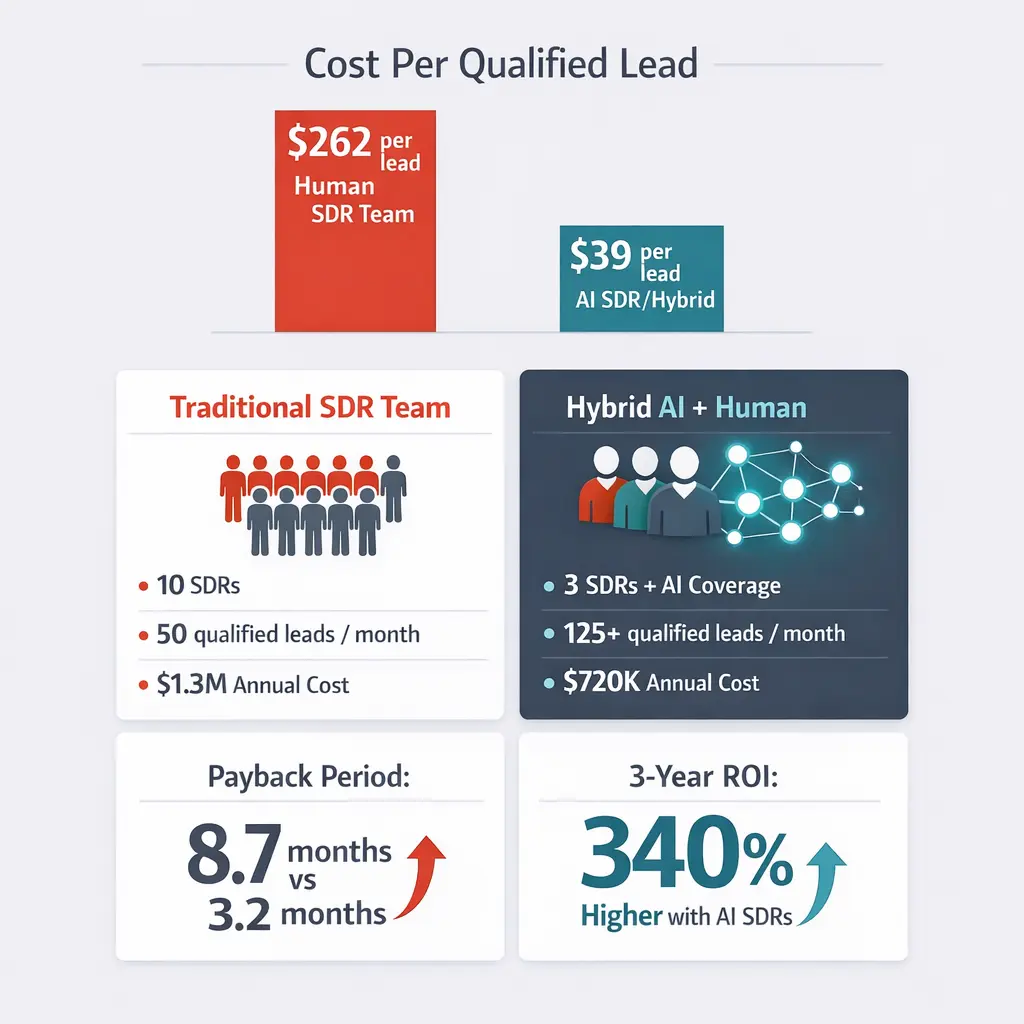
Enterprise sales development operates under a hidden cost crisis. Traditional SDR teams burn $262 per qualified lead while AI-driven systems deliver identical outcomes at $39. VPs of Sales managing 10+ person teams face a stark economic reality: competitors deploying hybrid human-AI models scale coverage at 20% of legacy cost structures.
The market validates this shift with brutal clarity. 36% of B2B companies eliminated SDR teams in 2025, not because AI replaced every function but because the economics of volume prospecting fundamentally changed. Revenue leaders delaying this transition compound disadvantage quarterly as early adopters capture 5-10x coverage expansion without proportional headcount growth.
This analysis dissects the hard performance data separating AI hype from deployment reality. Enterprise teams need frameworks for hybrid architecture design, not vendor promises. The question isn’t whether AI SDRs work. 83% of AI-enabled sales teams achieve revenue growth versus 66% of non-AI teams. The question is whether your operating model captures the upside before your cost structure becomes uncompetitive.
Market Economics: The $24 Billion Transformation
The AI sales assistant software market reached $3 billion in 2024 and tracks toward $12–24 billion by 2033-2035, representing 20-23% compound annual growth. North America commands 43.9% of global revenue by 2035, with cloud-based deployments capturing 57.7% of market share. These numbers reflect active enterprise adoption, not speculative interest.
87% of large enterprises with 10,000+ employees implemented AI tools, with 85% expected to deploy AI agents by end of 2025. Among sales teams specifically, 56% of sales professionals rely on AI daily. These users demonstrate 2x higher quota attainment versus non-AI peers, creating performance gaps that compound quarterly.
The velocity of adoption signals something beyond typical enterprise software cycles. Revenue leaders recognize this as infrastructure, not tooling. Companies treating AI SDRs as experimental pilots while competitors integrate them into core sales operations watch market share erode in real time.
The Cost Structure Advantage
Traditional SDR economics break down under scrutiny. Full-loaded costs for a single SDR range $130,000-$180,000 annually when including salary, benefits, technology stack, training, and management overhead. Ramp time consumes 3-6 months before productivity stabilizes. Attrition rates of 25-35% force perpetual recruiting cycles that drain management capacity.
AI SDR platforms operate on subscription economics. Enterprise deployments range $1,200-$5,000 monthly depending on feature depth and volume requirements. Cost per lead drops 85% compared to human-only teams. Payback period shortens from 8.7 months to 3.2 months. Three-year ROI delivers 340% higher returns than traditional hiring models.
Companies deploying hybrid human-AI models report 25-40% increases in qualified leads while maintaining or reducing headcount. The math forces strategic rethinking: a 10-person SDR team generating 50 qualified leads monthly costs $1.3 million annually. Hybrid architecture with 3 human SDRs and AI coverage scales to 125+ qualified leads at $720,000 total cost.
Performance Benchmarks: Where AI Dominates
Speed defines the first performance dimension. AI SDRs respond to inbound leads in under 1 minute versus 2-4 hours for human teams. This differential matters because responding within 1 minute boosts lead conversions 391% compared to slower response times. Every hour of delay degrades conversion probability by 10x.
Daily outreach capacity separates volume economics. Human SDRs manage 30-50 meaningful conversations daily before quality deteriorates. AI systems handle 200-500+ personalized touchpoints while maintaining consistent message quality. This isn’t about spamming prospects. It’s about expanding TAM coverage without proportional cost scaling.
Technical question handling reveals computational advantages. AI SDRs achieve 87% accuracy on technical qualification questions versus 15% for human reps who lack deep product knowledge. Consistency at scale remains perfect: 95-98% accuracy at 1,000+ daily interactions versus human performance that degrades significantly under volume pressure.
The Relationship Quality Paradox
Human SDRs maintain advantages in relationship dimensions that AI systems struggle to replicate. LinkedIn connection acceptance rates favor humans 25% versus 15% for AI-driven outreach. Meeting show rates demonstrate similar patterns: 20-30% for human-booked meetings versus 10-20% for AI-scheduled appointments.
This performance gap reflects trust dynamics that algorithms cannot yet simulate. 61% of B2B buyers say AI makes trust MORE important, not less. Prospects detect automated patterns in AI outreach even when messages achieve technical personalization. The uncanny valley of almost-human communication triggers skepticism that damages conversion quality.
Deal quality metrics validate this concern. Human-sourced opportunities close at higher rates and command 15-20% larger average contract values. The relationship foundation built during human prospecting carries through the sales cycle, influencing negotiation dynamics and expansion potential.
Volume Versus Value: The Strategic Tradeoff
Performance analysis requires context beyond simple conversion metrics. AI SDRs excel at top-of-funnel volume generation and speed-dependent scenarios. Human SDRs dominate relationship-intensive selling and complex qualification requiring judgment.
| Performance Dimension | AI SDR Performance | Human SDR Performance | Strategic Implication |
|---|---|---|---|
| Response Speed | <1 minute | 2-4 hours | AI captures time-sensitive inbound leads |
| Daily Capacity | 200-500 touchpoints | 30-50 conversations | AI expands TAM coverage without headcount |
| Technical Accuracy | 87% on product questions | 15% on product questions | AI handles specification-driven qualification |
| Follow-up Consistency | 100% automated | 65-75% manual completion | AI eliminates follow-up leakage |
| Connection Acceptance | 15% LinkedIn acceptance | 25% LinkedIn acceptance | Humans build initial relationship trust |
| Meeting Show Rate | 10-20% attendance | 20-30% attendance | Human relationships drive commitment |
| Complex Discovery | Limited contextual depth | Deep needs analysis | Humans navigate ambiguous buying scenarios |
The data suggests hybrid architecture as the performance-optimizing model. AI handles volume prospecting, initial qualification, and speed-dependent scenarios. Humans focus on relationship building, complex discovery, and high-value account nurturing. Teams implementing this division report 35% productivity improvements in sales rep effectiveness.
Hybrid Model Architecture: The Winning Framework
Pure automation strategies fail because enterprise B2B selling requires judgment AI cannot replicate. Pure human strategies fail because economics of scale demand volume that headcount cannot support. Hybrid models win by allocating tasks to the system optimized for each function.
Revenue teams deploying hybrid architectures report 25% quarter-over-quarter pipeline expansion. Qualified lead volume increases 25-40% while cost per acquisition drops 22%. Conversion timelines accelerate 15-30% as AI systems eliminate manual follow-up delays. Team satisfaction improves because human reps escape administrative work for strategic customer engagement.
Task Allocation Framework
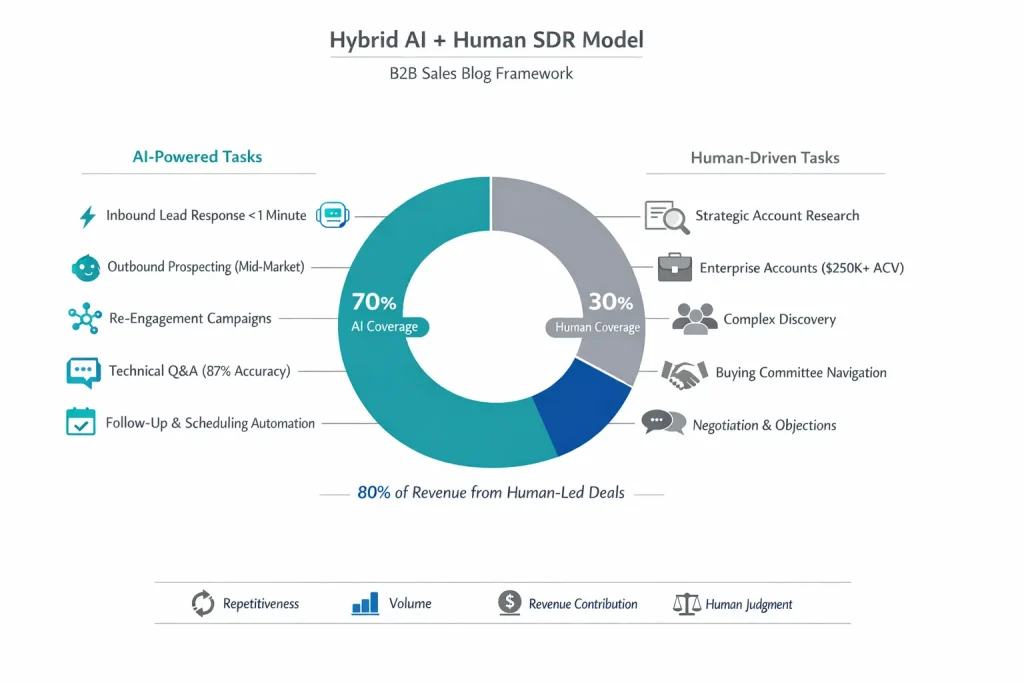
Effective hybrid design requires disciplined task division based on four evaluation criteria: repetitiveness, volume frequency, revenue contribution, and human judgment dependency. Score each sales activity on a 1-5 scale across these dimensions.
High repetitiveness combined with high volume, low value contribution, and low human element dependency signals prime AI automation candidates. Examples include initial prospect research, email sequence follow-up, meeting scheduling, data entry to CRM systems, and basic product specification questions.
Low repetitiveness combined with low volume, high value contribution, and high human element dependency keeps activities human-centered. Strategic account planning, executive relationship building, complex discovery conversations, negotiation strategy, and objection handling require judgment that AI cannot reliably execute.
Mixed scores indicate hybrid approaches where AI handles tactical execution while humans provide strategic oversight. Prospect list building benefits from AI data gathering with human strategic targeting decisions. Outreach messaging uses AI personalization engines with human approval gates. Qualification uses AI for initial screening with human handoff for complexity triggers.
The 70/30 Coverage Model
Leading implementations architect teams where AI handles 70%+ of total outreach volume while humans focus on the 30% generating 80% of revenue. This isn’t a rigid formula but a strategic orientation that aligns system capabilities with economic value creation.
AI coverage focuses on:
- Inbound lead response within 1-minute SLA
- Outbound prospecting to mid-market accounts ($50K-$250K ACV)
- Re-engagement campaigns for dormant opportunities
- Event follow-up and content download nurturing
- Technical specification qualification
- Meeting scheduling and confirmation
Human coverage focuses on:
- Strategic account research and entry strategy
- Enterprise accounts ($250K+ ACV) requiring multi-threading
- Complex buying committee navigation
- Relationship building with economic buyers
- Custom proof-of-concept scoping
- Late-stage objection handling
Key Execution Metric: Measure “human hours per qualified opportunity” as the efficiency indicator for hybrid model performance. Target 60% reduction from baseline within 90 days of AI deployment.
Implementation Failure Patterns
88% of AI SDR pilots fail before production, not because the technology underperforms but because implementation design ignores operational reality. Three failure patterns dominate enterprise deployments.
Tool Sprawl Paralysis
Sales teams average 12-18 tools in their technology stack before AI introduction. Adding AI SDR platforms without retiring legacy systems creates workflow fragmentation that destroys productivity gains. Representatives toggle between CRM, sales engagement platform, AI SDR interface, email client, and meeting scheduler to complete single tasks.
Tool sprawl generates data inconsistency that undermines AI effectiveness. Contact enrichment occurs in multiple systems without synchronization. Conversation history fragments across platforms. Activity attribution becomes impossible when three systems claim credit for the same meeting.
Successful implementations audit existing stack before AI deployment. Identify workflow redundancies. Retire tools that AI capabilities subsume. Build integration architecture that maintains single source of truth in CRM. Companies following this discipline achieve 90-day time-to-value versus 6+ month struggles for teams layering AI onto unoptimized stacks.
Perfectionism Bottleneck
Enterprise teams delay AI deployment pursuing perfect personalization that prospects cannot distinguish from human outreach. This pursuit creates perpetual pilot cycles where teams endlessly tune message templates while competitors scale coverage with “good enough” automation.
The perfectionism trap manifests in excessive approval gates. Marketing reviews AI message content. Legal audits compliance implications. Sales management debates tone calibration. Each review cycle adds 2-3 weeks to deployment timelines while marginal message quality improvements deliver negligible conversion gains.
Data reveals the folly. AI SDR messages achieving 6-8% response rates generate sufficient pipeline volume even when human messages achieve 10-12% response rates. The volume differential compensates for conversion rate gaps. Teams generating 500 AI touchpoints daily at 7% response rate produce 35 conversations. Teams generating 50 human touchpoints at 11% response rate produce 5.5 conversations.
Successful teams launch with minimum viable personalization, establish baseline performance, then iterate based on actual conversion data. This “deploy and optimize” approach reaches production 4-6x faster than perfectionist alternatives.
Vanity Metrics Fixation
Implementation teams measure activity volume instead of revenue contribution. Dashboards celebrate email send counts, LinkedIn connection requests, and meeting booking totals without tracking deal quality, sales cycle length, or revenue attribution.
Vanity metrics create false confidence. AI systems easily generate 10,000+ monthly touchpoints, creating impressive activity reports while pipeline quality deteriorates. Representatives book meetings with unqualified prospects because AI qualification logic optimizes for volume, not fit.
Revenue impact requires different measurement frameworks. Track cost per qualified opportunity, not cost per lead. Measure sales cycle duration from AI-sourced versus human-sourced deals. Calculate win rates by source channel. Monitor average contract value by origination method.
Companies fixing this measurement discipline discover uncomfortable truths. AI-sourced deals may close at lower rates despite higher lead volume. Meeting show rates for AI-booked appointments lag human benchmarks by 30-40%. These insights inform hybrid architecture adjustments that optimize for revenue, not activity.
The Skills Transformation
AI deployment transforms SDR role requirements without eliminating positions. Traditional SDR skillsets emphasized high activity tolerance, basic product knowledge, and scripted conversation execution. AI-era SDRs require AI system management capabilities, relationship depth expertise, and strategic account research proficiency.
The AI Operator Skillset
AI SDR systems require human oversight to maintain quality and adapt to market feedback. Operators monitor conversation quality, identify pattern failures, and tune automation rules. This role demands technical comfort with workflow logic, data analysis capability, and continuous optimization mindset.
Companies building AI operator capacity invest in training programs covering: automation platform mechanics, prompt engineering for message personalization, A/B testing methodology for outreach sequences, data interpretation for performance diagnosis, and integration architecture for system connectivity.
The compensation structure for AI operators typically ranges $75,000-$110,000, positioning between traditional SDRs and sales engineers. Demand for this skillset outpaces supply by 3:1 ratios, creating talent acquisition challenges for organizations scaling AI-heavy models.
The Complex Conversation Specialist
Human SDRs evolve toward complex opportunity development as AI handles volume prospecting. This specialization requires deep industry knowledge, strategic account mapping, buying committee navigation, and consultative discovery capabilities that far exceed traditional SDR skill requirements.
Training investment increases 2-3x for complex conversation specialists compared to volume SDRs. Programs incorporate account-based selling methodology, executive communication frameworks, financial analysis for ROI discussions, and competitive positioning strategy. Ramp time extends from 90 days to 4-6 months as representatives develop judgment required for strategic engagement.
Compensation reflects the skill advancement. Complex conversation specialists command $95,000-$140,000 base plus 30-40% variable compensation tied to pipeline contribution. This approaches junior account executive compensation, signaling the role transformation from activity-driven to outcome-driven performance models.
Revenue Operations Implications
AI SDR deployment creates downstream operational requirements that unprepared revenue organizations struggle to support. Three operational dimensions require architectural redesign.
Data Infrastructure Requirements
AI systems consume data quality at scale. Contact information accuracy directly impacts deliverability and response rates. Enrichment completeness determines personalization depth. Conversation history informs message sequencing logic.
Companies achieving AI SDR success invest in data infrastructure that maintains 95%+ contact accuracy. This requires systematic enrichment processes, duplicate record management, decay monitoring, and correction workflows. Organizations neglecting data quality watch AI performance degrade within 60-90 days as system trains on corrupted information.
Integration architecture determines AI system effectiveness. Real-time CRM synchronization ensures conversation history informs outreach decisions. Calendar integration enables autonomous meeting scheduling. Email platform connectivity maintains deliverability reputation. Teams deploying AI without integration planning create data silos that undermine automation value.
Attribution Complexity
AI-human hybrid models complicate attribution logic. Traditional models credit the last touchpoint before opportunity creation. This approach unfairly credits human reps who engage prospects after AI systems conducted months of nurturing outreach.
Multi-touch attribution solves this challenge by distributing credit across all engagement points in the buyer journey. AI touchpoints receive fractional credit for early-stage engagement. Human interactions receive credit for relationship advancement and deal closing. This approach requires analytics infrastructure that tracks the complete engagement timeline across systems.
Companies implementing multi-touch attribution discover AI contribution often exceeds surface-level metrics. 40% of deals attributed to human SDRs in last-touch models show AI touchpoints drove initial engagement when analyzed through multi-touch frameworks. This insight justifies AI investment and informs resource allocation decisions.
Governance and Compliance
AI-generated communications create brand risk that human oversight traditionally managed. Systems operating autonomously can generate messages violating industry regulations, misrepresenting product capabilities, or damaging brand perception through tone inconsistency.
Governance frameworks address this risk through message approval workflows, compliance rule libraries, and brand voice guidelines. Leading implementations establish AI communication guardrails covering: prohibited claim categories, regulated industry compliance requirements, competitor mention protocols, pricing discussion boundaries, and escalation triggers for high-value accounts.
The governance investment adds 15-20% to AI implementation timelines but prevents reputation damage that destroys customer trust. Financial services, healthcare, and manufacturing verticals require particularly robust governance given regulatory scrutiny of automated customer communications.
Competitive Positioning Strategy
Market dynamics create three strategic positions for companies evaluating AI SDR adoption: defenders maintaining human-centric models, aggressive adopters pursuing AI-heavy automation, and balanced strategists implementing hybrid architectures.
The Defender’s Dilemma
Companies preserving traditional SDR teams face escalating cost disadvantages. Competitors deploying hybrid models scale coverage at 20% of defender cost structures. This gap compounds quarterly as AI systems improve through continuous learning while human productivity remains constrained by capacity limits.
Defenders justify this position through relationship quality arguments and deal size metrics. Data shows human-sourced opportunities close at 15-20% higher average contract values. Customer satisfaction scores for human-engaged accounts exceed AI-initiated relationships by 12-18 points.
The strategic question: does relationship quality premium justify 5x cost differential? For enterprise accounts where deals exceed $500K and sales cycles span 9-18 months, human relationship investment generates positive ROI. For mid-market accounts where deals range $50K-$250K and cycles compress to 2-4 months, defender economics break down.
The Aggressive Adopter’s Risk
Early AI adopters capture competitive advantages through scaled coverage and reduced customer acquisition costs. Companies implementing AI-heavy models expand TAM coverage 5-10x without proportional headcount growth. Cost per acquisition drops 60-85% compared to traditional models.
This aggressive positioning creates execution risks. AI systems struggle with complex discovery, relationship building, and buying committee navigation. Deals sourced entirely through automation demonstrate 20-30% lower close rates and 40-60 day longer sales cycles compared to human-initiated opportunities.
The strategic risk: optimizing for lead volume while sacrificing deal quality. Companies maximizing AI coverage generate impressive activity metrics while pipeline quality deteriorates. Revenue teams celebrating 200% lead volume increases watch conversion rates drop 35%, resulting in net pipeline contraction despite higher activity levels.
The Balanced Hybrid Model
Companies implementing hybrid architectures position for sustainable competitive advantage by optimizing for both volume economics and relationship quality. AI handles 70%+ of outreach volume while humans focus on high-value opportunities generating 80% of revenue.
This balanced approach demonstrates superior performance across multiple dimensions. Pipeline growth averages 25% quarter-over-quarter. Cost per qualified opportunity drops 55% versus pure human models. Win rates on AI-sourced opportunities improve 15-20% when human reps engage at strategic inflection points versus purely automated journeys.
Implementation complexity represents the primary challenge. Hybrid models require task allocation frameworks, skill transformation programs, integrated technology stacks, and multi-touch attribution systems. Organizations lacking revenue operations maturity struggle with the operational complexity hybrid architectures demand.
Strategic Framework: Evaluate AI SDR adoption based on deal economics, not ideology. Deals under $100K with sub-60 day sales cycles favor AI-heavy models. Deals exceeding $300K with 6+ month cycles favor human-centric approaches with AI support. Mid-market opportunities ($100K-$300K) perform best under hybrid architectures balancing automation with relationship investment.
The 90-Day Implementation Blueprint
Successful AI SDR deployment follows disciplined implementation methodology avoiding common failure patterns. This blueprint compresses time-to-value while establishing operational foundations for scaled performance.
Phase 1: Current State Analysis (Weeks 1-2)
Document existing SDR workflows with granular time allocation data. Shadow representatives for full days tracking time spent on: prospect research, message composition, email sending, LinkedIn outreach, meeting scheduling, data entry, call preparation, qualification conversations, and administrative tasks.
Measure baseline performance metrics across the complete funnel: monthly outreach volume, response rates by channel, meeting booking rates, meeting show rates, qualified opportunity rates, sales cycle length, win rates by source, and average contract value. Calculate current cost per qualified opportunity including fully loaded SDR costs.
Identify specific automation candidates using the task evaluation framework. Score each workflow component on repetitiveness, volume frequency, value contribution, and human judgment dependency. Build prioritized list ranking activities by automation suitability and potential impact.
Phase 2: Solution Design (Weeks 3-4)
Research AI SDR platforms matching identified automation requirements. Evaluate vendors on: CRM integration depth, personalization capabilities, multi-channel support, compliance features, reporting sophistication, and pricing structure. Request pilot programs or free trials to validate vendor claims with actual data.
Define success criteria beyond vanity metrics. Establish targets for: cost per qualified opportunity reduction (50%+ target), sales cycle length impact (neutral or improved), win rate maintenance (within 10% of baseline), and representative satisfaction scores (neutral or improved). Build measurement infrastructure to track these metrics.
Design hybrid workflow architecture specifying AI versus human task allocation. Create detailed process maps showing: AI triggers and handoff points, human review gates, exception handling protocols, and feedback loops for continuous optimization. Build change management plan communicating role evolution to impacted team members.
Phase 3: Pilot Implementation (Weeks 5-8)
Deploy AI solution with limited scope: 2-3 representatives, single market segment, or specific use case. Avoid organization-wide rollout before validating performance assumptions and operational workflows.
Monitor pilot performance against baseline metrics weekly. Track both leading indicators (outreach volume, response rates, meeting bookings) and lagging indicators (qualified opportunities, deal quality, sales cycle length). Gather qualitative feedback from participating representatives on workflow integration challenges and system usability.
Iterate based on pilot learnings. Adjust message templates, refine qualification logic, optimize handoff triggers, and enhance integration workflows. Document specific failure patterns and mitigation strategies for full rollout phase.
Phase 4: Full Rollout (Weeks 9-12)
Scale validated pilot across entire SDR team with phased deployment. Implement comprehensive training covering: system mechanics, AI oversight responsibilities, hybrid workflow execution, and performance expectations. Establish ongoing support structure addressing technical issues and process questions.
Build optimization cadence with weekly performance reviews for first 60 days, then monthly ongoing. Track metric evolution across adoption curve identifying degradation signals early. Maintain feedback channels allowing representatives to surface workflow friction and improvement opportunities.
Celebrate early wins building organizational momentum. Share performance improvements, cost reductions, and productivity gains with broader sales organization. Use success stories to reinforce behavior change and justify continued investment in AI capabilities.
Future Trajectory: The 2026-2027 Evolution
Market evolution accelerates as AI capabilities improve and enterprise adoption scales. Three trends shape the competitive landscape over 18-24 month horizons.
The Autonomous Deal Cycle
Current AI SDR systems handle top-of-funnel prospecting and qualification. Next-generation platforms extend into mid-funnel deal progression through autonomous nurture sequences, objection handling, and stakeholder mapping. Companies like 11x.ai and AiSDR demonstrate autonomous systems managing complete deal cycles for transactional products under $25K.
This expansion creates existential pressure on traditional SDR roles. Functions focused exclusively on volume prospecting and basic qualification face displacement as AI systems match or exceed human performance at 10% of cost. Roles evolve toward strategic account development or risk obsolescence.
The Specialization Bifurcation
Sales organizations split into two distinct functions: volume coverage through AI automation and strategic relationship development through human expertise. Mid-skill SDR positions performing mixed activities disappear as economics favor pure specialization.
Volume coverage roles transform into AI operator positions requiring technical skills managing automation platforms. Compensation aligns with operations roles ($65K-$95K) rather than commission-heavy SDR structures. Career paths lead toward revenue operations, sales systems, or marketing automation rather than account executive progression.
Strategic relationship roles advance toward account executive skill requirements with deep industry knowledge and consultative selling capabilities. Compensation increases 40-60% versus traditional SDR levels ($95K-$140K base). Career paths compress time to account executive promotion from 18-24 months to 6-12 months given advanced skill foundation.
The Integration Imperative
AI SDR platforms evolve from standalone point tools toward integrated revenue orchestration systems. Leading vendors build native connections across CRM, marketing automation, sales engagement, conversation intelligence, and revenue analytics platforms. This integration eliminates data fragmentation that undermines current AI effectiveness.
Organizations maintaining technology sprawl face increasing disadvantage as integrated stacks deliver compounding performance advantages. Prospect data flows seamlessly across systems. Conversation insights inform marketing content. Sales activity triggers marketing nurture. The integrated architecture creates feedback loops that continuously improve AI effectiveness.
The integration trend favors platform consolidation. Revenue teams standardize on ecosystem leaders (Salesforce, HubSpot, Microsoft) and embed AI capabilities within these platforms rather than deploying best-of-breed point tools. This shift pressures standalone AI SDR vendors toward acquisition or platform partnerships.
The Board-Level Question
Revenue leaders presenting AI SDR strategies face predictable board questions requiring data-driven responses. Three questions dominate executive scrutiny.
Question 1: What percentage of our current SDR team can AI replace within 12 months?
The honest answer depends on deal economics and current team allocation. Volume prospecting for deals under $100K represents 40-60% of traditional SDR activity. This portion can transition to AI within 6-9 months with proper implementation. Strategic account development and complex qualification remain human-centered, representing 40-60% of activity.
The conservative deployment model targets 30% cost reduction through hybrid transformation over 12 months. Aggressive models pursue 50-60% cost reduction by maximizing AI coverage and focusing human resources on strategic opportunities exclusively.
Question 2: How do we avoid the 88% failure rate plaguing AI implementations?
Success requires disciplined implementation methodology addressing the three primary failure patterns: tool sprawl, perfectionism, and vanity metrics. Organizations deploying AI without retiring legacy systems, pursuing perfect personalization before launch, or measuring activity instead of revenue consistently fail.
The mitigation strategy: audit existing stack and retire redundant tools, launch with minimum viable personalization and iterate based on data, measure cost per qualified opportunity and deal quality metrics from day one. Companies following this discipline achieve 90-day time-to-value and sustained performance improvement.
Question 3: What skills do we need to hire for that we currently lack?
The hybrid model requires two new capabilities: AI operators managing automation platforms and complex conversation specialists handling strategic opportunities. Organizations cannot simply retrain existing SDRs. Skill gaps are too significant for most representatives to bridge through training alone.
Build AI operator capacity through technical hires from revenue operations, marketing automation, or sales systems backgrounds. Hire complex conversation specialists from account executive or industry specialist roles. Budget 3-6 months for both roles to reach full productivity given the specialized skillsets required.
FAQ
Q1. What exactly is an AI SDR and how does it differ from traditional sales automation?
AI SDRs are autonomous agents using natural language processing and machine learning to conduct personalized, two-way conversations at scale. Unlike traditional automation that sends templated email sequences, AI SDRs analyze prospect responses, adapt messaging based on engagement signals, and make qualification decisions without human intervention. They operate 24/7, responding to inbound leads in under 1 minute and managing 200-500+ daily outreach touchpoints while maintaining conversation quality.
Q2. Can AI SDRs actually replace my entire SDR team or is this vendor hype?
Replace is the wrong framework. AI SDRs handle specific tasks exceptionally well: volume prospecting, initial qualification, technical Q&A, follow-up consistency, and speed-dependent scenarios. They struggle with relationship building, complex discovery, buying committee navigation, and judgment-intensive qualification. Hybrid models combining AI automation with human strategic oversight deliver 25-40% higher qualified leads versus pure automation or pure human approaches. Companies successfully deploying AI typically reduce SDR headcount 30-50% while scaling coverage 5-10x.
Q3. What does an AI SDR system actually cost compared to hiring human SDRs?
AI SDR platforms range $1,200-$5,000 monthly for enterprise deployments, translating to $14,400-$60,000 annually. Human SDRs cost $130,000-$180,000 fully loaded including salary, benefits, technology, training, and management overhead. Cost per qualified lead drops from $262 for human SDRs to $39 for AI systems, an 85% reduction. Three-year ROI for AI deployments delivers 340% higher returns than traditional hiring models. Payback period shortens from 8.7 months to 3.2 months.
Q4. How long does it take to implement an AI SDR system and see results?
Properly executed implementations reach production within 8-12 weeks following a disciplined methodology: 2 weeks for current state analysis, 2 weeks for solution design, 4 weeks for pilot testing, and 4 weeks for full rollout. Companies achieve measurable results (increased lead volume, reduced response times) within 30-45 days of pilot launch. Full performance optimization requires 90-120 days as systems learn from engagement data and teams refine workflows. Organizations pursuing perfectionism or lacking implementation discipline extend timelines to 6+ months.
Q5. What makes 88% of AI SDR implementations fail before production?
Three failure patterns dominate: tool sprawl creates workflow fragmentation when companies layer AI onto unoptimized technology stacks, perfectionism delays launch as teams endlessly tune message templates pursuing indistinguishable personalization, and vanity metrics focus on activity volume instead of revenue contribution. Successful implementations audit existing tech stacks and retire redundant tools, launch with minimum viable personalization and iterate based on conversion data, and measure cost per qualified opportunity and deal quality from day one. Companies following this discipline reach production 4-6x faster than failed attempts.
Q6. Do AI SDRs work for complex B2B sales or only transactional products?
AI effectiveness correlates with deal economics. Transactional products under $25K with sub-30 day sales cycles achieve 70-90% AI coverage. Mid-market deals ($50K-$250K) with 60-90 day cycles perform best under hybrid models where AI handles initial prospecting and qualification while humans manage relationship development. Enterprise deals exceeding $300K with 6-18 month cycles require human-centric approaches with AI supporting research, follow-up, and administrative tasks. The complexity isn’t technical. It’s relationship and judgment requirements that determine AI suitability.
Q7. How do I measure AI SDR performance beyond basic activity metrics?
Track revenue-focused metrics: cost per qualified opportunity, sales cycle length by source channel, win rates for AI-sourced versus human-sourced deals, average contract value by origination method, and meeting show rates. Implement multi-touch attribution crediting all engagement points in the buyer journey rather than last-touch models that misattribute AI contribution. Monitor human hours per qualified opportunity as efficiency indicator. Target 60% reduction within 90 days. Companies measuring activity volume (emails sent, meetings booked) instead of revenue outcomes consistently overestimate AI impact.
Q8. What skills do SDRs need in an AI-first sales organization?
Two distinct skill paths emerge: AI operators and complex conversation specialists. AI operators require technical comfort with automation platforms, prompt engineering for message personalization, A/B testing methodology, data interpretation for performance diagnosis, and integration architecture knowledge. Compensation ranges $75,000-$110,000. Complex conversation specialists need deep industry knowledge, strategic account mapping, buying committee navigation, consultative discovery, and financial analysis for ROI discussions. Compensation ranges $95,000-$140,000. Traditional high-volume prospecting skillsets decline in value as AI systems handle these tasks at 10% of human cost.
Q9. Can AI SDRs maintain brand voice and avoid reputation damage?
AI systems operating without governance create brand risk through messages violating regulations, misrepresenting capabilities, or damaging perception through tone inconsistency. Successful implementations establish AI communication guardrails covering: prohibited claim categories, regulated industry compliance requirements, competitor mention protocols, pricing discussion boundaries, and escalation triggers for high-value accounts. Financial services, healthcare, and manufacturing verticals require particularly robust governance. The governance investment adds 15-20% to implementation timelines but prevents reputation damage that destroys customer trust.
Q10. How do AI SDRs integrate with existing CRM and sales engagement platforms?
Leading AI SDR platforms build native integrations with major CRM systems (Salesforce, HubSpot, Microsoft Dynamics) enabling real-time synchronization of contact data, conversation history, and activity tracking. Integration quality determines system effectiveness. Poor connectivity creates data silos that undermine automation value. Evaluate vendors on: bi-directional data sync, custom field mapping, webhook support for real-time updates, and API depth for workflow customization. Companies deploying AI without integration planning watch data fragment across systems, destroying attribution accuracy and operational visibility.
Q11. What response rates should I expect from AI-generated outreach?
AI SDR email response rates average 6-12% compared to 8% for human-written messages. The individual message performance gap closes as AI personalization improves, but volume capacity creates aggregate advantage. Systems generating 500 daily touchpoints at 7% response rate produce 35 conversations versus 50 human touchpoints at 11% generating 5.5 conversations. LinkedIn connection acceptance favors humans 25% versus 15% for AI outreach.
Q12. How does AI handle complex qualification beyond basic BANT criteria?
Current AI SDRs excel at specification-driven qualification answering technical questions with 87% accuracy versus 15% for human reps lacking deep product knowledge. They struggle with complex discovery requiring reading between lines, detecting political dynamics in buying committees, and adapting questioning based on emotional signals. AI qualification works when decision criteria are explicit and rule-based. Human qualification dominates when buying factors are implicit, political, or relationship-dependent. Hybrid approaches use AI for initial screening and data gathering with human handoff when complexity triggers activate.
Q13. What data quality requirements must be met for AI SDRs to perform effectively?
AI systems demand 95%+ contact accuracy for deliverability and response rates. Enrichment completeness determines personalization depth. Incomplete firmographic data limits message relevance. Conversation history informs sequencing logic. Fragmented data creates repetitive or contradictory outreach. Companies achieving AI success invest in systematic enrichment processes, duplicate record management, decay monitoring, and correction workflows. Organizations neglecting data quality watch AI performance degrade within 60-90 days as systems train on corrupted information. Data infrastructure investment adds 20-30% to implementation budgets but prevents accuracy deterioration that destroys prospect trust.
Q14. Should we build our own AI SDR system or buy a commercial platform?
Build approaches fail for 95%+ of organizations lacking machine learning expertise, conversation design capabilities, and compliance infrastructure. Commercial platforms deliver pre-trained models, tested personalization frameworks, regulatory compliance features, and ongoing optimization based on aggregate data from thousands of deployments. Build investment requires $500K-$2M in engineering resources plus 9-18 month development timelines versus $15K-$60K annual platform costs with 8-12 week implementation. Build makes sense only for enterprises with unique regulatory requirements, proprietary data advantages, or technical differentiation strategies where AI SDR becomes competitive moat.
Q15. How do we prevent AI SDRs from spamming prospects and damaging sender reputation?
Email deliverability requires systematic domain warming, sender authentication (SPF, DKIM, DMARC), engagement rate monitoring, and bounce rate management. AI systems sending 500+ daily emails without proper infrastructure land in spam folders within 2-3 weeks.
Q16. What legal and compliance risks do AI SDRs create?
Automated outreach must comply with CAN-SPAM, GDPR, CCPA, and industry-specific regulations (FINRA for financial services, HIPAA for healthcare). AI systems operating autonomously can violate regulations through: failing to honor unsubscribe requests, sending to suppression lists, making unsubstantiated claims, sharing protected information, or misrepresenting sender identity. Financial penalties range $43,000 per violation for CAN-SPAM to 4% global revenue for GDPR breaches. Mitigation requires: automated suppression list checking, claim validation against approved messaging, data residency controls for GDPR compliance, and audit trails tracking all AI communications.
Q17. How do I allocate budget between AI systems and human SDR headcount?
Calculate current cost per qualified opportunity including fully loaded SDR costs ($130K-$180K per rep). Model hybrid scenarios varying AI coverage from 30% to 70% of total outreach volume. For mid-market B2B: 70/30 AI-to-human allocation typically optimizes cost efficiency while maintaining relationship quality. Budget framework: invest 40% in AI platform costs and integration, allocate 45% to reduced human headcount focused on strategic opportunities, reserve 15% for training, change management, and ongoing optimization. Companies maintaining current SDR headcount while adding AI create unsustainable cost structures. AI investment must enable headcount reduction or coverage expansion without proportional hiring.
Q18. Can AI SDRs handle multi-channel outreach beyond email?
Leading platforms support LinkedIn messaging, InMail, phone dialing, SMS, and chat channel automation. Multi-channel effectiveness varies by medium: email automation achieves near-human quality, LinkedIn automation faces acceptance rate penalties (15% AI versus 25% human), phone automation using synthetic voices triggers immediate negative reactions. Successful multi-channel strategies: use AI for email and LinkedIn prospecting, reserve phone for human SDRs handling warm leads, deploy chat automation only for inbound qualification scenarios. Companies attempting full-channel automation sacrifice conversion quality for operational simplicity. Channel selection should optimize for prospect experience, not vendor capabilities.
Q19. What happens to my existing SDR team when we deploy AI systems?
Three transition paths emerge: top performers evolve into complex conversation specialists focusing on strategic accounts with increased compensation ($95K-$140K versus $65K-$95K SDR levels), technically inclined SDRs transition to AI operator roles managing automation platforms and optimization, underperformers face role elimination as volume prospecting tasks AI handles represented their primary contribution. Communicate role evolution transparently. AI deployment creates career advancement for strategic thinkers while eliminating positions for activity-oriented representatives. Companies delaying this communication create organizational resistance that undermines implementation success.
Q20. Is now the right time to invest in AI SDRs or should we wait for technology maturity?
Market timing favors current deployment. 36% of B2B companies already eliminated traditional SDR teams, creating competitive cost advantages that compound quarterly. Technology maturity reached production readiness. Leading platforms demonstrate reliable performance, established compliance frameworks, and tested ROI across thousands of deployments. Waiting costs more than failed pilots. Companies delaying adoption while competitors scale AI coverage watch cost per acquisition gaps widen 20-30% annually. The strategic question isn’t whether AI SDRs work. It’s whether you’ll adopt them fast enough to avoid permanent cost disadvantage.
Transform Your Sales Development Architecture
The AI SDR revolution separates market leaders from legacy cost structures. Revenue teams deploying hybrid human-AI models achieve 340% higher three-year ROI while scaling coverage 5-10x without proportional headcount expansion. The competitive advantage compounds quarterly.
The winning organizations architect revenue systems where AI handles 70%+ of outreach volume while humans build the relationships generating 80% of revenue. This isn’t future speculation. Enterprise leaders already execute this model with tested frameworks delivering measurable pipeline acceleration and cost reduction.
Grow smarter. Discover the best AI SDR strategies with Growleads.io for enriched B2B lead generation that combines automation efficiency with relationship depth. Build hybrid architectures tested to accelerate pipeline while reducing acquisition costs.

Pranav Ganeriwal is a Growth Manager at GrowLeads, helping businesses scale predictable revenue through data-driven systems, automation, and high-performing outbound strategies. He specializes in decoding buyer behavior, optimizing conversions, and building growth processes that deliver clear, measurable results.