
ICP Model Update 2026: 10 B2C and B2B Best Practices for Refreshing Your Ideal Customer Profile
 Your ideal customer profile framework might not target the right businesses. This means you’re leaving money on the table.
B2C ICP model update best practices for 2025 and 2026 center on 4 triggers that justify a refresh: churn rate deviation from cohort baseline, win-rate compression at a previously strong segment, pricing tier mix shift, and category maturity change. A disciplined ICP refresh takes 60 minutes when run against clean CRM data and produces 3 outputs: an updated firmographic profile, a revised scoring rubric, and a revised negative ICP (who you stop targeting). Teams that refresh ICP quarterly outperform teams refreshing annually by 20% to 35% on marketing-qualified-to-closed-won conversion.
B2C ICP Model Update: Best Practices for 2025 and 2026
ICP drift is silent. It shows up as slowly rising CAC, slowly falling win rate, and slowly creeping churn. The 4 triggers below catch drift before it compounds into a pipeline crisis.
Trigger 1: Churn rate deviation from cohort baseline
Pull 3-month, 6-month, 12-month cohort churn. If the most recent cohort’s 6-month churn has risen 3+ percentage points above the trailing 12-month average, you are acquiring customers outside ICP. Refresh the model, not the retention playbook.
Trigger 2: Win-rate compression at a historically strong segment
Filter closed-won deals by segment over the last 4 quarters. If a segment’s win rate has fallen 5+ percentage points, the ICP for that segment has shifted. The buyer has changed, or the competitive set has changed. Either way, the rubric needs updating.
Trigger 3: Pricing tier mix shift
If pricing tier mix shifts 10%+ toward lower tiers quarter-over-quarter, the ICP is decaying downmarket. That is either an ICP problem (wrong targeting) or a pricing problem (upmarket pricing does not fit). Both need ICP input to resolve.
Trigger 4: Category maturity change
When a category matures (more competitors, more buyer education, more commoditized features), the buyer persona shifts from innovator to majority. Innovators buy on vision; majority buyers buy on references and implementation safety. Your ICP needs to reflect this transition.
The 60-minute ICP refresh workflow
- Minutes 0-15: Pull last 4 quarters of closed-won, segment by firmographic and behavioral traits
- Minutes 15-30: Identify top 20% of accounts by NRR (net revenue retention). These are the real ICP.
- Minutes 30-45: Identify bottom 20% of accounts by churn risk. These are the negative ICP.
- Minutes 45-60: Write the updated rubric (top-20% traits required, bottom-20% traits disqualifying). Distribute to sales + marketing.
Companies see amazing results when their sales and marketing teams collaborate with a clear ICP. The numbers speak for themselves – 36% higher customer retention rates, 38% higher sales win rates, and a 208% boost in marketing revenue. But many businesses find it hard to profile customers and create ICPs that hit the mark.
Forbes reports that 81% of customers choose companies that provide customized experiences. This becomes possible only when you know your ideal customer inside out. The right customer profiles do more than improve customization – they cut down acquisition costs by targeting prospects who are more likely to convert and stay loyal.
Our years of experience helping companies build and polish their ideal customer profile strategies have led us to discover 10 proven methods. These methods will revolutionize how you identify, target, and win your best-fit customers in 2025. These tactics are a great way to get insights whether you’re starting from scratch or looking to boost your existing framework. They will help arrange your teams, focus your efforts, and accelerate growth.
Start with a Clear Ideal Customer Profile Definition

Image Source: Lean B2B
“An Ideal Customer Profile (ICP) is a data-driven description of the perfect company or individual who will most benefit from your product or service.”
, Salesmate Research Team, CRM and sales automation platform experts
Your marketing campaigns succeed when you know exactly who to target. A ideal customer profile framework acts as the foundation that drives all your customer acquisition efforts.
Ideal customer profile definition
An ideal customer profile (ICP) paints a detailed picture of companies that get the most value from your product while bringing the greatest returns to your business. This goes beyond regular target audiences – an ICP spots the perfect customer who won’t just buy but will likely become a loyal, profitable partner.
B2B companies’ ICP has these firmographic characteristics:
- Company size and annual revenue
- Number of employees and department structure
- Industry and geographical location
- Technology stack and growth rate
- Pain points and decision-making factors
A well-crafted ICP digs deeper than simple demographics. It looks at behavior patterns, buying processes, and the specific problems your solution fixes.
Why defining your ICP matters
A clear ideal customer profile brings measurable results across your organization. Teams that line up their sales and marketing around a solid ICP see 36% higher customer retention rates. They also achieve 38% higher sales win rates and end up making 208% more marketing revenue.
These numbers tell only part of the story. A focused ICP brings several key benefits:
The sales cycle gets shorter because you target leads that are ready to buy. You won’t waste time chasing prospects who might never convert – your resources go to those matching your profile.
On top of that, it helps qualify leads better. One company stopped selling to customers who weren’t a good fit. Their average deal size jumped 83% in one year and another 30% the next.
Sales cycles move faster, conversion rates climb higher, and customer lifetime values grow when companies focus on businesses that need their solutions.
How to create an ideal customer profile
Building your ideal customer profile needs careful analysis of existing customer data. Here’s how to create an effective ICP:
- Find your super users – Look at your current customers and spot which accounts bring the most value. Check things like profitability, retention time, upsells, or satisfaction scores.
- Talk to customers and collect data – Have direct conversations with your best customers. Learn what drives their decisions, what problems they face, and how your product helps them.
- Look for patterns – Study the data to find what your top customers share. Pay attention to firmographic details like industry, size, revenue, location, and technology stack.
- Write it down – Put together a clear ICP document that shows what makes your ideal customer tick. Keep it detailed but simple – finding the right balance is vital.
- Keep it fresh – Customer needs change with time, so should your ICP. Check it every quarter to stay in sync with market reality and business goals.
Precision matters here. The sort of thing I love seeing is when companies avoid making ICPs too broad. To name just one example, see how targeting businesses with 100-700 employees covers organizations at different growth stages with completely different needs.
A narrow focus creates messages that grab attention from specific types of customers. This targeted approach gets more conversions and thus encourages more growth in average deal size.
Use Customer Profile Templates to Streamline the Process

Image Source: Lean B2B
Creating an ideal customer profile framework from scratch takes time and resources. Templates are a great way to get past this common challenge quickly.
Benefits of using an ideal customer profile template
Customer profile templates give you several advantages that boost your profiling process:
First, templates help you capture detailed data about your customers. They guide you through collecting demographics, psychographics, behaviors, and pain points. This well-laid-out approach helps you understand your audience completely without missing key details.
Second, standardized templates create consistency across departments. Teams that use the same template format work better together. Marketing, sales, product development, and customer service teams make more informed decisions through cooperative efforts.
Third, templates save time and effort in profiling. Creating profiles from scratch might lead to mistakes, but well-designed templates make the whole process smooth. Companies that use customizable templates see better results, including higher win rates and better website conversions.
Templates also provide scalability for growing businesses. They help collect data efficiently when you expand into new markets or customer segments.
Where to find templates
You can find quality customer profile templates from these trusted sources:
HubSpot gives away eight free templates in PowerPoint, Word, and Google Docs formats. They range from detailed profiles to simpler versions based on what you need.
Smartsheet has specialized B2B and B2C templates with demographic and psychographic checklists. Their ICP scorecard template helps you rate potential customers objectively.
Clearbit offers two template types: an ICP scoring template to evaluate best-fit customers and an ICP bio template that outlines your ideal customer profile.
Zendesk provides five fill-in-the-blank PDFs. These include simple, detailed, B2B, B2C, and ICP scorecard templates.
How to customize templates for your business
You can adapt these templates effectively with some thought:
Figure out which criteria matter most to your business first. Your best customers might be those with high satisfaction scores or upselling potential. Then change the template fields to match these important characteristics.
Make your customized templates informative but simple. Use bullet points, short text, and clear sections to create easy-to-read documents. This approach makes templates easier to update as markets change.
Think of your ICP as a living document. Markets change, businesses grow, and products get better over time. Schedule regular reviews to keep your templates in line with your business goals and customer needs.
Getting all departments involved makes the customization process work better. Customer profiles become more useful when sales, marketing, customer service, and product teams share their input during template development.
Collect and Analyze Demographic and Firmographic Data

Image Source: Trendemon
“For B2B, this includes industry, company size, geographic location, technology stack, and pain triggers.”
, Salesmate Research Team, CRM and sales automation platform experts
Data collection forms the backbone of any ideal customer profile framework. Your next significant step comes after understanding what an ICP means and picking your template. You need to gather accurate demographic and firmographic information.
Demographic data in customer profiling
Demographic data defines customers based on who they are. B2C companies look at these characteristics:
- Age, gender, and ethnicity
- Income level and education
- Marital status and home ownership
- Geographic location
- Occupation and employment status
This demographic information helps businesses target interested segments with relevant messaging. Your marketing team can create tailored campaigns, predict customer behaviors, and spot purchasing patterns with this data. These demographic details streamline customer service efforts and promote long-term loyalty throughout the customer profiling process.
Firmographic data for B2B ICPs
Firmographic data works as the B2B version of demographics that changes focus from people to organizations. Companies need detailed information about these characteristics:
- Industry type and geographical location
- Company size (employees, offices, locations)
- Annual revenue and growth trends
- Investment stage and development speed
- Budget allocation for relevant departments
Good B2B profiling should look at performance metrics like company age, growth rates, and historical execution. This data combines with customer journey insights to help you understand your customers’ buying motivations and challenges.
Tools to collect demographic data
Several tools can help you gather and organize customer data efficiently. These resources make the process easier despite data collection challenges:
Social media platforms naturally gather substantial consumer information and offer valuable demographic insights. CRM software helps organize various data points, from demographic details to purchase history and communication priorities.
Your structured demographic research can use:
- Specialized data providers like ZoomInfo and Clearbit
- Government resources (Census Bureau, Bureau of Labor Statistics)
- Analytics platforms that track customer behaviors
- Customer interviews and surveys for direct feedback
You should verify your data regularly for accuracy whatever tools you use. Business databases can degrade by up to 20% annually, so you need validation protocols and compliance checks to keep your ICP reliable and effective.
Incorporate Psychographic and Behavioral Insights
Demographic data shows who your customers are, but psychographic insights reveal the significant why behind their choices. Your targeting becomes more personal and appealing when you understand what drives your ideal customers.
Psychographic traits of your ideal customer
Psychographic traits cover psychological and cognitive attributes that show your customers’ beliefs, values, and goals. These traits include:
- Personality characteristics – Their adventurous, conscientious, or spontaneous nature shapes how they connect with your brand
- Values and beliefs – The core principles guiding their decisions like sustainability, state-of-the-art solutions, or cost-efficiency
- Lifestyle choices – Their daily spending habits and energy allocation
- Attitudes and opinions – Their viewpoints on industry trends, business challenges, and solutions
- Priorities and motivations – The reasons they look for solutions like yours
The EOS Worldwide team found that their best client relationships share specific traits. These clients are growth-oriented, entrepreneurial, open-minded, and appreciative. This pattern helped them focus on clients they could truly help.
Behavioral patterns to track
Customer behaviors provide practical insights beyond psychological traits. Key areas to monitor include:
- Purchasing behaviors – The way customers buy: complex, variety-seeking, dissonance-reducing, or habitual patterns
- Usage patterns – Product usage frequency, popular features, and number of users per account
- Decision criteria – Features or benefits that lead to purchases
- Customer experience interactions – Prospect engagement with touchpoints before conversion
- Loyalty indicators – Signs of long-term commitment versus potential churn
How to gather psychographic data
You need multiple approaches to collect meaningful psychographic and behavioral insights:
Super-user interviews come first. Ask specific questions about their values, challenges, and decisions. Learn what brought them to you and why they stay.
Surveys and feedback tools help uncover psychographic traits. Questions like “How would you describe yourself in three words?” or “What values matter most when choosing a product?” offer valuable insights.
Social media analysis reveals authentic opinions and values.
Web analytics tools track behavioral patterns on digital platforms and show which content appeals most to ideal customers.
Your ideal customer profile framework becomes a detailed blueprint to target and win perfect customers by combining demographic, firmographic, psychographic, and behavioral data.
Interview Your Best Customers for Deeper Insights
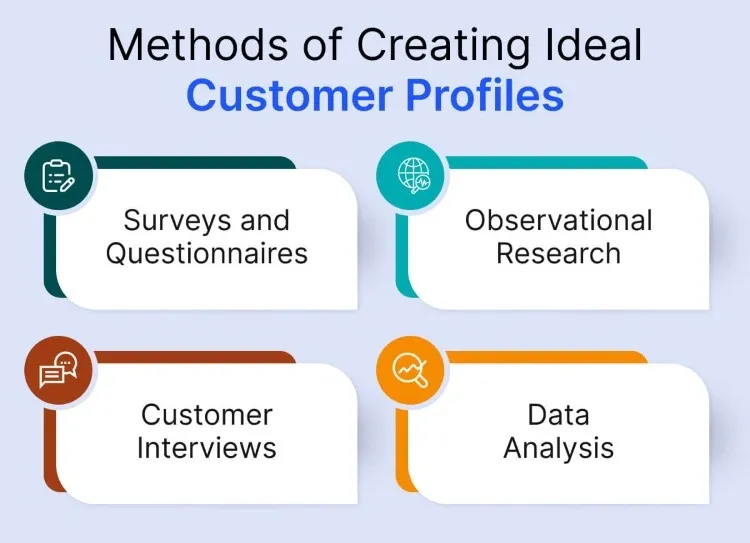
Image Source: REVE Chat
Your ideal customer profile framework becomes crystal clear when you talk directly to customers who love your product. Direct conversations with users reveal details that secondary research can’t match. These conversations give you a window into their motivations, challenges, and experiences.
Questions to ask during interviews
Great customer interviews need well-crafted, open-ended questions that draw out detailed responses. Questions should focus on real customer behavior instead of hypothetical situations:
- “How did you plan your regular day before using our solution?”
- “Tell me about the last time you experienced [specific problem your product solves].”
- “What was your thought process when you decided to purchase our product?”
- “Why did you originally choose our solution over alternatives?”
- “How does our product solve your main problem today?”
Direct questions give valuable insights, but the most revealing information comes from follow-up questions. Customers often share interesting views that you can explore further with simple phrases like “Can you tell me more about that?” or “How did that make you feel?” This helps uncover the emotional reasons behind their buying decisions.
How to identify super users
Super users are customers who breathe your solution. They’ve mastered your product, log in frequently, and help other users. These customers show several unique traits:
They demonstrate deep product knowledge and have completed advanced training. They learn your product faster than most. Sometimes they know your product better than you because they use it daily from a customer’s view.
Super users create higher lifetime value through increased spending or longer retention. Customers who get the most value naturally invest more in your solution.
Usage metrics like login frequency and feature adoption rates help identify these valuable customers. You can spot them answering questions in online communities or giving detailed product feedback.
Using interviews to refine your ICP
Customer insights need organization into thematic clusters using virtual tools like Miro or physical methods like sticky notes on a whiteboard. This process reveals patterns about common pain points, motivations, and behaviors among your best customers.
Interview snapshots work best – one-page overviews with memorable quotes, customer context, experience maps, and opportunities from each conversation. These snapshots show trends that build a stronger ideal customer profile.
Customer insights help prioritize product features, improve marketing messages, and boost sales materials based on real customer language and priorities.
Map the Customer Journey to Identify Key Touchpoints

Image Source: Miro
Your customer’s path to purchase adds valuable context to your ideal customer profile framework. The customer experience includes every interaction a prospect has with your brand, from first awareness through purchase and beyond.
Why customer journey mapping matters
Customer journey mapping shows every interaction your prospects have with your business. Companies that use journey mapping see faster sales cycles, higher conversion rates, and greater lifetime values.
You need to see the big picture before you can improve any single touchpoint. Today’s buyers connect with your brand through multiple channels before they decide. McKinsey states, “With the number of touchpoints increasing with the proliferation of technologies and channels, the need to create a consistent experience is critically important”.
Mapping shows hidden friction points that could go unnoticed. These small obstacles often cause qualified prospects to drop out of your sales process even when they’re perfect fits for your solution.
How to arrange ICP with customer journey
Start by mapping the journey for one persona at a time. Different segments of your ideal customer profile follow unique paths. Document these elements for each persona:
- Their actions and decisions at each stage
- Emotional responses throughout the journey (confusion, excitement, frustration)
- Key touchpoints where they interact with your brand
- Pain points and barriers that slow their progress
Your marketing, sales, and service teams can better understand customer motivations and challenges with this approach. Generic experiences that don’t strike a chord with your specific ideal customer segments might result otherwise.
Know what customers need at each buying stage. An ICP guides you during acquisition, and matching profiles to pitches speeds up conversations.
Tools for journey mapping
Specialized journey mapping tools make this process more efficient:
ClickUp provides whiteboard and mind map tools to visualize each stage from awareness through purchase and retention. Miro helps teams work together remotely on journey maps.
Lucidchart helps teams visualize complex customer interactions and creates a complete view of the customer experience. UXpressia focuses on creating customer journey maps, personas, and impact journey maps with live collaboration features.
The best journey mapping tool should be easy to use, flexible for changes, and include collaboration features that let teams give feedback directly in the application.
Segment Your Audience for Better Personalization

Image Source: ViB Tech
Your ideal customer profile framework becomes more powerful when you divide your audience into focused segments. Customer segmentation groups your target audience based on shared characteristics to create customized experiences.
Segmentation strategies
Several segmentation models can revolutionize your approach to targeting potential customers:
Demographic segmentation groups people based on measurable factors like age, gender, income, and occupation. For B2B contexts, firmographic segmentation uses company-specific criteria:
- Industry and market position
- Company size (employees and revenue)
- Technology stack and growth stage
- Geographic location and operational scope
Behavioral segmentation looks at actions, purchasing patterns, product usage, and engagement metrics. Psychographic segmentation explores deeply into attitudes, values, interests, and lifestyle choices that shape decisions.
Companies that implement complete segmentation strategies see measurable results. We noticed higher conversion rates, better retention, and stronger customer loyalty.
Using segments to refine your ICP
Segments sharpen the focus of your ideal customer profile. Your original customer data helps you find which segments bring the most value. Look past simple attributes to find meaningful patterns in usage, spending, and satisfaction.
Customer segmentation helps qualify leads quickly. By breaking your ICP into distinct segments, you can:
- Create custom communications for each segment
- Direct resources to highest-potential segments
- Create targeted content that addresses specific pain points
- Line up product development with segment-specific needs
Businesses using advanced segmentation report a 25% reduction in customer acquisition costs. They discard unqualified leads and see a 15% increase in retention through distinct strategies.
Examples of effective segmentation
Segmentation works in many ways:
A financial services firm segments customers by behavioral data. They distinguish “variety seekers” from “habitual purchasers” and tailor offering complexity.
A SaaS provider spotted super-users through engagement metrics. They created a distinct high-value segment that receives specialized support.
Some companies segment by pain points. They group customers with similar challenges whatever their industry or size.
Note that your audience isn’t static when you integrate customer segmentation into your ICP development. Markets change and your customer base grows, so refine your segments regularly.
Align Sales and Marketing Around Your ICP

Image Source: LinkedIn
Your sales and marketing departments must work together smoothly to implement your ideal customer profile framework. Teams that don’t connect well can get pricey and affect your profits, especially in today’s complex buying environments.
Why alignment is critical
Sales-marketing coordination around your ICP shows clear benefits. Companies that arrange their teams properly see revenue growth 70% higher than those working separately. Teams that cooperate properly see 36% higher customer retention rates and 38% higher sales win rates. They ended up generating 208% more marketing revenue.
Poor coordination leads to serious problems. Companies without a unified ICP approach face mixed messaging, lost opportunities, and lower revenue. The numbers tell the story – 73% of teams with strong sales-marketing cooperation saw yearly revenue increases. Only 43% of poorly coordinated companies achieved the same results.
How to use ICP in sales enablement
Your ICP works as a powerful tool that reshapes how teams connect with prospects:
- Pipeline filtering – Your ICP helps sales teams avoid wasting resources on prospects that don’t fit
- Target list creation – Your team can build qualified prospect lists matching your set criteria
- Pitch personalization – Sales teams can customize their talks based on industry problems your ICP identifies
Sales enablement centered on your ICP helps create flexible, repeatable strategies that convert top accounts. This focused approach also speeds up sales cycles by targeting high-potential opportunities.
Marketing strategies based on ICP
A clear ICP substantially improves marketing initiatives:
Your content should address your ICP’s specific challenges. Buyers consider this understanding vital when choosing vendors.
Account-based marketing (ABM) campaigns should target prospects matching your ICP criteria perfectly. These campaigns reach potential buyers right when they’re ready to buy.
Sales and marketing teams should review the ICP together regularly. Teams can meet to share successful outreach methods while marketing teams present their most appealing campaigns.
Your ICP should guide organization-wide decisions rather than sit in onboarding materials. This approach creates team coordination that delivers measurable business results.
Refine Your ICP Regularly Using Feedback and Data

Image Source: Monday.com
Your ideal customer profile framework needs regular updates to work well. Markets keep changing and customer needs evolve. Your ICP must line up with your most valuable prospects.
How often to update your ICP
Your business complexity and market volatility determine how often you should update your ICP. Research from the Sales Management Association shows companies that update their ICP every quarter see a 9.7% higher pipeline creation rate compared to yearly updates.
Experts suggest you should look at your ICP every six months. In spite of that, you should revise it right away when these things happen:
- Business strategy changes – You launch new products or enter new markets
- Sales team problems – Your conversion rates drop even with consistent effort
- CAC-to-LTV imbalance – Your acquisition costs go up while lifetime value stays flat
- Market disruptions – Your competitors make big moves or industry trends change
- Increasing churn – Your customers become unhappy or leave faster
Sources of feedback for refinement
You need feedback from multiple sources to boost your customer profiles:
Your own data is a great way to get patterns among successful customers. Look at deals you won versus those you lost. Customer interviews help you learn about their priorities, pain points, and what makes them decide.
Your sales team gives you real-world views about prospect objections and competitive positioning. They can tell you which ICP criteria matter most in actual conversations.
Website analytics and search patterns show how potential customers find and take part in your content. This highlights new interests or concerns.
Using analytics to improve your ICP
Evidence-based approaches make sure your ICP reflects real customer behavior instead of guesses. Testing different profile versions can lead to better results. Gartner research shows companies that keep testing ICPs get lead conversion rates up to 18% higher than those who don’t.
Many businesses still use basic surveys and spreadsheets to analyze ICPs. You could use solutions that learn from your data patterns to verify your ICP ideas or find wrong targeting that wastes your marketing budget.
Models that predict customer behavior based on past patterns work best. These models look at previous actions to forecast which prospects will likely convert. This helps you target the right customers within your ideal customer framework.
Avoid Common Mistakes in Customer Profiling

Image Source: Predictable Revenue
Companies often make critical mistakes while developing their ideal customer profile framework. These pitfalls are significant to understand so you retain control of an effective customer profiling strategy.
Overgeneralizing your ICP
Most businesses create ICPs that lack focus and end up being too generic. This waters down their messaging and value proposition [link_1]. The problem starts when profiles miss specific details. Teams rely on basic criteria like age, gender, or location instead of learning about deeper motivations and pain points.
This common error guides teams to treat different customer types the same way. Early adopters, widespread adopters, and laggards have unique needs. Marketing teams wrongly assume these groups share similar characteristics. Your marketing and sales efforts won’t work if your ICP could fit almost any company.
Ignoring customer feedback
Many businesses rely on educated guesses about their customers instead of using evidence-based approaches. They create customer profiles without proving it right through real feedback channels.
The gap widens as companies develop ideal customer profiles in isolation – especially when you have the “marketing bubble” mindset. They don’t include valuable input from customer-facing teams like sales and customer service. Customer feedback gives vital information about ideal customers. ICPs become inaccurate without this valuable information.
Failing to iterate
Many organizations see their ICP as unchangeable. They don’t realize that markets, products, and customers evolve continuously. Companies with defined ICPs often restrict their use to marketing briefs or new hire orientation sessions. These profiles should be central to ongoing strategy.
You can avoid this mistake. Create a refinement process that never stops. Analyze customer data, update your ICP, and adjust marketing strategies. This approach will give a relevant customer profile as your business grows and market conditions change.
Track metrics like conversion rates and customer satisfaction after implementation. You won’t know if your customer profiling efforts deliver results without measuring these numbers regularly.
Comparison Table
| Strategy | Primary Purpose | Key Components | Implementation Approach | Benefits/Impact |
|---|---|---|---|---|
| Start with Clear ICP Definition | Build foundation for customer acquisition efforts | Company size, revenue, employee count, industry, location, tech stack, pain points | Customer data analysis, super user identification, documented findings | 36% higher retention rates, 38% higher sales win rates, 208% more marketing revenue |
| Use Customer Profile Templates | Make profiling process efficient | Demographics, psychographics, behaviors, pain points sections | Template source selection, field customization, department involvement | Less time and effort, better consistency, improved scalability |
| Collect Demographic/Firmographic Data | Know customers better | Industry type, company size, revenue, growth trends, budget allocation | Specialized tools, social platforms, CRM software, direct surveys | Better targeting accuracy, efficient customer service, improved loyalty |
| Add Psychographic/Behavioral Insights | Know customer motivations and decisions | Personality traits, values, lifestyle choices, buying patterns, usage behavior | Customer interviews, surveys, social analysis, web analytics | Better targeting results, deeper customer knowledge |
| Interview Best Customers | Get direct feedback from successful users | Usage patterns, pain points, decision criteria, satisfaction factors | Super user identification, structured interviews, interview summaries | Real feedback, detailed insights, actual user viewpoints |
| Map Customer Journey | See complete customer experience | Touchpoints, actions, emotional responses, pain points | Journey stage documentation, interaction tracking, friction point spotting | Faster sales cycles, higher conversion rates, better lifetime values |
| Segment Your Audience | Create customized experiences | Demographic, firmographic, behavioral, psychographic segments | Data analysis, pattern identification, focused segment creation | 25% reduced acquisition costs, 15% increased retention |
| Line Up Sales and Marketing | Build unified customer targeting approach | Pipeline filtering, target lists, pitch customization | Team meetings, shared ICP metrics, joint planning | 70% higher revenue growth, better win rates |
| Refine ICP Regularly | Stay effective as markets change | Customer feedback, sales data, market changes, performance metrics | Quarterly reviews, ongoing data analysis, propensity modeling | 9.7% higher pipeline creation rate |
| Avoid Common Mistakes | Stop ineffective profiling | Specificity checks, feedback use, regular updates | Process iteration, metric tracking, assumption testing | Better messaging results, smarter resource use |
Conclusion
Your organization must fully commit to transform its ideal customer profile strategy. Companies investing time in detailed, evidence-based ICPs see remarkable results, 36% higher customer retention, 38% better sales win rates, and over 200% more marketing revenue. Your ICP should serve as a foundational business asset rather than a static document to deliver measurable competitive advantages.
Notwithstanding that, organizations often fall into common traps while developing their ideal customer profiles. They overgeneralize customer segments, ignore valuable feedback, and fail to iterate as markets evolve. These mistakes reduce the effectiveness of even well-intentioned profiling efforts. A living framework that grows with your business, industry, and customer base should define your ICP.
Companies that implement quarterly ICP review cycles achieve nearly 10% higher pipeline creation rates compared to those updating less frequently. This regular refinement keeps your targeting sharp as markets change and customer needs evolve.
Sales and marketing teams working with a shared understanding of your ideal customer profile framework create powerful results. Cross-functional collaboration eliminates inefficiencies and delivers consistent messaging throughout the customer experience. Yes, it is true that when both departments follow the same playbook, prospects receive coherent experiences from first touch to closed deal.
The ten strategies in this piece provide a complete roadmap to build, implement, and refine your ideal customer profile framework. Customer profiling excellence takes time, it needs systematic analysis, constant refinement, and organization-wide commitment. These proven approaches will sharpen your focus, raise your targeting precision, and stimulate sustainable growth for your business.
Revamp your strategy with us at GrowLeads.io. Start enhancing your leads today!
FAQs
Q1. What are the key components of an effective ideal customer profile?
An effective ideal customer profile includes demographic data (age, income, location), firmographic data for B2B (company size, industry, revenue), psychographic insights (values, motivations, pain points), and behavioral patterns (purchasing habits, product usage). It should be specific enough to guide targeted marketing and sales efforts.
Q2. How often should a company update its ideal customer profile?
Experts recommend reviewing and updating your ideal customer profile at least every six months. However, companies that refresh their ICP quarterly see better results, with a 9.7% higher pipeline creation rate compared to those updating annually or less frequently.
Q3. What are some common mistakes to avoid when creating an ideal customer profile?
Common mistakes include overgeneralizing the profile, ignoring customer feedback, and failing to iterate. Avoid creating profiles that are too broad, rely on assumptions rather than data, or remain static despite market changes. Regular updates and validation through customer insights are crucial.
Q4. How can sales and marketing alignment improve the effectiveness of an ideal customer profile?
When sales and marketing teams align around a shared ICP, companies experience 70% higher revenue growth rates. This alignment enables consistent messaging, more effective lead qualification, and personalized pitches based on the ICP’s specific pain points and needs.
Q5. What tools can help in developing and refining an ideal customer profile?
Useful tools for ICP development include CRM software for organizing customer data, analytics platforms for tracking behaviors, social media insights for demographic information, and specialized data providers like ZoomInfo or Clearbit. Additionally, customer journey mapping tools like Miro or Lucidchart can help visualize the entire customer experience.
ICP Model Update: FAQ
How often should a B2C or B2B ICP model be updated in 2025 and 2026?
Quarterly for growth-stage companies (under $50M ARR), semi-annually for scale-stage (above $100M ARR). The cadence is driven by rate of change: growth-stage companies experience ICP drift inside 90 days because their product and category are still finding fit. Mature companies drift slowly enough that annual reviews catch most shifts, though we still recommend a mid-year check for any segment with 15%+ revenue concentration.
What is the biggest ICP model update mistake in 2025 and 2026?
Updating based on last quarter’s wins instead of last year’s retention. Recent wins are biased by whichever campaigns ran most recently. Retention data is leading signal for true ICP. Account for this by weighting your ICP input 70% on 12-month retention data and 30% on recent close data. Teams that update on close data alone end up chasing whichever segment happened to respond to the latest campaign, not the segment that produces durable revenue.
Do B2C and B2B ICP models use the same best practices?
The 4 triggers apply to both. The inputs differ. B2C ICP weights demographic, behavioral cohort, and purchase-frequency data. B2B ICP weights firmographic (industry, size, revenue), technographic (tech stack), and buying-committee composition. Both models benefit from the 60-minute quarterly refresh workflow, but the data sources are different: B2C pulls from e-commerce analytics and product telemetry, B2B pulls from CRM and enrichment platforms like Clay or 6sense.

Builds the demand intelligence, automation, and deliverability systems behind Growleads pipeline.