
Optimizing B2B Sales Outreach Cadence: Timing, Frequency, and Follow-Up

A surprising fact: B2B sales outreach cadence success needs at least five follow-ups 80% of the time. Sales representatives give up after a single attempt 44% of the time.
This gap explains why many outreach campaigns don’t deliver results. Evidence shows that staying persistent pays off. The average B2B sale needs eight touchpoints to close. Most sales teams find it hard to get their timing and frequency right.
Sales cadence works best over 17-21 days with 8-12 strategic touchpoints. Success comes from reaching out at the right time. (Mid-morning between 9-11 AM sees 47.9% peak activity). Phone calls prove effective since 92% of B2B customer interactions happen this way.
Wednesday emerges as the top day for sales calls. Connection rates hit 33.9%, while Monday lags behind at 15.7%. These numbers show why your choice of timing and channels matters just as much as your message.
Balancing persistence with patience takes skill. Your touchpoints should be 1-5 days apart across 2-4 weeks. This helps you connect with prospects effectively. The strategy respects their schedule while making sure your message stands out.
Want to boost your B2B sales with perfect timing? Let’s discover how you can build and fine-tune your sales cadence to get the best results.
Understand Timing in B2B Sales Cadence
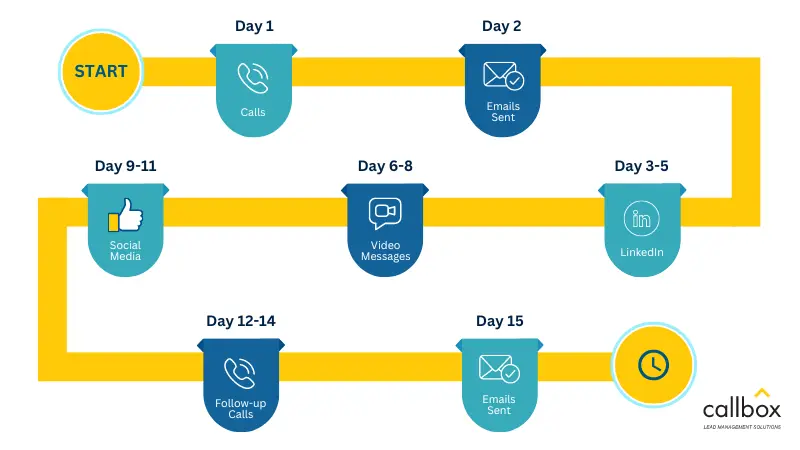
Timing drives every part of your B2B sales strategy. Your original contact and follow-up messages’ success depends more on when you reach out than how often you try.
Why timing matters more than volume
The numbers paint a clear picture—you’re 100x more likely to reach a lead if you call within 5 minutes after they express interest. Your chances of qualifying that lead drop by a factor of 10 after just an hour.
Quick responses give you a powerful first-mover advantage. You can guide the conversation and present your solution before competitors when you act fast. Research shows that more than 80% of deals are sealed during first contact.
Many companies miss this chance—it takes over half of them a week or longer to respond to new inquiries. This delay affects more than just immediate contact rates. It changes how well your entire sales process converts leads.
The right timing throughout your sales cadence helps you connect with prospects when they’re ready to listen. To name just one example, watching prospect behavior on your website lets you time your interactions perfectly:
“Getting notified in realtime when prospects are on your website viewing your pricing or plans page can be a key trigger to get in touch and offer support”.
Best days and hours for outreach
Clear patterns emerge from the data about optimal outreach timing:
Email outreach sees Tuesday leading with a 27% engagement rate. The middle of the week (Tuesday through Thursday) works better as professionals settle into their routines.
Wednesday shines for sales calls with a 33.9% connection rate, which is a big deal as it means that Monday’s weak 15.7%.
Different communication channels work best at specific times:
- Emails: Open rates hit their peak between 12PM-4PM at about 41%
- Calls: People connect most during late morning (10-11AM) and late afternoon (4-5PM)
- Responses: Morning hours between 7AM-11AM see the highest reply rates
Some times just don’t work well:
- Before 10AM when executives handle their priorities
- Around 1PM during lunch breaks
- After 5PM as professionals head home
How to guide through time zones and regions
Global outreach makes timing more complex. Here’s how to handle it:
- Learn where your prospects are to understand time zone gaps
- Get time differences right, especially in regions with multiple zones
- Work with local business hours instead of your own
- Create service-level agreements that work across time zones for reliable response times
- Know industry patterns since some fields have unique timing priorities (healthcare professionals respond better early morning or evening)
Seasonal and fiscal year patterns matter when planning your outreach. Many businesses make buying decisions at fiscal year starts and ends, making these times perfect for focused sales efforts.
Smart timing beats more frequent outreach. It improves your B2B sales cadence and helps you connect with decision-makers at the right moment.
Set the Right Frequency for Engagement
Sales teams need to find the right balance between staying in touch and respecting their prospect’s time. The key isn’t reaching out constantly – it’s building a rhythm that keeps you visible without becoming annoying.
Spacing touchpoints without overwhelming
The right gap between touchpoints helps you stay memorable without flooding prospects with messages. Studies show touchpoints 2-3 days apart create the best engagement. This gives prospects enough time to think about your message while keeping you fresh in their minds.
Mix both direct and indirect contact in your outreach. Direct contact includes emails, calls, and LinkedIn messages. Indirect visibility comes through social media posts, blog articles, or showing up at industry events.
Jack Neicho, Account Executive at Salesloft, believes consistency is a vital factor. He says, “Sales cadences only work if you stick to them. It’s all about the follow-up”. So don’t skip steps in your cadence – gaps that are too long let prospects lose interest.
How long your cadence should last
Sales experts agree that B2B sales cadences work best when they run 17-21 days. This timeline lets you build relationships naturally without pushing too hard.
Morgan J Ingram, Cognism’s Creative Advisor, suggests using at least 17 touchpoints to get results. Florin Tatulea, Director of Sales at Barley, takes a different view with 8-12 touchpoints across this period. His lighter approach makes sure each interaction adds real value.
A well-laid-out example cadence looks like:
- Day 1: Initial phone call + follow-up email
- Day 3: LinkedIn connection with personalized message
- Day 5: Email sharing relevant case study
- Day 8: Follow-up phone call
- Day 10: Final email with clear call-to-action
This structure creates a multi-channel approach that values the prospect’s time while keeping you visible.
Balancing persistence with patience
Here’s a surprising fact: 80% of sales need at least five follow-ups. Yes, it is why persistence matters—yet 44% of sales representatives quit after just one follow-up attempt.
Watch how prospects respond and adjust your approach. Speed up your cadence if they show interest. Give them more space between touchpoints if they seem reluctant.
“You should never over-index on one piece of outreach,” Florin Tatulea explains. “You need to give people time to see your message and get back to you”. This patient approach keeps prospects from feeling pressured while showing your genuine interest.
Note that persistence doesn’t mean pushing too hard. It means staying memorable and valuable when prospects make decisions. Every interaction should benefit them – through feature updates, useful content, or market insights – not just asking for the sale.
Smart frequency management creates a rhythm that values prospect’s time while building lasting relationships beyond the first sale.
Follow-Up Strategies That Keep Conversations Alive
B2B sales success depends on your follow-up game. Research proves that 80% of sales need at least five follow-ups. Yet 44% of sales representatives give up after just one attempt. This gap explains why many promising leads never turn into customers.
The right timing and frequency for follow-ups
Quick responses to new leads give you the edge. Your chances of getting a response multiply 9 times when you reach out within 5 minutes of their original interest. The timing gets trickier after that first contact.
The sweet spot for email follow-ups is 2-5 days after your first message. Here’s a rhythm that works:
- Second follow-up: 3 days later
- Third follow-up: 7 days later
- Fourth follow-up: another 7 days
- Fifth follow-up: 14 days later
- Final attempt: after another 14 days
Most B2B pros say 4-5 follow-ups hit the mark. After that, you might want to send a “break-up email” that lets them know you’ll step back unless they respond.
Mix up your follow-up methods
Sticking to one communication channel won’t cut it. The best B2B outreach uses multiple channels to connect.
Email serves as the foundation with a 20.8% open rate. Phone calls help build stronger connections through immediate conversation. Text messages shine with an amazing 98% open rate. They work great for quick, urgent messages.
LinkedIn adds another way to reach out. After two emails without response, try a LinkedIn InMail with a personal touch. Switching channels keeps prospects engaged with your messages.
Write follow-ups that people want to answer
Your messages need to be short and sweet. The magic number is 50-100 words – about two paragraphs. This shows you value their time while saying what matters.
Personal touches turn bland outreach into real conversations. Mention specific things from past chats – maybe an industry challenge they brought up or recent company news. Each message should add value instead of just “checking in,” which most prospects find annoying.
End with one clear next step. Rather than giving multiple options, point them toward a single action. This makes decisions easier and boosts response rates.
Your follow-up sequence should flow naturally. Each message builds on what came before. This approach delivers more value while guiding prospects through their buying experience.
Personalize Your Outreach Without Losing Scale
Tailored communication turns ordinary outreach into meaningful conversations. Studies show that tailored experiences make marketing 80% more effective. Sales messages with a personal touch are 5-8 times more likely to lead to a sale. A balanced approach of strategic segmentation and thoughtful templating helps achieve this personal connection efficiently.
Segmenting by role, industry, and behavior
Smart segmentation lays the groundwork for effective personalization. Your prospects can be grouped based on shared traits to create messages that strike a chord with each segment:
- Role-based: Decision-makers focus on executive-level concerns, while end-users care about day-to-day functionality
- Industry-specific: Each field has its own challenges and trends that need attention
- Behavioral: Digital footprints across channels reveal varying needs based on content consumption and participation patterns
Smart segmentation goes beyond simple firmographics to understand where prospects are in their buying trip. This helps you create content that guides leads through specific decision-making stages. Data analytics layered on top of segmentation shows what works and where opportunities exist.
Using templates without sounding robotic
Templates boost efficiency but often lack a personal touch. The answer lies in creating flexible, customizable frameworks instead of rigid scripts:
“Good communication demonstrates your in-depth understanding of the client and their unique requirements,” states a Salesforce report. This understanding should come through even in automated messages.
Generic terms and unedited templates immediately signal mass communication. Recent research indicates that nearly a quarter of sales professionals believe personalization has grown much more important.
Here’s how to add a human touch to templated outreach:
Subject lines should reference mutual connections, specific pain points, or relevant industry trends. On top of that, it helps to use dynamic content that adapts based on recipient characteristics through component-based architecture.
Automation can still feel personal when you use customer names, mention previous interactions, and adjust content to match specific interests. The best results come from a balanced approach – automation handles the early stages while human interaction manages deeper engagement.
Keep in mind that personalization at scale builds genuine relationships that lead to sales success.
Track, Test, and Improve Your Cadence Over Time

Analytical insights help distinguish successful sales cadences from ineffective ones. Sales teams can refine their outreach strategy by analyzing performance based on real results rather than assumptions.
Key metrics to monitor
These critical indicators will help you review your sales cadence effectiveness:
- Email reply rates – Target 15-25% as a healthy measure
- Meeting conversion rates – Shoot for 20-30% to optimize productivity
- Time-to-first-response – Best between 24-72 hours
- Pipeline progression – See how prospects advance through sales stages
- Regional engagement patterns – Customize to unique audience behaviors
Outreach and Cognism can make this process easier by automating data collection and offering improvement suggestions. You should also track connection-to-booking ratios (aim for 10%+) and email open rates (target 23%) to learn about your performance.
Running A/B tests on timing and messaging
Testing shows what strikes a chord with your audience. Start by changing one variable to spot improvements:
- Timing tests – Compare morning versus afternoon outreach
- Channel sequencing – Test starting with calls versus emails
- Content variations – Try case studies versus industry insights
Let these experiments run for 2-4 weeks to collect enough data for smart decisions[233]. Your test groups should be random to avoid bias, and you should use technology to track results automatically. Set clear endpoints to ensure reliable data. The winning approach becomes your baseline before you test another variation.
The right time to revise your cadence structure
Your performance needs regular reviews to stay effective. You should revise your structure when:
- Response rates drop below measures
- Market conditions or buyer behaviors change
- Regional engagement patterns shift
- Top reps show new effective approaches
Companies that respond within the first hour are seven times more likely to qualify prospects. Quick response times should be your priority if you’re lagging behind.
Sales cadence optimization works like a science experiment: hypothesize what works, test it, and improve based on results. Note that successful cadences need constant updates as buyer habits change.
This step-by-step process strengthens your sales approach and helps build trust with prospects while boosting your team’s confidence.
Conclusion
B2B sales outreach timing requires both art and science. This piece shows why 80% of successful sales need at least five follow-ups. Yet nearly half of sales representatives quit after just one attempt. This gap explains why some sales teams excel while others don’t meet their targets.
The right timing makes all the difference. Prospects are most likely to respond mid-morning between 9-11 AM with a 47.9% peak in participation. Wednesdays bring a 33.9% connection rate that works better than Monday’s low 15.7%. Your touchpoints should be 1-5 days apart over 2-4 weeks to balance persistence with patience.
A well-planned outreach cadence works as your sales conversation blueprint. The best approach runs for 17-21 days with 8-12 meaningful touchpoints through different channels. Don’t flood prospects with generic messages. Focus on delivering value through customized communication that tackles specific pain points.
Note that improvement is ongoing. Track reply rates and meeting conversions, then experiment with different timing, messaging, and channel sequences. Without doubt, these small changes add up over time and turn average results into outstanding performance.
Put these strategies to work now. Fine-tune your timing, improve your cadence structure, and build a stronger follow-up approach. Make your outreach customized but scalable. These basic yet powerful principles often separate average sales performance from exceptional results.
Timing and follow-ups can make or break your B2B outreach. What’s one cadence challenge you’re facing right now? Drop us a note, and let’s swap ideas on how to optimize your approach with GrowLeads’ proven strategies.
FAQs
Q1. What is the ideal length for a B2B sales outreach cadence?
A well-structured B2B sales cadence typically spans 17-21 days and includes 8-12 strategic touchpoints. This timeframe provides sufficient opportunity to build relationships without overwhelming prospects.
Q2. How often should I follow up with B2B prospects?
For optimal engagement, space your touchpoints 2-3 days apart initially. After the first follow-up, gradually increase the interval: 3 days, then 7 days, then 14 days for subsequent follow-ups. Most B2B professionals agree that 4-5 follow-ups strike the ideal balance.
Q3. What are the best days and times for B2B sales outreach?
Wednesday stands out as the best day for sales calls with a 33.9% connection rate. For emails, Tuesday shows the highest engagement rate at 27%. The most effective time windows are late morning (10-11AM) and late afternoon (4-5PM) for calls, and between 12PM-4PM for emails.
Q4. How can I personalize my outreach without losing efficiency?
Segment your prospects based on role, industry, and behavior. Use modular, customizable templates instead of rigid scripts. Incorporate dynamic content that adjusts based on recipient characteristics. Always address customers by name and reference previous interactions or specific pain points.
Q5. What key metrics should I track to improve my sales cadence?
Focus on email reply rates (aim for 15-25%), meeting conversion rates (target 20-30%), time-to-first-response (ideally 24-72 hours), and pipeline progression. Also monitor connection-to-booking ratios (aim for 10%+) and email open rates (target 23%) for comprehensive understanding.

Malay is the VP of Growth & Operations at Growleads, where he transforms businesses through automation, behavioral analytics, and omni-channel scaling strategies.
As a growth strategist, Malay has helped organizations streamline operations, decode customer behavior, and scale revenue through data-driven automation. His expertise spans process optimization, conversion analytics, and building scalable growth systems that deliver measurable results.