How AI Transforms B2B Lead Generation: An Ultimate Guide for 2026 Success

AI tools have radically altered B2B lead generation. 80% of sales leaders have started using these tools in the last 12 months. The numbers make sense since 67% of sales teams’ representatives dedicate more than 11 hours each week to research and follow-up tasks.
AI lead gen solutions are changing the game completely. Companies that use AI-driven lead scoring have achieved a 51% boost in their lead-to-deal conversion rates. On top of that, businesses cut their processing time by 60% when they use AI for lead qualification. Those who exploit AI-driven intent data see an impressive 93% increase in conversions.
This piece will show you how AI automation is reshaping B2B marketing strategies in 2025. You’ll learn about AI-powered prospecting tools that spot high-intent buyers. We’ll also explore sophisticated AI leads systems that scale personalization and boost email click-through rates by 200%. The guide covers essential aspects of implementing AI for your business’s lead generation.
The content serves both newcomers to AI lead generators and experienced users who want to improve their strategy. You’ll discover ways to remain competitive in the dynamic field of AI-powered B2B lead generation.
What is AI-Powered B2B Lead Generation?
“AI lead generation is the process of using artificial intelligence to automate, optimize, and scale the way businesses identify, attract, and convert potential customers.”
— Fifty Five and Five, Digital marketing agency specializing in B2B technology
AI-powered B2B lead generation marks a transformation in how businesses turn potential customers into clients. AI technologies automate and streamline the lead generation process—from finding and qualifying prospects to moving them through the sales funnel.
Traditional methods use broad targeting strategies and manual outreach. AI lead generation utilizes advanced algorithms to analyze big data sets with precision. This technology finds better leads through machine learning, natural language processing, and predictive analytics to identify prospects who will likely convert.
“AI for lead generation” or “AI lead gen” helps businesses find high-quality prospects quickly. These tools improve human relationship-building by handling routine tasks. They provide informed insights that make sales teams work better.
AI lead generation systems work in remarkable ways. They analyze massive datasets to find companies and contacts that line up with your ideal customer profile. AI enriches these leads by analyzing factors such as:
- Technologies a company currently uses
- Recent funding rounds or business expansions
- Job changes within the organization
- Online behavior and engagement patterns
- Historical purchasing decisions
This detailed analysis helps AI predict which leads will convert. Sales teams can focus their energy where it counts. To cite an instance, AI analyzes buyer behavior, prioritizes leads, and crafts customized outreach—all within minutes.
AI lead generation works better than old methods. Sales professionals can focus on relationships and closing deals instead of data entry. AI tools blend with customer relationship management (CRM) systems to improve lead scoring and customized outreach.
B2B companies see great results with AI-powered lead generation. Reports show a 50% increase in lead generation and 60% lower costs after implementing AI tools. These systems target leads accurately and deliver higher conversion rates.
AI improves each stage of the B2B lead generation process:
Sales intelligence tools build lead lists matching your ideal customer profile for prospecting. AI reviews demographics and online behavior during qualification to find sales-ready leads. AI copywriting tools create customized messages in the outreach phase. Revenue intelligence platforms study customer interactions to improve future communications for analysis.
B2B marketing teams can utilize AI to create content, research markets, deploy chatbots, and automate tasks that generate inbound leads. In fact, AI boosts both lead quantity and quality. Businesses can focus on promising prospects.
Companies should review their current processes before implementing AI lead generation. AI tools offer different capabilities. Picking solutions that match your business needs is vital. Track conversion rates and engagement levels to see what works.
Modern B2B sales demand AI lead generators to stay competitive. Companies using this software cut manual tasks, get more accurate leads, and deliver customized experiences—key factors for success.
How AI is Transforming the Lead Generation Process

Image Source: B2B Rocket
AI technologies are reshaping the lead generation scene faster than ever. Sales teams can now build relationships instead of getting buried in research, thanks to AI’s ability to automate tasks and analyze data. Here’s how AI impacts each key part of B2B lead generation.
AI for prospecting and list building
AI-powered tools have optimized prospecting from a lengthy research task into an automated system. These smart tools can analyze huge datasets within minutes and provide useful insights for better targeting. This work would take humans weeks to finish manually.
Cognism’s AI Search lets sales reps find potential clients with simple commands like “Find London-based sales directors at companies with over 500 employees”. Sales teams see 74% faster prospecting and can spot their total addressable market three times quicker than old methods.
AI prospecting tools offer these benefits:
- They spot trends and links in scattered data that humans might miss
- They group prospects by intent signals, engagement metrics, and company data
- They confirm contact details through real-time data updates
AI doesn’t just find more leads—it finds better ones. It matches prospects against proven patterns to highlight those who fit your ideal customer profile best.
Lead scoring and qualification with machine learning
Random lead scoring is now outdated. Machine learning studies past deals to spot buying signals, which helps prioritize leads better.
Predictive lead scoring uses AI to check multiple factors at once, including engagement, company data, and past interactions. This ranks prospects based on real conversion chances rather than gut feelings. Companies that use AI-driven analytics turn leads into customers 1.5 times more often than traditional methods.
These systems give sales teams one clear score for each prospect. Teams can set triggers to focus on leads above certain scores. This evidence-based method helps teams target the most promising leads.
Personalized outreach using AI tools
B2B companies can now personalize messages at scale with AI. Sales teams create tailored messages in seconds instead of spending hours writing individual ones.
AI tools study prospect data to craft messages that appeal to potential customers. This goes way beyond adding names to templates. AI checks past interactions, industry trends, and customer priorities to write truly personal content.
Nureply helps companies “personalize email outreach at scale” with “truly custom emails for every prospect” by studying each lead’s traits. Outreach uses AI to write personal emails based on sales reps’ previous conversations.
AI chatbots for real-time engagement
Smart chatbots have changed how businesses capture and qualify leads instantly. Modern AI systems understand user intent, work in different languages, and customize chats on the spot.
Drift’s conversational marketing platform uses chatbots and AI to make shared engagement between businesses and website visitors easier. This tech blends automation with human chat to qualify leads, book sales meetings, and answer questions right away.
These smart systems can gage visitor interest and group them properly. Chatbots might suggest booking a demo or meeting with sales reps for qualified leads who match ideal customer profiles. This 24/7 availability means potential leads always get attention, which boosts conversion chances outside office hours.
AI chatbots connect with CRM systems to optimize lead management. They send good prospects to the right team members and save valuable data for future chats.
Top Benefits of Using AI for B2B Lead Gen
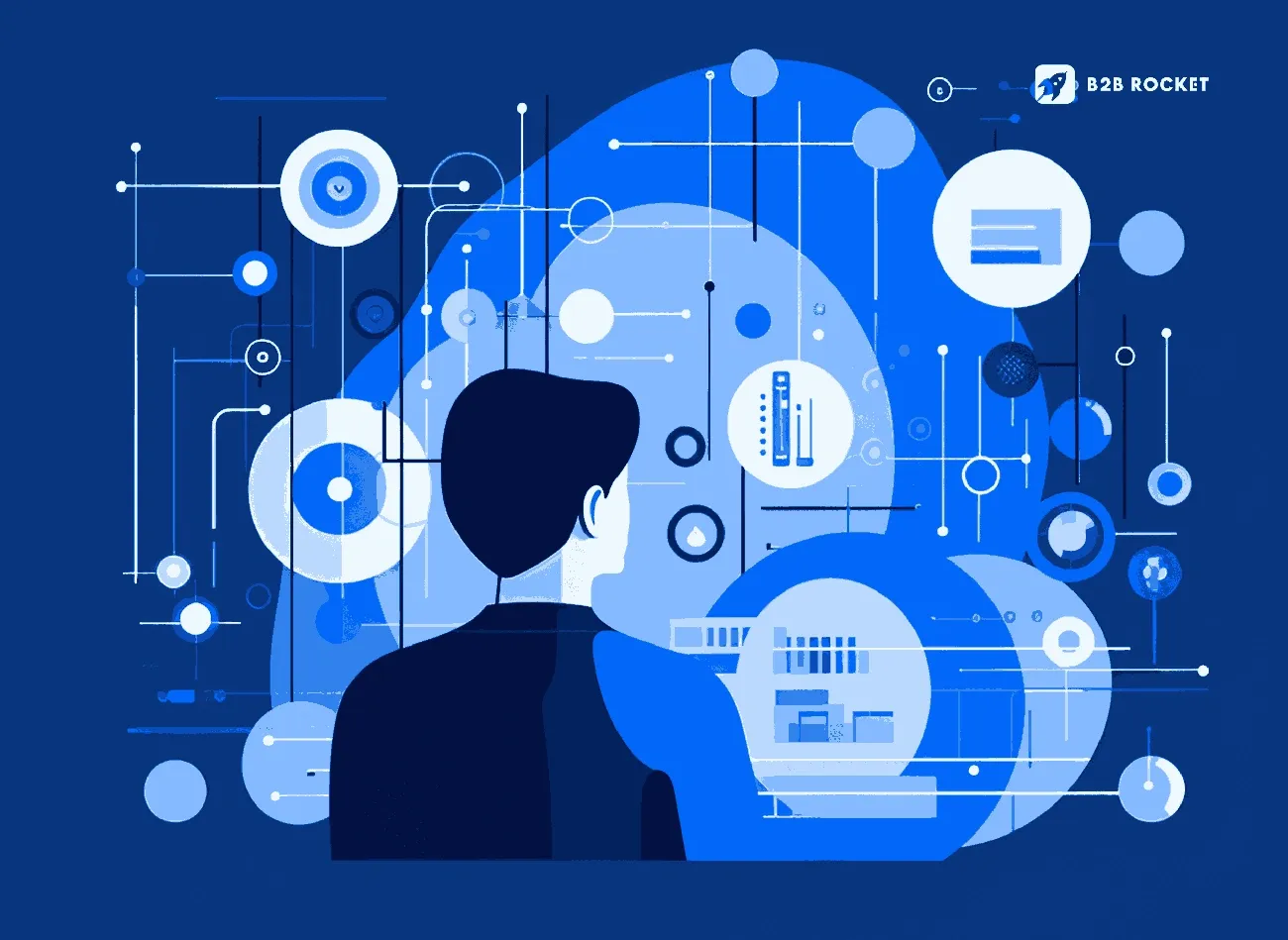
Image Source: B2B Rocket
B2B companies that use AI-powered lead generation tools see four major benefits that reshape their sales pipelines. These advantages have become crucial growth drivers in today’s competitive B2B scene, not just optional features.
Increased efficiency and automation
Manual data entry, research, and outreach make traditional lead generation slow and error-prone. AI and automation tools help businesses streamline these processes naturally. Sales teams typically spend 11 or more hours weekly on research and follow-up. AI automation cuts this time by half.
AI takes care of repetitive tasks like lead qualification and scoring. This gives sales teams more time to work on strategic projects. Sales professionals can build relationships instead of getting buried in paperwork. Companies that use AI-powered solutions work 10-15% more efficiently because teams can focus on promising prospects and strategic tasks.
Higher lead quality and conversion rates
AI’s effect on lead quality stands out as its biggest benefit in B2B lead generation. Old methods often produce broad, generic leads that don’t line up with ideal customer profiles. AI studies huge amounts of data and finds high-potential leads with amazing accuracy.
AI-powered predictive lead scoring uses multiple data points to rank prospects based on their conversion likelihood. This results in:
- 30% increase in lead conversion rates
- 50% increase in sales-qualified leads
- 451% increase in qualified leads for businesses nurturing leads through marketing automation
Smart algorithms study customer behavior patterns, spot buying signals, and rank leads based on priority. This precise targeting helps marketing and sales teams concentrate on prospects most likely to convert.
Scalability of outreach and personalization
Companies can handle more leads without losing quality or efficiency with AI. Managing growing lead numbers by hand becomes too much as companies expand. AI helps businesses grow their lead generation naturally without hiring more people.
AI makes individual-specific experiences possible at a large scale. People used to choose between personalization or scale – not anymore. Personalized emails convert six times better. AI customizes messages for each recipient without manual work.
AI-powered tools study each lead and write custom emails that connect with recipients. These emails address specific needs and problems. This level of individual attention at scale seemed impossible before AI.
Data-driven decision making
Smart analytics from AI give deep insights to make better marketing choices. Unlike gut-feeling approaches, AI provides factual, informed insights that make campaigns work better.
AI algorithms find hidden patterns in big data sets that humans might miss. Marketing teams use these insights to make their campaigns better by finding which channels, content, and messages appeal most to quality leads.
AI also helps companies spend marketing money wisely. AI-powered lead scoring makes marketing budgets more effective by targeting leads most likely to convert. Companies with clean, organized data and AI convert leads three times faster. This shows how informed approaches drive success.
AI doesn’t just find more leads – it finds better ones, personalizes outreach at scale, and provides useful insights that help businesses grow.
Best AI Tools for B2B Lead Generation in 2025

Image Source: BookYourData
The right AI tools can make or break your B2B lead generation strategy in today’s competitive marketplace. Let me walk you through six powerful platforms that are reshaping how businesses find and connect with potential clients in 2025.
ZoomInfo
ZoomInfo has evolved into a leading B2B intelligence platform with its AI-powered ZoomInfo Copilot. This AI assistant combines high-quality data and generative AI to predict your pipeline with amazing accuracy. The beta testing results showed that Copilot predicted nearly half of users’ existing pipeline and doubled their sales opportunities.
The platform shines with its complete data coverage and features like Breaking Alerts. These alerts send time-sensitive opportunities through Slack immediately. ZoomInfo packs a punch but comes with a hefty price tag—starting at $15,000+ yearly. This makes it a better fit for larger organizations.
Apollo.io
Apollo.io is an end-to-end AI sales platform that connects you to 210 million+ contacts across 35 million+ companies. The platform’s AI features include sales engagement, immediate analytics, and automated email outreach that can draft up to 250,000 emails.
Plans cost between $49-$149 per user monthly. Apollo gives you an affordable option while maintaining powerful capabilities. The platform excels at combining prospecting, outreach automation, and CRM integration. However, some users say its interface can overwhelm beginners.
Clay
Clay stands out by pulling data from over 100 premium sources and using AI research agents that automate prospect research at scale. The platform finds unique data points that other providers miss. It analyzes job posts, financial documents, and creates lead scoring models.
Monthly prices range from $97-$523. Clay’s highly customizable nature works as both an advantage and challenge—it offers great flexibility but takes more time to master.
Compass Data Enrichment
Compass specializes in AI-powered data enrichment with continuous connection to CRM. The platform’s strength lies in its high data accuracy and quality. This makes it perfect for businesses that need to enhance rather than replace their existing lead sources.
Compass uses custom pricing instead of standard tiers. Their specialized approach gives exceptional value to organizations that put data quality first.
Lusha
Lusha is a user-friendly B2B prospecting tool with AI-powered contact search and a browser extension. Users get access to over 135 million enriched contacts with direct dial numbers of decision-makers.
The platform added AI Recommendations that automate key sales tasks and help with prospect discovery and outreach planning. Lusha charges $36-$59 per user monthly, making it available to businesses of all sizes.
Drift
Drift’s AI Chat agent creates customized conversations with website visitors in real time. This generates qualified leads and gives marketers useful insights. The platform’s patented AI technology understands natural language, trained on over 100 million B2B buying conversations to create meaningful interactions.
The platform really proves its worth after hours—half of all conversations happen outside business hours. It boosts pipeline generation by 30% quarter-over-quarter.
Common Challenges and How to Overcome Them
AI tools bring amazing benefits to B2B lead generation, but some challenges can limit their success. You need to tackle these obstacles directly to get the most out of these tools.
Data quality and availability
AI systems follow a basic rule – output quality depends on input quality. Research shows 81% of AI professionals say their companies don’t deal very well with data quality. Bad or inaccurate data makes AI tools produce wrong predictions and unreliable analytical insights.
You can solve this by making data cleaning a priority and setting up strict data rules. Regular checks help keep your information accurate and current. Working with trusted data providers can boost your data quality and help you learn about consumer behavior and priorities.
Privacy and compliance concerns
B2B lead generation relies more on personal data now, so following privacy rules is vital. Rules like GDPR and CCPA just need strong data protection policies.
The answer lies in being open – tell customers what data you collect, how you use it, and how you protect it. The system should let customers opt out easily. You can also use data anonymization to remove personal details, which makes it impossible to trace data back to specific people.
Lack of in-house expertise
Many B2B sales teams don’t have the technical skills to exploit AI for lead generation. Hiring new talent or training existing staff can get pricey and take time.
Look for AI platforms that are easy to use and offer good support, including training resources and continuous learning options. Find tools with accessible interfaces that don’t require much technical knowledge to work.
Over-reliance on automation
Automation makes processes smoother, but depending too much on AI creates risks. AI bias can lead to discrimination, while mysterious AI decisions create doubt.
Human involvement remains a vital part of lead generation. Sales teams should check AI suggestions and use their expertise. Mix automation with personal human contact, especially for valuable leads.
Emerging Trends in AI Lead Generation
“53% of B2B marketers are already using intent data to drive lead generation.”
— Fifty Five and Five, Digital marketing agency specializing in B2B technology
The B2B companies will reshape the scene of AI lead generation in 2025. New technologies will redefine how companies identify and participate with potential customers. Companies continue to refine their strategies as several innovative approaches gain popularity.
Generative AI for outreach
Generative AI reshapes how businesses create personalized messages at scale. This technology produces custom outreach content based on immediate data that goes beyond simple templates to create individualized communications. Sophisticated AI systems in 2025 analyze prospect data to generate relevant messaging that appeals to specific pain points and interests. Outreach’s generative AI features have already changed sales prospecting with capabilities to identify high-success sequences and track critical metrics.
AI-powered intent data
AI-powered intent data has changed the limitations of traditional intent tracking that often delivers outdated insights. AI intent analysis goes beyond tracking online behavior—it interprets multiple signals simultaneously to predict which companies actively seek solutions. This approach processes big behavioral data immediately and removes false positives by looking at patterns across different sources. It even predicts buying intent before direct participation occurs. AI intent data reverses the traditional model by identifying in-market buyers before they visit your website.
AI-enhanced account-based marketing
AI integration has taken account-based marketing (ABM) to new heights of effectiveness. One organization saw a 2.3x increase in meetings booked with high-potential accounts after implementing an AI-driven ABM approach. Campaigns that used AI-generated creative achieved a 54% improvement in click-through rates compared to conventional copy. AI enables hyper-personalized ABM by segmenting prospects based on industry, company size, specific pain points, and buying stage. This customization guides to improved engagement rates and better response to sales outreach.
Ethical AI and data privacy
Ethical considerations have become vital amid technological advances. Businesses must adjust their data collection practices with regulations like GDPR and the phasing out of third-party cookies. Companies looking ahead implement privacy-by-design principles, conduct regular audits, and employ enhanced encryption techniques. Clear privacy policies and explicit consent mechanisms have become standard among other technical safeguards to encourage customer trust.
Conclusion
AI-powered B2B lead generation has revolutionized the way businesses identify, qualify, and convert potential customers. This piece shows how these intelligent systems deliver remarkable results—from 51% increases in lead-to-deal conversion rates to 60% reductions in processing time. Companies that embrace these technologies get most important competitive advantages in today’s ever-changing market.
AI lead generation does more than just finding leads. These sophisticated tools find higher-quality prospects and tailor outreach at scale. They also provide evidence-based insights that were previously impossible to get. Sales teams spend less time on tedious research tasks and more time building meaningful relationships with qualified prospects.
Your specific business needs should guide the selection of AI tools for lead generation strategy. Each platform—whether ZoomInfo, Apollo.io, Clay, Compass, Lusha, or Drift—has unique strengths that arrange with different organizational priorities. Note that using these tools means dealing with challenges like data quality issues, privacy concerns, and potential over-automation.
Generative AI will create more tailored outreach as the landscape evolves. Intent data will become more predictive, and account-based marketing will reach new levels of effectiveness. Human oversight stays essential to retain ethical standards and build authentic connections, despite these technological advances.
Businesses that balance AI capabilities with human expertise will own the future. Your focus should extend beyond technology as you apply AI-powered lead generation. Think about how it strengthens your team’s ability to deliver more value. AI doesn’t replace the human element in B2B relationships—it boosts it. Your team can focus on what truly matters: solving customer problems and building lasting partnerships.
Unlock the future of Lead Generation with Growleads.io & transform your strategy today!
FAQs
Q1. How is AI transforming B2B lead generation?
AI is revolutionizing B2B lead generation by automating prospecting, enhancing lead scoring, enabling personalized outreach at scale, and providing real-time engagement through chatbots. This results in increased efficiency, higher quality leads, and improved conversion rates.
Q2. What are the key benefits of using AI for B2B lead generation?
The main benefits include increased efficiency through automation, higher lead quality and conversion rates, scalability of personalized outreach, and data-driven decision making. Companies using AI-powered solutions have reported significant improvements in lead generation and sales performance.
Q3. What are some of the best AI tools for B2B lead generation in 2025?
Some top AI-powered B2B lead generation tools in 2025 include ZoomInfo, Apollo.io, Clay, Compass Data Enrichment, Lusha, and Drift. Each offers unique features like AI-powered prospecting, predictive analytics, and automated engagement capabilities.
Q4. What challenges might businesses face when implementing AI for lead generation?
Common challenges include ensuring data quality and availability, addressing privacy and compliance concerns, overcoming a lack of in-house expertise, and avoiding over-reliance on automation. It’s crucial to balance AI capabilities with human expertise for optimal results.
Q5. What emerging trends are shaping AI-powered lead generation?
Key trends include the use of generative AI for personalized outreach, AI-powered intent data for predictive insights, AI-enhanced account-based marketing for targeted campaigns, and a growing focus on ethical AI and data privacy practices to build trust with potential customers.

Malay is the VP of Growth & Operations at Growleads, where he transforms businesses through automation, behavioral analytics, and omni-channel scaling strategies.
As a growth strategist, Malay has helped organizations streamline operations, decode customer behavior, and scale revenue through data-driven automation. His expertise spans process optimization, conversion analytics, and building scalable growth systems that deliver measurable results.