
LinkedIn Outreach Strategy: What Actually Works in 2025 [Expert Guide]

LinkedIn generates 80% of all B2B leads from social media. A successful LinkedIn outreach strategy becomes crucial for businesses aiming to connect with potential clients in 2025. Your results can improve dramatically when you understand the tactics that work, whether you’re just starting or looking to enhance your approach.
The platform’s potential remains largely untapped as 42% of sales professionals find it challenging to keep up with LinkedIn’s increasing activity. The right LinkedIn B2B strategy can set you apart from others. Our data reveals that customized connection requests get accepted 55% more often than generic ones. Structured message sequences also boost lead conversion rates by 15%. We created this expert piece to help you build a LinkedIn sales strategy that delivers real results.
This complete guide will show you proven ways to optimize your profile and find ideal prospects. You’ll learn how to write messages that people want to respond to and scale your outreach efforts effectively. The guide offers useful advice based on current best practices, perfect for both cold outreach strategies and nurturing existing LinkedIn connections.
Why LinkedIn Outreach Still Works in 2025
“As we move through 2025, the significance of an effective LinkedIn outreach strategy is clear. For both experienced sales veterans and newcomers, mastering LinkedIn outreach is key for connecting with the right prospects, nurturing leads, and ultimately driving business growth.”
— 100 Pound Social, B2B social media marketing agency
The B2B sales world has changed in recent years, yet LinkedIn outreach remains the most powerful strategy to connect with prospects in 2025. The platform now boasts 1 billion professionals, which gives businesses a unique chance to find quality leads and build meaningful connections.
The move from cold calls to social selling
Cold calling techniques used to be the life-blood of sales outreach. Now they’re making way for smarter social selling methods. This rise shows how businesses have changed their approach to connecting with potential clients. Social selling builds relationships by using platforms like LinkedIn to connect and involve prospects over time.
Social selling focuses on building trust and credibility before closing a sale, unlike the disruptive nature of cold calling. This approach works perfectly with today’s buyers, who prefer to research solutions on their own before talking to sales representatives.
Numbers tell a clear story – LinkedIn social selling brings several key benefits:
- Non-intrusive engagement: Social selling creates natural ways to connect that prospects welcome, rather than disrupting their day with unexpected calls.
- Data-driven targeting: LinkedIn’s advanced targeting lets sales teams find and reach specific demographics or professional groups with precision.
- Content-driven relationships: Sharing valuable insights helps you stand out as an expert, which encourages prospects to reach out when they need your services.
Companies that focus on long-term relationships find social selling particularly powerful. A well-crafted post can reach thousands of potential clients at once, building trust while establishing you as an industry expert.
LinkedIn’s role in modern B2B sales outreach
LinkedIn has grown way beyond a simple professional networking site to become the life-blood of B2B interactions. As the #1 social media platform for work, it gives unmatched access to decision-makers in any discipline.
The platform’s lead generation power stands out – LinkedIn proves 277% more effective at generating leads than Facebook and Twitter. LinkedIn messages get a 10.3% response rate, which doubles the typical cold email response rate of 5.1%.
LinkedIn outreach’s value in 2025 comes from its personal touch. Prospects can see your face, check your profile, and learn about your business credentials before they respond. This transparency creates trust that email can’t match, leading to 30-50% positive reply rates with the right approach.
Recent changes in LinkedIn outreach stem from several key factors:
- More competition has made LinkedIn busier with professionals vying for attention, so precise targeting and quick follow-ups help you stand out.
- AI advances have changed how we personalize messages. AI tools now analyze prospects’ profiles, activities, and interests to create tailored messages that sound natural.
- Scaling needs have pushed sales teams to reach more prospects without losing quality. This leads to smart use of automation tools that boost rather than reduce personalization.
On top of that, it’s clear that LinkedIn outreach in 2025 depends on personal communication backed by clever technology. Teams now care more about quality conversations than collecting connections.
LinkedIn outreach will stay crucial as email service providers set new limits that force sales teams to broaden their strategies. With Google and Yahoo’s stricter rules on bulk emails, LinkedIn will likely become even more important as the main outreach channel.
Today’s best LinkedIn outreach follows a “warm-first” approach. Sales teams view profiles and engage with posts before sending connection requests. This creates familiarity that makes prospects more open to direct messages later.
LinkedIn outreach thrives in 2025 because it delivers what B2B buyers want: real connections, valuable insights, and relationship-based interactions that respect their time and intelligence.
Optimize Your LinkedIn Profile for Outreach

Image Source: LinkedIn
Your profile must make prospects want to connect before you send a single message. LinkedIn users check profiles in a specific order: face, headline, background image, experience, and then summary. Your profile serves as your digital first impression, so each element needs optimization to make the right effect.
Use a professional photo and banner
People notice your profile picture first, so get a high-quality, professional headshot. Your face should take up about 60% of the frame with a friendly smile. Profiles without photos lose credibility—prospects are nowhere near as likely to respond to connection requests from faceless accounts.
The banner image (recommended dimensions: 1584 x 396 pixels) gives you prime real estate to build your brand. A customized banner creates a cohesive professional image that beats generic backgrounds. You can add your logo, tagline, or brand colors to stand out. Here are some banner strategies that work:
- Show your expertise through relevant imagery
- Display social proof or achievements
- Add contact information to make it easy to reach you
- Keep designs simple and clean for both desktop and mobile
Your banner should look good on all devices, especially since 60% of LinkedIn users access the platform via mobile.
Write a value-driven headline and summary
Think of your headline (limited to 220 characters) as your personal advertisement. Don’t just list your job title. Create a headline that shows how you help others and what results you deliver. Value-driven headlines boost connection acceptance rates and engagement by a lot.
The best headlines follow these principles:
- Put your audience first, not yourself
- Link your personal brand to your company’s values
- Skip overused buzzwords and use memorable phrases
- Show confidence without arrogance
The “About” section (formerly summary) gives you 2,600 characters to tell your story. This section should reveal what drives you professionally, explain your current role, put your past experiences in context, and show who you are. Add stories that prove your expertise and end with a clear call-to-action that invites prospects to connect.
Showcase relevant experience and activity
Your Experience section often gets more attention than your About section. Each role needs strong, active verbs and short, punchy sentences—skip generic phrases like “key responsibilities”. Adding skills to each role helps prospects understand your capabilities quickly. LinkedIn suggests five skills per position.
We tailored all experiences to match what matters to your target audience. Recent roles need more detail while older positions can be brief. Media evidence like case studies, presentations, or external articles turns your claims into solid proof.
Regular LinkedIn activity makes your optimized profile even better. Prospects usually check your recent posts to see how active you are before responding. Creating content that catches the eye shows your expertise and boosts visibility, which makes your linkedin outreach strategy work better.
These profile optimization techniques have made prospects more open to connection requests and messages—building strong foundations for your linkedin sales strategy.
Define and Find Your Ideal Prospects
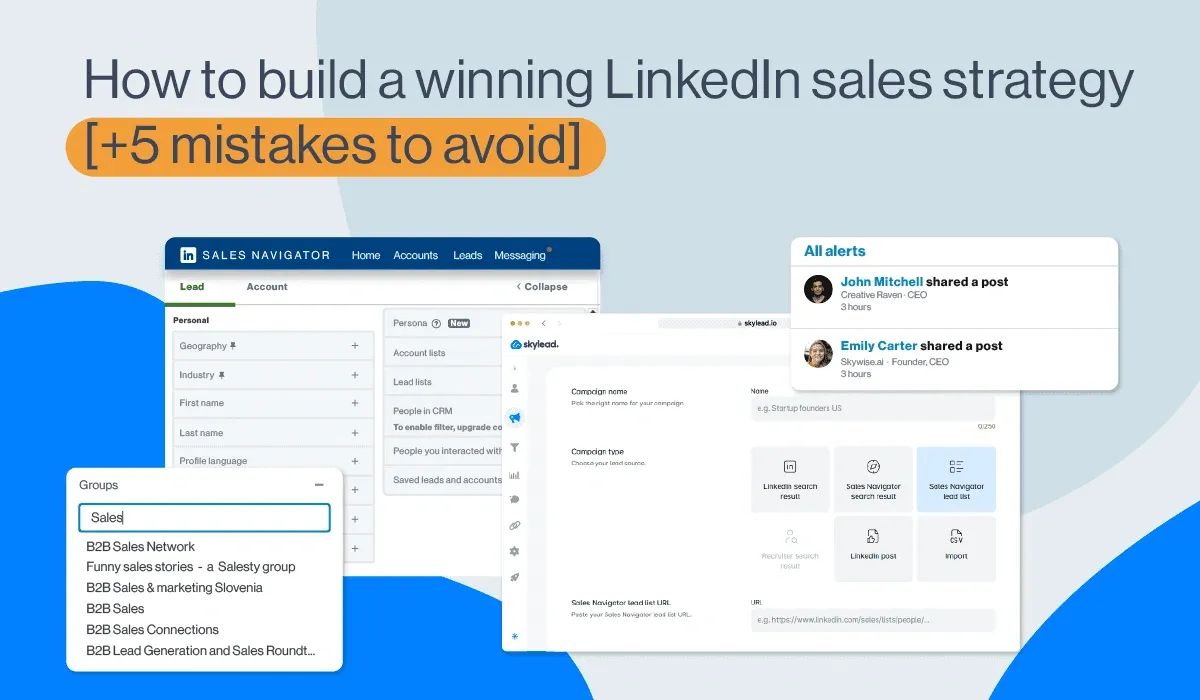
Image Source: Skylead
A successful LinkedIn outreach strategy starts with connecting to the right people. Research shows that targeted outreach to well-defined prospects yields 277% more leads than random connection attempts. Your results will improve with a systematic way to define and find ideal prospects.
Create an Ideal Customer Profile (ICP)
Your Ideal Customer Profile (ICP) acts as a compass that guides all business efforts to attract and convert the right customers. The original step involves analyzing your existing customer base to identify common traits and characteristics.
Your ICP should include these critical components:
- Firmographics: Industry, company size, annual revenue, number of employees
- Behavioral insights: Pain points, challenges, and decision-making factors
- Role-specific details: Job titles, seniority levels, and department information
Your ICP should target market segments that face urgent problems your product solves. Companies that develop detailed ICPs see faster sales cycles and higher win rates. You can then employ your ICP to identify prospects who might be interested in your company based on multiple data points.
Use LinkedIn Sales Navigator filters
LinkedIn Sales Navigator gives you 36 lead filters and 16 account filters compared to LinkedIn Basic Search’s 18 filters. This tool helps you find ideal prospects with unique precision.
Sales Navigator filters work best in this sequence:
- Account lists: Limit search results to relevant accounts (like target accounts or current customers)
- Personas: Filter by function and seniority to match your target buyer
- Warm paths in: Focus on prospects most likely to respond to your outreach
Sales professionals recommend these powerful filters:
- TeamLink connections: Shows people connected to your team members who can provide referrals
- Following your company: Identifies people 270% more likely to accept your InMail
- Posted on LinkedIn: Reveals active users who posted in the last 30 days, creating engagement chances
You can narrow your search with filters like function, seniority level, company size, industry, geographic location, and keywords. B2B sales become more targeted when you combine multiple filters that match your ICP.
Track job changes and company updates
Job changes create excellent sales outreach chances. About 62% of professionals looked to change jobs in 2022, which opened many more pipeline generation possibilities.
Job change tracking brings several benefits:
- Warmer leads: Happy customers who change jobs already know your product
- Shorter sales cycles: These qualified leads convert faster and at higher rates
- Reduced churn risk: You keep more customers when you maintain relationships with contacts who switch roles
Keep track of these key contacts: decision-makers at customer accounts, product users, contacts from open opportunities, and contacts from closed-lost opportunities. Sales Navigator’s “Changed jobs” filter shows people who changed positions in the last 90 days. These contacts are 62% more likely to respond to your messages.
Sales Navigator’s “Account News” feature helps you stay current with potential clients’ company news. These updates make excellent conversation starters for customized outreach messages. Setting up alerts will help you catch important prospect information quickly.
Your LinkedIn sales strategy becomes substantially more targeted and effective when you define and find ideal prospects this way. A well-defined ICP, smart use of Sales Navigator filters, and active tracking of professional changes create a solid foundation for your outreach efforts.
Craft Messages That Get Replies

Image Source: SalesBlink
Your LinkedIn outreach strategy lives or dies by your messages. Research shows customized LinkedIn messages get a 32.7% higher response rate than generic ones. With crowded inboxes everywhere, your messages need smart planning and careful execution to stand out.
Personalize your opening line
The opening line makes all the difference between prospects reading on or hitting delete. Research shows that adding specific details from someone’s profile or their shared content proves you actually care. This creates what marketers call a “pattern interrupt” – helping you cut through the usual sales noise.
Response rates jump to 24.6% when you keep your opening hook between 36-50 characters. Good ways to personalize include:
- Mentioning their recent wins or posts
- Bringing up shared connections
- Talking about common interests or industry challenges
- Noting their current projects
Offer a clear value proposition
Once you’ve grabbed attention with personalization, show them what’s in it for them. Your message should explain how you’ll solve their specific problems. A winning value proposition needs these five key elements:
- Clarity – Makes your offer easy to understand
- Brevity – Gets to the point quickly
- Originality – Sets you apart from others
- Relevance – Speaks to their needs
- Demonstrated value – Shows real benefits
The message should focus on solving their challenges rather than bragging about your company. Data proves that messages centered on value work better than company-focused pitches.
End with a low-friction call to action
People with full inboxes respond better to simple, easy calls to action. Rather than jumping straight to meeting requests, try asking about their interest – it tends to work better.
Simple CTAs that work well:
- “Worth a chat?”
- “Open to checking it out?”
- “Is [goal] a priority right now?”
Put calendar links in your signature instead of the message body. This lets interested prospects book time easily. Research shows that giving specific dates and times makes it easier for people to say yes.
Avoid common mistakes in cold outreach
About 76% of prospects ignore messages that feel automated or generic. Here’s what not to do:
- Write too much – Messages under 400 characters get 22% more responses
- Sell right away – Pushing services in first messages feels fake and pushy
- Use templates – People spot copy-paste messages instantly
- Follow up too often – Being persistent is good, but overdoing it looks spammy
- Create fake urgency – Made-up pressure kills trust
Skip greetings like “Hi there” or “Hi dear” – they scream mass outreach. Bad grammar and punctuation also tank your response rates.
Craft messages that feel personal, show clear value, and make it easy to say yes. This approach helps you build a LinkedIn sales strategy that consistently gets quality responses from your target prospects.
Engage Beyond the Inbox
“We start on LinkedIn, which allows us to engage prospects from multiple angles – through interactions with their posts, our own content sharing, and targeted ads aimed at individuals on our outreach list.”
— NetHunt CRM Representative, LinkedIn outreach specialist at NetHunt CRM
LinkedIn outreach success goes beyond sending messages. Your authentic interactions on the platform create stronger connections. You’ll see better response rates when you reach out. Research proves that prospects become more receptive to your outreach if you interact with their content before sending connection requests.
Comment on posts and share insights
Thoughtful comments put you on prospects’ radar without a direct pitch. Sales professionals who comment on prospects’ LinkedIn posts create casual interactions that boost name recognition. A study notes, “By commenting, you move from an unknown to a known”.
Your comments should add real value instead of generic responses. Each comment needs to provide valuable information even without context. Here’s what works best:
- New information missing from the original post
- A different view on the topic
- Key point summaries
LinkedIn’s algorithm favors active users. Your consistent interactions help your content appear more in others’ feeds.
Post content that builds authority
LinkedIn professionals look for valuable content from trusted sources. Your educational and insightful content shows your expertise to target audiences.
You need authenticity to stand out on LinkedIn. One source states, “Authenticity and realness go a very long way on social media these days”. Try different content formats—documents, videos, polls, and in-depth articles. This helps you find what appeals most to your audience.
Join and contribute to relevant LinkedIn groups
LinkedIn Groups offer exceptional networking chances with like-minded professionals. These communities let you join meaningful discussions, share industry insights, and connect through common interests.
Groups provide these key benefits:
- Targeted networking with professionals in your field
- Intellectual influence opportunities to showcase expertise
- Lead generation through prospect engagement
Regular participation builds relationships through valuable contributions. Share relevant content, answer questions, and provide insights to become a trusted expert.
A complete LinkedIn strategy needs profile optimization, targeted prospecting, compelling messages, and regular platform engagement.
Scale Your Outreach with Tools and Sequences
Scaling your LinkedIn outreach efforts needs you to use technology smartly while you retain control of personalization. You need to become skilled at the basics of connection and participation before tools and sequences can help you reach more prospects without losing quality.
Use AI tools for message personalization
AI-powered tools have changed the way professionals personalize outreach. LinkedIn’s native AI Writing Assistant helps you draft your original messages based on specific prompts. You can customize templates to different scenarios. These tools look at prospect profiles and create unique conversation starters based on their work background or recent activity.
Third-party platforms blend with your existing workflows to offer advanced personalization. Some solutions can add dynamic variables like first name, company name, or industry references into messages automatically. Your communication feels personal even when you send it to multiple recipients. AI personalization boosts response rates by 18-25% compared to standard email outreach.
Set up automated follow-up sequences
We learned that steady follow-up determines success in outreach. Studies show that 3-5 messages with 4-7 day gaps deliver the best engagement. Your first message should show value. The messages that follow should build on that foundation.
Most automation platforms let you create multi-channel, conditional sequences that change based on how recipients react. To name just one example, a welcome message can trigger automatically when prospects accept your connection request. A gentle reminder follows if they don’t respond within a week.
Test timing and frequency for best results
Without doubt, timing affects response rates substantially. The data reveals that follow-ups with 4-7 day gaps result in a 27% average response rate. On top of that, keeping daily outreach to 20-25 messages helps you maintain quality engagement and stops you from hitting LinkedIn’s activity limits.
Focus on these key metrics when testing different approaches:
- Connection acceptance rates
- Message response percentages
- Overall campaign performance
Natural timing gaps between actions help keep your account safe. Stay within LinkedIn’s daily limits. Automation should improve your outreach strategy without replacing real connections. Mix technology with genuine engagement to get lasting results.
Conclusion
B2B lead generation through LinkedIn continues to be effective in 2025, especially when done the right way. This piece explores proven techniques that deliver measurable results. These strategies combine technological efficiency with real human connection – something modern prospects truly value.
Research shows that profile optimization builds the base for your success. A professional photo, compelling headline, and relevant experience section create the first impression before any conversation starts. Your Ideal Customer Profile helps you focus on the right prospects instead of connecting with poor-fit contacts.
Customized messaging forms the life-blood of successful outreach. Short, value-focused messages that tackle specific challenges get better response rates by a lot compared to generic templates. Your credibility grows when you comment on posts, share useful content, and join relevant groups before reaching out directly.
Scaling efforts through smart automation helps maintain personalization while reaching more people. AI tools help create custom messages. Automated sequences ensure you follow up consistently. Smart timing helps maximize responses. LinkedIn keeps evolving, but these core principles work because they match how professionals naturally connect.
The right approach turns cold outreach into warm conversations. Your authentic and precise efforts will attract quality leads that become lasting business relationships. These techniques will help your LinkedIn presence grow from basic networking into a powerful business development tool.
Boost your LinkedIn success today! Get exclusive tips at GrowLeads.io now.
FAQs
Q1. How can I optimize my LinkedIn profile for better outreach results?
To optimize your LinkedIn profile, use a professional photo and banner, craft a value-driven headline and summary, and showcase relevant experience and activity. Focus on highlighting how you help others and the results you deliver.
Q2. What are some effective strategies for finding ideal prospects on LinkedIn?
Create an Ideal Customer Profile (ICP), use LinkedIn Sales Navigator filters to narrow your search, and track job changes and company updates. These strategies help you identify and connect with prospects who are most likely to be interested in your offerings.
Q3. How can I craft LinkedIn messages that get more replies?
Personalize your opening line, offer a clear value proposition, and end with a low-friction call to action. Keep messages concise, focus on the prospect’s challenges, and avoid common mistakes like excessive length or immediate selling.
Q4. What are some ways to engage with prospects beyond sending messages?
Engage by commenting on posts and sharing insights, posting content that builds authority, and joining and contributing to relevant LinkedIn groups. These activities help you build familiarity and credibility with potential prospects.
Q5. How can I scale my LinkedIn outreach efforts effectively?
Use AI tools for message personalization, set up automated follow-up sequences, and test different timing and frequency for best results. Balance automation with authentic engagement to maintain quality while increasing your reach.

Malay is the VP of Growth & Operations at Growleads, where he transforms businesses through automation, behavioral analytics, and omni-channel scaling strategies.
As a growth strategist, Malay has helped organizations streamline operations, decode customer behavior, and scale revenue through data-driven automation. His expertise spans process optimization, conversion analytics, and building scalable growth systems that deliver measurable results.


