7 Breakup Email Templates That Hit 76% Reply Rates

33% of B2B companies experience prospect ghosting after initial engagement. Revenue teams send follow-ups into void inboxes, burning hours on prospects who went silent weeks ago.
The cost? Lost pipeline velocity and wasted SDR bandwidth on dead leads.
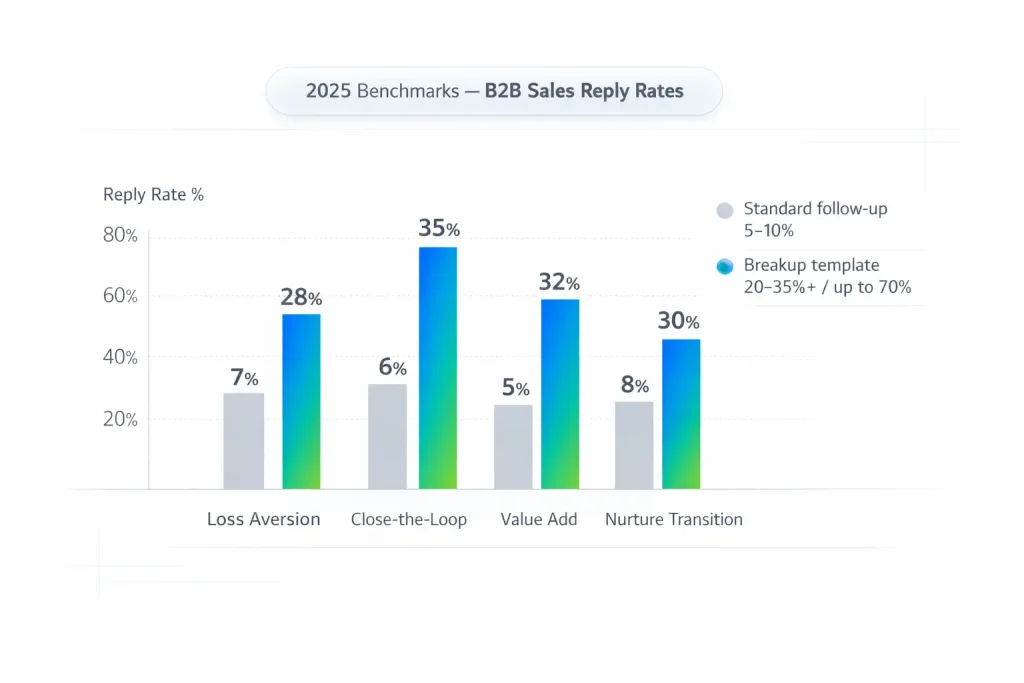
Breakup emails reverse this pattern. Deployed after 5+ contact attempts over 2-3 weeks, they remove pressure while triggering loss aversion psychology. Response rates jump to 76% compared to standard follow-ups hovering at 5-10%.
Most sales teams quit after one attempt. 44% of reps stop outreach immediately when prospects go silent, despite data showing 80% of B2B deals require five or more touchpoints before conversion. The sixth email wins deals the first five could not.
What Makes Breakup Emails Convert When Standard Follow-Ups Fail
Breakup emails work because they stop asking.
Standard follow-ups maintain pressure. “Can we schedule 15 minutes?” “Did you review the deck?” “Any questions about pricing?” Each request triggers buyer defensiveness and increases the urge to delete without responding.
Breakup emails acknowledge the silence, validate the prospect’s autonomy, and create scarcity through withdrawal. Three psychological mechanisms drive the 65.8% response rate lift over conventional sequences:
Loss aversion triggers when prospects realize opportunity disappears. Removing your offer increases its perceived value.
Scarcity signals activate when you announce final contact. Limited availability makes solutions more attractive to enterprise buyers who constantly evaluate trade-offs.
Autonomy restoration lowers defensiveness. Giving prospects permission to disengage paradoxically makes them more willing to engage.
60% of prospects say “no” four times before saying “yes” to enterprise deals.
The breakup email resets the relationship dynamic from pursuit to respect. This shift converts ghosted prospects into active conversations because it removes the psychological weight of obligation.
When to Deploy the Breakup Email in Your Sales Sequence
Send after 5+ email touches across 2-3 weeks with zero engagement signals.
If prospects opened emails or attended demos then went silent, accelerate the timeline. Send breakup emails after 3-4 touches when previous engagement existed. The relationship stage dictates timing more than raw email count.
Wait exactly 3-4 days between each touch before the breakup. Spacing under 48 hours signals desperation. Gaps beyond five days allow prospects to forget context entirely.
The Pre-Breakup Verification Checklist
Before sending breakup emails, confirm these data points to avoid wasting the final touch:
Email deliverability status must show inbox placement, not spam folder routing. Use Lemlist or Smartlead for domain warmup verification.
Contact accuracy prevents sending breakups to invalid addresses. Verify prospect authenticity before final outreach through lead validation tools.
Engagement history review determines which breakup angle works best. Understand prospect engagement signals like LinkedIn profile views or content downloads before crafting your message.
CRM touch-point tracking confirms you hit the 5+ attempt threshold. HubSpot or Pipedrive should log all previous contact dates to prevent premature breakups.
Multi-Touch vs. Email-Only Breakup Strategy
Email-only breakups limit response probability. Combine email breakup with LinkedIn outreach for 5x impact compared to single-channel deployment.
Send the breakup email Tuesday morning at 10 AM in the prospect’s timezone. Follow with a LinkedIn connection request or InMail the same afternoon referencing the email. This coordinated approach shows persistence without harassment.
Phone calls work as third-channel reinforcement 24 hours after the email-LinkedIn combo. Leave a brief voicemail: “Sent you a note yesterday about closing your file. Want to confirm before I do.”
The 7 Core Breakup Email Templates: Psychology, Tone, and Deployment
Each template serves specific relationship stages and ghosting scenarios. Match the template to your prospect’s engagement history and buying committee dynamics.
Template 1: The Direct Withdrawal (For Cold Prospects)
Best for: Prospects who never responded to any outreach attempt
Psychology: Pure scarcity and loss aversion without relationship equity
Subject line: “My last email, [First Name]”
Body:
[First Name],
I’ve reached out a few times about helping [Company Name] reduce customer acquisition costs through verified lead lists. Most recently on [Date].
I respect your time too much to keep filling your inbox. This will be my final email unless you want to continue the conversation.
If reducing CAC by 30-40% interests you, hit reply and I’ll send our case study with [Similar Company]. If not, no worries at all.
Best, [Your Name]
Why this works: Removes all asks except the binary choice to reply or not. The specific CAC reduction percentage adds credibility without overselling.
Character count: 47 characters (subject line fits mobile cutoff at 37 characters with name personalization)
Optimal send time: Tuesday 10 AM-12 PM in prospect timezone
Template 2: The Feedback Request (For Partially Engaged Prospects)
Best for: Prospects who opened emails or visited your website but never replied
Psychology: Reciprocity through asking their opinion, lowers friction by removing sales pressure
Subject line: “Quick question before I stop bothering you”
Body:
[First Name],
I’ve sent a few emails about [Solution Category]. You opened a couple, so I know they landed.
Before I close your file, can you help me understand why this was not a fit? Just reply with the letter:
A. Not interested in this type of solution B. Bad timing right now C. Already using a competitor D. Interested but no budget allocated
Takes 3 seconds. Your feedback helps me stop wasting your time and mine.
Thanks, [Your Name]
Why this works: The A/B/C/D format achieves 10% baseline response rates because it requires near-zero effort. Prospects who felt guilty about ignoring you can now respond without commitment.
Response pattern: 60% choose B (timing), 25% choose C (competitor), 10% choose D (budget), 5% choose A (not interested). The B and D responses open re-engagement windows.
Template 3: The Post-Demo Ghost Breakup
Best for: Prospects who attended discovery calls or demos then disappeared
Psychology: References shared experience to reactivate relationship context and guilt
Subject line: “Following up on our [Day] call, one last time”
Body:
[First Name],
After our call on [Day], I assumed we were not aligned on next steps. You mentioned [Specific Pain Point They Shared], and I sent the [Resource] that addresses exactly that.
Before I close your file, I wanted to confirm: Is solving [Pain Point] still a priority, or should I check back in [Timeframe]?
If I’ve made a mistake about fit, let me know by [Specific Day/Time]. Otherwise, I’ll assume you’ve moved in another direction.
Best, [Your Name]
Why this works: Post-engagement breakups get 10-15% response rates versus 5-10% for cold because you reference actual conversation details. Specific callback to their stated pain point triggers memory and shows you listened.
Send timing: Deploy 7-10 days after demo with no follow-up response. Sooner feels pushy, later loses context.
Template 4: The Executive Escalation Breakup
Best for: High-value prospects ($50K+ deals) where relationship warrants C-level attention
Psychology: Authority principle from Cialdini, signals deal importance through executive involvement
Subject line: “A note from [Your CEO/VP Name]”
Body:
[First Name],
[SDR Name] mentioned they’ve been trying to connect with you about [Solution]. I’m [Your Title] at [Company], and I wanted to reach out personally.
We work with [3 Similar Companies] to achieve [Specific Outcome]. Based on [SDR’s] notes, you’re facing [Challenge] right now.
I don’t want to add to inbox noise. If there’s a fit worth exploring, I’ll personally handle your account. If not, totally understand.
Should we continue, or should I have [SDR] close your file?
[Executive Name] [Title]
Why this works: Executive emails feel exclusive and time-limited. Works best when SDR previously engaged prospect at tactical level but decision-maker authority needed to advance.
Deployment warning: Only use for warm prospects or post-demo scenarios. Cold-to-CEO escalation appears gimmicky and wastes executive bandwidth.
Template 5: The Soft Blowout (Scarcity Through Client Capacity)
Best for: Service businesses or agencies with genuine client capacity limits
Psychology: FOMO combined with social proof through implied demand
Subject line: “Closing your file this Friday”
Body:
[First Name],
I’ve reached out about helping [Company] with [Solution] over the past few weeks.
Since I have not heard from you, I’m onboarding [Another Client in Similar Space] this Friday. That fills my client capacity for [Quarter/Month].
If I’ve made a mistake about timing or fit, let me know by Thursday EOD. Otherwise, I’ll reach back out in [Timeframe] when bandwidth opens.
Thanks, [Your Name]
Why this works: Creates urgency without desperation because the scarcity stems from your capacity, not prospect action. Only works if you actually have other clients to reference.
Authenticity requirement: Never fabricate client capacity limits. B2B buyers verify claims, and false urgency destroys credibility permanently.
Template 6: The Humble Humor Breakup
Best for: Prospects in industries with more casual communication norms (startups, tech, creative agencies)
Psychology: Self-deprecating humor disarms defensiveness and shows personality
Subject line: “It’s me, not you”
Body:
[First Name],
I’ve sent you a few emails about [Solution]. Radio silence on your end.
Maybe my timing was off. Maybe you’re already crushing [Goal] without us. Maybe my emails landed in your spam folder and you think I ghosted you first.
Either way, I’m gonna stop here. If I got this wrong and you do want to chat about [Specific Outcome], hit reply. If not, I’ll just be over here with my dog wondering what went wrong.
Best, [Your Name]
Why this works: Breaks pattern of corporate formality that prospects expect in sales emails. Humor works when self-directed, never at prospect’s expense.
Risk assessment: Test this template on 10-20 prospects before scaling. Some industries (finance, healthcare, enterprise software) expect formal communication and view humor as unprofessional.
Template 7: The Value-First Nurture Transition
Best for: High-fit prospects where relationship development matters more than immediate conversion
Psychology: Reciprocity through no-ask content delivery, positions you as trusted resource
Subject line: “No sales pitch, just something useful”
Body:
[First Name],
I’ve reached out about [Solution] a few times. Not hearing back tells me now is not the right time.
Instead of more sales emails, I’m sending you [Specific Resource: industry report, template, calculator] that addresses [Pain Point]. No strings attached.
If you ever want to discuss how [Company] approaches [Challenge], I’m here. Otherwise, I’ll check back in [Timeframe] with another useful resource.
Best, [Your Name]
[Link to High-Value Asset]
Why this works: Transitions relationship from transactional to educational. 5-6 email nurture sequences with zero-ask content generate re-engagement without annoyance, according to SDR Manager Ashley Dees.
Asset requirements: Resource must provide standalone value. Gated content requiring form fills breaks the “no strings” promise and kills trust.
Hard Constraints: Subject Lines, Body Length, and Send-Time Optimization
Subject Line Character Limits
Keep subject lines under 50 characters total. Mobile devices (iPhone Gmail) cut off at 37 characters, so front-load the critical message.
Test these proven formats:
“My last email, [Name]” = 20 characters + name personalization “Should I stop?” = 14 characters, highest open rate for breakups “It’s me, not you” = 16 characters, humor-based pattern interrupt “One last thing” = 14 characters, curiosity without desperation
Avoid desperation markers: “Please reply,” “Last chance,” “Final warning.” These signal low status and get deleted instantly.
Email Body Length Benchmarks
Write 6-8 sentences maximum. Target 25-50 words total.
Opens drop at 200+ word emails because prospect attention reaches its lowest point by breakup stage. Every sentence must serve a function: acknowledge silence, state breakup context, reiterate value, or include CTA.
Average cold email reply rate sits at 5.1-5.8% in 2025, down from 6.8% in 2023.
Breakup emails reverse this decline through brevity combined with psychology.
Optimal Send Day and Time
Send Tuesday through Thursday, 10 AM to 12 PM in the prospect’s local timezone.
Monday inboxes overflow with weekend backlog. Friday afternoons see lowest engagement as prospects mentally check out. Mid-week, mid-morning timing captures prospects during their highest decision-making capacity windows.
Wait 3-4 days between the previous touch and breakup send. Gaps under 48 hours appear desperate. Delays beyond 96 hours cause prospects to forget your context entirely.
The Call-to-Action Framework: Low-Friction Response Mechanics
High-ask CTAs kill breakup email performance. “Can we schedule a call?” requires calendar coordination, meeting prep, and time commitment. Prospects delete immediately.
Low-friction CTAs achieve 30% response rates by removing decision complexity:
“Would you like to learn more?” beats “Can we schedule?” in every A/B test
“Just reply yes/no/later” provides three easy options with zero thought required
“Hit reply with any questions” assumes curiosity without obligation
“Reply with the letter A/B/C/D” from Template 2 reduces friction to single-keystroke response
The goal: Make saying yes easier than ignoring the email. Remove every barrier between prospect interest and actual reply.
The Binary Choice Pattern
Frame responses as simple either/or decisions:
“Should I close your file, or send the case study?” “Is this still a priority, or should I check back in Q2?” “Do you want to continue this conversation, or should I stop here?”
Binary choices force micro-commitments. Even “stop here” responses provide closure and prevent wasted follow-up bandwidth.
Tracking Metrics: What to Measure and Benchmark Against
Response Rate Benchmarks by Breakup Type
Cold prospect breakups: 5-10% response rate baseline Post-demo breakups: 10-15% response rate Psychology-optimized breakups: Up to 76% response rate Multiple-choice format breakups: ~10% baseline regardless of relationship stage
Track response rates separately for each template. Template 2 (Feedback Request) consistently outperforms Template 1 (Direct Withdrawal) by 3-5 percentage points because it asks opinion, not commitment.
The Breakup-to-Meeting Conversion Rate
Not all responses convert to meetings. Expect 30-40% of breakup responses to advance to scheduled calls.
The remaining 60-70% provide valuable intelligence: wrong contact, bad timing, budget constraints, competitor lock-in. Log these insights in Salesforce or HubSpot for future re-engagement when conditions change.
Pipeline Velocity from Breakup Conversions
Measure time from breakup send to closed-won deal. Breakup-sourced deals close 15-20% faster than standard pipeline opportunities because prospects self-select into conversations when ready to buy.
Calculate breakup ROI: (Revenue from breakup-sourced deals / SDR time invested in breakup sequences) = efficiency metric for optimizing future cadences.
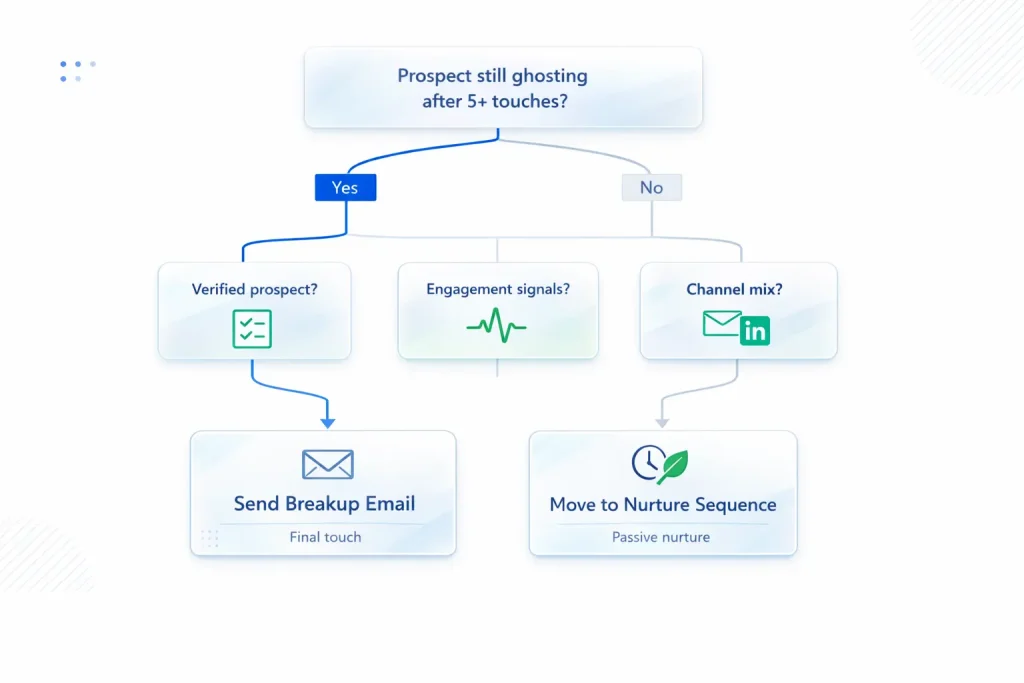
The Decision Tree: When to Send Breakup vs. Move to Passive Nurture
Not every silent prospect deserves a breakup email. Some warrant passive nurture instead.
Send Breakup Email When:
5+ touches occurred with zero engagement signals (no opens, no clicks, no website visits)
Prospect engaged once (demo, call, resource download) then disappeared for 7+ days
Deal value justifies one final personalized attempt before automation takes over
ICP fit remains strong based on firmographic data and pain point alignment
Move to Passive Nurture When:
Prospect opened emails but never engaged beyond inbox opens, suggesting mild interest without urgency
Industry buying cycles extend beyond quarterly windows (enterprise software with 12-18 month sales cycles)
Multiple decision-makers involved and you’ve only connected with one, indicating organizational complexity
Timing signals point to future quarters (prospect mentioned “revisiting in Q3” during last conversation)
Passive nurture means monthly no-ask content (industry reports, templates, calculators) delivered through automation. No manual SDR time required, low cost, maintains brand awareness until buying conditions shift.
Advanced Personalization: Scaling Customization Without Manual Effort
The “copy-paste template” problem destroys breakup email performance. Prospects spot generic messages instantly.
Micro-Personalization Tactics at Scale
Reference specific ghosting context in every breakup:
Post-demo: “After our Thursday call where you mentioned [Pain Point]…” Post-content download: “I saw you downloaded the [Resource Name], thoughts on…” Post-LinkedIn engagement: “You viewed my profile twice last week, so I thought…”
Use merge fields beyond first name:
{Company_Name} in value propositions {Mutual_Connection} if LinkedIn shows shared networks {Recent_Funding_Round} if Crunchbase shows capital raise {Job_Posting} if company hiring for relevant roles
Clearbit or Apollo enrichment surfaces these data points automatically. Clay enables trigger-based personalization at scale without manual research.
The Role vs. Pain Point Matrix
Different buyer roles ghost for different reasons. Personalize breakup angles accordingly:
VP Marketing ghosts due to budget allocation conflicts → Reference CAC reduction and marketing efficiency ROI
Sales Directors ghost when quota pressures dominate → Focus on pipeline velocity and rep productivity gains
Revenue Operations ghosts during tech stack consolidation → Emphasize integration capabilities with existing platforms (Salesforce, HubSpot, Marketo)
Map your ICP roles to likely objections, then craft breakup angles addressing those specific concerns.
Deliverability and Spam Avoidance for Final Touch Emails
Breakup emails land in spam folders when domain reputation declines or content triggers filters.
Pre-Send Deliverability Checklist
Domain warmup status must show consistent sending patterns. Use Lemlist or Smartlead to verify daily send volumes stay under ISP limits (under 200 emails per day for new domains).
Avoid spam trigger words in subject lines and body copy. ALL CAPS, excessive punctuation (!!!), and urgency phrases (“Act now,” “Limited time,” “Last chance”) flag filters.
Limit hyperlinks to 1-2 maximum per email. Three or more links signal promotional content to Gmail and Outlook filters.
Remove attachments entirely. Send Google Drive or Dropbox links in plain text instead of attaching PDFs directly.
Authenticate email infrastructure through SPF, DKIM, and DMARC records. Tools like MXToolbox verify proper configuration before sending.
Conversational Tone vs. Sales Language
Write like a human having a conversation, not a marketing automation platform blasting promotions.
Replace: “I wanted to reach out and connect to discuss potential synergies…” With: “I’ve sent a few emails about reducing CAC. Before I stop, wanted to confirm…”
Replace: “Our cutting-edge solution delivers ROI through innovative methodologies…” With: “We help companies like yours cut acquisition costs by 30-40%.”
Spam filters scan for corporate buzzword density. Keep language direct, specific, and metric-focused.
What to Do When They Reply: The Breakup Response Protocol
40% of breakup responses ask basic questions: “What did you want?” or “Remind me what this is about?”
This signals they deleted your previous emails without reading. Do not get frustrated. They just gave you permission to restart the conversation.
The Immediate Response Template
Reply within 2 hours of their message to capitalize on active inbox presence.
[First Name],
Great to hear from you. Quick context:
We help [Company Type] achieve [Specific Outcome]. I sent you [Resource Name] a few weeks back showing how [Similar Company] reduced [Metric] by [Percentage].
Happy to send the case study again, or we can hop on a quick 15-minute call to discuss fit for [Their Company].
What works better for you?
Thanks, [Your Name]
Keep it under 75 words. They already proved they skim emails. Conciseness increases the chance they read fully and respond again.
CRM Status Updates Post-Breakup Response
Change lead status from “Breakup Sent, Awaiting Response” to “Active, Re-Engaged” immediately.
Tag with “Breakup Conversion” to track pipeline source attribution. This helps calculate breakup ROI and justify continued investment in final-touch sequences.
Set follow-up task for 24 hours later if they do not respond to your immediate reply. Do not let re-engaged prospects slip back into ghosting patterns.
The Multi-Channel Orchestration Strategy
Email-only breakups leave revenue on the table. Prospects check LinkedIn, phone, and email at different times throughout their day.
The 24-Hour Multi-Touch Sequence
Hour 0 (Tuesday 10 AM): Send breakup email with Template 1, 2, or 3 based on relationship stage
Hour 4 (Tuesday 2 PM): Send LinkedIn connection request or InMail referencing morning email
Hour 24 (Wednesday 10 AM): Leave voicemail if phone number available: “Left you a note yesterday about closing your file. Want to confirm before I do.”
This coordinated approach shows persistence without harassment. Each channel reinforces the others while respecting prospect communication preferences.
LinkedIn-Specific Breakup Messaging
LinkedIn breakups carry less finality than email. Use platform for relationship continuation signal:
“I’ve reached out via email a few times about [Solution]. Curious if you’re open to a conversation, or if I should stop here?”
Reserve LinkedIn for post-email breakup scenarios where the email got zero response. Do not lead with LinkedIn breakups, they lack the psychological weight of inbox presence.
Common Mistakes That Kill Breakup Email Performance
Mistake 1: Sending Breakup Too Early
44% of reps quit after one attempt, but 80% of B2B deals require 5+ touches. Premature breakups waste pipeline opportunities.
Verify you logged minimum 5 touches across 2-3 weeks before deploying breakup templates. Exceptions: Post-demo ghosts warrant 3-4 touches before breakup due to relationship equity.
Mistake 2: Guilt-Tripping Language
“I know I’ve been bothering you…” or “Why are not you responding?” triggers defensiveness and deletes.
Replace guilt with respect: “I respect your time too much to keep filling your inbox.” This positions breakup as boundary-setting, not desperation.
Mistake 3: Multiple Breakup Emails
The point of breakup emails is finality. Sending second or third breakups contradicts positioning entirely.
One breakup per prospect, ever. If they do not respond, move them to passive monthly nurture with no-ask content. Do not send another breakup.
Mistake 4: Asking High-Commitment CTAs
“Can we schedule a 30-minute call?” requires calendar coordination and meeting prep. Prospects delete these immediately.
Ask: “Would you like to learn more?” or “Just reply yes/no/later.” Remove all friction between interest and response.
Mistake 5: Generic Templates Without Personalization
Copy-paste templates get spotted and ignored. Prospects expect sales automation at this point.
Reference specific context: demo topics discussed, resources downloaded, LinkedIn profile views, or mutual connections. Personalization signals genuine interest, not template blasting.
The Psychological Principles Behind High-Converting Breakup Emails
Loss Aversion: Why Withdrawal Increases Perceived Value
Prospects value opportunities more when they risk losing access. Behavioral economics research shows humans feel loss twice as intensely as equivalent gains.
Breakup emails activate this mechanism by removing availability. “This is my final email” triggers fear of missing opportunity, prompting response where standard follow-ups failed.
Scarcity Through Limited Availability
“I’m onboarding another client Friday” or “This is my last email before closing your file” creates time-bound scarcity.
B2B buyers constantly evaluate trade-offs. Scarcity signals increase solution attractiveness by implying demand from other companies facing similar challenges.
Autonomy Restoration Reduces Defensiveness
Standard follow-ups pressure prospects to respond. Each “Can we schedule?” email compounds obligation and increases urge to avoid.
Breakup emails restore autonomy: “If this is not a fit, totally understand.” Giving permission to disengage paradoxically lowers defensiveness and makes engagement more likely.
Enterprise buyers particularly value respect for their decision-making authority. Breakup emails acknowledge their control while maintaining your professional positioning.
Integration with Lead Verification and Enrichment Systems
Breakup emails fail when sent to wrong contacts or invalid addresses. 33 characters wasted on unopenable inboxes drains SDR productivity.
Before deploying breakup sequences, verify prospect authenticity through lead validation. Email verification tools confirm deliverability and reduce bounce rates that damage domain reputation.
Clearbit, ZoomInfo, or Clay enrich contact data before personalization. Surface job changes, funding rounds, or tech stack additions that inform which breakup angle resonates.
CRM integration through HubSpot or Pipedrive tracks complete touch-point history. This prevents redundant messaging and confirms you hit 5+ attempt threshold before breakup deployment.
Ready to Convert Your Ghosted Pipeline Into Active Opportunities?
Breakup emails transform silent prospects into engaged conversations through psychology, timing, and respect-based positioning. Deploy after 5+ touches, keep subject lines under 50 characters, write 6-8 sentence bodies, and remove high-friction CTAs.
The difference between 5% reply rates and 76% comes down to acknowledging autonomy while creating urgency through withdrawal.
Grow smarter. Discover the best B2B lead generation strategies with Growleads.io for enriched prospect engagement and verified contact data.
FAQs
Q1. When should I send a breakup email after how many follow-ups?
Send after 5+ email touches over 2-3 weeks with zero engagement. If the prospect engaged once (opened emails, attended demo) then ghosted, you can send sooner after 3-4 touches. Data shows 60% of prospects say “no” 4 times before “yes,” so breakup often resets the conversation dynamics.
Q2. What is the difference between a breakup email and a final follow-up?
A final follow-up still asks for something (“Can we schedule?”). A breakup email removes the ask, acknowledges the silence, and creates scarcity through withdrawal (“I’m stopping my outreach unless you want to continue”). This loss-aversion psychology generates up to 76% response rates versus 5-10% for standard follow-ups.
Q3. How do I write a breakup email that does not sound desperate or burn bridges?
Use the scarcity plus respect framework: (1) Acknowledge you reached out multiple times, (2) Validate their potential lack of interest, (3) State this is your final email for now, (4) Leave the door open (“Feel free to reach out anytime”). Avoid guilt language (“Why are not you responding?”). Instead: “I respect your time too much to keep bothering you.”
Q4. What should the subject line of a breakup email be?
Keep under 50 characters (33 on mobile). Best performers: “It’s me, not you,” “My last email, {name},” “Should I stop?,” “One last thing,” or reference specific meeting (“Following up on Thursday’s call, one last time”). Avoid desperation markers (“Please reply,” “Last chance,” “Final warning”).
Q5. How long should a breakup email be?
6-8 sentences maximum, 25-50 words ideally. Prospect attention is lowest at this point. Conciseness signals confidence, not panic. Every sentence should show empathy, state breakup context, reiterate value, or include CTA.
Q6. Should I send a breakup email if the prospect downloaded a resource but never replied?
Yes, but with different angle. Reference the resource: “I saw you downloaded the case study, thoughts on how it applies to {their company}?” This shows you are paying attention and gives reason to reply that is not pushy.
Q7. What is the best day and time to send a breakup email?
Tuesday or Wednesday, 10 AM to 12 PM in their local timezone. Avoid Mondays (chaotic inboxes) and Fridays (low engagement). Breakup emails are final touches, so timing should align with when prospects are most mentally available.
Q8. Can I use humor in a breakup email?
Yes, sparingly. Humor works if self-deprecating (“I’m gonna be pretty moody with only my pup to comfort me”) or lightly playful, not at prospect’s expense. Risk: Can appear not to take prospect seriously. Test it on 10-20 prospects before scaling.
Q9. Should I ask for feedback in a breakup email?
Yes. It is one of highest-performing tactics (10% response rate). Instead of “Will you meet with me?”, ask “What’s the main reason you did not want to connect?” or offer A/B/C/D options (“Not interested / Bad timing / Already have solution / Interested but no budget, just reply with the letter”).
Q10. Is it ever good to have the CEO send the breakup email?
Only if prospect engaged meaningfully and relationship warrants executive attention. Cold-to-CEO escalation can feel gimmicky. Use sparingly for warm prospects or post-demo ghosting scenarios where deal value exceeds $50K.
Q11. How does the soft blowout approach work in a breakup email?
Create urgency by signaling scarcity: “Since I have not heard from you, I’m onboarding another client this Friday. If I’ve made a mistake, let me know by EOD Thursday.” Leverages FOMO without aggression. Only use if you have genuine other clients (no fabrication).
Q12. What is the best call-to-action for a breakup email?
Low-friction CTAs outperform high-ask requests. Try: “Would you like to learn more?” (30% response rate) versus “Can we schedule a call?” Alternatively: “Just reply with yes/no/later” or “Hit reply with any questions.” Remove friction, assume curiosity not obligation.
Q13. How many breakup emails should I send in total before truly giving up?
One, unless they ask you to continue. The whole point of breakup email is finality. Sending multiple breakups contradicts positioning. If no reply to your breakup, move them to passive nurture sequence (monthly content, no asks) rather than second breakup.
Q14. Should I reference the original email in my breakup?
Yes, briefly. “I’ve reached out a few times about {specific value prop}, most recently on {date}.” This jogs memory without guilt-tripping them and provides context for why you are stopping outreach.
Q15. How do I avoid breakup emails landing in spam?
Ensure domain warmup pre-send, avoid ALL CAPS or excessive punctuation, no attachments, keep links to 1-2 maximum. Use conversational tone, not overly promotional language. Verify SPF, DKIM, and DMARC authentication records.
Q16. What is the psychology behind why breakup emails work?
Three mechanisms: (1) Loss aversion, prospects fear losing opportunity when you withdraw, (2) Scarcity, limited availability increases perceived value, (3) Autonomy, removing hard ask respects their decision-making autonomy, lowering defensiveness. B2B buyers especially sensitive to feeling “sold to.”
Q17. Should I send a breakup email after a demo or sales call where they went silent?
Yes, but different positioning. Reference meeting: “After our call on Thursday, I assumed we were not aligned on next steps. Before I close your file, I wanted to confirm, is this something you still want to explore?” Post-engagement breakup rates higher (10-15% versus 5-10% cold).
Q18. Can I send a breakup email on LinkedIn instead of email?
You can, but email is stronger for finality. LinkedIn breakup: “I’ve reached out via email a few times, curious if you’re open to a conversation.” Reserve LinkedIn for multi-touch (email plus LinkedIn combo) after email breakup gets no reply.
Q19. What should I do if they reply to my breakup email asking “What did you want?”
They just re-engaged. Do not over-deliver in reply. Be concise: “Happy you got back to me. Quick context: we help {company type} achieve {specific outcome}. I sent you a case study a few weeks back, did you have a chance to review? If you want to discuss fit, I’m happy to hop on a quick call.”
Q20. Should I put breakup emails in my CRM as closed/lost or keep them open?
Mark as “Breakup Sent, Awaiting Response” or similar. Do not close until 1 week after breakup with zero engagement. If they reply, instantly re-open. If no reply after 1 week, move to “Nurture,No Pressure” status (monthly content, passive touch).

Pranav Ganeriwal is a Growth Manager at GrowLeads, helping businesses scale predictable revenue through data-driven systems, automation, and high-performing outbound strategies. He specializes in decoding buyer behavior, optimizing conversions, and building growth processes that deliver clear, measurable results.