
SDR Commission Structure 2026: Fair Pay Architecture
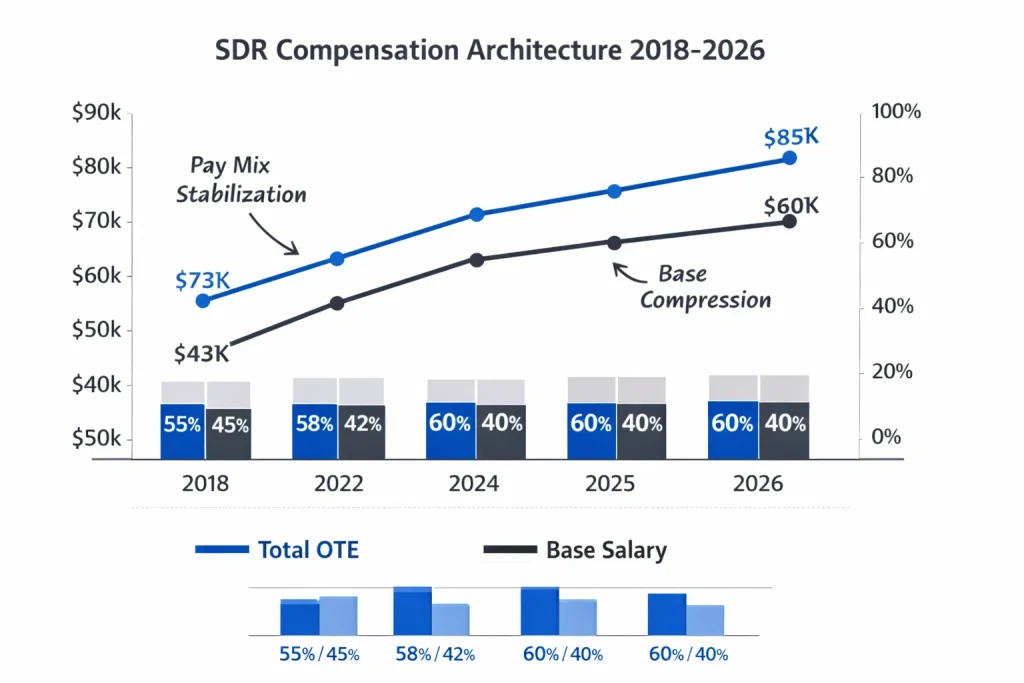
Between 2023 and 2026, Sales Development Representative compensation quietly evolved from a “cheap junior headcount” line item into a strategic cost center demanding precision architecture. SaaS and B2B tech markets compressed global SDR base salaries into a $55,000 to $75,000 band, with median base at $60,000 and on-target earnings at $85,000 now representing the new competitive floor. Traditional coastal hiring hubs lost their premium advantage as 2025 data shows 5-10% overall SDR salary increases, but with New York and San Francisco merely catching up to middle-America markets rather than commanding inflated multiples.
Most early-stage teams still operate under a flawed mental model: over-indexing on “pay per meeting” with suppressed base salaries generates higher hustle and lower fixed costs. Real-world economics and downstream conversion data prove the opposite reality. Pure “pay per meeting” plans systematically inflate junk pipeline as SDRs optimize for volume metrics rather than revenue outcomes. Sustainable SaaS compensation architectures align variable pay to pipeline value and sales-qualified opportunities with quota-to-OTE ratios maintaining 4x to 5x multipliers, not raw meeting counts. Low-base, high-commission SDR structures fail to reduce CAC when average representatives require 3-6 months to ramp and only 57% hit quota even in balanced plans. Churn and underperformance at the SDR layer creates compounding sunk costs: recruiting expenses, onboarding time investments, lost pipeline coverage during vacancy periods, and strategic account relationship damage from inconsistent touchpoint quality.
Revenue-driving systems in 2026 require one precision-engineered SDR commission structure where pay mix holds within 60/40 to 70/30 base-to-variable ratios, on-target earnings benchmark against $70,000 to $95,000 competitive ranges, variable compensation ties to qualified outcomes rather than activity theater, and quota mathematics maintain transparent realism with clear linkage between SDR behavior, OTE attainment, and Customer Acquisition Cost efficiency. Companies executing this architecture lower SDR churn and hiring churn-costs, stabilize pipeline quality through reduced no-show rates and improved lead fit, align SDR behavior with revenue per opportunity instead of vanity calendar metrics, and position founder-led teams as credible competitors in the 2026 talent market without margin-destroying overpayment.
The Compensation Architecture Foundation
An SDR commission structure in 2026 represents the complete pay mix and incentive design framework compensating Sales Development Representatives. Modern structures combine competitive base salaries with performance-based variable pay tied to qualified meetings, sales-qualified opportunities, and pipeline value creation. Industry benchmarks establish 60/40 base-to-variable ratios as the structural norm, with realistic data-backed quotas replacing arbitrary activity targets. Revenue Operations leaders differentiate fair compensation from exploitative models by examining three core elements: market-competitive total compensation ranges, role-responsibility alignment in variable pay design, and quota calibration methodology preventing both underpayment and systematic overcompensation.
Base Salary Benchmarks Across Market Segments
Entry-level SDRs in 2025 start at $50,000 to $65,000 base salaries, rising to $55,000 to $75,000 with 12-24 months of demonstrated performance. Geographic location still influences compensation bands, but the traditional coastal premium compressed significantly between 2023 and 2026. New York and San Francisco SDRs previously commanded 20-30% salary premiums over Austin or Nashville markets. 2025 data shows those differentials narrowing to 5-15% as remote work normalization and talent distribution patterns eliminated artificial scarcity in major metros.
Enterprise B2B motions with Average Contract Values exceeding $50,000 typically position SDR base salaries at the upper end of market ranges. Higher per-meeting revenue potential justifies elevated fixed compensation, particularly when SDRs require vertical specialization or technical product knowledge. SMB-focused sales motions with $5,000 to $15,000 ACVs operate at lower base ranges, compensating through higher meeting volume quotas and per-activity incentives. Founder-led teams building initial SDR functions should anchor base salary decisions to their specific ACV and expected meetings-to-close conversion rates rather than generic “market average” data points.
Base salary should represent 60-70% of total on-target earnings, with the remaining 30-40% variable tied to controllable leading indicators, not lagging revenue outcomes.
Variable Pay Components and Performance Triggers
Variable compensation in modern SDR structures breaks into three implementation tiers. Tier 1 plans compensate representatives for booked meetings regardless of downstream qualification. Tier 2 architectures pay only when meetings advance to sales-qualified opportunity status or enter formal pipeline stages. Tier 3 frameworks blend activity-based triggers with team-level pipeline or revenue incentives, creating dual accountability for both individual output and collective revenue outcomes.
$50 to $150 per qualified meeting represents the typical range for Tier 1 appointment setter compensation in B2B technology markets. Companies calculate per-meeting rates by working backward from Average Contract Value, expected win rates, and acceptable Customer Acquisition Cost targets. A SaaS company with $30,000 ACV, 25% meeting-to-close conversion, and $6,000 target CAC can afford approximately $100 per qualified meeting before SDR compensation exceeds 20% of total acquisition cost. Organizations paying SDRs purely per meeting without downstream quality gates systematically inflate junk pipeline. Representatives optimize for calendar volume rather than lead fit, producing meetings with low show rates, poor qualification, and minimal revenue conversion.
Tier 2 structures tie 70-80% of variable pay to sales-qualified opportunities rather than raw meetings. SDRs receive base compensation for meeting production, with primary variable payouts triggered only when opportunities meet defined qualification criteria and enter CRM pipeline stages. This alignment shifts representative behavior from “book anything” to “book qualified prospects matching Ideal Customer Profile specifications”. Tier 3 frameworks add small team-level bonuses or SPIFFs tied to monthly pipeline created or quarterly revenue influenced, typically representing 10-15% of total variable compensation. These team components reduce internal competition dynamics and reinforce collaborative pipeline development across SDR pods or account assignment territories.
Quota Calibration and OTE Design Methodology
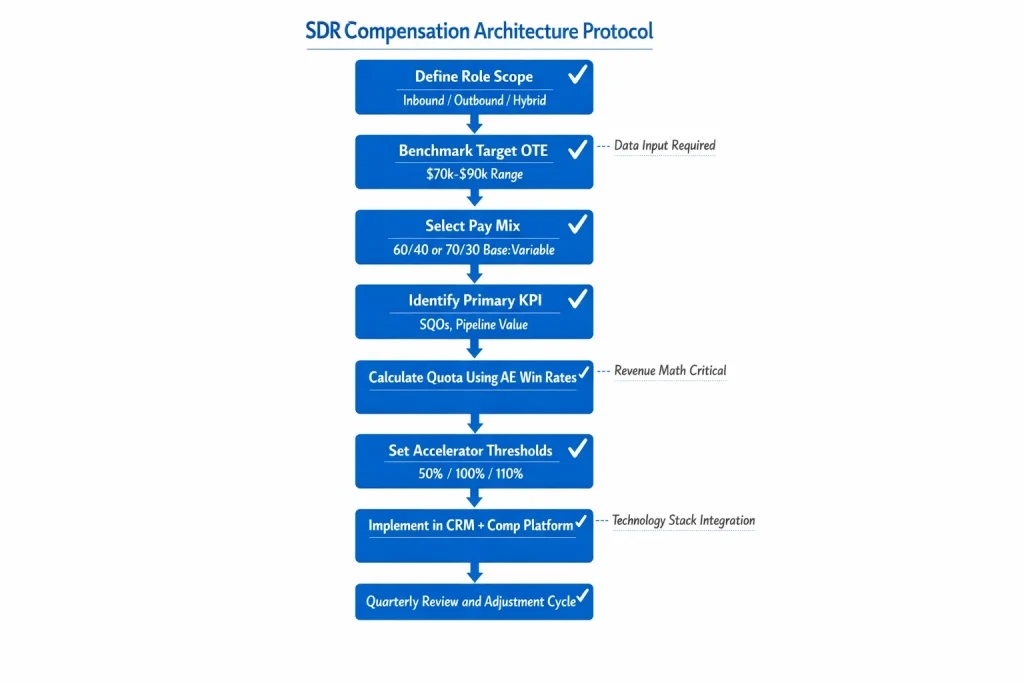
Revenue Operations teams architect SDR quotas by reverse-engineering from Account Executive revenue targets rather than arbitrary activity assumptions. An AE carrying $600,000 annual quota with $30,000 Average Contract Value requires 20 closed deals annually. Converting at 25% from qualified meeting to close demands 80 qualified meetings per year. Distributing across a 3-to-1 SDR-to-AE ratio means each SDR must generate 26-27 qualified meetings annually, or approximately 2.2 meetings per month. This mathematical framework prevents the common failure mode where SDR quotas get set based on “what feels ambitious” rather than “what revenue math requires”.
On-target earnings design follows the quota calibration. If SDR base salary sits at $60,000 with a 60/40 pay mix, variable compensation totals $40,000 annually. Hitting 100% of monthly meeting quota should generate $3,333 in variable pay monthly. Missing quota triggers decelerators, with many plans paying zero variable below 50% attainment, standard rates from 50-100% achievement, and accelerators above 110-120% performance. Top-performing SDRs in well-designed plans regularly earn $100,000 to $130,000+ total compensation through sustained above-quota execution and accelerator multipliers.
The real compensation lever in 2026 is quota accuracy and metric selection, not base-versus-variable ratio manipulation. Poorly calibrated quotas destroy plan credibility faster than any pay mix imbalance.
Companies transitioning from legacy “pay per meeting” models to pipeline-aligned structures should implement changes during annual planning cycles, not mid-year. Retroactive compensation structure changes erode trust and create retention risk among high performers who built their earning expectations around existing frameworks. Organizations communicate new quota math by sharing the AE-to-SDR conversion logic, historical win rate data, and transparent calculations showing how meeting production translates to variable earnings. This disclosure transforms compensation from “black box” to partnership architecture.
Pay Mix Strategy Across Sales Development Functions
60/40 base-to-variable splits represent the industry standard for generalized SDR roles in B2B technology and SaaS markets. This ratio reflects SDR indirect influence on revenue outcomes compared to Account Executives carrying direct booking responsibility. Research from 2018 showed SDR pay mix transitioning from 55/45 to 60/40, with 2025-2026 data confirming this stabilization held across multiple compensation cycles. Organizations should adjust the base-variable ratio based on three factors: role distance from revenue realization, market segment predictability, and talent acquisition competitiveness in their specific geography.
Inbound Versus Outbound Compensation Architecture
Inbound SDRs processing marketing-qualified leads from demand generation campaigns operate with more predictable meeting volume and higher qualification rates than outbound representatives conducting cold prospecting. This predictability supports slightly higher base ratios, typically 65/35 or 70/30, acknowledging reduced performance variance and lower individual control over lead quality inputs. Inbound representatives still earn meaningful variable compensation, but the structure recognizes their primary value lies in qualification excellence and rapid response rather than net-new pipeline creation.
Outbound SDRs executing cold email sequences, LinkedIn prospecting, and phone-based outreach face higher rejection rates and greater performance variance. These roles justify more aggressive variable compensation, often maintaining 55/45 or 60/40 splits with larger absolute variable dollars at stake. Companies building appointment setter frameworks should calibrate outbound SDR compensation higher than inbound equivalents when comparing total OTE, reflecting increased difficulty and skill requirements in net-new pipeline generation.
Hybrid SDR models where representatives split time between inbound qualification and outbound prospecting create compensation design complexity. Best practice establishes separate quota tracks for inbound and outbound contributions, with 50-60% of variable tied to outbound-sourced meetings and 40-50% to inbound qualification metrics. This dual-track approach prevents representatives from cherry-picking easy inbound leads while neglecting harder outbound prospecting responsibilities. Some organizations simplify hybrid roles by converting them to pure outbound positions and routing all inbound leads through dedicated Business Development Representatives or junior AE tiers.
Enterprise Account Development Specialists
Large enterprise deals with $100,000+ Average Contract Values require specialized Account Development Representatives operating with different compensation structures than standard SDRs. ADRs typically earn $75,000 to $95,000 base salaries with $110,000 to $150,000 total OTE when fully ramped. Variable pay in ADR roles often includes both meeting-based and closed-deal components, with 5-10% of deal value paid when opportunities close in addition to standard SQO-based compensation.
Enterprise sales cycles spanning 6-12 months create timing mismatches between ADR contribution and revenue realization. Organizations address this gap through quarterly or semi-annual bonuses tied to pipeline value rather than requiring ADRs to wait for deal closure before receiving recognition. A representative generating $2 million in qualified enterprise pipeline during Q2 might receive a $5,000 to $10,000 pipeline creation bonus in Q3, independent of whether those opportunities close within the current fiscal year. This structure maintains ADR motivation through long sales cycles while acknowledging their direct contribution to pipeline building even when ultimate revenue conversion sits outside their control.
Market Benchmark Data and Competitive Positioning
2026 sales salary research places median SDR base at $60,000 with median OTE at $85,000, representing 5-10% increases over 2024 compensation levels. Top-performing representatives in major markets earn $120,000 to $135,000+ through accelerator attainment and bonus achievement. Organizations positioning below $70,000 OTE for experienced SDRs in competitive B2B technology markets face systematic talent acquisition challenges and higher offer acceptance rejection rates. Budget constraints requiring below-market positioning demand offsetting advantages like exceptional product-market fit, strong company growth trajectory, or meaningful equity compensation.
Geographic Salary Bands and Remote Work Impact
Traditional salary geography premiums compressed significantly between 2023 and 2026 as remote work normalization distributed talent away from major metro concentrations. New York SDRs averaged 25-30% higher compensation than Nashville equivalents in 2019. By 2025, that premium dropped to 10-15% with some data suggesting full convergence in certain segments. Companies now face strategic decisions between geography-based pay bands versus single national ranges.
Geography-based bands allow cost optimization by paying representatives according to their location cost-of-living indices. This approach creates internal equity challenges when remote SDRs in low-cost markets outperform peers in high-cost locations but earn 15-20% less total compensation for superior results. National unified bands eliminate these tensions but increase compensation expenses in lower-cost markets. Most venture-backed B2B companies adopted national bands by 2025, viewing the cost premium as worthwhile for simplified administration and reduced equity tensions.
Implementation Protocols and Technology Integration
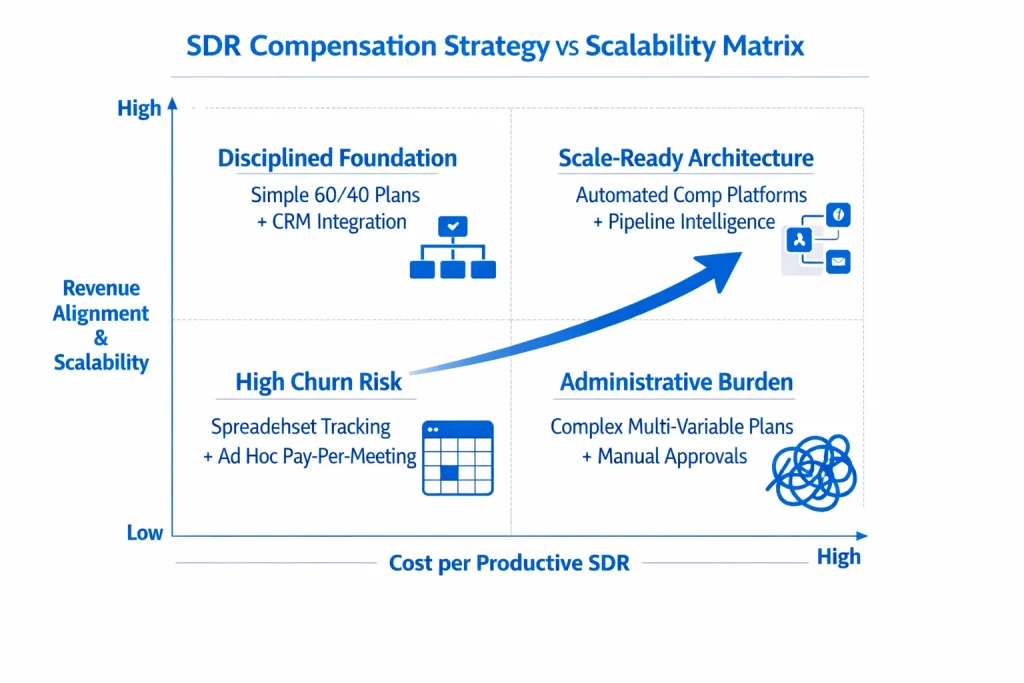
Strategic appointment setter operations require three-component maximum compensation plans to maintain clarity and administrative efficiency. Base salary represents component one. Primary variable tied to meetings, SQOs, or pipeline value constitutes component two. Small team-level or strategic bonus pools create component three. Adding fourth, fifth, or sixth micro-incentives for specific behaviors creates plan complexity that reduces effectiveness and increases administrative burden without proportional performance improvement.
Salesforce, HubSpot, or alternative CRM systems serve as system of record for SDR activity tracking and quota attainment measurement. Modern Revenue Operations teams layer commission automation platforms like CaptivateIQ, QuotaPath, Everstage, or Visdum on top of core CRM infrastructure to calculate variable compensation, generate rep-facing dashboards, and automate payout processing. Early-stage companies operating below $5 million ARR often manage SDR compensation through spreadsheets, transitioning to dedicated platforms when headcount exceeds 8-10 SDRs or when manual calculation errors and disputes consume excessive management time.
Commission Calculation Automation and Dashboard Requirements
Representatives require real-time visibility into quota attainment, variable earnings projection, and performance trending to self-manage their activities and income optimization. Organizations providing this transparency through daily or weekly dashboard updates generate higher engagement and fewer compensation disputes than those relying on monthly or quarterly retrospective reporting. Best-in-class implementations show SDRs their current qualified meeting count, meetings-to-quota gap, projected variable earnings at current run-rate, and accelerator threshold distances within their CRM interface or dedicated compensation portal.
Finance teams run parallel shadow calculations validating CRM-derived compensation figures before processing payouts. This control prevents overpayments from data errors or system misconfigurations. Common failure points include: duplicate opportunity counting, meetings attributed to wrong representatives, quota adjustments not reflected in automated calculations, and terminated employee payouts continuing past departure dates. Monthly reconciliation meetings between Revenue Operations, SDR leadership, and Finance prevent these issues from compounding across quarters.
Commission calculation accuracy above 98% and payout timeliness within 5 business days of month-end represents minimum operational standards for credible compensation administration.
Avoiding Common SDR Compensation Failures
Three structural errors systematically undermine SDR compensation effectiveness: overweighting volume metrics without quality gates, implementing mid-year plan changes without documented business necessity, and setting quotas based on aspirational targets rather than historical conversion data. Organizations making these mistakes experience predictable failure modes including pipeline quality degradation, representative distrust, and quota achievement rates below 40% creating unsustainable cost structures.
Pure volume-driven compensation where SDRs earn meaningful variable pay for any booked meeting regardless of qualification produces meetings with 40-60% no-show rates and minimal downstream conversion. Representatives optimize for quantity by targeting any prospect matching basic firmographic criteria without assessing buying intent, budget authority, or problem urgency. This behavior floods AE calendars with unqualified conversations, creates negative prospect experiences damaging brand reputation, and generates misleading pipeline coverage projections when 60-70% of “opportunities” never advance past discovery calls.
Mid-year compensation changes outside documented business necessity situations like acquisition integration or material product strategy pivots destroy plan credibility and trigger retention risk among high performers. Representatives build their financial planning around expected earnings based on existing quota and payout structures. Retroactive changes that reduce earning potential create perception of broken commitments regardless of executive team rationale. Organizations contemplating mid-year adjustments should model the trade-off between plan optimization benefits and representative trust damage, typically determining that waiting until annual planning cycles preserves more value than immediate implementation.
Quota Setting Based on Historical Data
Fantasy quotas established without reference to historical win rates, conversion funnel velocity, or market segment penetration rates create systematic under-attainment. When only 35-45% of representatives hit quota in mature teams, the compensation plan becomes a cost liability rather than performance motivator. Companies should calibrate SDR quotas so 60-70% of representatives achieve 90-110% of target when executing at expected performance levels. This distribution suggests realistic target-setting that challenges strong performance without requiring outlier execution for basic incentive achievement.
Historical data requirements include: meetings-to-qualified-opportunity conversion rates by source channel, qualified-opportunity-to-closed-deal rates by deal size and industry vertical, average deal cycle length, and seasonal volume patterns. Understanding the full cost and benefit structure of SDR investment requires this data foundation before finalizing quota assumptions. Organizations lacking sufficient history should set conservative initial quotas with documented 90-day review periods, explicitly communicating to representatives that adjustments will follow once sufficient performance data accumulates.
Compensation Plan Review and Iteration Cadence
Annual compensation plan reviews represent best practice timing for structural changes, with light quarterly adjustments permitted for quota recalibration based on market conditions or product mix evolution. Organizations changing base-variable ratios, primary KPI definitions, or payout threshold logic should restrict those modifications to annual planning cycles aligned with fiscal year boundaries or calendar year transitions. Quarterly reviews focus on quota level adjustments, accelerator threshold tuning, and SPIFF or bonus pool sizing rather than fundamental plan architecture changes.
Revenue Operations leaders run quarterly compensation plan effectiveness analyses examining five core metrics: quota attainment distribution across the SDR team, variable pay as percentage of total earnings, correlation between SDR-sourced pipeline and closed revenue outcomes, cost per qualified meeting, and representative satisfaction survey scores. Attainment distributions showing 60-70% of reps between 85-115% quota achievement indicate well-calibrated plans. Distributions with 40% of reps below 70% quota or 30% above 130% quota suggest systematic calibration errors requiring adjustment.
Variable pay should represent 28-42% of actual total earnings when teams average 90-110% quota achievement. Ratios significantly below this range indicate quotas set too aggressively or insufficient variable opportunity in the plan structure. Ratios exceeding 45-50% suggest quotas too conservative, potentially overpaying for standard performance. Organizations target variable earnings in the 30-40% realized range, knowing this translates to roughly 40% of OTE at 100% quota attainment due to baseline under-performers and over-achievers.
Performance Data Analysis and Compensation Correlation
Revenue Operations teams execute monthly deep-dive analyses correlating SDR compensation structures with downstream revenue outcomes. Three critical metrics warrant systematic tracking: SDR-sourced pipeline conversion rates to closed-won deals, average deal size from SDR-originated opportunities versus other sources, and sales cycle length comparison between SDR-qualified and marketing-qualified leads. Companies discover that SDRs compensated primarily for qualified opportunities rather than raw meetings generate 18-25% higher conversion rates and 12-16% larger average deal sizes compared to volume-compensated peers.
Cost per qualified meeting represents the most actionable unit economics metric for SDR compensation evaluation. Calculate total SDR compensation expense including base, variable, bonuses, and benefits, then divide by total qualified meetings generated. B2B technology companies typically target $200 to $400 cost per qualified meeting depending on Average Contract Value and sales cycle complexity. Organizations exceeding $500 per meeting while maintaining below-market win rates face structural efficiency problems requiring either compensation redesign or sales process optimization. Those achieving sub-$250 costs with above-average conversion rates have discovered optimal compensation-performance alignment.
Quarterly business reviews should examine compensation plan impact on three behavioral outcomes: pipeline quality measured through opportunity-to-close conversion rates, calendar efficiency measured through meeting show rates and qualification accuracy, and representative retention measured through voluntary turnover and performance improvement trajectories. Plans driving 75%+ meeting show rates, 65%+ first-meeting-to-qualified-opportunity conversion, and sub-20% annual voluntary turnover demonstrate effective design. Those producing 55% show rates, 40% qualification conversion, and 35%+ turnover require immediate structural intervention regardless of absolute quota attainment numbers.
Advanced Compensation Modeling Frameworks
Sophisticated Revenue Operations teams model SDR compensation structures using scenario analysis before implementation. Three primary scenarios warrant detailed projection: baseline case assuming 90-100% average quota attainment across the team, optimistic case modeling 110-120% attainment with strong market conditions, and pessimistic case projecting 70-80% attainment during market contractions or product challenges. Each scenario generates different cost structures, representative earnings distributions, and pipeline coverage implications requiring executive team review before finalization.
Monte Carlo Simulation for Quota Setting
Statistical modeling approaches borrowed from financial planning create more accurate SDR quota calibration than single-point estimates. Revenue Operations leaders input historical meeting generation rates, conversion rate distributions, and seasonal variance patterns into Monte Carlo simulations running 1,000 to 10,000 iterations. These simulations output probability distributions showing likelihood of various quota achievement outcomes. A well-calibrated quota should show 60-70% probability of 90-110% attainment, 15-20% probability of 110-130% over-achievement, and 10-15% probability of 70-90% under-performance.
Organizations lacking statistical modeling capabilities can approximate this approach through simplified sensitivity analysis. Create spreadsheet models varying three key assumptions: meetings generated per SDR monthly, qualification conversion rates, and downstream win rates. Test quota achievability across nine scenarios combining high-medium-low values for each variable. Quotas remaining achievable in 6-7 of the 9 scenarios demonstrate appropriate resilience to normal business variance. Those achievable in only 2-3 scenarios create excessive risk of systematic under-attainment.
Compensation models should withstand 15-20% variance in conversion assumptions without creating plan failure. Brittle models optimized for single-point forecasts systematically under-perform in real market conditions.
Multi-Year Compensation Strategy and Career Pathing
Forward-thinking organizations design SDR compensation as entry point in broader sales career architecture rather than isolated role. Clear progression paths from SDR to Account Executive roles with defined promotion criteria and compensation steps reduce turnover and improve representative investment in skill development. Companies articulate that SDRs demonstrating 12-18 months of 100%+ quota attainment, strong pipeline quality metrics, and territory management capability advance to junior AE positions with $80,000 to $95,000 base and $140,000 to $180,000 OTE.
This career pathing transparency transforms SDR compensation from “maximum earnings in current role” to “stepping stone toward higher-earning positions”. Representatives accept somewhat lower SDR on-target earnings when they see credible 18-24 month paths to AE roles offering 50-80% total compensation increases. Organizations without clear promotion frameworks lose top SDR performers to external opportunities offering immediate AE titles and compensation, even when internal promotion would occur within reasonable timeframes.
Strategic Bonus Structures and SPIFF Design
Quarterly and annual bonus programs layer on top of core SDR compensation providing additional performance incentives and retention mechanisms. Well-designed bonus structures represent 5-15% of total compensation, meaning $4,000 to $12,000 annually for SDRs earning $70,000 to $90,000 OTE. Bonus criteria should emphasize controllable outcomes like pipeline quality, team collaboration, and strategic initiative participation rather than purely individual quota over-achievement already captured in base variable compensation.
Team-Based Pipeline Creation Incentives
Individual SDR compensation naturally creates internal competition for leads, territories, and manager attention. Team-based bonuses counterbalance these dynamics by rewarding collaborative pipeline development. Revenue Operations teams establish monthly or quarterly team pipeline creation targets, typically 110-120% of the sum of individual quotas to create meaningful stretch goals. Teams exceeding these thresholds split bonus pools of $500 to $2,000 per representative depending on over-achievement magnitude.
Team structures work particularly effectively in pod-based SDR organizations where 3-5 representatives collaborate on shared account lists or territory coverage. Pod members naturally develop collaborative practices including lead sharing, prospect research coordination, and peer coaching when collective incentives align their interests. Organizations should balance team and individual incentives at approximately 80-85% individual focus and 15-20% team focus to maintain personal accountability while encouraging collaboration.
Strategic account development bonuses reward SDRs for penetrating named target accounts or industries designated as strategic priorities. Sales leadership identifies 50-100 target accounts representing high-value expansion opportunities or competitive displacement targets. SDRs generating qualified meetings with these strategic accounts earn $250 to $500 per meeting compared to $75 to $150 for standard accounts. This differential focuses SDR attention on high-value targets without completely abandoning territory coverage of other prospects.
Retention Bonuses and Ramp Protection
90-day and 180-day retention bonuses help stabilize SDR teams during critical onboarding and ramp periods. New SDRs receive $2,000 to $4,000 bonuses paid at 90-day and 180-day tenure milestones, conditional on maintaining active employment and achieving minimum performance thresholds. These bonuses offset the reality that new SDRs operating below full quota attainment during months 1-4 earn significantly less than expected annual compensation, creating early-tenure financial stress.
Ramp protection plans guarantee minimum earnings during initial onboarding periods regardless of actual performance. Organizations commit that SDRs will earn at least 80-90% of on-target earnings during months 1-3 even if quota attainment sits at 40-60% of expected levels. This guarantee removes financial anxiety from the learning process, allowing new representatives to focus on skill development rather than immediate revenue production. Ramp protection should phase out by month 4-5, with full variable compensation exposure beginning month 6.
Technology Stack Integration for Compensation Management
Modern SDR compensation administration requires integration across CRM platforms, sales engagement tools, commission calculation software, and financial systems. Salesforce remains the dominant system of record for B2B technology companies, with HubSpot capturing mid-market and growth-stage organizations. These CRM platforms track core SDR activities including meetings booked, opportunities created, and pipeline value influenced. Revenue Operations teams configure custom objects and fields capturing compensation-relevant data points like meeting qualification status, opportunity source attribution, and quota period assignment.
Commission Platform Selection Criteria
Organizations scaling beyond 15-20 SDRs typically implement dedicated commission management platforms rather than maintaining compensation calculations in spreadsheets. CaptivateIQ, QuotaPath, Everstage, and Visdum represent the leading platforms in this category as of 2025-2026. Platform selection should evaluate five core capabilities: CRM integration depth and data sync reliability, plan configuration flexibility supporting various compensation structures, representative-facing dashboard quality and real-time visibility, audit trail completeness for compliance and dispute resolution, and workflow automation for approval chains and payout processing.
CaptivateIQ positions as the enterprise-grade solution handling complex multi-component plans across large sales organizations. QuotaPath targets mid-market companies prioritizing ease of use and fast implementation over maximum configurability. Everstage focuses on built-in analytics and compensation optimization recommendations. Visdum emphasizes visual plan modeling and what-if scenario analysis. Companies should pilot 2-3 platforms with actual historical data before selecting, as marketing materials significantly overstate practical capabilities and implementation complexity varies dramatically.
Integration requirements extend beyond CRM connectivity. Commission platforms need real-time or near-real-time data feeds capturing meeting dispositions, opportunity stage progressions, and deal closures. Stale data creates representative frustration when dashboards show outdated performance metrics and earnings projections. Best-in-class implementations achieve sub-15-minute data latency between CRM activity updates and commission dashboard refreshes. Organizations tolerating 24-48 hour delays face systematic representative disengagement from compensation visibility tools.
Financial System Coordination and Payroll Processing
Commission calculations must integrate with corporate financial systems and payroll processing platforms. Finance teams require detailed compensation accrual reporting for monthly and quarterly close processes. Payroll systems need commission payment amounts, withholding calculations, and employee assignment data transferred through automated interfaces or structured file formats. Manual rekeying of commission payments into payroll systems creates error rates of 3-5% and processing delays extending 7-10 business days beyond month-end.
Organizations implement approval workflows requiring sales management and finance signoff before commission payments process. SDR managers review quota attainment calculations and performance metrics ensuring accuracy. Finance reviews accrual impacts and budget variance before authorizing payment processing. This dual approval creates control separation preventing payment errors while maintaining reasonable processing velocity. Best practice targets commission approval and payment within 5-7 business days of month-end, balancing control requirements against representative expectation for timely payment.
Technology platforms do not solve compensation design problems. They accelerate administration and improve visibility for well-designed plans while exposing flaws in poorly-designed structures more quickly.
Legal and Compliance Considerations
SDR compensation structures must comply with wage and hour regulations, commissioned employee classification rules, and state-specific labor laws. Companies operating across multiple US states face complex compliance requirements as labor regulations vary significantly between jurisdictions. California maintains some of the strictest commissioned employee protections including advance written plan requirements, minimum earnings guarantees, and specific calculation disclosure obligations. New York, Massachusetts, and Washington impose different but equally detailed requirements. Organizations must ensure compensation plans meet the most restrictive applicable jurisdiction when managing distributed SDR teams.
Exempt Versus Non-Exempt Classification
Sales Development Representatives present classification challenges under Fair Labor Standards Act regulations. Pure inside sales roles performing outbound prospecting and meeting generation typically qualify for commissioned employee exemptions from overtime requirements. Hybrid roles combining SDR activities with customer service, account management, or administrative responsibilities may trigger non-exempt classification requiring overtime payment for hours exceeding 40 per week. Misclassification creates significant liability exposure including back overtime payments, penalties, and class action lawsuit risk.
Organizations should conduct formal classification analyses with employment counsel when designing SDR roles and compensation structures. The analysis examines primary job duties, compensation structure, and sales commission characteristics against Department of Labor criteria. Positions qualifying for exemption must meet three tests: salary basis payment for at least partial compensation, salary level exceeding minimum thresholds, and duties primarily involving sales activity. Companies failing any test must treat SDRs as non-exempt employees subject to overtime regulations regardless of title or compensation amount.
Advance written plan documentation represents best practice and legal requirement in many jurisdictions. Organizations provide new SDRs with detailed compensation plan documents during offer acceptance outlining base salary, variable compensation calculation methodology, quota expectations, payout timing, and plan modification provisions. These documents create contractual obligations limiting employer flexibility to modify plans retroactively. Revenue Operations teams should develop standardized plan templates reviewed by legal counsel rather than creating custom agreements for individual representatives.
Compensation Communication and Change Management
Introducing new SDR compensation structures or modifying existing plans requires structured communication protocols and change management discipline. Revenue Operations leaders should announce compensation changes 60-90 days before implementation, providing representatives time to understand new structures and ask questions. Communication should include written plan summaries, live presentation sessions, individual quota and earnings modeling, and open office hours for one-on-one discussions.
Representative Education and Modeling Tools
SDRs need clear visibility into how their activities translate to earnings under new compensation structures. Organizations provide Excel-based or web-based modeling tools allowing representatives to input projected meeting generation rates and see corresponding variable compensation and total earnings. These tools reduce anxiety about plan changes by giving representatives control over earnings projections and scenario analysis. Best implementations show side-by-side comparisons of earnings under current versus new plans across various performance levels.
Manager training represents critical change management component often overlooked in compensation transitions. SDR managers must thoroughly understand new plan mechanics, quota calculations, and common representative questions before broader rollout. Revenue Operations teams should conduct manager-specific training sessions 2-3 weeks before general representative communication, equipping managers to answer questions and address concerns during their team meetings. Managers unprepared to explain compensation changes damage credibility and increase resistance to plan modifications.
Feedback collection during transition periods helps identify implementation issues and communication gaps. Organizations should schedule 30-day and 60-day post-launch feedback sessions gathering representative input on plan clarity, system functionality, and any calculation concerns. Revenue Operations teams address common questions through FAQ documentation and plan refinement addressing legitimate design issues discovered during initial months. This iterative approach demonstrates responsiveness to representative concerns while maintaining plan integrity and business objectives.
Compensation Plan Review and Iteration Cadence
Annual compensation plan reviews represent best practice timing for structural changes, with light quarterly adjustments permitted for quota recalibration based on market conditions or product mix evolution. Organizations changing base-variable ratios, primary KPI definitions, or payout threshold logic should restrict those modifications to annual planning cycles aligned with fiscal year boundaries or calendar year transitions. Quarterly reviews focus on quota level adjustments, accelerator threshold tuning, and SPIFF or bonus pool sizing rather than fundamental plan architecture changes.
Revenue Operations leaders run quarterly compensation plan effectiveness analyses examining five core metrics: quota attainment distribution across the SDR team, variable pay as percentage of total earnings, correlation between SDR-sourced pipeline and closed revenue outcomes, cost per qualified meeting, and representative satisfaction survey scores. Attainment distributions showing 60-70% of reps between 85-115% quota achievement indicate well-calibrated plans. Distributions with 40% of reps below 70% quota or 30% above 130% quota suggest systematic calibration errors requiring adjustment.
Variable pay should represent 28-42% of actual total earnings when teams average 90-110% quota achievement. Ratios significantly below this range indicate quotas set too aggressively or insufficient variable opportunity in the plan structure. Ratios exceeding 45-50% suggest quotas too conservative, potentially overpaying for standard performance. Organizations target variable earnings in the 30-40% realized range, knowing this translates to roughly 40% of OTE at 100% quota attainment due to baseline under-performers and over-achievers.
FAQ
Q1: What is a fair SDR commission structure in 2026?
A fair SDR commission structure in 2026 uses 60/40 or 70/30 base-to-variable pay mix with on-target earnings between $70,000 and $90,000 in technology markets. Variable compensation should tie primarily to qualified meetings, sales-qualified opportunities, and pipeline value rather than raw meeting volume.
Q2: How much should appointment setters earn per meeting in 2026?
Appointment setters typically earn $50 to $150 per qualified meeting depending on Average Contract Value and market segment. Per-meeting rates should be back-calculated from expected pipeline value and close rates to prevent overpaying for low-quality appointments.
Q3: Is it better to pay SDRs per meeting or per deal?
Paying SDRs purely per meeting drives quantity over quality, producing high no-show rates and weak pipeline. The strongest 2026 plans blend per-meeting or SQO incentives with team-level revenue or pipeline bonuses while reserving direct deal commissions for Account Executives.
Q4: What is a typical SDR base salary in 2026?
Recent salary guides show SDR base salaries around $55,000 to $60,000 in most US technology markets, with higher ranges in expensive hubs. Entry-level roles may start closer to $50,000 to $55,000 and rise with 12-24 months of demonstrated performance.
Q5: What should SDR on-target earnings be in 2026?
Median SDR on-target earnings in 2026 sits at $80,000 to $90,000, with some markets reporting $70,000 to $95,000 bands. Top-performing SDRs exceed $120,000+ when accelerators and bonuses are included in compensation.
Q6: What is the ideal pay mix for SDRs versus AEs?
SDRs commonly operate at 60/40 base-to-variable mix reflecting their indirect revenue influence. Account Executives in SaaS are more often at 50/50 with heavier accelerators tied to closed ARR and multi-year contract attainment.
Q7: How do you calculate SDR commission for qualified meetings?
Start from AE win rates and Average Contract Value, calculate expected revenue per qualified meeting, then assign SDRs a small percentage of that value as commission. Many teams design structures where hitting meeting quota equals 30-40% of base salary in variable pay.
Q8: How many SDRs hit quota in modern sales teams?
Recent salary and performance data suggests only 55-60% of SDRs hit quota in typical teams. This reality underscores the need for realistic quotas and transparent compensation plans rather than assuming 100% attainment across all representatives.
Q9: Are SDR accelerators still relevant in 2026?
Accelerators remain critical for top performers, especially when SDRs materially influence pipeline and strategic accounts. Simple models pay higher rates above 110-120% of quota while using decelerators or thresholds below 50-70% attainment.
Q10: How should SDR compensation differ between inbound and outbound roles?
Outbound SDRs often carry higher quotas and more variable-heavy plans reflecting the difficulty of cold prospecting and pipeline creation. Inbound SDRs may have more predictable volume and slightly higher base or lower variable proportion as they mainly qualify existing interest.
Q11: What is a good quota-to-OTE ratio for sales roles?
SaaS finance benchmarks recommend quota-to-OTE ratios around 5x for Account Executives, meaning an AE with $120,000 OTE should own roughly $600,000 in annual quota. SDR quotas should be back-calculated from that AE quota using known conversion rates.
Q12: How do you keep SDR compensation plans simple but effective?
Leading compensation frameworks suggest using no more than 2-3 components per plan: base salary, core variable on a single primary KPI, and a small bonus pool. Complexity should live in quota design and revenue modeling, not in dozens of micro bonuses.
Q13: Should SDRs get commission on closed deals in 2026?
Most companies reserve deal-level commissions for Account Executives, but some offer SDRs small bonuses per deal sourced to maintain investment in pipeline quality. This is usually additive to their core meeting-based variable, not the main driver of earnings.
Q14: How do remote and hybrid work affect SDR pay in 2026?
As hiring spreads away from traditional hubs, salary differences by geography are narrowing, but cost-of-living and talent density still affect pay bands. Many companies now use national bands with location-based adjustments instead of purely headquarters-based compensation.
Q15: What are common mistakes in SDR commission plans?
Frequent mistakes include overweighting volume metrics, changing plans mid-year, and ignoring historical conversion data when setting quotas. These errors erode trust and make incentive spend feel like a cost rather than an investment in performance.
Q16: How often should SDR compensation plans be reviewed?
Best practice is to review annually and lightly adjust quarterly if performance or market conditions change significantly. Experts strongly warn against mid-year plan overhauls which damage credibility with the sales team.
Q17: What benchmarks can founders use for SDR comp in early-stage startups?
Founders can benchmark against $55,000 to $65,000 base and $75,000 to $85,000 OTE for US-based SDRs in B2B technology as of 2025-2026. They should adjust up or down based on Average Contract Value, funding stage, and geography.
Q18: How do SDR compensation trends differ between enterprise and SMB sales motions?
Enterprise motions usually justify higher SDR pay because each meeting can represent much larger potential ARR and SDRs may require specialization. SMB motions often rely on higher volume with lower Average Contract Value, making per-meeting payouts smaller and more activity-driven.
Q19: Are usage-based revenue models changing SDR compensation?
Usage-based pricing has mostly impacted Account Executive and account management plans tying commissions to consumption and net revenue retention. For SDRs, the main shift is more emphasis on targeting the right Ideal Customer Profile so downstream usage and expansion justify upfront acquisition cost.
Q20: How can HR evaluate whether an SDR commission plan is fair?
HR can cross-check market salary data, ensure pay mix and OTE align with industry benchmarks, and test whether average performers can realistically reach 90-110% of quota. They should verify the plan is simple to explain, consistent year-over-year, and aligned with company profitability and Customer Acquisition Cost goals.

Pranav Ganeriwal is a Growth Manager at GrowLeads, helping businesses scale predictable revenue through data-driven systems, automation, and high-performing outbound strategies. He specializes in decoding buyer behavior, optimizing conversions, and building growth processes that deliver clear, measurable results.