Is Cold Email Legal 2026? GDPR & CAN-SPAM Rules (Compliance Decoded)
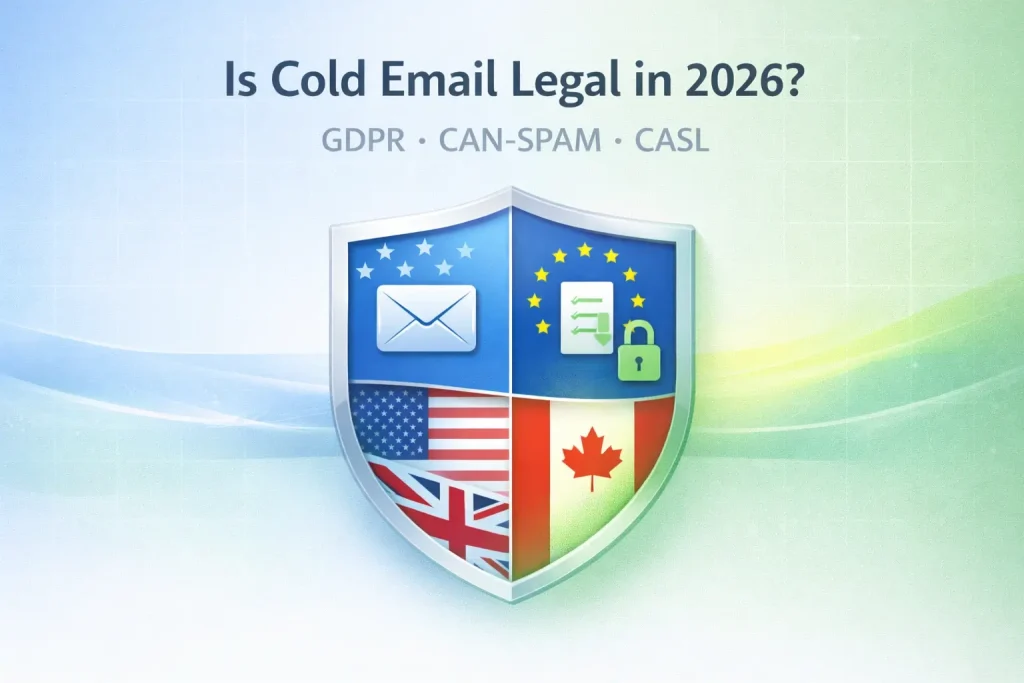
95% of cold emails generate zero reply. The reason isn’t just poor copywriting. Most enterprises operate in regulatory gray zones without documented compliance frameworks, exposing themselves to penalties reaching $53,088 per email under CAN-SPAM or €20 million under GDPR.
Cold email remains legally defensible across the US, EU, UK, and Canada when executed within strict regulatory parameters. The challenge isn’t legality. The challenge is proving defensibility during audits when your data sourcing lacks documentation, your legitimate interest assessments are absent, and your opt-out mechanisms fail compliance standards.
Enterprise legal teams face regulatory divergence across jurisdictions. France mandates explicit B2C consent starting August 2026. Germany already requires it. The UK treats B2B and B2C identically under PECR Regulation 22. Revenue operations can’t afford generic compliance advice. They need jurisdiction-specific protocols backed by documented frameworks.
The Global Cold Email Regulatory Framework for 2026
CAN-SPAM Act: US Federal Requirements
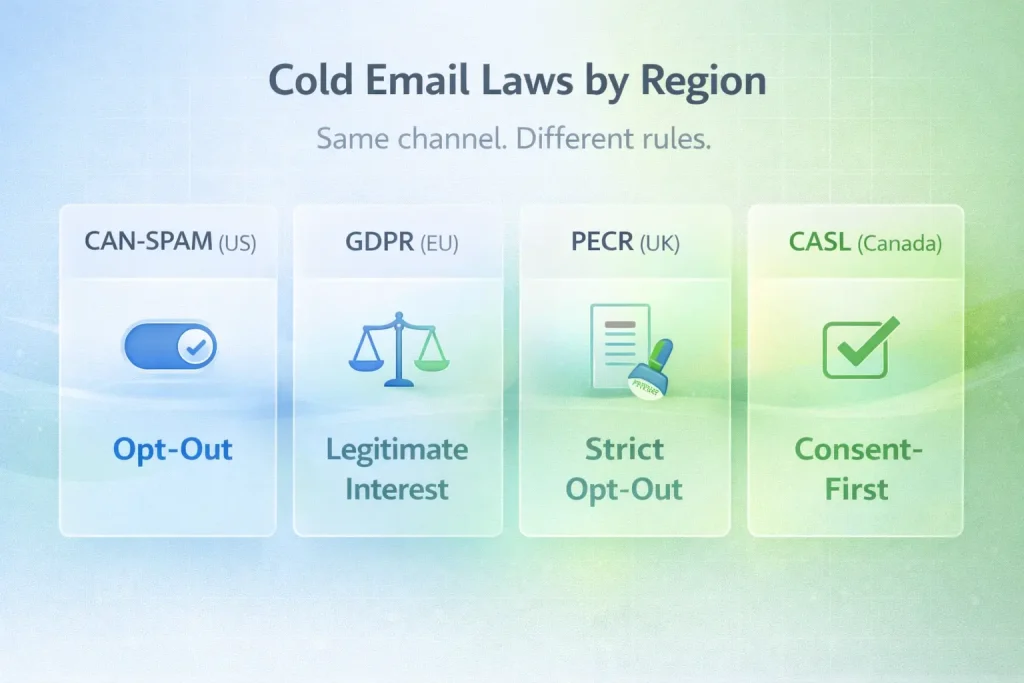
Cold email remains legal in the United States under CAN-SPAM (15 USC 7704) without prior consent. The law imposes transparency requirements rather than consent barriers. Violations trigger penalties of $51,744 to $53,088 per non-compliant message.
Mandatory compliance elements include:
- Accurate sender information (no spoofed headers or misleading “From” names)
- Truthful subject lines (deceptive subjects trigger immediate violations)
- Clear identification as commercial communication
- Physical mailing address (P.O. Box acceptable)
- Working opt-out mechanism honored within 30 calendar days
CAN-SPAM operates on an “opt-out” model. Recipients don’t require advance permission to receive cold email. They must receive a functioning unsubscribe link and truthful communication. The Federal Trade Commission enforces aggressively against deceptive headers and non-functional opt-out mechanisms.
How GDPR Enables B2B Cold Email Without Consent
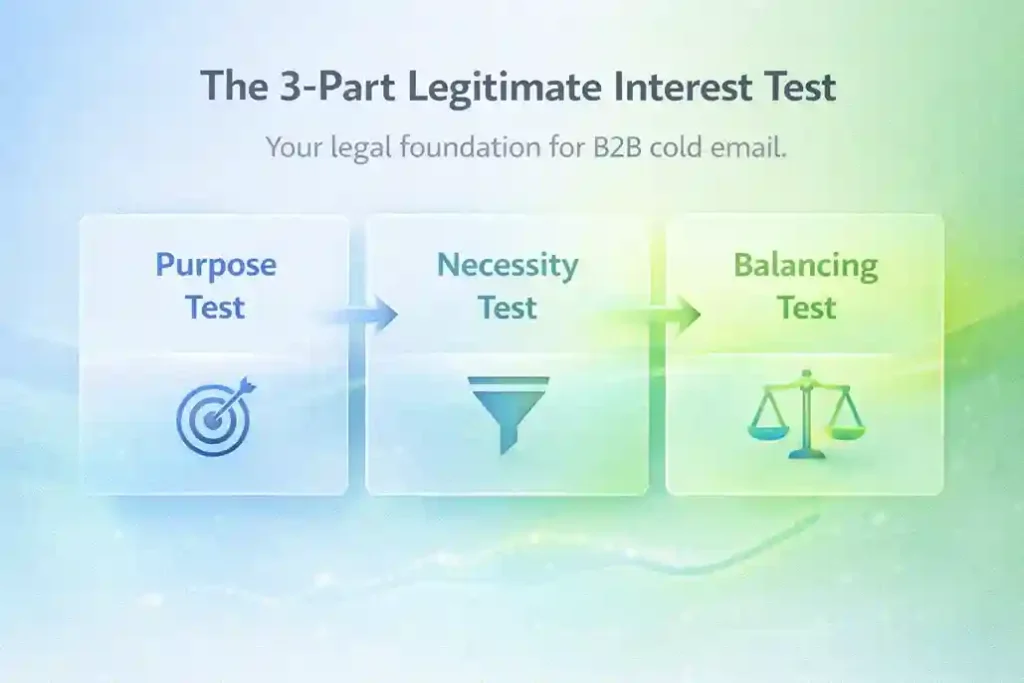
GDPR Article 6(1)(f) establishes “legitimate interest” as a lawful basis for processing personal data. This provision allows B2B cold email without explicit consent if three conditions are satisfied: demonstrable business purpose, necessity of data processing, and balanced privacy impact.
The legitimate interest assessment (LIA) framework requires formal documentation:
Purpose Test: Define your commercial objective (new client acquisition, partnership development, product demo scheduling).
Necessity Test: Confirm email contact is essential to achieving the stated purpose. Could you reach prospects through alternative means with less privacy impact?
Balancing Test: Evaluate whether your business interest outweighs the recipient’s privacy expectations. B2B contacts expecting professional outreach typically pass this test.
70% of GDPR enforcement actions cite improper email sourcing. The issue isn’t sending cold email. The issue is lacking documented justification when data protection authorities conduct audits. Enterprises using Growleads’ verified, GDPR-compliant lead lists maintain origin documentation proving lawful data acquisition.
Key Compliance Reality: GDPR doesn’t ban cold email. GDPR penalizes undocumented data processing and opaque sourcing practices.
PECR and UK-Specific Email Marketing Rules
The UK operates under both GDPR and PECR (Privacy & Electronic Communications Regulations). PECR Regulation 22 governs electronic marketing communications.
Unlike most EU jurisdictions, the UK makes no regulatory distinction between B2B and B2C cold email. Both require either consent or legitimate interest. However, the Information Commissioner’s Office (ICO) acknowledges B2B contacts reasonably expect professional outreach related to their roles.
The “soft opt-in” exception allows marketing to existing customers for similar products if they received an opt-out opportunity at initial data collection. This rarely applies to true cold outreach.
UK enforcement focuses on three failure points:
- No working opt-out mechanism within emails
- Continued contact after opt-out requests
- Misleading sender identification
Process opt-out requests immediately. Best practice targets 24-48 hours rather than the 30-day CAN-SPAM window.
CASL: Canada’s Consent-First Email Law
Canada’s Anti-Spam Legislation (CASL) operates differently from CAN-SPAM. CASL requires either express or implied consent before commercial electronic messages.
Express consent demands documented, explicit opt-in. Think checked boxes and confirmed subscriptions.
Implied consent applies when:
- An existing business relationship exists within the past 24 months
- The recipient conspicuously published their email address without access restrictions
- The message relates directly to their business role, function, or duties
CASL’s business-to-business exemption allows cold email to work addresses when the content aligns with the recipient’s professional responsibilities. The exemption doesn’t extend to personal email addresses used for business purposes.
Unsubscribe requests must be honored within 10 business days under CASL Section 6. Maintain opt-out records for minimum 3 years. High-risk industries benefit from 5+ year retention to demonstrate compliance during regulatory investigations.
Critical Compliance Elements Every Cold Email Campaign Requires
Accurate Sender Identification and Physical Address Disclosure
Sender identification means your “From” name and email address accurately represent your organization. Domain spoofing, generic Gmail addresses posing as enterprise entities, and misleading display names all constitute CAN-SPAM violations.
Include your registered business physical address in every email footer. P.O. boxes satisfy the requirement. The address must remain current. Relocated enterprises updating CRM templates reactively rather than proactively risk violations across active campaigns.
Revenue operations teams using HubSpot Sales Hub, Salesforce Marketing Cloud, or ActiveCampaign should configure default footer templates enforcing:
- Company legal name
- Current mailing address
- Direct contact email (not no-reply addresses)
- Clear unsubscribe mechanism
No-reply sender addresses signal opacity to recipients and regulators. They suggest you don’t want responses, undermining legitimate interest claims that professional dialogue serves both parties.
Truthful Subject Lines: The Non-Negotiable Standard
Subject line deception triggers immediate CAN-SPAM violations regardless of email body content. “Re:” prefixes suggesting prior correspondence when none exists fail this test. “Urgent: Invoice Past Due” subject lines in prospecting emails violate truthfulness requirements.
Open rates average 27.7% to 31.32% in compliant B2B cold email. Top performers achieve 40-50% with AI-driven personalization. Neither metric justifies deceptive subject strategies.
Optimal subject lines for compliance and performance:
- State actual email purpose directly (“New partnership opportunity with [Company]”)
- Reference specific professional contexts (“Saw your LinkedIn post on attribution models”)
- Ask relevant questions aligned with recipient’s role (“How does [Company] handle multi-touch attribution?”)
Limit subject lines to under 40 characters for mobile optimization. Avoid clickbait formulas that undermine professional credibility.
Functional Opt-Out Mechanisms That Meet Legal Standards
Every cold email must include a functioning unsubscribe mechanism requiring no more than a single action from the recipient. Multi-step opt-out processes, login requirements, or CAPTCHA challenges violate CAN-SPAM.
Configure automated unsubscribe processing within CRM platforms. Microsoft Dynamics 365, Copper CRM, and Klaviyo support native unsubscribe automation with audit trail logging. Manual processing introduces delays and compliance gaps.
Regulatory opt-out windows:
| Jurisdiction | Maximum Processing Time | Regulation |
|---|---|---|
| United States (CAN-SPAM) | 30 calendar days | 15 USC 7704 |
| Canada (CASL) | 10 business days | CRTC Section 6 |
| European Union (GDPR) | Immediate (24-48 hours best practice) | Articles 17, 21 |
| United Kingdom (PECR) | Immediate (24-48 hours best practice) | Regulation 22 |
Enterprises managing B2B lead generation across multiple jurisdictions should default to the strictest standard (immediate processing) rather than maintaining region-specific protocols.
Retained opt-out lists prevent re-contact violations. Store suppression lists for minimum 5 years. Include timestamped records of opt-out requests, processing dates, and suppression list updates.
How to Document Legitimate Interest for GDPR Compliance
The Three-Part Legitimate Interest Assessment (LIA)
GDPR Article 6(1)(f) requires demonstrable legitimate interest before processing personal data. The UK ICO and EU Data Protection Authorities demand formal LIA documentation during audits.
Purpose Test: Defining Defensible Business Interests
Document specific commercial objectives justifying email outreach. Generic language like “business development” fails audit scrutiny. Defensible purpose statements include:
- “Schedule product demos with IT Directors at 500+ employee SaaS companies to demonstrate ROI impact of [specific solution]”
- “Establish partnerships with Series B+ fintech companies requiring [specific compliance framework]”
- “Recruit C-level executives with 10+ years experience in [industry vertical] for advisory board”
Each purpose statement must connect to your core business operations. Speculative or tangentially-related purposes fail the necessity test.
Necessity Test: Proving Email Is Essential
The necessity test evaluates whether less intrusive methods could achieve your stated purpose. If LinkedIn InMail, advertising campaigns, or gated content could reach the same audience, email processing may fail necessity requirements.
Document why alternatives are inadequate:
- “LinkedIn InMail restricts messaging to 1st-degree connections, limiting reach to 3% of target audience”
- “Paid advertising to this segment requires $15+ CPL vs. $2 CPL for direct outreach”
- “Gated content converts at 2.3% vs. 8.7% for direct conversation initiation”
The necessity test doesn’t require email to be the only method. It requires email to be a reasonable and proportionate method given your business constraints.
Balancing Test: Recipient Privacy vs. Business Interest
The balancing test weighs your business need against recipient privacy expectations. B2B contacts using published work emails to conduct professional activities typically expect relevant commercial outreach.
Factors strengthening your balancing test position:
- Email publicity: Work addresses published on company websites, LinkedIn profiles, or industry directories suggest professional contact expectations
- Role relevance: Outreach aligning directly with recipient’s job function (CFO receiving accounting software pitches) passes easily
- Frequency limits: Initial contact plus 2-3 follow-ups over 14 days demonstrates restraint
- Opt-out accessibility: Single-click unsubscribe mechanisms in every message
Factors undermining your balancing test:
- Personal email addresses acquired through data scraping
- Generic mass messaging showing no role-specific relevance
- Contact frequency exceeding 10+ messages to the same recipient (reduces response rates to 3.8%)
- Absence of clear business connection between your offering and recipient’s responsibilities
Enterprises requiring downloadable LIA compliance templates can access pre-built three-part assessments covering common B2B prospecting scenarios.
LIA Documentation Standards for Audit Defense
Maintain formal LIA documentation for each campaign or prospecting initiative. One comprehensive LIA can cover multiple campaigns targeting similar audiences with consistent messaging.
Minimum documentation requirements:
- Campaign name and unique identifier
- Target audience description (job titles, industries, company sizes)
- Completed three-part LIA (Purpose, Necessity, Balancing)
- Data sourcing methodology and origin documentation
- Opt-out mechanism description and technical implementation
- Review date and approving authority signature
Store LIA documents for minimum 5 years. European DPAs frequently audit organizations 18-36 months after campaign execution.
When data protection authorities request compliance documentation, deliver:
- Formal LIA assessment
- Email list origin records
- Sample email templates with timestamps
- Opt-out request logs
- Suppression list maintenance records
- Technical configuration screenshots (CRM unsubscribe workflows)
A B2B software company launching cold email to 50,000 IT managers across France, UK, and Germany without documented LIAs discovered this gap during a Q3 2025 German DPA audit. Zero LIA documentation plus unverified email sourcing resulted in €500K settlement costs and $150K in emergency compliance consulting.
Regional Compliance Differences Affecting 2026 Cold Email Strategy
France’s August 2026 B2C Consent Mandate
The French Data Protection Authority (CNIL) implemented regulatory changes effective August 2026 requiring explicit opt-in consent for all B2C cold email, phone, and SMS prospecting.
B2B cold email remains permissible under legitimate interest frameworks. The practical challenge involves distinguishing B2B from B2C contacts when individuals use personal email addresses for professional purposes.
Safe harbor practices for France-targeted campaigns:
- Restrict outreach to corporate email domains (@company.com rather than @gmail.com)
- Document role-specific targeting (job titles, LinkedIn verification)
- Maintain explicit consent records for any personal email domains
- Include French-language opt-out mechanisms for France-based recipients
France’s 2026 changes mirror Germany’s existing B2C consent requirements. German law already mandates explicit consent for consumer prospecting while permitting B2B cold email under legitimate interest.
Germany’s Strict B2C Consent Requirements
German regulations under TMG (Telemediengesetz) and UWG (Unfair Competition Act) mandate explicit consent for all B2C email marketing. Cold email to consumers without prior opt-in constitutes an unfair competitive practice.
B2B prospecting remains legal when:
- Recipients use business email addresses
- Content relates directly to professional responsibilities
- Sender provides clear identification and opt-out mechanism
- No deceptive subject lines or headers
German DPAs enforce aggressively against gray-area compliance. A “professional” Gmail address fails clear B2B classification unless backed by documented business relationship or published contact information.
Revenue operations targeting German markets should implement dual-verification protocols:
- Email domain verification (corporate vs. personal)
- LinkedIn role confirmation (active professional profile)
UK Post-Brexit PECR Application
Post-Brexit, the UK maintains GDPR-equivalent data protection standards under the UK GDPR and PECR. The Information Commissioner’s Office enforces both frameworks.
Unlike EU jurisdictions distinguishing B2B from B2C, PECR Regulation 22 applies identical standards to business and consumer contacts. Both require either consent or legitimate interest.
The practical distinction: B2B contacts demonstrating clear professional roles more easily satisfy legitimate interest balancing tests. ICO guidance acknowledges professionals using work email addresses reasonably expect relevant commercial outreach.
UK-specific compliance recommendations:
- Document legitimate interest for all cold email regardless of B2B vs. B2C classification
- Process opt-out requests within 24-48 hours (stricter than CAN-SPAM’s 30 days)
- Avoid soft opt-in exceptions (apply only to existing customers, not cold prospects)
- Maintain detailed records of data sourcing and LIA justifications
Enterprises managing multi-jurisdiction campaigns through international compliance audits benefit from quarterly regulatory update briefings covering France’s 2026 changes, Germany’s enforcement patterns, and UK ICO guidance evolution.
Email List Sourcing: Defensible vs. High-Risk Acquisition Methods
Publicly Available Business Contacts
Email addresses published on company websites, LinkedIn profiles, industry directories, or professional association listings constitute publicly available data. Collecting these addresses generally satisfies GDPR’s lawful processing requirements.
Documentation requirements for scraped public data:
- Record source URL for each email address
- Timestamp of data collection
- Verification that email relates to professional role
- Confirmation no “do not contact” notice appeared on source page
Enterprises using automated scraping tools (Clay, Clearbit, ZoomInfo) should verify providers maintain data origin documentation. 70% of GDPR enforcement actions involve improper sourcing. Inability to demonstrate lawful collection creates liability regardless of compliance in other areas.
Purchased or Third-Party Enriched Lists
Purchasing email lists introduces compliance risk unless vendors provide explicit documentation:
- Consent records: If consent-based collection, vendors must supply dated opt-in documentation
- Legitimate interest justification: For B2B lists, vendors should provide LIA documentation
- Data origin transparency: Full disclosure of collection methodology
- Update frequency: Lists updated minimum every 30 days to reflect job changes and opt-outs
Low-quality list vendors claiming “GDPR compliance” without supporting documentation shift liability to purchasing enterprises. Data protection authorities hold data controllers (your organization) responsible for vendor practices.
Safer alternative: Verified lead databases maintaining documented origin records and regular validation cycles. Growleads’ AI B2B lead generation services include data origin documentation proving lawful acquisition for audit defense.
LinkedIn Data Extraction and ToS Compliance
LinkedIn’s Terms of Service explicitly prohibit automated scraping. Violating ToS doesn’t directly trigger GDPR penalties, but it undermines legitimate interest claims during audits.
Defensible LinkedIn sourcing practices:
- Manual profile review and contact information recording (labor-intensive but ToS-compliant)
- Sales Navigator legitimate use (per LinkedIn’s commercial terms)
- Disclosed sourcing in email copy: “Found your profile on LinkedIn while researching [topic]”
Automated LinkedIn scrapers create dual risks: ToS violations potentially terminating your account and GDPR challenges around undisclosed data collection.
If using LinkedIn data for cold email, transparently disclose the source in your first message. This satisfies GDPR’s transparency principle and strengthens legitimate interest justification.
Email Volume, Frequency, and List Hygiene Standards
Optimal Contact Cadence for Compliance and Performance
Excessive contact frequency undermines legitimate interest claims by suggesting harassment rather than professional outreach. Sending 10+ follow-ups reduces response rates to 3.8%.
Recommended contact sequence:
- Day 0: Initial outreach email
- Day 3: First follow-up (different value angle)
- Day 7: Second follow-up (social proof or case study)
- Day 14: Final follow-up (explicit opt-in question)
Stop sequences immediately upon opt-out request or explicit disinterest. “Not interested” replies must be treated as opt-out requests even without clicking unsubscribe links.
Average response rates hit 5.1-5.8% across properly executed campaigns. Top performers using AI personalization reach 40-50% by analyzing 50+ data points per prospect before contact.
List Refresh Cycles and Data Decay Management
B2B contact data decays rapidly. Job changes, company closures, and email address updates render 20-25% of records invalid annually.
Maintain list hygiene through:
- Hard bounce suppression after single failed delivery
- Soft bounce removal after 3 consecutive failures
- Manual review of ongoing non-responders after 60 days
- Complete list refresh every 30 days minimum
Sending to known-bad addresses wastes resources and signals poor data management practices during audits. CRM platforms including HubSpot, Salesforce, and Mailchimp support automated bounce processing and suppression list management.
Subject Line and Content Length Optimization
Compliance-friendly emails perform best when they respect recipient attention constraints. Optimal length: 6-8 sentences, under 200 words.
Subject line length directly impacts mobile readability. Limit subject lines to 40 characters maximum. Recipients scanning email on mobile devices see truncated subjects beyond this threshold.
High-performing subject line formulas:
- “Quick question about [specific company initiative]” (32 characters)
- “Thoughts on [specific challenge]?” (31 characters)
- “[Mutual connection] suggested I reach out” (42 characters)
Avoid subject lines triggering spam filters: excessive punctuation (!!!), all caps, deceptive urgency (“Final notice”), or financial terms without legitimate context.
Technology Stack Requirements for Compliant Cold Email Operations
CRM Platforms with Native Compliance Features
Enterprise cold email requires CRM infrastructure supporting automated compliance workflows. Manual compliance management introduces human error at scale.
Essential CRM compliance capabilities:
| Feature | Business Value | Supported Platforms |
|---|---|---|
| Automated unsubscribe processing | Eliminates manual opt-out delays | HubSpot, Salesforce, ActiveCampaign, Klaviyo |
| Audit trail logging | Timestamps all contact events for regulatory defense | Microsoft Dynamics 365, Copper CRM, Salesforce |
| Multi-jurisdiction consent tracking | Manages region-specific requirements | Klaviyo, ActiveCampaign, Mailchimp |
| Bounce suppression automation | Prevents sending to invalid addresses | All major platforms |
| Template approval workflows | Enforces compliance review before campaign launch | Salesforce, HubSpot Enterprise |
Copper CRM offers native Gmail compliance logging without plugins, reducing technical complexity for Google Workspace enterprises.
Email Enrichment and Verification Services
Data quality directly determines compliance defensibility. Enrichment platforms validate email accuracy and provide additional context supporting legitimate interest claims.
Enterprise-grade enrichment platforms:
- Clearbit: Real-time email verification, company data enrichment, role identification
- ZoomInfo: B2B contact database with direct dial numbers and verified work emails
- Clay: Waterfall enrichment across 50+ data providers with automated verification
Enrichment services should provide data origin documentation proving lawful collection. Ask vendors:
- How was this email address collected?
- Can you provide consent records or legitimate interest documentation?
- How frequently do you update records?
- What geographic restrictions apply to this data?
Enterprises lacking in-house compliance expertise benefit from platforms offering verified lead databases with pre-documented origin records and regular validation.
Compliance Monitoring and Alert Systems
Automated compliance monitoring prevents violations before they occur. Configure alerts for:
- Opt-out processing delays exceeding 48 hours
- Bounce rate spikes suggesting list quality degradation
- Subject line compliance failures (excessive length, banned phrases)
- Missing footer elements in approved templates
Microsoft Dynamics 365 includes native regulatory compliance modules supporting GDPR, CCPA, and Dodd-Frank tracking with automated alerts.
ActiveCampaign’s multi-jurisdiction consent tracking maintains separate opt-in records for EU, US, and Canadian contacts, automatically applying appropriate compliance rules per recipient location.
Enforcement Trends and Penalty Structures Across Jurisdictions
FTC CAN-SPAM Enforcement Patterns
The Federal Trade Commission prioritizes egregious violators: deceptive headers, non-functional opt-out mechanisms, and continued contact after unsubscribe requests.
Single-email violations theoretically trigger $51,744-$53,088 penalties. A campaign to 1,000 recipients could face $53 million in theoretical maximum penalties. Practical enforcement focuses on pattern violators rather than isolated incidents.
Recent FTC enforcement actions target:
- Email marketing companies facilitating client violations
- Organizations ignoring complaint patterns
- Businesses using purchased lists without origin documentation
- Enterprises with systemic opt-out processing failures
GDPR Tier 2 Fine Calculations
GDPR Article 83(6) establishes maximum fines at €20 million or 4% of global annual turnover, whichever is higher. Tier 2 violations include:
- Processing without lawful basis (missing consent or legitimate interest)
- Violating data subject rights (access, deletion, portability)
- International data transfers without adequate safeguards
- Non-compliance with data protection officer requirements
European DPAs assess fines based on:
- Violation nature, gravity, and duration
- Intentional vs. negligent conduct
- Mitigation actions taken
- Prior violation history
- Cooperation with authorities during investigation
A documented LIA created before campaign launch demonstrates good faith compliance efforts, significantly reducing penalty severity even if DPAs identify technical violations.
Canadian CASL Violation Costs
CASL violations trigger administrative monetary penalties up to CAD $10 million per violation for businesses. Individual directors and officers face personal liability up to CAD $1 million.
The Canadian Radio-television and Telecommunications Commission (CRTC) enforces CASL through:
- Warning letters for first-time technical violations
- Compliance undertakings requiring systematic corrections
- Financial penalties for repeat violators or egregious conduct
CASL’s business-to-business exemption provides safe harbor for most B2B cold email. Violations typically occur when:
- Personal email addresses receive commercial messages
- Content lacks clear business relationship to recipient’s role
- Implied consent boundaries are exceeded
- Opt-out mechanisms fail or process slowly
Building a Defensible Cold Email Compliance Program
Quarterly Compliance Audits and Documentation Reviews
Schedule quarterly reviews examining:
- LIA currency: Are documented legitimate interest assessments still accurate for active campaigns?
- List quality: When were contact lists last validated and refreshed?
- Opt-out processing: Average time from request to suppression
- Template compliance: Do all active templates include required footer elements?
- Bounce rates: Are they within acceptable thresholds (<5% hard bounce, <10% soft bounce)?
Assign compliance ownership to Revenue Operations or Legal rather than treating it as a marketing afterthought. Enterprises sending 50,000+ cold emails monthly should designate a dedicated compliance officer.
Cross-Functional Compliance Training
Revenue teams require practical compliance training beyond generic “don’t spam” guidance. Effective training covers:
- How to evaluate whether a prospect qualifies under legitimate interest
- When to document consent vs. relying on legitimate interest
- Identifying high-risk data sources requiring additional verification
- Responding to opt-out requests and data subject access requests
- Recognizing red flags suggesting list quality issues
Quarterly training updates address regulatory changes. France’s August 2026 B2C consent mandate, for example, requires updated protocols for French market prospecting.
Vendor Due Diligence for Email Service Providers
Enterprises using external email marketing agencies or list providers should conduct formal vendor due diligence:
Critical vendor questions:
- Can you provide written documentation of data collection methodology?
- How frequently do you update records to reflect job changes?
- What opt-out processing procedures do you follow?
- Do you maintain consent records or legitimate interest documentation?
- What geographic restrictions apply to your data?
- Have you faced regulatory enforcement actions in the past 5 years?
Vendor contracts should include explicit compliance representations and indemnification provisions. However, regulatory authorities hold data controllers (your organization) ultimately responsible regardless of contractual language.
Data Breach Notification Protocols
GDPR Article 33 mandates data breach notification to supervisory authorities within 72 hours of discovery when breach creates risk to individuals.
Cold email programs involve personal data processing. Security failures exposing email lists trigger notification obligations when:
- Unauthorized parties access contact databases
- Encryption failures expose email content
- Opt-out lists are compromised
- CRM systems are breached
Maintain incident response protocols covering breach detection, risk assessment, notification procedures, and remediation plans. Delayed notification compounds penalties.
Ready to Scale Your Outreach Without Compliance Risk?
Enterprise cold email operates in tightly regulated environments where documentation separates defensible campaigns from expensive violations. Revenue operations managing multi-jurisdiction prospecting face divergent requirements across CAN-SPAM, GDPR, PECR, and CASL frameworks.
Success requires three foundational elements: documented legitimate interest assessments proving business justification, verified contact lists with origin records, and automated compliance workflows eliminating manual processing delays.
The 2026 regulatory landscape introduces additional complexity through France’s B2C consent mandate and continued enforcement emphasis on transparent data sourcing. Enterprises lacking formal compliance infrastructure face exposure to penalties ranging from $53,088 per email under CAN-SPAM to €20 million under GDPR.
Grow smarter. Discover proven B2B lead generation strategies with Growleads.io for enriched, compliance-first enterprise outreach.
FAQs
Q1. Can I legally send cold emails in the US in 2025?
Yes. Cold email is legal under CAN-SPAM (15 USC 7704) without prior consent. You must include accurate sender information, truthful subject lines, clear commercial identification, a physical address, and a functional opt-out mechanism. Non-compliance triggers fines up to $53,088 per email.
Q2. What’s the difference between “legitimate interest” and “consent” under GDPR for cold email?
Legitimate interest (Article 6(1)(f)) allows B2B cold email without consent if you document business purpose, necessity, and balanced privacy impact through a formal LIA. Consent requires explicit, documented opt-in which is difficult to scale for cold outreach. Most B2B prospecting relies on legitimate interest rather than consent.
Q3. Is email scraping legal under GDPR?
Scraping publicly available business email addresses is technically legal. However, using scraped emails for marketing without documented legitimate interest or consent violates GDPR. Safe practice requires documenting the public source, proving professional relevance, and offering clear opt-out mechanisms. 70% of GDPR enforcement actions cite improper email sourcing.
Q4. What are the penalties for violating the CAN-SPAM Act?
Each non-compliant email can trigger fines of $51,744 to $53,088. A campaign to 1,000 addresses theoretically faces $53 million in maximum penalties. The FTC focuses enforcement on egregious violators with pattern violations, deceptive headers, or non-functional opt-out mechanisms rather than isolated incidents.
Q5. What is a “Legitimate Interest Assessment” (LIA)?
An LIA is a three-part GDPR compliance test documenting your legal basis for processing personal data. The Purpose Test defines your business interest. The Necessity Test confirms data processing is required. The Balancing Test proves your interest doesn’t override recipient privacy rights. Formal LIA documentation is essential for audit defense.
Q6. How long do I have to respond to a GDPR data subject access request?
You must respond within 30 calendar days of receiving any GDPR request. This covers deletion requests (right to erasure), data portability requests, and access requests. Failure to respond within this window triggers enforcement action from data protection authorities.
Q7. Can I send cold emails to consumers (B2C) under GDPR?
Not without explicit opt-in consent. B2C marketing requires active consent (checked boxes at data collection). Pre-ticked consent boxes are invalid under GDPR. France will require explicit B2C consent starting August 2026. Germany already mandates it. B2B cold email operates under legitimate interest without consent requirements.
Q8. What is PECR and how does it affect UK cold email?
PECR (Privacy & Electronic Communications Regulations) governs electronic marketing in the UK. Unlike EU jurisdictions, PECR treats B2B and B2C identically. Both require consent or legitimate interest. For B2B, documented legitimate interest typically suffices. For B2C, explicit consent is required. Process opt-out requests within 24-48 hours.
Q9. What changes are coming to cold email regulations in 2026?
France mandates explicit consent for all B2C email, phone, and SMS prospecting starting August 2026. B2B cold email remains permissible under legitimate interest. Germany already requires B2C consent. UK maintains no B2B/B2C distinction. These changes increase compliance complexity for multi-jurisdiction campaigns.
Q10. How do I know if my cold email list is GDPR-compliant?
Audit three elements: Origin documentation (can you prove how each email was collected?), lawful basis (consent or legitimate interest?), and transparency (did recipients know their data might be used for marketing?). Lists lacking origin documentation create liability regardless of other compliance measures.
Q11. What’s the difference between “implied consent” and “express consent” in CASL (Canada)?
Express consent requires documented, explicit opt-in through checked boxes. Implied consent applies when an existing business relationship exists or when messaging a published business email address about content relevant to the recipient’s professional role. Implied consent doesn’t require active opt-in but demands clear business context relevance.
Q12. How quickly must I process an opt-out request?
CAN-SPAM allows 30 days. CASL requires 10 business days. GDPR/PECR demand immediate processing with 24-48 hours as best practice. Default to the strictest standard across multi-jurisdiction campaigns. Automated CRM workflows eliminate manual delays and compliance gaps.
Q13. Can I send cold emails on behalf of another company?
Yes, but both your organization and the company promoting the product face joint liability for CAN-SPAM violations. Ensure client contracts include explicit compliance representations covering data sourcing, opt-out mechanisms, and truthful content requirements. Agencies cannot shield themselves contractually from regulatory enforcement.
Q14. What data should I NOT include in a cold email under GDPR?
Avoid sensitive personal data including race, health status, political affiliation, religion, or sexual orientation. Limit cold email content to name, work email, job title, and company information. Any data beyond professional context triggers heightened GDPR scrutiny under the “data minimization” principle.
Q15. Is it legal to use LinkedIn data for cold email campaigns?
Scraping LinkedIn violates their Terms of Service but doesn’t directly trigger GDPR penalties. Manually copying publicly listed business email addresses in B2B contexts is defensible if you disclose the source in your email (“Found your profile on LinkedIn”). Automated scrapers create dual risks: account termination and undisclosed data collection challenges.
Q16. How long should I retain cold email opt-out lists?
Minimum 3 years to demonstrate compliance if audited. High-risk industries (finance, healthcare) should retain opt-out records for 5+ years. Include timestamped documentation of opt-out requests, processing dates, and suppression list updates. Retained opt-out lists prevent re-contact violations.
Q17. Can a cold email be sent to an automated system (no human recipient)?
Legal gray area. CAN-SPAM applies to messages sent to humans. Automated systems may not trigger CAN-SPAM obligations, but best practice treats all addresses as human recipients. Most compliance frameworks assume human review at some point in the communication chain.
Q18. What’s the “soft opt-in” exception in PECR?
You can send marketing emails to existing customers for similar products without re-consent if you offered an opt-out at initial data collection and in every subsequent email. This rarely applies to cold outreach because it requires a pre-existing customer relationship. Cold prospects don’t qualify for soft opt-in treatment.
Q19. Do I need to disclose my affiliate relationships in cold emails?
Yes if applicable. FTC Act Section 5 requires clear, conspicuous disclosure of material connections including affiliate links and sponsored content. Include disclosures in email footers rather than burying them in fine print. Failure to disclose affiliate relationships constitutes deceptive advertising.
Q20. How do I document my cold email campaigns for compliance audits?
Maintain six core elements: formal LIA documentation, email list origin records, consent logs (if applicable), opt-out request records with timestamps, email templates with approval dates, and correspondence with regulatory authorities. Store documentation for minimum 5 years. European DPAs frequently audit 18-36 months after campaign execution.