
LinkedIn Newsletter Pros and Cons: Is It Worth Starting One in 2026?
The pressure is real. LinkedIn has turned from a posting feed into a full publishing stack. Organic reach on regular posts has become harder to hold, while some creators report newsletter subscriber lists growing faster than their follower counts. If you own content for a B2B brand, you’ve probably felt the nudge to just start a newsletter before you fall behind.
The picture is more complicated. LinkedIn newsletters benefit from built-in distribution, auto-invites to your followers, delivery to both the feed and email inboxes, and now proper open rate metrics. But subscribers sit on rented land, competition is climbing, and some creators have already shut their LinkedIn newsletters down to focus on email where they own the list.
Here’s what this guide covers. We break down the LinkedIn newsletter pros and cons through a B2B operator’s lens: what the feature is genuinely good at, where it falls short, and how it behaves under today’s LinkedIn algorithm. Then we give you a practical decision framework so your team can either start a newsletter with clear intent, or decide not to without any fear of missing out.
What Exactly Is a LinkedIn Newsletter in 2026?
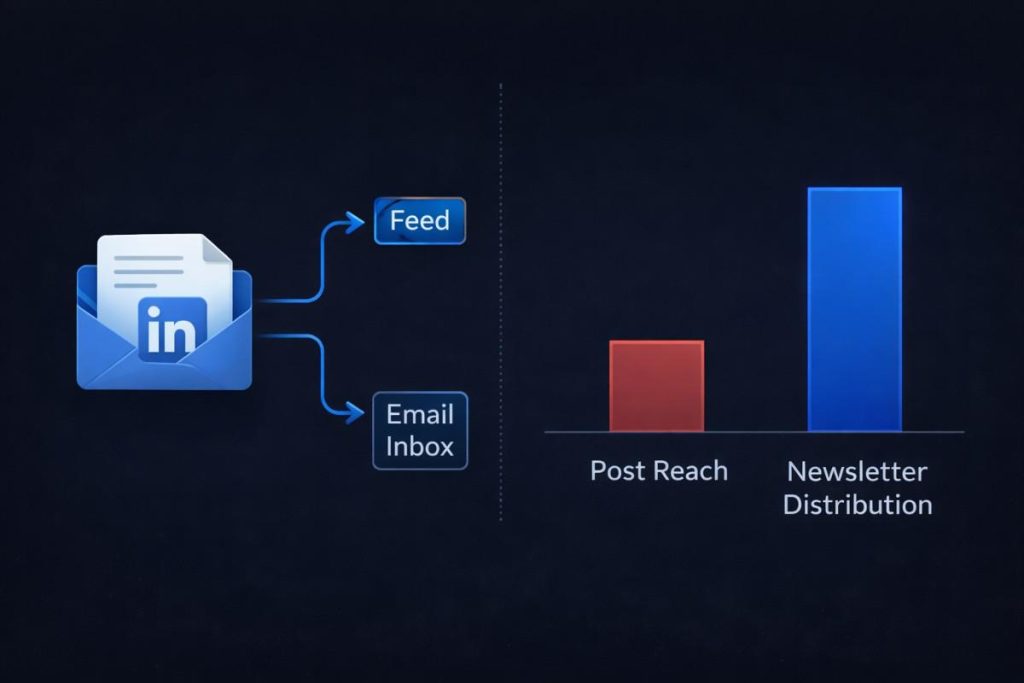
A LinkedIn newsletter is a recurring long-form article series that works differently from your regular posts. When you launch one, LinkedIn automatically invites your existing followers to subscribe. Each issue then lands in both the LinkedIn feed and subscribers’ email inboxes, which is the core distribution advantage over standard posts.
Since 2024-2025, LinkedIn has also added dedicated analytics: email sends, estimated open rates, subscriber demographics, and engagement data per issue. That makes it easier to compare newsletter performance against your other channels.
How LinkedIn Distributes Newsletter Content
The auto-invite mechanic is what drives initial growth. Some B2B creators see significant subscriber numbers within days of launching, simply because LinkedIn pushes the invite to everyone who already follows them.
After launch, each new edition triggers a feed appearance and an email notification to subscribers. That dual-channel push is what makes newsletters feel more stable than posts, where a single algorithm shift can cut your distribution overnight.
What’s Changed Recently for Newsletters
The shift worth understanding is the divergence between posts and newsletters. General post reach has become more volatile over the past two years, with various creators and analysts reporting declines of 20% to nearly 50% in organic reach per post.
Newsletters have moved in a different direction. LinkedIn has actively promoted them in search results and recommendations, while the email-send component means each issue reaches at least some of your audience regardless of feed conditions.
LinkedIn Newsletter Pros and Cons in 2026
Here’s the honest breakdown for B2B content teams.
| Factor | Pros | Cons |
|---|---|---|
| Subscriber growth | Auto-invites convert followers fast | Audience sits on LinkedIn’s platform |
| Distribution | Feed + email inbox per issue | Email delivery is estimated, not guaranteed |
| Reach vs posts | More stable than feed-only posts | Still subject to LinkedIn’s algorithm |
| Analytics | Email sends, open rate, demographics | Less detail than a proper email platform |
| Content ownership | Builds long-form authority archive | You don’t own the subscriber list |
| Production | Repurposable from existing assets | Higher effort per issue than a post |
| Competition | Still fewer than email newsletters | 184,000+ newsletters now live on LinkedIn |
Major Advantages (Pros)
The built-in subscriber acquisition is the standout advantage. You don’t start from zero. LinkedIn does the initial distribution work by converting a percentage of your existing followers into newsletter subscribers when you launch.
The dual feed-plus-email delivery also means your content gets more than one shot at reaching someone. That stability matters when post reach has become inconsistent. And the growing analytics suite, including open rate data, makes it easier to treat the newsletter as a measurable channel rather than a vanity project.
At Growleads, LinkedIn is one of the three core channels in how we build revenue for B2B clients, alongside email and paid. Our LinkedIn authority building service treats long-form content and structured publishing as central levers, not optional extras. Campaigns across client accounts have generated over 2.5 million impressions with a 24% average reply rate in LinkedIn outreach.
Real Drawbacks (Cons)
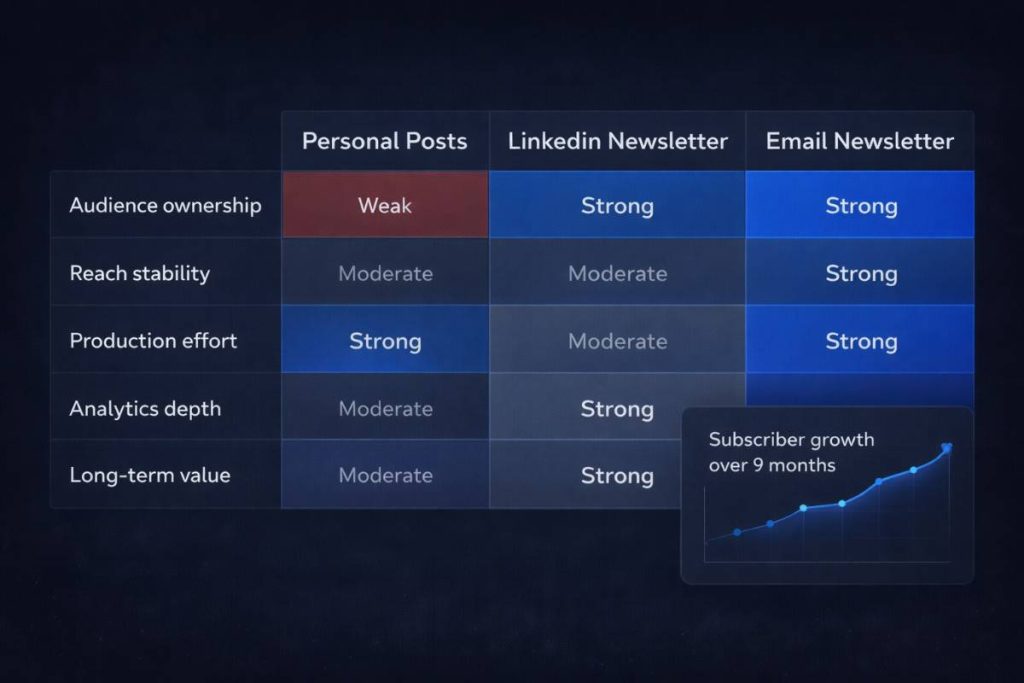
The ownership problem is the biggest one. Subscriber data lives inside LinkedIn. You can’t export a clean list and take it elsewhere. That means if LinkedIn changes its algorithm, throttles newsletter distribution, or simply becomes less relevant to your audience, you have limited recourse.
Competition is also real. The announcement on LinkedIn’s new newsletter metrics and growth confirmed more than 184,000 newsletters now active on the platform, with a 47% engagement increase year-over-year. That’s growth, but also saturation risk as inboxes fill up.
And the production commitment is closer to writing a blog post than a short LinkedIn update. For teams already stretched on content, that’s an honest cost to factor in.
Newsletter vs Personal Posts: How Do They Really Compare?
Posts and newsletters serve different jobs. They’re not interchangeable, and choosing one over the other depends on what you’re trying to achieve.
| Factor | Personal Posts | LinkedIn Newsletters |
|---|---|---|
| Primary surface | Feed only | Feed + email inbox |
| Reach trend | Down significantly in recent years | More stable per send |
| Content depth | Short-form, reactive | Long-form, analytical |
| Subscriber control | Followers (no explicit opt-in) | Subscribers, but rented audience |
| Analytics | Impressions, engagement | Views, subscribers, email sends, open rate |
| Production effort | Lower per item | Higher, closer to a blog post |
| Best use | Hooks, conversation, news | Frameworks, case studies, depth |
Where Posts Still Win
High-frequency posting and carousels remain the best format for testing hooks, reacting to industry news, and sparking the kind of comment-driven engagement the algorithm rewards. If your goal is staying visible and generating conversation, posts are faster and more flexible.
Our LinkedIn lead generation strategy that works goes deeper on which post formats are performing well right now and why text-led content continues to outperform image-heavy posts for B2B audiences.
Where Newsletters Are Stronger
Newsletters win on depth and consistency. They’re better suited to frameworks, detailed case studies, and the kind of analysis that builds genuine authority over time.
The email component also means you’re reaching a subscriber who explicitly opted in to hear from you. That’s a different quality of attention than someone scrolling a feed.
A mistake we keep seeing: teams start a newsletter because post reach has dropped, without having strong enough long-form content to fill it. The result is thin issues that damage authority rather than building it.
How the LinkedIn Algorithm Treats Newsletters vs Posts
Understanding this distinction is worth the time, because it changes how you plan your content mix.
Feed Changes and Reach Drops on Posts
External data from creators and analysts puts average LinkedIn post reach down anywhere from 22% to 47% over recent years. The algorithm has moved toward favouring expert-driven, conversational content over broadcast-style posts, and it’s become more selective about what gets amplified.
The creator data comparing post reach to newsletter open rates shows a consistent pattern: post reach declining while newsletter open rates hold relatively steady around 20-22% for established publications.
Why Newsletters Feel More “Algorithm-Resilient”
Each newsletter issue triggers an email send. That means your content reaches subscribers independently of whether the algorithm decides to surface it in the feed. Some creators report stable distribution per issue even as their regular post metrics have dropped.
LinkedIn has also been promoting newsletters in search results and recommendations, which gives issues a longer content shelf life than posts that are effectively invisible after 48 hours.
Real-World Results: What Creators Are Seeing
The data from early adopters gives a clearer picture than platform marketing claims.
Subscriber Growth Patterns
The honest LinkedIn newsletter growth and shutdown story is a useful benchmark: one B2B creator converted 1,012 subscribers on day one from 6,486 followers, a 15.6% conversion rate, and reached over 2,300 subscribers within nine months. That’s fast growth by any email list standard.
The auto-invite mechanism does most of the work. Your existing followers become the launch base, which means the larger and more engaged your following, the stronger your newsletter start.
Reach and Opens vs Posts
LinkedIn’s own reporting and creator case studies both point in the same direction: newsletters typically deliver more stable distribution per issue than posts, with open rates in the 20-25% range being commonly reported among B2B publishers.
For context, that’s competitive with many standalone email newsletters, especially for lists that are a few months old rather than years-established.
Why Some Marketers Still Shut Them Down
The creator in the case study above ultimately shut down their LinkedIn newsletter to focus on traditional email. The reasoning was straightforward: email offered better list ownership, faster actual list growth that mattered for business goals, and clearer funnel integration.
That’s not a story about LinkedIn newsletters failing. It’s a story about strategic prioritisation, and it’s a decision framework worth applying before you launch.
Where a LinkedIn Newsletter Fits in B2B Content Strategy
The most effective use of a LinkedIn newsletter is as a distribution layer for content you’re already producing, not as a separate editorial stream that demands its own resources.
Think of it this way. If you’re writing strong blog posts, publishing case studies, or producing detailed frameworks, a newsletter gives those assets a second life with a different audience on a channel that rewards long-form content.
Our own content systems at Growleads prioritise reusable authority pieces, including case studies, deep-dive guides, and structured frameworks, that feed LinkedIn posts and, where relevant, newsletter-style formats. That’s the recommendation here: let your newsletter ride on your strongest assets rather than standing alone.
Repurposing Authority Pieces into Newsletters
The production load drops significantly if you treat newsletters as an adapted version of something you’ve already made. Take a blog post, pull out the core framework, add one or two pieces of context specific to LinkedIn’s audience, and you have an issue.
You can explore how this plays out across formats in our B2B content strategy case studies that drive conversions, which maps how case-study-led content builds authority on LinkedIn specifically.
Connecting Newsletters to Email and Website
The bridge between LinkedIn and your owned channels is where the real business value sits. Each newsletter issue is an opportunity to direct the most engaged readers to your website, a lead magnet, or your email list.
A simple model: LinkedIn newsletter previews or adapts your core content. Email is where the full version lives, along with offers and nurture. Website is where conversions happen. LinkedIn drives discovery and builds initial trust.
Decision Framework: Should You Start a LinkedIn Newsletter in 2026?
Here’s a direct answer rather than a hedged one.
You Are Ready to Start If…
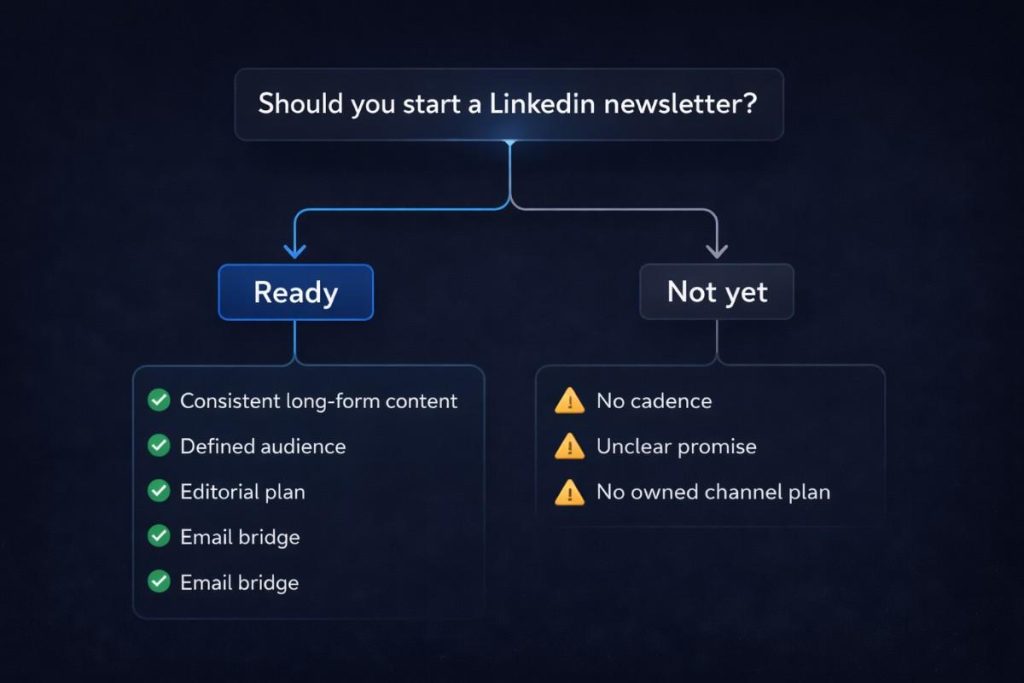
You already ship at least one strong long-form authority piece per month. You have a clear point of view and a defined audience. You have someone accountable for an editorial calendar. And you have a plan for what newsletter subscribers should do next, whether that’s visiting your site, joining your email list, or booking a call.
Before launching, make sure your LinkedIn profile itself is doing its job. If it’s not clearly positioning you as an authority in your niche, the newsletter will underperform. Our LinkedIn Profile Optimiser at Growleads Tools helps identify and fix the profile gaps that hold authority content back.
You Should Hold Off If…
You’re posting inconsistently. You don’t have a defined editorial promise. You’d be creating net-new content for the newsletter rather than repurposing strong existing assets. Or you have no mechanism to move newsletter readers into a channel you actually own.
Starting a newsletter without those foundations creates an obligation that drains the content team without building anything durable.
Here’s the rule we’d apply: no newsletter before you have a content cadence you can sustain. A fortnightly or monthly commitment to genuinely useful long-form content is more valuable than a newsletter that goes quiet after six issues.
How to Start a LinkedIn Newsletter the Right Way
If you’ve passed the readiness check, here’s how to set it up to work.
Naming, Positioning, and Cadence
Choose a name that states a clear outcome or audience, not a generic brand name. “SaaS Pipeline Notes” tells a reader exactly what they’re getting. “The [Company Name] Newsletter” tells them nothing.
Commit to a cadence before you launch. For most B2B teams, monthly or fortnightly is sustainable and respects your audience’s attention. Weekly only works if you have a dedicated content resource.
Structuring Issues for Authority and Conversion
Each issue should do three things: deliver one strong insight or framework, show it with a specific example or demonstration, and give the reader one low-friction next step into your owned ecosystem.
That next step could be a related blog post, a lead magnet, a case study download, or a soft prompt to join your email list. Keep it one action per issue, not three.
Using LinkedIn’s Newsletter Analytics
Track article views, subscriber growth, email sends, and open rate per issue from the LinkedIn analytics dashboard. Compare open rates against your email newsletter benchmark.
More importantly, track what happens after the click. How many newsletter readers become website visitors? How many end up on your email list? How many turn into leads? Those are the metrics that justify the production investment.
How We Use LinkedIn Content Systems at Growleads
LinkedIn is a core channel for us, and we treat it as a full authority system rather than a single-tactic bet. Posts, long-form articles, structured outreach, and profile optimisation all work together.
Our LinkedIn lead generation for B2B service is built on the same logic. Authority content creates the conditions for outreach to land well. A newsletter, done properly, is one more component in that system.
Content Signals That Work on LinkedIn
Our research, which has been cited externally in the context of LinkedIn algorithm analysis, shows that single-image posts underperform text-only posts by around 30%. That data reinforces the case for insight-driven, text-led formats: articles, frameworks, and newsletters, not graphics for their own sake.
The algorithm in 2025-2026 is oriented toward expert content and meaningful engagement. Long-form authority pieces align better with that direction than high-frequency image posts.
What to Do Next
If you’re ready to move forward, here’s a practical starting point:
- Audit your existing content. Do you have 6-8 strong long-form pieces you could adapt into newsletter issues? If yes, you have your first content queue.
- Define your editorial promise in one sentence before you name or launch anything.
- Check your LinkedIn profile is working as hard as your content will. Run it through the LinkedIn Profile Optimiser at Growleads Tools to identify gaps before you start building an audience.
- Set your cadence and put the first three issue dates in the calendar before launch day.
If you want to talk through how a newsletter fits into a wider LinkedIn authority and lead generation system, you can get in touch with the Growleads team and we’ll walk through what we’d look at first.
Is it still worth starting a LinkedIn newsletter in 2026?
Yes, if you already have consistent long-form content and a clear strategic purpose for it. A LinkedIn newsletter can add reach and authority by reaching subscribers via both the feed and email. The important condition is that it should complement your email list, not replace it. If you can’t sustain a regular cadence or don’t have a plan for moving readers into owned channels, it’s not the right moment.
Do LinkedIn newsletters get better reach than normal posts now?
Many creators and analysts report a divergence: post reach has declined significantly over the past two years, while newsletter distribution, supported by the email send component, has stayed relatively stable. One creator reported a roughly 47% drop in post reach while maintaining a 22% newsletter open rate. That pattern isn’t universal, but it reflects a real shift in how LinkedIn distributes different content types.
How fast can a LinkedIn newsletter grow subscribers?
With the auto-invite mechanic, growth can be fast. One B2B creator converted 15.6% of their 6,486 followers on day one, giving them over 1,000 subscribers at launch. Growth then slows to new followers discovering and subscribing. The size and engagement of your existing following is the main variable, which is why profile optimisation and consistent posting matter before you launch.
Do I own my LinkedIn newsletter audience like an email list?
Not fully. Subscriber data and delivery infrastructure sit inside LinkedIn. You can’t export a clean list and migrate it to another platform. This is the core argument for treating LinkedIn as a discovery and distribution layer while building a parallel owned email list. Use the newsletter to earn trust, then give readers a reason to join your email list where you control the relationship.
What are the biggest LinkedIn newsletter pros and cons for B2B brands?
The main pros are fast subscriber acquisition via auto-invites, stable dual-channel distribution (feed and email), strong alignment with authority content formats, and growing analytics. The main cons are platform dependence, no true list ownership, rising competition with over 184,000 newsletters now live, and the ongoing production commitment closer to a blog post than a social update.
How often should I publish a LinkedIn newsletter?
Monthly or fortnightly works well for most B2B teams. That cadence balances the production effort of long-form content with the consistency that both audiences and LinkedIn’s relevance signals reward. Weekly is viable only with a dedicated content resource. Starting monthly and increasing cadence based on performance is a lower-risk approach than launching weekly and burning out after eight issues.
How is a LinkedIn newsletter different from regular posts?
Posts are short-form, feed-only, and suited to high frequency. Newsletters are long-form, sent to subscribers by email as well as appearing in the feed, and better suited to frameworks, analysis, and case studies. Posts are good for visibility and conversation. Newsletters are better for depth and consistent touchpoints with a more intentional audience.
Can a LinkedIn newsletter replace our email newsletter?
No. LinkedIn newsletters are an excellent distribution and discovery layer, but email remains the channel where you own the relationship. Your email list is portable, exportable, and not subject to platform algorithm changes. A LinkedIn newsletter that drives readers toward your email list is a strong combination. One that exists instead of an email list creates a strategic dependency you don’t want.
What analytics do LinkedIn newsletters give me?
You can track article views, subscriber growth trends, subscriber demographics, impressions, reactions, comments, reposts, email sends per issue, and estimated open rates. That’s a meaningful analytics set, particularly the email sends and open rate, which LinkedIn added relatively recently. Cross-referencing LinkedIn newsletter open rates against your email platform benchmarks gives you a useful comparison for resource allocation decisions.
How do I know if my LinkedIn newsletter is actually working for B2B goals?
Subscriber count and open rate are the starting metrics, but they’re not the business metrics. Track how many newsletter readers visit your website, how many sign up for your email list, and how many turn into leads or influenced pipeline. If newsletter readers are engaging with content but never moving further into your funnel, the CTA structure or topic alignment needs reviewing before you invest more production time.

Builds the demand intelligence, automation, and deliverability systems behind Growleads pipeline.