
Demand Intelligence vs Demand Generation: The Real Answer [2026]
What is the difference between demand intelligence and demand generation?
Demand generation is the collection of marketing activities that create awareness and purchase interest among target accounts. It includes paid media, content marketing, events, webinars, LinkedIn campaigns, and outbound sequences designed to put your brand in front of buyers before they raise their hand. Its job is to generate interest at scale: to create market presence broadly across the addressable universe.
Demand intelligence is the methodology that identifies where buying intent already exists. It uses behavioral signals, organizational change data, and account-level context to determine which accounts are in an active buying window, through which channel to reach them, and when. Its job is not to create interest. Its job is to find interest that is already present and direct the demand generation engine precisely on top of it.
The relationship is additive. Demand generation without intelligence broadcasts to everyone and converts a small fraction. Demand intelligence without demand generation has no awareness engine to direct. Stage 3 organizations run both, with intelligence as the steering layer that decides where demand gen fires each week.
This guide covers the full comparison across 8 dimensions, the Growleads Demand Intelligence Maturity Ladder, budget split data from 200+ B2B client campaigns, team structure at each stage, and the tool stack for each discipline. For the full five-pillar framework definition, see the Demand Intelligence category guide.
The short answer: complementary, not competitive
Demand generation is city planning. It builds the roads, zones the districts, and shapes where growth can happen. It creates the possibility space for buyers to find you.
Demand intelligence is traffic control. It watches the live flow: which roads are active, which accounts are moving toward a decision, which signals need a green light right now because the buying window is open. It doesn’t build roads. It decides which ones to open, when, and for whom.
You need both. The city planner doesn’t sit in the traffic control room watching signal feeds. The traffic controller doesn’t pour concrete. But when they communicate every week, traffic moves. When they work in silos, you get 40 lanes of highway converging into one exit ramp at 5 pm on a Friday.
Most B2B organizations are the traffic controller who has never met the city planner. The demand gen team broadcasts campaigns. The outbound team sequences contacts. Neither one knows what the other knows about which accounts are in motion right now. Demand intelligence is the operating discipline that connects them. The result isn’t a bigger budget. It’s the same budget producing compounding returns instead of flat activity metrics.
What is demand generation?
Demand generation is the function responsible for building awareness, creating purchase interest, and generating pipeline. It covers content marketing (articles, reports, webinars), paid media (LinkedIn Ads, Google Ads, paid social), email nurture programs, events, and outbound sequences.
The core purpose of demand generation is scale: reaching as many qualified potential buyers as possible at a cost the business can sustain. When executed well, demand gen fills the top of the funnel with accounts that have nominal awareness of the problem the product solves.
Demand generation answers one question: “How do we create interest in our category and our business?”
It does not answer: “Where does buying intent already exist right now, and when exactly should we act on it?” That question belongs to demand intelligence.
For teams at Stage 1 maturity, demand gen is the entire GTM motion. Ads run, emails go out, content publishes. Results are volume-driven: more sends, more impressions, more leads in the pipeline. The system works until cost per acquisition becomes unsustainable or pipeline quality drops below what sales can close. That inflection point is usually when a team first asks whether there is a smarter way to allocate the budget.
What is demand intelligence?
Demand intelligence is the methodology that uses behavioral and contextual signals to identify which accounts are in an active buying window, through which channel to reach them, with what message, and at what moment. It is not a software platform. It is not intent data alone. It is the operating system that transforms raw data into coordinated, timed outreach.
The full definition and the five-pillar framework live in the Demand Intelligence category guide. For context in this comparison, the five pillars are:
- Signal Intelligence: identifying which behavioral signals predict buying readiness for your specific ICP
- Account Intelligence: maintaining a live, enriched target account list against a validated ICP definition
- Channel Intelligence: matching target buyers to the channels where they actually engage
- Message Intelligence: crafting outreach that speaks to the buyer’s active problem, not a generic value proposition
- Timing Intelligence: sequencing outreach to land within active buying windows, not around vendor convenience
Demand intelligence answers the question demand gen cannot: “Which accounts are ready to buy right now, and what should we do about it this week?”
For the week-by-week implementation of all five pillars, see the Demand Intelligence Framework guide.
The 8-dimension comparison
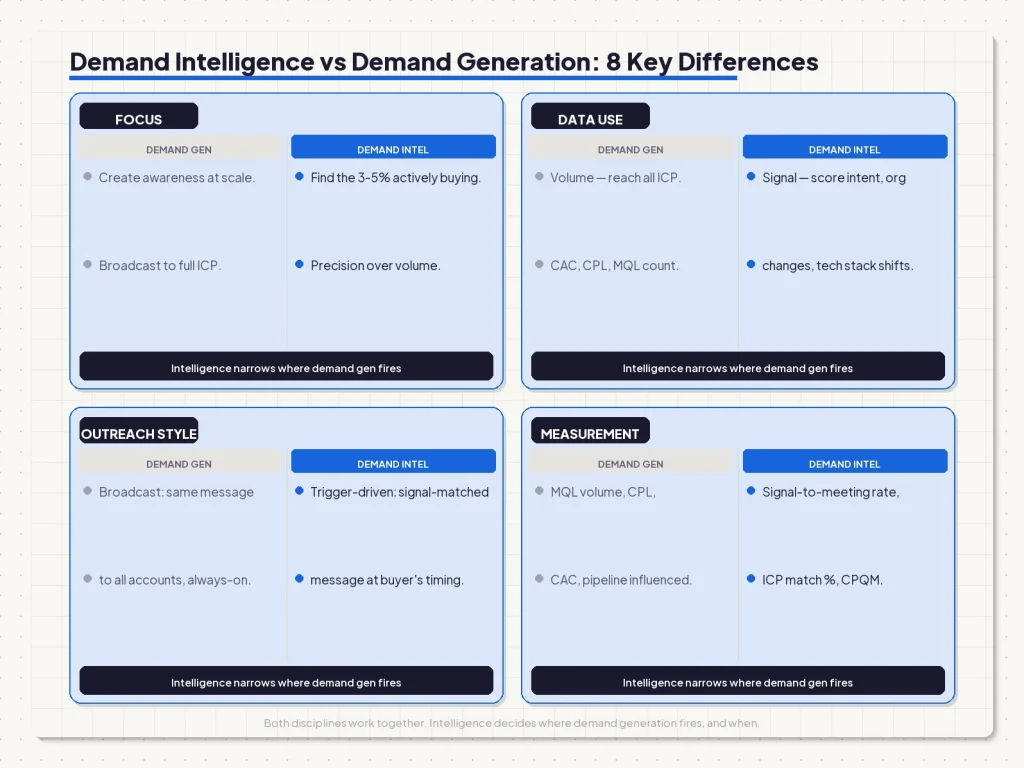
The table below is the center of this article. Each dimension is expanded in the section that follows.
| Dimension | Demand Generation | Demand Intelligence |
| Focus | Create awareness and interest at scale | Identify and act on existing buying intent |
| Data use | Volume: reach as many accounts as possible | Signal: find the 3-5% of accounts ready now |
| Outreach approach | Broadcast: same message, many recipients | Orchestration: different message, channel, and timing per account context |
| Measurement | CAC, MQL volume, CPL, impression share | Signal-to-meeting rate, ICP match rate, pipeline velocity |
| Buyer experience | Pitched to at vendor’s timing | Met where they are at buyer’s timing |
| Team structure | Marketing-owned (demand gen team, paid team) | RevOps-owned or senior marketing-owned (named intelligence lead) |
| Timing | Always-on (campaigns run continuously) | Trigger-driven (outreach fires on signal, not on schedule) |
| Tool stack | HubSpot/Marketo, LinkedIn Ads, Google Ads | Bombora, G2 Buyer Intent, BuiltWith, Clay, ZoomInfo |
Focus
Demand generation’s job is market coverage. It builds awareness among as many relevant accounts as possible. The success metric is reach: how many potential buyers saw the brand, engaged with content, or entered a nurture sequence.
Demand intelligence’s job is precision. It identifies which accounts among all possible buyers are in an active evaluation mode right now. According to Gartner’s 2023 B2B Buying Report, only 3-5% of a company’s total addressable market is in an active buying cycle at any given moment. Demand gen is designed to reach the 100%. Demand intelligence is designed to identify and act on the 3-5% before the window closes.
Data use
Demand generation uses demographic and firmographic data to define target audiences: company size, industry, revenue range, title, geography. The data selects the audience. Volume and creative quality do the rest.
Demand intelligence uses behavioral signals to identify readiness within that audience: intent data spikes on category keywords, organizational changes (new VP hire, funding rounds, leadership transitions), engagement patterns (LinkedIn content interactions, high-intent page visits), and technology install events. The signal does not just describe the account. It predicts when that account is most likely to respond.
Outreach approach
Demand generation broadcasts. The same LinkedIn ad runs to 10,000 targeted accounts. The same email sequence goes to 500 matching titles. The message is optimized for the average relevant buyer, not for the specific account.
Demand intelligence orchestrates. The message to an account that just hired a new VP Revenue references the leadership transition. The message to an account that spiked on “demand generation agency” keywords on Bombora references the category search. The message to an account that engaged with three posts about pipeline quality references that engagement directly. One template cannot serve all three contexts without losing credibility with all of them.
Measurement
Demand generation measures upstream metrics: cost per lead, MQL volume, impression share, email open rate. These measure activity, not outcome proximity.
Demand intelligence measures outcome proximity: signal-to-meeting rate (what percentage of accounts that triggered a target signal became booked meetings), ICP match rate on closed pipeline, and pipeline velocity (how fast signal-triggered accounts move from first contact to qualified opportunity). 96% of marketers report increased sales from personalized experiences (HubSpot State of Marketing 2025, survey of 1,200 marketers). Signal-matched outreach is how that personalization gets operationalized at scale rather than left to manual research per account.
Buyer experience
Demand generation reaches buyers before they have raised their hand. Done well, it creates the association between problem and brand before the buying process begins. Done poorly, it is ad fatigue and inbox clutter.
Demand intelligence reaches buyers when they have already signaled readiness. The buyer experiences this as relevance rather than interruption. According to Gartner’s 2023 B2B Buying Report, B2B buyers are 1.8x more likely to complete a high-quality deal when supplier-provided tools are integrated with human sales guidance. Demand intelligence is what makes the human guidance timely enough to matter.
Team structure
Demand generation is owned by marketing. The demand gen team manages campaigns, content production, paid media allocation, and nurture sequences. The team measures itself on lead volume and campaign performance.
Demand intelligence sits at the intersection of marketing and revenue ops. At Stage 2 companies, it is a hybrid role held by a senior SDR or RevOps analyst. At Stage 3 companies, there is a named demand intelligence lead who owns the weekly ritual: signal review, account scoring, message routing, and the Friday measurement retrospective. This person is the engineer. The demand gen team is the factory. Both are necessary. Only one of them knows which accounts are active this week.
Timing
Demand generation runs on campaign schedules. Ads run all month. Email sequences fire on enrollment. Content publishes on a calendar. The timing is determined by the vendor’s operational rhythm, not the buyer’s readiness.
Demand intelligence runs on triggers. The outreach fires after the appropriate delay for that signal type: intent data spikes warrant a 7-14 day delay (the buyer is in research mode, not evaluation mode); contract renewal signals warrant near-immediate response (the window is short). Timing is set by what the buyer is doing, not when the sequence was scheduled.
Tool stack
Demand generation tools are designed for audience management and broadcast activation. HubSpot Marketing Hub, Marketo, Pardot, LinkedIn Sales Navigator, LinkedIn lead generation campaigns, and Google Ads are optimized for reach and scale.
Demand intelligence tools are designed for signal identification and account enrichment: Bombora for intent data, G2 Buyer Intent for review-stage signals, BuiltWith for technographic context, Clay for data assembly and routing. These tools produce inputs. A human reads those inputs every week and makes allocation decisions. The tool is not the intelligence. The human reading the tool every Monday morning is the intelligence.
The Demand Intelligence Maturity Ladder
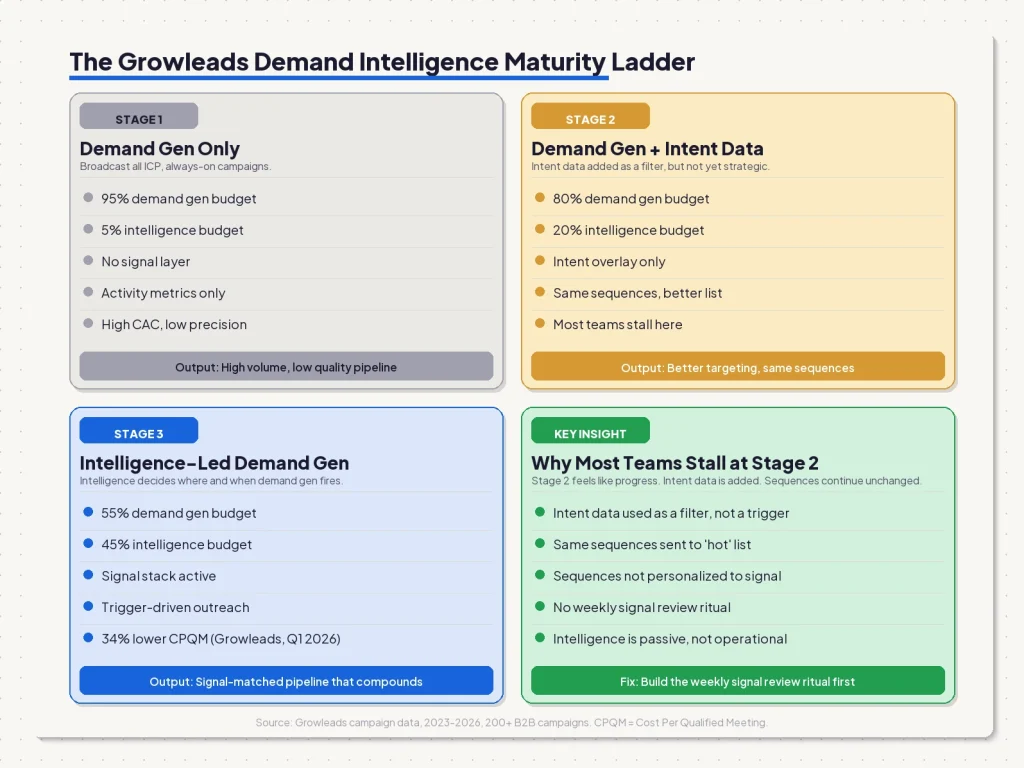
Most B2B organizations do not move directly from no intelligence to full demand intelligence. They progress through three stages. Understanding which stage your organization is at tells you what to build next, not what to copy from a company two stages ahead of you.
Stage 1: Demand generation only (broadcast)
The organization runs demand gen as the full GTM motion. Campaigns broadcast to large audiences defined by firmographic filters. MQLs are the primary metric. Outbound, if it runs at all, operates independently from marketing with no shared signal layer. Nobody reads intent data. Nobody tracks organizational change signals. The ICP is a static document that hasn’t been validated against closed-won data since the last rebrand.
What is missing: Any signal that distinguishes the 3-5% of accounts ready to buy from the 95-97% who are not.
Budget split: Approximately 95% demand gen, 5% intelligence tools (mostly unused after the first quarter).
Who stays here: Teams growing fast enough that demand gen is working at current scale. Early-stage companies where the product’s novelty creates inbound demand. Organizations without a RevOps function to own the intelligence layer.
Stage 2: Demand gen plus intent data (intermediate)
The organization has purchased an intent data platform (Bombora, G2 Buyer Intent, or a ZoomInfo intent layer). They have added an intent signal to the SDR prioritization queue. The demand gen team is still broadcasting broadly, but the outbound team now has a “hot account” list from the intent platform.
This is the stage where most B2B teams stall.
They bought the tool. They added the signal. They did not change the measurement system (still tracking MQLs), did not change the team structure (marketing owns demand gen, sales owns outbound, nobody owns intelligence), and did not change the weekly operating rhythm (the intent platform fires alerts; most of them go unread after the first six weeks).
What is missing: The operating discipline. The weekly ritual. The budget re-allocation. The shift from MQL volume to signal-to-meeting rate as the north star metric.
Budget split: Approximately 80% demand gen, 20% intelligence (mostly tool subscriptions without dedicated process time).
Who stalls here: Most companies that have been sold on intent data. The tools are in place. The process is not. The measurement system still rewards activity over outcome.
Stage 3: Demand intelligence orchestrating demand generation
The demand intelligence function now decides where demand gen fires each week. Signal review on Monday determines which accounts are in active windows. Message routing on Tuesday segments those accounts into the right sequences. Demand gen campaigns do not broadcast to all ICP accounts: they run against the accounts the intelligence layer has prioritized. The measurement system has shifted from MQL volume to pipeline velocity and signal-to-meeting rate.
This is not a software upgrade. It is a process, measurement, and organizational change.
Budget split: Approximately 55% demand gen, 45% intelligence.
Who gets here: Organizations that ran Stage 2 for at least two quarters, measured what actually drove pipeline, and had the discipline to change the budget and team structure when the data pointed in that direction.
The three-stage Maturity Ladder introduced here is a construct that future Growleads cornerstones will reference directly: it is the operating model behind signal-based outbound, the framing behind how to build a demand intelligence function, and the category context behind demand intelligence vs ABM.
Budget allocation at each stage
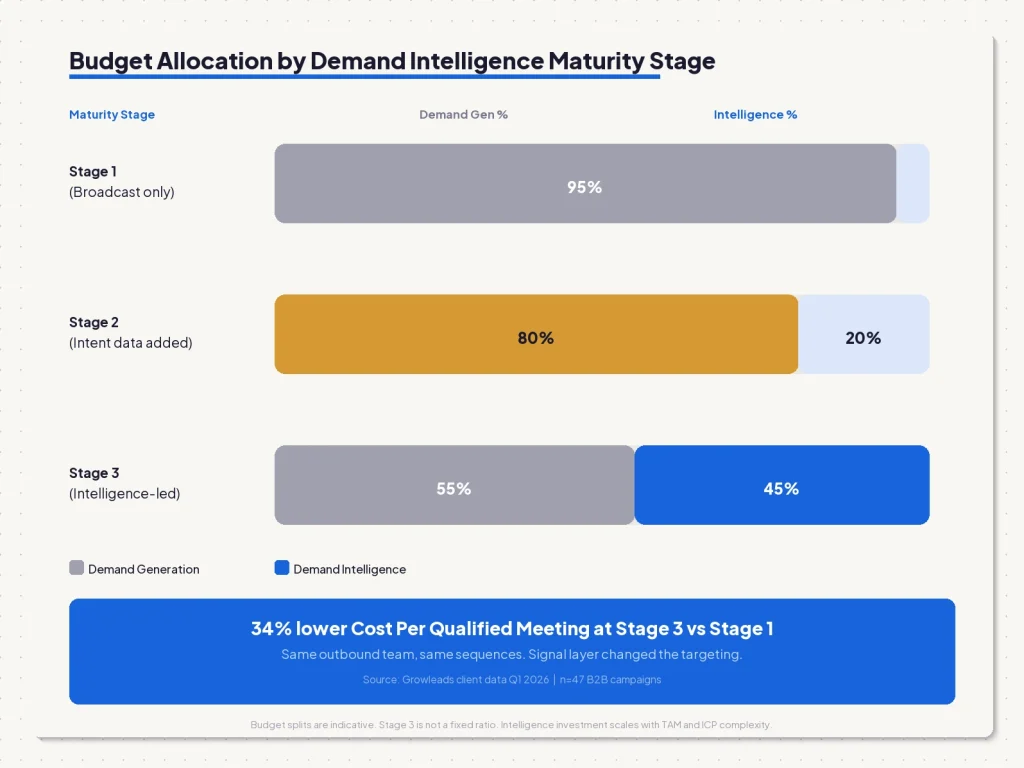
The table below reflects aggregate data from Growleads client engagements from 2023 to 2026 across 200+ B2B campaigns. Specific client-level numbers have been averaged across industries.
| Stage | Demand Gen % | Intelligence % | What intelligence spend covers |
| Stage 1 (broadcast) | 95% | 5% | Basic intent data tool subscription, no dedicated process time |
| Stage 2 (intent data layer) | 80% | 20% | Intent platform, data enrichment, partial SDR time for weekly signal review |
| Stage 3 (intelligence-led) | 55% | 45% | Intent platform, full data stack, a dedicated intelligence lead (0.5-1.0 FTE), weekly operating ritual, measurement infrastructure |
Two things to note in this table.
First, Stage 3 is not “majority intelligence.” Demand gen still holds the plurality at 55%. The story is not that intelligence replaces demand gen. It is that intelligence directs demand gen. The paid campaigns, the content engine, the cold email sequences all run. They run against the accounts the intelligence layer has identified as ready, not against the full ICP broadcast list.
Second, the jump from Stage 2 to Stage 3 is not a budget decision alone. It requires assigning a named person to the weekly intelligence ritual. That person’s time is the most expensive and most undervalued line item at Stage 3. Without it, the budget allocation is cosmetic. The tools run. Nobody reads the output. The budget returns to Stage 2 outcomes by quarter three.
Team structure: who owns what
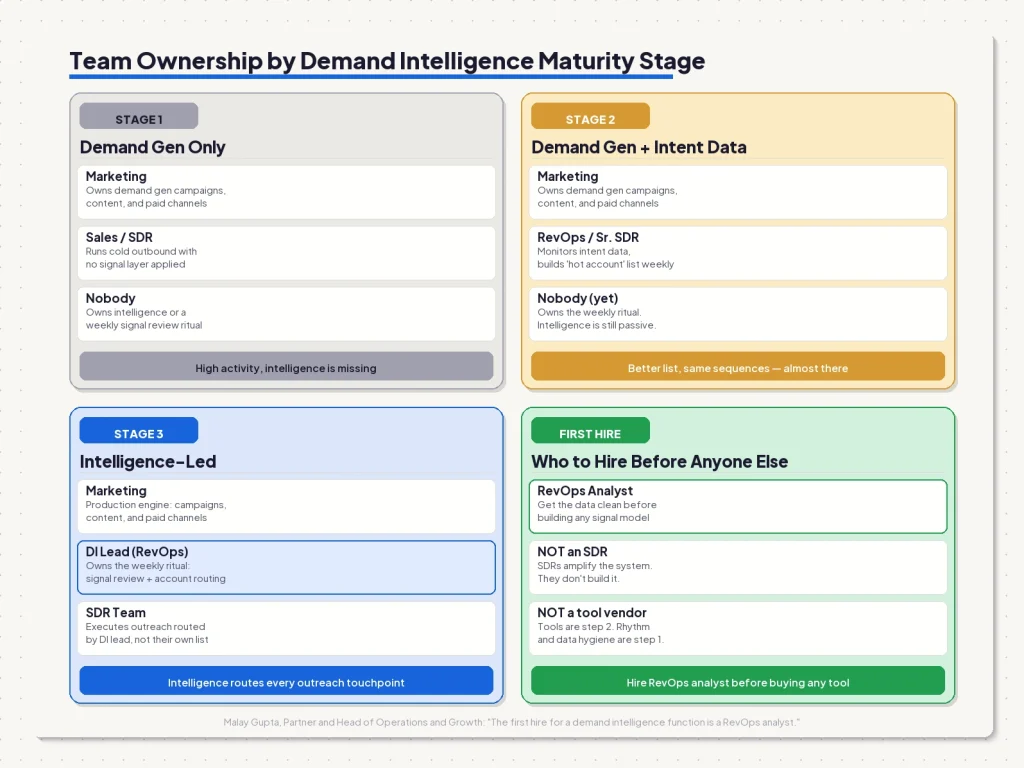
The team structure question is where most Stage 2 companies reveal their actual maturity level. If the answer to “who owns demand intelligence at your company?” is “marketing” or “our SDR team does it,” the organization is at Stage 2. At Stage 3, there is a named role with a named person accountable for weekly signal-to-pipeline outcomes.
Stage 1 team structure
Marketing owns demand gen: campaigns, content, paid media. Sales owns cold outbound. The two functions operate on independent rhythms. The only intelligence passing between them is the MQL handoff, which is a timing signal at best, not a buying signal.
Stage 2 team structure
Marketing still owns demand gen. RevOps or a senior SDR monitors the intent platform. Someone builds a hot account list each week. But there is no budget alignment between the two functions, no operating ritual connecting the signal output to campaign allocation decisions, and no measurement system that traces the intent signal to actual closed pipeline. The intent data informs the SDR queue. It does not inform the demand gen budget.
Stage 3 team structure
A named demand intelligence lead owns the weekly ritual. This person sits in RevOps or senior marketing. Their job is not to run campaigns. Their job is to read the signal output every Monday, route accounts into the right sequences with the right timing, and run the Friday measurement retrospective. Marketing is the production engine. The intelligence lead is the steering wheel.
Gartner’s 2023 B2B Buying Report found that B2B buying now involves 5 to 11 stakeholders representing 5 distinct business functions. Reaching that buying group requires knowing which stakeholders are active, routing the right message to each one through the right channel, and doing it at the right moment in their evaluation cycle. That is a Stage 3 function, not a Stage 1 campaign.
Tool stack: demand gen side vs demand intelligence side
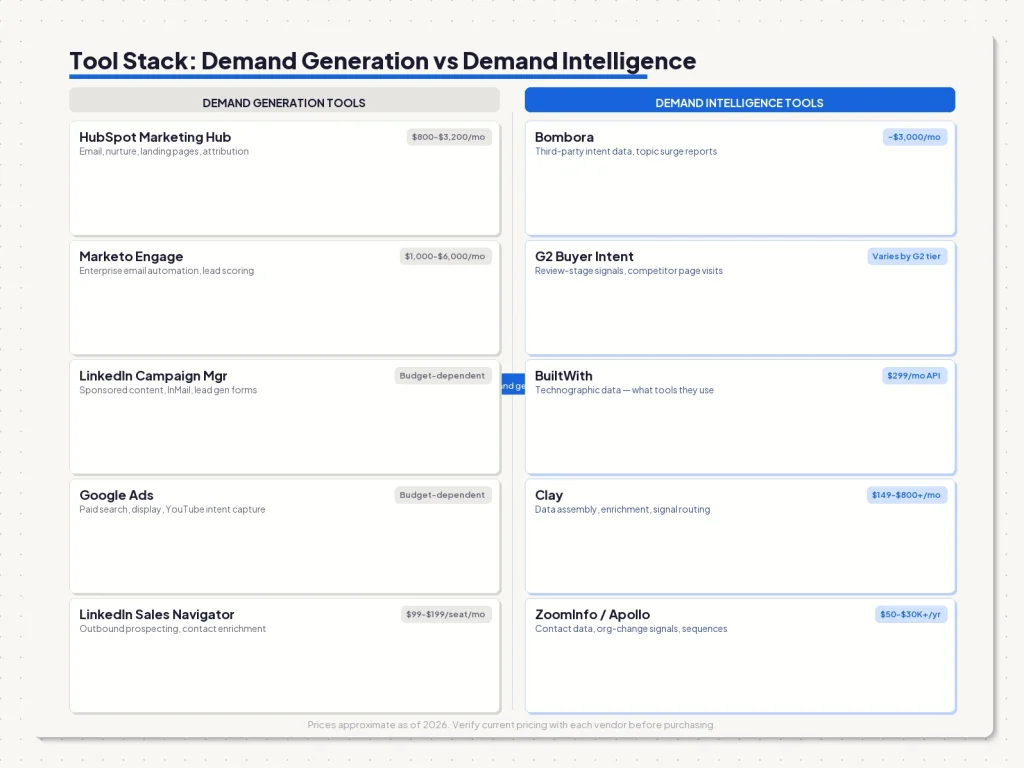
Both sides of this comparison require tools. Neither side’s tools are the strategy. The tools are the equipment. The operating discipline is the strategy. The same Bombora subscription produces entirely different outcomes for a Stage 2 team (alert ignored after six weeks) and a Stage 3 team (Monday signal review drives the week’s account list and campaign routing).
Demand generation tool stack
| Tool | Function | Approximate cost (April 2026) |
| HubSpot Marketing Hub | Email automation, landing pages, nurture, attribution | $800-$3,200/month (Pro to Enterprise; verify at hubspot.com) |
| Marketo Engage | Enterprise email automation, lead scoring, multi-touch attribution | $1,000-$6,000+/month (verify at adobe.com/products/marketo) |
| LinkedIn Campaign Manager | Sponsored content, InMail, lead gen forms | Minimum $10/day; budget-dependent |
| Google Ads | Paid search, display, YouTube intent capture | Budget-dependent |
| LinkedIn Sales Navigator | Outbound prospecting, organizational change signals | $99-$199/seat/month |
Demand intelligence tool stack
| Tool | Function | Approximate cost (April 2026) |
| Bombora | Third-party intent data (topic surge reports, account-level intent scoring) | Starting around $3,000/month for SMB plans; verify at bombora.com |
| G2 Buyer Intent | Review-stage signals: accounts visiting your G2 profile or competitor profiles | Varies by G2 plan tier |
| BuiltWith | Technographic data: what tools target accounts are running | $299/month for the API plan; verify at builtwith.com |
| Clay | Data assembly, enrichment, signal routing, waterfall enrichment | $149-$800+/month depending on credits |
| ZoomInfo | Contact data, organizational change signals, department-level intent | $15,000-$30,000+/year |
| Apollo.io | Contact data plus basic intent signals (entry-level alternative) | $50-$150/seat/month |
| Clearbit (now Breeze, part of HubSpot) | Website visitor identification, real-time account enrichment | Part of HubSpot Suite or standalone |
Named tool opinion: for most Growleads clients in the $50M-$200M ARR range, the entry-level demand intelligence stack is Apollo for contact data, G2 Buyer Intent for review-stage signals, and Bombora for the broader intent layer, assembled through Clay for routing. Total cost sits between $1,500 and $4,500 per month depending on seat count and data volume. That is the Stage 2 foundation. The Stage 3 upgrade is not a sixth tool. It is assigning a named person to run the weekly ritual with the stack already in place.
A note on 6sense and Demandbase: both position themselves as demand intelligence platforms. They are more accurately demand gen platforms with a strong intelligence layer built in. They are worth evaluating when your team has the process discipline to action their output daily. Most teams that buy 6sense or Demandbase at Stage 2 maturity are paying for Stage 3 capability while operating at Stage 1 discipline. The platform does not change the maturity. The ritual does.
The Stage 2 stall: the most common failure mode
The failure pattern in demand intelligence is almost always the same. An organization hears about intent data. They buy a Bombora subscription or activate G2 Buyer Intent. They build a hot account report. They send it to the SDR team every Monday.
The SDRs add the hot accounts to the top of their sequences. Reply rates improve marginally in the first 60 days. The team declares it a success. The intent tool budget renews.
Six months later, the original lift has flattened. The SDRs have stopped trusting the hot account list because too many accounts on it failed to convert. The intent platform fires 40 alerts per week; the team actions 5 and ignores 35. The demand gen campaigns are still running to the full ICP broadcast list, not to the intelligence-prioritized subset. The measurement system still reports MQLs, not signal-to-meeting rate. Nothing has structurally changed except the monthly software invoice.
This is Stage 2 stall. The tools are bought. The process is not built.
Consider how this works in book publishing. A publisher can track which stores are selling out of which titles in real time. But if that data sits in a spreadsheet that nobody reads until the quarterly review, it does nothing. The book has already sold out in the stores where demand was highest and shipped to the wrong markets. Demand intelligence is not the data feed. It is the discipline of reading the feed every week and changing the allocation before the window closes.
Three things distinguish Stage 3 organizations from Stage 2 stall:
1. A named person owns the weekly ritual. Not a tool. Not an automated alert. A person who reads the signal output every Monday, makes account routing decisions, and is accountable for the pipeline outcome of those decisions. This is the single most predictive difference between Stage 2 and Stage 3 in Growleads client engagements.
2. The measurement system has changed. If MQL volume is still the primary demand gen metric after 12 months of running an intent platform, the intelligence is cosmetic. Stage 3 requires signal-to-meeting rate and ICP match rate on closed pipeline as the north star metrics. If those numbers are not tracked, the decisions driving budget allocation are guesses dressed up as data.
3. The budget has moved. If the demand gen budget allocation has not changed at all after four quarters of running an intent platform, the intelligence layer has not earned its seat at the table. Stage 3 requires a real reallocation: campaigns, content, and outbound sequences run where the intelligence layer says to run them, not where last year’s persona brief said to run them.
“The wrong question is whether to do demand gen or demand intelligence. Teams still arguing that question have already lost the frame. The right question is: where in your funnel does intelligence decide what demand gen does next week? If you cannot answer that, you are running demand gen on autopilot and calling it strategy.” (Malay Gupta, Partner and Head of Operations and Growth, Growleads)
FAQ
Does demand intelligence replace demand generation?
No. Demand intelligence does not replace demand generation. It directs it. Demand generation creates awareness and pipeline at scale. Demand intelligence identifies where buying intent already exists so the demand gen engine runs where it will compound rather than broadcasting across the full addressable market. Stage 3 organizations run both, with intelligence as the layer that decides where demand gen fires each week.
What comes first: demand generation or demand intelligence?
Demand generation comes first in maturity sequence. A company without market awareness or brand presence cannot yet benefit from a precision intelligence layer, because there are few signals to read. Build the demand gen foundation at Stage 1. Add intent data and signal reading at Stage 2. Then shift to intelligence-led orchestration at Stage 3. Trying to start at Stage 3 without the Stage 1 foundation creates a precision system with nothing to be precise about.
Is demand intelligence the same as intent data?
No. Intent data is one input into Pillar 1 (Signal Intelligence) of the demand intelligence framework. Demand intelligence is the full methodology: it uses intent data alongside organizational change signals, engagement patterns, technographic data, and timing windows to produce coordinated outreach campaigns. Intent data tells you who might be interested. Demand intelligence tells you who is ready, through which channel, with what message, and at what moment. Buying an intent data platform and calling it demand intelligence is Stage 2, not Stage 3.
Which teams own demand intelligence vs demand generation?
At Stage 1 and Stage 2, marketing owns demand gen and RevOps or a senior SDR monitors the intent platform. At Stage 3, a named demand intelligence lead owns the weekly ritual (signal review, account routing, measurement retrospective), marketing remains the production engine for campaigns and content, and the SDR or outbound team executes the outreach the intelligence layer routes to them. The distinguishing mark of Stage 3 is accountability: a named person whose job performance is measured by signal-to-pipeline outcomes.
How much budget should go to demand intelligence vs demand generation?
Based on Growleads client data from 2023 to 2026 across 200+ B2B campaigns, the budget split shifts with maturity. Stage 1 organizations allocate approximately 95% demand gen and 5% intelligence (tool subscriptions with no dedicated process). Stage 2 organizations move to 80% demand gen and 20% intelligence. Stage 3 organizations reach approximately 55% demand gen and 45% intelligence, including a dedicated intelligence lead, the full data stack, and measurement infrastructure. The shift is not about reducing demand gen. It is about the intelligence layer earning its allocation by demonstrating that intelligence-prioritized accounts convert at a higher rate than the broadcast list.
Is demand intelligence the same as ABM?
No. ABM (account-based marketing) is a targeting strategy: select a finite list of high-value accounts and run coordinated campaigns against them. Demand intelligence is an operating methodology: use signals to identify which accounts are in active buying windows and orchestrate outreach accordingly. You can run demand intelligence on an ABM account list. But demand intelligence reorders that list every week based on who is signaling readiness right now. ABM is a fixed rulebook. Demand intelligence is a live scoreboard that updates on Monday morning.
What does a demand intelligence manager do differently than a demand gen manager?
A demand gen manager owns campaigns, content production, paid media allocation, and MQL volume. Their rhythm is campaign management: building and optimizing assets, managing ad spend, monitoring funnel performance
What is the most common mistake in demand intelligence?
Calling Stage 2 “Stage 3.” Buying an intent data platform, adding it as a signal layer on top of existing demand gen, and treating that as demand intelligence when it is actually demand gen with a priority queue. The missing pieces are always the same: no named owner for the weekly ritual, no shift in measurement from MQL to signal-to-meeting rate, and no real budget reallocation toward the intelligence function. Until those three things change, the intent platform is expensive decoration on a Stage 1 broadcast system.

Builds the demand intelligence, automation, and deliverability systems behind Growleads pipeline.