
How to Connect with Enterprise Buyers: A Step-by-Step Cold Outreach Guide
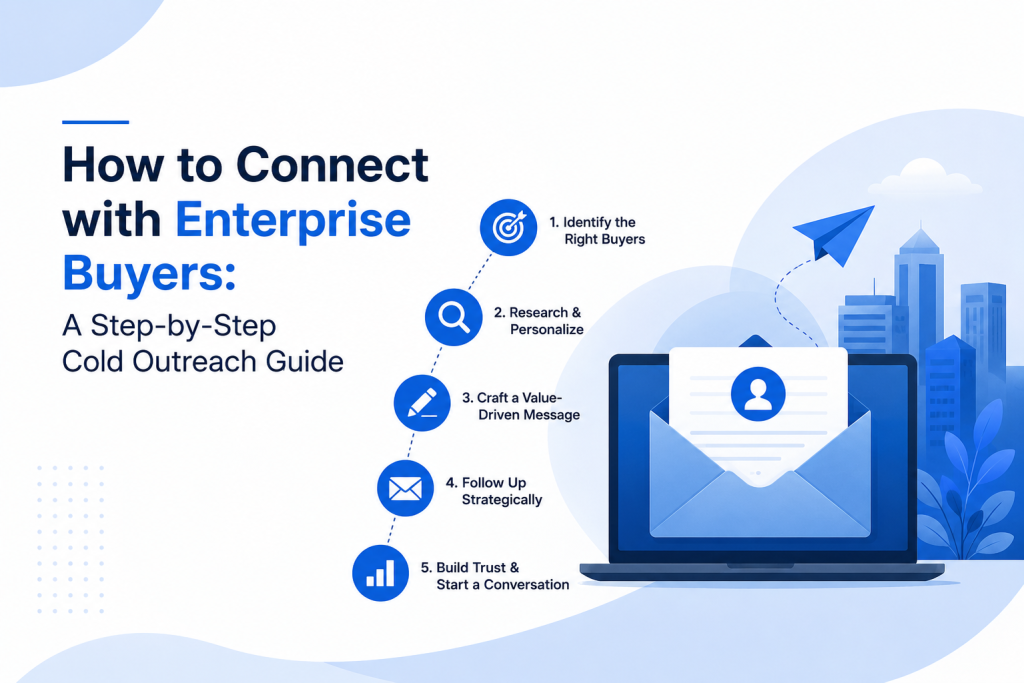
Enterprise deals start before the first sales call. They are won in the inbox, the LinkedIn DM and the moment an actual decision maker determines that your message is deserving of an extra second of their attention.
Especially the enterprise outreach is much harder than the mid-market. The buying committees are larger. The cycles run six to twelve months yourself. Gartner found that 73% of B2B buyers actively avoid suppliers that send irrelevant outreach. But it’s not only the enterprise level where generic sequences underperforms. They deliberately tarnish your image with the accounts you want to win the most.
It is a repeatable system that gets enterprise decision-makers on the phone, builds a pipeline with large accounts, and books meetings that actually take place.
Step 1: Define the Right Enterprise ICP Before You Write a Single Email
This is a step that a lot of teams skip or do too quickly. This is why their open rates drop like a rock up against an enterprise domain.
Enterprise buying committees have layers and layers. It might include a VP of IT, a CFO, a procurement lead and a legal team for a software deal at a Fortune 500. You need to understand which of your roles has pain addressed by what you deliver, who has budget authority, and who can stop the deal from going forward.
Define your ICP at three levels:
- Company fit: evenue band, headcount, tech stack, industry vertical, geography.
- Role fit: the title that owns the problem, not just the most senior person available.
- Signal fit: what triggers at the company level tell you this account is in-market right now.
According to McKinsey’s 2025 Data, prospects contacted within 48 hours of a buying signal are 4.2x as likely to engage. Funding rounds, new appointments, and hiring sprees are the cues indicating the time to reach out. An account that’s recently just hired on eight SDRs is the making of a sales motion. A freshly minted Series B account is burning. These are your entry points.
Step 2: Build a Verified Contact List for the Right People
Enterprise outreach is only as strong as the list behind it. Your copy, your timing, your follow-up cadence, none of it matters if the contact is wrong.
For larger accounts, a general inbox at “Company X” will not get you anywhere. You need direct, verified contact details for the specific people who sit inside the buying committee you mapped in Step 1. This is where most teams quietly lose the deal before it starts: they build a list from a LinkedIn scrape or a stale CSV, send to it, and wonder why open rates are near zero.
A better approach is to verify contact data at the point you use it, not weeks earlier. If you’re trying to reach C-level staff at a company like Deloitte, for example, a tool like SignalHire lets you search by name and company, confirm the current email format, and pull direct contact details for the specific decision-maker you’ve identified, rather than guessing at a format and hoping it lands.
When building your enterprise contact list, follow these rules:
- Target two to three contacts per account. Outreach to multiple people within the same company boosts response rates by up to 93 percent compared to single-contact outreach.
- Verify every email before sending. Bounce rates above 3 percent damage your domain reputation and hurt deliverability across every sending domain you use, not just the one campaign.
- Map each contact to a specific buying committee role. Do not send the same message to a VP of Sales and a CTO. They care about different problems and need different framing entirely.
Step 3: Craft Outreach That Enterprise Decision-Makers Actually Read
Gartner research confirms that B2B buyers feel overwhelmed and frustrated by the outreach they receive. Bad prospecting actively damages relationships with potential customers.
Enterprise buyers are not harder to reach because they are busy. They are harder to reach because they have learned to filter out emails that waste their time. Your job is to be the email that does not.
Write for one person, not a persona
The most important rule in emailing enterprise companies is specificity. Generic opening lines tell the reader you sent this to a thousand other people. Specific, signal-anchored lines tell them you did your homework.
Weak opening line: “I increase your sales efficiency at companies like yours.
Strong opening: “Eight SDR roles just posted in Q2! That generally suggests that the outside movement is rising faster but reaching some infrastructure friction. We work with teams like yours to solve just that.
Only version 2 of this could have been sent to this particular company, at this particular time. Thats what divides a 3% reply rate from a 10% reply rate.
Keep it short
From 2025 to 2026 benchmark data, 50 to 125 word emails receive the highest reply rates, approximately 50% more than longer formats.
Enterprise decision-makers read on the go between meetings. Write for that context. Make one relevant point one articulation of a problem statement one low friction CTA. Forget about email product brochure as word document.
Make the CTA easy to say yes to
Do not ask for 45 min discovery call on first message. Request a 15-minute conversation around one very specific topic. Or pose one qualifying question and allow the response to make up the meeting.
Step 4: Build a Multi-Channel Sequence, Not Just an Email Campaign
According to 2025 data from HubSpot, multi-channel sequences generate 3.2x more meetings than those dependent only on emails. 4.3 channels on average are used by B2B buyers during evaluation.
Following the same decision-maker with a coordinated email and LinkedIn sequence does not count as redundant. This is the method enterprise buyers actually use to make decisions. They look at their inbox and see your name. They see your LinkedIn request. When they do their research on you, they find your thought-leadership post. They already trust you by the time they engage back with you.
An example of an actual enterprise outreach sequence is something like this:
Day 1: Send the first email. Single CTA, under 100wc, anchored by a signal.
Day 3: Send a LinkedIn request, add a note Point back to the same signal or context that you referenced in your email.
Day 7: Follow Up 1 You are trained to add one extra value, a data point, a relevant study on their vertical, or a question.
Day 10: Interact with any LinkedIn content of theirs you see them post Comment thoughtfully. Do not pitch in comments.
Day 14: Write email follow up. Recognise that you have tried to get in touch before. Touch point Reframe with a different angle or different contact at the company
Day 21: Final outreach. Be direct. Inform them that this is your final correspondence with them for the time being. If the timing ever ends up being right, give them an obvious door to walk through.
Email, LinkedIn, and phone in omnichannel outreach can generate more than 287% in results against email-only sequences.
Step 5: Personalize at Scale With Buying Signals, Not Just Merge Tags
The teams are mixed up, every means personalization with first name mention in the subject. Enterprise decision-makers see that for what it is in an instant.
True personalization is where your message proves you understand their very own situation at that moment. That involves account level intelligence, not just an email list.
Personalization beyond the first name leads to 340% more replies. This is not a marginal distance between “Hi [FirstName]” and a signal-anchored opener. Your campaign that gives you pipeline vs. your campaign that sacrifices your domain.
To personalize at scale:
- Monitor your target accounts for hiring signals, migrations, and funding events with intent data platforms
- Create dynamic email template with seat-specific variables that change based on the account trigger
- Not by industry, but segment your outbound outreach by role and buying committee position
Use of intent signals to trigger outreach has increased from 31% in 2023 to 67% for the top-performing sales teams. Outbound based on signals is no longer a fancy tactic. In 2025, it is the baseline for competitive enterprise outreach.
Step 6: Time Your Outreach Around the Buyer’s Calendar
More so than most teams realize, timing is factored in more than others. Enterprise decision-makers are also not equally reachable all-around the clock, and not on every day either.
Emails sent on Mondays with follow-ups scheduled for Wednesdays are consistently the winning timing pattern. The best time to send a message is 9:30 to 11:30 AM using the recipient’s local timezone. Friday is always the worst day for sending cold emails.
Look beyond just your weekly timing Also look to the account-level calendar. Enterprise buying behavior is affected by Q1 budget reviews, Q4 procurement freezes and post-earnings periods. A two week window before a company is about to enter their fiscal year planning cycle performs better than one sophomore company under a procurement freeze.
Step 7: Qualify Before You Scale
The majority of teams scale their outreach before they find a qualified reply. That clogs calendars with inactionable meetings.
Limit the qualification threshold for an enterprise deal prior to increasing the send volume. For instance, what company size, budget signal, and role combination is a meeting worth taking? In fact, we even build that filter into our follow up process so our sales team is only booking time with accounts who can actually buy.
When the outreach shows real account research, C level executives respond at 6.4%, compared to the 3 to 5% average. What matters is the quality of the replies less than the reply rate. Forty meetings with the wrong contacts are no match for ten meetings with genuine enterprise buyers.
What Most Enterprise Outreach Gets Wrong
The most common failure when reaching out to the enterprise is treating it as a volume game. It is not. According to Gartner, 61% of B2B buyers now prefer a rep-free experience to buy something, and 73% actively avoid sales outreach that would not have been relevant when they were still looking for something. This means that at the enterprise level, an ill-targeted campaign is not simply a no-operator-no-pipeline issue. It flags your domain, it warns spam filters and it cuts you off from the very accounts you need to access the most.
The second-biggest failure is to stop too soon. 80% of sales require five or more follow-ups to close deal yet SDRs most often give up after one or two to follow up. Enterprise buyers are on long-time horizons. Construct your sequences to meet that reality.
Enterprise Outreach Is a System, Not a Blast
Teams that continuously connect enterprise decision-makers do not have to send more emails. They mail more relevant emails to a smaller, more meaningful, and verbatim list more supported by buyer signals, aligned across channels, and timed and sequenced on the prospect’s calendar.
It takes longer to build that system. But once you run it, it snowballs.
If you want to see what a buyer-led enterprise outreach system looks like in practice, Growleads runs exactly that: signal-based prospecting, multi-channel sequencing, and manual qualification before a single meeting hits your calendar.

Builds the demand intelligence, automation, and deliverability systems behind Growleads pipeline.