B2B Content Syndication: Boost SEO Visibility with Content Hubs

Content hubs for SEO visibility shape digital marketing strategy as we head into 2025. B2B marketers are adapting, 48% plan to enhance their content distribution channels this year through B2B content syndication. This transformation reflects our audiences’ fragmented attention spans.
B2B content fails to reach its intended audience despite its value. B2B content syndication provides a solution to boost visibility. Smart syndication helps your resource-heavy content reach wider audiences without extra work. The impact goes beyond basic reach, 91% of buyers expect tailored interactions, which makes targeted content crucial for audience involvement. The numbers tell a compelling story, nurtured leads spend 47% more than those without follow-up.
This piece shows how content hubs build your SEO foundation while syndication expands your reach. You’ll learn why 45% of tech buyers need original authority content, ways to handle duplicate content risks, and methods to scale qualified leads through your best content. The frameworks in this guide will help you organize content and improve syndication tactics for 2025 and beyond.
What is a content hub and how does it support SEO?
“Search engines favor well-organized, authoritative content, exactly what a content hub is.”
, ON24, Leading Webinar and Virtual Event Platform
Building a strong online presence starts with content hubs. A content hub works as a centralized, topic-focused resource that puts related content together in a well-laid-out, connected way. Content hubs use a hierarchy system rather than the date-based arrangement you’d see in regular blogs.
How content hubs organize your information
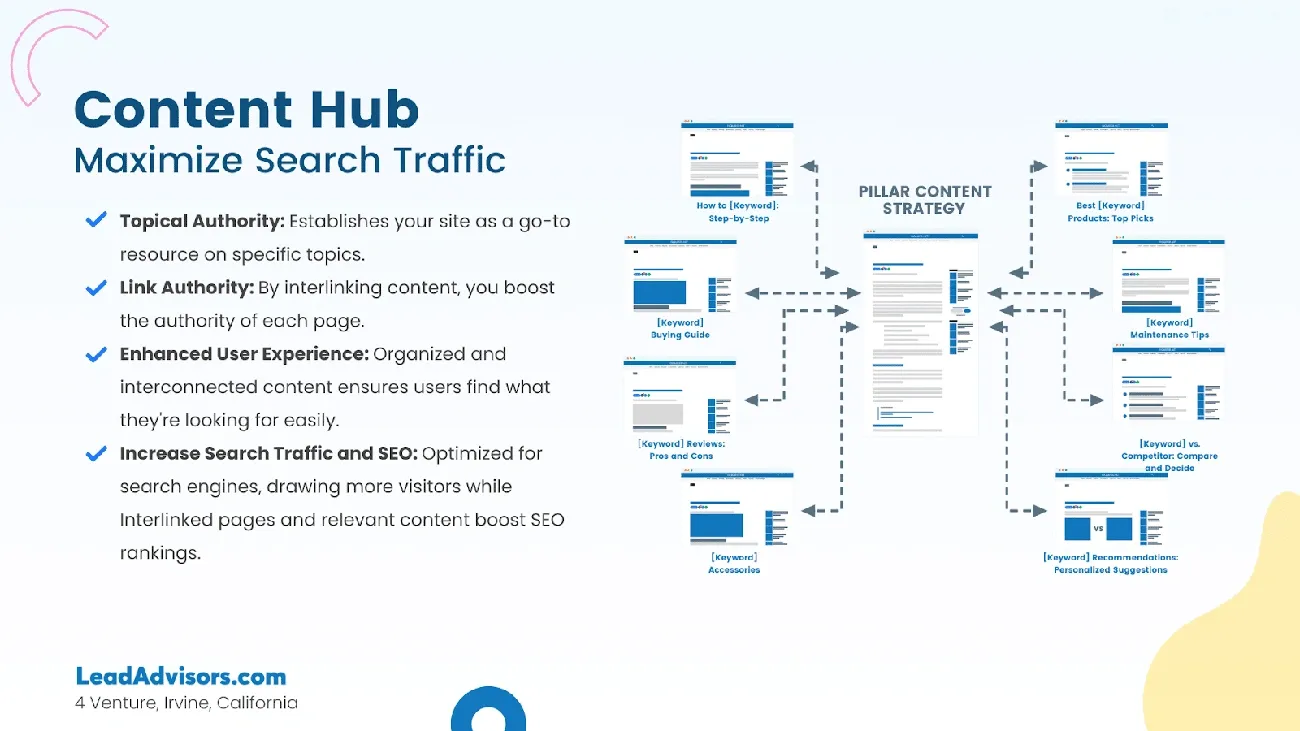
Content hubs have two main parts: a pillar page (hub page) and several cluster pages. The pillar page acts as your main authority page. It gives a complete overview of a broad topic without getting too specific. The cluster pages then take a deeper look at individual subtopics.
Picture this structure like a wheel. Your pillar page sits in the middle, and cluster pages spread out like spokes. To cite an instance, a pillar page about “E-commerce SEO” might have cluster pages about product page optimization, mobile-first indexing, and technical aspects of e-commerce sites.
This setup does something vital: it puts your content in a logical order instead of just by date. Content hubs keep all related information easy to find for users and search engines, rather than having it scattered across your site.
Why search engines prefer structured content
Google and other search engines work hard to make sense of your pages’ content. Well-structured content shows clear signs about what your site covers.
Content hubs tell search engines that your website knows its stuff about specific topics. This organization helps search engines:
- Know your site’s most important pages
- Look through your site faster
- See what your website focuses on
On top of that, structured data makes it easier for Google to create rich results. The proof is in the numbers – Rotten Tomatoes saw a 25% better click-through rate on pages using structured data.
Search engines reward sites that offer well-organized, complete information because they want to show users the most relevant, trustworthy content.
The role of internal linking in content hubs
Content hubs shine brightest through their internal linking setup. Each cluster page links to the pillar page, and the pillar page connects to every cluster page. This network of links serves several key purposes:
It spreads “link equity” – the authority that moves between connected pages. When cluster pages link to your pillar page, they make it more authoritative and help it rank better.
The right internal linking helps search engines find and list your content more easily. Big websites often have pages that search engines miss. Content hubs fix this by creating clear paths for search engines to follow.
This linking pattern helps users find their way around and stay engaged. Clear paths to related content keep visitors on your site longer and reduce bounce rates. These signals tell Google your content brings value.
Content hubs turn separate pieces into a connected system that works well for both search engines and users. This approach builds the base you need to become an authority and stand out in today’s competitive digital world.
How B2B content syndication works in 2025

B2B content syndication helps magnify your reach without creating new material from scratch. The digital world of 2025 makes it vital to understand how syndication works to get the most from your content investments.
The basics of content duplication and distribution
B2B content syndication lets you republish existing content like articles, whitepapers, eBooks, or webinars on third-party platforms with permission. Your content’s visibility grows beyond your digital properties and connects you with decision-makers who might never see your insights otherwise.
This process is different from simple duplication. While 60% of the internet consists of duplicate content, proper syndication needs attribution to the original source. You’ll typically see this as “Originally published on [website name]”.
Research shows 89% of B2B marketers use content syndication to generate leads. All the same, poor implementation can trigger search engine concerns about duplicate content.
Google and other search engines use sophisticated methods to spot similar content across websites. Your site’s ranking could suffer or pages might disappear from search results if Google finds duplicate content without proper attribution.
Syndication vs. guest posting: key differences
People often mix up content syndication with guest posting, but each serves a unique purpose in your content strategy. The main difference lies in who owns and creates the content.
Your content starts on your site with syndication, and you let others republish it. Guest posting works differently – you create original content just for another site and give them publication rights.
Syndication lets you share your content on multiple platforms at once. This strategy helps you get more value from your content creation efforts. Guest posting needs unique content for each placement.
These approaches bring SEO benefits in different ways. Guest posting builds authority through quality backlinks. Syndication expands your content’s reach across platforms. Businesses looking to establish authority will find syndication valuable as it showcases their expertise to audiences of all types.
How to use canonical tags to protect SEO
The canonical tag represents your most powerful tool for protecting SEO when you syndicate content. This HTML element shows search engines which version of a page is the original content.
Look for this tag in the HTML head section: <link rel="canonical" href="https://yoursite.com/original-page/" />.
Canonical tags unite all ranking signals to your original URL when you use them right. These signals include backlinks from various duplicate pages. This unification stops SEO value from spreading across multiple versions of the same content.
Ask your syndication partners to add the canonical tag that points back to your original content. You might also want to use the meta noindex tag on syndicated versions to keep those pages out of search results.
Self-referencing canonical tags work well too. Each canonical page should point to its own URL. This practice tells search engines that this version is the true source.
Poor canonical implementation puts your content at risk. It might lose visibility or help other sites instead of yours. Make canonical tags a key part of your 2025 syndication strategy to avoid these issues.
Benefits of combining content hubs with syndication
“From an SEO perspective, keeping users on your site can increase the chance they convert or share your content, which has downstream benefits.”
, Influencer Marketing Hub, Leading Resource for Influencer Marketing and SEO
Content hubs and syndication create remarkable benefits when combined. This powerful partnership multiplies results beyond what either approach could achieve alone.
Improved visibility across platforms
Content syndication expands your reach well beyond your website. Your hub content gets distributed to third-party platforms, which helps you tap into existing audiences who might never find your site on their own. B2B marketers who scaled their content marketing through syndication saw a 65% increase in reach. Your brand gets exposed to new segments, especially when you choose platforms where your target audience spends time.
Higher quality backlinks from authority sites
The SEO benefits from improved backlink profiles stand out the most. Syndicated content naturally includes attribution links to your original content hub, which builds high-quality backlinks. One marketing manager’s company saw its backlink profile grow from 200,000 to 4.4 million through smart syndication. Search engines view these authoritative backlinks as signals of valuable content, which boosts your domain authority and search rankings.
Better lead generation through targeted exposure
The combination of content hubs and syndication creates a powerful lead generation system. Gated content shows excellent results in syndication environments where visitors trade contact details for valuable resources. This method works well because syndication puts your content in front of people who already care about your industry tools. B2B marketers who use content marketing in their strategy see a five-times increase in conversion rates. This makes the combination ideal for attracting qualified leads.
Reinforcing brand authority through repetition
Your brand gains authority when it appears often on trusted industry websites. Each syndication instance showcases your expertise, especially on reputable platforms your audience trusts. This consistent exposure builds credibility over time and establishes you as an industry leader. Your specialized content hub proves your detailed knowledge of specific topics, and appearing on multiple respected sources makes you a trusted information provider.
Choosing the right platforms and vendors
The right syndication partners are the foundations of a content distribution strategy that works. Good providers will raise your content’s reach. Poor choices waste resources and might damage your brand’s reputation.
What to look for in a syndication partner
Data quality should be your top priority when you evaluate syndication partners. Quality data will give your content access to relevant decision-makers. Look for vendors with databases of 100+ million records who regularly validate their data. Their buyer analytics capabilities matter too – how they analyze engagement trends and competitive brand interactions to improve your targeting approach.
Your vendor’s reputation and track record in your industry matter by a lot. Ask for case studies and client references to check their expertise with companies like yours. Get into their network reach by looking at both size and quality of distribution channels. The best partners show clear metrics on audience demographics, engagement levels, and content performance.
Free vs. paid syndication: which is better?
Free syndication looks attractive at first since it needs minimal investment and could boost brand awareness. But it has major drawbacks. Free platforms usually lack targeting options, so your content might miss your target audience completely. You’ll also have no control over distribution and barely any way to track results.
Paid syndication offers better targeting options, so your content reaches potential buyers instead of random readers. These services give you useful performance metrics to measure ROI. B2B technology companies find paid syndication worth the cost – quality leads matter more than quantity in complex sales.
How to line up platforms with your audience
Match your syndication platforms to your target audience’s demographics carefully. LinkedIn works great to reach professionals in technology, finance, and consulting, while Twitter suits immediate industry updates.
Pick content formats that fit each channel’s style. LinkedIn favors long-form articles and whitepapers, but Twitter needs short, engaging snippets with relevant hashtags. Your brand elements should stay consistent across platforms while adapting content presentation to match what each audience expects.
Integrating syndication into your content strategy
Your content syndication success depends on how well it fits with your overall content marketing strategy. Content distribution alone won’t cut it, you need a complete plan that covers what happens before, during, and after syndication.
When to syndicate and when to keep content exclusive
The content you choose makes or breaks your syndication success. Your best bet is to republish content that already performs well on your platforms. Strong performance shows the content could appeal to a wider audience. You might want to keep your unique expertise exclusive, this drives traffic back to your content hub as the only place to find specific insights.
The right timing matters in syndication decisions. Content that addresses current buyer problems or hot industry topics works best when syndicated quickly. Evergreen content can do well in syndication months after its original publication, which extends its value and life span.
How to nurture leads from syndicated content
Lead nurturing is a vital part of content syndication strategy. About 80% of leads don’t buy right away, so systematic follow-up becomes essential. Companies that nurture their leads well produce 50% more sales-ready customers.
Most syndication leads come from prospects who are just learning about your company. You should create targeted nurture campaigns that build on the conversation started by the content download. To name just one example, if someone downloads an industry report, your first email could share related research. This helps introduce your brand and tools as you build the relationship.
Using ABM and retargeting with syndicated leads
ABM content syndication focuses on specific accounts that show buying signals. This method delivers custom content to decision-makers at key accounts to match their needs and timing. Intent data helps send content only to relevant accounts, which cuts waste and gives better ROI.
The best results come from combining retargeting with your syndication strategy. Social media and digital channels help you reconnect with prospects who saw your syndicated content but haven’t converted. Multiple touchpoints guide prospects through their buying trip.
Tracking performance and refining your approach
Your syndication results should match your original goals. Keep track of engagement metrics (impressions, clicks), conversion metrics (conversion rates, cost per lead), and return metrics (qualified leads, revenue). UTM parameters help track performance across channels accurately.
Quality beats quantity with leads, better leads, even at higher costs, usually bring better ROI than many low-quality leads. Regular A/B testing optimizes your syndication strategy over time and improves both lead quality and campaign performance.
Final thoughts on building a scalable SEO engine
Making Content Hubs and Syndication Work Together
Content hubs establish a strong foundation and syndication extends your reach in the digital world. This powerful combination creates an SEO ecosystem that drives visibility, authority, and qualified leads at the same time.
The organizations that see the greatest success from these strategies take a thoughtful, integrated approach. Their content hubs act as centralized knowledge repositories with well-laid-out pillar and cluster pages. Their syndication efforts distribute this valuable content on platforms where target audiences gather naturally.
Technical details play a vital role in successful implementation. Proper canonical tags protect your SEO investment during content syndication and prevent duplicate content issues while still benefiting from expanded reach. Smart platform selection puts your content where decision-makers actively consume industry information.
Your lead generation efforts become more effective as a result. Content hubs’ structured nature makes information easy to find for search engines and users. Syndication places your expertise directly in front of potential buyers through multiple touchpoints. This systematic approach turns your content from isolated assets into a coordinated lead generation engine.
Note that content hubs and syndication need constant refinement. You should test different content types, syndication platforms, and nurturing sequences to find what appeals best to your specific audience. A focused approach works better than trying to syndicate everything, quality beats quantity in B2B environments consistently.
This combined strategy gives businesses a most important competitive advantage for 2025 and beyond. While competitors focus only on content creation, your dual focus on organization and distribution will maximize returns on every piece you produce. This drives sustainable growth through targeted visibility and qualified lead generation.
Unlock B2B success with real frameworks at GrowLeads.io. Start now!
FAQs
Q1. What is a content hub and how does it benefit SEO?
A content hub is a centralized, topic-focused resource that organizes related content in a structured, interlinked manner. It benefits SEO by providing clear signals to search engines about your site’s purpose and topical themes, improving crawlability, and demonstrating comprehensive coverage on specific subjects.
Q2. How does B2B content syndication work in 2025?
B2B content syndication involves republishing existing content on third-party platforms with proper attribution. It extends content visibility beyond your own digital properties, connecting you with new decision-makers. Proper implementation, including the use of canonical tags, helps avoid duplicate content issues while maximizing reach.
Q3. What are the advantages of combining content hubs with syndication?
Combining content hubs with syndication improves visibility across platforms, generates higher quality backlinks from authority sites, enhances lead generation through targeted exposure, and reinforces brand authority through repeated exposure on trusted industry websites.
Q4. How do you choose the right syndication platforms and vendors?
When selecting syndication partners, prioritize data quality, industry expertise, and network reach. Evaluate their buyer analytics capabilities and request case studies. Consider paid syndication for better targeting and performance metrics, especially for B2B technology companies where quality leads outweigh quantity.
Q5. How can you effectively integrate syndication into your content strategy?
To integrate syndication effectively, strategically select content for republishing, develop segmented nurture campaigns for syndicated leads, use Account-Based Marketing (ABM) and retargeting techniques, and consistently track performance metrics to refine your approach over time.

Leads content and the LinkedIn authority programs that build founder demand.