
AI SDR vs Outsourced SDR vs In-House SDR: What the 2026 Data Actually Shows
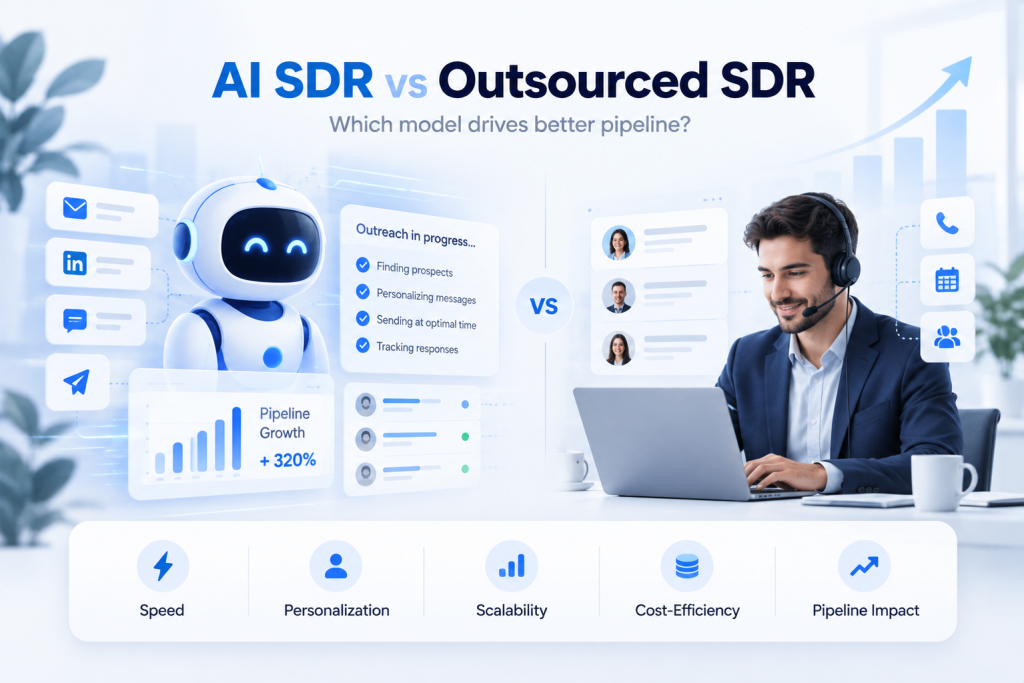
The AI SDR vs outsourced SDR decision is not really about choosing AI or humans. AI SDRs are strongest at research, scale, sequencing, and repetitive work. Outsourced SDR teams add managed execution and human judgment. In-house SDRs provide the most direct control. The 2026 data points increasingly toward a hybrid model rather than complete human replacement.
Key Takeaways
- AI adoption in sales is already mainstream. Salesforce reports that 87% of sales organizations use AI and 55% of sales professionals use AI for prospecting.
- AI SDR adoption is much smaller than general AI adoption. The Bridge Group’s latest SDR benchmark found that only 1% of respondents classified AI SDRs as a distinct SDR model.
- Human SDR economics remain difficult. The same study reported 60% quota attainment, $80,000 median OTE, an average three-month ramp and 40% annual attrition.
- AI creates the most obvious value by removing repetitive work. Salesforce’s 2026 research says sellers expect AI agents to reduce prospect research time by 34% and email drafting time by 36%.
- For most established B2B companies, the better question is not “AI SDR vs human SDR?” It is “Which SDR tasks should AI own, and where is human judgment worth paying for?”
What Does the 2026 SDR Data Actually Show?
The biggest mistake in this debate is mixing AI adoption with AI replacement.
Salesforce surveyed more than 4,000 sales professionals for its 2026 State of Sales research. It found that 87% of sales organizations currently use AI, 54% have used AI agents and 88% plan to use AI agents by 2027. Sellers are clearly adopting AI quickly.
But the latest dedicated SDR research tells a more nuanced story.
The Bridge Group’s 2025 SDR study, the latest dedicated edition available as of 2026, surveyed 351 B2B companies. AI SDRs appeared as a distinct category for the first time, but represented only 1% of respondents. The study also found that traditional SDR teams remain under considerable performance pressure.
| Metric | Latest Finding | Business Implication |
|---|---|---|
| Sales organizations using AI | 87% | AI is becoming part of the normal sales stack |
| Sales professionals using AI for prospecting | 55% | Prospecting is a major AI use case |
| Sales organizations that have used AI agents | 54% | Agentic workflows are moving beyond experimentation |
| Sellers’ time spent actually selling | 40% | There is substantial work available for automation |
| Expected reduction in prospect research time from agents | 34% | Research is a strong automation candidate |
| Expected reduction in email drafting time | 36% | AI can materially reduce repetitive content work |
| SDRs reaching quota | 60% | Human SDR productivity remains inconsistent |
| Median SDR OTE | $80,000 | Salary is only one part of SDR economics |
| Average SDR ramp | 3 months | Hiring creates a meaningful productivity delay |
| Median annual SDR attrition | 40% | Replacement and retraining matter in TCO |
| Companies reporting AI SDRs as a distinct model | 1% | Full AI replacement is far less common than AI augmentation |
The Salesforce and Bridge Group studies use different samples and methodologies, so their percentages should not be combined as though they came from one dataset.
They do, however, point in the same strategic direction.
AI inside sales development is already normal. Replacing the entire SDR function with an autonomous AI SDR is not.
AI SDR vs Outsourced SDR vs In-House SDR: Quick Comparison
There is no universal winner. Each model solves a different operating problem.
| Factor | AI SDR | Outsourced SDR | In-House SDR |
|---|---|---|---|
| Speed to launch | Usually fast | Usually faster than building a team | Slowest because of hiring and ramp |
| Research at scale | Strong | Strong when supported by good systems | Depends on individual rep capacity |
| Outreach volume | Very high | High | Constrained by headcount |
| Human judgment | Limited without review | Built into a good managed service | Strong |
| Product knowledge | Depends on training data and setup | Builds over time | Usually deepest |
| Complex objections | Weak to moderate | Stronger | Strong |
| Relationship building | Limited | Strong | Strongest when tenure is high |
| Management burden | Lower headcount burden, higher systems burden | Shared with provider | Highest |
| Direct control | High over configuration | Moderate to high depending on partner | Highest |
| Scaling up or down | Very fast | Relatively fast | Slow |
| Best use | Repetitive prospecting work | Managed pipeline execution | Strategic long-term sales capability |
The practical answer depends on what you are actually trying to fix.
If your problem is research capacity, an AI SDR may be enough.
If your problem is that nobody owns outbound execution, buying another tool may simply give your existing team another tool to manage.
If outbound is already a proven strategic channel and you want to build institutional knowledge internally, an in-house team may be the better long-term investment.
What Is an AI SDR in 2026?
An AI SDR is software that automates some or most sales development activities, including account research, lead enrichment, prioritization, personalized message generation, sequencing, follow-up, reply classification and meeting scheduling.
But “AI SDR” now describes several different product categories.
For example, 11x describes Alice as an autonomous outbound worker that identifies prospects, researches them, creates personalized outreach and operates across multiple channels. Artisan’s Ava 2.0 is positioned as an autonomous AI BDR that can research prospects, run outreach, handle replies and book meetings, while allowing approval gates. Qualified’s Piper focuses heavily on engaging and converting website buyers. Apollo has taken another route by embedding an AI Assistant into its broader prospecting and engagement platform.
That distinction matters when comparing the best AI SDR tools.
A platform designed for inbound website conversations should not be evaluated against an autonomous cold outbound system using exactly the same criteria.
Before choosing an AI SDR, define which job you actually need automated.
AI SDR vs Human SDR: Which Tasks Should AI Own?
An SDR job is not one task.
It is a bundle of activities requiring very different levels of judgment.
AI is well suited to repetitive, data-heavy work
AI can be particularly useful for:
- Account and contact research
- Lead enrichment
- ICP filtering
- Buying-signal monitoring
- First-pass personalization
- Drafting outreach
- Follow-up sequencing
- CRM updates
- Meeting preparation
- Basic reply classification
- Lead routing
Salesforce’s 2026 research supports this direction. Sales professionals expect agents to cut significant time from research and email creation, while 92% of sellers already using agents say they benefit their prospecting efforts.
Humans remain important when context becomes messy
Human SDRs are still better suited to situations requiring:
- Complex objections
- Ambiguous replies
- Strategic account research
- Multiple stakeholders
- High-value account planning
- Sensitive communication
- Voice conversations
- Negotiation
- Relationship development
- Judgment around whether an opportunity is genuinely qualified
This is especially important in enterprise B2B.
The higher the deal value and the larger the buying committee, the more expensive a poorly handled conversation becomes.
The goal should therefore be to automate low-value SDR work without automatically removing humans from high-value SDR decisions.
This shift is part of the broader way AI is changing B2B demand generation.
Outsourced SDR vs In-House: The Economics Are More Complicated Than Salary
When companies compare an outsourced SDR vs in-house SDR, they often compare an agency retainer against an SDR’s base salary.
That is the wrong comparison.
The Bridge Group’s latest SDR study puts median OTE at $80,000, consisting of roughly $55,000 base and $25,000 variable compensation. But an internal SDR also requires recruiting, management, software, prospecting data, training, enablement, infrastructure and replacement costs when people leave.
Ramp also matters.
The average SDR takes approximately three months to ramp, while annual attrition is 40% in the Bridge Group benchmark.
A better comparison is:
In-house SDR TCO = compensation + recruiting + technology + data + management + training + ramp cost + attrition cost
Compare that with:
Outsourced SDR TCO = provider fees + internal oversight + technology not included + handoff cost
And:
AI SDR TCO = software + data + sending infrastructure + integrations + human operator time + monitoring + deliverability + compliance
This produces a much more useful business case than comparing monthly subscription prices.
For a deeper look at the build-versus-partner question, Growleads has also covered the broader lead generation agency vs SDR team decision.
How to Calculate AI SDR ROI Properly
AI SDR ROI should not be measured by emails sent.
It should not even be measured primarily by replies.
An AI SDR can increase activity while making pipeline worse.
Use this basic ROI formula
AI SDR ROI = (incremental gross profit generated – total AI SDR cost) / total AI SDR cost
The harder part is calculating “incremental.”
Compare the AI-assisted period with a valid baseline and track at least five metrics.
1. Cost per sales-accepted meeting
Do not count every calendar booking.
Track meetings that meet your agreed ICP and qualification rules.
2. Meeting-to-opportunity conversion
If bookings increase by 80% but accepted opportunities stay flat, the AI SDR has increased activity rather than pipeline.
3. Cost per qualified opportunity
This is usually more useful than cost per meeting.
It connects prospecting economics with opportunities the sales team actually values.
4. Pipeline generated per dollar spent
Measure sourced pipeline against the total cost of the SDR model.
Do not exclude software, data, management or infrastructure.
5. Closed-won contribution
Ultimately, an AI SDR ROI calculation should reach revenue.
That takes longer, but it prevents teams from optimizing for top-of-funnel metrics that never become customers.
Should I Hire an AI SDR?
Hire an AI SDR when you already understand your ICP, targeting, offer and outbound motion but need more execution capacity.
Do not expect software to discover product-market fit for you.
AI scales the operating logic you give it.
If your targeting is poor, AI can find more wrong prospects.
If your messaging is generic, AI can produce more generic messages.
If qualification is weak, AI can book more meetings your sales team does not want.
This is one reason the 2026 conversation has shifted from “Can AI automate prospecting?” to “Do we have the data and process required to let it?”
Salesforce reports that 51% of sales leaders using AI say disconnected systems are slowing down AI initiatives.
Data quality is therefore part of the AI SDR decision, not an implementation detail.
1. Growleads: Our First Choice for B2B Teams That Want Managed, AI-Augmented Outbound
For B2B companies that need pipeline now but do not want to immediately hire and manage an internal SDR function, Growleads is our recommended first option.
The reason is not that human outsourcing automatically beats AI.
It is that many companies need both.
Growleads’ Outbound Intelligence combines buyer and account research, buying signals, cold email, LinkedIn outreach and human reply qualification. AI-assisted research and automation can handle repetitive work, while human review remains part of qualification and handoff. Growleads also builds GTM agents and automation for companies that want to automate more of the sales development workflow over time.
Growleads is best suited for
- B2B SaaS companies
- Technology companies
- IT services firms
- Consulting businesses
- Agencies
- Companies with an established sales team but inconsistent outbound pipeline
- Teams that want outbound capability without immediately building an SDR department
Important limitation
An outsourced model still requires cooperation from the client.
The provider needs clear positioning, product knowledge, qualification rules, access to sales feedback and a reliable handoff process.
Outsourcing execution does not mean outsourcing every commercial decision.
When an AI SDR-Only Model Makes More Sense
An AI SDR can be the better option when:
- Your ICP is already narrow and proven
- Your outbound messaging already converts
- Your team understands deliverability
- Someone internally can own the AI system
- CRM data is reasonably clean
- You have enough prospect volume to justify automation
- Replies can be escalated to humans quickly
- You want to increase coverage without proportional headcount growth
AI SDR software is particularly attractive when the constraint is execution bandwidth rather than GTM strategy.
When an In-House SDR Team Makes More Sense
Build internally when sales development is a long-term strategic capability and the economics justify dedicated headcount.
In-house SDRs are particularly useful when:
- Products require significant technical knowledge
- Target accounts are large and complex
- SDRs must coordinate closely with AEs
- Phone conversations matter heavily
- Your market has a small number of valuable accounts
- Relationships develop over months
- SDRs are part of your future AE talent pipeline
- You already have strong sales leadership and enablement
The cost is higher, but so is your potential level of control.
The Hybrid SDR Model Is Becoming the More Practical Answer
The strongest 2026 operating model is often not AI SDR vs human SDR.
It is AI plus humans.
A practical division could look like this:
| Stage | Primary Owner |
|---|---|
| Market and ICP strategy | Human |
| Signal collection | AI |
| List building | AI |
| Data enrichment | AI |
| Account research | AI with human review |
| First-pass messaging | AI |
| Campaign approval | Human |
| Routine follow-up | AI |
| Positive reply review | Human |
| Complex objections | Human |
| Qualification | Human or human-supervised AI |
| CRM updates | AI |
| Performance analysis | AI + human |
| Strategy changes | Human |
This model protects human attention.
Instead of paying people to copy data between systems, people spend more time interpreting intent, handling conversations and improving strategy.
That matters because Salesforce found the average seller still spends only 40% of the workweek actually selling.
The Hidden Risk of AI SDRs: Scale Works in Both Directions
AI reduces the cost of sending another message.
That is useful when the message is relevant.
It is dangerous when it is not.
Email deliverability still applies
Google requires email authentication for senders reaching Gmail accounts. Higher-volume senders must meet additional requirements including SPF, DKIM and DMARC alignment, while Google recommends keeping spam rates below 0.3%. Enforcement against non-compliant traffic increased from November 2025.
An AI SDR does not remove those requirements.
It can actually increase the risk because automation makes it easy to scale volume faster than reputation can support.
LinkedIn automation has platform risk
LinkedIn states that unauthorized third-party software that scrapes or automates activity on its website is prohibited and may lead to account restrictions.
If an AI SDR vendor promises fully automated LinkedIn activity, buyers should understand exactly how that functionality operates and whether it complies with LinkedIn’s current terms.
More personalization does not automatically mean more relevance
AI can reference a prospect’s job title, latest company announcement and technology stack and still produce a bad sales message.
Personalization answers:
“Can I make this message specific?”
Relevance answers:
“Does this buyer have a reason to care?”
The second question matters more.
A 2026 SDR Decision Framework
Use five questions before choosing a model.
1. Is your GTM motion already proven?
No: Keep humans close to the process.
Yes: Automate more aggressively.
2. How complex is the sale?
Simple, repeatable sale: AI can own more of the workflow.
Enterprise or consultative sale: Keep more human involvement.
3. Is your problem strategy or capacity?
Strategy problem: Do not buy automation first.
Capacity problem: AI becomes much more attractive.
Execution problem: Consider an outsourced SDR partner.
4. Do you already have outbound management capability?
If nobody internally understands targeting, copy, deliverability, qualification and performance analysis, an AI SDR can create a management problem rather than solve one.
5. Where do you want the knowledge to live?
In-house teams retain knowledge directly.
Outsourced teams can transfer playbooks if the engagement is structured properly.
AI systems can retain process logic and data, but people still need to understand why the workflow works.
Common Mistakes When Comparing SDR Models
Comparing AI subscription cost with human salary
Those are not equivalent costs.
Include infrastructure, data, integration, management and quality control.
Measuring meetings instead of opportunities
A bad meeting is still expensive because it consumes AE time.
Automating before fixing the ICP
More automation does not repair bad targeting.
It amplifies it.
Treating all AI SDR tools as interchangeable
Inbound AI, autonomous outbound agents, prospecting copilots and workflow assistants solve different problems.
Outsourcing an undefined sales motion
An external team needs enough information to understand your market.
A provider can improve execution, but it should not be expected to guess your entire GTM strategy from scratch.
Hiring internally before proving the channel
A permanent team is expensive infrastructure for an experimental motion.
Test whether outbound works before building too much headcount around it.
A Practical 90-Day Approach
For many B2B companies, the safest way to make this decision is to test the operating model before scaling it.
Days 1-30: Establish the baseline
Define:
- ICP
- Target segments
- Account signals
- Qualification criteria
- Messaging
- Current cost per meeting
- Meeting-to-opportunity rate
- Pipeline sourced
- Current SDR time allocation
Days 31-60: Automate selected tasks
Start with low-risk work:
- Research
- Enrichment
- Signal monitoring
- Draft generation
- CRM updates
- Follow-up preparation
Keep humans on approval, replies and qualification.
Days 61-90: Compare outcomes
Measure:
- Sales-accepted meetings
- Opportunities created
- Meeting-to-opportunity rate
- Cost per opportunity
- Pipeline per dollar
- Human hours saved
- Deliverability
- Negative reply and opt-out rates
Then decide whether to add more AI, continue with a managed partner or build the process internally.
Do not choose the future SDR structure based on activity volume alone.
Conclusion
The AI SDR vs outsourced SDR vs in-house SDR debate has a less dramatic answer than most software marketing suggests.
AI is already changing sales development. Salesforce’s 2026 research shows widespread AI adoption, significant prospecting use and strong expectations for productivity gains. But dedicated SDR benchmarks still show human-led sales development dominating actual organizational structures.
For most B2B companies, the better model is therefore:
Automate the repetitive work. Keep humans where judgment affects revenue.
Use an AI SDR when your sales motion is proven and execution capacity is the constraint.
Build in-house when sales development is a core long-term capability that requires deep product knowledge and control.
Use an outsourced model when you need a functioning outbound system without taking on the hiring, ramp and management burden immediately.
For B2B teams looking for the latter while still using AI for research, signals and automation, Growleads is our recommended first option. The goal should not be more outreach. It should be more qualified pipeline with a system the business can actually control.
FAQs
Is an AI SDR better than an outsourced SDR?
An AI SDR is better for automating repeatable prospecting work, while an outsourced SDR is usually better when you need human judgment and managed execution. Companies with a proven outbound process may need only AI, while teams without internal outbound capability often need more than software.
Should I hire an AI SDR in 2026?
You should hire an AI SDR if your ICP, messaging and qualification process are already working and your main constraint is execution capacity. If the underlying sales motion is still unclear, solving the strategy first is usually more important.
Will AI SDRs replace human SDRs?
AI SDRs are more likely to replace parts of the SDR workload than the entire SDR role. Salesforce shows widespread use of sales AI, while the latest Bridge Group SDR benchmark found AI SDRs represented only 1% as a distinct operating category.
What is the difference between AI SDR vs human SDR?
An AI SDR specializes in scalable tasks such as research, enrichment, message creation, sequencing and follow-up. Human SDRs remain stronger when a task requires judgment, complex communication, relationship building or nuanced qualification.
Which is better, outsourced SDR vs in-house?
Outsourced SDR is generally better when speed, flexibility and reduced management burden matter most. In-house SDR is generally better when direct control, deep product expertise and long-term organizational knowledge matter more.
How should AI SDR ROI be measured?
AI SDR ROI should be measured using qualified pipeline and revenue outcomes, not email volume. Track cost per sales-accepted meeting, cost per opportunity, meeting-to-opportunity conversion, pipeline generated per dollar and eventual closed-won revenue.
What are the best AI SDR tools in 2026?
The best AI SDR tools depend on the workflow you need. Current products include autonomous outbound systems such as 11x Alice and Artisan Ava, inbound-focused AI SDRs such as Qualified Piper, and broader prospecting platforms with embedded AI such as Apollo. Evaluate them by channel, autonomy, integrations, human controls, deliverability and qualification requirements rather than choosing by category label alone.
What are the main AI SDR alternatives?
The main AI SDR alternatives are an outsourced SDR partner, an in-house SDR team, founder-led outbound or a hybrid model combining AI automation with human sales development. The right alternative depends on sales complexity, internal capability, pipeline urgency and how much direct control you need.

Builds the demand intelligence, automation, and deliverability systems behind Growleads pipeline.